School Counselor Teaching Philosophy
Page 1
Teaching Philosophy
School Counselor
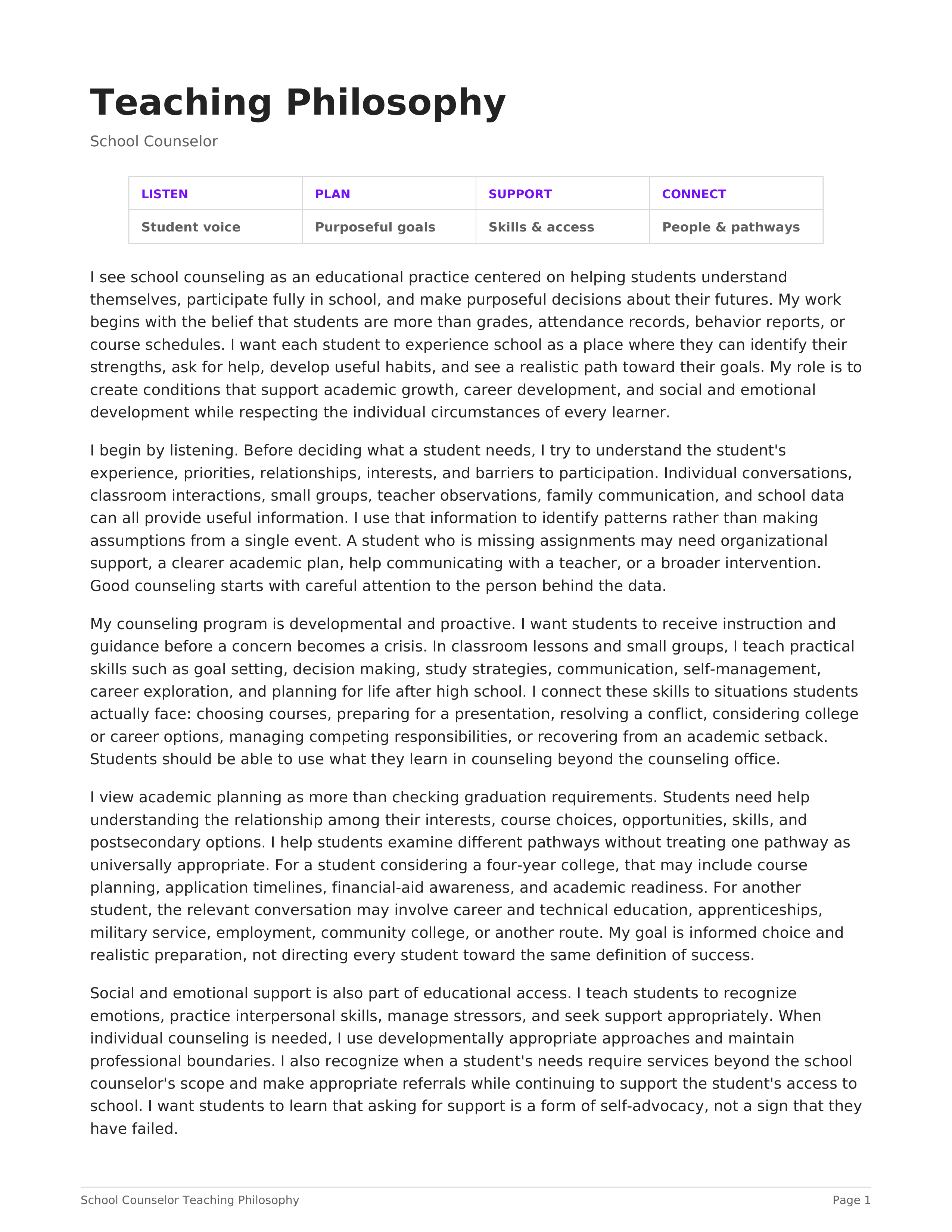
LISTEN
PLAN
SUPPORT
CONNECT
Student voice
Purposeful goals
Skills & access
People & pathways
I see school counseling as an educational practice centered on helping students understand
themselves, participate fully in school, and make purposeful decisions about their futures. My work
begins with the belief that students are more than grades, attendance records, behavior reports, or
course schedules. I want each student to experience school as a place where they can identify their
strengths, ask for help, develop useful habits, and see a realistic path toward their goals. My role is to
create conditions that support academic growth, career development, and social and emotional
development while respecting the individual circumstances of every learner.
I begin by listening. Before deciding what a student needs, I try to understand the student's
experience, priorities, relationships, interests, and barriers to participation. Individual conversations,
classroom interactions, small groups, teacher observations, family communication, and school data
can all provide useful information. I use that information to identify patterns rather than making
assumptions from a single event. A student who is missing assignments may need organizational
support, a clearer academic plan, help communicating with a teacher, or a broader intervention.
Good counseling starts with careful attention to the person behind the data.
My counseling program is developmental and proactive. I want students to receive instruction and
guidance before a concern becomes a crisis. In classroom lessons and small groups, I teach practical
skills such as goal setting, decision making, study strategies, communication, self-management,
career exploration, and planning for life after high school. I connect these skills to situations students
actually face: choosing courses, preparing for a presentation, resolving a conflict, considering college
or career options, managing competing responsibilities, or recovering from an academic setback.
Students should be able to use what they learn in counseling beyond the counseling office.
I view academic planning as more than checking graduation requirements. Students need help
understanding the relationship among their interests, course choices, opportunities, skills, and
postsecondary options. I help students examine different pathways without treating one pathway as
universally appropriate. For a student considering a four-year college, that may include course
planning, application timelines, financial-aid awareness, and academic readiness. For another
student, the relevant conversation may involve career and technical education, apprenticeships,
military service, employment, community college, or another route. My goal is informed choice and
realistic preparation, not directing every student toward the same definition of success.
Social and emotional support is also part of educational access. I teach students to recognize
emotions, practice interpersonal skills, manage stressors, and seek support appropriately. When
individual counseling is needed, I use developmentally appropriate approaches and maintain
professional boundaries. I also recognize when a student's needs require services beyond the school
counselor's scope and make appropriate referrals while continuing to support the student's access to
school. I want students to learn that asking for support is a form of self-advocacy, not a sign that they
have failed.
School Counselor Teaching Philosophy
Page 2
Teaching Philosophy
School Counselor | continued
ACADEMIC
CAREER
SOCIAL & EMOTIONAL
Assessment in school counseling should help me determine whether the program is making a
meaningful difference. I use participation information, student reflections, pre- and post-lesson
checks, attendance and academic patterns, goal progress, and other relevant school data to evaluate
services. Data are not labels for students; they are signals that help me ask better questions. When a
strategy is not producing the intended result, I revise it, seek collaboration, or connect the student
with another appropriate support. I also examine whether students have unequal access to
information, opportunities, or interventions and adjust my practice when barriers become visible.
Collaboration is essential to my philosophy. Students rarely experience academic, career, and social
concerns in isolation, so I work with teachers, administrators, families, specialists, and community
partners when collaboration benefits the student. I aim to make communication purposeful and
respectful, protecting student privacy while sharing information appropriately. With teachers, I may
help identify a learning barrier or coordinate a support plan. With families, I try to communicate in
ways that invite partnership rather than simply report problems. With community organizations, I
connect students to resources that expand what the school can provide.
I am also committed to creating an inclusive counseling environment. Students bring different
cultures, languages, family circumstances, identities, abilities, experiences, and expectations to
school. I make counseling resources accessible, use language students can understand, provide
multiple ways to participate, and examine my own assumptions. I want students to see themselves
represented in examples and opportunities while also learning about pathways they may not yet
know exist. Equity means paying attention to who is receiving information, encouragement,
challenge, and access - not assuming that a single approach serves everyone equally well.
Ultimately, I want students to leave my counseling program with greater clarity, agency, and
confidence. I want them to know how to seek accurate information, set a goal, evaluate options,
communicate with the people who support them, and take a next step even when the future is
uncertain. I do not measure success by how dependent students become on the counseling office. I
measure it by whether students increasingly understand their choices, advocate for their needs, use
available resources, and make decisions with purpose. My teaching philosophy as a school counselor
is therefore grounded in listening, instruction, collaboration, and reflection - helping students build
the knowledge and habits they need to navigate school and life beyond it.