Foreign Language Teacher Teaching Philosophy
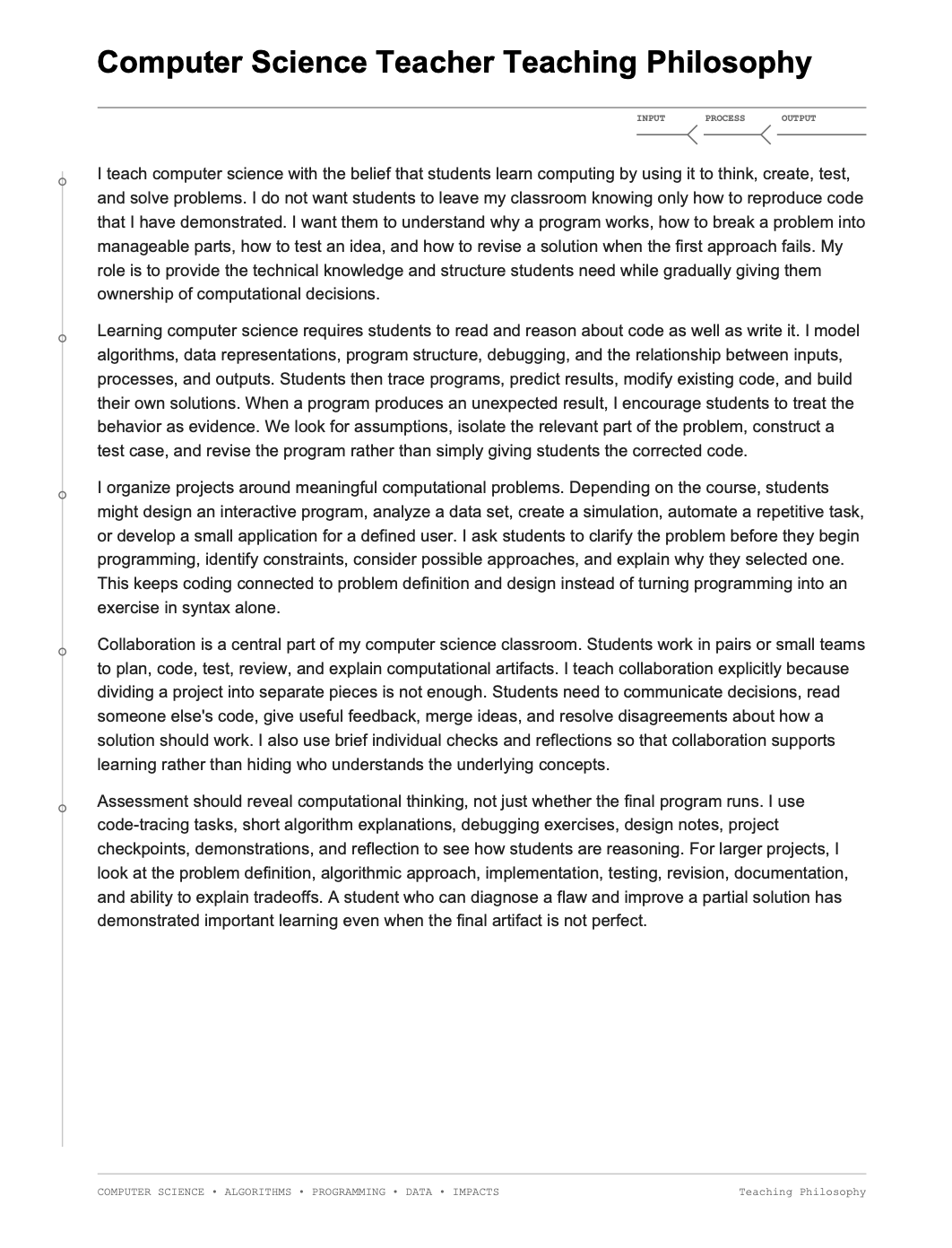
INTERPRET
INTERACT
PRESENT
I teach foreign language with the belief that language learning becomes meaningful when students use
a new language to understand people, express ideas, and participate in situations that have a purpose
beyond completing an exercise. Vocabulary, grammar, pronunciation, and cultural knowledge all matter,
but I want students to experience them as tools for communication rather than as separate lists to
memorize. My responsibility is to make the language understandable, create frequent opportunities to
use it, and help students become increasingly independent communicators.
Communication guides my planning. I use the interpretive, interpersonal, and presentational modes
together so students practice understanding messages, interacting with others, and communicating for
an audience. A unit may begin with a short text, recording, image sequence, or other authentic material,
continue with partner or small-group interaction, and lead to a spoken or written presentation. These
connections help students see that language skills are related and that successful communication often
requires moving among listening, reading, speaking, and writing.
I use the target language as much as possible and make it comprehensible through context, visuals,
gestures, modeling, repetition, familiar routines, and carefully chosen language supports. Students learn
expressions for asking for clarification, confirming meaning, describing uncertainty, and keeping a
conversation going. I want them to learn strategies for communication rather than believing they must
know every word before they can speak. As their proficiency develops, I increase the complexity and
independence of the language they encounter and produce.
Grammar and vocabulary have a clear purpose in my classroom. I teach structures explicitly when
students need them to communicate more accurately or precisely, and then I return those structures to
meaningful tasks. Students may use a past-tense form to recount an experience, comparative language
to explain a preference, or functional phrases to solve a problem with a partner. I ask students to notice
patterns and make choices based on context and audience. Accuracy matters, but I do not want
concern about perfect form to prevent students from communicating an idea.
I want students to encounter the cultures connected to the language in complex and respectful ways.
We examine authentic or appropriately adapted materials, everyday practices, perspectives, and
regional variation so students can see that no language community is a single culture with one way of
living. I encourage students to ask how context affects communication, whose perspective is
represented, and what assumptions they may be making. Cultural learning is therefore woven into
language use rather than reserved for occasional holiday activities.
FOREIGN LANGUAGE EDUCATION • COMMUNICATION • CULTURE • PROFICIENCY
Teaching Philosophy
Foreign Language Teacher Teaching Philosophy
Assessment should measure what learners can do with the language. I use interpretive tasks,
interpersonal conversations, presentational speaking and writing, comprehension checks,
vocabulary-in-context activities, and short reflections during instruction. I give students chances to
rehearse, receive focused feedback, and try again. In speaking tasks, I consider comprehensibility,
interaction, language control, and ability to sustain meaning rather than relying only on isolated
grammar accuracy. Assessment results help me determine whether students need more input,
additional modeling, more interaction, or a new level of challenge.
I recognize that students arrive with different linguistic backgrounds, prior coursework, motivations, and
confidence. Some may have studied another language formally, some may have family or community
experience with a language, and some may have never had sustained exposure to one. I use flexible
grouping, multiple entry points, visual and language supports, choice within tasks, and varied
opportunities for practice. For heritage speakers or multilingual learners, I build on existing linguistic
knowledge while providing instruction that expands academic vocabulary, literacy, register, and control
when those are relevant goals.
I want the classroom to be a safe place to take linguistic risks. Errors are expected when students are
using a developing language, and I respond in ways that protect communication while still helping
students improve. I use modeling, recasts, targeted corrections, and brief conferences according to the
learning goal. Students practice listening to classmates, asking follow-up questions, and repairing
misunderstandings because real communication rarely happens with perfectly prepared sentences.
These habits build both competence and confidence.
My role is also to help students understand that proficiency develops through sustained use. I teach
students how to use context, cognates when appropriate, familiar patterns, reference tools, and
communication strategies when they encounter unfamiliar language. I want them to become less
dependent on teacher translation and more capable of figuring out meaning or finding a way to express
what they need. The classroom should gradually shift from teacher-directed practice toward
student-directed communication and reflection.
Ultimately, I want students to leave my classroom able to use another language with greater purpose,
flexibility, and respect. They should be able to understand messages, participate in conversations,
present information or ideas, navigate moments of misunderstanding, and recognize that
communication is shaped by cultural context and audience. Whether students continue language study,
use another language in college or work, communicate with family or community members, or simply
encounter other languages throughout their lives, I want them to see language learning as a continuing
practice rather than a course that ends with a final exam. I also reflect on my own teaching by
examining student language samples, participation, and assessment evidence, then adjusting the
amount of modeling, interaction, and independence students receive.
FOREIGN LANGUAGE EDUCATION • COMMUNICATION • CULTURE • PROFICIENCY
Teaching Philosophy