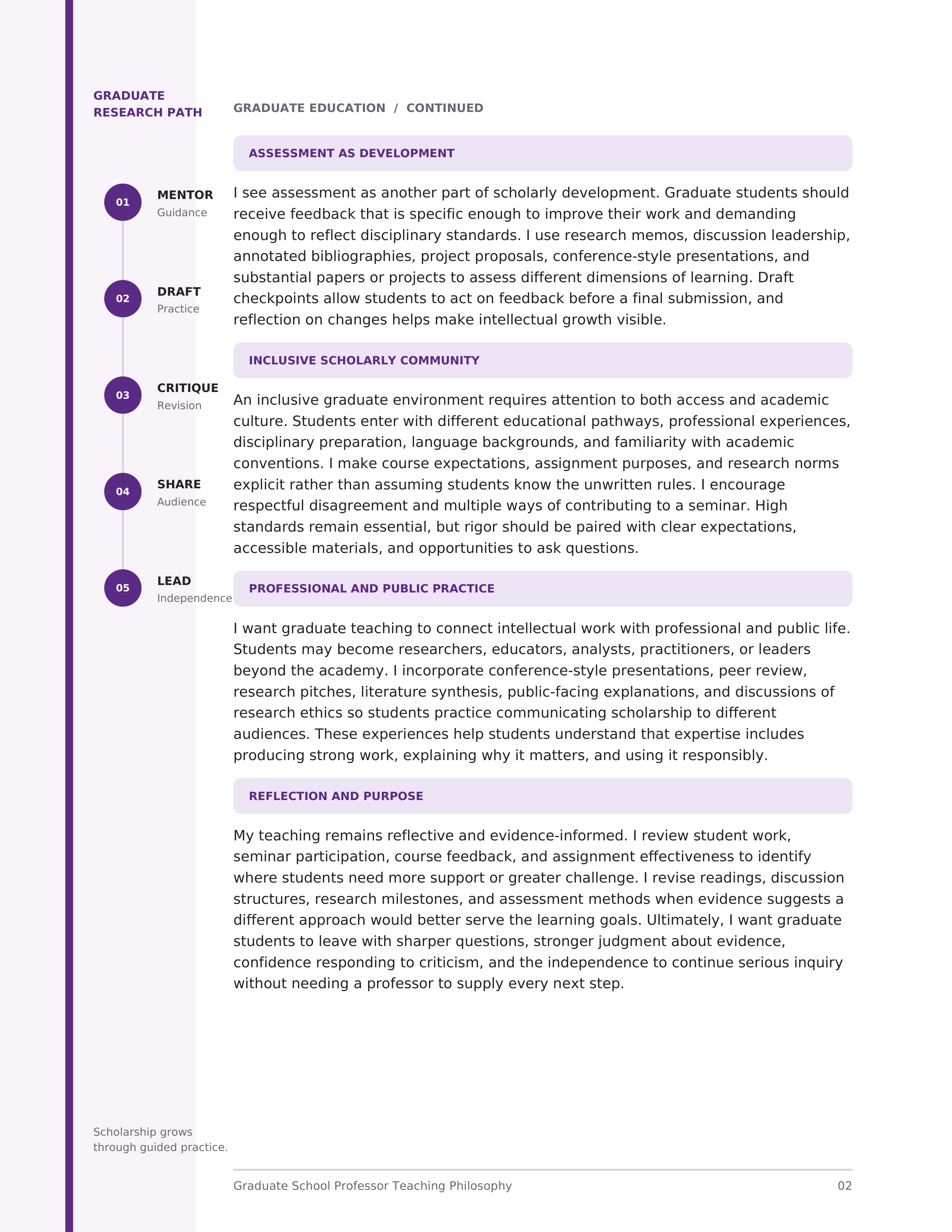
GRADUATE
RESEARCH PATH
01
MENTOR
Guidance
02
DRAFT
Practice
03
CRITIQUE
Revision
04
SHARE
Audience
05
LEAD
Independence
Scholarship grows
through guided practice.
GRADUATE EDUCATION / CONTINUED
ASSESSMENT AS DEVELOPMENT
I see assessment as another part of scholarly development. Graduate students should
receive feedback that is specific enough to improve their work and demanding
enough to reflect disciplinary standards. I use research memos, discussion leadership,
annotated bibliographies, project proposals, conference-style presentations, and
substantial papers or projects to assess different dimensions of learning. Draft
checkpoints allow students to act on feedback before a final submission, and
reflection on changes helps make intellectual growth visible.
INCLUSIVE SCHOLARLY COMMUNITY
An inclusive graduate environment requires attention to both access and academic
culture. Students enter with different educational pathways, professional experiences,
disciplinary preparation, language backgrounds, and familiarity with academic
conventions. I make course expectations, assignment purposes, and research norms
explicit rather than assuming students know the unwritten rules. I encourage
respectful disagreement and multiple ways of contributing to a seminar. High
standards remain essential, but rigor should be paired with clear expectations,
accessible materials, and opportunities to ask questions.
PROFESSIONAL AND PUBLIC PRACTICE
I want graduate teaching to connect intellectual work with professional and public life.
Students may become researchers, educators, analysts, practitioners, or leaders
beyond the academy. I incorporate conference-style presentations, peer review,
research pitches, literature synthesis, public-facing explanations, and discussions of
research ethics so students practice communicating scholarship to different
audiences. These experiences help students understand that expertise includes
producing strong work, explaining why it matters, and using it responsibly.
REFLECTION AND PURPOSE
My teaching remains reflective and evidence-informed. I review student work,
seminar participation, course feedback, and assignment effectiveness to identify
where students need more support or greater challenge. I revise readings, discussion
structures, research milestones, and assessment methods when evidence suggests a
different approach would better serve the learning goals. Ultimately, I want graduate
students to leave with sharper questions, stronger judgment about evidence,
confidence responding to criticism, and the independence to continue serious inquiry
without needing a professor to supply every next step.
Graduate School Professor Teaching Philosophy
02