MIDDLE SCHOOL ENGLISH
01
Middle School English
Teacher Teaching Philosophy
READING · WRITING · DISCUSSION · REVISION
Teaching Philosophy
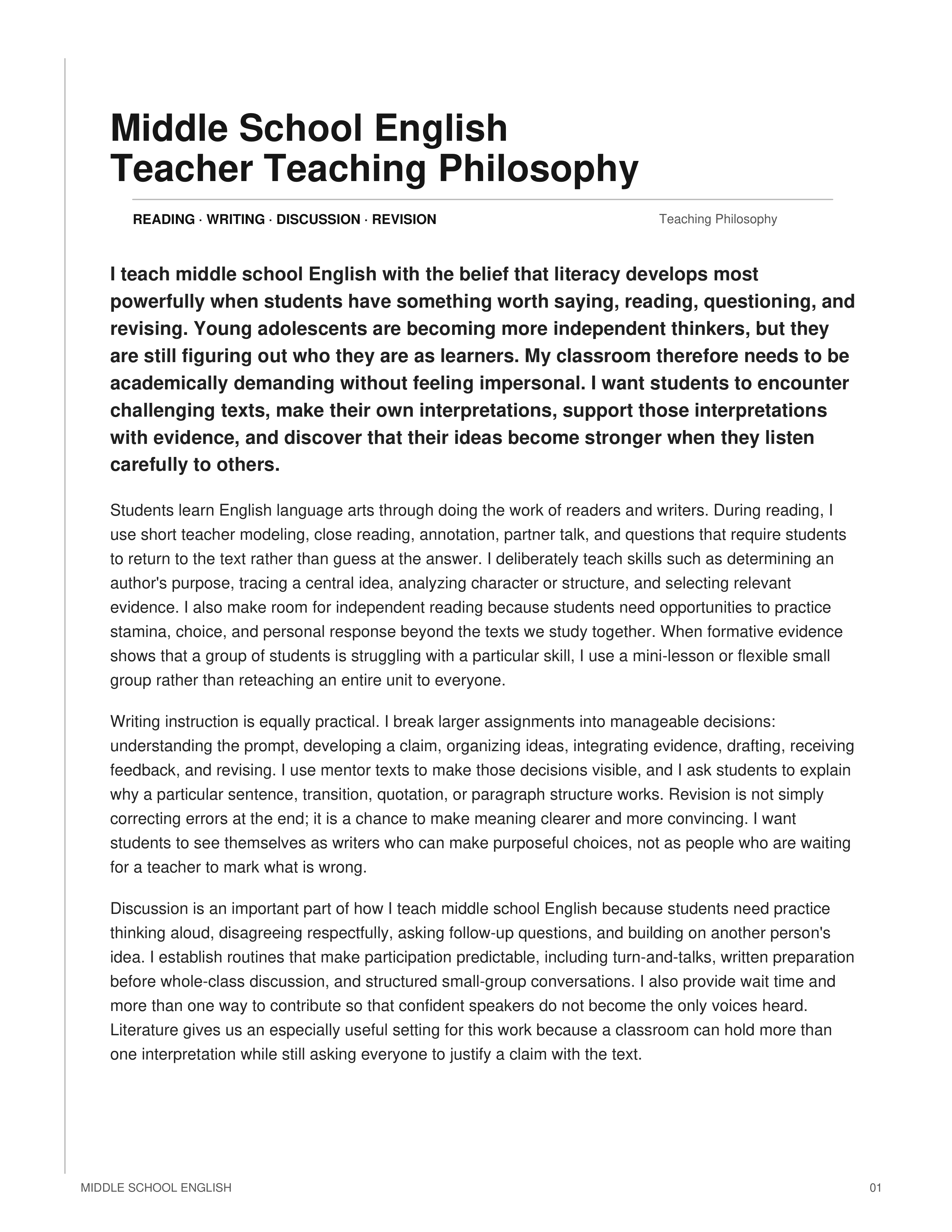
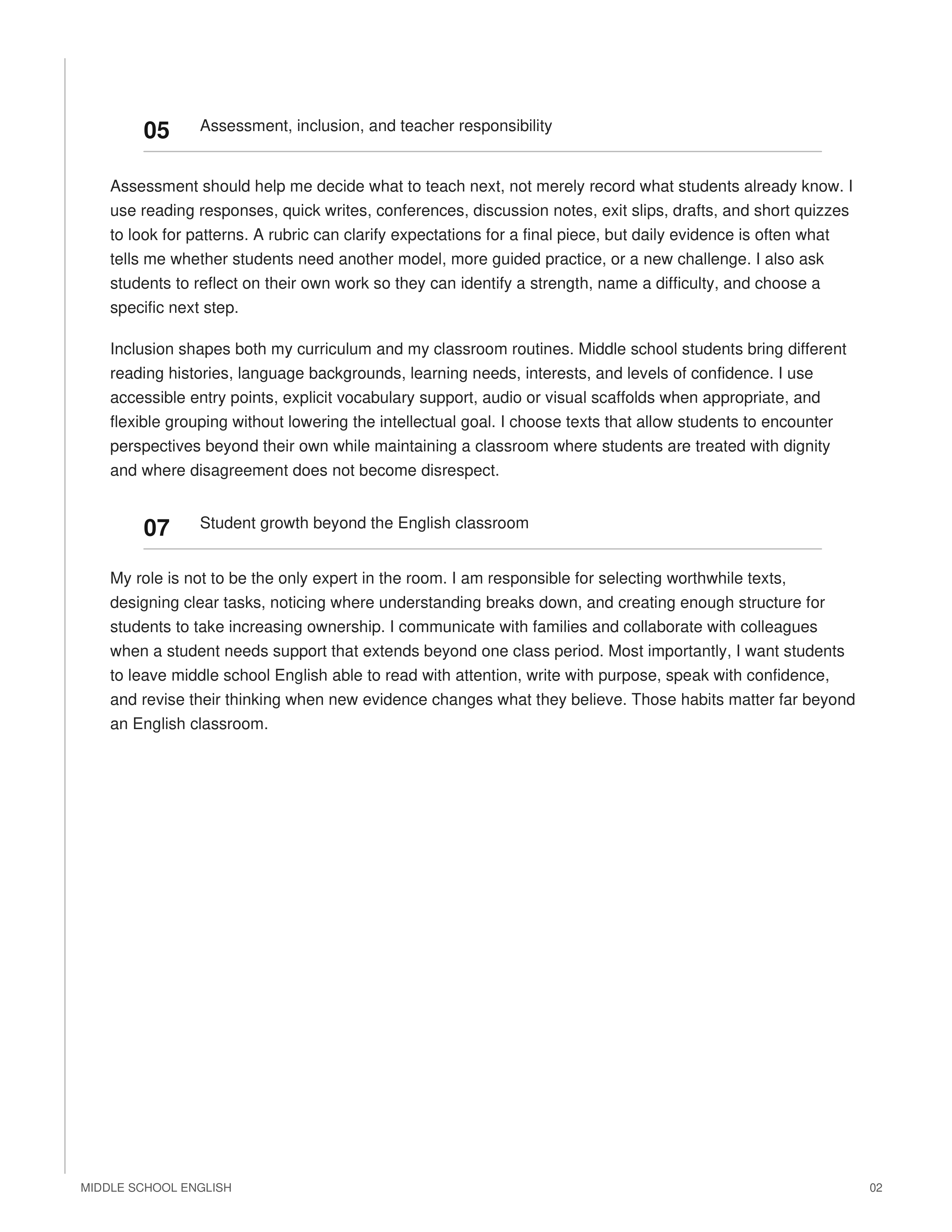
I teach middle school English with the belief that literacy develops most
powerfully when students have something worth saying, reading, questioning, and
revising. Young adolescents are becoming more independent thinkers, but they
are still figuring out who they are as learners. My classroom therefore needs to be
academically demanding without feeling impersonal. I want students to encounter
challenging texts, make their own interpretations, support those interpretations
with evidence, and discover that their ideas become stronger when they listen
carefully to others.
Students learn English language arts through doing the work of readers and writers. During reading, I
use short teacher modeling, close reading, annotation, partner talk, and questions that require students
to return to the text rather than guess at the answer. I deliberately teach skills such as determining an
author's purpose, tracing a central idea, analyzing character or structure, and selecting relevant
evidence. I also make room for independent reading because students need opportunities to practice
stamina, choice, and personal response beyond the texts we study together. When formative evidence
shows that a group of students is struggling with a particular skill, I use a mini-lesson or flexible small
group rather than reteaching an entire unit to everyone.
Writing instruction is equally practical. I break larger assignments into manageable decisions:
understanding the prompt, developing a claim, organizing ideas, integrating evidence, drafting, receiving
feedback, and revising. I use mentor texts to make those decisions visible, and I ask students to explain
why a particular sentence, transition, quotation, or paragraph structure works. Revision is not simply
correcting errors at the end; it is a chance to make meaning clearer and more convincing. I want
students to see themselves as writers who can make purposeful choices, not as people who are waiting
for a teacher to mark what is wrong.
Discussion is an important part of how I teach middle school English because students need practice
thinking aloud, disagreeing respectfully, asking follow-up questions, and building on another person's
idea. I establish routines that make participation predictable, including turn-and-talks, written preparation
before whole-class discussion, and structured small-group conversations. I also provide wait time and
more than one way to contribute so that confident speakers do not become the only voices heard.
Literature gives us an especially useful setting for this work because a classroom can hold more than
one interpretation while still asking everyone to justify a claim with the text.