SPECIAL EDUCATION
Professor Teaching Philosophy
UNIVERSITY TEACHING | INCLUSION | PROFESSIONAL PREPARATION
EVIDENCE
ACCESS
PRACTICE
"
Rigorous learning should expand access, agency, and professional judgment.
A teaching philosophy for faculty preparing future special education professionals.
01
PURPOSE AND PROFESSIONAL PREPARATION
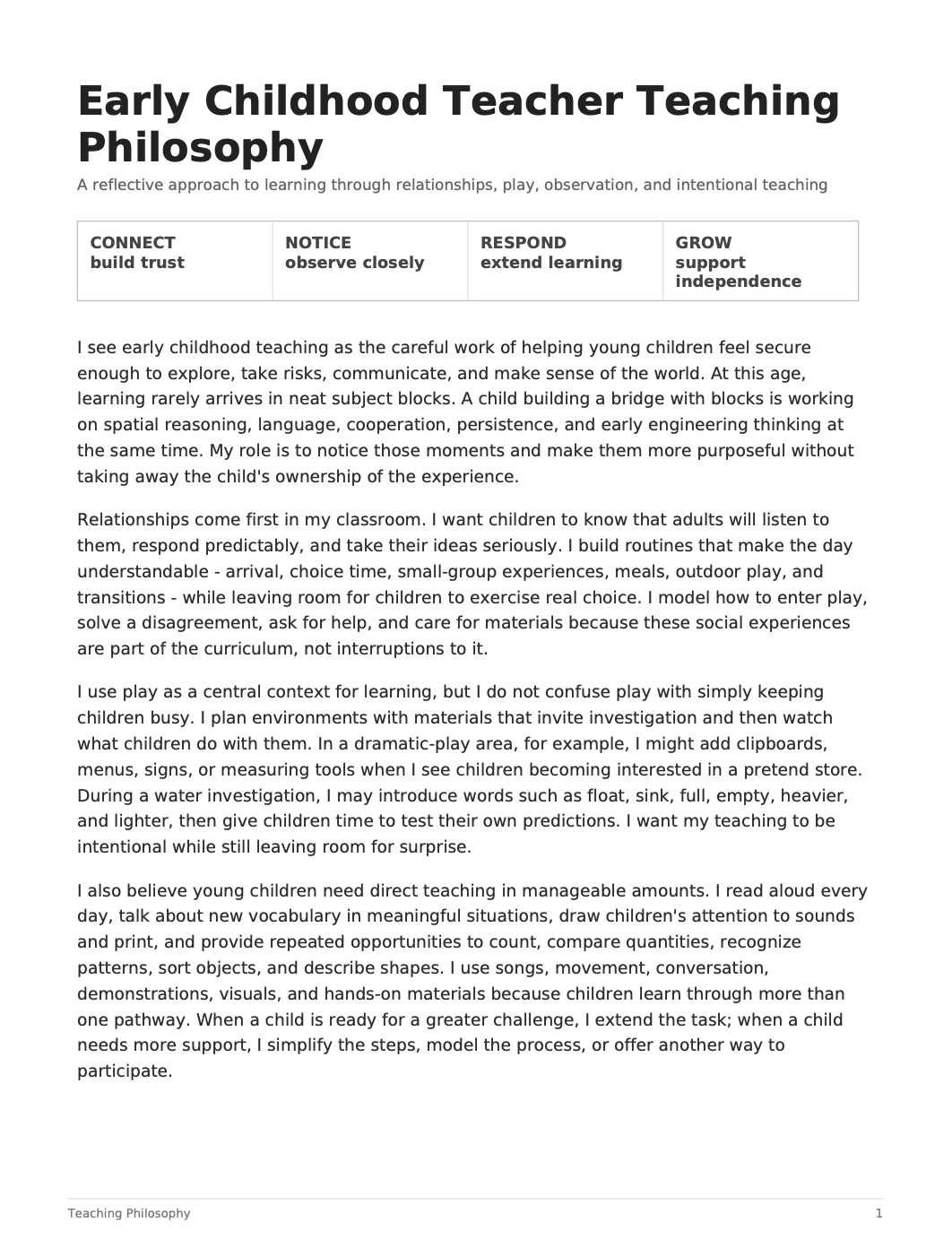
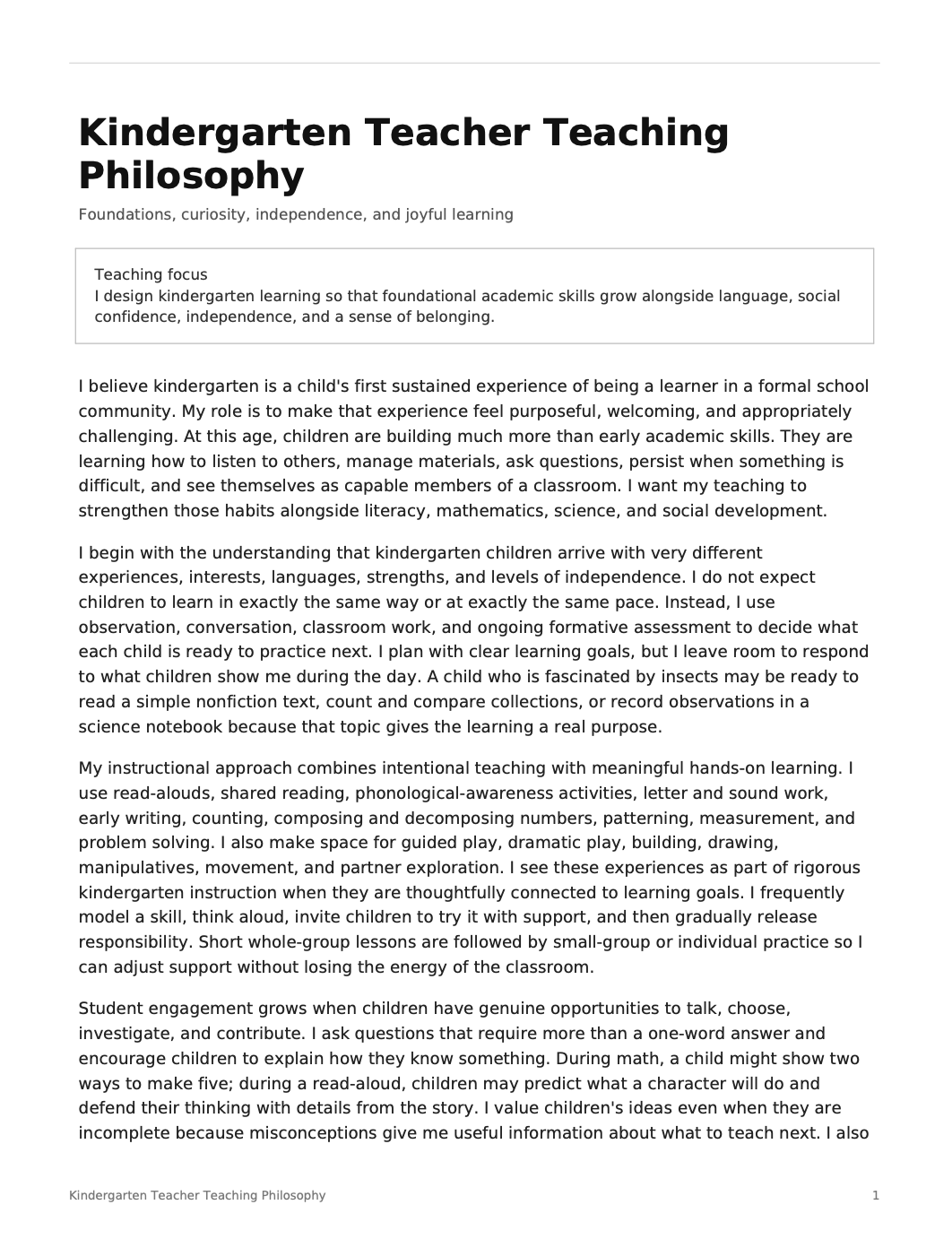
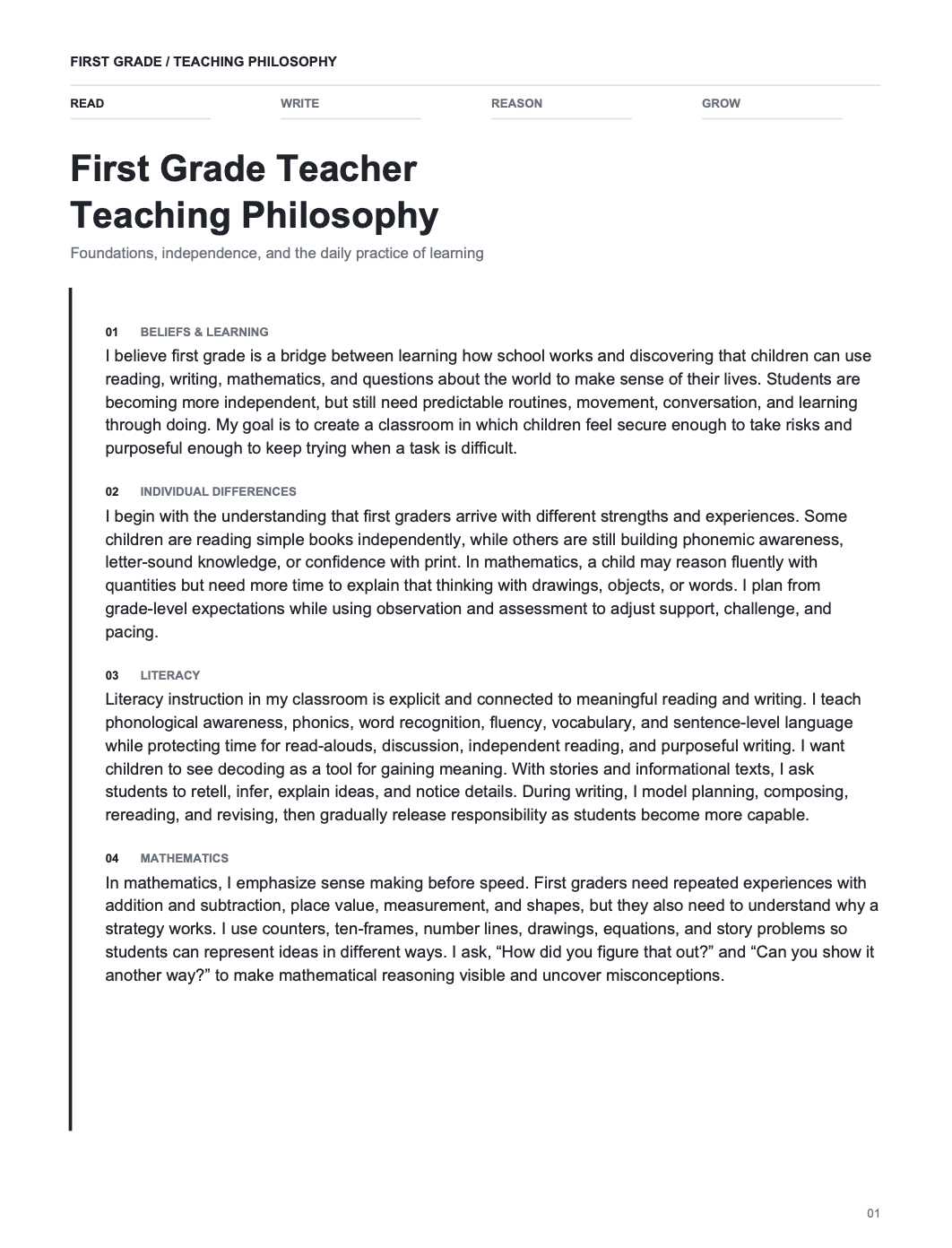
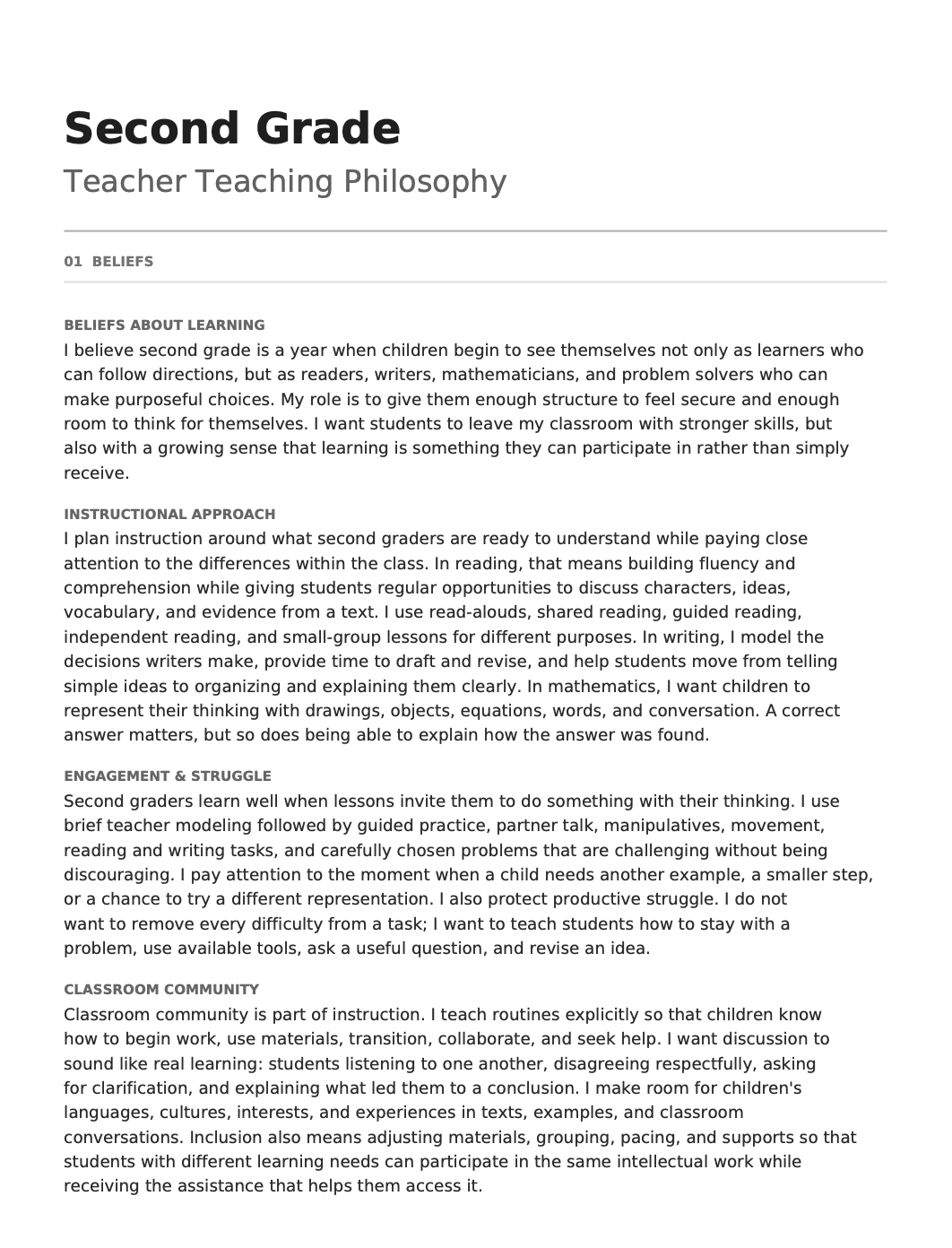
I teach special education at the university level with the belief that preparing educators is both an intellectual
responsibility and a practical one. Students need strong knowledge of disability, learning, assessment, instructional
design, behavior, and educational systems, but they also need to understand how those ideas affect real people. My role
is to help future teachers, specialists, and education professionals develop sound judgment, professional humility, and
the ability to support students with disabilities as whole learners. I want my classroom to connect rigorous study with
respect for individual differences.
02
CONNECTING THEORY TO PRACTICE
I begin courses with clear learning goals and a transparent explanation of why each goal matters in professional practice.
In an assessment course, for example, I want students to understand not only procedures but also how information can
be interpreted responsibly and used to guide instruction. In methods courses, I connect instructional principles to lesson
planning, progress monitoring, accommodations, assistive technology, and collaboration with general education teachers
and families. I use direct instruction when a precise framework is needed, then move students toward application through
cases, problem solving, demonstrations, and guided practice.
03
LEARNING THROUGH COMPLEX CASES
Case-based learning is central to my teaching because special education decisions rarely occur in isolation. A learner
may have an individualized education program, academic strengths, communication needs, behavioral concerns, cultural
and linguistic considerations, and preferences that all matter at once. I ask students to examine these layers rather than
reduce a learner to a diagnosis. They may analyze a student profile, interpret classroom data, identify barriers to
participation, propose supports, and explain how they would monitor results. I emphasize that professional judgment
should be grounded in evidence while remaining attentive to the student's voice and context.
04
EVIDENCE AND RESEARCH LITERACY
I want students to become careful consumers and users of educational research. Special education professionals
encounter claims about interventions, instructional programs, technologies, and behavior supports. In my courses,
students ask what evidence supports a practice, how outcomes were measured, whose experiences were represented,
and what limitations should temper a conclusion. Assignments may include reading research articles, comparing
approaches, evaluating an intervention plan, or preparing a recommendation for a school team. The goal is to help
students make decisions that are thoughtful, transparent, and responsive to evidence.
SPECIAL EDUCATION PROFESSOR | TEACHING PHILOSOPHY
01
TEACHING PHILOSOPHY
Special Education Professor | Continued
PLAN
ENGAGE
ASSESS
REFLECT
ADAPT
05
DESIGNING FOR ACCESS
Accessibility is central to my teaching because I ask students to design learning environments that reduce
unnecessary barriers for others. I apply that principle to my university courses by organizing materials
predictably, providing clear instructions and examples, using accessible digital resources, and presenting
important information in more than one format when appropriate. I plan for learner variability rather than treating
accommodations as an afterthought. This does not mean lowering expectations. It means protecting the
essential learning goal while reducing avoidable obstacles in how students access and demonstrate it.
Universal Design for Learning provides a useful framework for this work.
06
TEACHING COLLABORATION
I also teach collaboration as a professional skill. Special education is connected to general education, related
services, school leadership, families, and community partners. A strong professional must be able to explain a
concern without blaming, listen to other perspectives, contribute useful evidence, and reach workable next
steps. I build these skills through structured discussions, team-based case conferences, role-based planning
activities, and short presentations for different audiences. I expect students to disagree thoughtfully and to
revise a position when new information warrants it.
07
ASSESSMENT FOR LEARNING
Assessment in my courses is designed to make learning visible and improve learning while it is still happening. I
use low-stakes activities, guided practice, case responses, and draft checkpoints to identify misconceptions
before larger assignments. Major assessments may include intervention plans, assessment analyses,
professional briefs, case presentations, or research-informed papers. My feedback focuses on the reasoning
behind a student's decision: the quality of evidence, alignment between need and support, clarity of explanation,
and attention to implementation. I want students to know what they did well and which professional habit they
should strengthen next.
08
MENTORING TOWARD INDEPENDENCE
Mentoring is another important part of how I teach. Students preparing for special education careers may feel
uncertainty about difficult cases, field experiences, professional expectations, or their own readiness. I make
time for questions and encourage students to bring practical problems to office hours, conferences, or class
discussion. At the same time, I resist creating dependence on the instructor. I want students to locate reliable
resources, consult policies and professional guidance, ask for appropriate support, and make a reasoned plan
when an answer is not immediately obvious. My goal is confidence grounded in competence.
09
STRENGTHS, DIGNITY, AND INCLUSION
I approach disability with a strengths-based perspective while still taking barriers and support needs seriously.
Students should learn accurate terminology and professional concepts, but they should also recognize interests,
abilities, agency, and environmental factors. In discussion, I challenge deficit-only descriptions and ask what
changes in instruction, communication, routines, technology, or expectations could expand participation. I want
future professionals to see inclusion as an instructional and organizational responsibility, not simply as a
placement decision. Respect should be evident in the language we use, the questions we ask, and the choices
we make.
10
REFLECTIVE AND EVOLVING PRACTICE
My teaching continues to develop through reflection and evidence. I review student work, course feedback,
assessment patterns, field observations, and my own notes after major lessons. When students consistently
struggle, I reconsider whether the explanation, example, sequence, or assignment is creating confusion. I may
add modeling, change a case, revise an assessment, or consult colleagues about a better approach. Ultimately,
I want graduates to leave with more than a collection of strategies. I want disciplined habits of observation,
ethical decision-making, collaboration, evidence use, and reflection. In special education, good teaching means
maintaining high expectations while creating meaningful access, and I expect that commitment to guide my own
practice.
SPECIAL EDUCATION PROFESSOR | TEACHING PHILOSOPHY
02