1
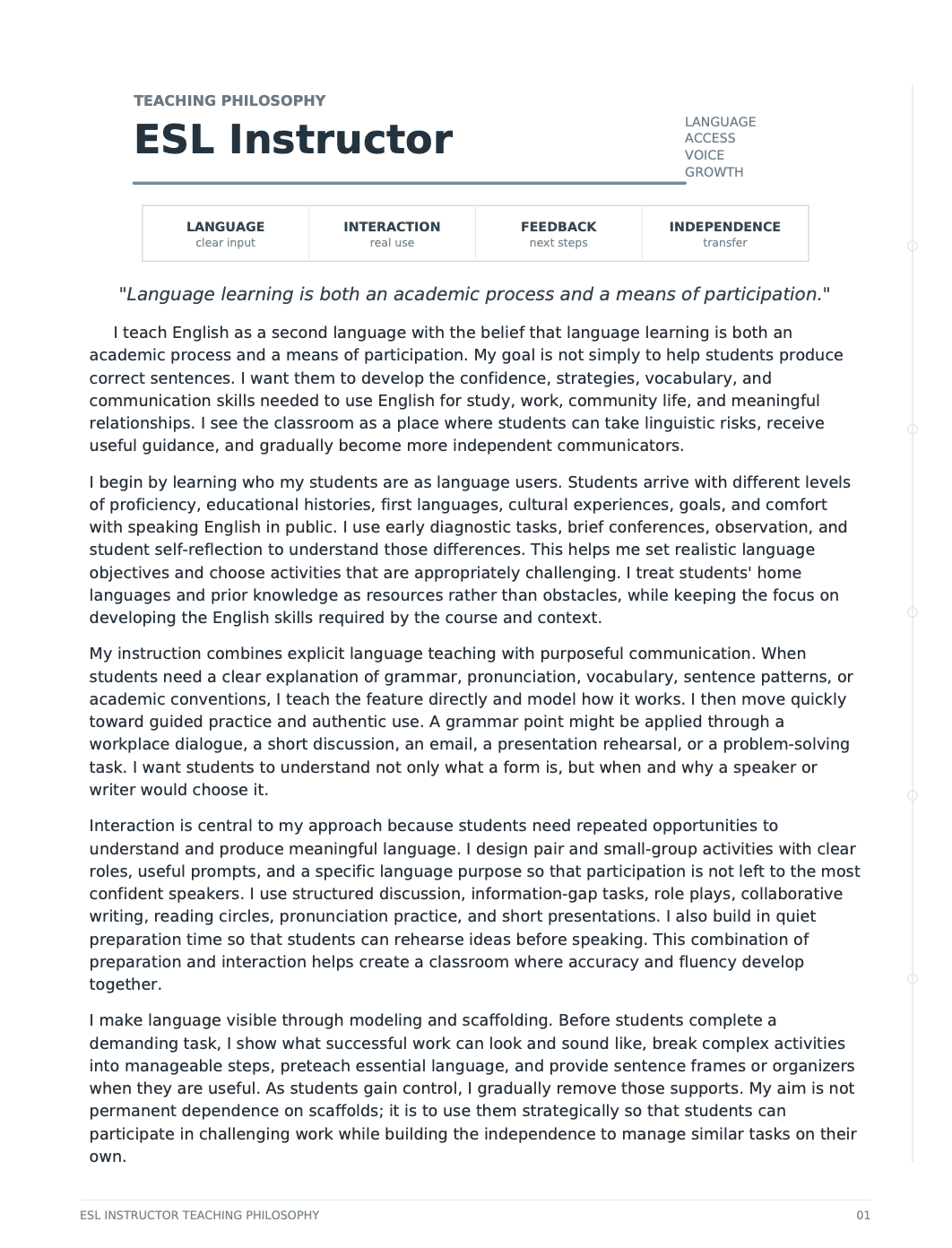
LANGUAGE • LEARNING • PARTICIPATION
ESL Teacher Teaching Philosophy
My classroom
focus
English development that opens access to grade-level learning,
conversation, and independence.
I believe effective ESL teaching begins with a clear respect for what multilingual learners already know.
Students enter an English language classroom with languages, cultural knowledge, academic experiences,
and ways of communicating that are resources for learning, not obstacles to overcome. My responsibility is
to help students develop the English they need for school and everyday life while making sure language
development does not become a reason to lower expectations for meaningful academic work. I want
students to leave my classroom more willing to communicate, more aware of how language works, and
more confident in using English to express ideas that matter to them.
I teach English as a way into learning, not as a barrier students must clear before they
are allowed to participate.
I see language learning as active, social, and connected to purpose. Students make stronger progress when
they hear useful language in context, have a reason to use it, receive understandable models, and get
repeated opportunities to speak, listen, read, and write. In practice, that means I rarely ask students to
memorize vocabulary in isolation. I build lessons around situations they might actually encounter: explaining
a process, asking for clarification, comparing viewpoints, participating in a group discussion, reading a
school text, or writing a response supported by evidence. I make the language demands of those tasks
visible so students can focus not only on what they are learning, but also on how they can communicate it.
My instruction is intentionally scaffolded. I may begin with a visual, model a response, preview key
vocabulary, annotate a short text, or think aloud through a task before asking students to try it themselves.
Sentence frames, word banks, partner rehearsal, graphic organizers, gestures, and other multimodal
supports can make a difficult task accessible without doing the thinking for the learner. I also believe
scaffolding should be temporary. As students gain control, I remove prompts, broaden the possible
responses, and ask them to choose language that fits their own meaning. I adjust the amount of support
according to what students demonstrate rather than assuming that a proficiency label tells the whole story.
Talk is central to my classroom. I plan structured opportunities for students to rehearse ideas with a partner
or small group before sharing publicly, because a quiet student may need thinking time while another may
need a safe opportunity to take a language risk. I teach students how to ask for clarification, build on another
speaker's idea, disagree respectfully, and keep a conversation going. I also use authentic texts and
examples that make room for different cultures and experiences. Students should see that learning English
does not require them to set aside who they are; it gives them another way to participate and be heard.
Assessment is most useful to me when it changes what I do next. I listen to student conversations, examine
writing, use quick checks for understanding, and review performance on reading and content tasks to
identify patterns. I pay attention to whether a difficulty is primarily linguistic, conceptual, or connected to the
task itself. A short oral response might show that a student understands the science concept but needs