Nursing Instructor Teaching Philosophy
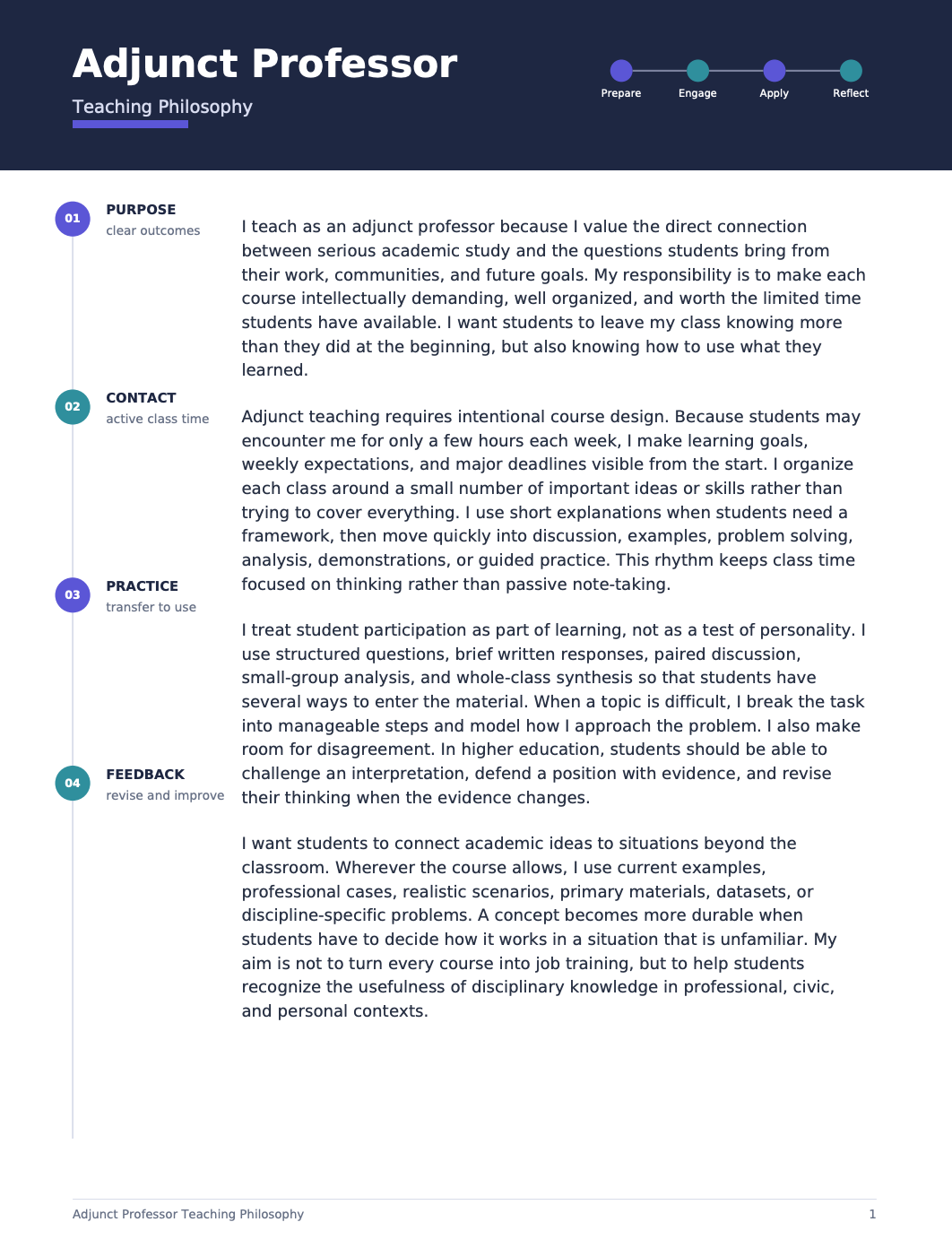
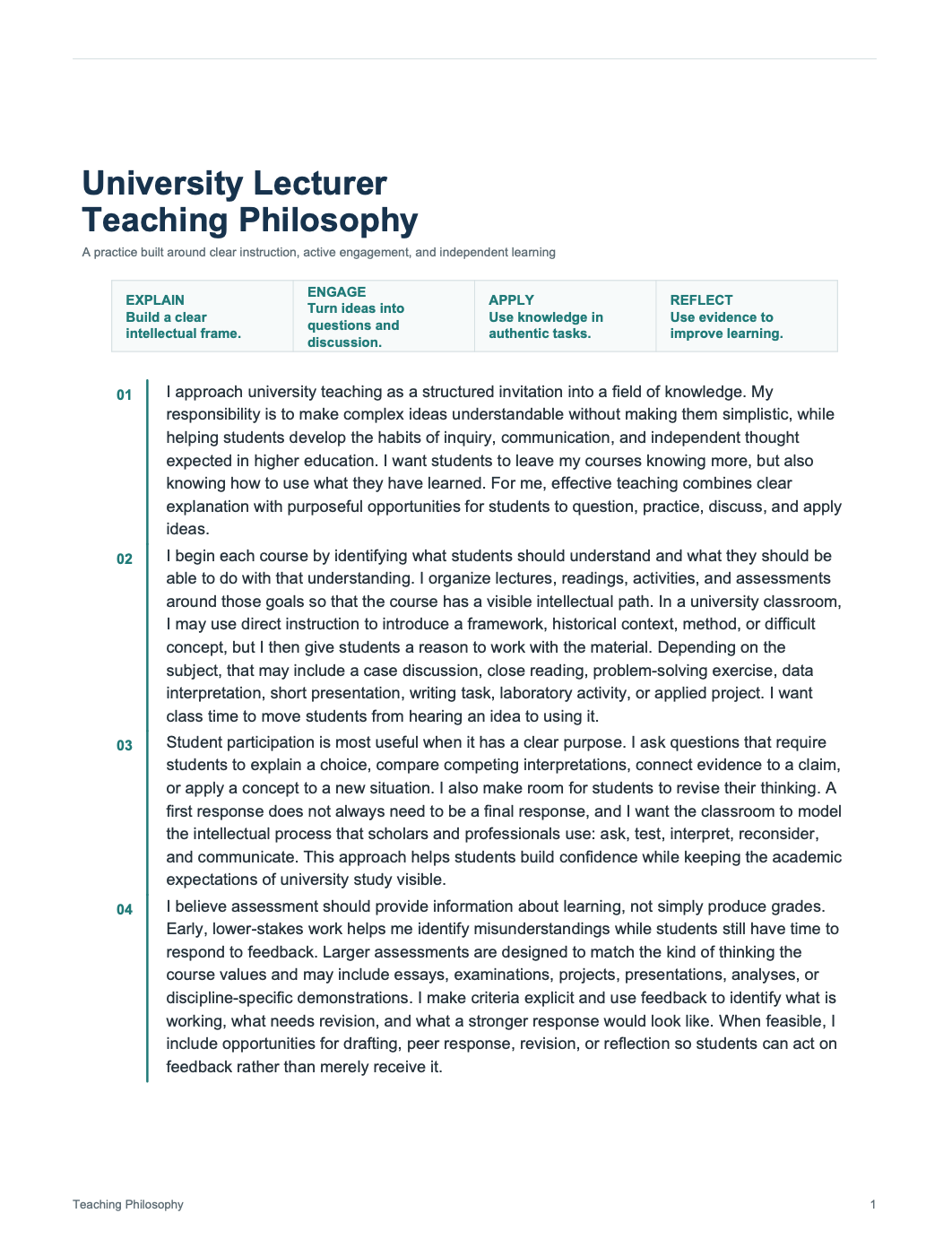
ASSESS
JUDGE
ACT
EVALUATE
I teach nursing with the belief that students become safe, thoughtful practitioners when they can connect
nursing knowledge to the decisions they will make with real patients. Knowing a disease process or
memorizing a medication list is important, but nursing education must also help students recognize
changing clinical cues, prioritize care, communicate clearly, and evaluate whether an intervention is
working. My responsibility is to create learning experiences in which students can build those habits while
receiving the guidance and feedback needed to move toward independent clinical judgment.
I organize instruction around the relationship between knowledge and practice. In the classroom, I use
patient scenarios, concept mapping, case analysis, questioning, and focused explanations to help
students connect pathophysiology, pharmacology, assessment findings, ethics, and nursing
interventions. In simulation or skills laboratory, students have opportunities to practice assessment,
communication, technical procedures, documentation, and prioritization in a setting where mistakes can
become learning opportunities before a student's actions affect a patient. I want students to explain why
they are making a decision, not simply demonstrate that they can follow a checklist.
Clinical experiences require a different kind of teaching because the situation can change quickly. I
prepare students to enter clinical settings with clear expectations for safety, professional communication,
infection prevention, documentation, and respect for patients and families. During clinical learning, I use
questioning to help students notice relevant cues, connect those cues to nursing knowledge, consider
possible priorities, act within their level of preparation, and evaluate the response. I intervene directly
when safety requires it, but otherwise I want students to experience the reasoning involved in making and
revising a plan of care.
I use simulation deliberately rather than treating it as a performance exercise. A realistic scenario can
require students to recognize a deterioration in condition, communicate with a patient or family member,
collaborate with another professional, administer care, and respond when the expected outcome does
not occur. Debriefing is essential because students need time to reconstruct what they noticed, what they
prioritized, why they acted, and what they would change. I use that reflection to turn an experience into
clinical reasoning they can transfer to another patient or setting.
Assessment should show whether students are developing the competencies required for nursing
practice. I use formative questioning, dosage calculations, focused patient assessments, written clinical
reasoning, skill demonstrations, simulation performance, care plans, and reflective activities to identify
learning needs. I provide clear criteria and timely feedback so students know what they have
demonstrated and what remains to be developed. When a student struggles, I distinguish a knowledge
gap from a reasoning problem, a technical-skill problem, or difficulty communicating under pressure. That
distinction helps me select the right next learning experience.
NURSING EDUCATION • CLINICAL JUDGMENT • COMPETENCE • PATIENT SAFETY
Teaching Philosophy
Nursing Instructor Teaching Philosophy
I believe nursing students need high expectations and a classroom culture in which asking for help is
professional rather than embarrassing. Students arrive with different academic preparation, clinical
exposure, cultural backgrounds, language experiences, and levels of confidence. I use structured
preparation, visual and verbal explanations, guided practice, case repetition with increasing complexity,
and different ways to demonstrate understanding when appropriate. I do not lower expectations for
competence; I provide the scaffolding needed to help students reach them safely.
Professional formation is part of nursing education. Students learn from how I communicate with them,
how I speak about patients, how I handle uncertainty, and how I respond when a mistake occurs. I expect
students to protect privacy, communicate respectfully, document accurately, seek clarification when
something is unclear, and recognize the limits of their own knowledge. I also emphasize interprofessional
collaboration because safe patient care depends on nurses being able to communicate concerns,
contribute their assessment, and listen to the expertise of other members of the health care team.
I want evidence to guide my teaching as much as it guides nursing care. I review patterns in student
performance, clinical evaluations, simulation debriefings, and course assessments to identify recurring
misunderstandings. When students repeatedly struggle with a concept, I reconsider the way I explained it
or the sequence in which they encountered it rather than assuming the difficulty belongs only to the
learner. I also keep my clinical knowledge current because students deserve instruction that reflects
contemporary nursing practice, professional standards, and the realities of the health care environment.
Ultimately, my goal is to help students become nurses who can think clearly, care responsibly, and
continue learning after graduation. I want them to enter practice able to assess a patient, recognize
meaningful changes, prioritize appropriately, communicate with the team, use evidence, and evaluate the
results of their actions. I also want them to understand that nursing competence is not a finish line
reached by passing one examination; it develops through reflection, feedback, experience, and continued
study. I see my role as both teacher and professional role model, and I continually examine my own
teaching so that classroom, laboratory, simulation, and clinical experiences give students stronger
opportunities to develop sound judgment and safe practice.
NURSING EDUCATION • CLINICAL JUDGMENT • COMPETENCE • PATIENT SAFETY
Teaching Philosophy