Accountability
Personality
Traits
1.
The
Traits
at
a
Glance
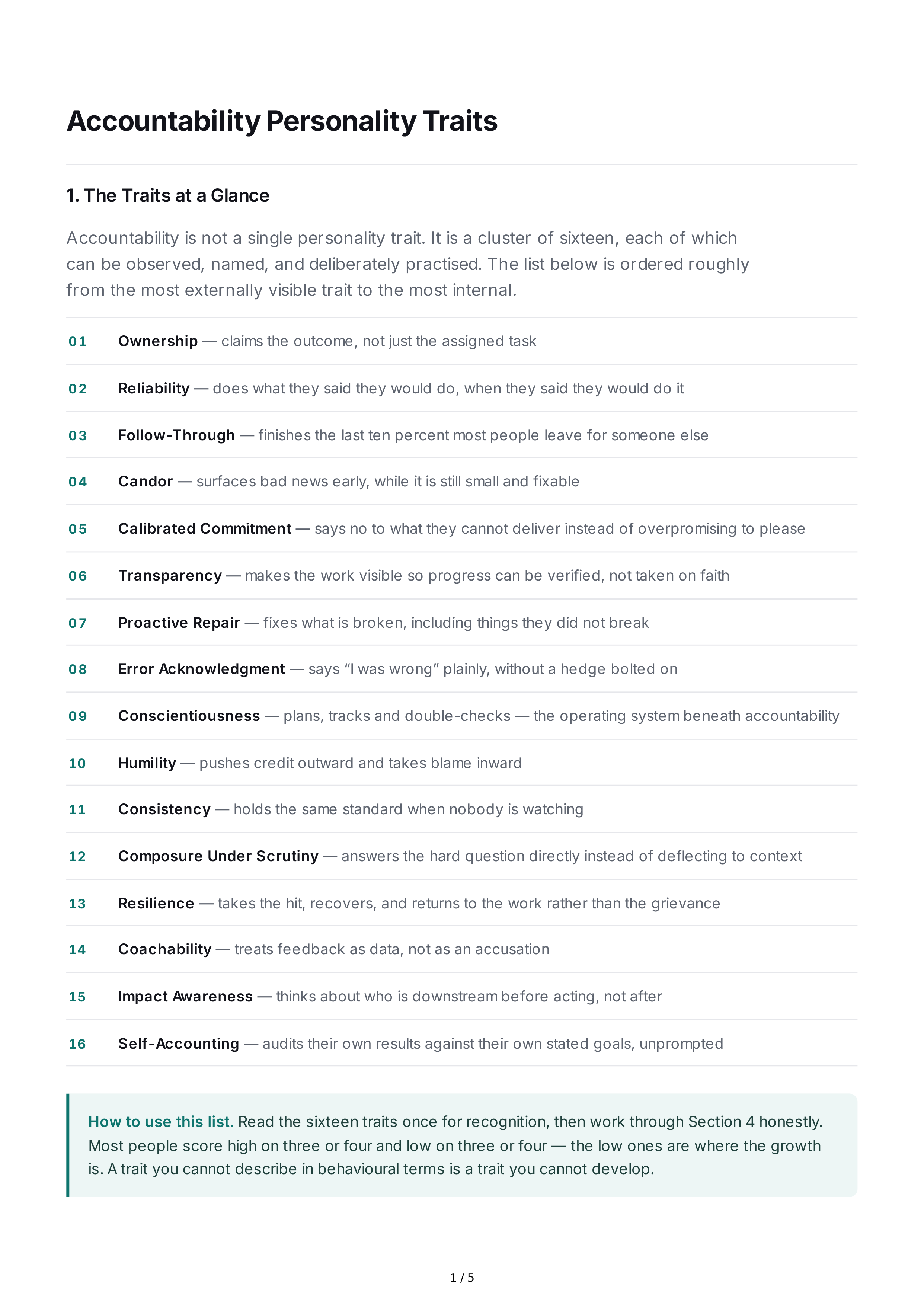
Accountability
is
not
a
single
personality
trait
.
It
is
a
cluster
of
sixteen
,
each
of
which
can
be
observed
,
named
,
and
deliberately
practised
.
The
list
below
is
ordered
roughly
from
the
most
externally
visible
trait
to
the
most
internal
.
01
Ownership
—
claims
the
outcome
,
not
just
the
assigned
task
02
Reliability
—
does
what
they
said
they
would
do
,
when
they
said
they
would
do
it
03
Follow
-
Through
—
finishes
the
last
ten
percent
most
people
leave
for
someone
else
04
Candor
—
surfaces
bad
news
early
,
while
it
is
still
small
and
fixable
05
Calibrated
Commitment
—
says
no
to
what
they
cannot
deliver
instead
of
overpromising
to
please
06
Transparency
—
makes
the
work
visible
so
progress
can
be
verified
,
not
taken
on
faith
07
Proactive
Repair
—
fixes
what
is
broken
,
including
things
they
did
not
break
08
Error
Acknowledgment
—
says
“
I
was
wrong
”
plainly
,
without
a
hedge
bolted
on
09
Conscientiousness
—
plans
,
tracks
and
double
-
checks
—
the
operating
system
beneath
accountability
10
Humility
—
pushes
credit
outward
and
takes
blame
inward
11
Consistency
—
holds
the
same
standard
when
nobody
is
watching
12
Composure
Under
Scrutiny
—
answers
the
hard
question
directly
instead
of
deflecting
to
context
13
Resilience
—
takes
the
hit
,
recovers
,
and
returns
to
the
work
rather
than
the
grievance
14
Coachability
—
treats
feedback
as
data
,
not
as
an
accusation
15
Impact
Awareness
—
thinks
about
who
is
downstream
before
acting
,
not
after
16
Self
-
Accounting
—
audits
their
own
results
against
their
own
stated
goals
,
unprompted
How
to
use
this
list
.
Read
the
sixteen
traits
once
for
recognition
,
then
work
through
Section
4
honestly
.
Most
people
score
high
on
three
or
four
and
low
on
three
or
four
—
the
low
ones
are
where
the
growth
is
.
A
trait
you
cannot
describe
in
behavioural
terms
is
a
trait
you
cannot
develop
.
1 / 5
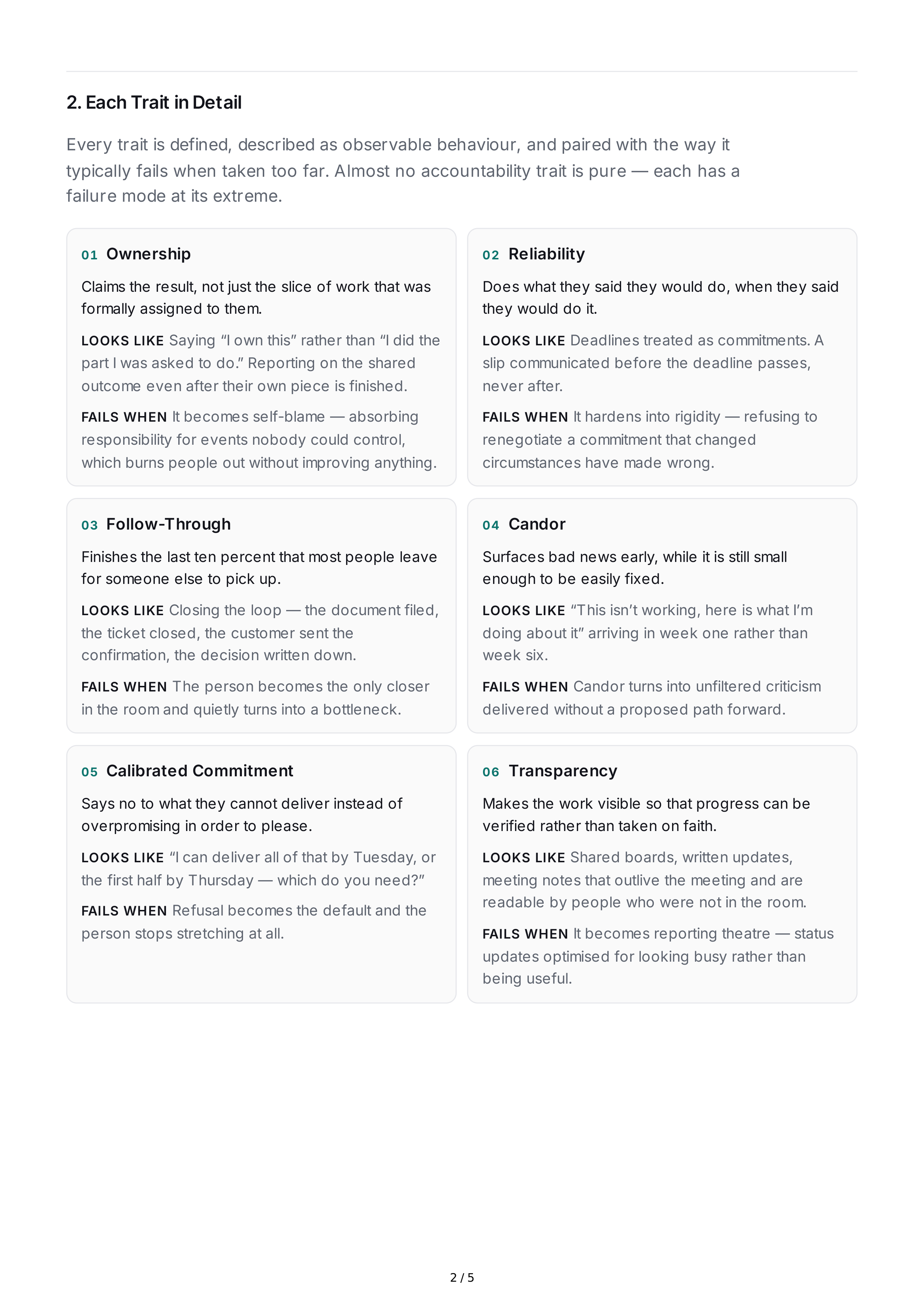
2.
Each
Trait
in
Detail
Every
trait
is
defined
,
described
as
observable
behaviour
,
and
paired
with
the
way
it
typically
fails
when
taken
too
far
.
Almost
no
accountability
trait
is
pure
—
each
has
a
failure
mode
at
its
extreme
.
01
Ownership
Claims
the
result
,
not
just
the
slice
of
work
that
was
formally
assigned
to
them
.
LOOKS
LIKE
Saying
“
I
own
this
”
rather
than
“
I
did
the
part
I
was
asked
to
do
.”
Reporting
on
the
shared
outcome
even
after
their
own
piece
is
finished
.
FAILS
WHEN
It
becomes
self
-
blame
—
absorbing
responsibility
for
events
nobody
could
control
,
which
burns
people
out
without
improving
anything
.
02
Reliability
Does
what
they
said
they
would
do
,
when
they
said
they
would
do
it
.
LOOKS
LIKE
Deadlines
treated
as
commitments
.
A
slip
communicated
before
the
deadline
passes
,
never
after
.
FAILS
WHEN
It
hardens
into
rigidity
—
refusing
to
renegotiate
a
commitment
that
changed
circumstances
have
made
wrong
.
03
Follow
-
Through
Finishes
the
last
ten
percent
that
most
people
leave
for
someone
else
to
pick
up
.
LOOKS
LIKE
Closing
the
loop
—
the
document
filed
,
the
ticket
closed
,
the
customer
sent
the
confirmation
,
the
decision
written
down
.
FAILS
WHEN
The
person
becomes
the
only
closer
in
the
room
and
quietly
turns
into
a
bottleneck
.
04
Candor
Surfaces
bad
news
early
,
while
it
is
still
small
enough
to
be
easily
fixed
.
LOOKS
LIKE
“
This
isn
’
t
working
,
here
is
what
I
’
m
doing
about
it
”
arriving
in
week
one
rather
than
week
six
.
FAILS
WHEN
Candor
turns
into
unfiltered
criticism
delivered
without
a
proposed
path
forward
.
05
Calibrated
Commitment
Says
no
to
what
they
cannot
deliver
instead
of
overpromising
in
order
to
please
.
LOOKS
LIKE
“
I
can
deliver
all
of
that
by
Tuesday
,
or
the
first
half
by
Thursday
—
which
do
you
need
?”
FAILS
WHEN
Refusal
becomes
the
default
and
the
person
stops
stretching
at
all
.
06
Transparency
Makes
the
work
visible
so
that
progress
can
be
verified
rather
than
taken
on
faith
.
LOOKS
LIKE
Shared
boards
,
written
updates
,
meeting
notes
that
outlive
the
meeting
and
are
readable
by
people
who
were
not
in
the
room
.
FAILS
WHEN
It
becomes
reporting
theatre
—
status
updates
optimised
for
looking
busy
rather
than
being
useful
.
2 / 5
07
Proactive
Repair
Fixes
what
is
broken
,
including
the
things
they
had
nothing
to
do
with
breaking
.
LOOKS
LIKE
Correcting
the
document
,
flagging
the
unassigned
gap
,
picking
up
the
task
everyone
assumed
someone
else
had
.
FAILS
WHEN
The
person
keeps
rescuing
everyone
else
’
s
work
and
never
finishes
their
own
.
08
Error
Acknowledgment
Says
“
I
was
wrong
”
plainly
,
without
a
hedge
or
an
explanation
welded
onto
it
.
LOOKS
LIKE
“
I
made
that
call
.
It
was
wrong
.
Here
is
the
correction
.”
Nothing
more
required
.
FAILS
WHEN
Acknowledgment
becomes
the
entire
response
—
apologising
repeatedly
without
changing
the
behaviour
.
09
Conscientiousness
Plans
,
tracks
and
double
-
checks
—
the
operating
system
that
sits
beneath
visible
accountability
.
LOOKS
LIKE
A
checklist
that
exists
before
the
work
starts
;
a
detail
verified
before
it
ships
rather
than
after
a
complaint
.
FAILS
WHEN
Process
replaces
judgement
—
checking
the
boxes
instead
of
checking
the
outcome
.
10
Humility
Pushes
credit
outward
and
takes
blame
inward
,
in
public
and
in
private
alike
.
LOOKS
LIKE
“
The
team
got
us
there
”
said
out
loud
;
“
I
misjudged
that
”
said
just
as
readily
,
to
the
same
audience
.
FAILS
WHEN
Humility
becomes
performative
—
modesty
deployed
as
a
status
move
.
11
Consistency
Holds
the
same
standard
when
nobody
is
watching
as
when
everyone
is
.
LOOKS
LIKE
The
unreviewed
part
of
the
work
getting
the
same
care
as
the
part
that
will
be
presented
.
FAILS
WHEN
It
hardens
into
inflexibility
toward
other
people
’
s
different
-
but
-
valid
standards
.
12
Composure
Under
Scrutiny
Answers
the
difficult
question
directly
,
rather
than
deflecting
to
context
or
history
.
LOOKS
LIKE
“
Yes
,
that
one
is
on
me
.
Here
is
the
sequence
of
what
happened
.”
No
preamble
,
no
blame
ladder
.
FAILS
WHEN
Composure
becomes
flatness
—
the
person
stops
signalling
that
the
miss
matters
to
them
.
13
Resilience
Takes
the
hit
,
recovers
,
and
returns
to
the
work
rather
than
to
the
grievance
.
LOOKS
LIKE
The
retrospective
happens
,
the
lessons
get
written
down
,
the
next
cycle
starts
on
schedule
.
FAILS
WHEN
Bouncing
back
turns
into
rushing
past
—
never
processing
what
actually
went
wrong
.
14
Coachability
Treats
feedback
as
data
to
be
tested
,
not
as
an
accusation
to
be
defended
against
.
LOOKS
LIKE
Asking
a
clarifying
question
before
responding
,
then
trying
the
change
and
reporting
what
happened
.
FAILS
WHEN
The
person
agrees
with
every
piece
of
feedback
and
integrates
none
of
it
.
3 / 5
15
Impact
Awareness
Thinks
about
who
is
downstream
before
acting
,
not
after
the
consequences
arrive
.
LOOKS
LIKE
Support
,
the
next
shift
,
and
the
end
customer
being
considered
in
the
room
where
the
decision
is
made
.
FAILS
WHEN
Consideration
becomes
paralysis
—
nothing
ships
because
every
possible
consequence
is
weighed
forever
.
16
Self
-
Accounting
Audits
their
own
results
against
their
own
stated
goals
,
without
being
asked
to
.
LOOKS
LIKE
Revisiting
last
quarter
’
s
commitments
unprompted
and
reporting
the
honest
number
,
including
the
disappointing
one
.
FAILS
WHEN
Self
-
review
becomes
self
-
flagellation
,
which
produces
avoidance
rather
than
change
.
3.
Traits
That
Work
Against
Accountability
Accountability
rarely
disappears
outright
.
It
is
usually
displaced
by
a
competing
habit
that
looks
reasonable
in
the
moment
.
These
seven
are
the
most
common
substitutes
.
Anti
-
traits
,
the
language
they
hide
behind
,
and
the
cost
they
impose
.
ANTI
-
TRAIT
WHAT
IT
SOUNDS
LIKE
WHAT
IT
COSTS
Blame
-
shifting
“
If
the
data
had
been
accurate
,
I
would
have
hit
the
number
.”
The
team
learns
to
protect
itself
instead
of
the
result
.
Excuse
-
making
“
Nobody
told
me
that
was
my
responsibility
.”
The
gap
is
closed
late
,
by
someone
else
,
at
roughly
double
the
cost
.
Passive
deflection
“
I
flagged
a
concern
about
that
in
the
meeting
.”
Raising
a
risk
is
treated
as
though
it
retires
the
risk
.
Accountability
theatre
“
Whatever
it
takes
—
I
’
m
fully
committed
to
this
.”
Enthusiasm
substitutes
for
a
plan
,
an
owner
,
and
a
date
.
Credit
-
hoarding
“
That
was
my
strategy
.”
Ownership
of
the
wins
without
ownership
of
the
losses
.
Martyrdom
“
I
’
ll
just
do
it
myself
.
Again
.”
Resentment
replaces
a
clear
renegotiation
of
the
commitment
.
Perfectionism
as
avoidance
“
It
isn
’
t
ready
yet
.”
The
deadline
passes
and
the
delay
is
reframed
as
care
.
4 / 5
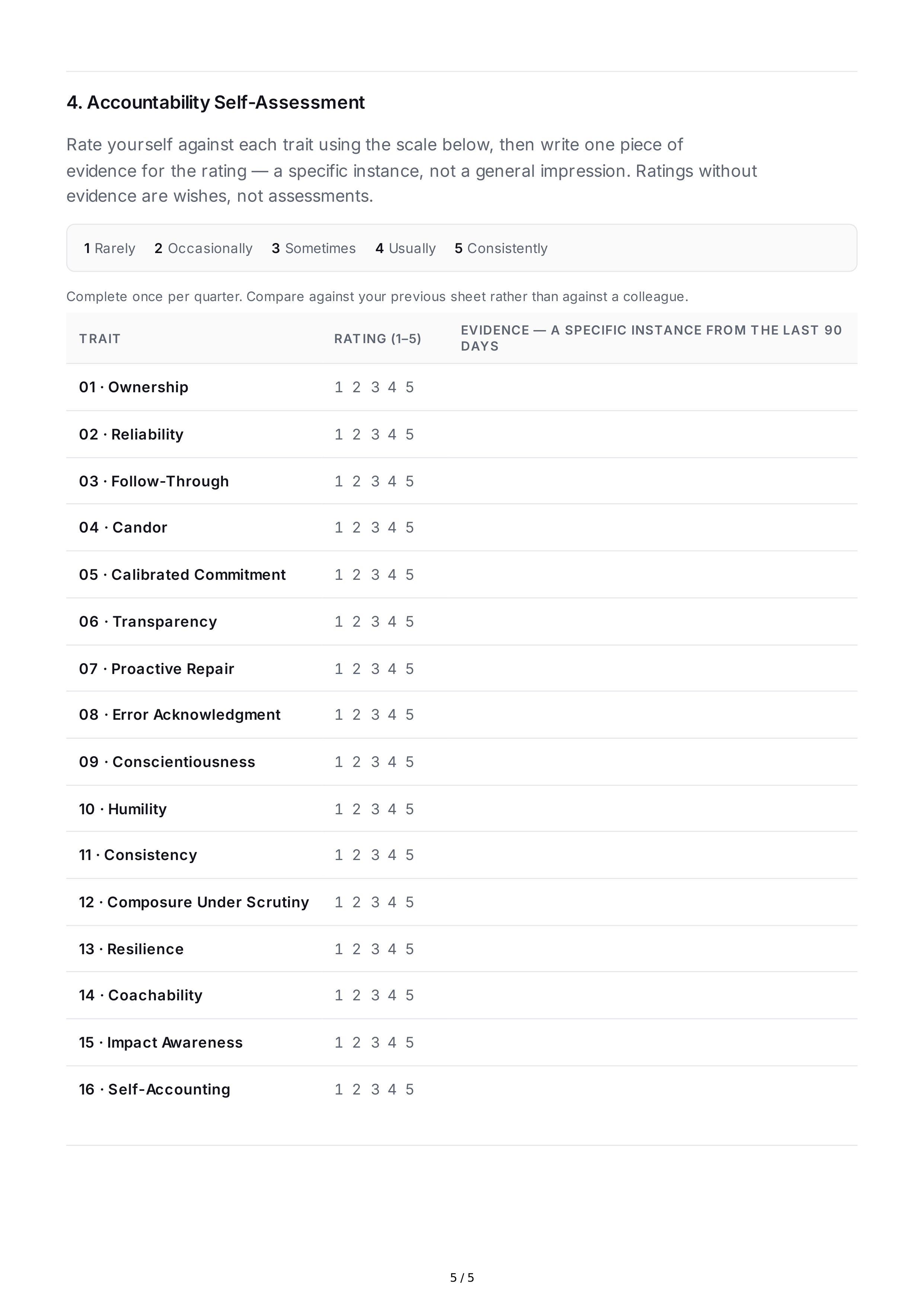
4.
Accountability
Self
-
Assessment
Rate
yourself
against
each
trait
using
the
scale
below
,
then
write
one
piece
of
evidence
for
the
rating
—
a
specific
instance
,
not
a
general
impression
.
Ratings
without
evidence
are
wishes
,
not
assessments
.
1
Rarely
2
Occasionally
3
Sometimes
4
Usually
5
Consistently
Complete
once
per
quarter
.
Compare
against
your
previous
sheet
rather
than
against
a
colleague
.
TRAIT
RATING
(1–5)
EVIDENCE
—
A
SPECIFIC
INSTANCE
FROM
THE
LAST
90
DAYS
01 ·
Ownership
1 2 3 4 5
02 ·
Reliability
1 2 3 4 5
03 ·
Follow
-
Through
1 2 3 4 5
04 ·
Candor
1 2 3 4 5
05 ·
Calibrated
Commitment
1 2 3 4 5
06 ·
Transparency
1 2 3 4 5
07 ·
Proactive
Repair
1 2 3 4 5
08 ·
Error
Acknowledgment
1 2 3 4 5
09 ·
Conscientiousness
1 2 3 4 5
10 ·
Humility
1 2 3 4 5
11 ·
Consistency
1 2 3 4 5
12 ·
Composure
Under
Scrutiny
1 2 3 4 5
13 ·
Resilience
1 2 3 4 5
14 ·
Coachability
1 2 3 4 5
15 ·
Impact
Awareness
1 2 3 4 5
16 ·
Self
-
Accounting
1 2 3 4 5
5 / 5