
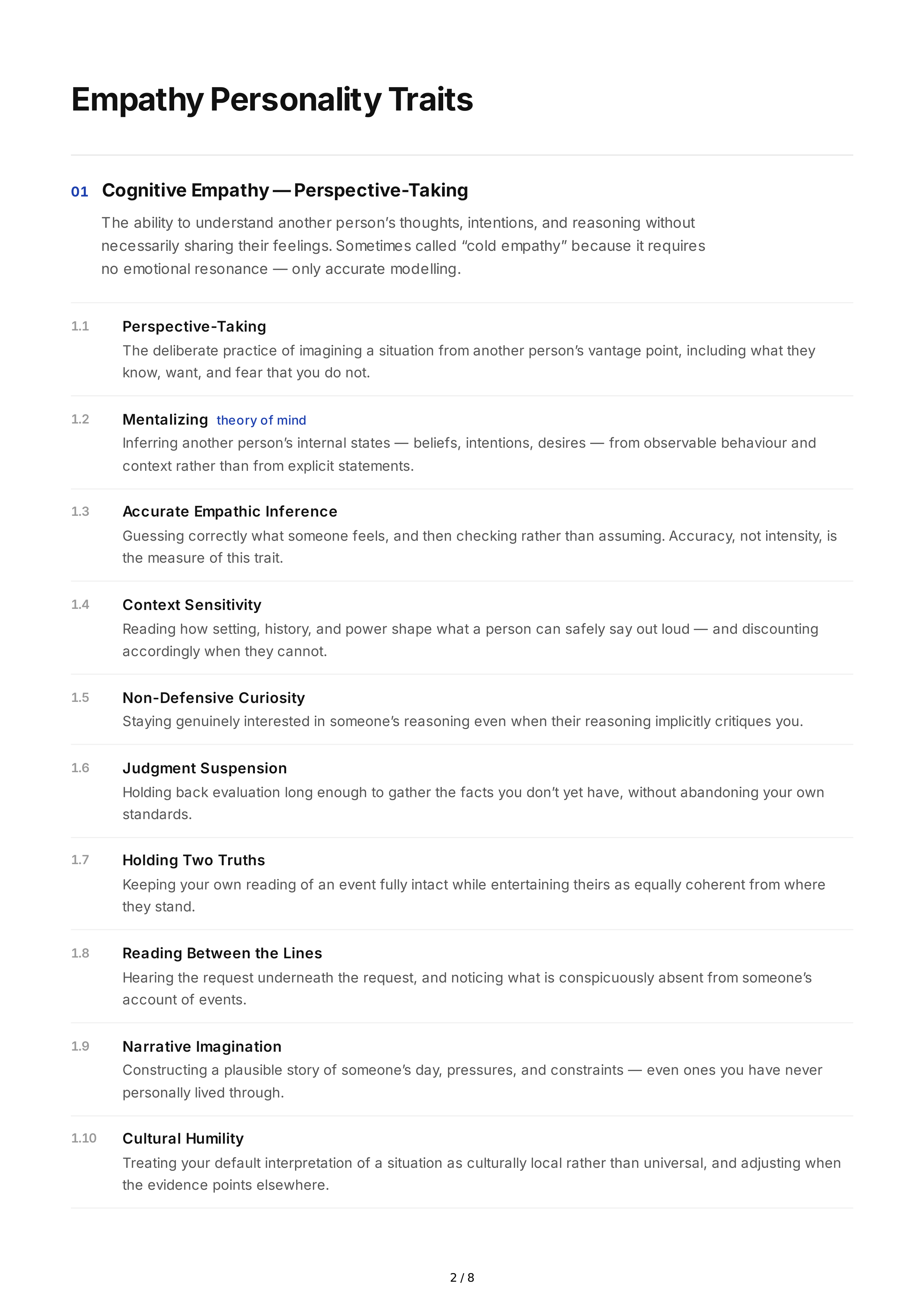
Empathy
Personality
Traits
01
Cognitive
Empathy
—
Perspective
-
Taking
The
ability
to
understand
another
person
’
s
thoughts
,
intentions
,
and
reasoning
without
necessarily
sharing
their
feelings
.
Sometimes
called
“
cold
empathy
”
because
it
requires
no
emotional
resonance
—
only
accurate
modelling
.
1.1
Perspective
-
Taking
The
deliberate
practice
of
imagining
a
situation
from
another
person
’
s
vantage
point
,
including
what
they
know
,
want
,
and
fear
that
you
do
not
.
1.2
Mentalizing
theory
of
mind
Inferring
another
person
’
s
internal
states
—
beliefs
,
intentions
,
desires
—
from
observable
behaviour
and
context
rather
than
from
explicit
statements
.
1.3
Accurate
Empathic
Inference
Guessing
correctly
what
someone
feels
,
and
then
checking
rather
than
assuming
.
Accuracy
,
not
intensity
,
is
the
measure
of
this
trait
.
1.4
Context
Sensitivity
Reading
how
setting
,
history
,
and
power
shape
what
a
person
can
safely
say
out
loud
—
and
discounting
accordingly
when
they
cannot
.
1.5
Non
-
Defensive
Curiosity
Staying
genuinely
interested
in
someone
’
s
reasoning
even
when
their
reasoning
implicitly
critiques
you
.
1.6
Judgment
Suspension
Holding
back
evaluation
long
enough
to
gather
the
facts
you
don
’
t
yet
have
,
without
abandoning
your
own
standards
.
1.7
Holding
Two
Truths
Keeping
your
own
reading
of
an
event
fully
intact
while
entertaining
theirs
as
equally
coherent
from
where
they
stand
.
1.8
Reading
Between
the
Lines
Hearing
the
request
underneath
the
request
,
and
noticing
what
is
conspicuously
absent
from
someone
’
s
account
of
events
.
1.9
Narrative
Imagination
Constructing
a
plausible
story
of
someone
’
s
day
,
pressures
,
and
constraints
—
even
ones
you
have
never
personally
lived
through
.
1.10
Cultural
Humility
Treating
your
default
interpretation
of
a
situation
as
culturally
local
rather
than
universal
,
and
adjusting
when
the
evidence
points
elsewhere
.
2 / 8
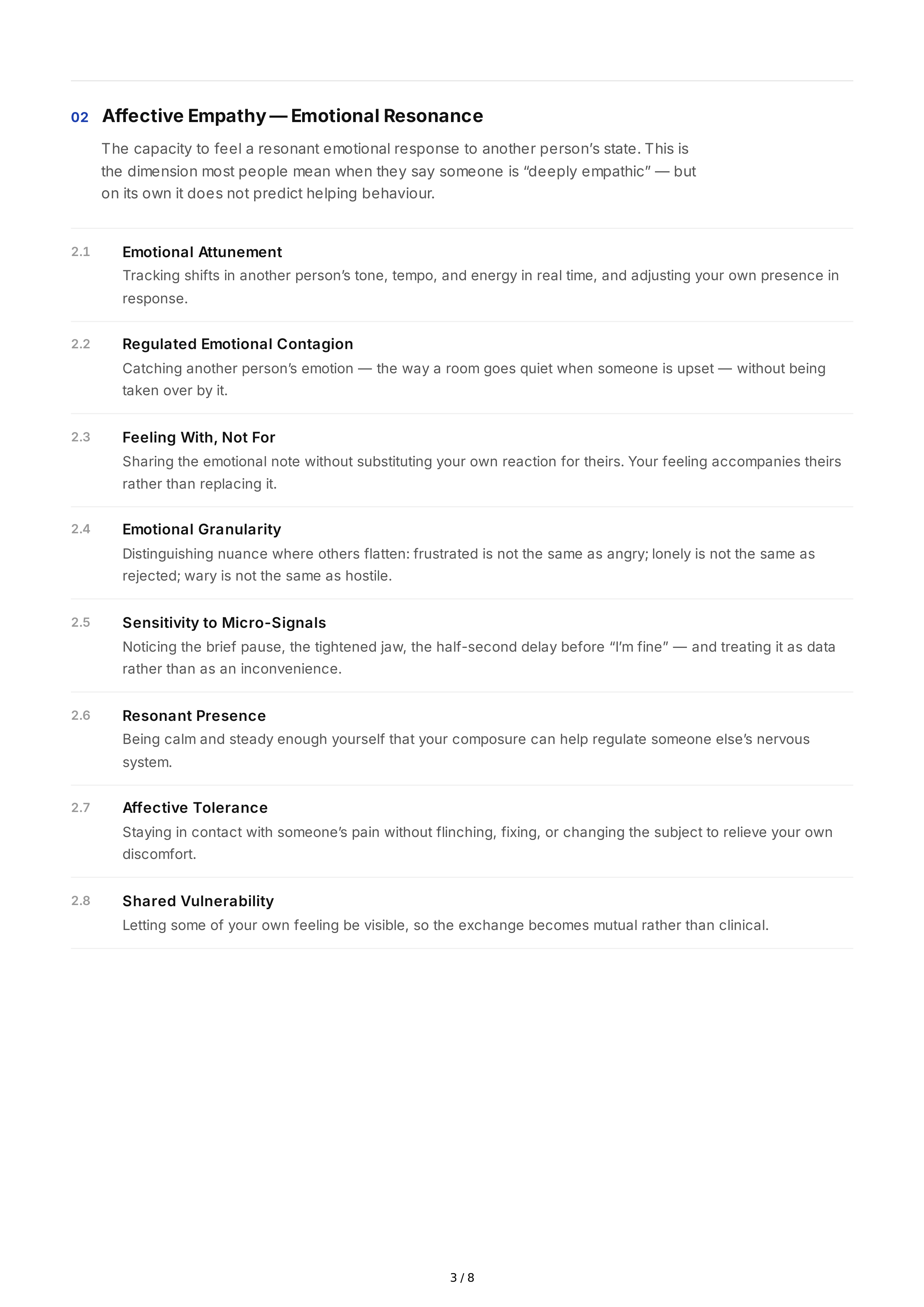
02
Affective
Empathy
—
Emotional
Resonance
The
capacity
to
feel
a
resonant
emotional
response
to
another
person
’
s
state
.
This
is
the
dimension
most
people
mean
when
they
say
someone
is
“
deeply
empathic
” —
but
on
its
own
it
does
not
predict
helping
behaviour
.
2.1
Emotional
Attunement
Tracking
shifts
in
another
person
’
s
tone
,
tempo
,
and
energy
in
real
time
,
and
adjusting
your
own
presence
in
response
.
2.2
Regulated
Emotional
Contagion
Catching
another
person
’
s
emotion
—
the
way
a
room
goes
quiet
when
someone
is
upset
—
without
being
taken
over
by
it
.
2.3
Feeling
With
,
Not
For
Sharing
the
emotional
note
without
substituting
your
own
reaction
for
theirs
.
Your
feeling
accompanies
theirs
rather
than
replacing
it
.
2.4
Emotional
Granularity
Distinguishing
nuance
where
others
flatten
:
frustrated
is
not
the
same
as
angry
;
lonely
is
not
the
same
as
rejected
;
wary
is
not
the
same
as
hostile
.
2.5
Sensitivity
to
Micro
-
Signals
Noticing
the
brief
pause
,
the
tightened
jaw
,
the
half
-
second
delay
before
“
I
’
m
fine
” —
and
treating
it
as
data
rather
than
as
an
inconvenience
.
2.6
Resonant
Presence
Being
calm
and
steady
enough
yourself
that
your
composure
can
help
regulate
someone
else
’
s
nervous
system
.
2.7
Affective
Tolerance
Staying
in
contact
with
someone
’
s
pain
without
flinching
,
fixing
,
or
changing
the
subject
to
relieve
your
own
discomfort
.
2.8
Shared
Vulnerability
Letting
some
of
your
own
feeling
be
visible
,
so
the
exchange
becomes
mutual
rather
than
clinical
.
3 / 8
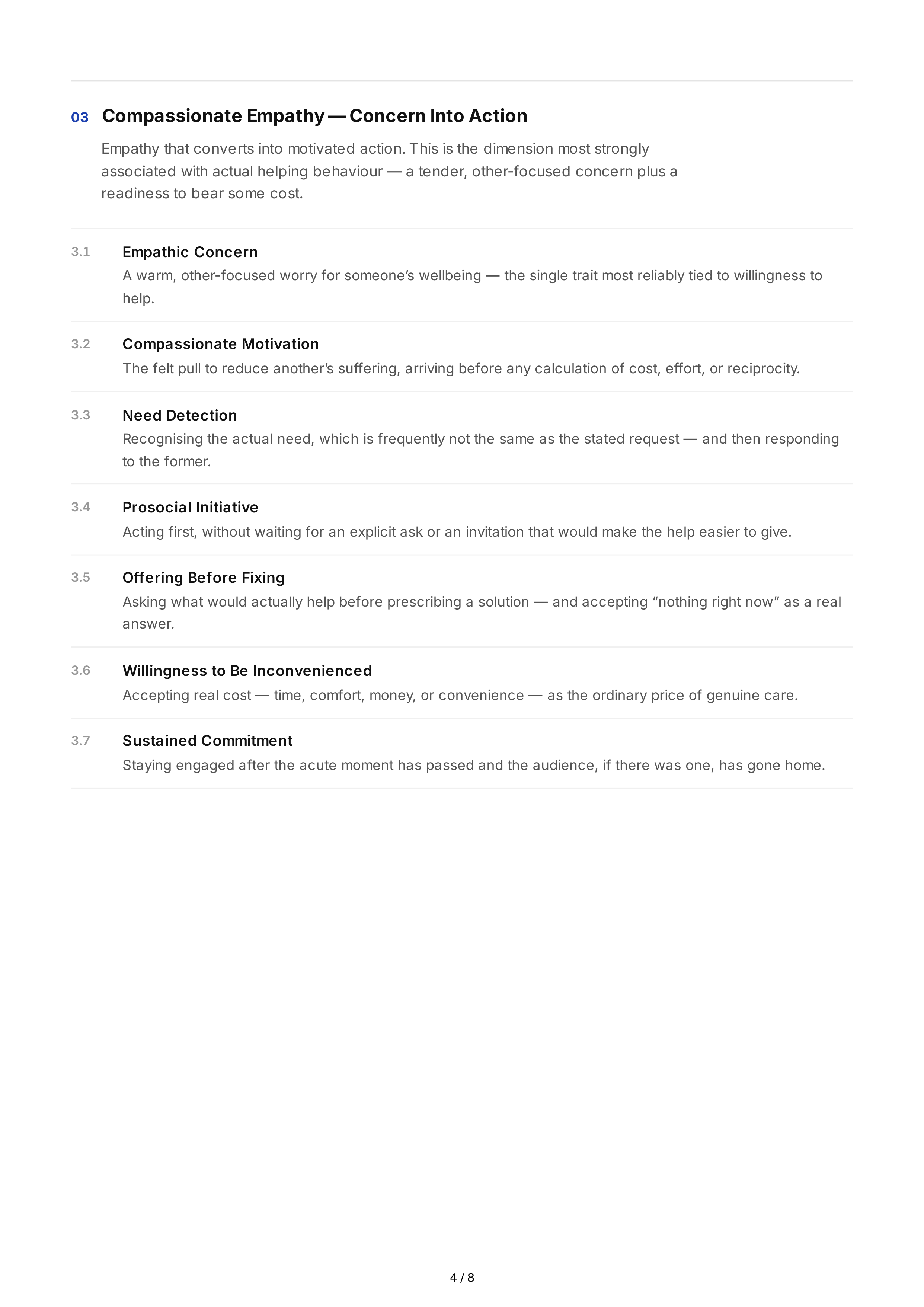
03
Compassionate
Empathy
—
Concern
Into
Action
Empathy
that
converts
into
motivated
action
.
This
is
the
dimension
most
strongly
associated
with
actual
helping
behaviour
—
a
tender
,
other
-
focused
concern
plus
a
readiness
to
bear
some
cost
.
3.1
Empathic
Concern
A
warm
,
other
-
focused
worry
for
someone
’
s
wellbeing
—
the
single
trait
most
reliably
tied
to
willingness
to
help
.
3.2
Compassionate
Motivation
The
felt
pull
to
reduce
another
’
s
suffering
,
arriving
before
any
calculation
of
cost
,
effort
,
or
reciprocity
.
3.3
Need
Detection
Recognising
the
actual
need
,
which
is
frequently
not
the
same
as
the
stated
request
—
and
then
responding
to
the
former
.
3.4
Prosocial
Initiative
Acting
first
,
without
waiting
for
an
explicit
ask
or
an
invitation
that
would
make
the
help
easier
to
give
.
3.5
Offering
Before
Fixing
Asking
what
would
actually
help
before
prescribing
a
solution
—
and
accepting
“
nothing
right
now
”
as
a
real
answer
.
3.6
Willingness
to
Be
Inconvenienced
Accepting
real
cost
—
time
,
comfort
,
money
,
or
convenience
—
as
the
ordinary
price
of
genuine
care
.
3.7
Sustained
Commitment
Staying
engaged
after
the
acute
moment
has
passed
and
the
audience
,
if
there
was
one
,
has
gone
home
.
4 / 8
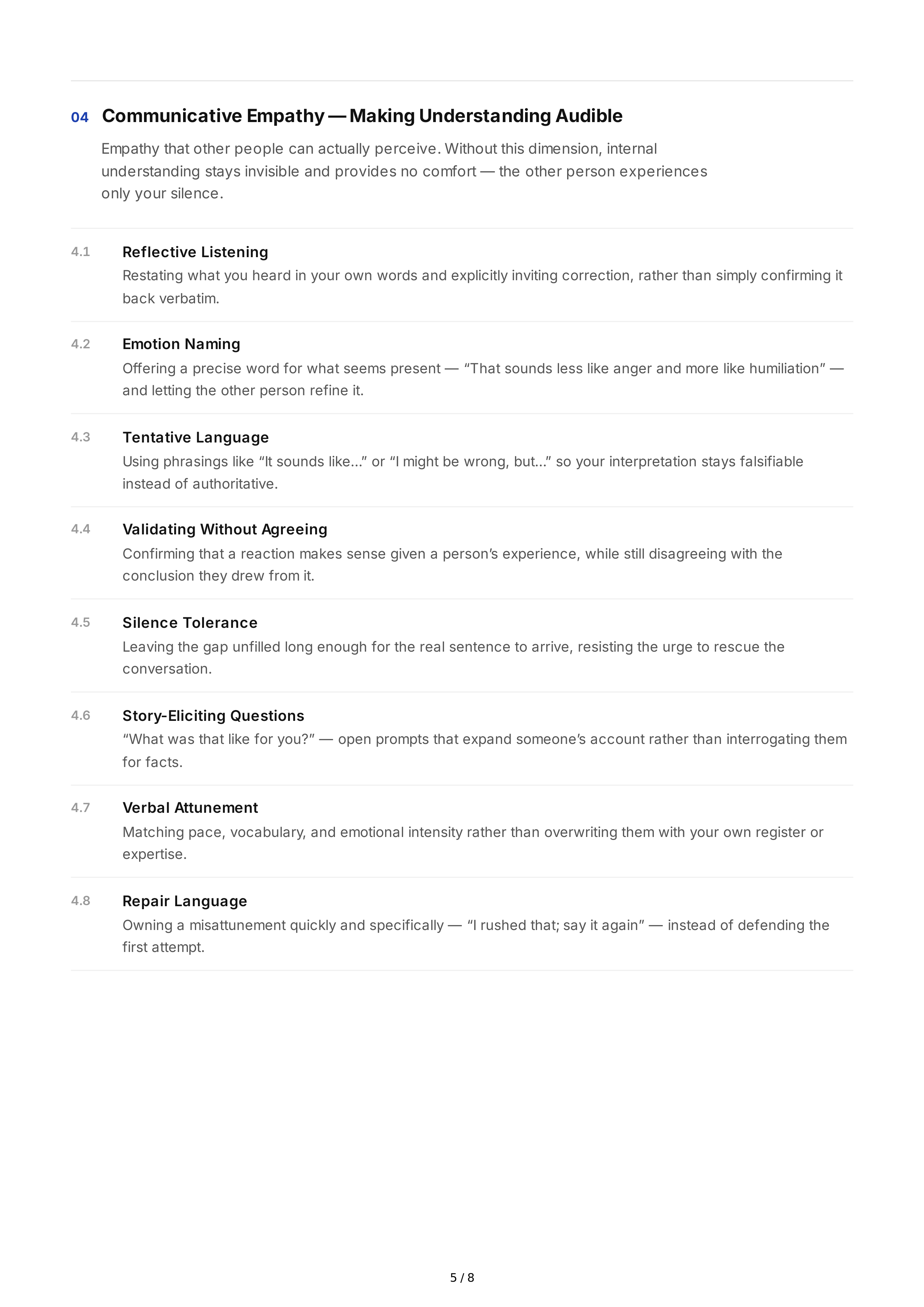
04
Communicative
Empathy
—
Making
Understanding
Audible
Empathy
that
other
people
can
actually
perceive
.
Without
this
dimension
,
internal
understanding
stays
invisible
and
provides
no
comfort
—
the
other
person
experiences
only
your
silence
.
4.1
Reflective
Listening
Restating
what
you
heard
in
your
own
words
and
explicitly
inviting
correction
,
rather
than
simply
confirming
it
back
verbatim
.
4.2
Emotion
Naming
Offering
a
precise
word
for
what
seems
present
— “
That
sounds
less
like
anger
and
more
like
humiliation
” —
and
letting
the
other
person
refine
it
.
4.3
Tentative
Language
Using
phrasings
like
“
It
sounds
like
…”
or
“
I
might
be
wrong
,
but
…”
so
your
interpretation
stays
falsifiable
instead
of
authoritative
.
4.4
Validating
Without
Agreeing
Confirming
that
a
reaction
makes
sense
given
a
person
’
s
experience
,
while
still
disagreeing
with
the
conclusion
they
drew
from
it
.
4.5
Silence
Tolerance
Leaving
the
gap
unfilled
long
enough
for
the
real
sentence
to
arrive
,
resisting
the
urge
to
rescue
the
conversation
.
4.6
Story
-
Eliciting
Questions
“
What
was
that
like
for
you
?” —
open
prompts
that
expand
someone
’
s
account
rather
than
interrogating
them
for
facts
.
4.7
Verbal
Attunement
Matching
pace
,
vocabulary
,
and
emotional
intensity
rather
than
overwriting
them
with
your
own
register
or
expertise
.
4.8
Repair
Language
Owning
a
misattunement
quickly
and
specifically
— “
I
rushed
that
;
say
it
again
” —
instead
of
defending
the
first
attempt
.
5 / 8
05
Relational
&
Behavioral
Empathy
—
Patterns
Over
Time
The
traits
that
show
up
across
weeks
and
months
rather
than
in
a
single
good
conversation
.
These
are
the
ones
other
people
actually
use
to
decide
whether
someone
is
safe
to
be
close
to
.
5.1
Emotional
Availability
Being
reachable
and
responsive
on
ordinary
days
,
when
nothing
is
wrong
and
no
one
is
asking
for
anything
.
5.2
Boundary
Respect
Tracking
the
line
between
care
and
intrusion
,
and
honouring
“
I
don
’
t
want
to
talk
about
it
”
the
first
time
it
is
said
.
5.3
Follow
-
Through
Remembering
what
mattered
last
week
and
asking
about
it
this
week
without
needing
to
be
reminded
.
5.4
Small
Noticings
Naming
what
you
see
—
a
harder
week
,
a
quieter
voice
on
the
call
,
a
withdrawn
joke
—
without
making
a
production
of
it
.
5.5
Repair
Orientation
Treating
ruptures
as
normal
and
repairable
events
rather
than
as
verdicts
on
the
relationship
or
the
person
.
5.6
Reciprocity
Awareness
Noticing
when
an
exchange
has
gone
consistently
one
-
directional
and
correcting
it
—
in
either
direction
.
5.7
Conflict
Humility
Assuming
the
other
person
holds
information
about
the
disagreement
that
you
genuinely
do
not
have
.
5.8
Inclusion
Instinct
Scanning
automatically
for
who
has
gone
quiet
,
and
making
room
for
them
without
drawing
attention
to
the
fact
that
you
did
.
6 / 8
06
Self
-
Regulation
&
Empathic
Balance
Empathy
without
regulation
degrades
.
These
traits
determine
whether
a
person
’
s
empathic
capacity
stays
usable
under
pressure
,
over
years
,
and
in
the
presence
of
people
who
disagree
with
them
.
6.1
Empathic
Accuracy
Under
Stress
Remaining
a
reasonably
good
reader
of
other
people
even
while
your
own
threat
response
is
activated
.
6.2
Differentiation
of
Self
Maintaining
a
stable
sense
of
your
own
position
while
staying
emotionally
close
to
someone
who
holds
a
different
one
.
6.3
Emotional
Boundary
Setting
Knowing
where
you
end
and
another
person
’
s
feelings
begin
—
and
acting
on
that
line
even
when
it
disappoints
them
.
6.4
Distress
-
to
-
Concern
Conversion
Catching
your
own
vicarious
discomfort
and
deliberately
converting
it
into
other
-
focused
concern
rather
than
into
escape
.
6.5
Recovery
Practice
Having
a
routine
that
actually
restores
you
after
heavy
emotional
load
—
and
using
it
before
you
need
it
,
not
after
.
6.6
Fatigue
Awareness
Recognising
the
early
signals
of
compassion
fatigue
—
flatness
,
irritability
,
avoidance
—
before
they
harden
into
withdrawal
or
numbness
.
6.7
Selective
Empathy
Awareness
Noticing
whose
pain
you
respond
to
automatically
and
whose
you
have
to
work
at
—
and
treating
the
difference
as
information
about
you
.
7 / 8
07
Empathy
’
s
Shadow
—
Over
-
Arousal
Traits
Traits
that
look
like
empathy
,
frequently
travel
alongside
it
,
and
cost
the
person
who
carries
them
.
These
are
not
failures
of
empathy
—
they
are
the
predictable
consequence
of
it
going
unregulated
.
7.1
Personal
Distress
Self
-
focused
discomfort
at
another
person
’
s
suffering
—
the
kind
that
motivates
escape
,
distraction
,
or
shutdown
rather
than
help
.
7.2
Empathic
Overwhelm
Being
flooded
by
another
person
’
s
state
to
the
point
of
losing
functional
capacity
in
the
moment
it
matters
most
.
7.3
Boundary
Erosion
Absorbing
other
people
’
s
problems
as
personal
obligations
until
your
own
needs
become
genuinely
invisible
to
you
.
7.4
Appeasement
fawning
Using
accommodation
to
manage
someone
else
’
s
emotions
instead
of
stating
your
own
position
—
empathy
converted
into
self
-
abandonment
.
7.5
Over
-
Identification
Collapsing
your
own
experience
entirely
into
someone
else
’
s
,
which
ultimately
erases
both
their
reality
and
yours
.
7.6
Empathic
Guilt
Treating
any
discomfort
you
cause
as
evidence
of
cruelty
—
even
when
the
discomfort
was
warranted
,
proportionate
,
and
overdue
.
7.7
Compassion
Fatigue
Progressive
emotional
exhaustion
and
measurably
reduced
empathy
following
prolonged
caregiving
or
exposure
to
others
’
suffering
.
8 / 8
