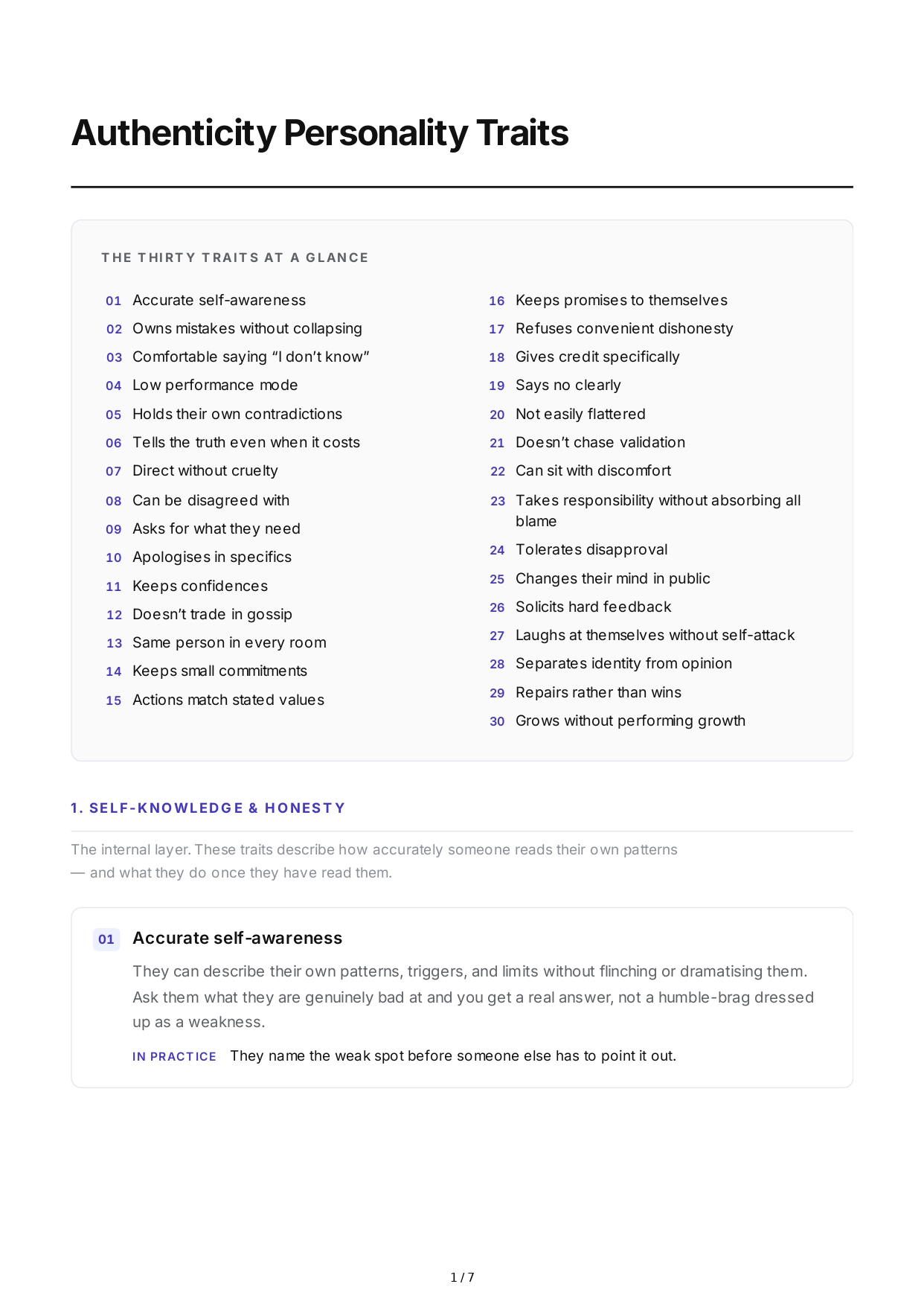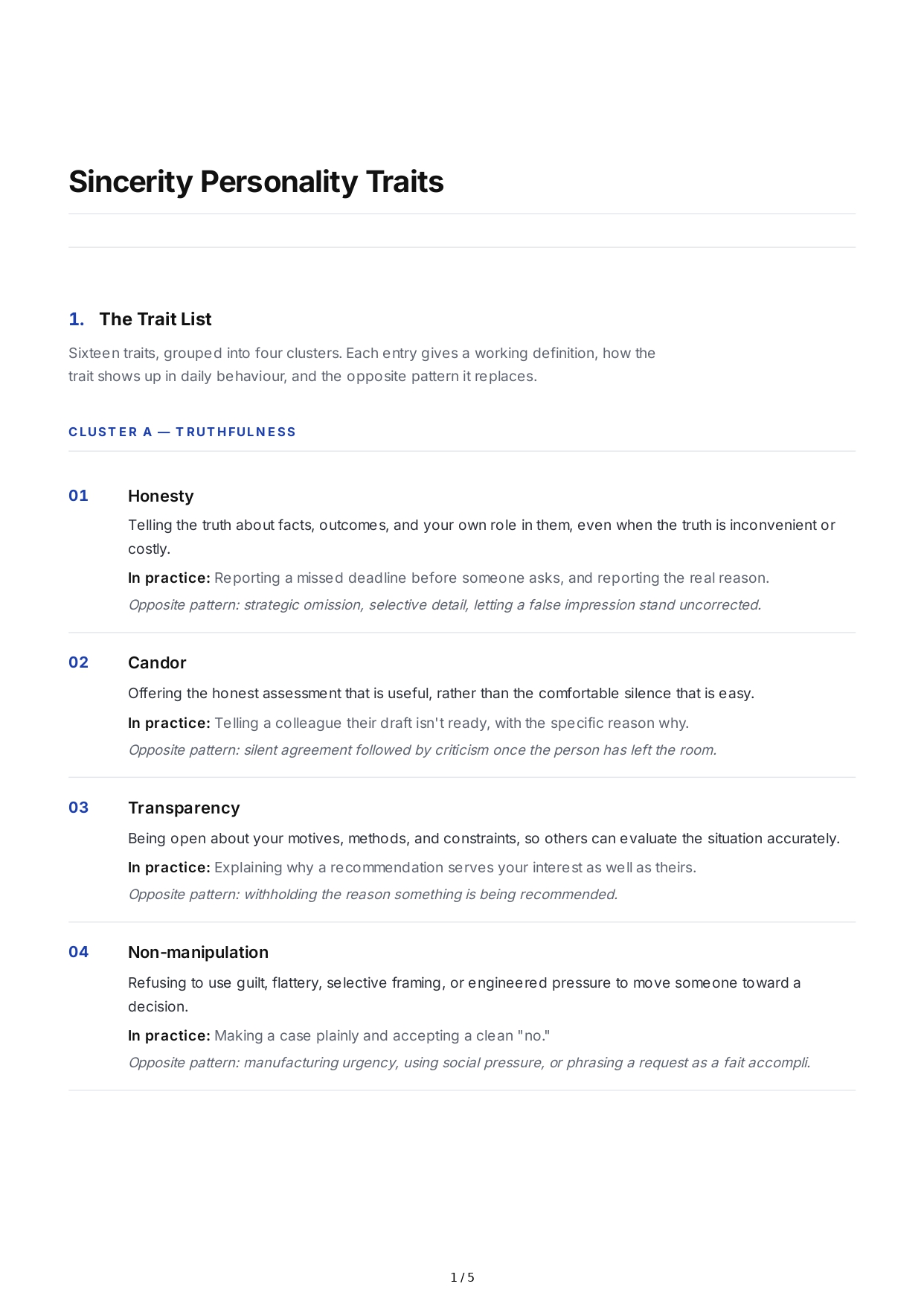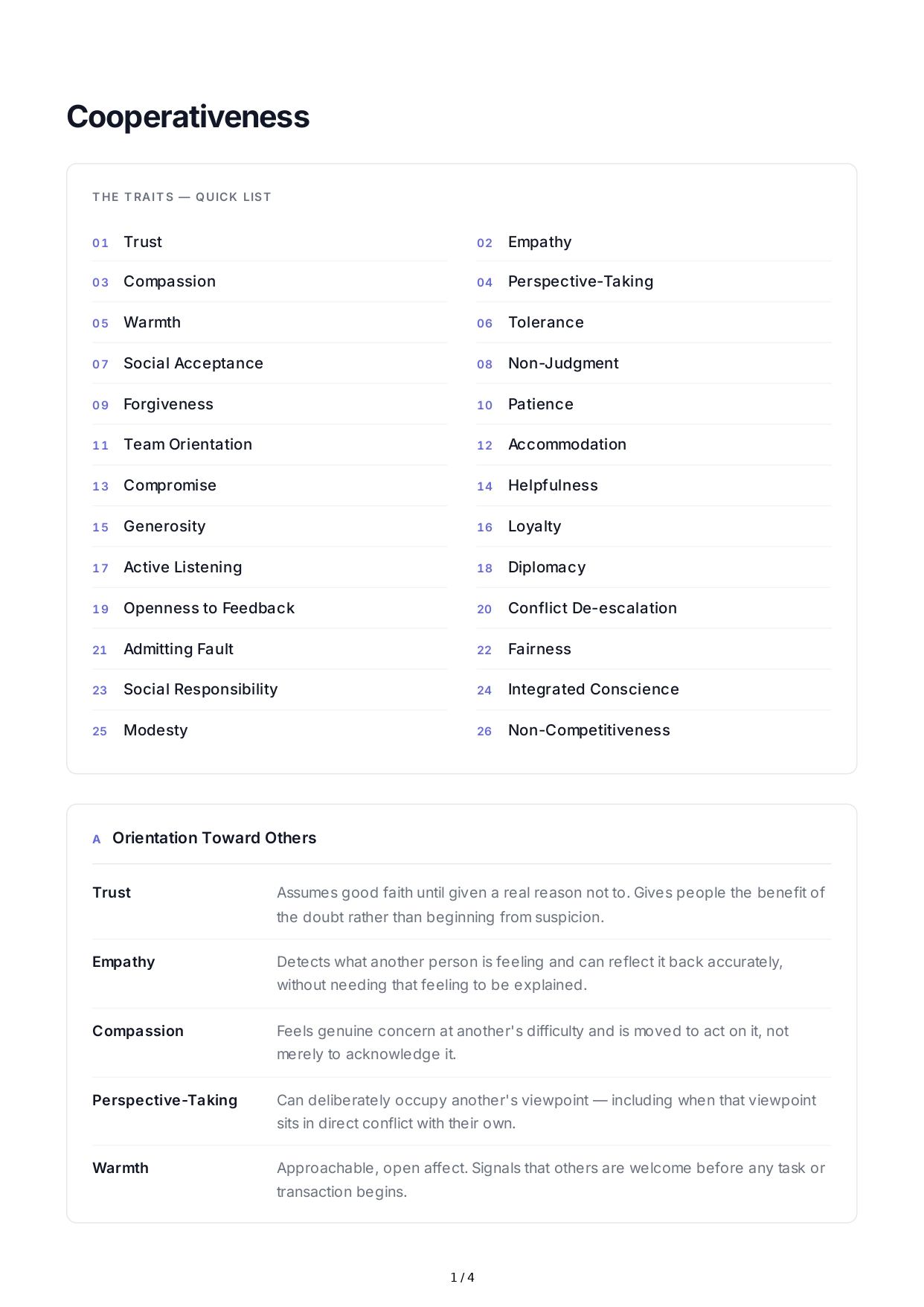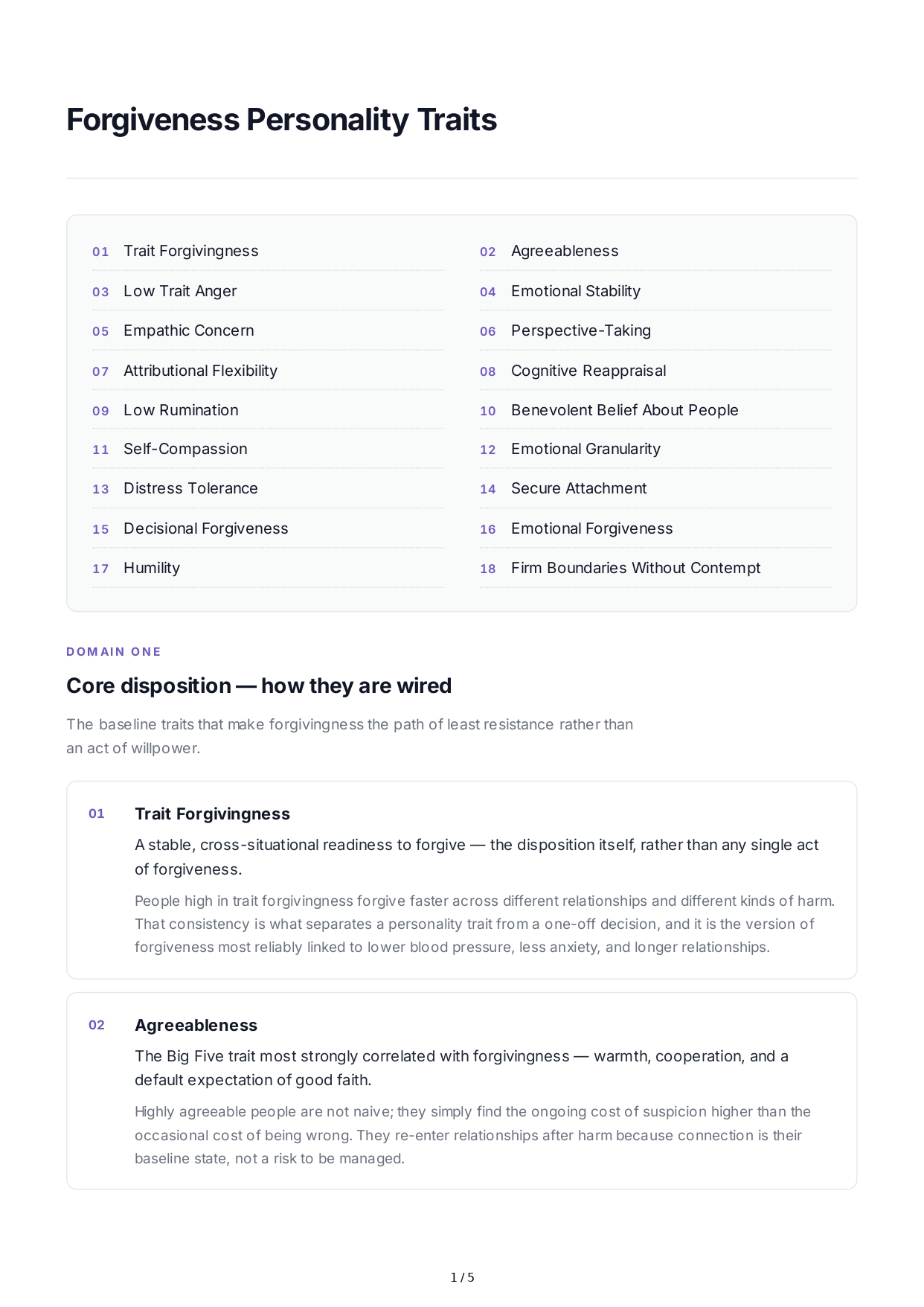
Dependability
Personality
Traits
1 / 6
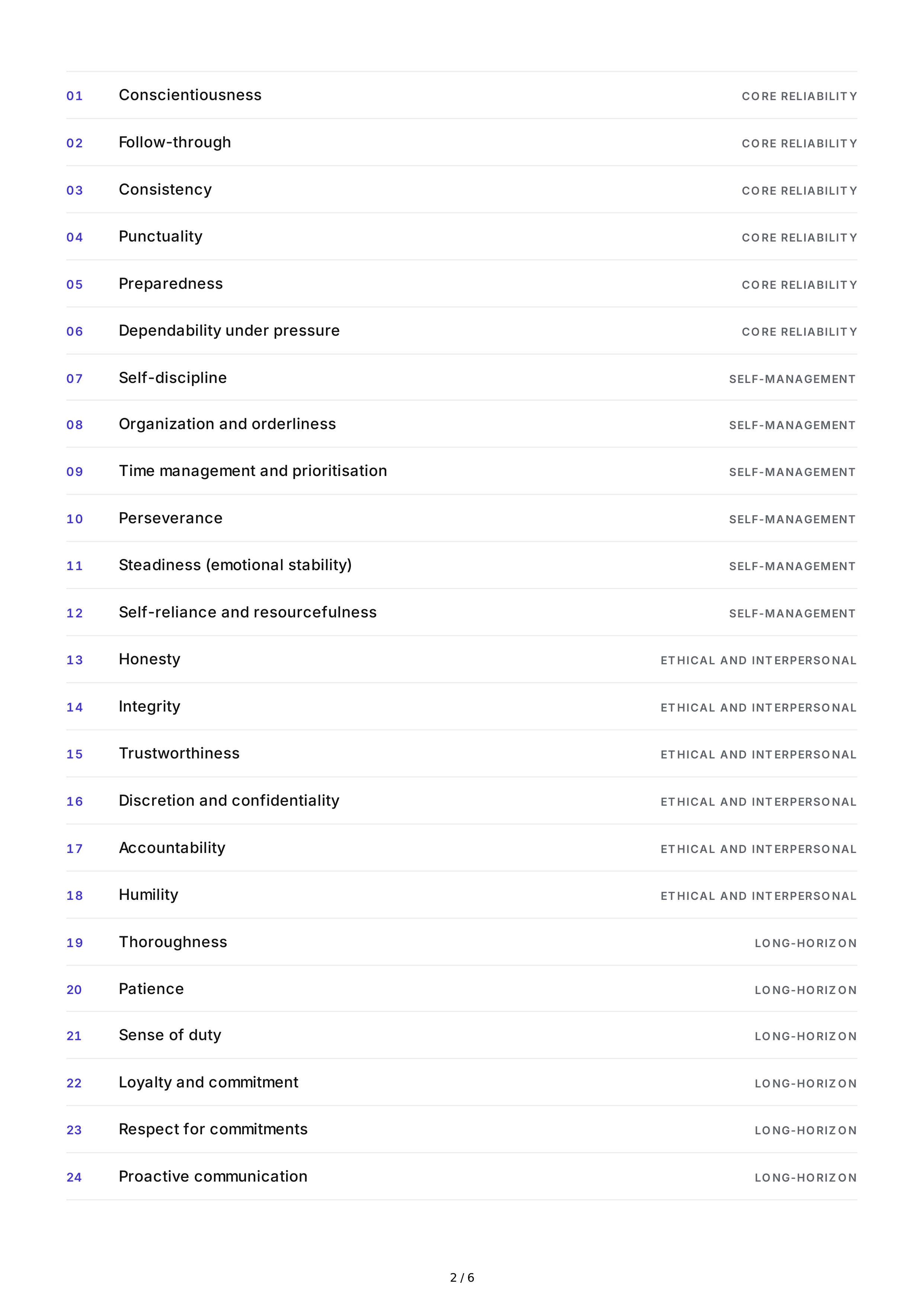
01
Conscientiousness
CO RE
RELIABILIT Y
02
Follow
-
through
CO RE
RELIABILIT Y
03
Consistency
CO RE
RELIABILIT Y
04
Punctuality
CO RE
RELIABILIT Y
05
Preparedness
CO RE
RELIABILIT Y
06
Dependability
under
pressure
CO RE
RELIABILIT Y
07
Self
-
discipline
SELF
-
MANAGEMENT
08
Organization
and
orderliness
SELF
-
MANAGEMENT
09
Time
management
and
prioritisation
SELF
-
MANAGEMENT
10
Perseverance
SELF
-
MANAGEMENT
11
Steadiness
(
emotional
stability
)
SELF
-
MANAGEMENT
12
Self
-
reliance
and
resourcefulness
SELF
-
MANAGEMENT
13
Honesty
ET HICAL
AND
INT ERPERSO NAL
14
Integrity
ET HICAL
AND
INT ERPERSO NAL
15
Trustworthiness
ET HICAL
AND
INT ERPERSO NAL
16
Discretion
and
confidentiality
ET HICAL
AND
INT ERPERSO NAL
17
Accountability
ET HICAL
AND
INT ERPERSO NAL
18
Humility
ET HICAL
AND
INT ERPERSO NAL
19
Thoroughness
LO NG
-
HO RIZ O N
20
Patience
LO NG
-
HO RIZ O N
21
Sense
of
duty
LO NG
-
HO RIZ O N
22
Loyalty
and
commitment
LO NG
-
HO RIZ O N
23
Respect
for
commitments
LO NG
-
HO RIZ O N
24
Proactive
communication
LO NG
-
HO RIZ O N
2 / 6
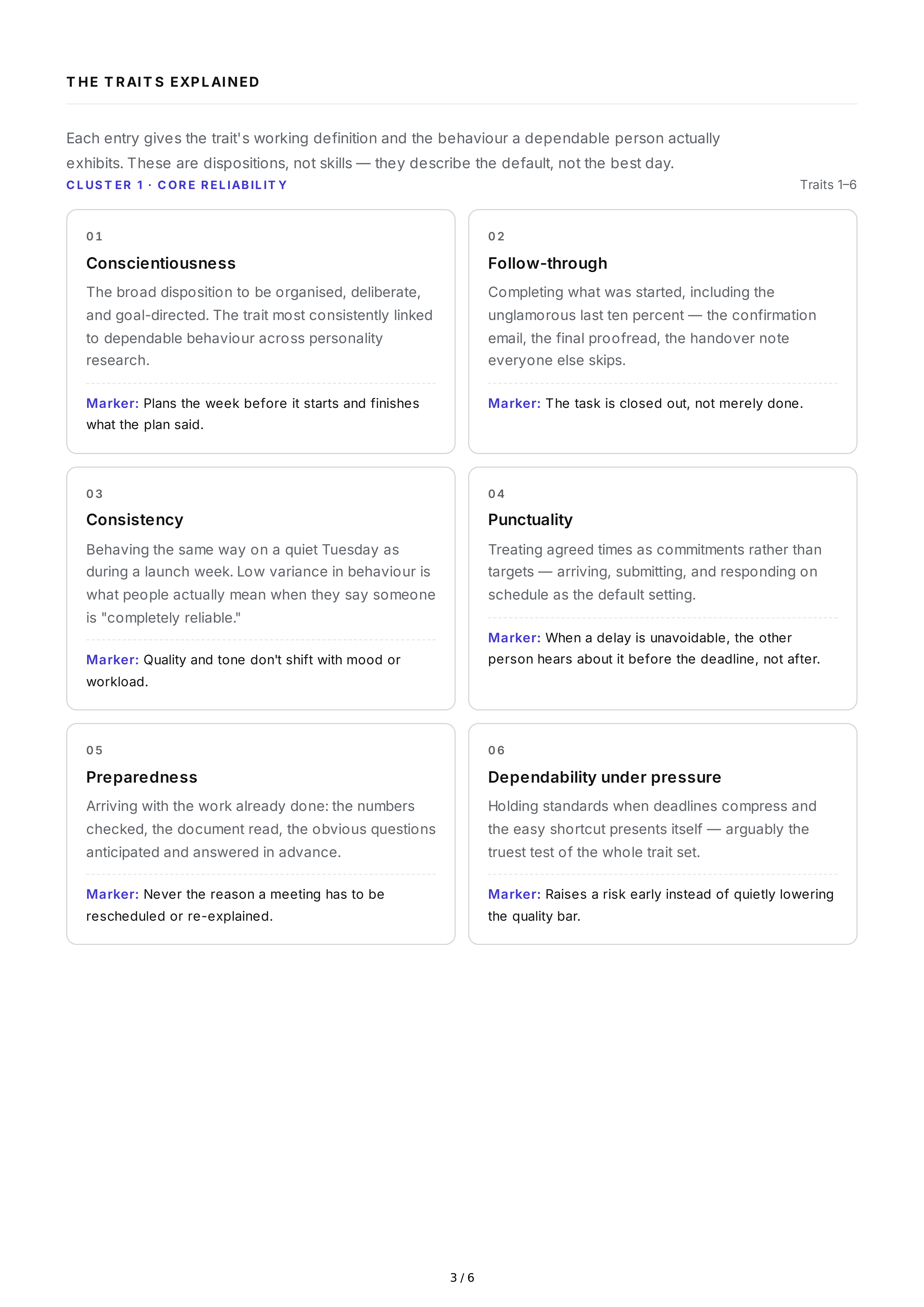
T HE
T RAIT S
EXPL AINED
Each
entry
gives
the
trait
'
s
working
definition
and
the
behaviour
a
dependable
person
actually
exhibits
.
These
are
dispositions
,
not
skills
—
they
describe
the
default
,
not
the
best
day
.
C L US T ER
1 ·
C OR E
R EL IAB IL IT Y
Traits
1–6
01
Conscientiousness
The
broad
disposition
to
be
organised
,
deliberate
,
and
goal
-
directed
.
The
trait
most
consistently
linked
to
dependable
behaviour
across
personality
research
.
Marker
:
Plans
the
week
before
it
starts
and
finishes
what
the
plan
said
.
02
Follow
-
through
Completing
what
was
started
,
including
the
unglamorous
last
ten
percent
—
the
confirmation
email
,
the
final
proofread
,
the
handover
note
everyone
else
skips
.
Marker
:
The
task
is
closed
out
,
not
merely
done
.
03
Consistency
Behaving
the
same
way
on
a
quiet
Tuesday
as
during
a
launch
week
.
Low
variance
in
behaviour
is
what
people
actually
mean
when
they
say
someone
is
"
completely
reliable
."
Marker
:
Quality
and
tone
don
'
t
shift
with
mood
or
workload
.
04
Punctuality
Treating
agreed
times
as
commitments
rather
than
targets
—
arriving
,
submitting
,
and
responding
on
schedule
as
the
default
setting
.
Marker
:
When
a
delay
is
unavoidable
,
the
other
person
hears
about
it
before
the
deadline
,
not
after
.
05
Preparedness
Arriving
with
the
work
already
done
:
the
numbers
checked
,
the
document
read
,
the
obvious
questions
anticipated
and
answered
in
advance
.
Marker
:
Never
the
reason
a
meeting
has
to
be
rescheduled
or
re
-
explained
.
06
Dependability
under
pressure
Holding
standards
when
deadlines
compress
and
the
easy
shortcut
presents
itself
—
arguably
the
truest
test
of
the
whole
trait
set
.
Marker
:
Raises
a
risk
early
instead
of
quietly
lowering
the
quality
bar
.
3 / 6
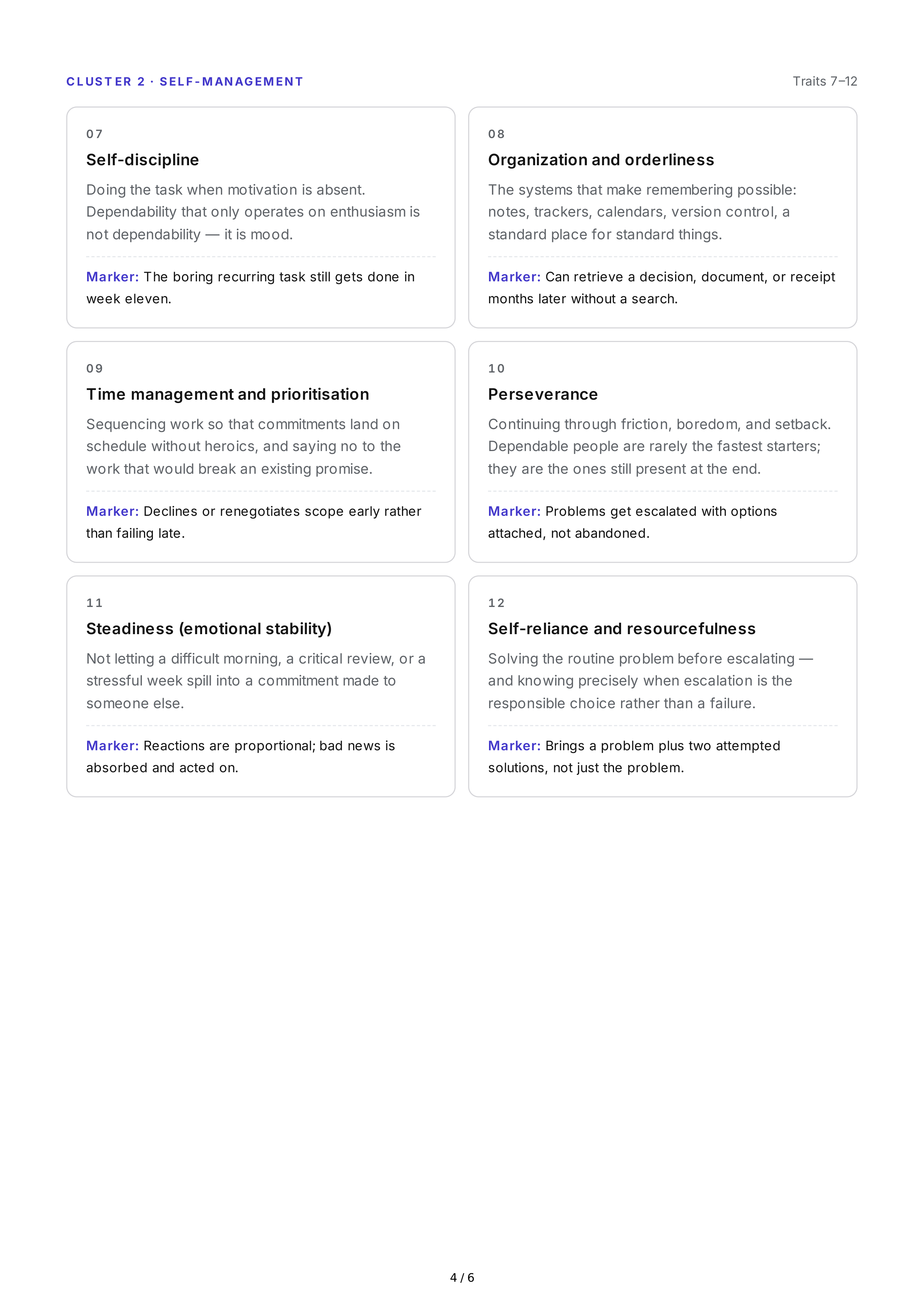
C L US T ER
2 ·
S EL F
-
M AN AG EM EN T
Traits
7–12
07
Self
-
discipline
Doing
the
task
when
motivation
is
absent
.
Dependability
that
only
operates
on
enthusiasm
is
not
dependability
—
it
is
mood
.
Marker
:
The
boring
recurring
task
still
gets
done
in
week
eleven
.
08
Organization
and
orderliness
The
systems
that
make
remembering
possible
:
notes
,
trackers
,
calendars
,
version
control
,
a
standard
place
for
standard
things
.
Marker
:
Can
retrieve
a
decision
,
document
,
or
receipt
months
later
without
a
search
.
09
Time
management
and
prioritisation
Sequencing
work
so
that
commitments
land
on
schedule
without
heroics
,
and
saying
no
to
the
work
that
would
break
an
existing
promise
.
Marker
:
Declines
or
renegotiates
scope
early
rather
than
failing
late
.
10
Perseverance
Continuing
through
friction
,
boredom
,
and
setback
.
Dependable
people
are
rarely
the
fastest
starters
;
they
are
the
ones
still
present
at
the
end
.
Marker
:
Problems
get
escalated
with
options
attached
,
not
abandoned
.
11
Steadiness
(
emotional
stability
)
Not
letting
a
difficult
morning
,
a
critical
review
,
or
a
stressful
week
spill
into
a
commitment
made
to
someone
else
.
Marker
:
Reactions
are
proportional
;
bad
news
is
absorbed
and
acted
on
.
12
Self
-
reliance
and
resourcefulness
Solving
the
routine
problem
before
escalating
—
and
knowing
precisely
when
escalation
is
the
responsible
choice
rather
than
a
failure
.
Marker
:
Brings
a
problem
plus
two
attempted
solutions
,
not
just
the
problem
.
4 / 6
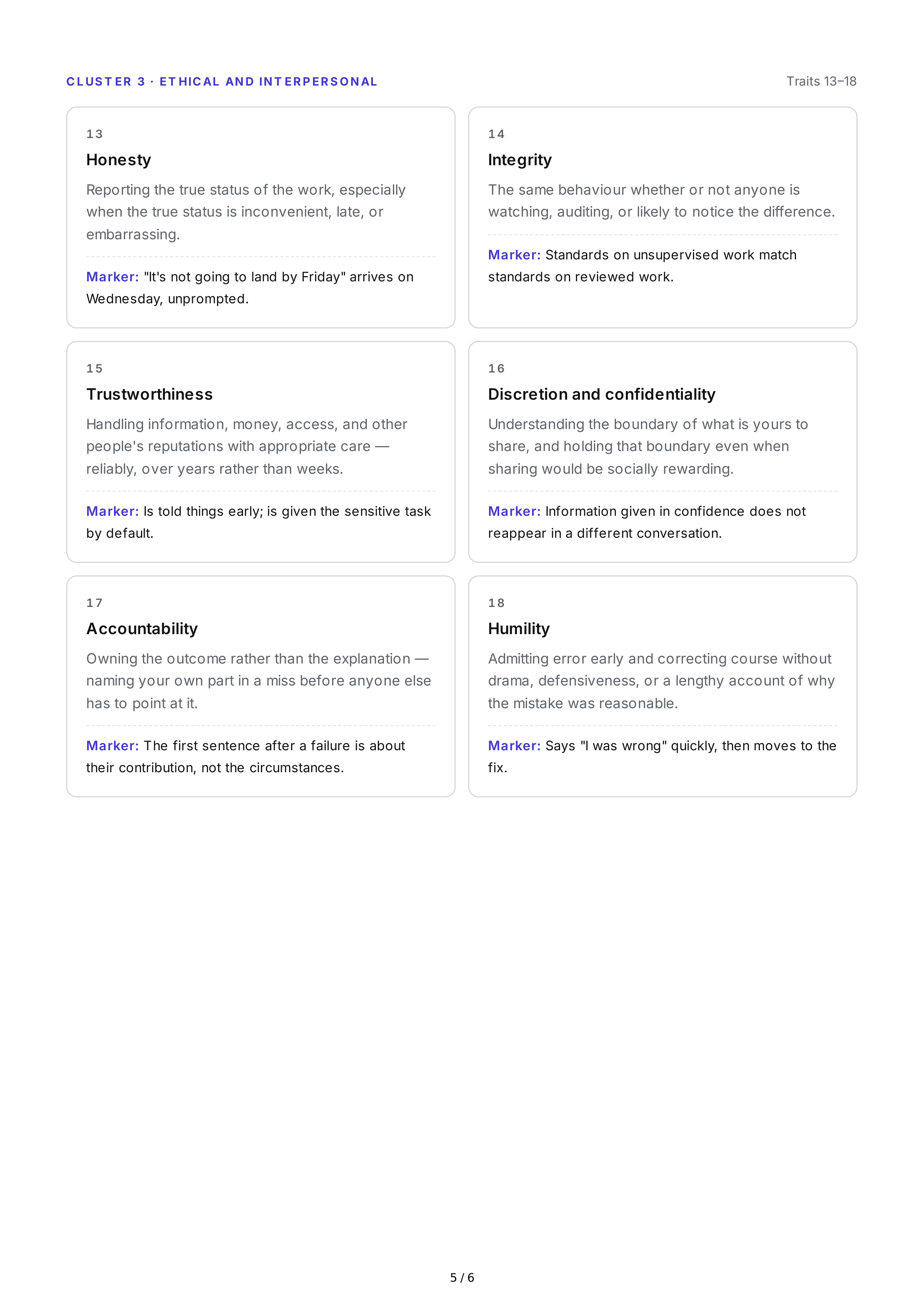
C L US T ER
3 ·
ET HIC AL
AN D
IN T ER P ER S ON AL
Traits
13–18
13
Honesty
Reporting
the
true
status
of
the
work
,
especially
when
the
true
status
is
inconvenient
,
late
,
or
embarrassing
.
Marker
:
"
It
'
s
not
going
to
land
by
Friday
"
arrives
on
Wednesday
,
unprompted
.
14
Integrity
The
same
behaviour
whether
or
not
anyone
is
watching
,
auditing
,
or
likely
to
notice
the
difference
.
Marker
:
Standards
on
unsupervised
work
match
standards
on
reviewed
work
.
15
Trustworthiness
Handling
information
,
money
,
access
,
and
other
people
'
s
reputations
with
appropriate
care
—
reliably
,
over
years
rather
than
weeks
.
Marker
:
Is
told
things
early
;
is
given
the
sensitive
task
by
default
.
16
Discretion
and
confidentiality
Understanding
the
boundary
of
what
is
yours
to
share
,
and
holding
that
boundary
even
when
sharing
would
be
socially
rewarding
.
Marker
:
Information
given
in
confidence
does
not
reappear
in
a
different
conversation
.
17
Accountability
Owning
the
outcome
rather
than
the
explanation
—
naming
your
own
part
in
a
miss
before
anyone
else
has
to
point
at
it
.
Marker
:
The
first
sentence
after
a
failure
is
about
their
contribution
,
not
the
circumstances
.
18
Humility
Admitting
error
early
and
correcting
course
without
drama
,
defensiveness
,
or
a
lengthy
account
of
why
the
mistake
was
reasonable
.
Marker
:
Says
"
I
was
wrong
"
quickly
,
then
moves
to
the
fix
.
5 / 6
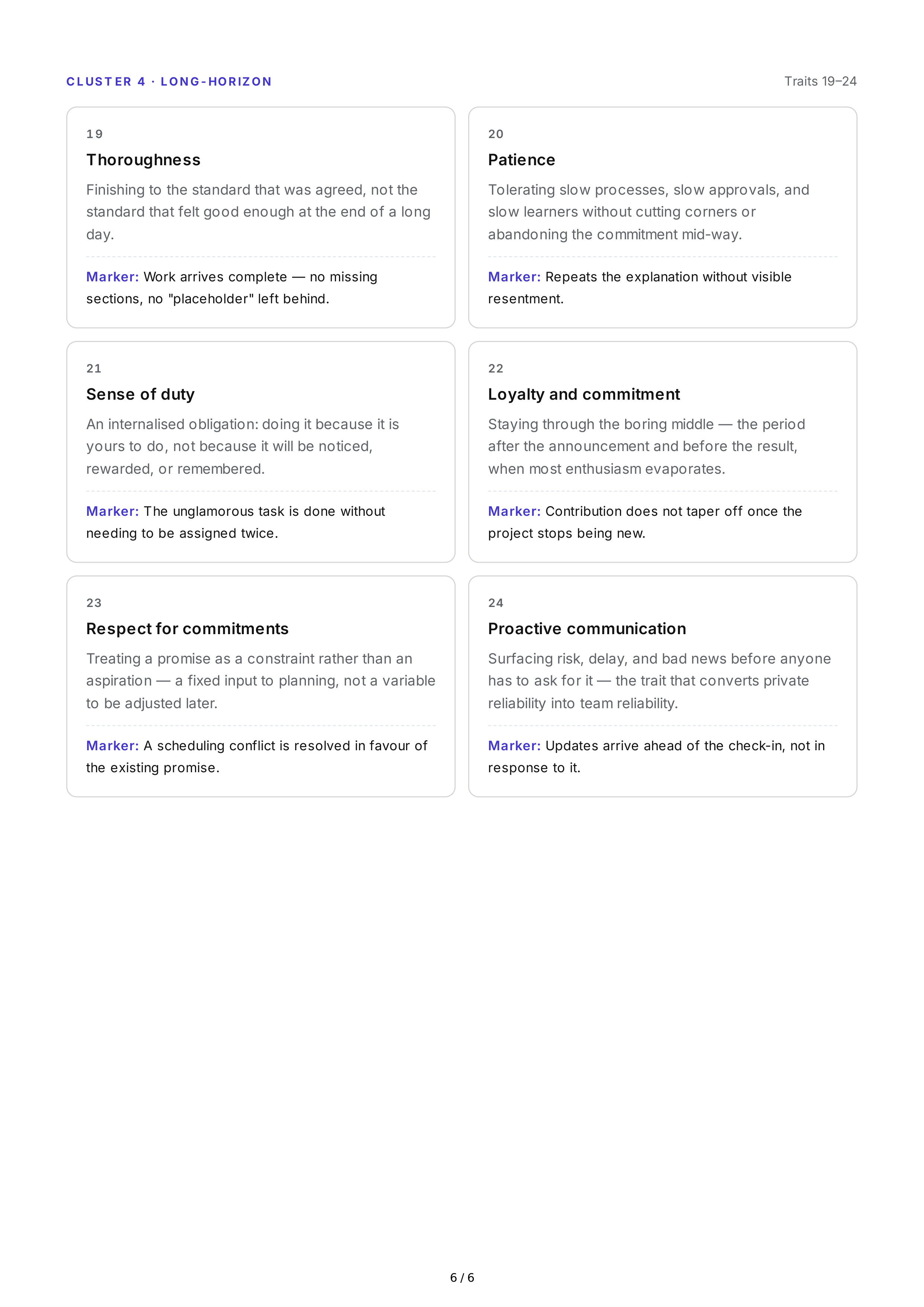
C L US T ER
4 ·
L ON G
-
HOR IZ ON
Traits
19–24
19
Thoroughness
Finishing
to
the
standard
that
was
agreed
,
not
the
standard
that
felt
good
enough
at
the
end
of
a
long
day
.
Marker
:
Work
arrives
complete
—
no
missing
sections
,
no
"
placeholder
"
left
behind
.
20
Patience
Tolerating
slow
processes
,
slow
approvals
,
and
slow
learners
without
cutting
corners
or
abandoning
the
commitment
mid
-
way
.
Marker
:
Repeats
the
explanation
without
visible
resentment
.
21
Sense
of
duty
An
internalised
obligation
:
doing
it
because
it
is
yours
to
do
,
not
because
it
will
be
noticed
,
rewarded
,
or
remembered
.
Marker
:
The
unglamorous
task
is
done
without
needing
to
be
assigned
twice
.
22
Loyalty
and
commitment
Staying
through
the
boring
middle
—
the
period
after
the
announcement
and
before
the
result
,
when
most
enthusiasm
evaporates
.
Marker
:
Contribution
does
not
taper
off
once
the
project
stops
being
new
.
23
Respect
for
commitments
Treating
a
promise
as
a
constraint
rather
than
an
aspiration
—
a
fixed
input
to
planning
,
not
a
variable
to
be
adjusted
later
.
Marker
:
A
scheduling
conflict
is
resolved
in
favour
of
the
existing
promise
.
24
Proactive
communication
Surfacing
risk
,
delay
,
and
bad
news
before
anyone
has
to
ask
for
it
—
the
trait
that
converts
private
reliability
into
team
reliability
.
Marker
:
Updates
arrive
ahead
of
the
check
-
in
,
not
in
response
to
it
.
6 / 6