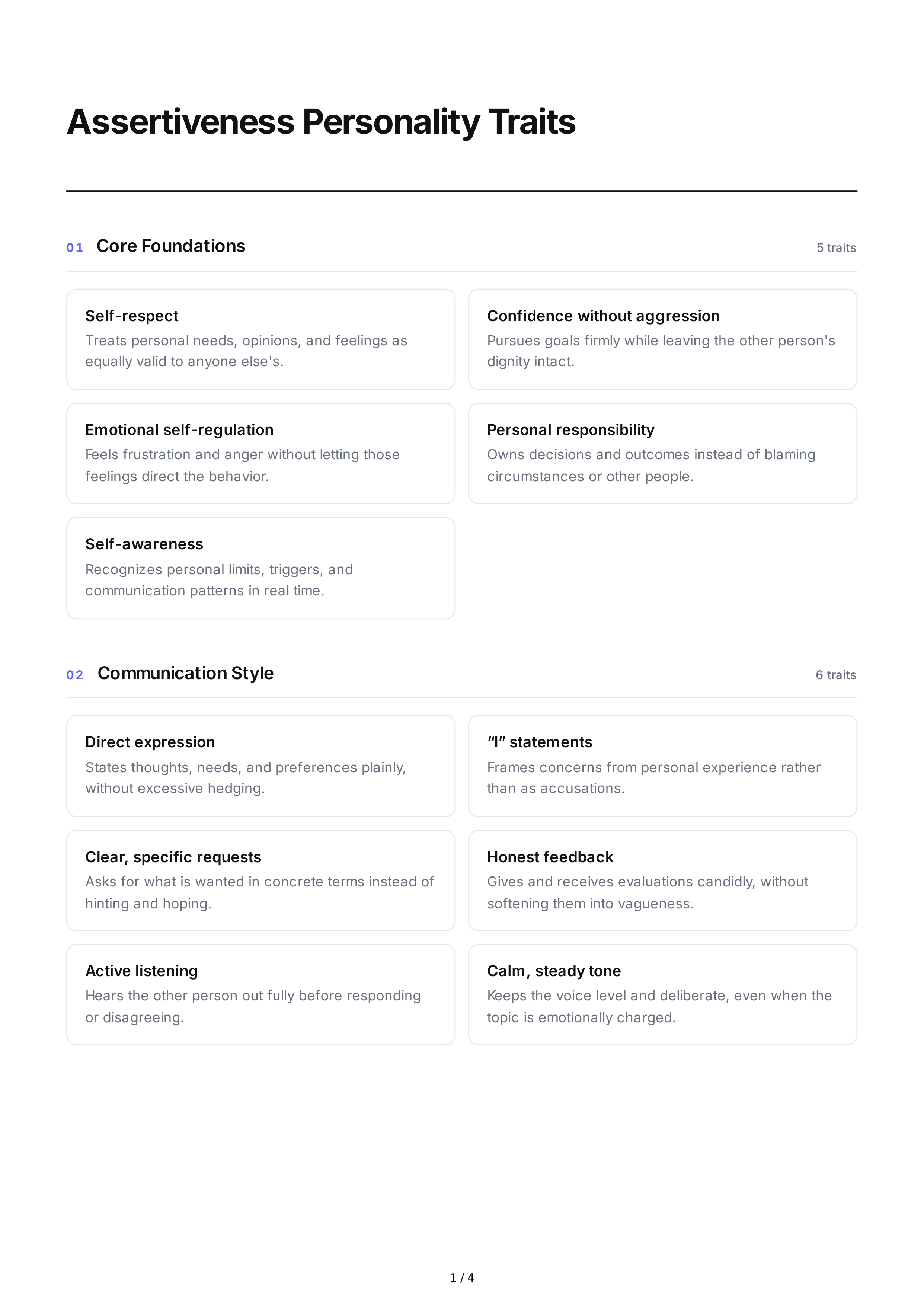
Assertiveness
Personality
Traits
01
Core
Foundations
5
traits
Self
-
respect
Treats
personal
needs
,
opinions
,
and
feelings
as
equally
valid
to
anyone
else
'
s
.
Confidence
without
aggression
Pursues
goals
firmly
while
leaving
the
other
person
'
s
dignity
intact
.
Emotional
self
-
regulation
Feels
frustration
and
anger
without
letting
those
feelings
direct
the
behavior
.
Personal
responsibility
Owns
decisions
and
outcomes
instead
of
blaming
circumstances
or
other
people
.
Self
-
awareness
Recognizes
personal
limits
,
triggers
,
and
communication
patterns
in
real
time
.
02
Communication
Style
6
traits
Direct
expression
States
thoughts
,
needs
,
and
preferences
plainly
,
without
excessive
hedging
.
“
I
”
statements
Frames
concerns
from
personal
experience
rather
than
as
accusations
.
Clear
,
specific
requests
Asks
for
what
is
wanted
in
concrete
terms
instead
of
hinting
and
hoping
.
Honest
feedback
Gives
and
receives
evaluations
candidly
,
without
softening
them
into
vagueness
.
Active
listening
Hears
the
other
person
out
fully
before
responding
or
disagreeing
.
Calm
,
steady
tone
Keeps
the
voice
level
and
deliberate
,
even
when
the
topic
is
emotionally
charged
.
1 / 4
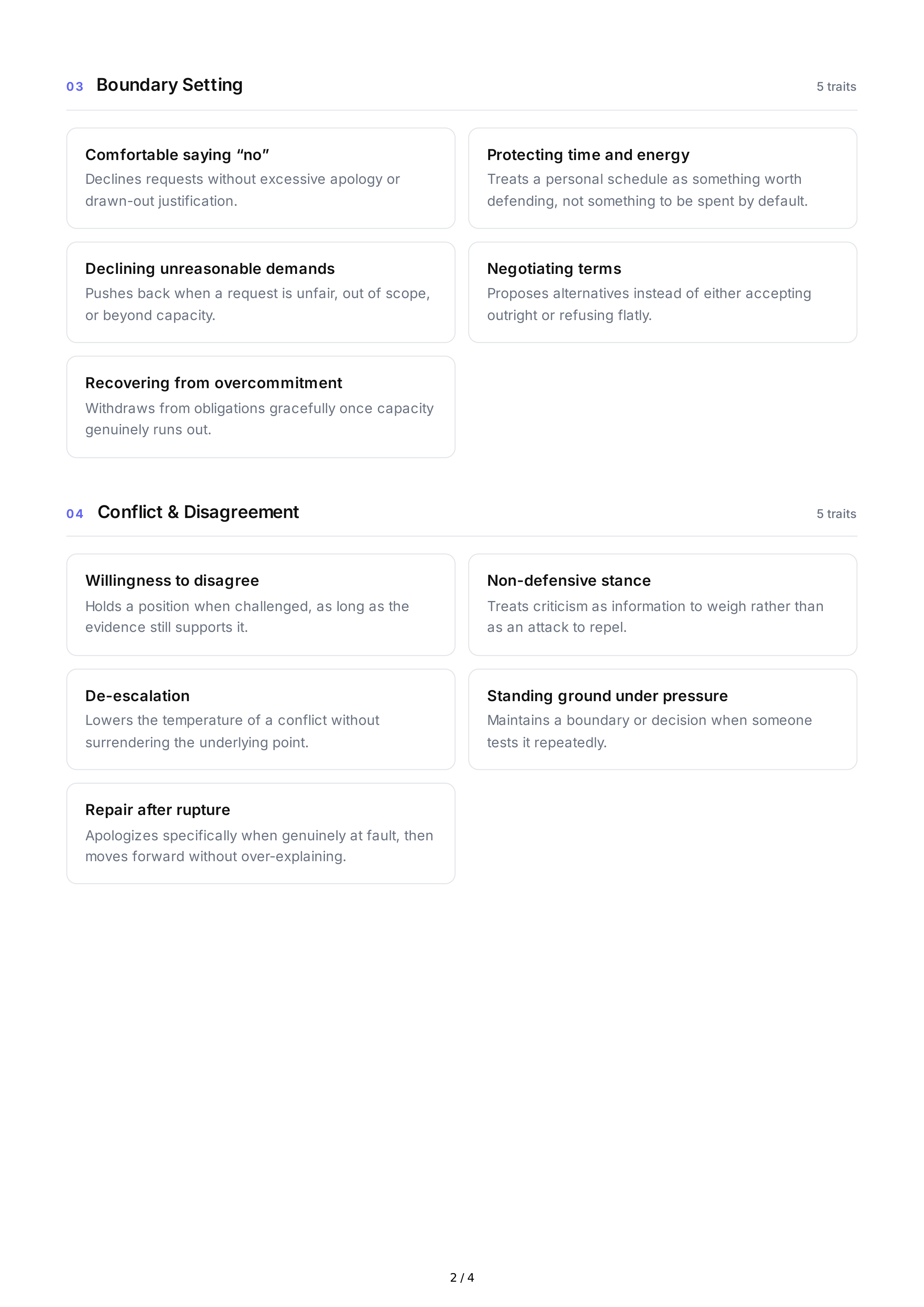
03
Boundary
Setting
5
traits
Comfortable
saying
“
no
”
Declines
requests
without
excessive
apology
or
drawn
-
out
justification
.
Protecting
time
and
energy
Treats
a
personal
schedule
as
something
worth
defending
,
not
something
to
be
spent
by
default
.
Declining
unreasonable
demands
Pushes
back
when
a
request
is
unfair
,
out
of
scope
,
or
beyond
capacity
.
Negotiating
terms
Proposes
alternatives
instead
of
either
accepting
outright
or
refusing
flatly
.
Recovering
from
overcommitment
Withdraws
from
obligations
gracefully
once
capacity
genuinely
runs
out
.
04
Conflict
&
Disagreement
5
traits
Willingness
to
disagree
Holds
a
position
when
challenged
,
as
long
as
the
evidence
still
supports
it
.
Non
-
defensive
stance
Treats
criticism
as
information
to
weigh
rather
than
as
an
attack
to
repel
.
De
-
escalation
Lowers
the
temperature
of
a
conflict
without
surrendering
the
underlying
point
.
Standing
ground
under
pressure
Maintains
a
boundary
or
decision
when
someone
tests
it
repeatedly
.
Repair
after
rupture
Apologizes
specifically
when
genuinely
at
fault
,
then
moves
forward
without
over
-
explaining
.
2 / 4
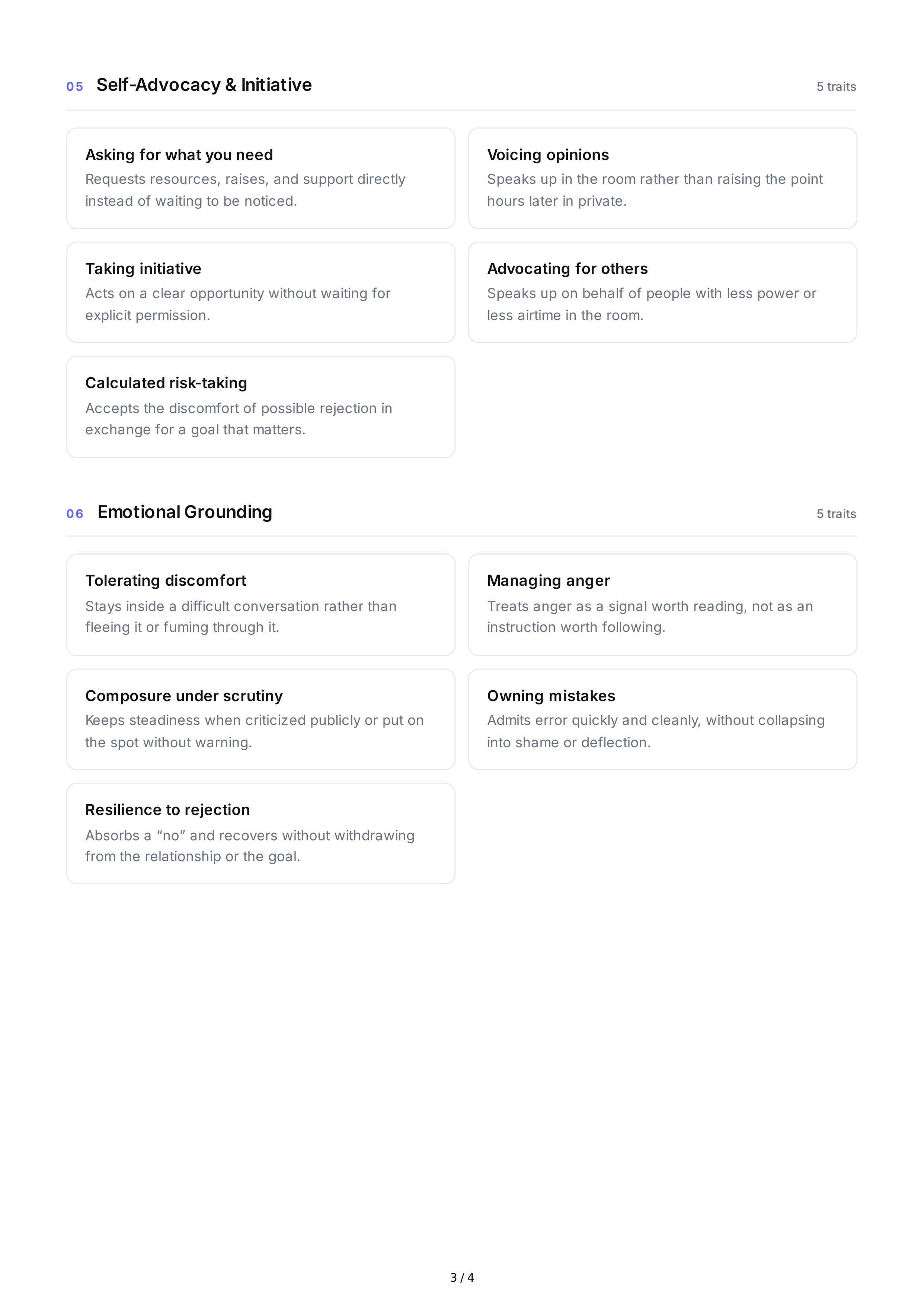
05
Self
-
Advocacy
&
Initiative
5
traits
Asking
for
what
you
need
Requests
resources
,
raises
,
and
support
directly
instead
of
waiting
to
be
noticed
.
Voicing
opinions
Speaks
up
in
the
room
rather
than
raising
the
point
hours
later
in
private
.
Taking
initiative
Acts
on
a
clear
opportunity
without
waiting
for
explicit
permission
.
Advocating
for
others
Speaks
up
on
behalf
of
people
with
less
power
or
less
airtime
in
the
room
.
Calculated
risk
-
taking
Accepts
the
discomfort
of
possible
rejection
in
exchange
for
a
goal
that
matters
.
06
Emotional
Grounding
5
traits
Tolerating
discomfort
Stays
inside
a
difficult
conversation
rather
than
fleeing
it
or
fuming
through
it
.
Managing
anger
Treats
anger
as
a
signal
worth
reading
,
not
as
an
instruction
worth
following
.
Composure
under
scrutiny
Keeps
steadiness
when
criticized
publicly
or
put
on
the
spot
without
warning
.
Owning
mistakes
Admits
error
quickly
and
cleanly
,
without
collapsing
into
shame
or
deflection
.
Resilience
to
rejection
Absorbs
a
“
no
”
and
recovers
without
withdrawing
from
the
relationship
or
the
goal
.
3 / 4
07
Presence
&
Body
Language
5
traits
Steady
eye
contact
Meets
the
other
person
'
s
gaze
naturally
,
without
staring
or
looking
away
.
Open
posture
Relaxed
shoulders
,
uncrossed
arms
,
and
a
grounded
,
unhurried
stance
.
Appropriate
volume
and
pace
Speaks
neither
too
quietly
to
be
heard
nor
loudly
enough
to
dominate
the
room
.
Physical
calm
Minimal
nervous
fidgeting
;
breathing
stays
controlled
when
the
stakes
rise
.
Space
-
taking
Occupies
the
room
without
apology
,
asking
for
the
room
rather
than
shrinking
into
it
.
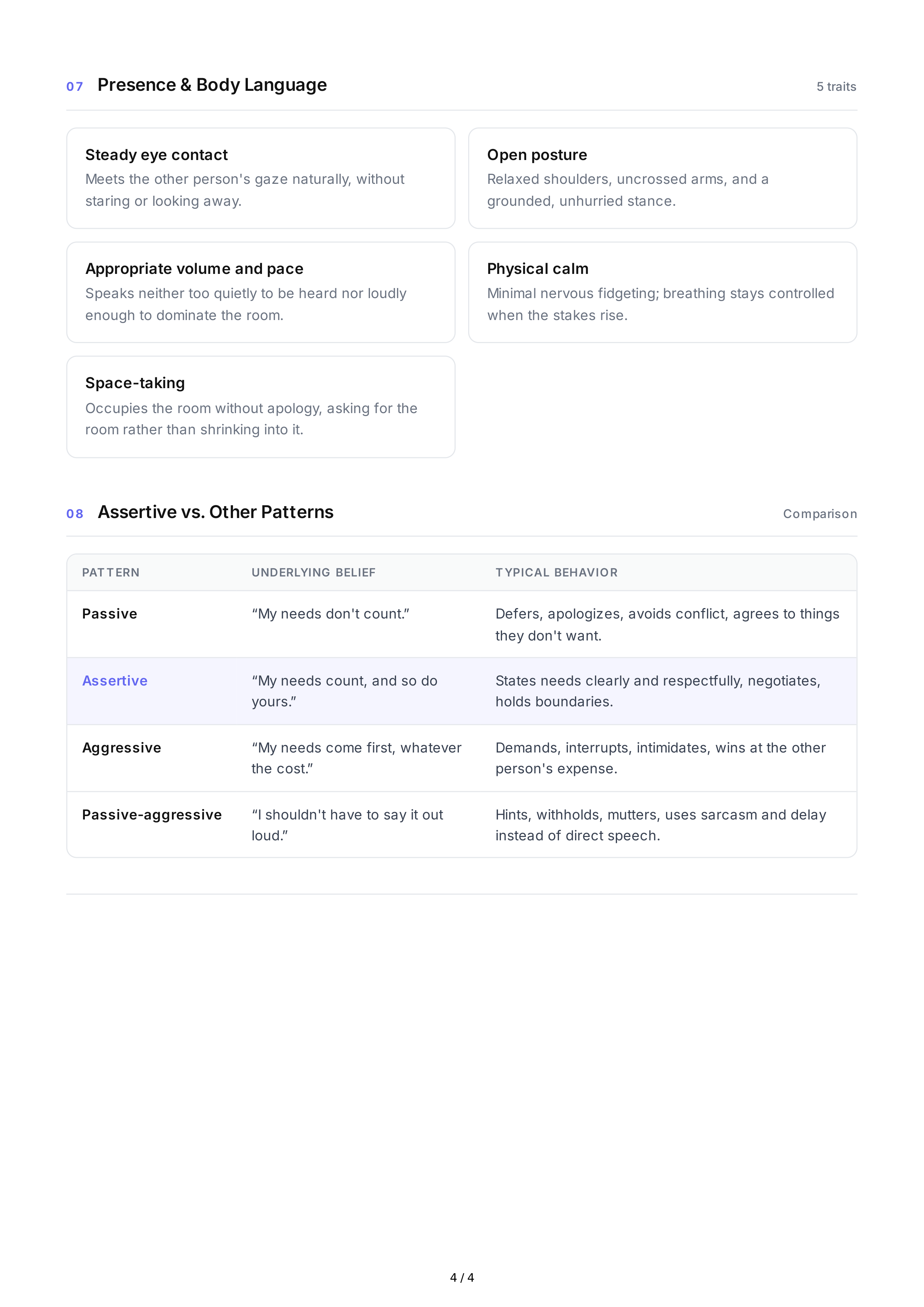
08
Assertive
vs
.
Other
Patterns
Comparison
PATTERN
UNDERLYING
BELIEF
TYPICAL
BEHAVIOR
Passive
“
My
needs
don
'
t
count
.”
Defers
,
apologizes
,
avoids
conflict
,
agrees
to
things
they
don
'
t
want
.
Assertive
“
My
needs
count
,
and
so
do
yours
.”
States
needs
clearly
and
respectfully
,
negotiates
,
holds
boundaries
.
Aggressive
“
My
needs
come
first
,
whatever
the
cost
.”
Demands
,
interrupts
,
intimidates
,
wins
at
the
other
person
'
s
expense
.
Passive
-
aggressive
“
I
shouldn
'
t
have
to
say
it
out
loud
.”
Hints
,
withholds
,
mutters
,
uses
sarcasm
and
delay
instead
of
direct
speech
.
4 / 4