Flexibility
Personality
Traits
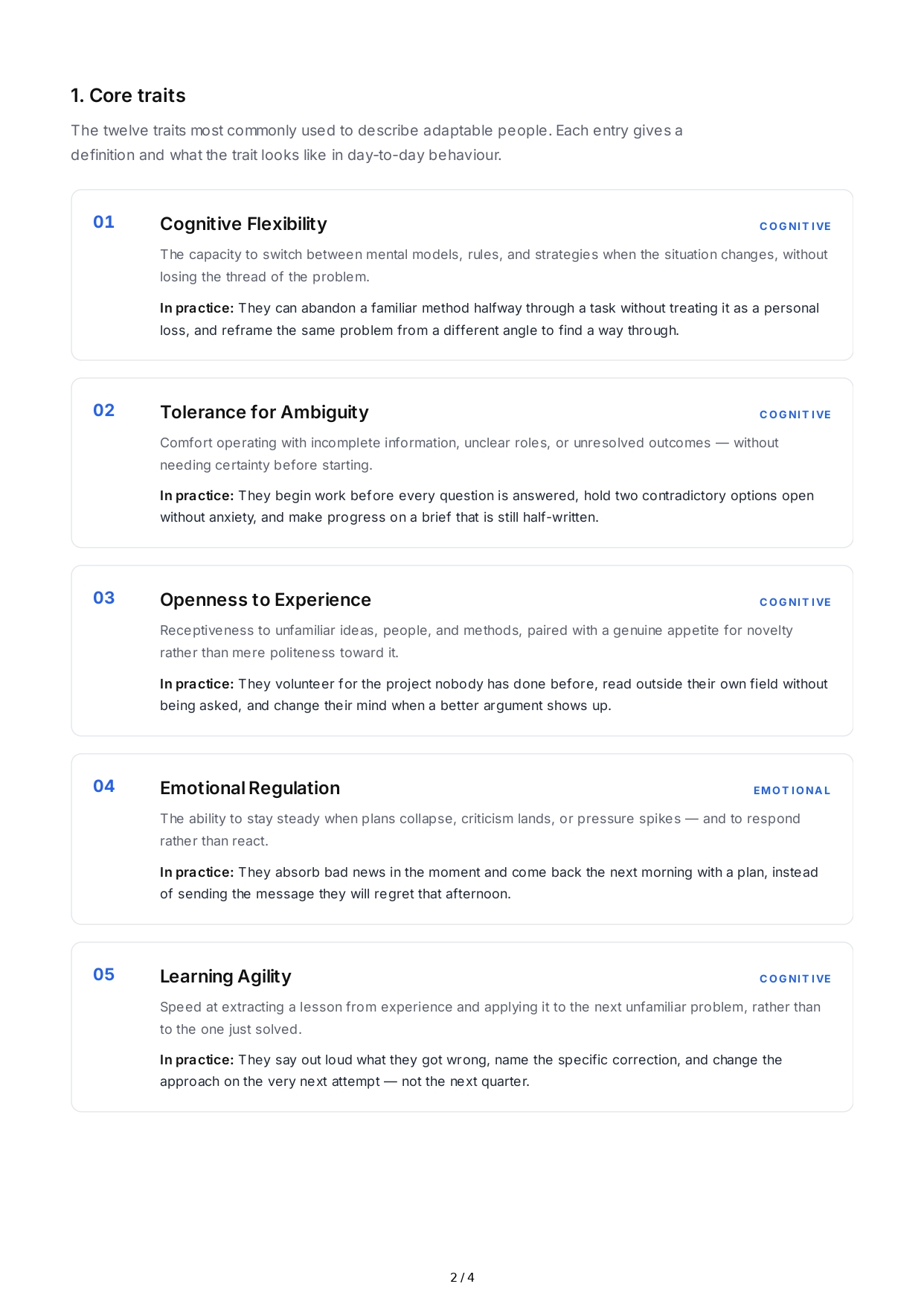
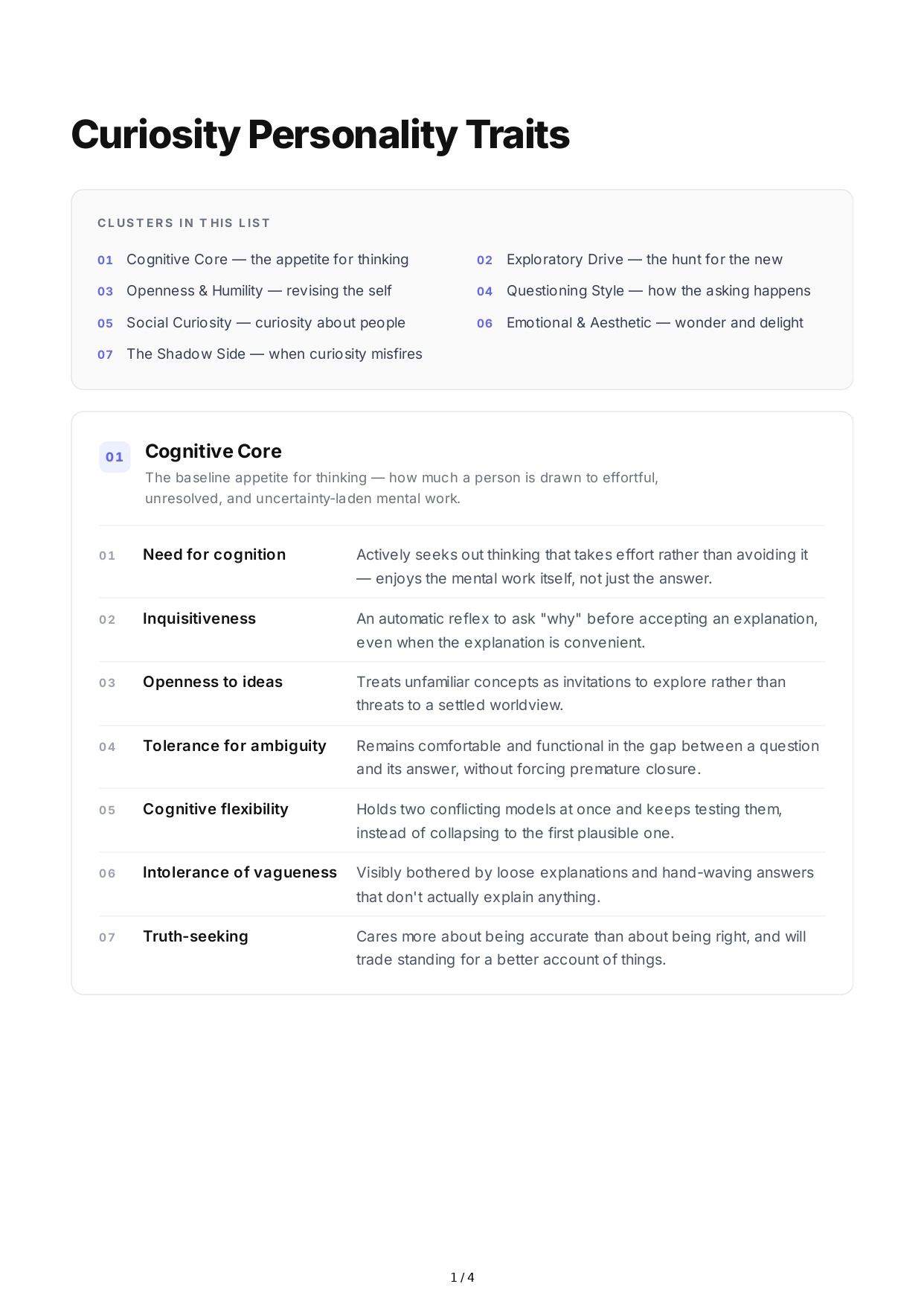
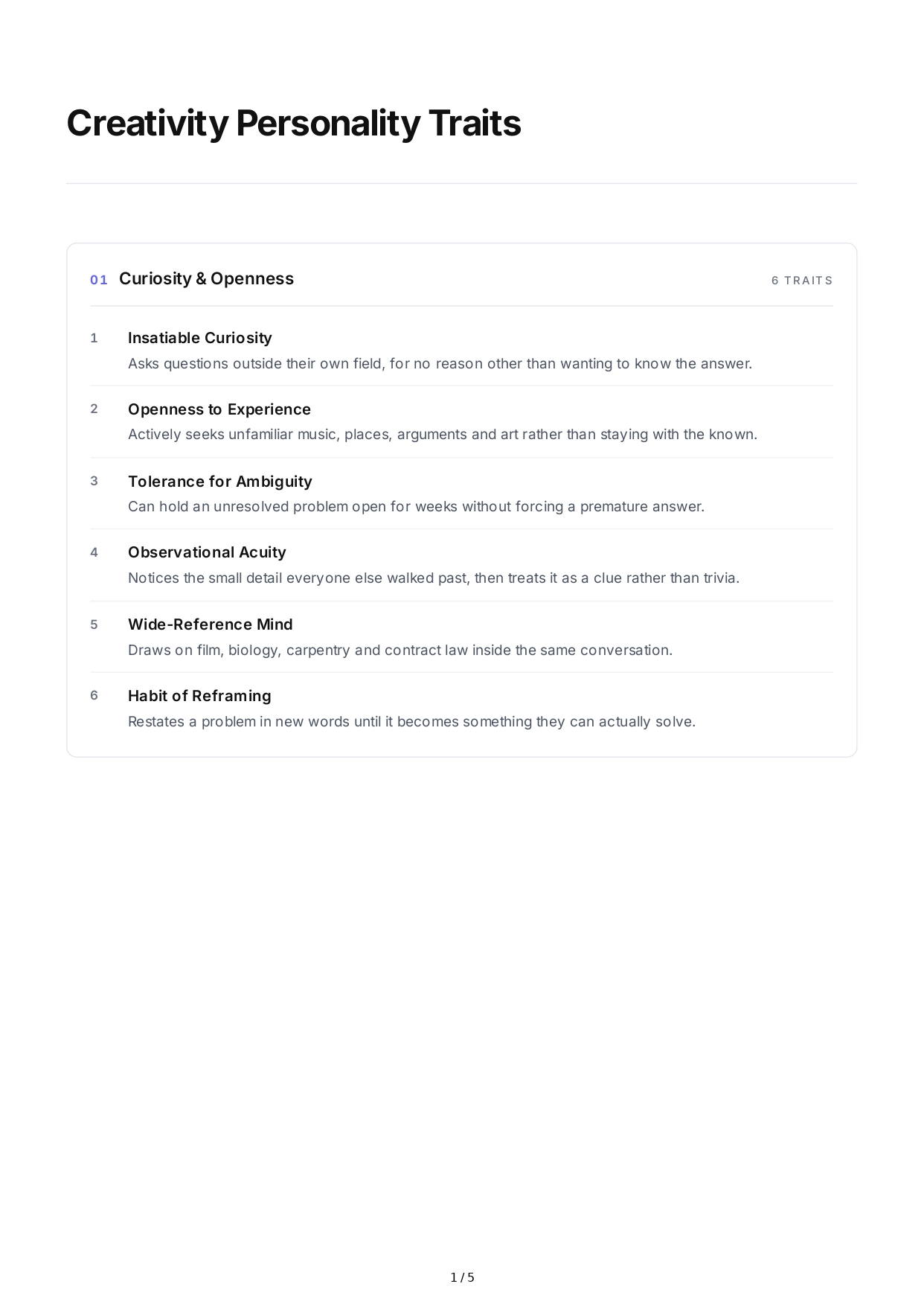
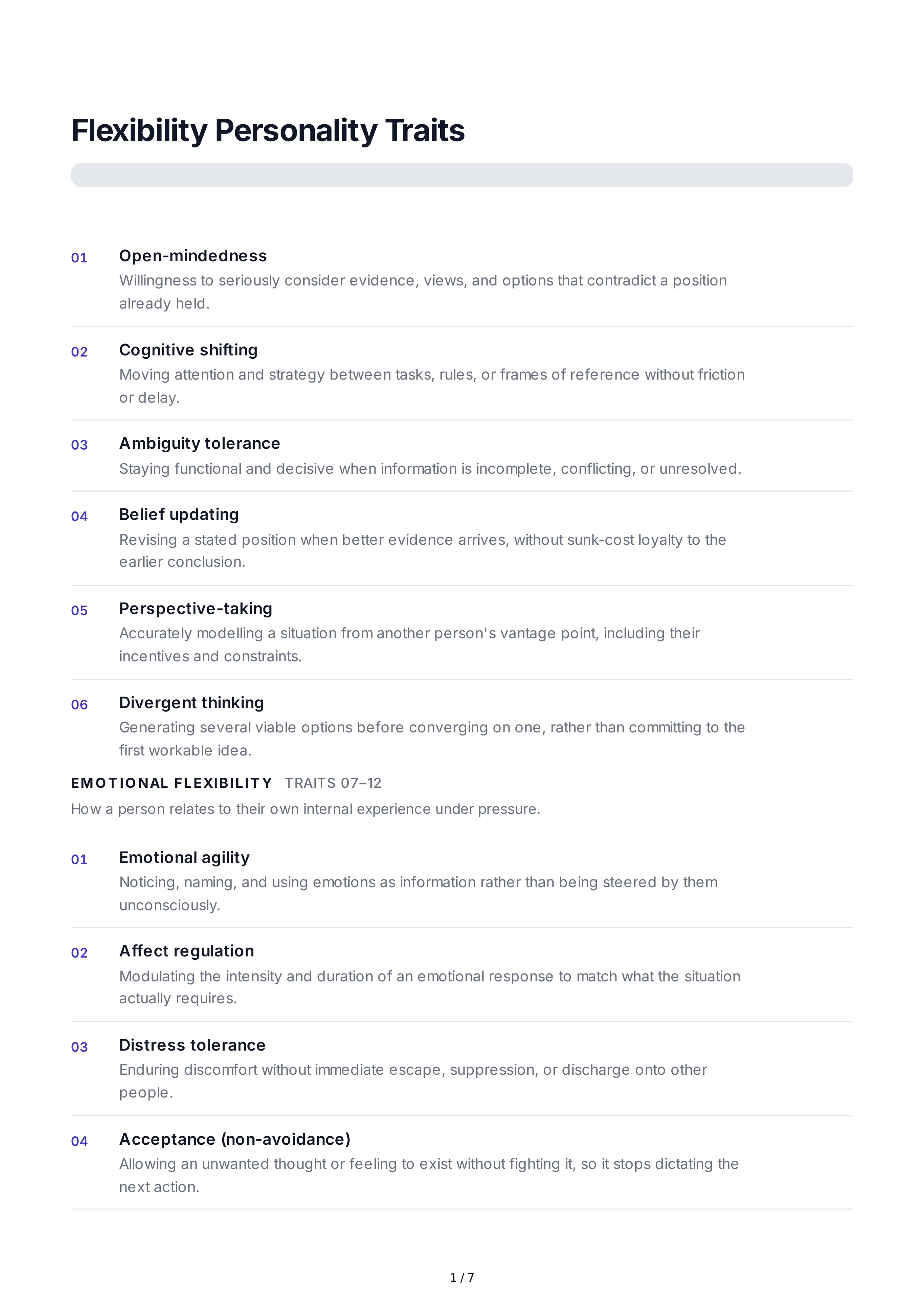
01
Open
-
mindedness
Willingness
to
seriously
consider
evidence
,
views
,
and
options
that
contradict
a
position
already
held
.
02
Cognitive
shifting
Moving
attention
and
strategy
between
tasks
,
rules
,
or
frames
of
reference
without
friction
or
delay
.
03
Ambiguity
tolerance
Staying
functional
and
decisive
when
information
is
incomplete
,
conflicting
,
or
unresolved
.
04
Belief
updating
Revising
a
stated
position
when
better
evidence
arrives
,
without
sunk
-
cost
loyalty
to
the
earlier
conclusion
.
05
Perspective
-
taking
Accurately
modelling
a
situation
from
another
person
'
s
vantage
point
,
including
their
incentives
and
constraints
.
06
Divergent
thinking
Generating
several
viable
options
before
converging
on
one
,
rather
than
committing
to
the
first
workable
idea
.
EMO T IO NAL
FLEXIBILIT Y
TRAITS
07–12
How
a
person
relates
to
their
own
internal
experience
under
pressure
.
01
Emotional
agility
Noticing
,
naming
,
and
using
emotions
as
information
rather
than
being
steered
by
them
unconsciously
.
02
Affect
regulation
Modulating
the
intensity
and
duration
of
an
emotional
response
to
match
what
the
situation
actually
requires
.
03
Distress
tolerance
Enduring
discomfort
without
immediate
escape
,
suppression
,
or
discharge
onto
other
people
.
04
Acceptance
(
non
-
avoidance
)
Allowing
an
unwanted
thought
or
feeling
to
exist
without
fighting
it
,
so
it
stops
dictating
the
next
action
.
1 / 7
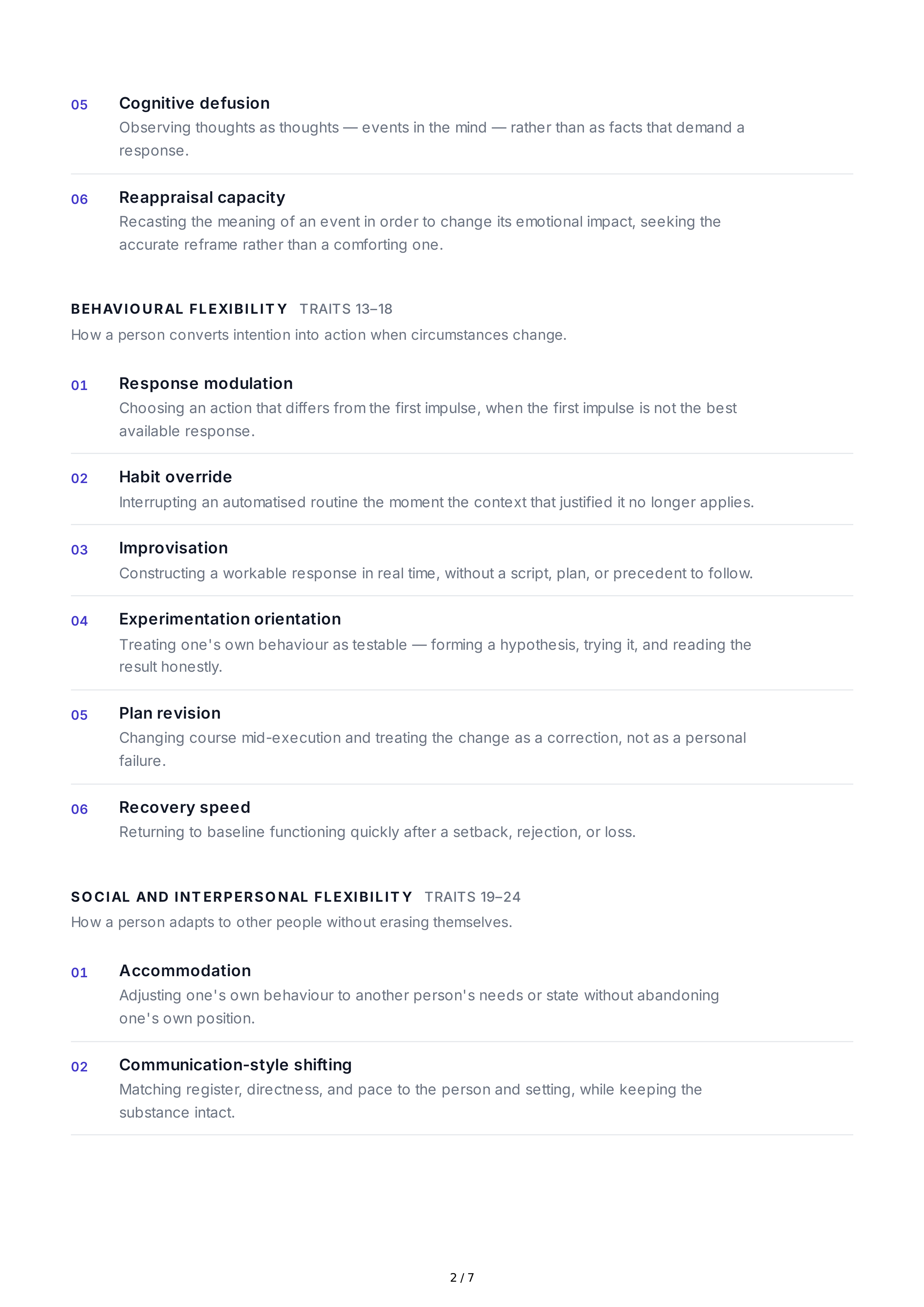
05
Cognitive
defusion
Observing
thoughts
as
thoughts
—
events
in
the
mind
—
rather
than
as
facts
that
demand
a
response
.
06
Reappraisal
capacity
Recasting
the
meaning
of
an
event
in
order
to
change
its
emotional
impact
,
seeking
the
accurate
reframe
rather
than
a
comforting
one
.
BEHAVIO URAL
FLEXIBILIT Y
TRAITS
13–18
How
a
person
converts
intention
into
action
when
circumstances
change
.
01
Response
modulation
Choosing
an
action
that
differs
from
the
first
impulse
,
when
the
first
impulse
is
not
the
best
available
response
.
02
Habit
override
Interrupting
an
automatised
routine
the
moment
the
context
that
justified
it
no
longer
applies
.
03
Improvisation
Constructing
a
workable
response
in
real
time
,
without
a
script
,
plan
,
or
precedent
to
follow
.
04
Experimentation
orientation
Treating
one
'
s
own
behaviour
as
testable
—
forming
a
hypothesis
,
trying
it
,
and
reading
the
result
honestly
.
05
Plan
revision
Changing
course
mid
-
execution
and
treating
the
change
as
a
correction
,
not
as
a
personal
failure
.
06
Recovery
speed
Returning
to
baseline
functioning
quickly
after
a
setback
,
rejection
,
or
loss
.
SO CIAL
AND
INT ERPERSO NAL
FLEXIBILIT Y
TRAITS
19–24
How
a
person
adapts
to
other
people
without
erasing
themselves
.
01
Accommodation
Adjusting
one
'
s
own
behaviour
to
another
person
'
s
needs
or
state
without
abandoning
one
'
s
own
position
.
02
Communication
-
style
shifting
Matching
register
,
directness
,
and
pace
to
the
person
and
setting
,
while
keeping
the
substance
intact
.
2 / 7
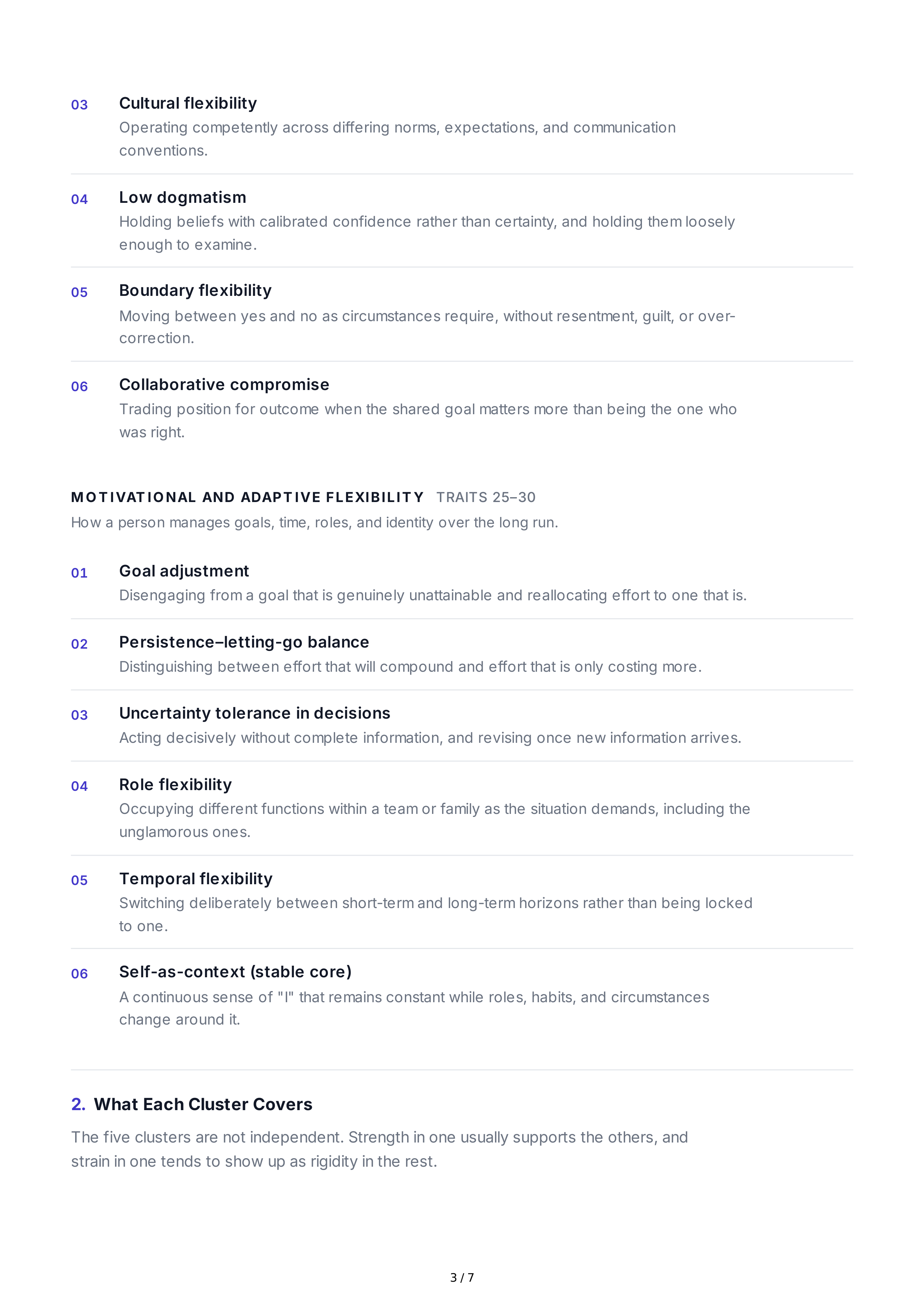
03
Cultural
flexibility
Operating
competently
across
differing
norms
,
expectations
,
and
communication
conventions
.
04
Low
dogmatism
Holding
beliefs
with
calibrated
confidence
rather
than
certainty
,
and
holding
them
loosely
enough
to
examine
.
05
Boundary
flexibility
Moving
between
yes
and
no
as
circumstances
require
,
without
resentment
,
guilt
,
or
over
-
correction
.
06
Collaborative
compromise
Trading
position
for
outcome
when
the
shared
goal
matters
more
than
being
the
one
who
was
right
.
MO T IVAT IO NAL
AND
ADAPT IVE
FLEXIBILIT Y
TRAITS
25–30
How
a
person
manages
goals
,
time
,
roles
,
and
identity
over
the
long
run
.
01
Goal
adjustment
Disengaging
from
a
goal
that
is
genuinely
unattainable
and
reallocating
effort
to
one
that
is
.
02
Persistence
–
letting
-
go
balance
Distinguishing
between
effort
that
will
compound
and
effort
that
is
only
costing
more
.
03
Uncertainty
tolerance
in
decisions
Acting
decisively
without
complete
information
,
and
revising
once
new
information
arrives
.
04
Role
flexibility
Occupying
different
functions
within
a
team
or
family
as
the
situation
demands
,
including
the
unglamorous
ones
.
05
Temporal
flexibility
Switching
deliberately
between
short
-
term
and
long
-
term
horizons
rather
than
being
locked
to
one
.
06
Self
-
as
-
context
(
stable
core
)
A
continuous
sense
of
"
I
"
that
remains
constant
while
roles
,
habits
,
and
circumstances
change
around
it
.
2.
What
Each
Cluster
Covers
The
five
clusters
are
not
independent
.
Strength
in
one
usually
supports
the
others
,
and
strain
in
one
tends
to
show
up
as
rigidity
in
the
rest
.
3 / 7
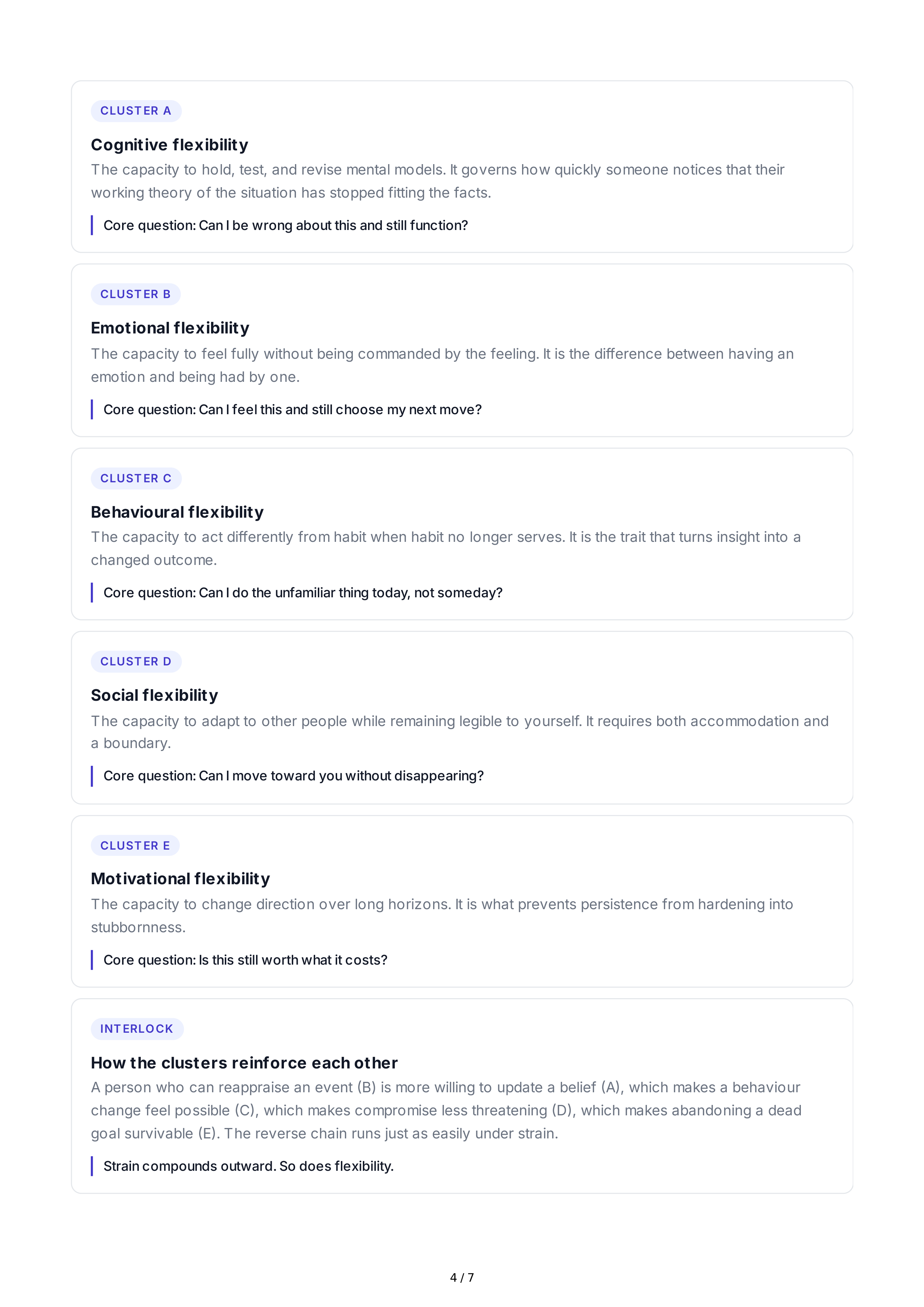
CLUST ER
A
Cognitive
flexibility
The
capacity
to
hold
,
test
,
and
revise
mental
models
.
It
governs
how
quickly
someone
notices
that
their
working
theory
of
the
situation
has
stopped
fitting
the
facts
.
Core
question
:
Can
I
be
wrong
about
this
and
still
function
?
CLUST ER
B
Emotional
flexibility
The
capacity
to
feel
fully
without
being
commanded
by
the
feeling
.
It
is
the
difference
between
having
an
emotion
and
being
had
by
one
.
Core
question
:
Can
I
feel
this
and
still
choose
my
next
move
?
CLUST ER
C
Behavioural
flexibility
The
capacity
to
act
differently
from
habit
when
habit
no
longer
serves
.
It
is
the
trait
that
turns
insight
into
a
changed
outcome
.
Core
question
:
Can
I
do
the
unfamiliar
thing
today
,
not
someday
?
CLUST ER
D
Social
flexibility
The
capacity
to
adapt
to
other
people
while
remaining
legible
to
yourself
.
It
requires
both
accommodation
and
a
boundary
.
Core
question
:
Can
I
move
toward
you
without
disappearing
?
CLUST ER
E
Motivational
flexibility
The
capacity
to
change
direction
over
long
horizons
.
It
is
what
prevents
persistence
from
hardening
into
stubbornness
.
Core
question
:
Is
this
still
worth
what
it
costs
?
INT ERLOCK
How
the
clusters
reinforce
each
other
A
person
who
can
reappraise
an
event
(
B
)
is
more
willing
to
update
a
belief
(
A
),
which
makes
a
behaviour
change
feel
possible
(
C
),
which
makes
compromise
less
threatening
(
D
),
which
makes
abandoning
a
dead
goal
survivable
(
E
).
The
reverse
chain
runs
just
as
easily
under
strain
.
Strain
compounds
outward
.
So
does
flexibility
.
4 / 7
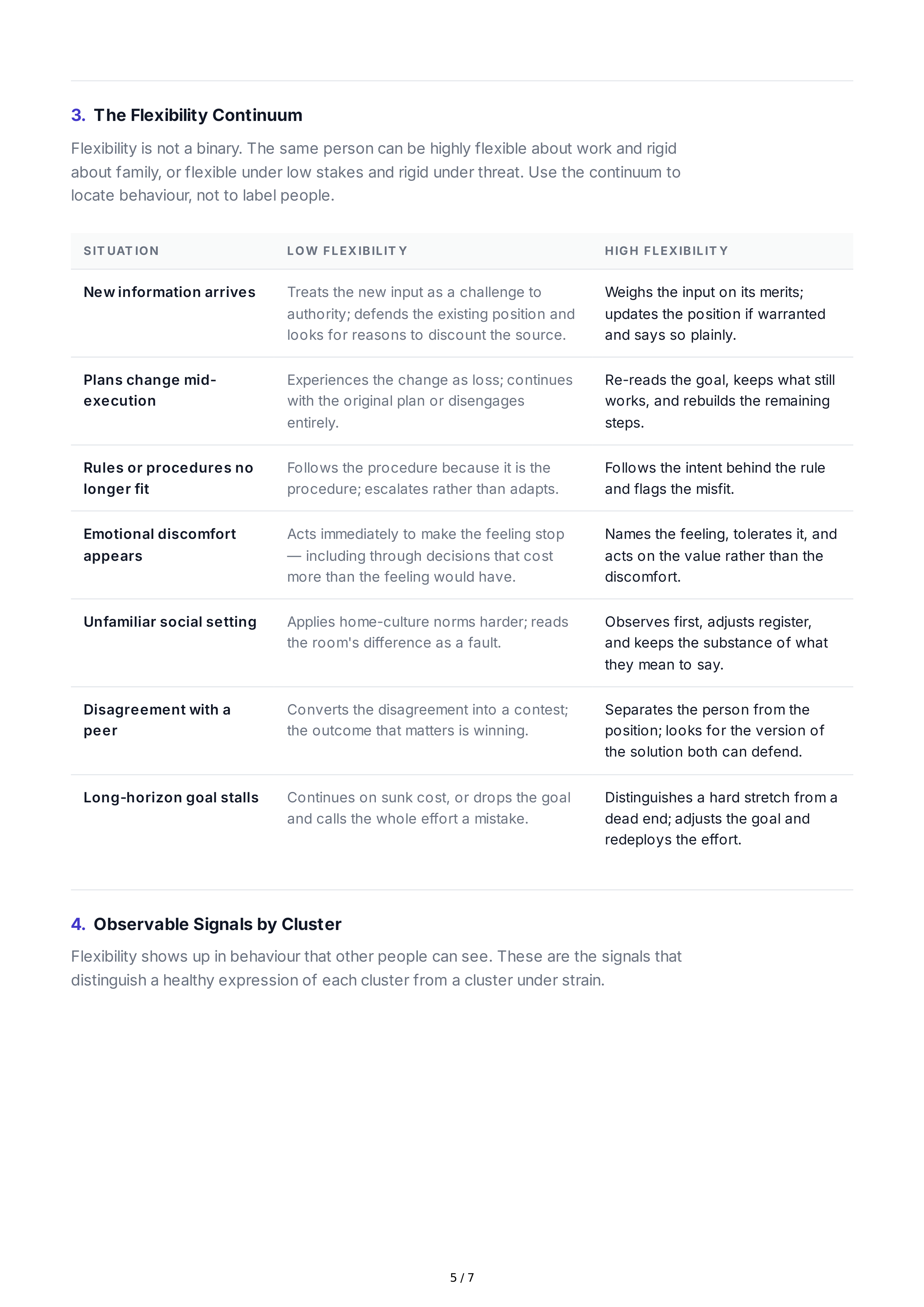
3.
The
Flexibility
Continuum
Flexibility
is
not
a
binary
.
The
same
person
can
be
highly
flexible
about
work
and
rigid
about
family
,
or
flexible
under
low
stakes
and
rigid
under
threat
.
Use
the
continuum
to
locate
behaviour
,
not
to
label
people
.
SIT UAT ION
LOW
FLEXIBILIT Y
HIGH
FLEXIBILIT Y
New
information
arrives
Treats
the
new
input
as
a
challenge
to
authority
;
defends
the
existing
position
and
looks
for
reasons
to
discount
the
source
.
Weighs
the
input
on
its
merits
;
updates
the
position
if
warranted
and
says
so
plainly
.
Plans
change
mid
-
execution
Experiences
the
change
as
loss
;
continues
with
the
original
plan
or
disengages
entirely
.
Re
-
reads
the
goal
,
keeps
what
still
works
,
and
rebuilds
the
remaining
steps
.
Rules
or
procedures
no
longer
fit
Follows
the
procedure
because
it
is
the
procedure
;
escalates
rather
than
adapts
.
Follows
the
intent
behind
the
rule
and
flags
the
misfit
.
Emotional
discomfort
appears
Acts
immediately
to
make
the
feeling
stop
—
including
through
decisions
that
cost
more
than
the
feeling
would
have
.
Names
the
feeling
,
tolerates
it
,
and
acts
on
the
value
rather
than
the
discomfort
.
Unfamiliar
social
setting
Applies
home
-
culture
norms
harder
;
reads
the
room
'
s
difference
as
a
fault
.
Observes
first
,
adjusts
register
,
and
keeps
the
substance
of
what
they
mean
to
say
.
Disagreement
with
a
peer
Converts
the
disagreement
into
a
contest
;
the
outcome
that
matters
is
winning
.
Separates
the
person
from
the
position
;
looks
for
the
version
of
the
solution
both
can
defend
.
Long
-
horizon
goal
stalls
Continues
on
sunk
cost
,
or
drops
the
goal
and
calls
the
whole
effort
a
mistake
.
Distinguishes
a
hard
stretch
from
a
dead
end
;
adjusts
the
goal
and
redeploys
the
effort
.
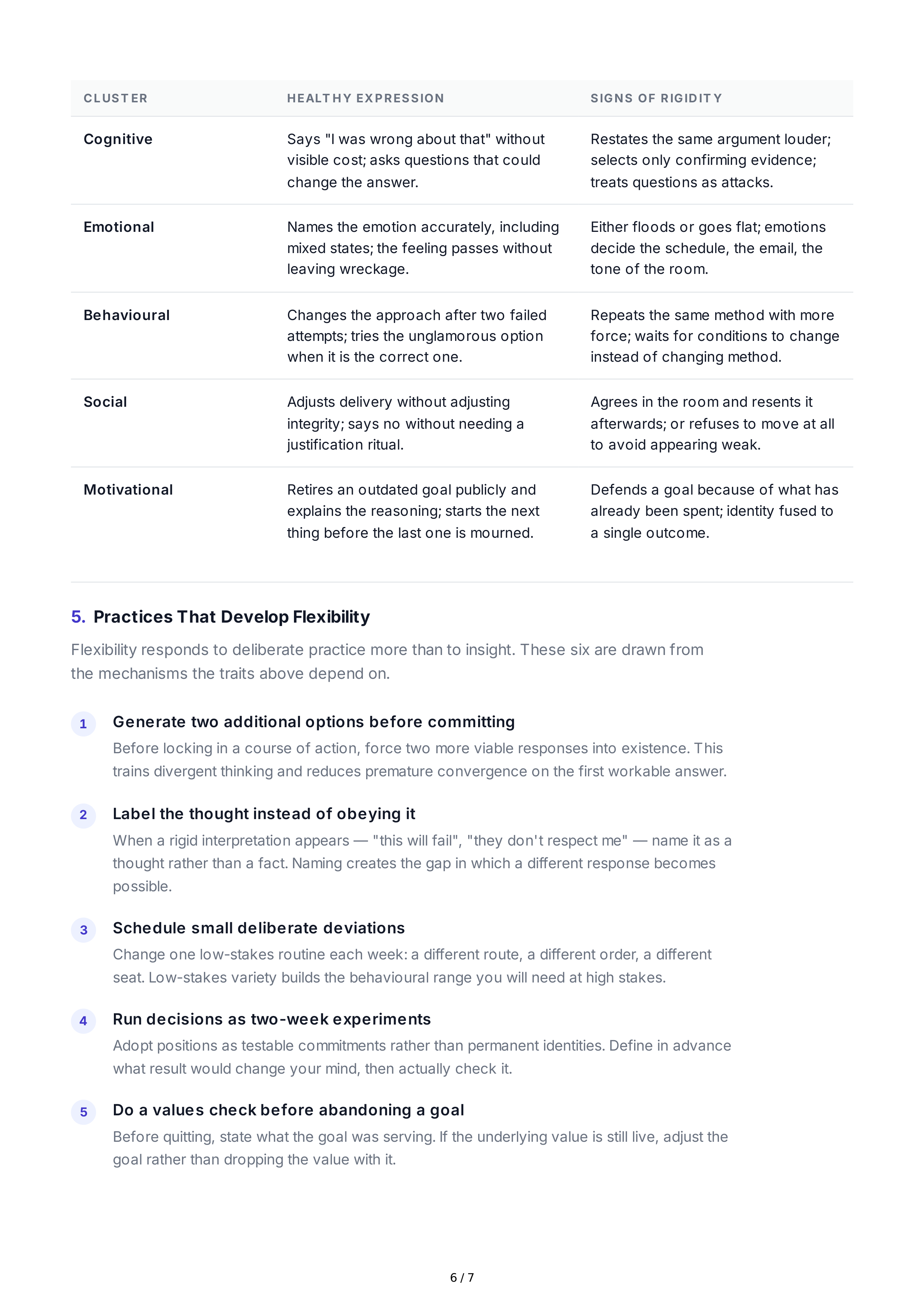
4.
Observable
Signals
by
Cluster
Flexibility
shows
up
in
behaviour
that
other
people
can
see
.
These
are
the
signals
that
distinguish
a
healthy
expression
of
each
cluster
from
a
cluster
under
strain
.
5 / 7
CLUST ER
HEALT HY
EXPRESSION
SIGNS
OF
RIGID IT Y
Cognitive
Says
"
I
was
wrong
about
that
"
without
visible
cost
;
asks
questions
that
could
change
the
answer
.
Restates
the
same
argument
louder
;
selects
only
confirming
evidence
;
treats
questions
as
attacks
.
Emotional
Names
the
emotion
accurately
,
including
mixed
states
;
the
feeling
passes
without
leaving
wreckage
.
Either
floods
or
goes
flat
;
emotions
decide
the
schedule
,
the
email
,
the
tone
of
the
room
.
Behavioural
Changes
the
approach
after
two
failed
attempts
;
tries
the
unglamorous
option
when
it
is
the
correct
one
.
Repeats
the
same
method
with
more
force
;
waits
for
conditions
to
change
instead
of
changing
method
.
Social
Adjusts
delivery
without
adjusting
integrity
;
says
no
without
needing
a
justification
ritual
.
Agrees
in
the
room
and
resents
it
afterwards
;
or
refuses
to
move
at
all
to
avoid
appearing
weak
.
Motivational
Retires
an
outdated
goal
publicly
and
explains
the
reasoning
;
starts
the
next
thing
before
the
last
one
is
mourned
.
Defends
a
goal
because
of
what
has
already
been
spent
;
identity
fused
to
a
single
outcome
.
5.
Practices
That
Develop
Flexibility
Flexibility
responds
to
deliberate
practice
more
than
to
insight
.
These
six
are
drawn
from
the
mechanisms
the
traits
above
depend
on
.
Generate
two
additional
options
before
committing
Before
locking
in
a
course
of
action
,
force
two
more
viable
responses
into
existence
.
This
trains
divergent
thinking
and
reduces
premature
convergence
on
the
first
workable
answer
.
1
Label
the
thought
instead
of
obeying
it
When
a
rigid
interpretation
appears
— "
this
will
fail
", "
they
don
'
t
respect
me
" —
name
it
as
a
thought
rather
than
a
fact
.
Naming
creates
the
gap
in
which
a
different
response
becomes
possible
.
2
Schedule
small
deliberate
deviations
Change
one
low
-
stakes
routine
each
week
:
a
different
route
,
a
different
order
,
a
different
seat
.
Low
-
stakes
variety
builds
the
behavioural
range
you
will
need
at
high
stakes
.
3
Run
decisions
as
two
-
week
experiments
Adopt
positions
as
testable
commitments
rather
than
permanent
identities
.
Define
in
advance
what
result
would
change
your
mind
,
then
actually
check
it
.
4
Do
a
values
check
before
abandoning
a
goal
Before
quitting
,
state
what
the
goal
was
serving
.
If
the
underlying
value
is
still
live
,
adjust
the
goal
rather
than
dropping
the
value
with
it
.
5
6 / 7

Debrief
the
divergence
afterwards
When
a
plan
changed
,
record
what
actually
happened
versus
what
you
feared
would
happen
.
Accurate
records
of
survived
change
are
what
reduce
the
cost
of
the
next
one
.
6
7 / 7