Adaptability
Personality
Traits
1 / 4
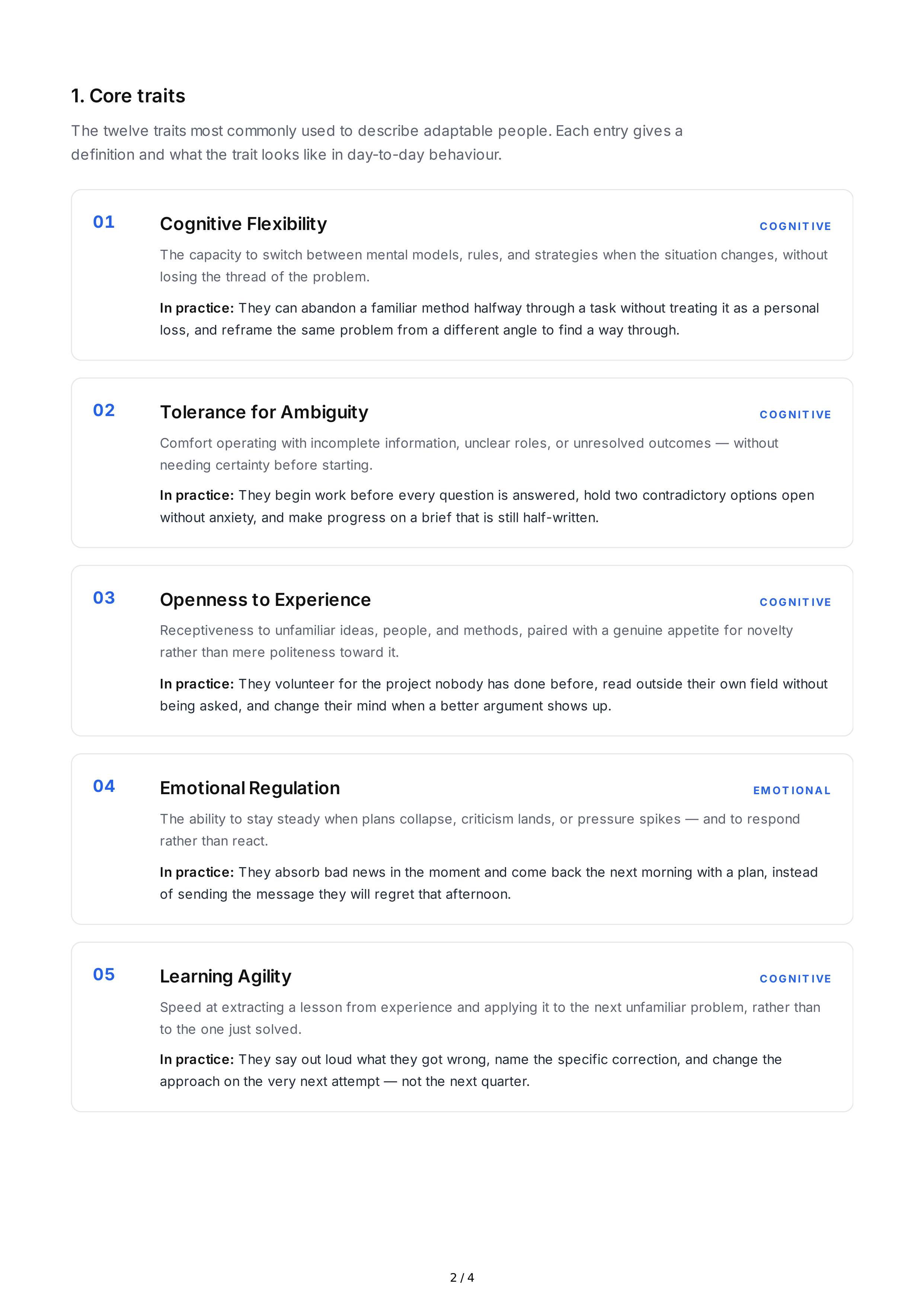
1.
Core
traits
The
twelve
traits
most
commonly
used
to
describe
adaptable
people
.
Each
entry
gives
a
definition
and
what
the
trait
looks
like
in
day
-
to
-
day
behaviour
.
01
Cognitive
Flexibility
C OG NIT IVE
The
capacity
to
switch
between
mental
models
,
rules
,
and
strategies
when
the
situation
changes
,
without
losing
the
thread
of
the
problem
.
In
practice
:
They
can
abandon
a
familiar
method
halfway
through
a
task
without
treating
it
as
a
personal
loss
,
and
reframe
the
same
problem
from
a
different
angle
to
find
a
way
through
.
02
Tolerance
for
Ambiguity
C OG NIT IVE
Comfort
operating
with
incomplete
information
,
unclear
roles
,
or
unresolved
outcomes
—
without
needing
certainty
before
starting
.
In
practice
:
They
begin
work
before
every
question
is
answered
,
hold
two
contradictory
options
open
without
anxiety
,
and
make
progress
on
a
brief
that
is
still
half
-
written
.
03
Openness
to
Experience
C OG NIT IVE
Receptiveness
to
unfamiliar
ideas
,
people
,
and
methods
,
paired
with
a
genuine
appetite
for
novelty
rather
than
mere
politeness
toward
it
.
In
practice
:
They
volunteer
for
the
project
nobody
has
done
before
,
read
outside
their
own
field
without
being
asked
,
and
change
their
mind
when
a
better
argument
shows
up
.
04
Emotional
Regulation
EM OT IONA L
The
ability
to
stay
steady
when
plans
collapse
,
criticism
lands
,
or
pressure
spikes
—
and
to
respond
rather
than
react
.
In
practice
:
They
absorb
bad
news
in
the
moment
and
come
back
the
next
morning
with
a
plan
,
instead
of
sending
the
message
they
will
regret
that
afternoon
.
05
Learning
Agility
C OG NIT IVE
Speed
at
extracting
a
lesson
from
experience
and
applying
it
to
the
next
unfamiliar
problem
,
rather
than
to
the
one
just
solved
.
In
practice
:
They
say
out
loud
what
they
got
wrong
,
name
the
specific
correction
,
and
change
the
approach
on
the
very
next
attempt
—
not
the
next
quarter
.
2 / 4
06
Resilience
EM OT IONA L
Recovery
after
setback
—
not
the
absence
of
setback
.
The
return
to
a
normal
working
rhythm
once
the
initial
impact
has
passed
.
In
practice
:
After
a
failed
launch
or
a
lost
account
,
they
keep
the
lesson
and
drop
the
self
-
punishment
,
getting
back
to
useful
output
within
days
rather
than
weeks
.
07
Situational
Awareness
S OC IA L
Reading
the
room
,
the
market
,
and
the
moment
accurately
before
acting
—
noticing
what
has
changed
that
nobody
has
announced
yet
.
In
practice
:
They
register
that
a
meeting
'
s
mood
has
shifted
,
that
a
client
'
s
priorities
have
quietly
moved
,
or
that
the
plan
on
paper
no
longer
matches
the
reality
on
the
ground
.
08
Adaptive
Communication
S OC IA L
Adjusting
tone
,
detail
,
and
format
to
the
person
and
the
moment
,
instead
of
delivering
every
message
the
same
way
.
In
practice
:
They
lead
with
the
headline
for
an
executive
,
the
mechanism
for
an
engineer
,
and
the
reassurance
for
a
nervous
client
—
same
facts
,
three
different
shapes
.
09
Proactive
Problem
-
Solving
BEH AVIOU R A L
Addressing
change
before
it
becomes
a
crisis
,
rather
than
waiting
for
the
problem
to
demand
attention
.
In
practice
:
They
flag
the
risk
three
weeks
before
the
deadline
,
or
quietly
build
the
workaround
while
everyone
else
is
still
debating
whether
the
problem
is
real
.
10
Curiosity
C OG NIT IVE
Sustained
interest
in
how
things
work
and
why
people
behave
the
way
they
do
—
the
engine
that
keeps
adaptability
supplied
with
new
options
.
In
practice
:
They
ask
open
questions
in
meetings
,
follow
up
on
a
conversation
with
reading
that
nobody
assigned
,
and
show
real
interest
in
the
person
across
the
table
.
11
Receptiveness
to
Feedback
S OC IA L
Treating
critique
as
data
rather
than
verdict
—
separable
from
the
delivery
,
and
usable
even
when
the
delivery
was
clumsy
.
In
practice
:
They
ask
what
specifically
should
change
,
thank
the
person
for
saying
it
,
and
apply
it
in
the
next
revision
instead
of
defending
the
last
one
.
3 / 4

12
Resourcefulness
BEH AVIOU R A L
Reaching
a
workable
outcome
with
what
is
actually
available
,
rather
than
waiting
for
ideal
conditions
or
ideal
resources
.
In
practice
:
They
ship
with
the
tools
on
hand
,
find
the
person
who
already
knows
the
answer
,
and
treat
constraints
as
a
design
input
rather
than
a
reason
to
stop
.
4 / 4