Open
-
Mindedness
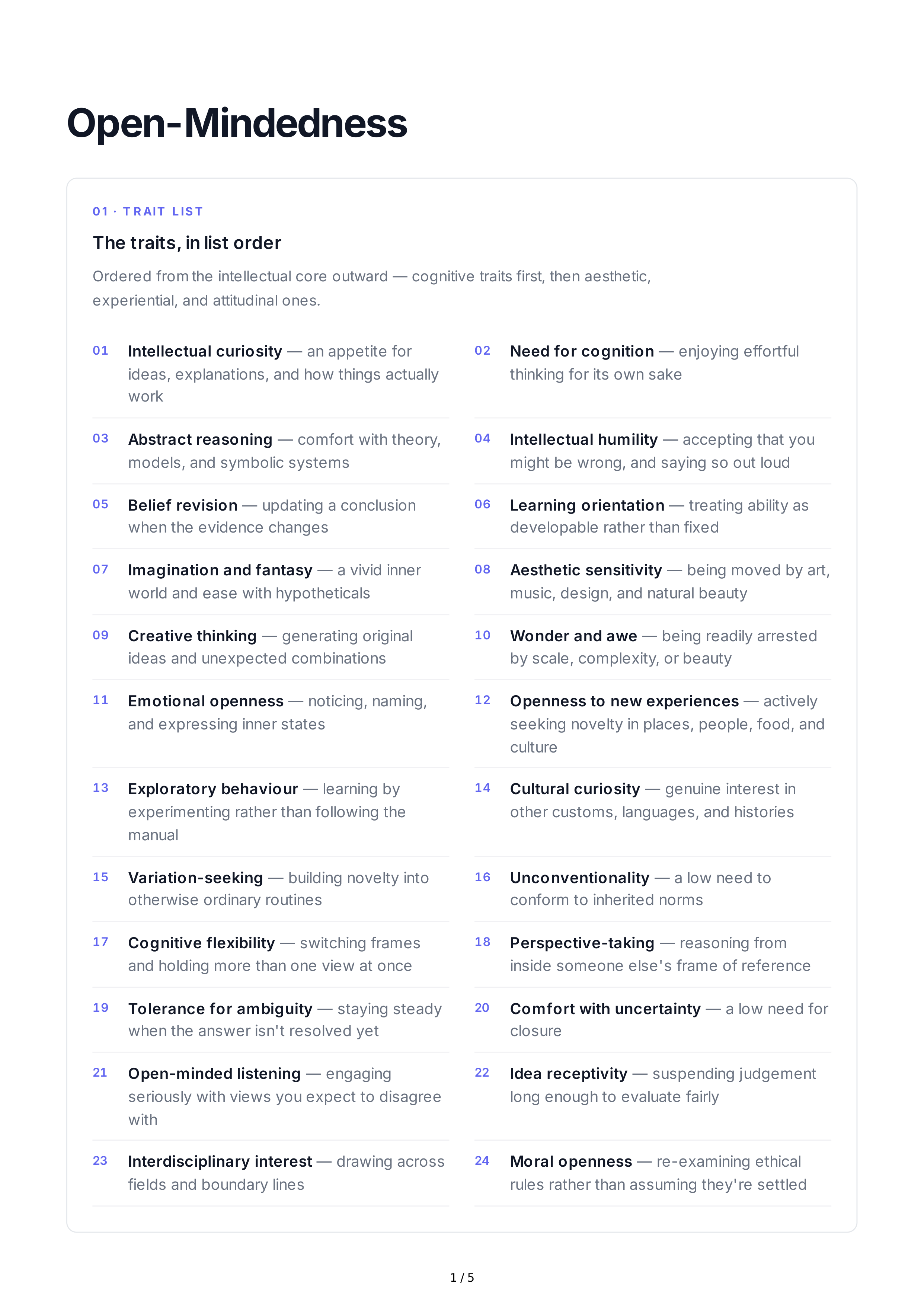
0 1 ·
T R AIT
L IS T
The
traits
,
in
list
order
Ordered
from
the
intellectual
core
outward
—
cognitive
traits
first
,
then
aesthetic
,
experiential
,
and
attitudinal
ones
.
01
Intellectual
curiosity
—
an
appetite
for
ideas
,
explanations
,
and
how
things
actually
work
02
Need
for
cognition
—
enjoying
effortful
thinking
for
its
own
sake
03
Abstract
reasoning
—
comfort
with
theory
,
models
,
and
symbolic
systems
04
Intellectual
humility
—
accepting
that
you
might
be
wrong
,
and
saying
so
out
loud
05
Belief
revision
—
updating
a
conclusion
when
the
evidence
changes
06
Learning
orientation
—
treating
ability
as
developable
rather
than
fixed
07
Imagination
and
fantasy
—
a
vivid
inner
world
and
ease
with
hypotheticals
08
Aesthetic
sensitivity
—
being
moved
by
art
,
music
,
design
,
and
natural
beauty
09
Creative
thinking
—
generating
original
ideas
and
unexpected
combinations
10
Wonder
and
awe
—
being
readily
arrested
by
scale
,
complexity
,
or
beauty
11
Emotional
openness
—
noticing
,
naming
,
and
expressing
inner
states
12
Openness
to
new
experiences
—
actively
seeking
novelty
in
places
,
people
,
food
,
and
culture
13
Exploratory
behaviour
—
learning
by
experimenting
rather
than
following
the
manual
14
Cultural
curiosity
—
genuine
interest
in
other
customs
,
languages
,
and
histories
15
Variation
-
seeking
—
building
novelty
into
otherwise
ordinary
routines
16
Unconventionality
—
a
low
need
to
conform
to
inherited
norms
17
Cognitive
flexibility
—
switching
frames
and
holding
more
than
one
view
at
once
18
Perspective
-
taking
—
reasoning
from
inside
someone
else
'
s
frame
of
reference
19
Tolerance
for
ambiguity
—
staying
steady
when
the
answer
isn
'
t
resolved
yet
20
Comfort
with
uncertainty
—
a
low
need
for
closure
21
Open
-
minded
listening
—
engaging
seriously
with
views
you
expect
to
disagree
with
22
Idea
receptivity
—
suspending
judgement
long
enough
to
evaluate
fairly
23
Interdisciplinary
interest
—
drawing
across
fields
and
boundary
lines
24
Moral
openness
—
re
-
examining
ethical
rules
rather
than
assuming
they
'
re
settled
1 / 5
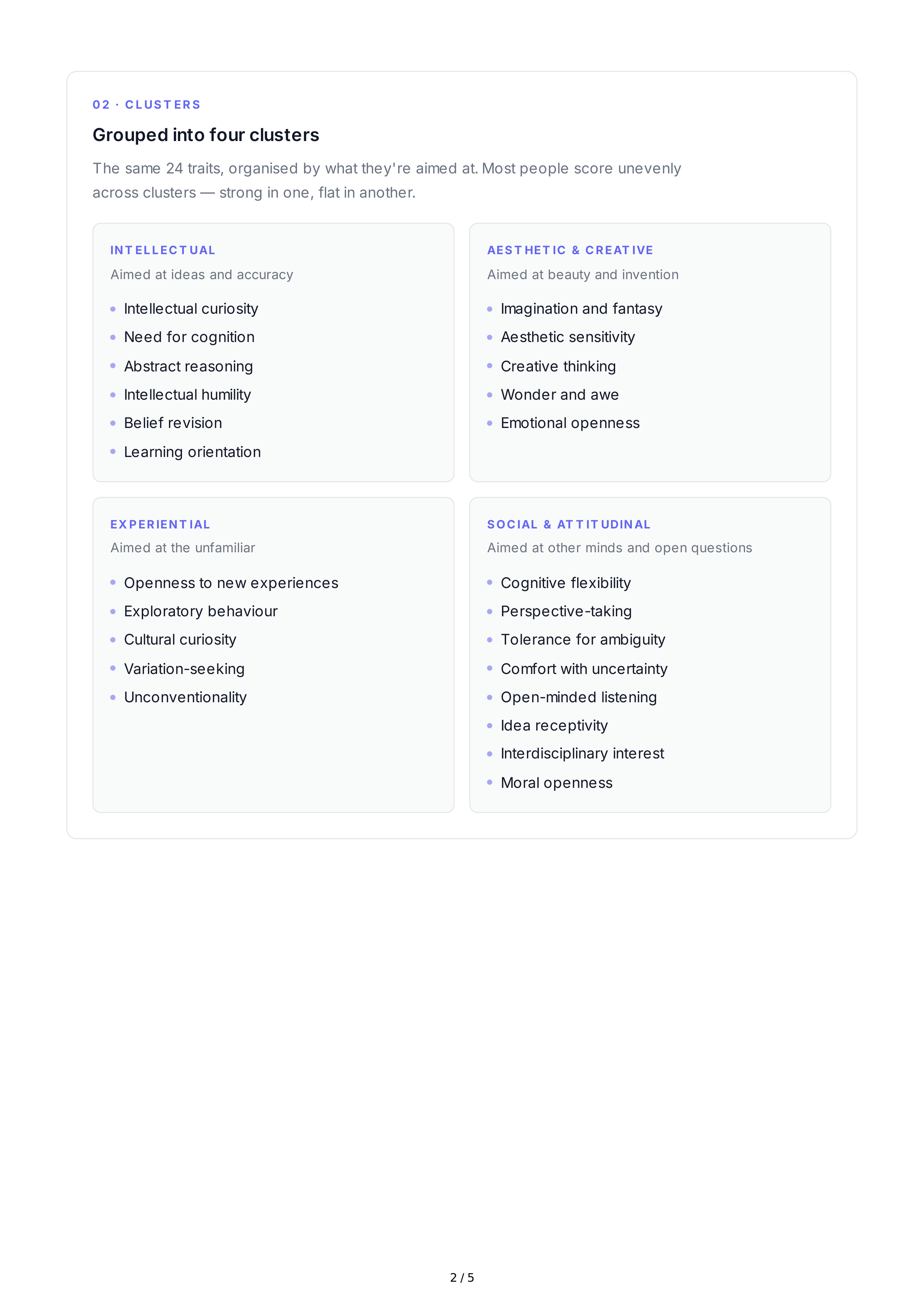
0 2 ·
C L US T ER S
Grouped
into
four
clusters
The
same
24
traits
,
organised
by
what
they
'
re
aimed
at
.
Most
people
score
unevenly
across
clusters
—
strong
in
one
,
flat
in
another
.
INT EL L EC T UAL
Aimed
at
ideas
and
accuracy
AES T HET IC
&
C R EAT IVE
Aimed
at
beauty
and
invention
EX P ER IENT IAL
Aimed
at
the
unfamiliar
S OC IAL
&
AT T IT UDINAL
Aimed
at
other
minds
and
open
questions
Intellectual
curiosity
Need
for
cognition
Abstract
reasoning
Intellectual
humility
Belief
revision
Learning
orientation
Imagination
and
fantasy
Aesthetic
sensitivity
Creative
thinking
Wonder
and
awe
Emotional
openness
Openness
to
new
experiences
Exploratory
behaviour
Cultural
curiosity
Variation
-
seeking
Unconventionality
Cognitive
flexibility
Perspective
-
taking
Tolerance
for
ambiguity
Comfort
with
uncertainty
Open
-
minded
listening
Idea
receptivity
Interdisciplinary
interest
Moral
openness
2 / 5
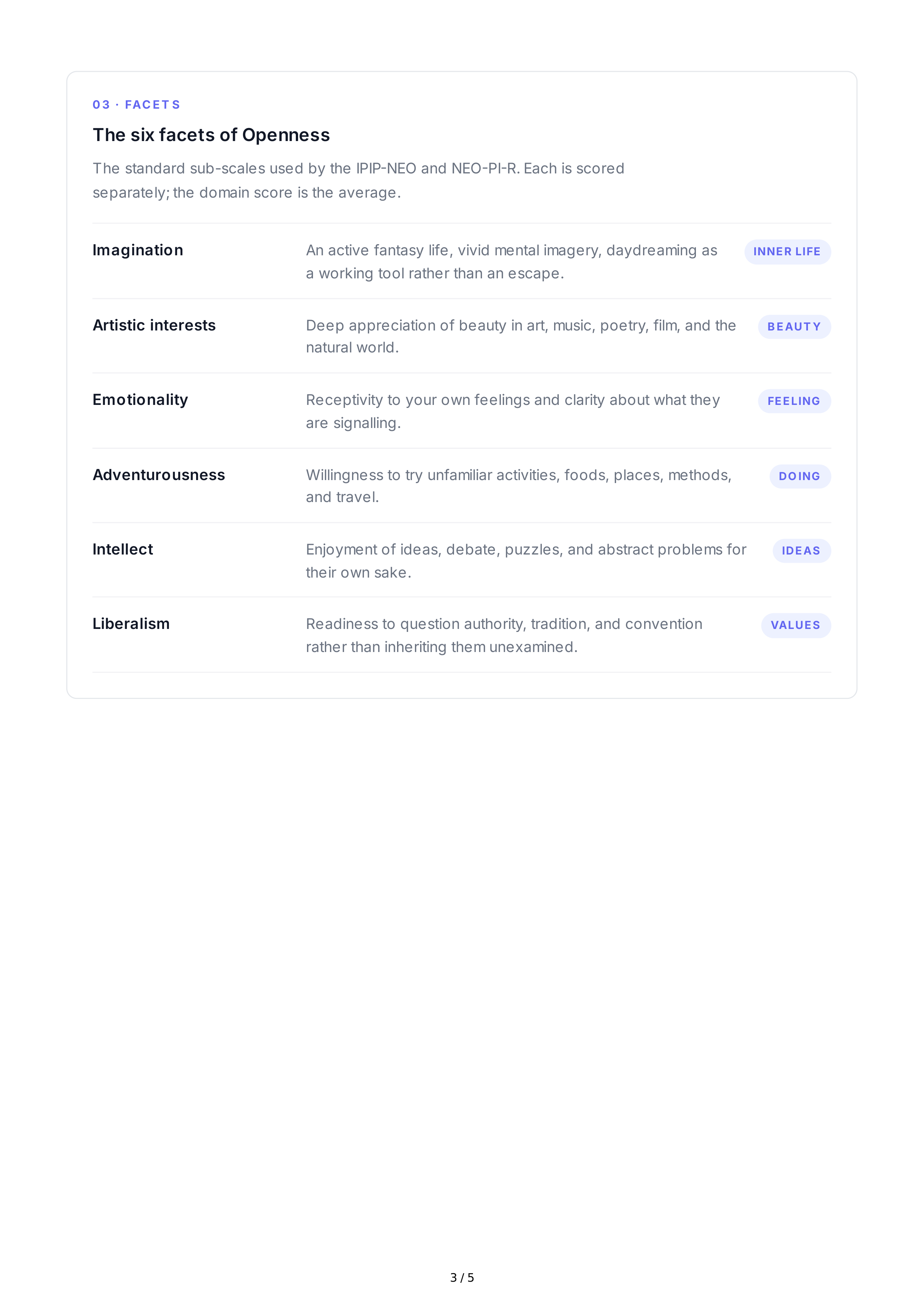
0 3 ·
FAC ET S
The
six
facets
of
Openness
The
standard
sub
-
scales
used
by
the
IPIP
-
NEO
and
NEO
-
PI
-
R
.
Each
is
scored
separately
;
the
domain
score
is
the
average
.
Imagination
An
active
fantasy
life
,
vivid
mental
imagery
,
daydreaming
as
a
working
tool
rather
than
an
escape
.
INNER
LIFE
Artistic
interests
Deep
appreciation
of
beauty
in
art
,
music
,
poetry
,
film
,
and
the
natural
world
.
B EAUT Y
Emotionality
Receptivity
to
your
own
feelings
and
clarity
about
what
they
are
signalling
.
FEELING
Adventurousness
Willingness
to
try
unfamiliar
activities
,
foods
,
places
,
methods
,
and
travel
.
DO ING
Intellect
Enjoyment
of
ideas
,
debate
,
puzzles
,
and
abstract
problems
for
their
own
sake
.
IDEAS
Liberalism
Readiness
to
question
authority
,
tradition
,
and
convention
rather
than
inheriting
them
unexamined
.
VALUES
3 / 5
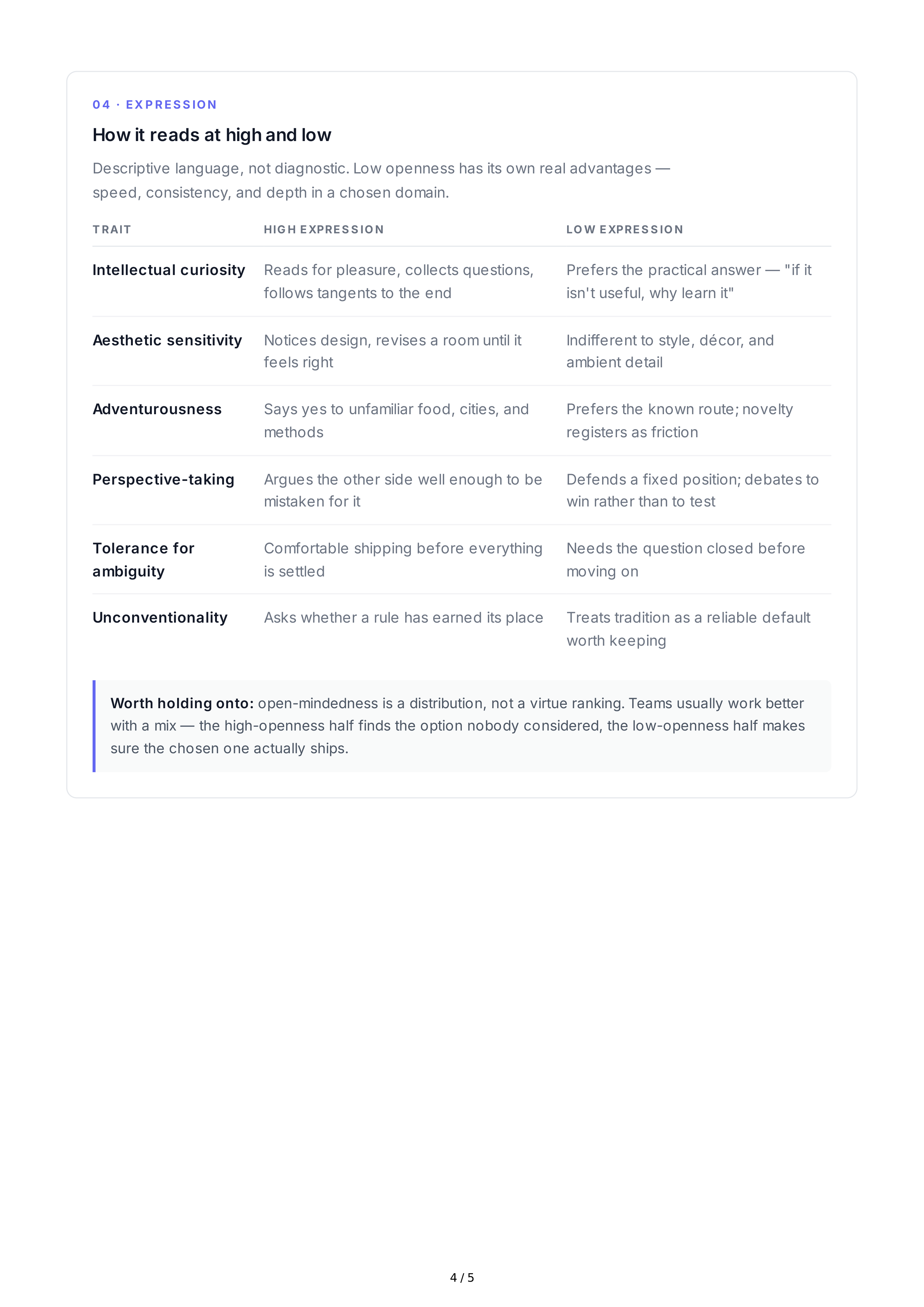
0 4 ·
EX P R ES S IO N
How
it
reads
at
high
and
low
Descriptive
language
,
not
diagnostic
.
Low
openness
has
its
own
real
advantages
—
speed
,
consistency
,
and
depth
in
a
chosen
domain
.
T RAIT
HIG H
EXPRES S IO N
LO W
EXPRES S IO N
Intellectual
curiosity
Reads
for
pleasure
,
collects
questions
,
follows
tangents
to
the
end
Prefers
the
practical
answer
— "
if
it
isn
'
t
useful
,
why
learn
it
"
Aesthetic
sensitivity
Notices
design
,
revises
a
room
until
it
feels
right
Indifferent
to
style
,
décor
,
and
ambient
detail
Adventurousness
Says
yes
to
unfamiliar
food
,
cities
,
and
methods
Prefers
the
known
route
;
novelty
registers
as
friction
Perspective
-
taking
Argues
the
other
side
well
enough
to
be
mistaken
for
it
Defends
a
fixed
position
;
debates
to
win
rather
than
to
test
Tolerance
for
ambiguity
Comfortable
shipping
before
everything
is
settled
Needs
the
question
closed
before
moving
on
Unconventionality
Asks
whether
a
rule
has
earned
its
place
Treats
tradition
as
a
reliable
default
worth
keeping
Worth
holding
onto
:
open
-
mindedness
is
a
distribution
,
not
a
virtue
ranking
.
Teams
usually
work
better
with
a
mix
—
the
high
-
openness
half
finds
the
option
nobody
considered
,
the
low
-
openness
half
makes
sure
the
chosen
one
actually
ships
.
4 / 5
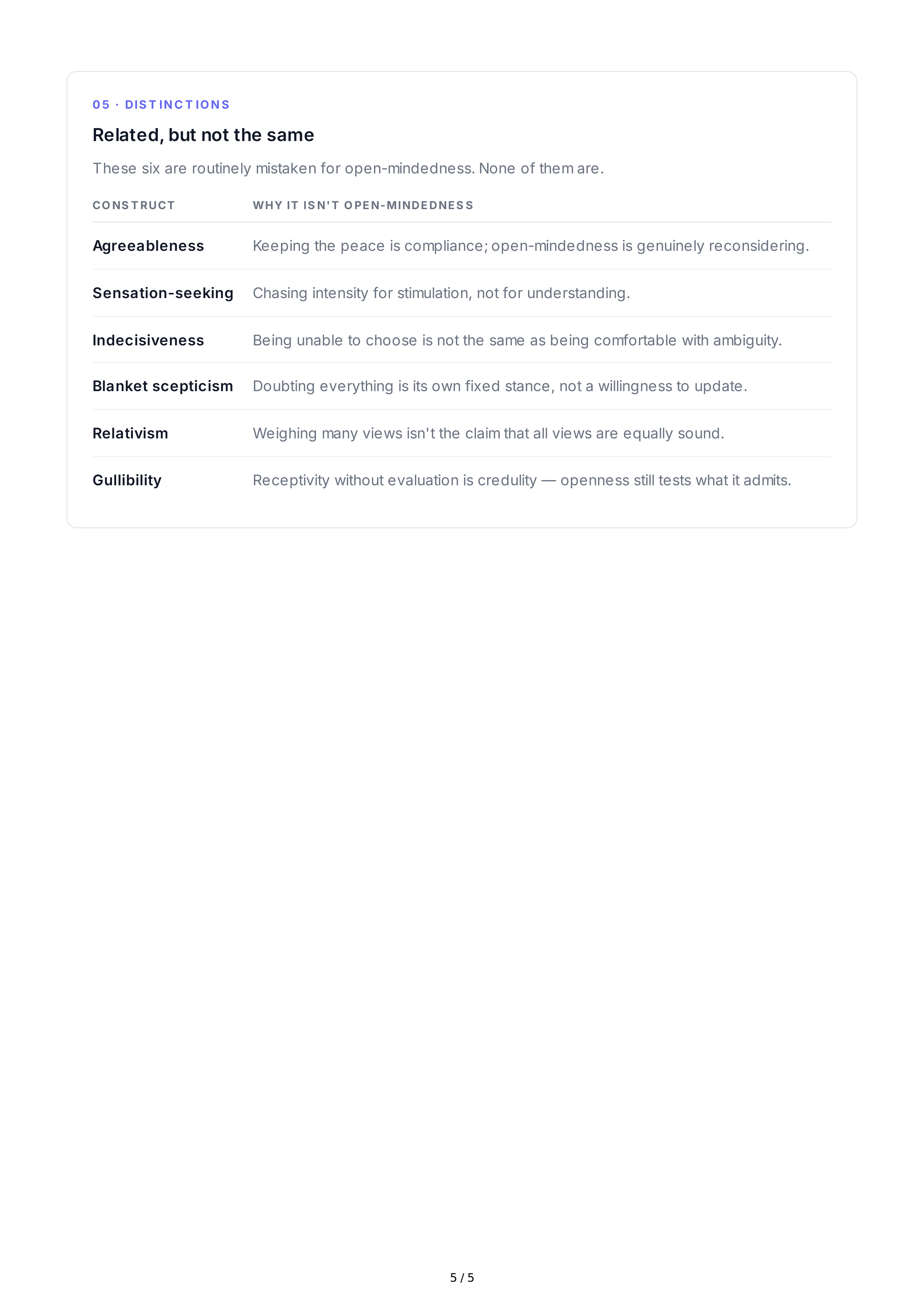
0 5 ·
DIS T IN C T IO N S
Related
,
but
not
the
same
These
six
are
routinely
mistaken
for
open
-
mindedness
.
None
of
them
are
.
CO NS T RUCT
WHY
IT
IS N
'
T
O PEN
-
MINDEDNES S
Agreeableness
Keeping
the
peace
is
compliance
;
open
-
mindedness
is
genuinely
reconsidering
.
Sensation
-
seeking
Chasing
intensity
for
stimulation
,
not
for
understanding
.
Indecisiveness
Being
unable
to
choose
is
not
the
same
as
being
comfortable
with
ambiguity
.
Blanket
scepticism
Doubting
everything
is
its
own
fixed
stance
,
not
a
willingness
to
update
.
Relativism
Weighing
many
views
isn
'
t
the
claim
that
all
views
are
equally
sound
.
Gullibility
Receptivity
without
evaluation
is
credulity
—
openness
still
tests
what
it
admits
.
5 / 5