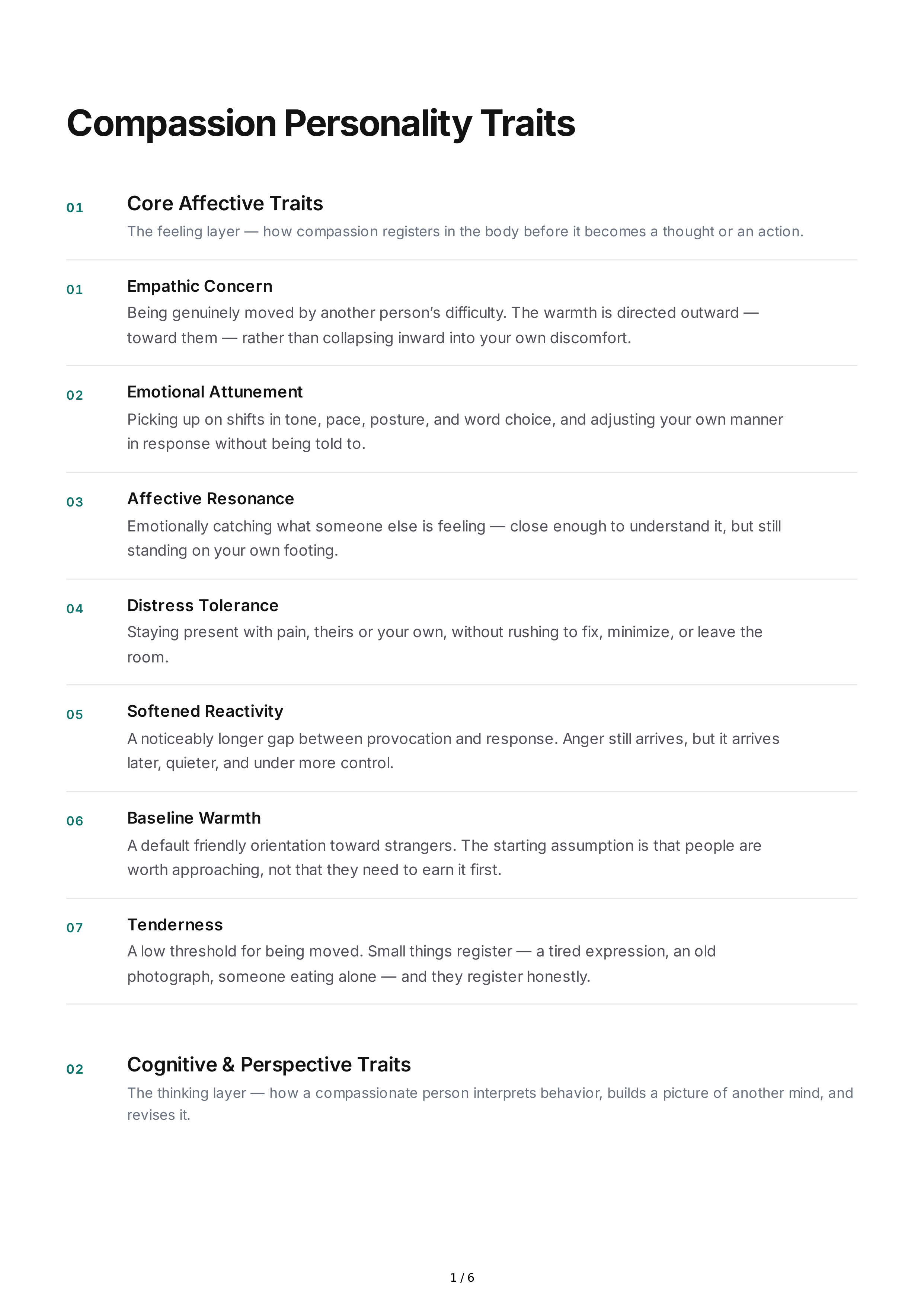
Compassion
Personality
Traits
01
Core
Affective
Traits
The
feeling
layer
—
how
compassion
registers
in
the
body
before
it
becomes
a
thought
or
an
action
.
01
Empathic
Concern
Being
genuinely
moved
by
another
person
’
s
difficulty
.
The
warmth
is
directed
outward
—
toward
them
—
rather
than
collapsing
inward
into
your
own
discomfort
.
02
Emotional
Attunement
Picking
up
on
shifts
in
tone
,
pace
,
posture
,
and
word
choice
,
and
adjusting
your
own
manner
in
response
without
being
told
to
.
03
Affective
Resonance
Emotionally
catching
what
someone
else
is
feeling
—
close
enough
to
understand
it
,
but
still
standing
on
your
own
footing
.
04
Distress
Tolerance
Staying
present
with
pain
,
theirs
or
your
own
,
without
rushing
to
fix
,
minimize
,
or
leave
the
room
.
05
Softened
Reactivity
A
noticeably
longer
gap
between
provocation
and
response
.
Anger
still
arrives
,
but
it
arrives
later
,
quieter
,
and
under
more
control
.
06
Baseline
Warmth
A
default
friendly
orientation
toward
strangers
.
The
starting
assumption
is
that
people
are
worth
approaching
,
not
that
they
need
to
earn
it
first
.
07
Tenderness
A
low
threshold
for
being
moved
.
Small
things
register
—
a
tired
expression
,
an
old
photograph
,
someone
eating
alone
—
and
they
register
honestly
.
02
Cognitive
&
Perspective
Traits
The
thinking
layer
—
how
a
compassionate
person
interprets
behavior
,
builds
a
picture
of
another
mind
,
and
revises
it
.
1 / 6
08
Perspective
-
Taking
Actively
constructing
another
person
’
s
viewpoint
from
the
inside
,
rather
than
assuming
your
own
reading
of
the
situation
is
the
shared
one
.
09
Non
-
Judgment
Observing
behavior
without
immediately
sorting
it
into
deserved
and
undeserved
.
Description
comes
first
;
evaluation
arrives
later
,
if
at
all
.
10
Attributional
Charity
Reaching
for
a
situational
explanation
before
a
character
explanation
. “
They
’
re
having
a
hard
week
”
is
available
before
“
they
’
re
careless
.”
11
Cognitive
Flexibility
Willingness
to
rewrite
your
working
model
of
a
person
when
new
information
contradicts
it
,
instead
of
defending
the
first
impression
.
12
Interpersonal
Curiosity
Real
interest
in
what
another
person
’
s
inner
life
is
actually
like
—
not
as
a
source
of
information
,
but
as
a
thing
worth
knowing
.
13
Context
Awareness
Noticing
power
,
history
,
culture
,
money
,
and
circumstance
before
drawing
conclusions
about
why
someone
behaves
the
way
they
do
.
14
Recognition
of
Common
Humanity
Seeing
your
own
flaws
and
failures
mirrored
in
other
people
—
and
responding
with
recognition
rather
than
contempt
or
distance
.
03
Motivational
&
Behavioral
Traits
The
action
layer
—
what
moves
a
compassionate
person
to
do
something
,
and
what
they
actually
do
when
it
costs
them
.
15
Prosocial
Motivation
An
intrinsic
pull
toward
helping
.
The
impulse
comes
from
inside
rather
than
from
obligation
,
reciprocity
,
or
social
expectation
.
16
Altruistic
Action
Doing
the
costly
thing
when
no
one
is
watching
and
nothing
is
coming
back
—
the
observable
signature
of
compassion
rather
than
its
stated
value
.
2 / 6
17
Responsive
Helping
Offering
the
support
the
other
person
actually
needs
,
rather
than
the
support
you
would
want
in
their
position
.
18
Everyday
Kindness
Small
,
unglamorous
,
largely
unrecorded
acts
—
holding
the
door
,
remembering
the
name
,
sending
the
follow
-
up
that
wasn
’
t
required
.
19
Moral
Courage
Speaking
up
on
someone
’
s
behalf
in
the
moment
when
silence
would
be
safer
,
cheaper
,
or
more
socially
comfortable
.
20
Generosity
Giving
time
,
credit
,
attention
,
and
resources
without
maintaining
a
running
ledger
of
what
is
owed
back
.
21
Advocacy
Moving
from
individual
care
to
structural
care
—
working
on
the
conditions
that
produced
the
suffering
in
the
first
place
.
04
Relational
&
Interpersonal
Traits
The
connection
layer
—
how
compassion
behaves
inside
an
actual
relationship
,
especially
a
difficult
one
.
22
Deep
Listening
Listening
with
the
intent
to
be
changed
by
what
you
hear
,
rather
than
to
prepare
your
reply
or
wait
for
a
pause
.
23
Patience
Allowing
another
person
their
own
timeline
—
for
grief
,
for
change
,
for
arriving
at
a
conclusion
you
reached
months
ago
.
24
Relational
Safety
People
relax
in
your
presence
.
You
tend
to
be
the
room
in
which
someone
finally
says
the
true
thing
they
’
ve
been
carrying
around
.
25
Non
-
Defensiveness
Able
to
receive
criticism
without
collapsing
into
shame
or
counterattacking
.
Feedback
can
land
without
triggering
a
fight
.
3 / 6
26
Boundary
Respect
Honoring
a
“
no
”
the
first
time
it
is
said
,
without
re
-
asking
,
negotiating
,
or
treating
the
boundary
as
an
obstacle
to
be
overcome
.
27
Repair
Orientation
Returning
after
conflict
in
order
to
mend
the
relationship
—
not
to
relitigate
the
argument
or
to
secure
an
admission
of
fault
.
28
Grace
Under
Disagreement
Disagreeing
with
someone
completely
,
and
continuing
to
treat
them
as
a
full
person
rather
than
an
opponent
to
be
reduced
.
05
Moral
&
Value
-
Based
Traits
The
principles
layer
—
the
commitments
that
keep
compassion
consistent
when
it
becomes
inconvenient
.
29
Mercy
Choosing
a
lighter
consequence
than
you
are
entitled
to
impose
,
when
you
hold
the
power
to
impose
a
heavier
one
.
30
Forgiveness
Releasing
the
debt
without
pretending
the
injury
never
happened
,
and
without
requiring
the
other
person
to
earn
it
back
first
.
31
Intellectual
Humility
Holding
your
own
perspective
as
one
perspective
among
many
,
and
being
genuinely
open
to
the
possibility
that
you
have
it
wrong
.
32
Integrity
Compassion
that
survives
contact
with
cost
.
It
shows
up
when
it
is
inconvenient
,
unobserved
,
and
unlikely
to
be
rewarded
.
33
Moral
Consistency
Treating
the
people
who
cannot
help
you
the
same
way
you
treat
the
people
who
can
—
the
server
,
the
porter
,
the
junior
,
the
stranger
.
34
Reverence
for
Dignity
Operating
from
the
premise
that
every
person
carries
worth
that
cannot
be
earned
,
increased
by
status
,
or
forfeited
by
failure
.
4 / 6
06
Self
-
Directed
Compassion
Traits
The
inward
layer
—
how
compassion
toward
yourself
determines
whether
the
rest
of
this
list
is
sustainable
or
self
-
consuming
.
35
Self
-
Compassion
Offering
yourself
the
same
tone
you
would
offer
a
friend
in
the
identical
situation
—
particularly
about
the
failures
you
find
hardest
to
mention
.
36
Emotional
Regulation
Feeling
things
fully
without
being
run
by
them
.
Intensity
is
present
,
but
it
does
not
make
the
decisions
.
37
Self
-
Awareness
Knowing
your
own
triggers
,
biases
,
projections
,
and
limits
well
enough
to
notice
when
they
are
shaping
your
response
to
someone
.
38
Sustainable
Caregiving
Recognizing
the
edge
of
your
own
capacity
before
resentment
,
depletion
,
or
compassion
fatigue
arrives
and
announces
it
for
you
.
39
Self
-
Forgiveness
Letting
your
own
past
mistakes
be
finished
.
Not
erasing
them
,
not
celebrating
them
—
simply
no
longer
relitigating
them
daily
.
07
Growth
-
Edge
Traits
Counter
-
indicators
—
the
patterns
that
mark
where
compassion
has
been
depleted
,
distorted
,
or
never
developed
.
40
Compassion
Fatigue
Empathy
that
has
been
spent
faster
than
it
has
been
restored
.
Care
continues
on
the
outside
;
the
felt
sense
of
it
has
gone
quiet
.
41
Personal
Distress
Absorbing
another
person
’
s
pain
as
your
own
until
your
discomfort
becomes
the
main
event
and
you
can
no
longer
be
useful
to
them
.
42
Pity
Over
Respect
Feeling
for
someone
from
above
rather
than
beside
them
—
a
form
of
care
that
quietly
communicates
diminished
status
.
5 / 6

43
Performative
Compassion
Care
expressed
primarily
for
an
audience
,
a
self
-
image
,
or
a
record
—
loud
in
public
,
absent
when
nobody
is
there
to
see
it
.
44
Compassion
Without
Boundaries
Giving
past
the
point
of
harm
to
yourself
,
then
mistaking
the
resulting
resentment
for
evidence
that
you
are
a
bad
person
.
45
Avoidance
of
Discomfort
Withdrawing
from
someone
’
s
suffering
because
witnessing
it
is
unpleasant
—
a
retreat
that
is
usually
experienced
as
pragmatism
.
6 / 6
