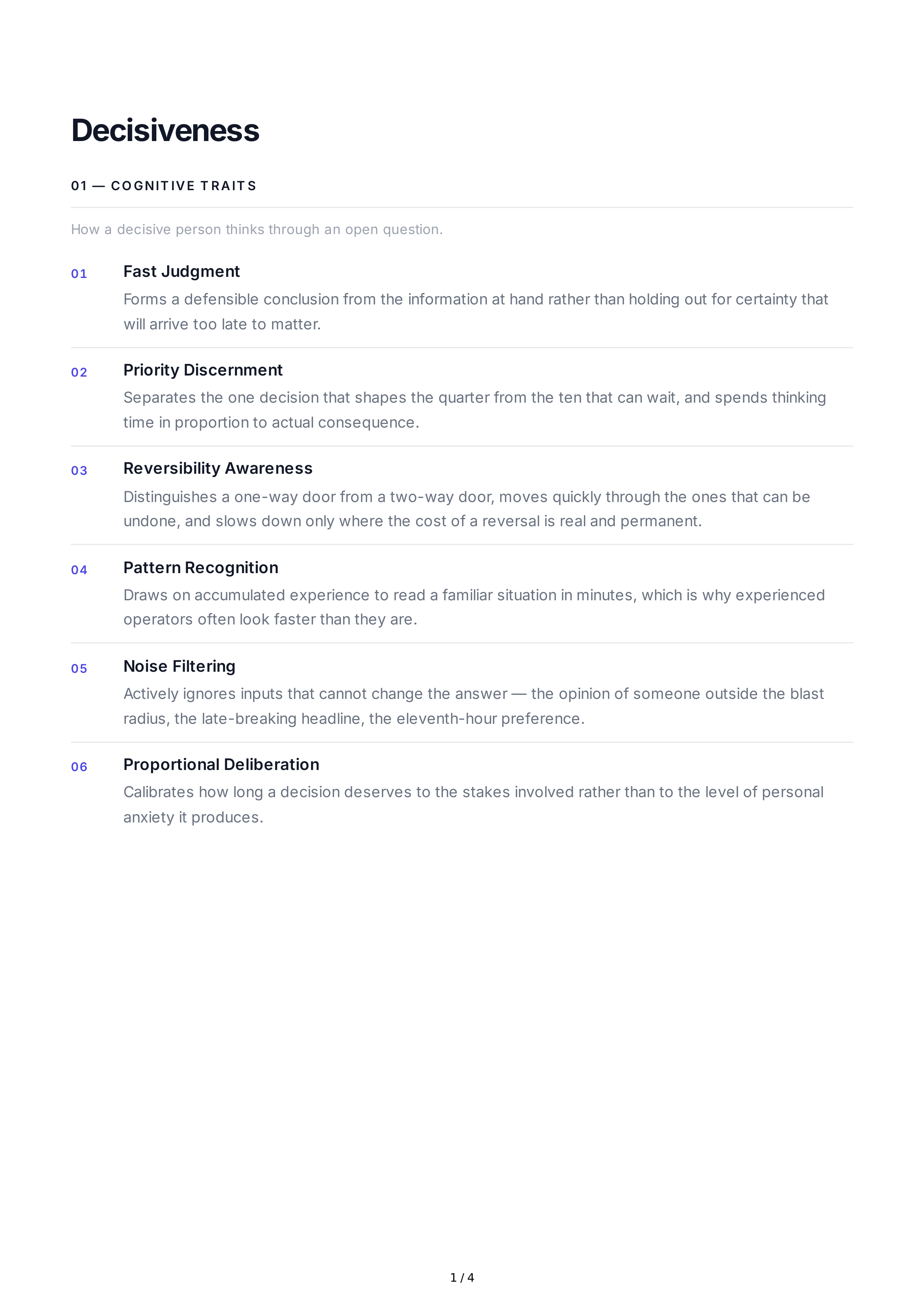
Decisiveness
01 —
CO GNIT IVE
T RAIT S
How
a
decisive
person
thinks
through
an
open
question
.
01
Fast
Judgment
Forms
a
defensible
conclusion
from
the
information
at
hand
rather
than
holding
out
for
certainty
that
will
arrive
too
late
to
matter
.
02
Priority
Discernment
Separates
the
one
decision
that
shapes
the
quarter
from
the
ten
that
can
wait
,
and
spends
thinking
time
in
proportion
to
actual
consequence
.
03
Reversibility
Awareness
Distinguishes
a
one
-
way
door
from
a
two
-
way
door
,
moves
quickly
through
the
ones
that
can
be
undone
,
and
slows
down
only
where
the
cost
of
a
reversal
is
real
and
permanent
.
04
Pattern
Recognition
Draws
on
accumulated
experience
to
read
a
familiar
situation
in
minutes
,
which
is
why
experienced
operators
often
look
faster
than
they
are
.
05
Noise
Filtering
Actively
ignores
inputs
that
cannot
change
the
answer
—
the
opinion
of
someone
outside
the
blast
radius
,
the
late
-
breaking
headline
,
the
eleventh
-
hour
preference
.
06
Proportional
Deliberation
Calibrates
how
long
a
decision
deserves
to
the
stakes
involved
rather
than
to
the
level
of
personal
anxiety
it
produces
.
1 / 4
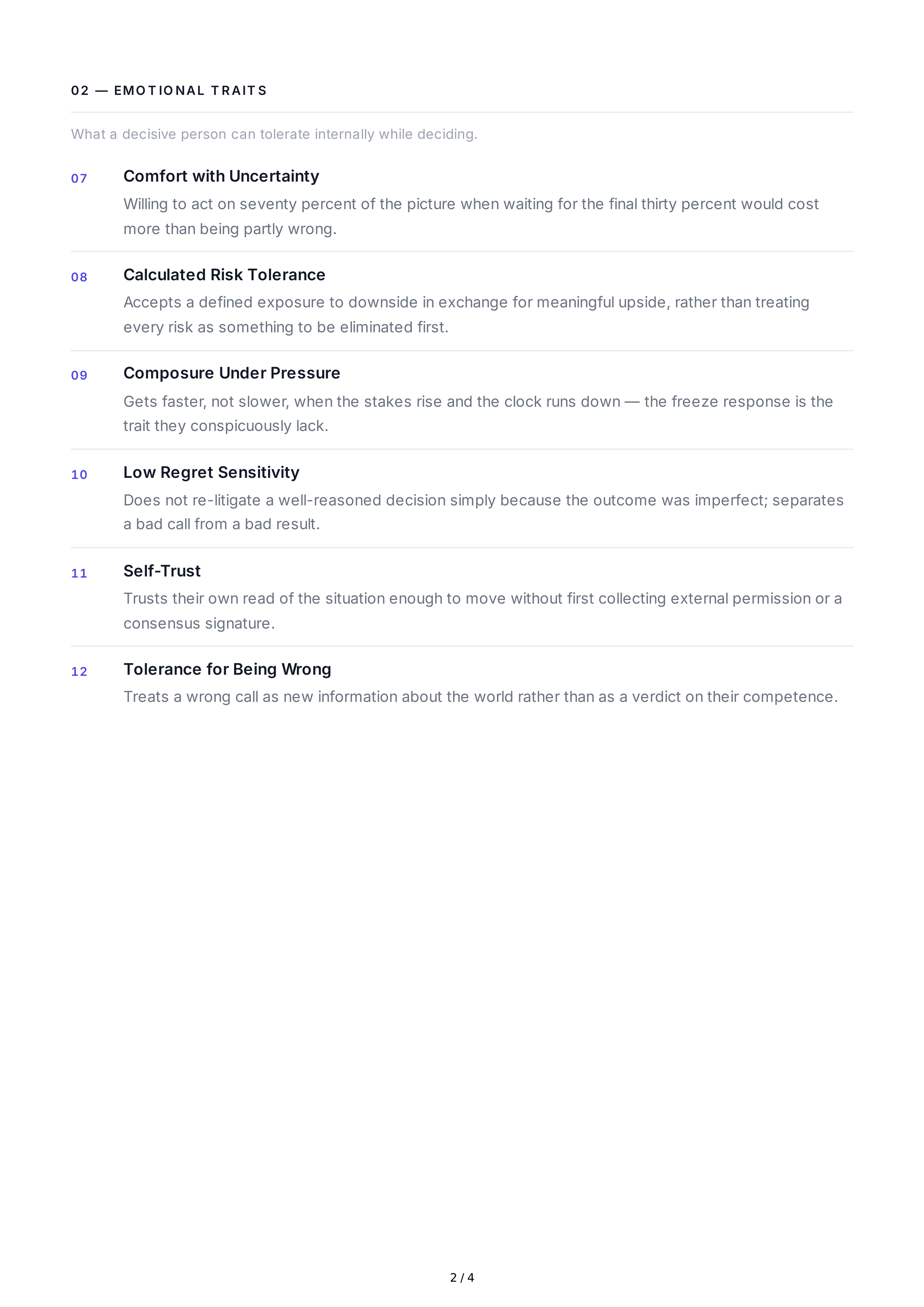
02 —
EMO T IO NAL
T RAIT S
What
a
decisive
person
can
tolerate
internally
while
deciding
.
07
Comfort
with
Uncertainty
Willing
to
act
on
seventy
percent
of
the
picture
when
waiting
for
the
final
thirty
percent
would
cost
more
than
being
partly
wrong
.
08
Calculated
Risk
Tolerance
Accepts
a
defined
exposure
to
downside
in
exchange
for
meaningful
upside
,
rather
than
treating
every
risk
as
something
to
be
eliminated
first
.
09
Composure
Under
Pressure
Gets
faster
,
not
slower
,
when
the
stakes
rise
and
the
clock
runs
down
—
the
freeze
response
is
the
trait
they
conspicuously
lack
.
10
Low
Regret
Sensitivity
Does
not
re
-
litigate
a
well
-
reasoned
decision
simply
because
the
outcome
was
imperfect
;
separates
a
bad
call
from
a
bad
result
.
11
Self
-
Trust
Trusts
their
own
read
of
the
situation
enough
to
move
without
first
collecting
external
permission
or
a
consensus
signature
.
12
Tolerance
for
Being
Wrong
Treats
a
wrong
call
as
new
information
about
the
world
rather
than
as
a
verdict
on
their
competence
.
2 / 4
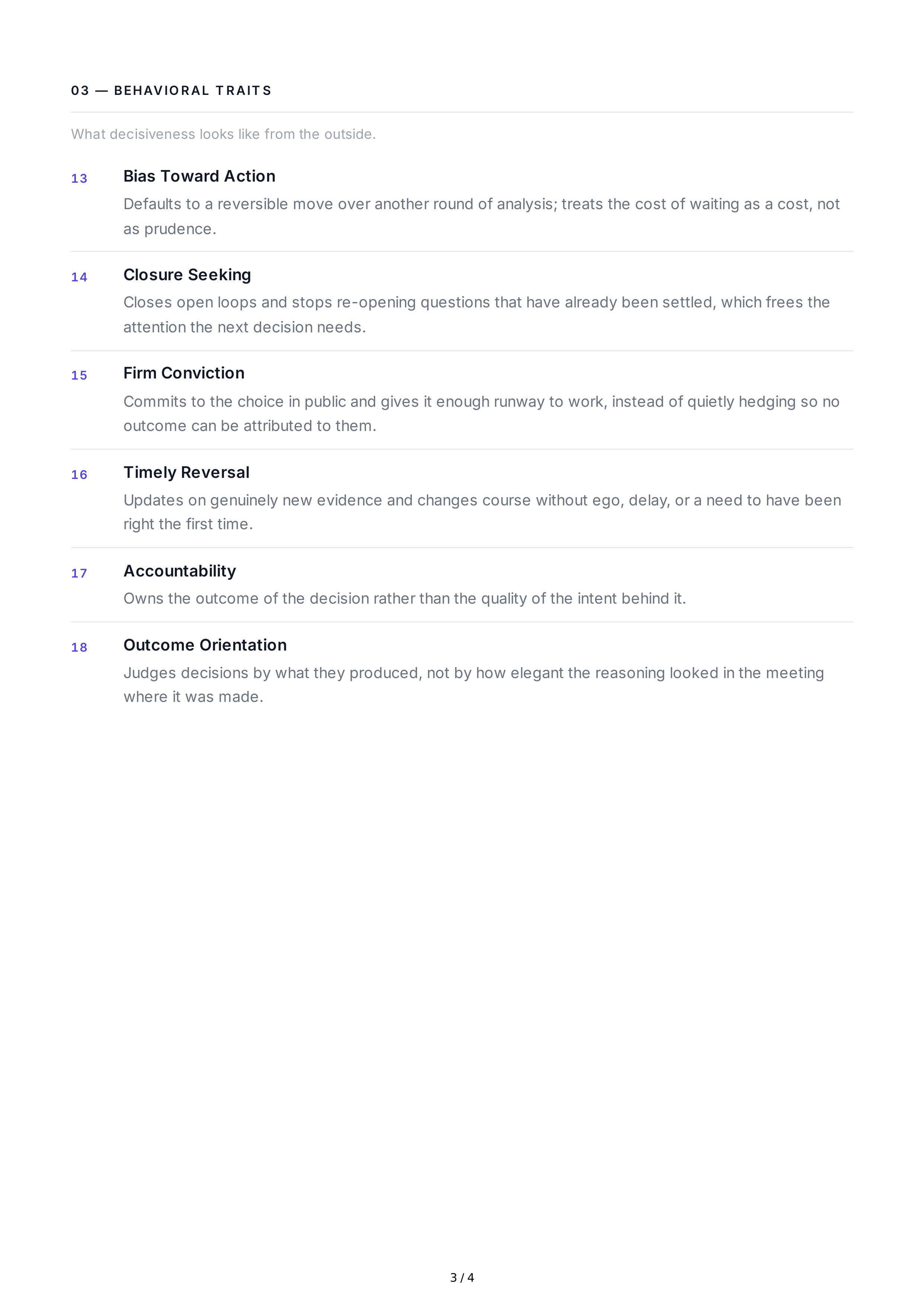
03 —
BEHAVIO RAL
T RAIT S
What
decisiveness
looks
like
from
the
outside
.
13
Bias
Toward
Action
Defaults
to
a
reversible
move
over
another
round
of
analysis
;
treats
the
cost
of
waiting
as
a
cost
,
not
as
prudence
.
14
Closure
Seeking
Closes
open
loops
and
stops
re
-
opening
questions
that
have
already
been
settled
,
which
frees
the
attention
the
next
decision
needs
.
15
Firm
Conviction
Commits
to
the
choice
in
public
and
gives
it
enough
runway
to
work
,
instead
of
quietly
hedging
so
no
outcome
can
be
attributed
to
them
.
16
Timely
Reversal
Updates
on
genuinely
new
evidence
and
changes
course
without
ego
,
delay
,
or
a
need
to
have
been
right
the
first
time
.
17
Accountability
Owns
the
outcome
of
the
decision
rather
than
the
quality
of
the
intent
behind
it
.
18
Outcome
Orientation
Judges
decisions
by
what
they
produced
,
not
by
how
elegant
the
reasoning
looked
in
the
meeting
where
it
was
made
.
3 / 4
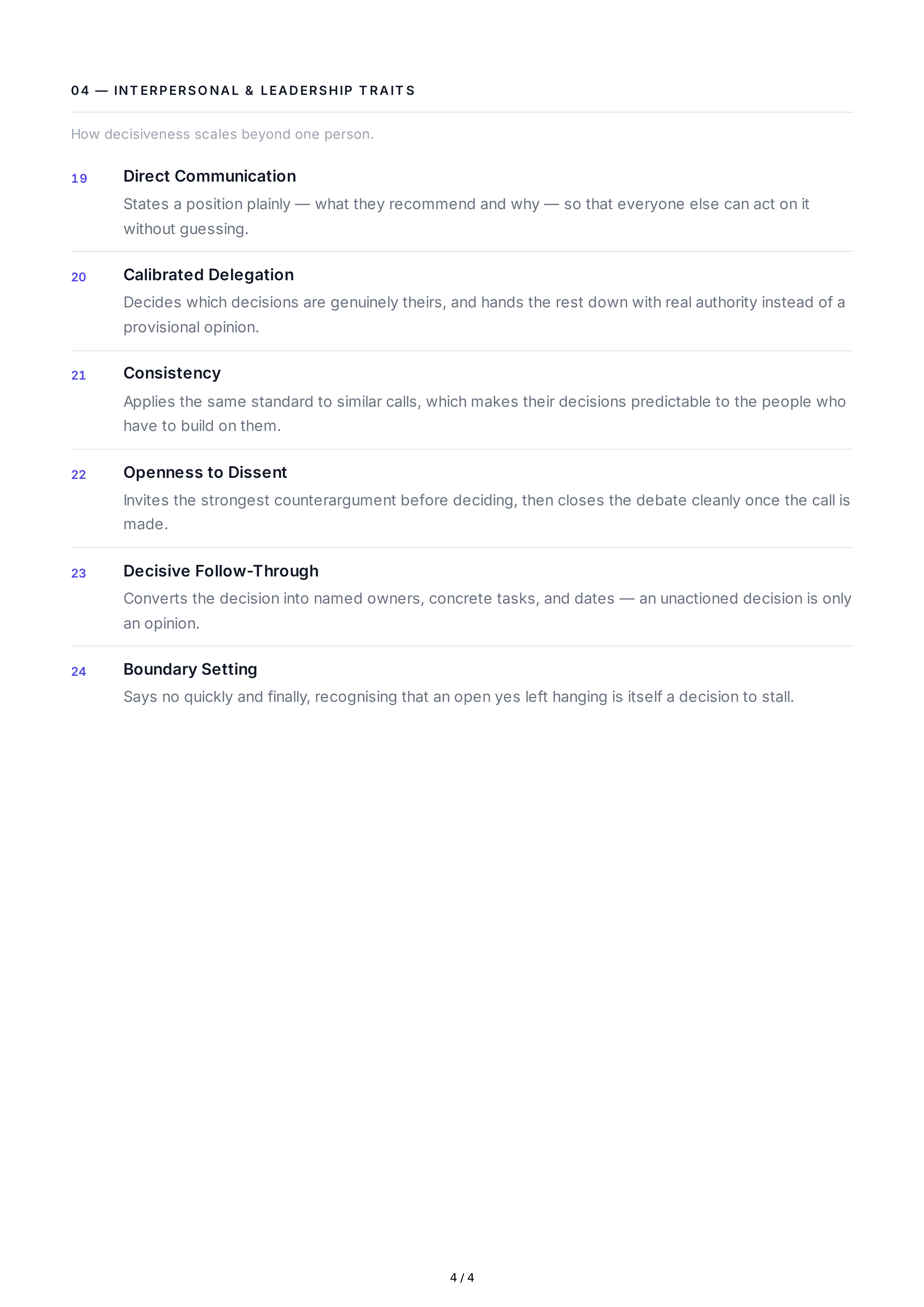
04 —
INT ERPERSO NAL
&
LEADERSHIP
T RAIT S
How
decisiveness
scales
beyond
one
person
.
19
Direct
Communication
States
a
position
plainly
—
what
they
recommend
and
why
—
so
that
everyone
else
can
act
on
it
without
guessing
.
20
Calibrated
Delegation
Decides
which
decisions
are
genuinely
theirs
,
and
hands
the
rest
down
with
real
authority
instead
of
a
provisional
opinion
.
21
Consistency
Applies
the
same
standard
to
similar
calls
,
which
makes
their
decisions
predictable
to
the
people
who
have
to
build
on
them
.
22
Openness
to
Dissent
Invites
the
strongest
counterargument
before
deciding
,
then
closes
the
debate
cleanly
once
the
call
is
made
.
23
Decisive
Follow
-
Through
Converts
the
decision
into
named
owners
,
concrete
tasks
,
and
dates
—
an
unactioned
decision
is
only
an
opinion
.
24
Boundary
Setting
Says
no
quickly
and
finally
,
recognising
that
an
open
yes
left
hanging
is
itself
a
decision
to
stall
.
4 / 4