Reliability
Personality
Traits
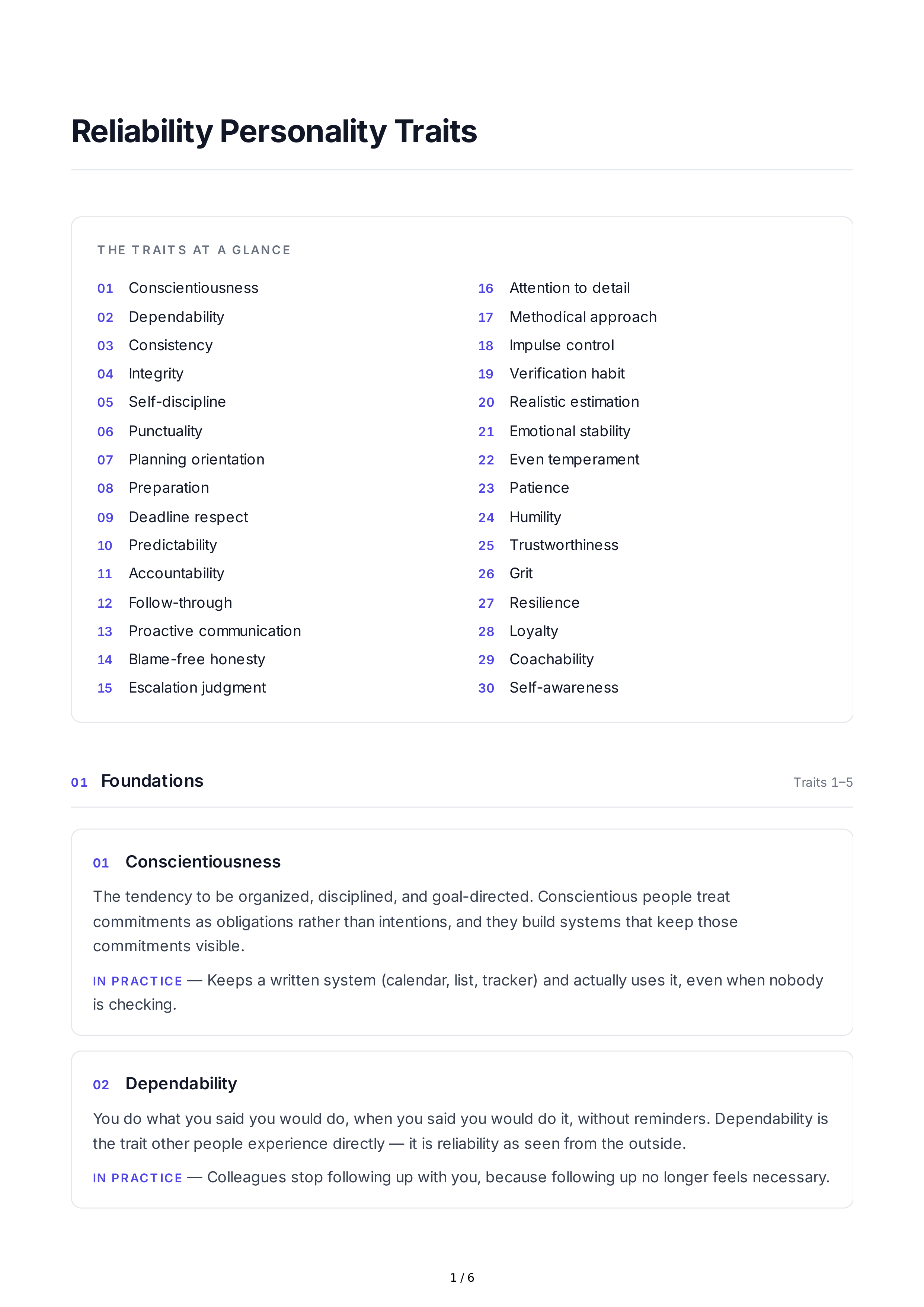
T HE
T R AIT S
AT
A
G LAN C E
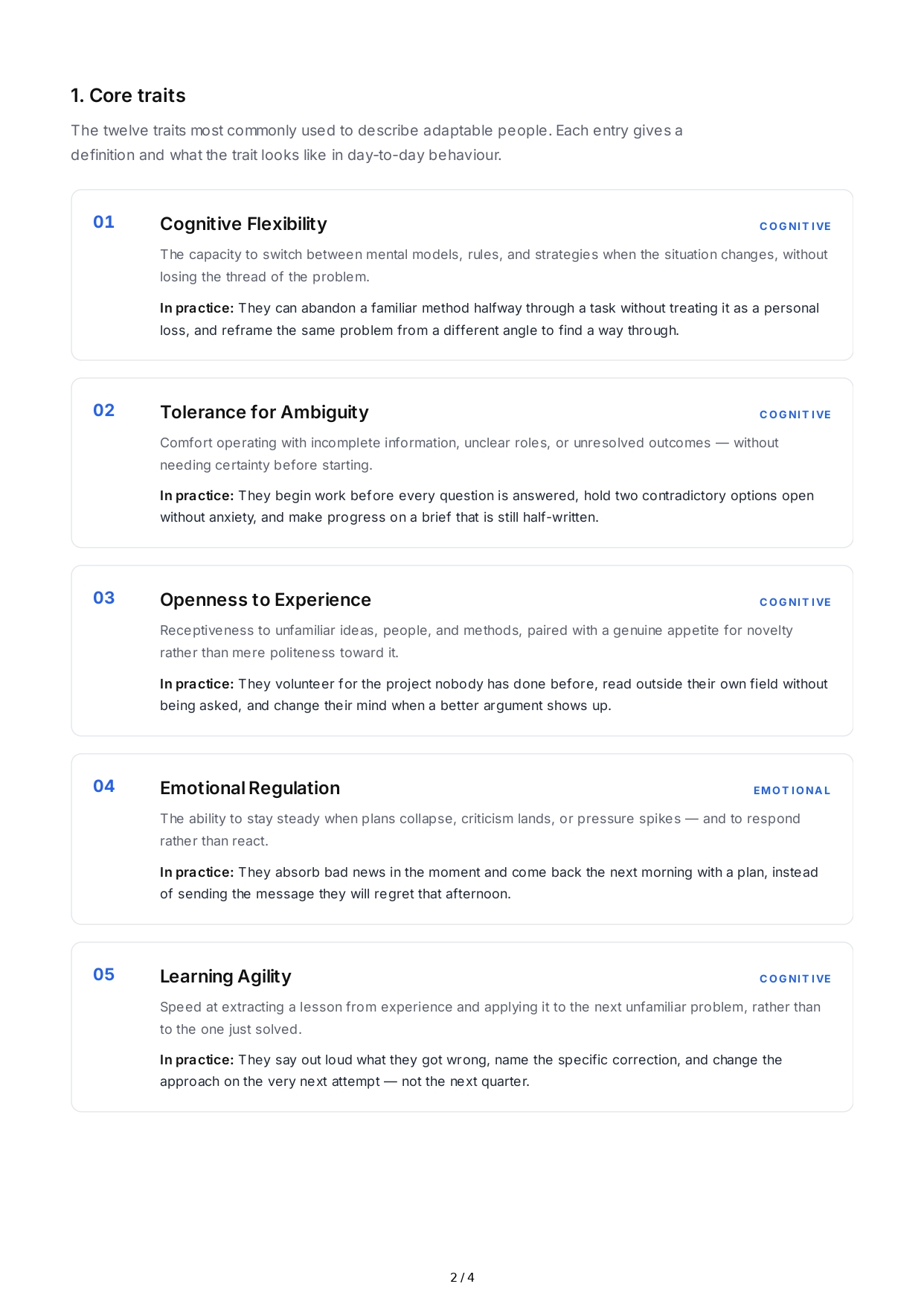
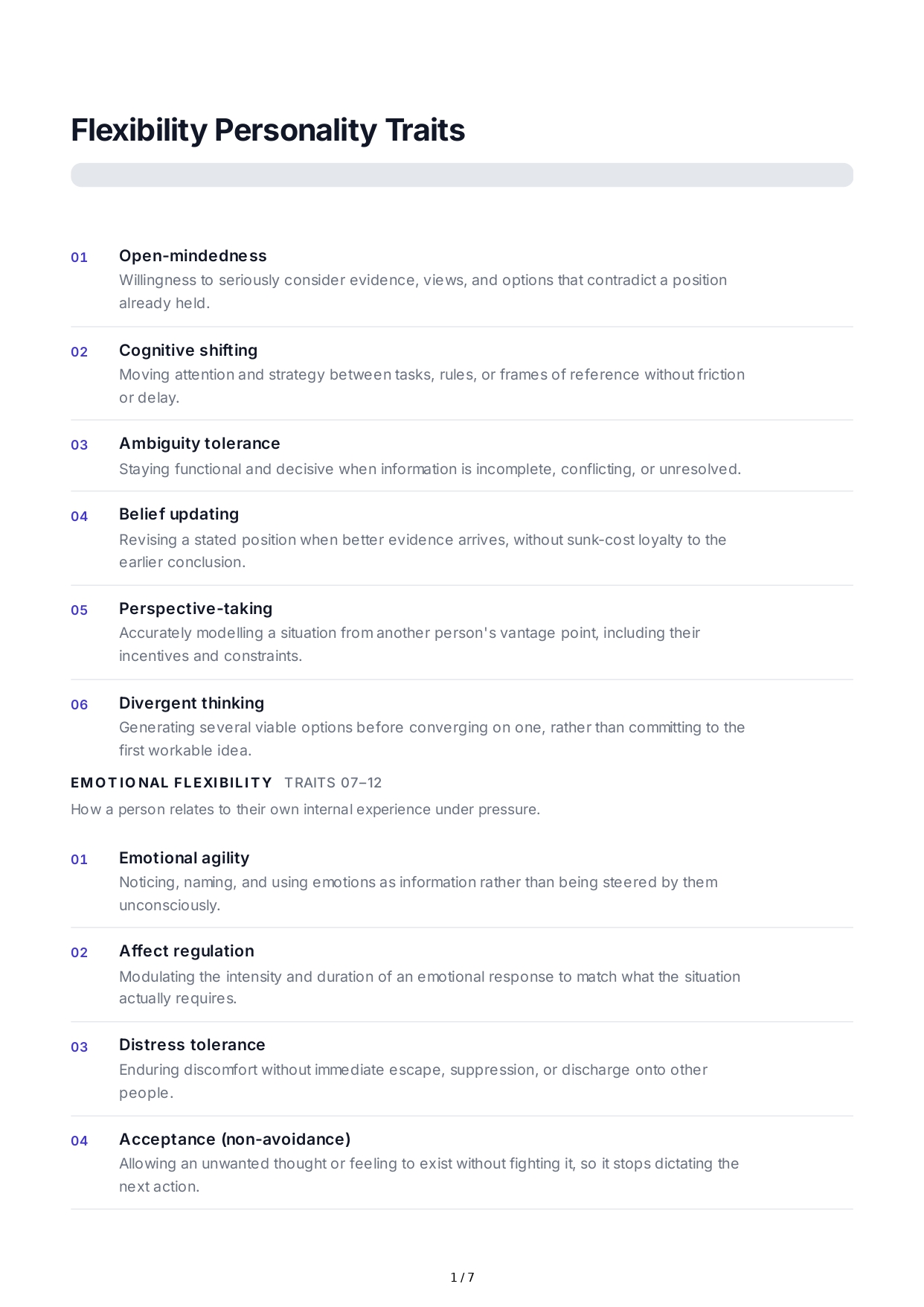
01
Conscientiousness
16
Attention
to
detail
02
Dependability
17
Methodical
approach
03
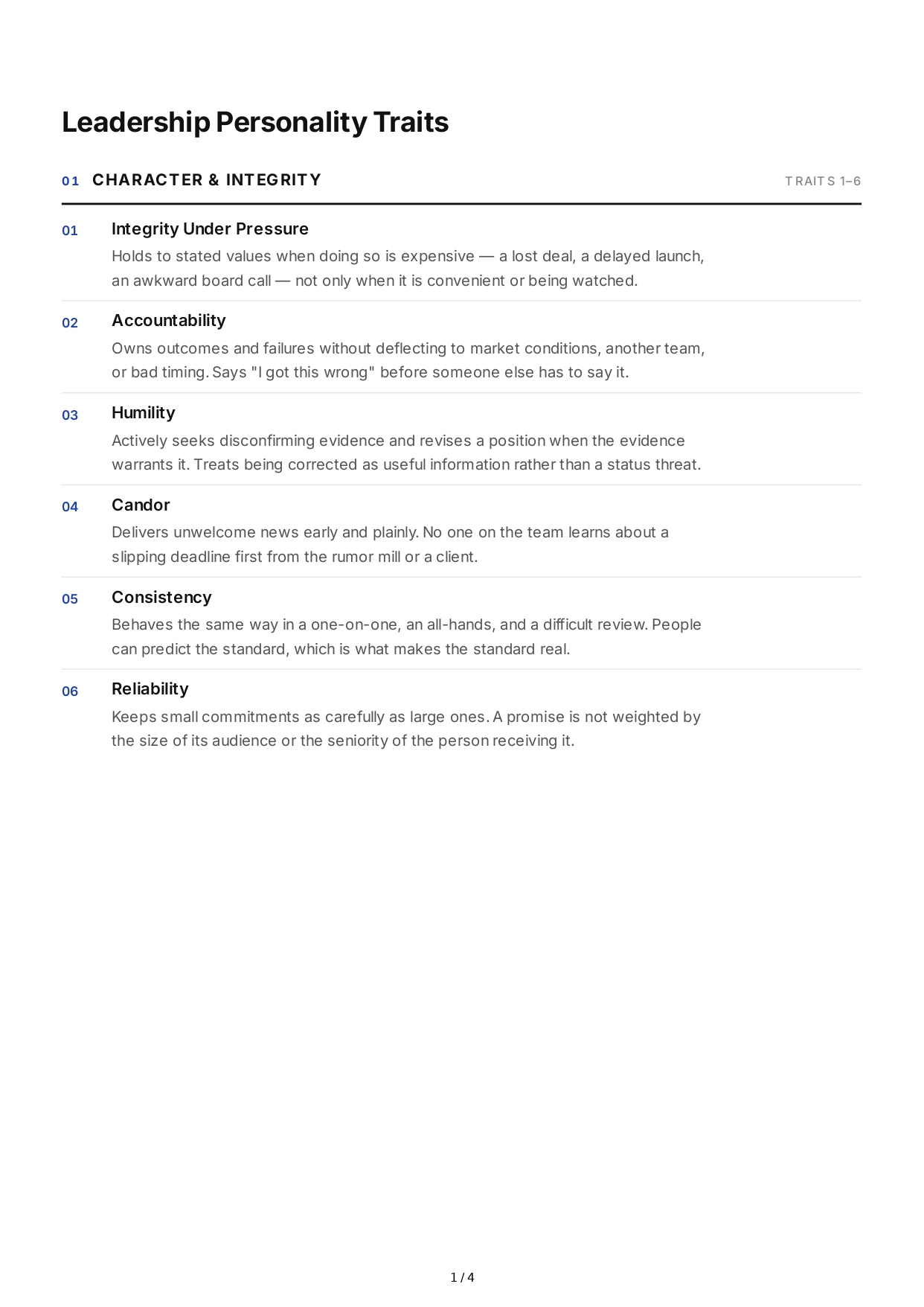
Consistency
18
Impulse
control
04
Integrity
19
Verification
habit
05
Self
-
discipline
20
Realistic
estimation
06
Punctuality
21
Emotional
stability
07
Planning
orientation
22
Even
temperament
08
Preparation
23
Patience
09
Deadline
respect
24
Humility
10
Predictability
25
Trustworthiness
11
Accountability
26
Grit
12
Follow
-
through
27
Resilience
13
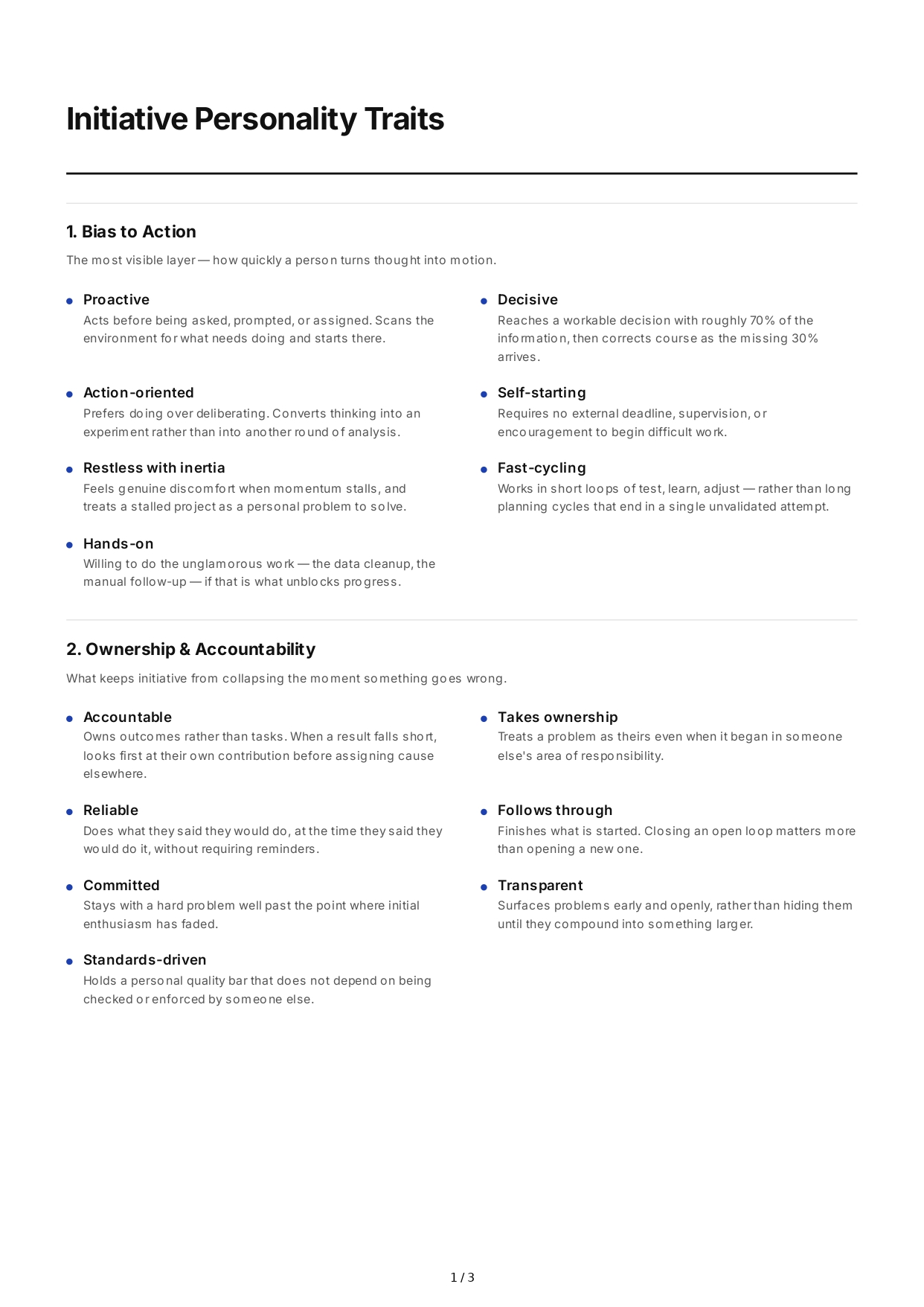
Proactive
communication
28
Loyalty
14
Blame
-
free
honesty
29
Coachability
15
Escalation
judgment
30
Self
-
awareness
01
Foundations
Traits
1–5
01
Conscientiousness
The
tendency
to
be
organized
,
disciplined
,
and
goal
-
directed
.
Conscientious
people
treat
commitments
as
obligations
rather
than
intentions
,
and
they
build
systems
that
keep
those
commitments
visible
.
IN
PRACT ICE
—
Keeps
a
written
system
(
calendar
,
list
,
tracker
)
and
actually
uses
it
,
even
when
nobody
is
checking
.
02
Dependability
You
do
what
you
said
you
would
do
,
when
you
said
you
would
do
it
,
without
reminders
.
Dependability
is
the
trait
other
people
experience
directly
—
it
is
reliability
as
seen
from
the
outside
.
IN
PRACT ICE
—
Colleagues
stop
following
up
with
you
,
because
following
up
no
longer
feels
necessary
.
1 / 6
03
Consistency
Output
quality
holds
steady
across
moods
,
weeks
,
and
workloads
.
There
are
no
strong
weeks
and
weak
weeks
,
only
a
stable
baseline
that
other
people
can
build
on
.
IN
PRACT ICE
—
Monday
'
s
work
and
Friday
'
s
work
read
the
same
way
to
an
outside
reviewer
.
04
Integrity
Telling
the
truth
when
the
truth
is
inconvenient
—
especially
about
your
own
work
,
your
own
numbers
,
and
your
own
mistakes
.
Integrity
is
what
makes
a
reliable
person
'
s
status
reports
worth
trusting
.
IN
PRACT ICE
—
Volunteers
bad
news
before
anyone
has
to
go
looking
for
it
.
05
Self
-
discipline
The
capacity
to
work
at
the
required
standard
without
supervision
,
external
pressure
,
or
an
audience
.
It
is
the
trait
that
separates
a
reliable
remote
worker
from
a
reliable
-
office
-
hours
worker
.
IN
PRACT ICE
—
Output
on
an
unsupervised
week
matches
output
on
a
supervised
one
.
02
Time
&
Commitment
Traits
6–10
06
Punctuality
Arriving
,
replying
,
and
delivering
at
the
stated
time
.
Punctuality
is
the
most
visible
reliability
signal
because
anyone
can
measure
it
without
knowing
anything
else
about
you
.
IN
PRACT ICE
—
Joins
calls
on
the
minute
;
if
delayed
,
explains
without
being
asked
.
07
Planning
orientation
Thinking
in
timelines
rather
than
in
tasks
.
Reliable
people
map
dependencies
,
identify
the
long
pole
,
and
add
buffers
before
the
buffer
is
needed
.
IN
PRACT ICE
—
Names
what
could
slip
,
well
before
it
slips
.
08
Preparation
Doing
the
reading
,
the
setup
,
and
the
thinking
before
the
meeting
rather
than
during
it
.
Preparation
converts
scarce
shared
time
into
decisions
instead
of
context
-
setting
.
IN
PRACT ICE
—
Arrives
with
questions
already
formed
,
not
with
blank
context
.
2 / 6
09
Deadline
respect
Treating
a
deadline
as
a
fixed
constraint
and
renegotiating
it
early
if
it
genuinely
cannot
hold
.
The
renegotiation
is
part
of
the
trait
—
silent
slippage
is
not
.
IN
PRACT ICE
—
The
first
person
to
flag
a
slip
,
never
the
last
.
10
Predictability
Behavior
that
others
can
forecast
.
This
is
not
dullness
—
it
is
the
absence
of
surprises
in
the
places
where
surprises
are
expensive
.
IN
PRACT ICE
—
Teams
plan
around
you
without
holding
a
backup
plan
in
reserve
.
03
Ownership
&
Accountability
Traits
11–15
11
Accountability
Owning
outcomes
rather
than
activities
. "
I
did
my
part
"
is
not
the
same
statement
as
"
it
got
done
,"
and
reliable
people
know
the
difference
.
IN
PRACT ICE
—
Uses
"
I
"
for
failures
and
"
we
"
for
wins
.
12
Follow
-
through
Closing
the
loops
you
open
.
Every
request
,
question
,
or
promise
reaches
a
resolution
rather
than
quietly
expiring
in
an
inbox
.
IN
PRACT ICE
—
No
thread
simply
stops
;
each
one
gets
a
yes
,
a
no
,
or
a
date
.
13
Proactive
communication
Surfacing
status
,
risk
,
and
blockers
before
someone
has
to
ask
.
Reliable
communication
flows
ahead
of
the
question
,
not
in
response
to
it
.
IN
PRACT ICE
—
Sends
the
update
before
the
chase
email
is
written
.
14
Blame
-
free
honesty
Reporting
your
own
mistakes
early
,
while
they
are
still
cheap
to
fix
.
This
trait
is
what
keeps
small
errors
from
compounding
into
large
ones
.
IN
PRACT ICE
— "
I
broke
the
build
"
arrives
within
minutes
,
not
at
review
time
.
3 / 6
15
Escalation
judgment
Knowing
when
to
solve
a
problem
yourself
and
when
to
raise
it
.
Reliable
people
escalate
neither
too
early
,
which
wastes
other
people
'
s
time
,
nor
too
late
,
which
wastes
more
of
it
.
IN
PRACT ICE
—
Problems
reach
the
right
person
while
they
are
still
small
.
04
Work
Style
&
Judgment
Traits
16–20
16
Attention
to
detail
Catching
the
small
errors
that
undermine
trust
in
an
otherwise
strong
deliverable
—
the
wrong
figure
,
the
broken
link
,
the
stale
name
in
a
document
.
IN
PRACT ICE
—
Documents
arrive
without
typos
,
dead
links
,
or
carry
-
over
numbers
.
17
Methodical
approach
Working
from
a
repeatable
process
rather
than
from
inspiration
or
adrenaline
.
Method
is
what
makes
quality
reproducible
on
a
bad
day
.
IN
PRACT ICE
—
Can
explain
the
steps
they
took
,
not
just
the
result
they
reached
.
18
Impulse
control
Pausing
before
sending
,
committing
,
or
reacting
.
Deliberateness
over
reflex
—
particularly
in
writing
,
where
a
reaction
cannot
be
un
-
sent
.
IN
PRACT ICE
—
The
frustrated
message
gets
drafted
,
not
delivered
.
19
Verification
habit
Checking
your
own
work
against
the
original
requirement
before
handing
it
over
.
This
is
a
discipline
rather
than
a
skill
,
which
is
precisely
why
it
predicts
reliability
so
well
.
IN
PRACT ICE
—
Runs
the
check
even
when
no
one
would
ever
find
out
they
skipped
it
.
20
Realistic
estimation
Giving
timelines
based
on
evidence
rather
than
optimism
,
and
revising
them
when
the
evidence
changes
.
The
opposite
is
not
ambition
—
it
is
a
broken
promise
delivered
in
advance
.
IN
PRACT ICE
—
Estimates
come
with
assumptions
and
dependencies
attached
.
4 / 6
05
Emotional
&
Interpersonal
Traits
21–25
21
Emotional
stability
Steady
mood
and
steady
effort
under
pressure
.
Stress
raises
the
pace
of
work
;
it
does
not
change
the
standard
of
work
.
IN
PRACT ICE
—
The
calmest
person
in
the
incident
channel
.
22
Even
temperament
Reacting
to
setbacks
at
proportional
volume
.
No
shouting
,
no
sulking
,
no
quiet
punishment
for
people
who
delivered
bad
news
.
IN
PRACT ICE
—
Disagreement
stays
about
the
work
and
never
becomes
about
the
person
.
23
Patience
Tolerating
slow
progress
,
repeated
questions
,
and
long
feedback
cycles
without
cutting
corners
or
shortening
explanations
to
end
the
conversation
faster
.
IN
PRACT ICE
—
Explains
the
same
thing
a
third
time
without
an
audible
sigh
.
24
Humility
Knowing
the
boundaries
of
your
own
competence
and
saying
so
out
loud
.
This
is
the
trait
that
prevents
confident
wrong
answers
from
reaching
production
.
IN
PRACT ICE
— "
I
don
'
t
know
—
let
me
find
out
"
is
treated
as
a
complete
answer
.
25
Trustworthiness
Handling
other
people
'
s
information
,
access
,
money
,
and
reputations
with
care
—
and
without
needing
to
be
monitored
while
doing
it
.
IN
PRACT ICE
—
Gets
given
the
keys
,
the
card
,
and
the
confidential
deck
.
5 / 6
06
Stamina
&
Growth
Traits
26–30
26
Grit
Persisting
on
difficult
work
long
after
the
initial
motivation
has
run
out
.
Grit
is
what
carries
a
commitment
through
the
unglamorous
middle
section
of
a
project
.
IN
PRACT ICE
—
Still
working
the
problem
in
month
four
,
at
roughly
the
same
intensity
as
week
one
.
27
Resilience
Recovering
from
failure
and
setback
without
a
lasting
drop
in
output
or
engagement
.
Reliable
people
are
not
unaffected
by
setbacks
;
they
simply
return
to
baseline
faster
.
IN
PRACT ICE
—
Back
on
the
next
task
after
a
hard
review
,
within
the
same
week
.
28
Loyalty
Staying
committed
to
a
team
,
project
,
or
client
through
the
long
middle
,
when
the
work
stops
being
novel
and
the
recognition
thins
out
.
IN
PRACT ICE
—
Does
not
disappear
when
the
interesting
part
ends
.
29
Coachability
Taking
feedback
as
data
rather
than
as
a
verdict
,
and
changing
behavior
as
a
result
.
This
is
what
turns
a
reliable
junior
into
a
reliable
senior
over
time
.
IN
PRACT ICE
—
The
same
piece
of
feedback
does
not
need
to
be
given
twice
.
30
Self
-
awareness
An
accurate
model
of
your
own
failure
modes
,
paired
with
a
system
that
compensates
for
them
.
The
most
reliable
people
are
not
the
ones
without
weaknesses
—
they
are
the
ones
who
have
accounted
for
theirs
.
IN
PRACT ICE
—
Knows
they
estimate
badly
,
and
pads
the
number
on
purpose
.
6 / 6