Competitiveness
Personality
Traits
1 / 6
1.
The
traits
,
in
a
list
Numbered
1–51
for
reference
.
Each
entry
is
named
in
the
conventional
psychological
wording
;
full
definitions
follow
in
section
2.
A
M O T IVAT IO N AL
CO RE
1–8
1.
Achievement
striving
2.
Need
for
mastery
3.
Ambition
4.
Win
orientation
5.
Goal
orientation
6.
Status
motivation
7.
Excellence
standards
8.
Distinctiveness
drive
B
CO G N IT IVE
&
ST RAT EG IC
9–16
9.
Comparative
appraisal
10.
Advantage
scanning
11.
Strategic
foresight
12.
Performance
calibration
13.
Zero
-
sum
/
positive
-
sum
framing
14.
Pattern
-
recognition
speed
15.
Counterfactual
rehearsal
16.
Tactical
patience
C
BEHAVIO URAL
&
ACT IO N
17–24
17.
Initiative
taking
18.
Persistence
under
setback
19.
Decisiveness
20.
Preparation
intensity
21.
Contest
risk
tolerance
22.
Effort
mobilisation
23.
Adaptive
strategy
switching
24.
Stakes
urgency
D
IN T ERPERSO N AL
&
SO CIAL
25–32
25.
Dominance
26.
Assertiveness
27.
Self
-
promotion
28.
Status
awareness
29.
Negotiation
appetite
30.
Comparison
orientation
31.
Boundary
firmness
32.
Internal
-
rivalry
tolerance
E
EM O T IO N AL
&
REG ULAT O RY
33–39
33.
Outcome
investment
34.
Loss
-
aversion
intensity
35.
Arousal
tolerance
36.
Defeat
resilience
37.
Pride
regulation
38.
Frustration
tolerance
39.
Redemption
drive
F
RELAT IO N AL
O VERUSE
(
SHADO W
SIDE
)
40–46
40.
Contest
hostility
41.
Rank
contempt
42.
Envy
proneness
43.
Strategic
manipulation
44.
Win
-
at
-
any
-
cost
rigidity
45.
Cooperation
discount
46.
Striving
burnout
G
M AT URE
CO M PET IT IVEN ESS
47–51
47.
Development
competitiveness
48.
Grace
in
defeat
49.
Comparative
humility
50.
Collaborative
rivalry
51.
Long
-
game
orientation
2 / 6
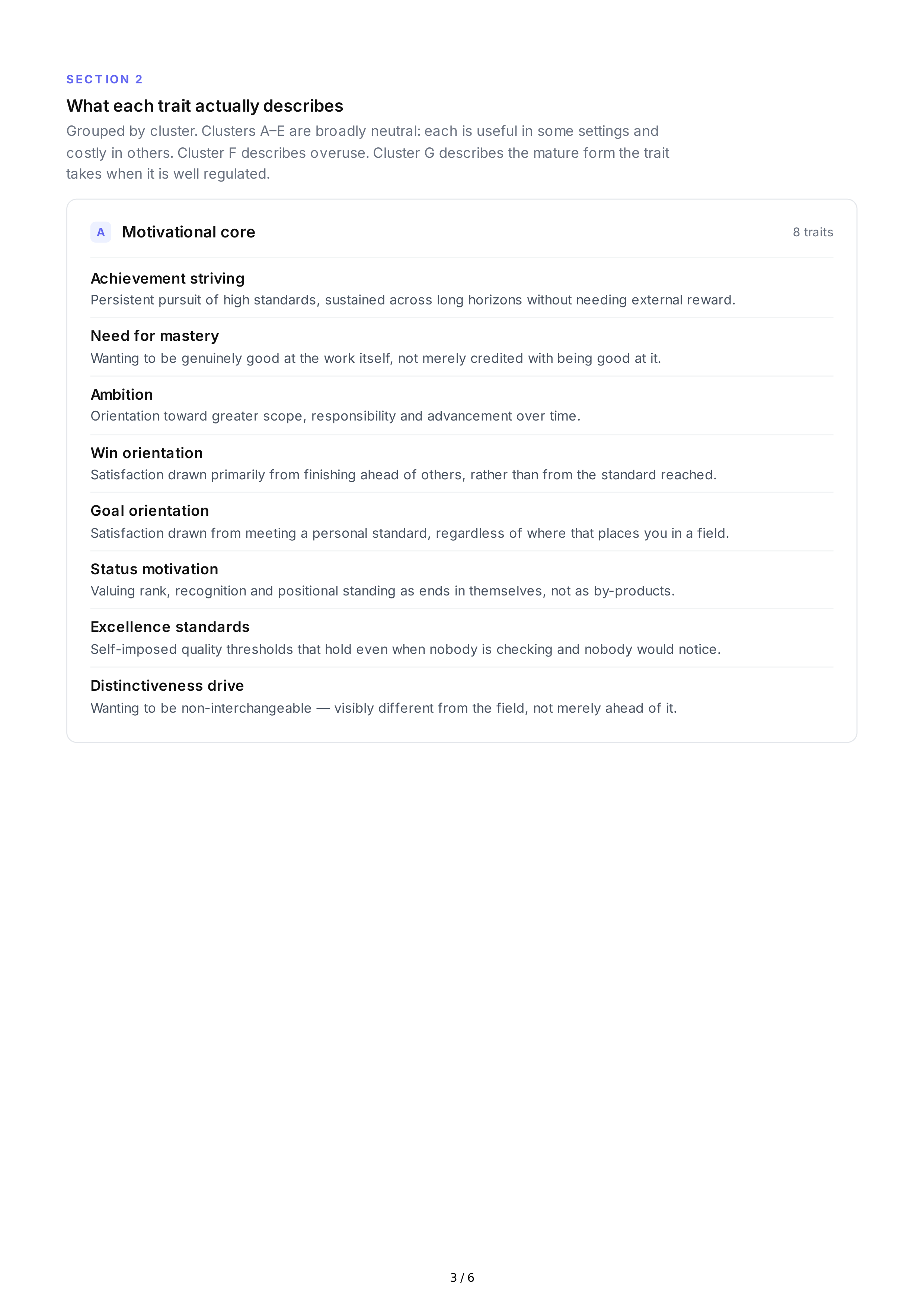
S EC T ION
2
What
each
trait
actually
describes
Grouped
by
cluster
.
Clusters
A
–
E
are
broadly
neutral
:
each
is
useful
in
some
settings
and
costly
in
others
.
Cluster
F
describes
overuse
.
Cluster
G
describes
the
mature
form
the
trait
takes
when
it
is
well
regulated
.
A
Motivational
core
8
traits
Achievement
striving
Persistent
pursuit
of
high
standards
,
sustained
across
long
horizons
without
needing
external
reward
.
Need
for
mastery
Wanting
to
be
genuinely
good
at
the
work
itself
,
not
merely
credited
with
being
good
at
it
.
Ambition
Orientation
toward
greater
scope
,
responsibility
and
advancement
over
time
.
Win
orientation
Satisfaction
drawn
primarily
from
finishing
ahead
of
others
,
rather
than
from
the
standard
reached
.
Goal
orientation
Satisfaction
drawn
from
meeting
a
personal
standard
,
regardless
of
where
that
places
you
in
a
field
.
Status
motivation
Valuing
rank
,
recognition
and
positional
standing
as
ends
in
themselves
,
not
as
by
-
products
.
Excellence
standards
Self
-
imposed
quality
thresholds
that
hold
even
when
nobody
is
checking
and
nobody
would
notice
.
Distinctiveness
drive
Wanting
to
be
non
-
interchangeable
—
visibly
different
from
the
field
,
not
merely
ahead
of
it
.
3 / 6
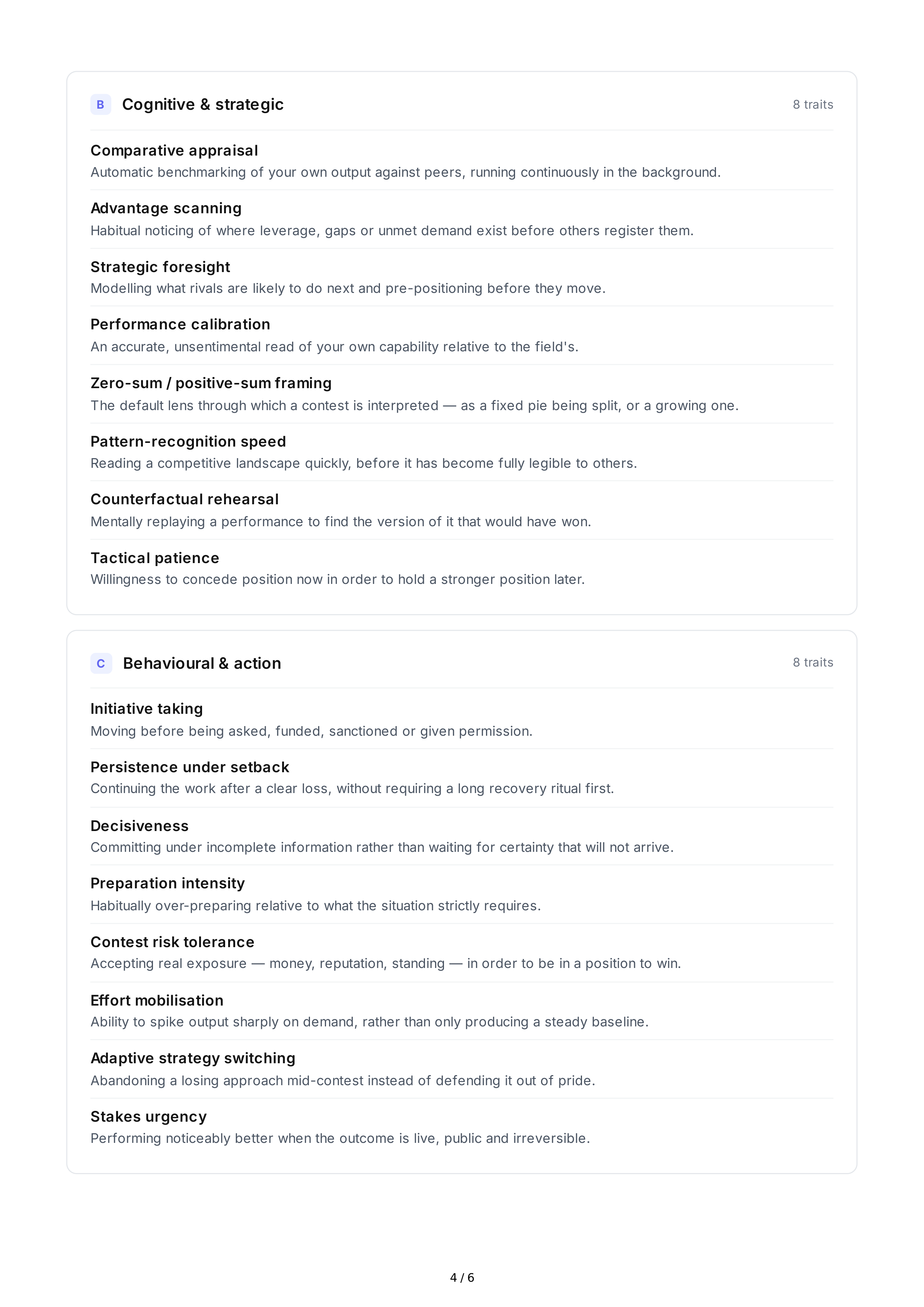
B
Cognitive
&
strategic
8
traits
Comparative
appraisal
Automatic
benchmarking
of
your
own
output
against
peers
,
running
continuously
in
the
background
.
Advantage
scanning
Habitual
noticing
of
where
leverage
,
gaps
or
unmet
demand
exist
before
others
register
them
.
Strategic
foresight
Modelling
what
rivals
are
likely
to
do
next
and
pre
-
positioning
before
they
move
.
Performance
calibration
An
accurate
,
unsentimental
read
of
your
own
capability
relative
to
the
field
'
s
.
Zero
-
sum
/
positive
-
sum
framing
The
default
lens
through
which
a
contest
is
interpreted
—
as
a
fixed
pie
being
split
,
or
a
growing
one
.
Pattern
-
recognition
speed
Reading
a
competitive
landscape
quickly
,
before
it
has
become
fully
legible
to
others
.
Counterfactual
rehearsal
Mentally
replaying
a
performance
to
find
the
version
of
it
that
would
have
won
.
Tactical
patience
Willingness
to
concede
position
now
in
order
to
hold
a
stronger
position
later
.
C
Behavioural
&
action
8
traits
Initiative
taking
Moving
before
being
asked
,
funded
,
sanctioned
or
given
permission
.
Persistence
under
setback
Continuing
the
work
after
a
clear
loss
,
without
requiring
a
long
recovery
ritual
first
.
Decisiveness
Committing
under
incomplete
information
rather
than
waiting
for
certainty
that
will
not
arrive
.
Preparation
intensity
Habitually
over
-
preparing
relative
to
what
the
situation
strictly
requires
.
Contest
risk
tolerance
Accepting
real
exposure
—
money
,
reputation
,
standing
—
in
order
to
be
in
a
position
to
win
.
Effort
mobilisation
Ability
to
spike
output
sharply
on
demand
,
rather
than
only
producing
a
steady
baseline
.
Adaptive
strategy
switching
Abandoning
a
losing
approach
mid
-
contest
instead
of
defending
it
out
of
pride
.
Stakes
urgency
Performing
noticeably
better
when
the
outcome
is
live
,
public
and
irreversible
.
4 / 6
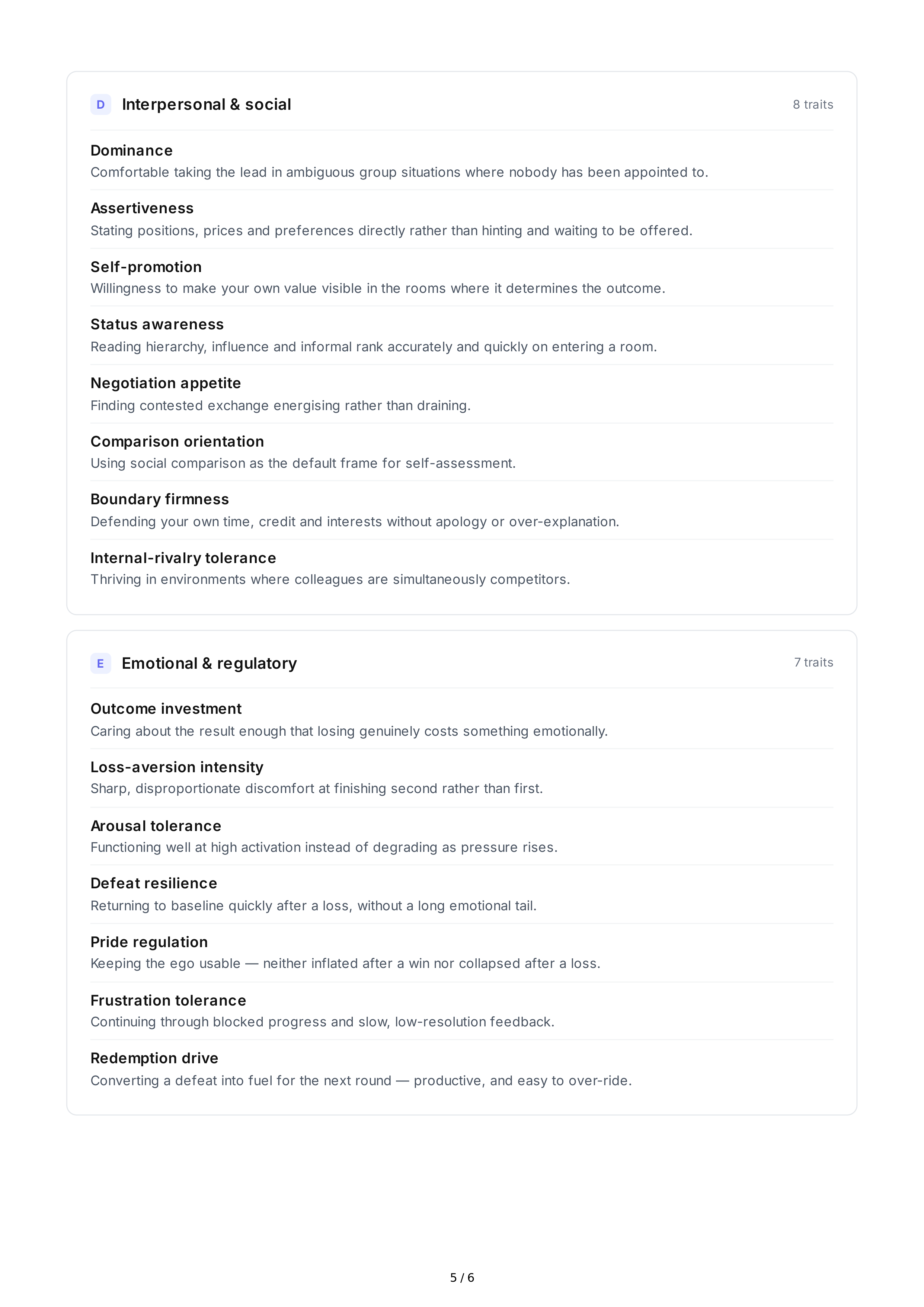
D
Interpersonal
&
social
8
traits
Dominance
Comfortable
taking
the
lead
in
ambiguous
group
situations
where
nobody
has
been
appointed
to
.
Assertiveness
Stating
positions
,
prices
and
preferences
directly
rather
than
hinting
and
waiting
to
be
offered
.
Self
-
promotion
Willingness
to
make
your
own
value
visible
in
the
rooms
where
it
determines
the
outcome
.
Status
awareness
Reading
hierarchy
,
influence
and
informal
rank
accurately
and
quickly
on
entering
a
room
.
Negotiation
appetite
Finding
contested
exchange
energising
rather
than
draining
.
Comparison
orientation
Using
social
comparison
as
the
default
frame
for
self
-
assessment
.
Boundary
firmness
Defending
your
own
time
,
credit
and
interests
without
apology
or
over
-
explanation
.
Internal
-
rivalry
tolerance
Thriving
in
environments
where
colleagues
are
simultaneously
competitors
.
E
Emotional
&
regulatory
7
traits
Outcome
investment
Caring
about
the
result
enough
that
losing
genuinely
costs
something
emotionally
.
Loss
-
aversion
intensity
Sharp
,
disproportionate
discomfort
at
finishing
second
rather
than
first
.
Arousal
tolerance
Functioning
well
at
high
activation
instead
of
degrading
as
pressure
rises
.
Defeat
resilience
Returning
to
baseline
quickly
after
a
loss
,
without
a
long
emotional
tail
.
Pride
regulation
Keeping
the
ego
usable
—
neither
inflated
after
a
win
nor
collapsed
after
a
loss
.
Frustration
tolerance
Continuing
through
blocked
progress
and
slow
,
low
-
resolution
feedback
.
Redemption
drive
Converting
a
defeat
into
fuel
for
the
next
round
—
productive
,
and
easy
to
over
-
ride
.
5 / 6
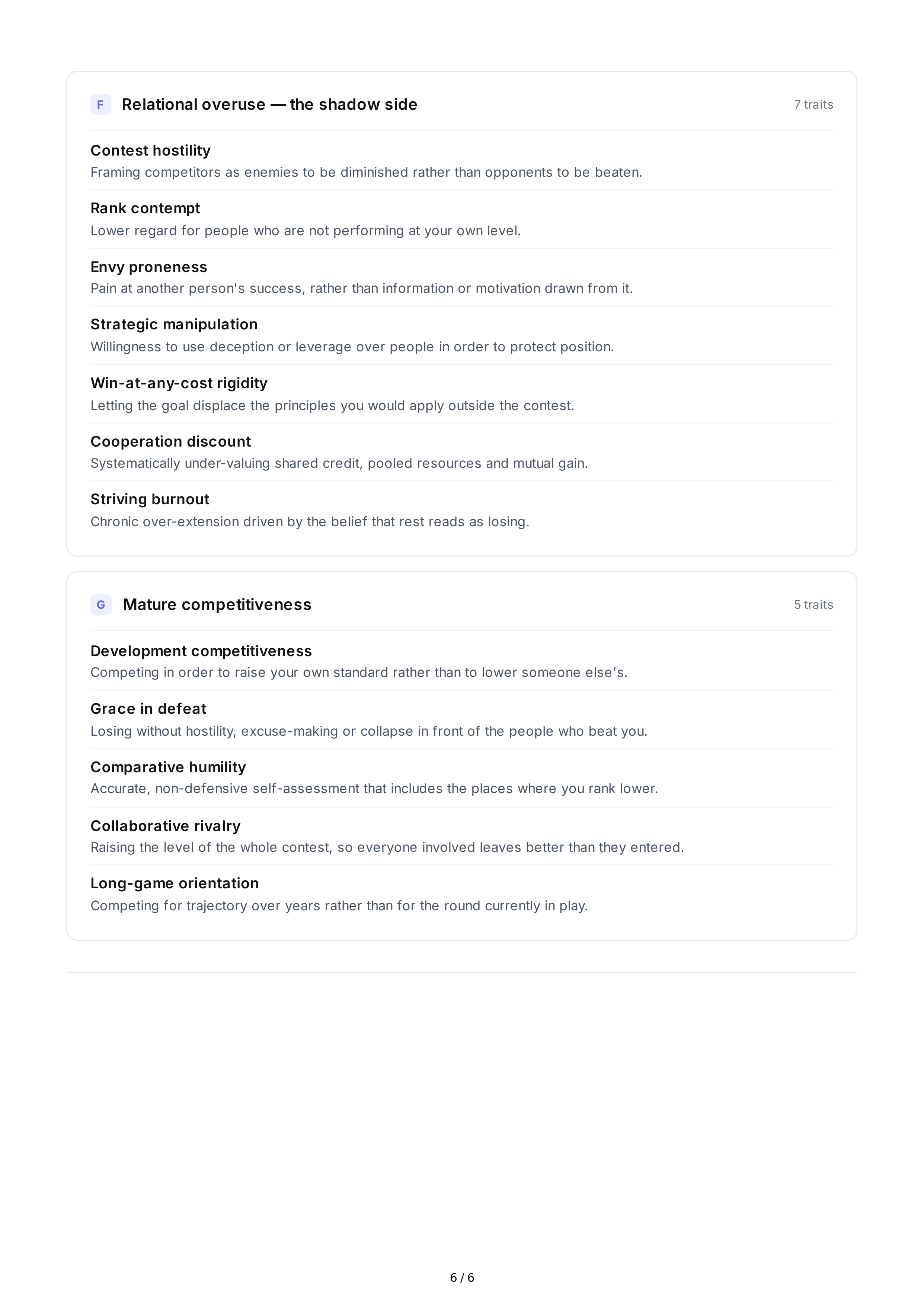
F
Relational
overuse
—
the
shadow
side
7
traits
Contest
hostility
Framing
competitors
as
enemies
to
be
diminished
rather
than
opponents
to
be
beaten
.
Rank
contempt
Lower
regard
for
people
who
are
not
performing
at
your
own
level
.
Envy
proneness
Pain
at
another
person
'
s
success
,
rather
than
information
or
motivation
drawn
from
it
.
Strategic
manipulation
Willingness
to
use
deception
or
leverage
over
people
in
order
to
protect
position
.
Win
-
at
-
any
-
cost
rigidity
Letting
the
goal
displace
the
principles
you
would
apply
outside
the
contest
.
Cooperation
discount
Systematically
under
-
valuing
shared
credit
,
pooled
resources
and
mutual
gain
.
Striving
burnout
Chronic
over
-
extension
driven
by
the
belief
that
rest
reads
as
losing
.
G
Mature
competitiveness
5
traits
Development
competitiveness
Competing
in
order
to
raise
your
own
standard
rather
than
to
lower
someone
else
'
s
.
Grace
in
defeat
Losing
without
hostility
,
excuse
-
making
or
collapse
in
front
of
the
people
who
beat
you
.
Comparative
humility
Accurate
,
non
-
defensive
self
-
assessment
that
includes
the
places
where
you
rank
lower
.
Collaborative
rivalry
Raising
the
level
of
the
whole
contest
,
so
everyone
involved
leaves
better
than
they
entered
.
Long
-
game
orientation
Competing
for
trajectory
over
years
rather
than
for
the
round
currently
in
play
.
6 / 6