Persistence
Personality
Traits
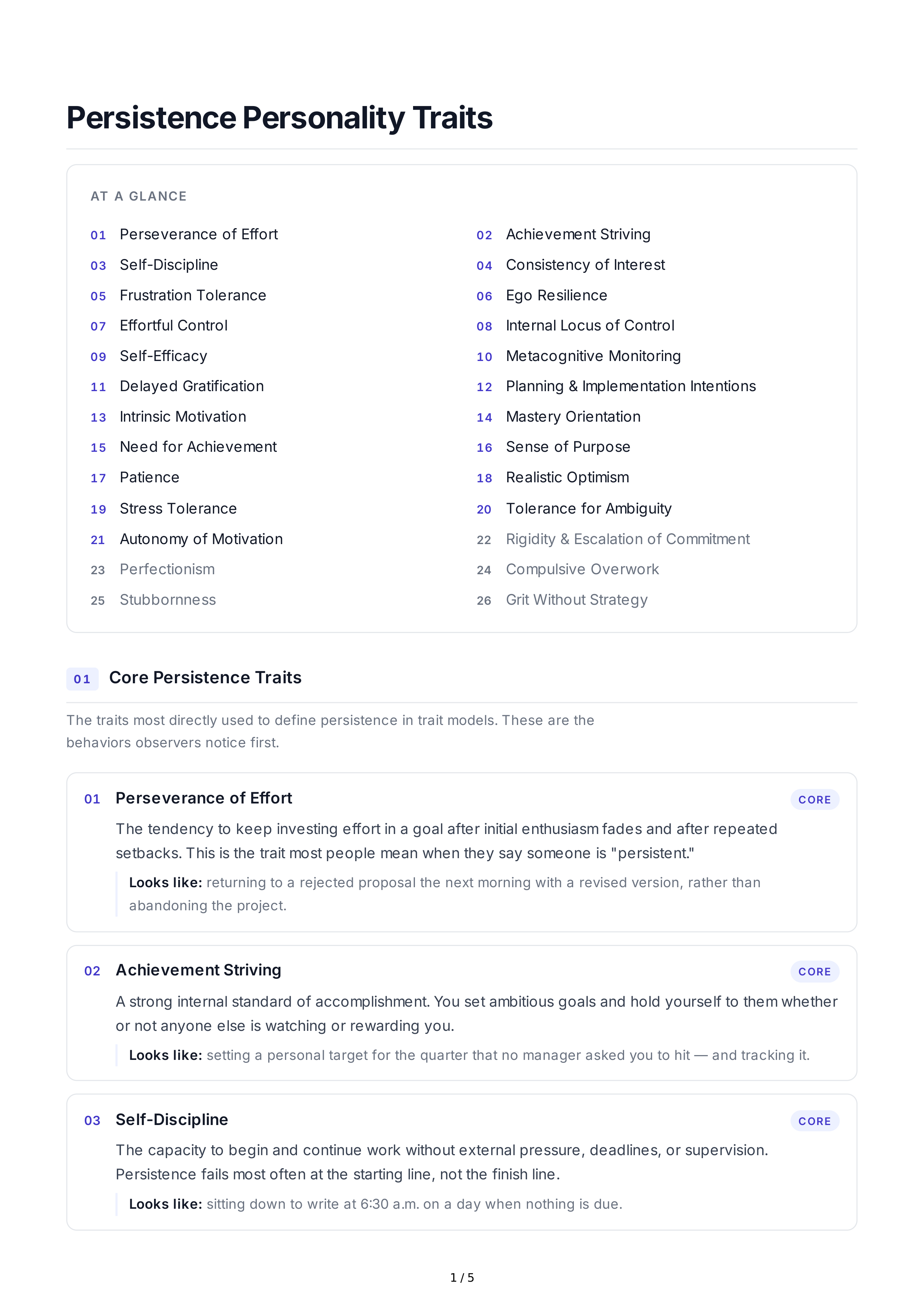
AT
A
GLANCE
01
Perseverance
of
Effort
02
Achievement
Striving
03
Self
-
Discipline
04
Consistency
of
Interest
05
Frustration
Tolerance
06
Ego
Resilience
07
Effortful
Control
08
Internal
Locus
of
Control
09
Self
-
Efficacy
10
Metacognitive
Monitoring
11
Delayed
Gratification
12
Planning
&
Implementation
Intentions
13
Intrinsic
Motivation
14
Mastery
Orientation
15
Need
for
Achievement
16
Sense
of
Purpose
17
Patience
18
Realistic
Optimism
19
Stress
Tolerance
20
Tolerance
for
Ambiguity
21
Autonomy
of
Motivation
22
Rigidity
&
Escalation
of
Commitment
23
Perfectionism
24
Compulsive
Overwork
25
Stubbornness
26
Grit
Without
Strategy
0 1
Core
Persistence
Traits
The
traits
most
directly
used
to
define
persistence
in
trait
models
.
These
are
the
behaviors
observers
notice
first
.
01
Perseverance
of
Effort
CORE
The
tendency
to
keep
investing
effort
in
a
goal
after
initial
enthusiasm
fades
and
after
repeated
setbacks
.
This
is
the
trait
most
people
mean
when
they
say
someone
is
"
persistent
."
Looks
like
:
returning
to
a
rejected
proposal
the
next
morning
with
a
revised
version
,
rather
than
abandoning
the
project
.
02
Achievement
Striving
CORE
A
strong
internal
standard
of
accomplishment
.
You
set
ambitious
goals
and
hold
yourself
to
them
whether
or
not
anyone
else
is
watching
or
rewarding
you
.
Looks
like
:
setting
a
personal
target
for
the
quarter
that
no
manager
asked
you
to
hit
—
and
tracking
it
.
03
Self
-
Discipline
CORE
The
capacity
to
begin
and
continue
work
without
external
pressure
,
deadlines
,
or
supervision
.
Persistence
fails
most
often
at
the
starting
line
,
not
the
finish
line
.
Looks
like
:
sitting
down
to
write
at
6:30
a
.
m
.
on
a
day
when
nothing
is
due
.
1 / 5
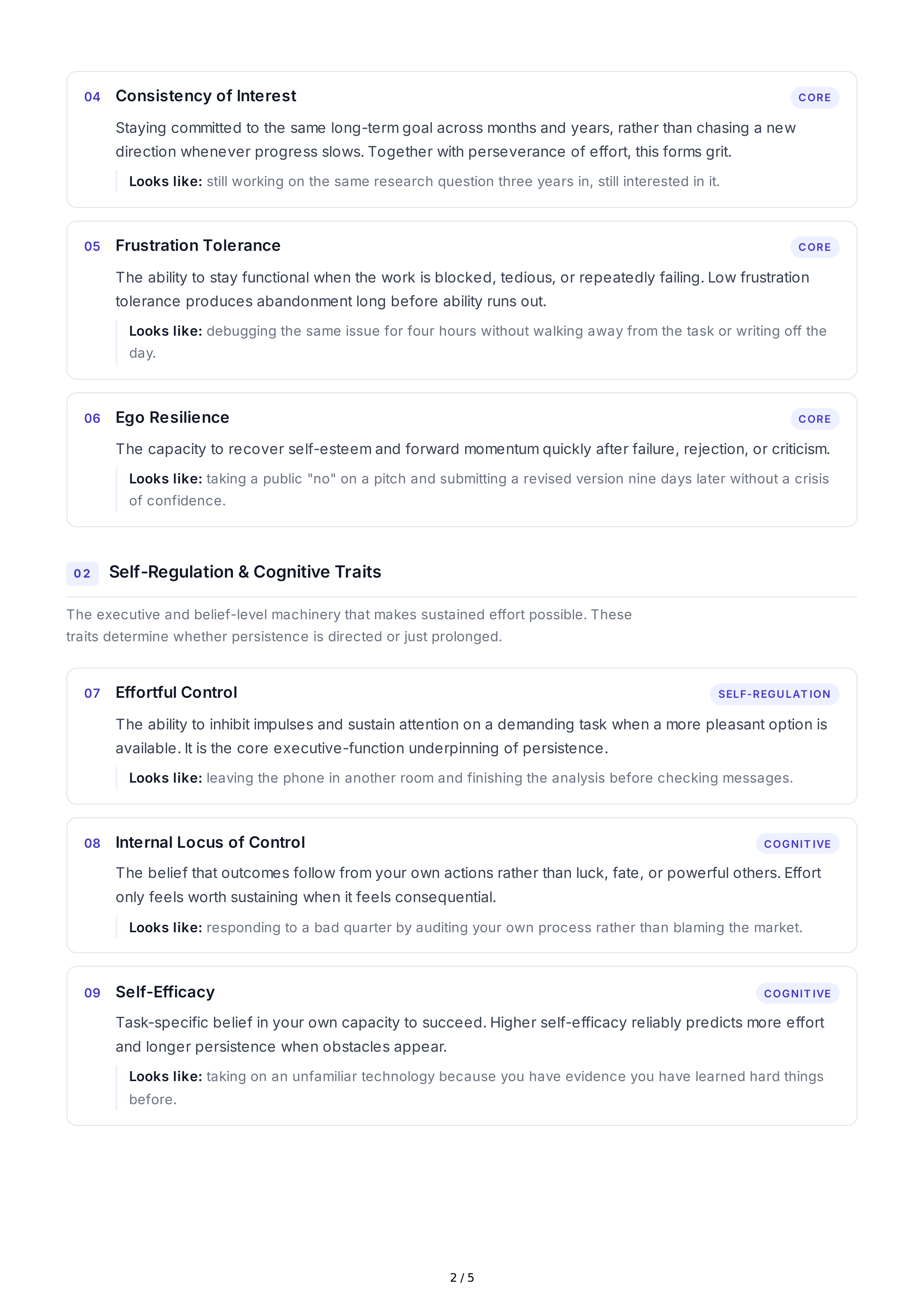
04
Consistency
of
Interest
CORE
Staying
committed
to
the
same
long
-
term
goal
across
months
and
years
,
rather
than
chasing
a
new
direction
whenever
progress
slows
.
Together
with
perseverance
of
effort
,
this
forms
grit
.
Looks
like
:
still
working
on
the
same
research
question
three
years
in
,
still
interested
in
it
.
05
Frustration
Tolerance
CORE
The
ability
to
stay
functional
when
the
work
is
blocked
,
tedious
,
or
repeatedly
failing
.
Low
frustration
tolerance
produces
abandonment
long
before
ability
runs
out
.
Looks
like
:
debugging
the
same
issue
for
four
hours
without
walking
away
from
the
task
or
writing
off
the
day
.
06
Ego
Resilience
CORE
The
capacity
to
recover
self
-
esteem
and
forward
momentum
quickly
after
failure
,
rejection
,
or
criticism
.
Looks
like
:
taking
a
public
"
no
"
on
a
pitch
and
submitting
a
revised
version
nine
days
later
without
a
crisis
of
confidence
.
0 2
Self
-
Regulation
&
Cognitive
Traits
The
executive
and
belief
-
level
machinery
that
makes
sustained
effort
possible
.
These
traits
determine
whether
persistence
is
directed
or
just
prolonged
.
07
Effortful
Control
SELF
-
REGULAT ION
The
ability
to
inhibit
impulses
and
sustain
attention
on
a
demanding
task
when
a
more
pleasant
option
is
available
.
It
is
the
core
executive
-
function
underpinning
of
persistence
.
Looks
like
:
leaving
the
phone
in
another
room
and
finishing
the
analysis
before
checking
messages
.
08
Internal
Locus
of
Control
COGNIT IVE
The
belief
that
outcomes
follow
from
your
own
actions
rather
than
luck
,
fate
,
or
powerful
others
.
Effort
only
feels
worth
sustaining
when
it
feels
consequential
.
Looks
like
:
responding
to
a
bad
quarter
by
auditing
your
own
process
rather
than
blaming
the
market
.
09
Self
-
Efficacy
COGNIT IVE
Task
-
specific
belief
in
your
own
capacity
to
succeed
.
Higher
self
-
efficacy
reliably
predicts
more
effort
and
longer
persistence
when
obstacles
appear
.
Looks
like
:
taking
on
an
unfamiliar
technology
because
you
have
evidence
you
have
learned
hard
things
before
.
2 / 5
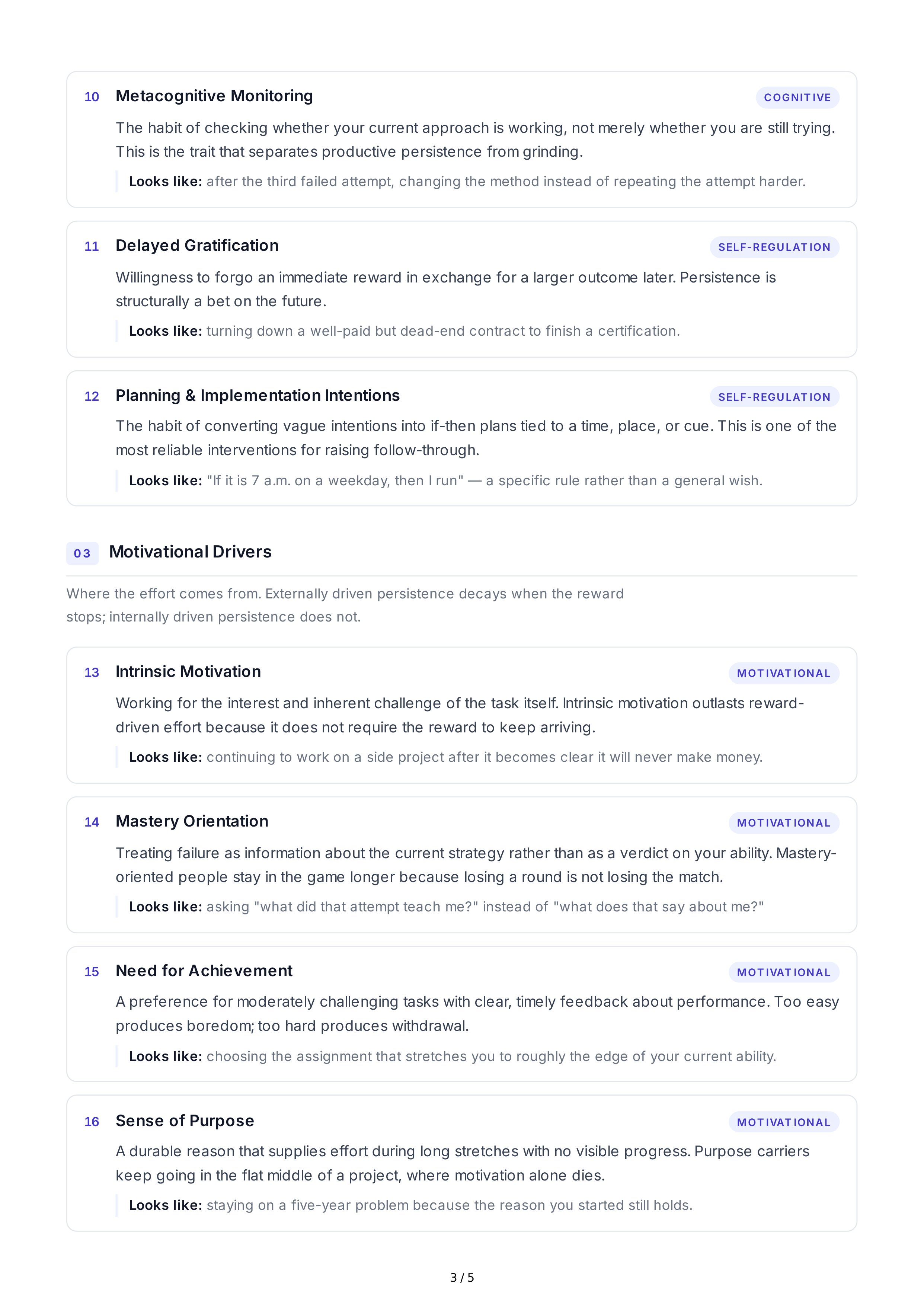
10
Metacognitive
Monitoring
COGNIT IVE
The
habit
of
checking
whether
your
current
approach
is
working
,
not
merely
whether
you
are
still
trying
.
This
is
the
trait
that
separates
productive
persistence
from
grinding
.
Looks
like
:
after
the
third
failed
attempt
,
changing
the
method
instead
of
repeating
the
attempt
harder
.
11
Delayed
Gratification
SELF
-
REGULAT ION
Willingness
to
forgo
an
immediate
reward
in
exchange
for
a
larger
outcome
later
.
Persistence
is
structurally
a
bet
on
the
future
.
Looks
like
:
turning
down
a
well
-
paid
but
dead
-
end
contract
to
finish
a
certification
.
12
Planning
&
Implementation
Intentions
SELF
-
REGULAT ION
The
habit
of
converting
vague
intentions
into
if
-
then
plans
tied
to
a
time
,
place
,
or
cue
.
This
is
one
of
the
most
reliable
interventions
for
raising
follow
-
through
.
Looks
like
:
"
If
it
is
7
a
.
m
.
on
a
weekday
,
then
I
run
" —
a
specific
rule
rather
than
a
general
wish
.
0 3
Motivational
Drivers
Where
the
effort
comes
from
.
Externally
driven
persistence
decays
when
the
reward
stops
;
internally
driven
persistence
does
not
.
13
Intrinsic
Motivation
MOT IVAT IONAL
Working
for
the
interest
and
inherent
challenge
of
the
task
itself
.
Intrinsic
motivation
outlasts
reward
-
driven
effort
because
it
does
not
require
the
reward
to
keep
arriving
.
Looks
like
:
continuing
to
work
on
a
side
project
after
it
becomes
clear
it
will
never
make
money
.
14
Mastery
Orientation
MOT IVAT IONAL
Treating
failure
as
information
about
the
current
strategy
rather
than
as
a
verdict
on
your
ability
.
Mastery
-
oriented
people
stay
in
the
game
longer
because
losing
a
round
is
not
losing
the
match
.
Looks
like
:
asking
"
what
did
that
attempt
teach
me
?"
instead
of
"
what
does
that
say
about
me
?"
15
Need
for
Achievement
MOT IVAT IONAL
A
preference
for
moderately
challenging
tasks
with
clear
,
timely
feedback
about
performance
.
Too
easy
produces
boredom
;
too
hard
produces
withdrawal
.
Looks
like
:
choosing
the
assignment
that
stretches
you
to
roughly
the
edge
of
your
current
ability
.
16
Sense
of
Purpose
MOT IVAT IONAL
A
durable
reason
that
supplies
effort
during
long
stretches
with
no
visible
progress
.
Purpose
carriers
keep
going
in
the
flat
middle
of
a
project
,
where
motivation
alone
dies
.
Looks
like
:
staying
on
a
five
-
year
problem
because
the
reason
you
started
still
holds
.
3 / 5
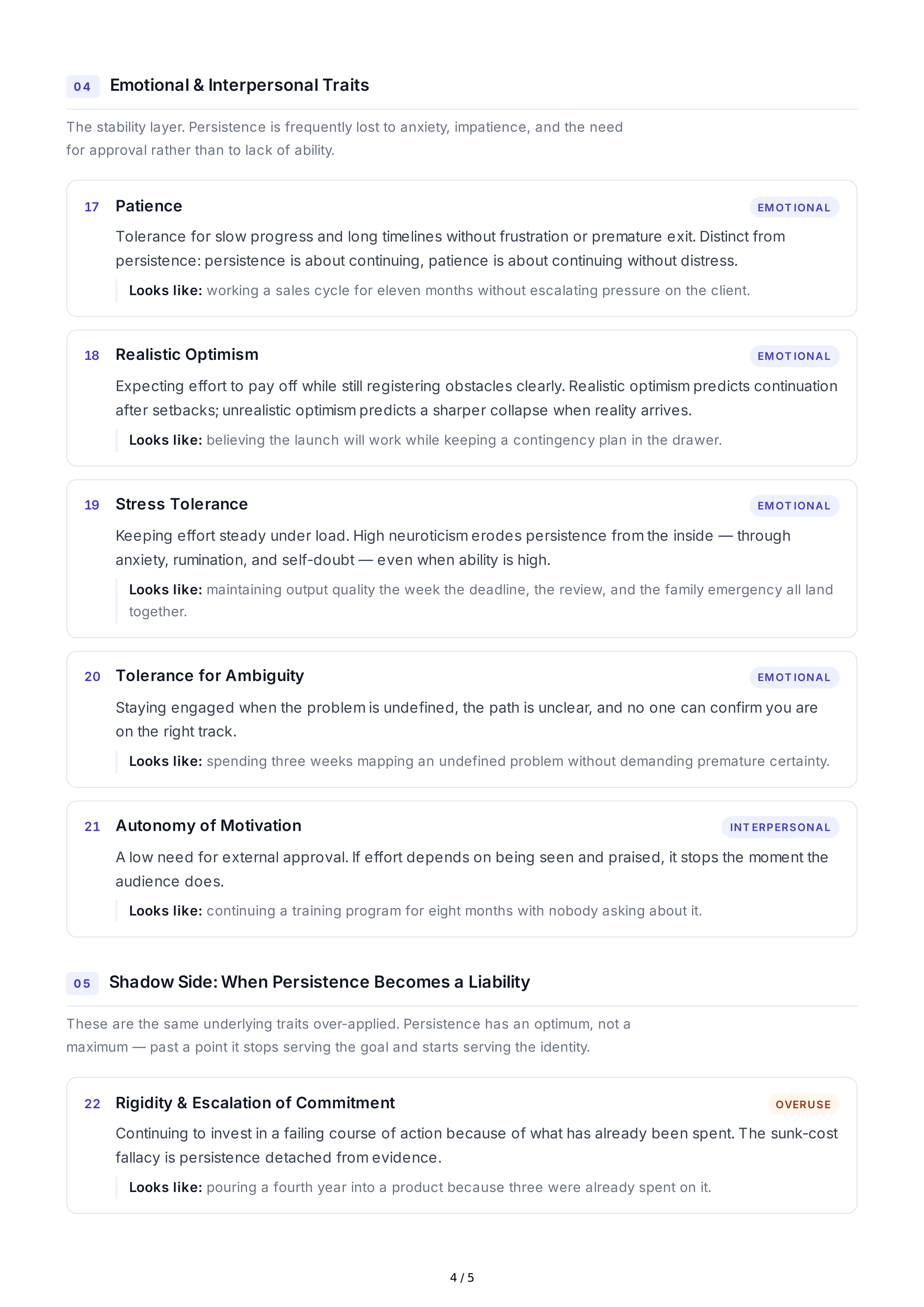
0 4
Emotional
&
Interpersonal
Traits
The
stability
layer
.
Persistence
is
frequently
lost
to
anxiety
,
impatience
,
and
the
need
for
approval
rather
than
to
lack
of
ability
.
17
Patience
EMOT IONAL
Tolerance
for
slow
progress
and
long
timelines
without
frustration
or
premature
exit
.
Distinct
from
persistence
:
persistence
is
about
continuing
,
patience
is
about
continuing
without
distress
.
Looks
like
:
working
a
sales
cycle
for
eleven
months
without
escalating
pressure
on
the
client
.
18
Realistic
Optimism
EMOT IONAL
Expecting
effort
to
pay
off
while
still
registering
obstacles
clearly
.
Realistic
optimism
predicts
continuation
after
setbacks
;
unrealistic
optimism
predicts
a
sharper
collapse
when
reality
arrives
.
Looks
like
:
believing
the
launch
will
work
while
keeping
a
contingency
plan
in
the
drawer
.
19
Stress
Tolerance
EMOT IONAL
Keeping
effort
steady
under
load
.
High
neuroticism
erodes
persistence
from
the
inside
—
through
anxiety
,
rumination
,
and
self
-
doubt
—
even
when
ability
is
high
.
Looks
like
:
maintaining
output
quality
the
week
the
deadline
,
the
review
,
and
the
family
emergency
all
land
together
.
20
Tolerance
for
Ambiguity
EMOT IONAL
Staying
engaged
when
the
problem
is
undefined
,
the
path
is
unclear
,
and
no
one
can
confirm
you
are
on
the
right
track
.
Looks
like
:
spending
three
weeks
mapping
an
undefined
problem
without
demanding
premature
certainty
.
21
Autonomy
of
Motivation
INT ERPERSONAL
A
low
need
for
external
approval
.
If
effort
depends
on
being
seen
and
praised
,
it
stops
the
moment
the
audience
does
.
Looks
like
:
continuing
a
training
program
for
eight
months
with
nobody
asking
about
it
.
0 5
Shadow
Side
:
When
Persistence
Becomes
a
Liability
These
are
the
same
underlying
traits
over
-
applied
.
Persistence
has
an
optimum
,
not
a
maximum
—
past
a
point
it
stops
serving
the
goal
and
starts
serving
the
identity
.
22
Rigidity
&
Escalation
of
Commitment
OVERUSE
Continuing
to
invest
in
a
failing
course
of
action
because
of
what
has
already
been
spent
.
The
sunk
-
cost
fallacy
is
persistence
detached
from
evidence
.
Looks
like
:
pouring
a
fourth
year
into
a
product
because
three
were
already
spent
on
it
.
4 / 5
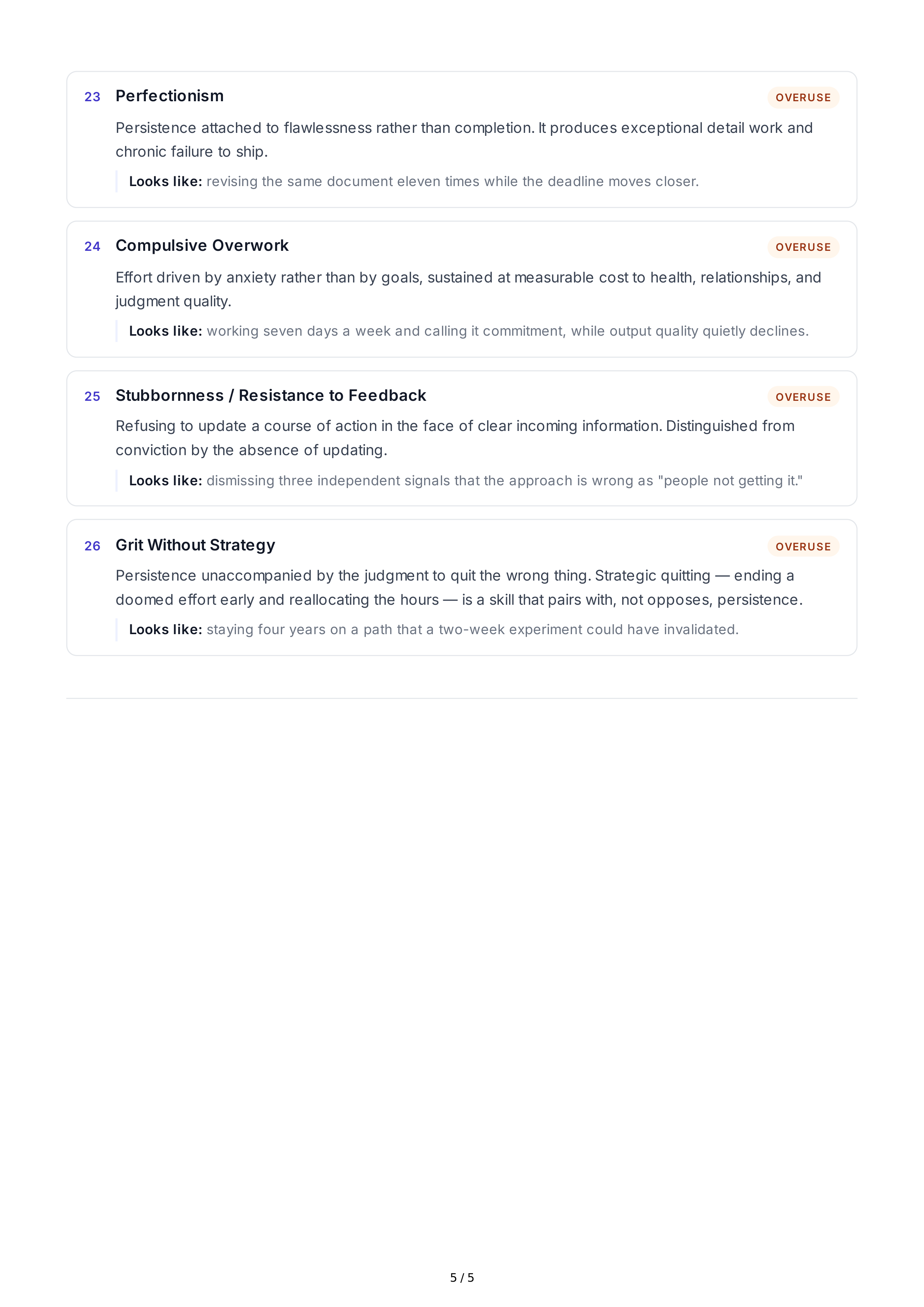
23
Perfectionism
OVERUSE
Persistence
attached
to
flawlessness
rather
than
completion
.
It
produces
exceptional
detail
work
and
chronic
failure
to
ship
.
Looks
like
:
revising
the
same
document
eleven
times
while
the
deadline
moves
closer
.
24
Compulsive
Overwork
OVERUSE
Effort
driven
by
anxiety
rather
than
by
goals
,
sustained
at
measurable
cost
to
health
,
relationships
,
and
judgment
quality
.
Looks
like
:
working
seven
days
a
week
and
calling
it
commitment
,
while
output
quality
quietly
declines
.
25
Stubbornness
/
Resistance
to
Feedback
OVERUSE
Refusing
to
update
a
course
of
action
in
the
face
of
clear
incoming
information
.
Distinguished
from
conviction
by
the
absence
of
updating
.
Looks
like
:
dismissing
three
independent
signals
that
the
approach
is
wrong
as
"
people
not
getting
it
."
26
Grit
Without
Strategy
OVERUSE
Persistence
unaccompanied
by
the
judgment
to
quit
the
wrong
thing
.
Strategic
quitting
—
ending
a
doomed
effort
early
and
reallocating
the
hours
—
is
a
skill
that
pairs
with
,
not
opposes
,
persistence
.
Looks
like
:
staying
four
years
on
a
path
that
a
two
-
week
experiment
could
have
invalidated
.
5 / 5