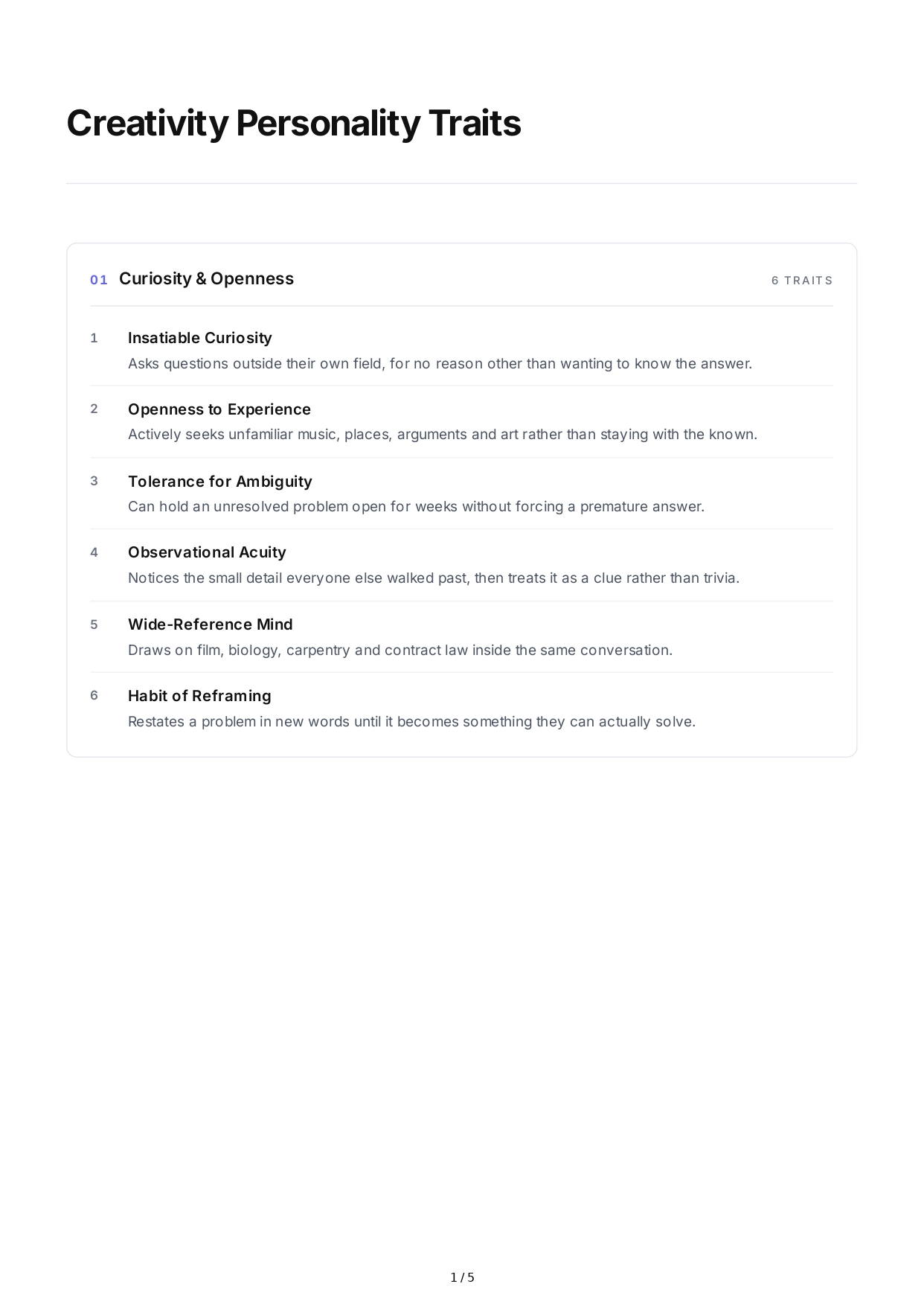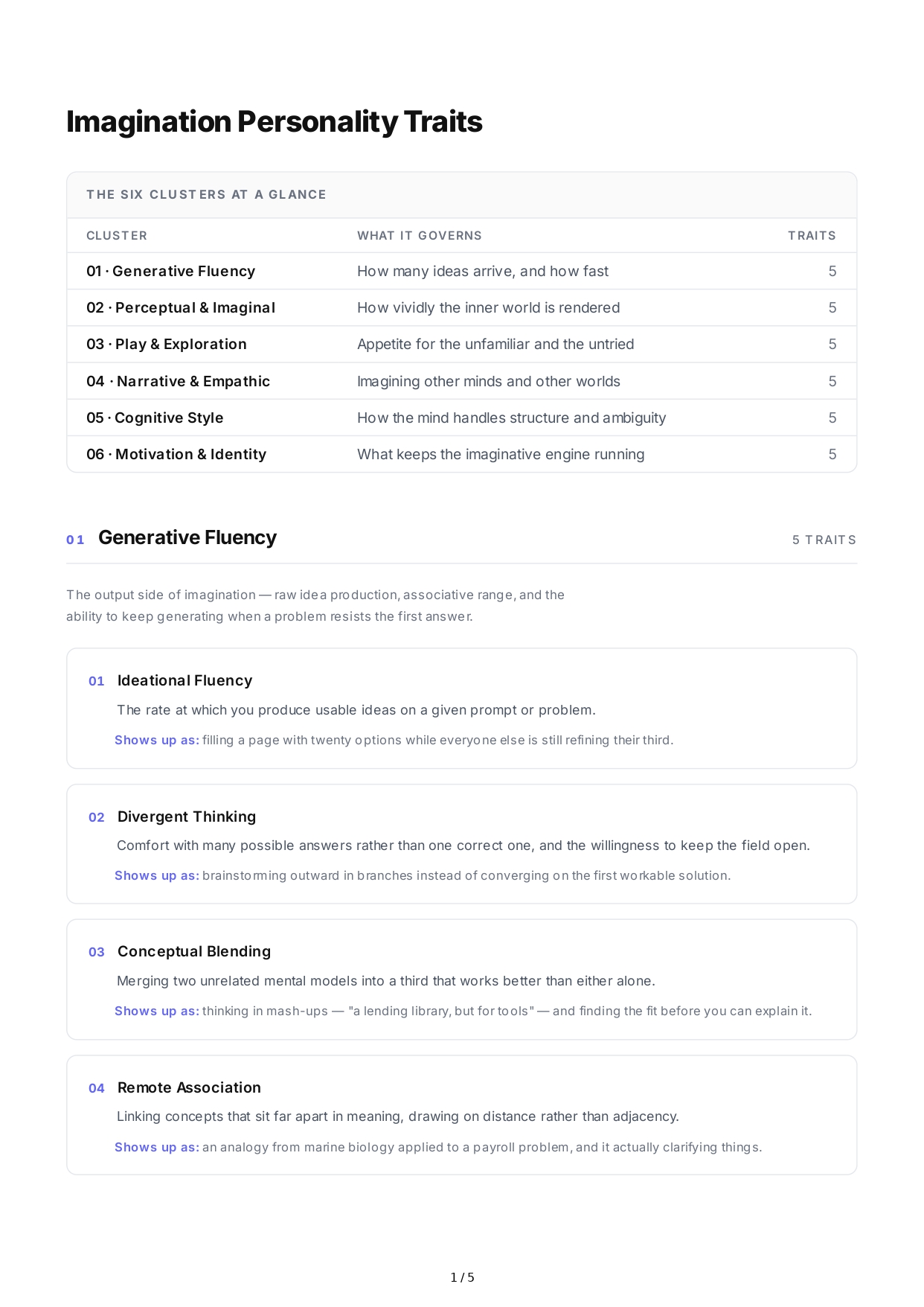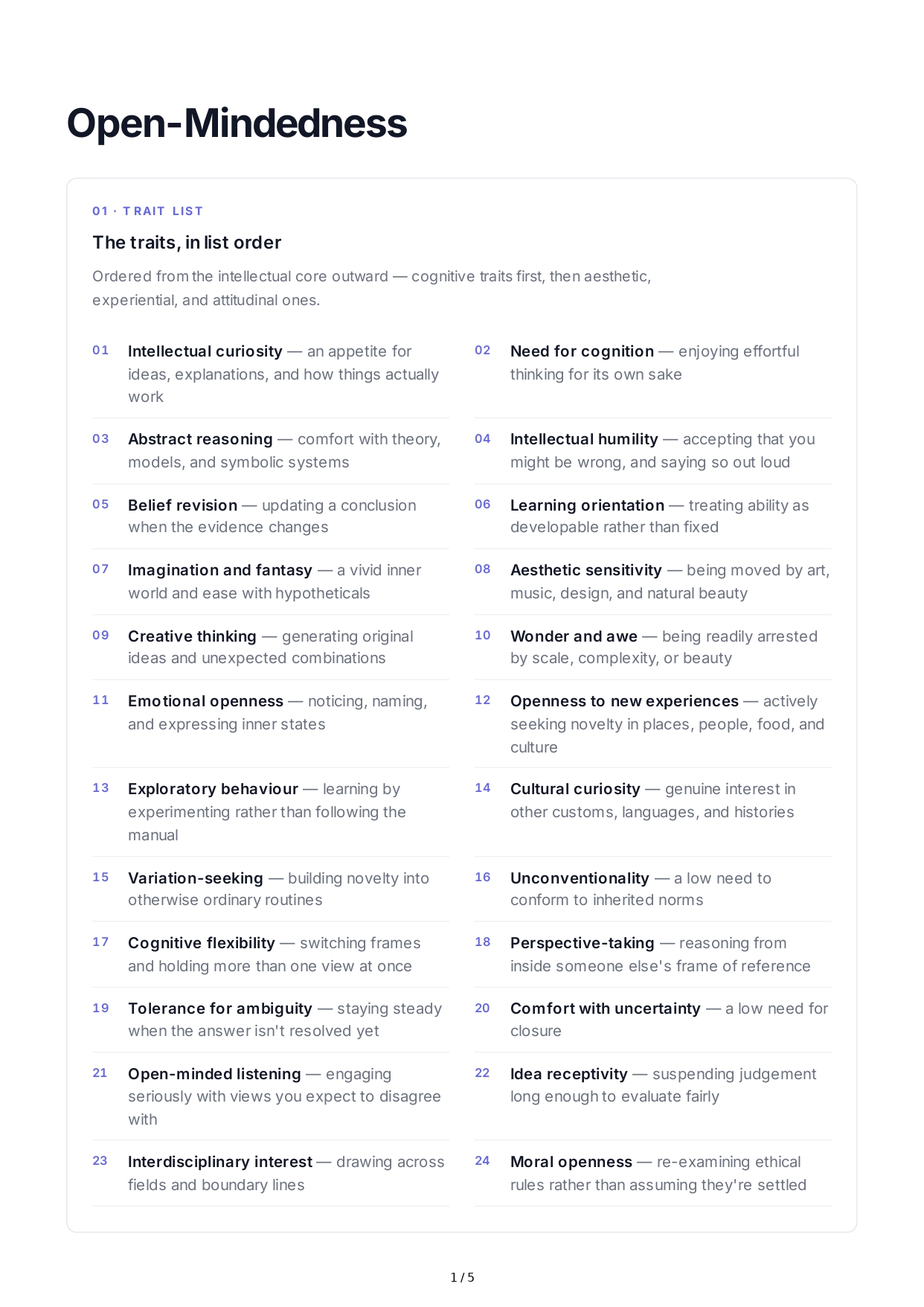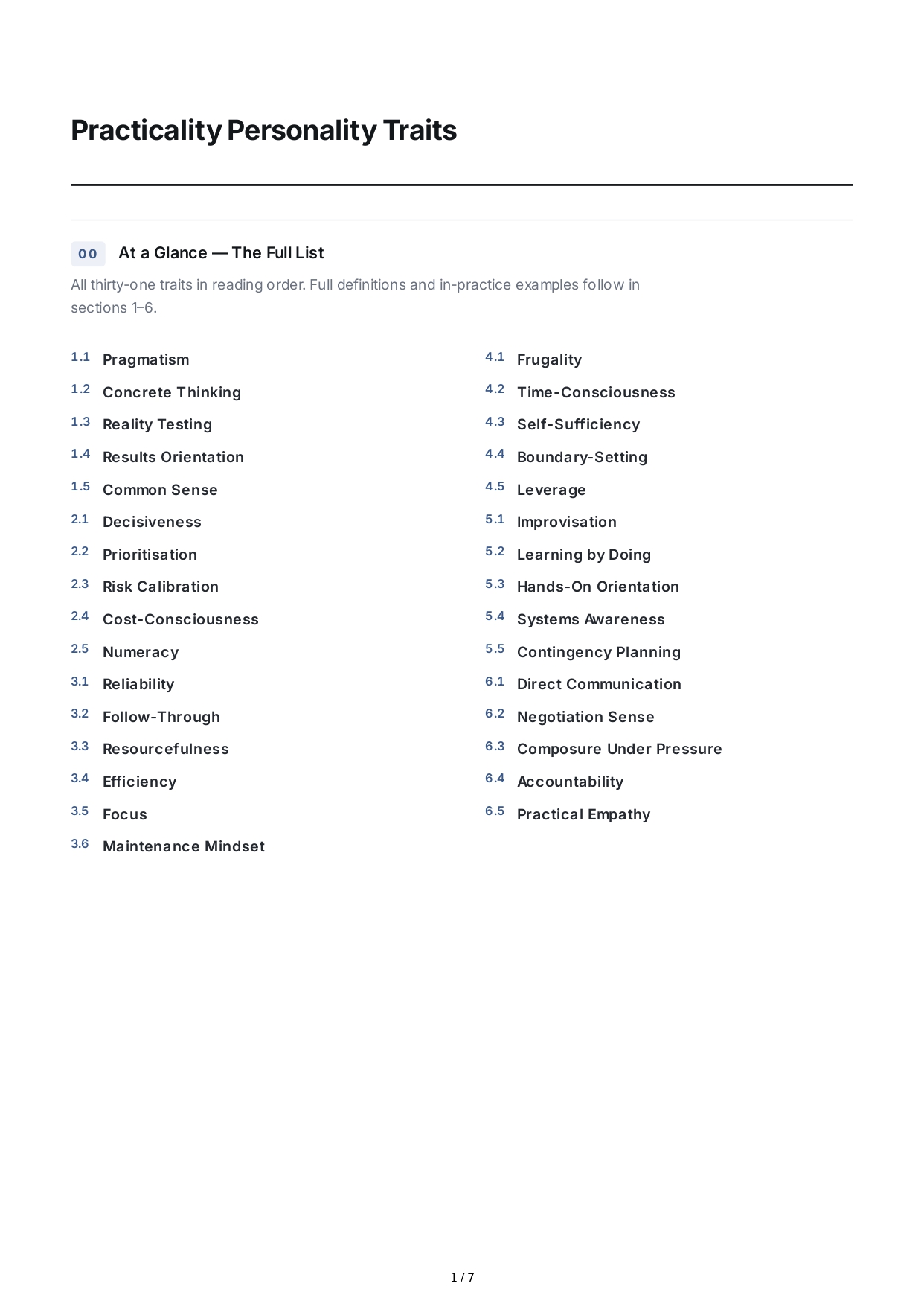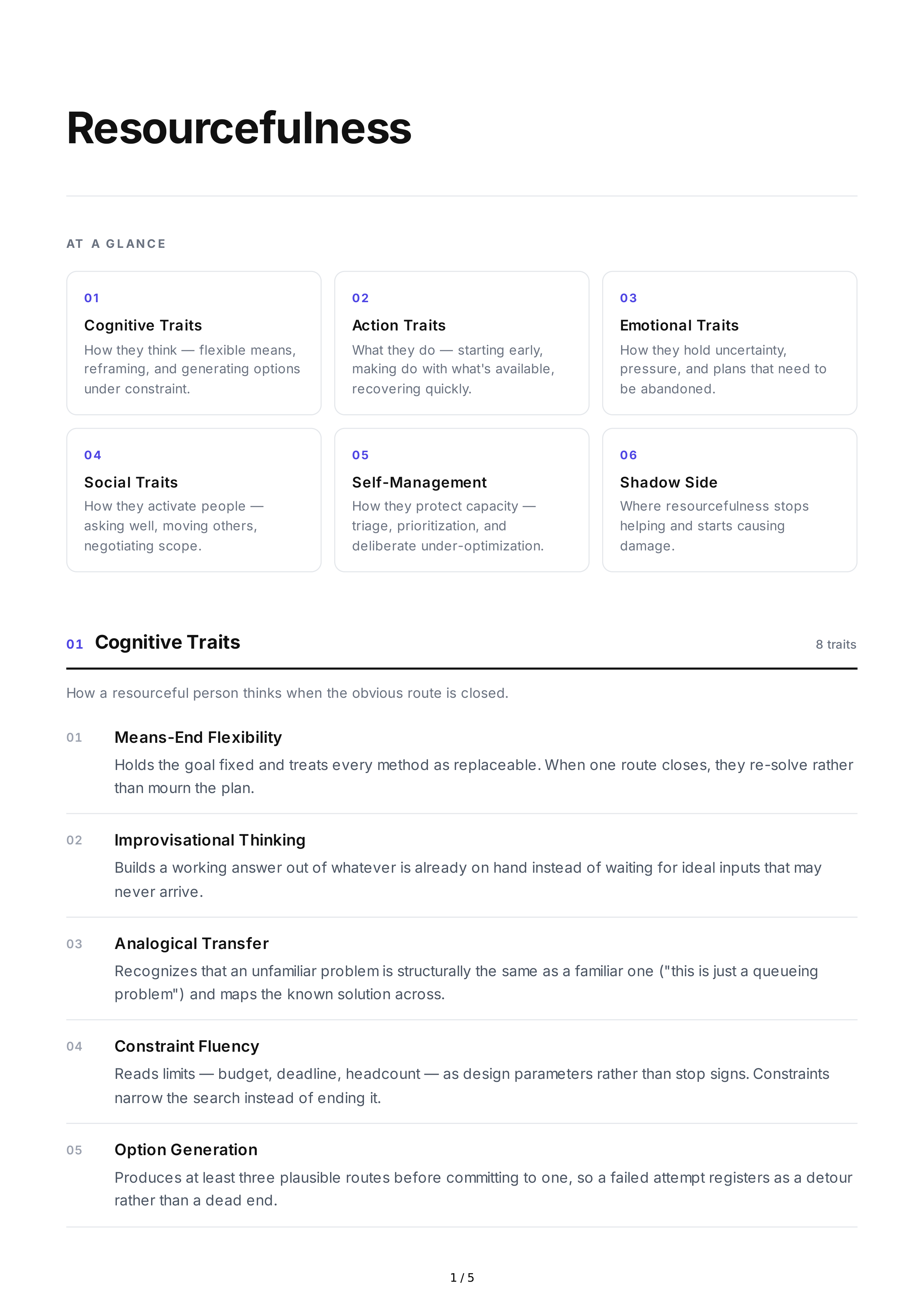
Resourcefulness
AT
A
G L AN C E
01
Cognitive
Traits
How
they
think
—
flexible
means
,
reframing
,
and
generating
options
under
constraint
.
02
Action
Traits
What
they
do
—
starting
early
,
making
do
with
what
'
s
available
,
recovering
quickly
.
03
Emotional
Traits
How
they
hold
uncertainty
,
pressure
,
and
plans
that
need
to
be
abandoned
.
04
Social
Traits
How
they
activate
people
—
asking
well
,
moving
others
,
negotiating
scope
.
05
Self
-
Management
How
they
protect
capacity
—
triage
,
prioritization
,
and
deliberate
under
-
optimization
.
06
Shadow
Side
Where
resourcefulness
stops
helping
and
starts
causing
damage
.
01
Cognitive
Traits
8
traits
How
a
resourceful
person
thinks
when
the
obvious
route
is
closed
.
01
Means
-
End
Flexibility
Holds
the
goal
fixed
and
treats
every
method
as
replaceable
.
When
one
route
closes
,
they
re
-
solve
rather
than
mourn
the
plan
.
02
Improvisational
Thinking
Builds
a
working
answer
out
of
whatever
is
already
on
hand
instead
of
waiting
for
ideal
inputs
that
may
never
arrive
.
03
Analogical
Transfer
Recognizes
that
an
unfamiliar
problem
is
structurally
the
same
as
a
familiar
one
("
this
is
just
a
queueing
problem
")
and
maps
the
known
solution
across
.
04
Constraint
Fluency
Reads
limits
—
budget
,
deadline
,
headcount
—
as
design
parameters
rather
than
stop
signs
.
Constraints
narrow
the
search
instead
of
ending
it
.
05
Option
Generation
Produces
at
least
three
plausible
routes
before
committing
to
one
,
so
a
failed
attempt
registers
as
a
detour
rather
than
a
dead
end
.
1 / 5
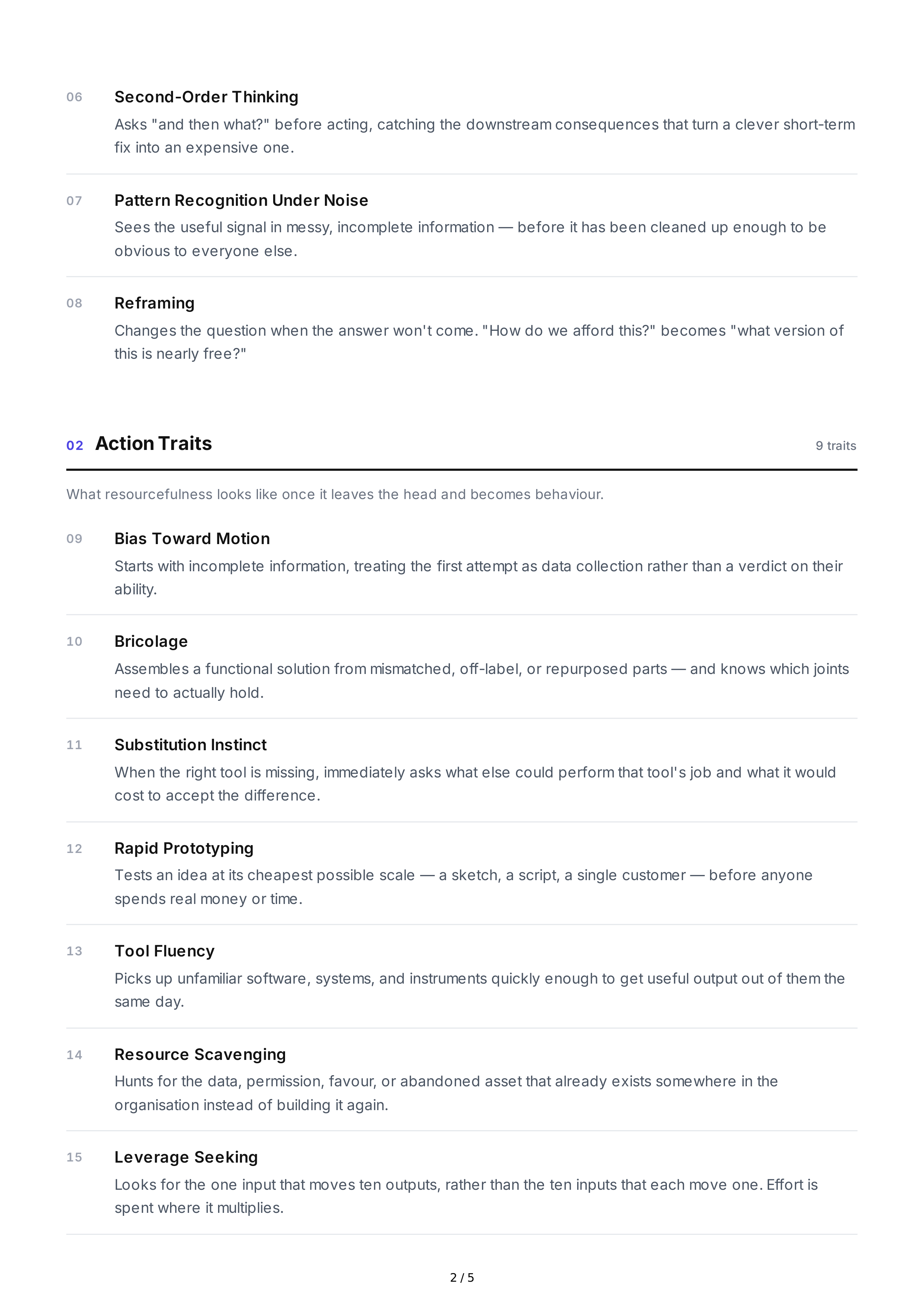
06
Second
-
Order
Thinking
Asks
"
and
then
what
?"
before
acting
,
catching
the
downstream
consequences
that
turn
a
clever
short
-
term
fix
into
an
expensive
one
.
07
Pattern
Recognition
Under
Noise
Sees
the
useful
signal
in
messy
,
incomplete
information
—
before
it
has
been
cleaned
up
enough
to
be
obvious
to
everyone
else
.
08
Reframing
Changes
the
question
when
the
answer
won
'
t
come
. "
How
do
we
afford
this
?"
becomes
"
what
version
of
this
is
nearly
free
?"
02
Action
Traits
9
traits
What
resourcefulness
looks
like
once
it
leaves
the
head
and
becomes
behaviour
.
09
Bias
Toward
Motion
Starts
with
incomplete
information
,
treating
the
first
attempt
as
data
collection
rather
than
a
verdict
on
their
ability
.
10
Bricolage
Assembles
a
functional
solution
from
mismatched
,
off
-
label
,
or
repurposed
parts
—
and
knows
which
joints
need
to
actually
hold
.
11
Substitution
Instinct
When
the
right
tool
is
missing
,
immediately
asks
what
else
could
perform
that
tool
'
s
job
and
what
it
would
cost
to
accept
the
difference
.
12
Rapid
Prototyping
Tests
an
idea
at
its
cheapest
possible
scale
—
a
sketch
,
a
script
,
a
single
customer
—
before
anyone
spends
real
money
or
time
.
13
Tool
Fluency
Picks
up
unfamiliar
software
,
systems
,
and
instruments
quickly
enough
to
get
useful
output
out
of
them
the
same
day
.
14
Resource
Scavenging
Hunts
for
the
data
,
permission
,
favour
,
or
abandoned
asset
that
already
exists
somewhere
in
the
organisation
instead
of
building
it
again
.
15
Leverage
Seeking
Looks
for
the
one
input
that
moves
ten
outputs
,
rather
than
the
ten
inputs
that
each
move
one
.
Effort
is
spent
where
it
multiplies
.
2 / 5
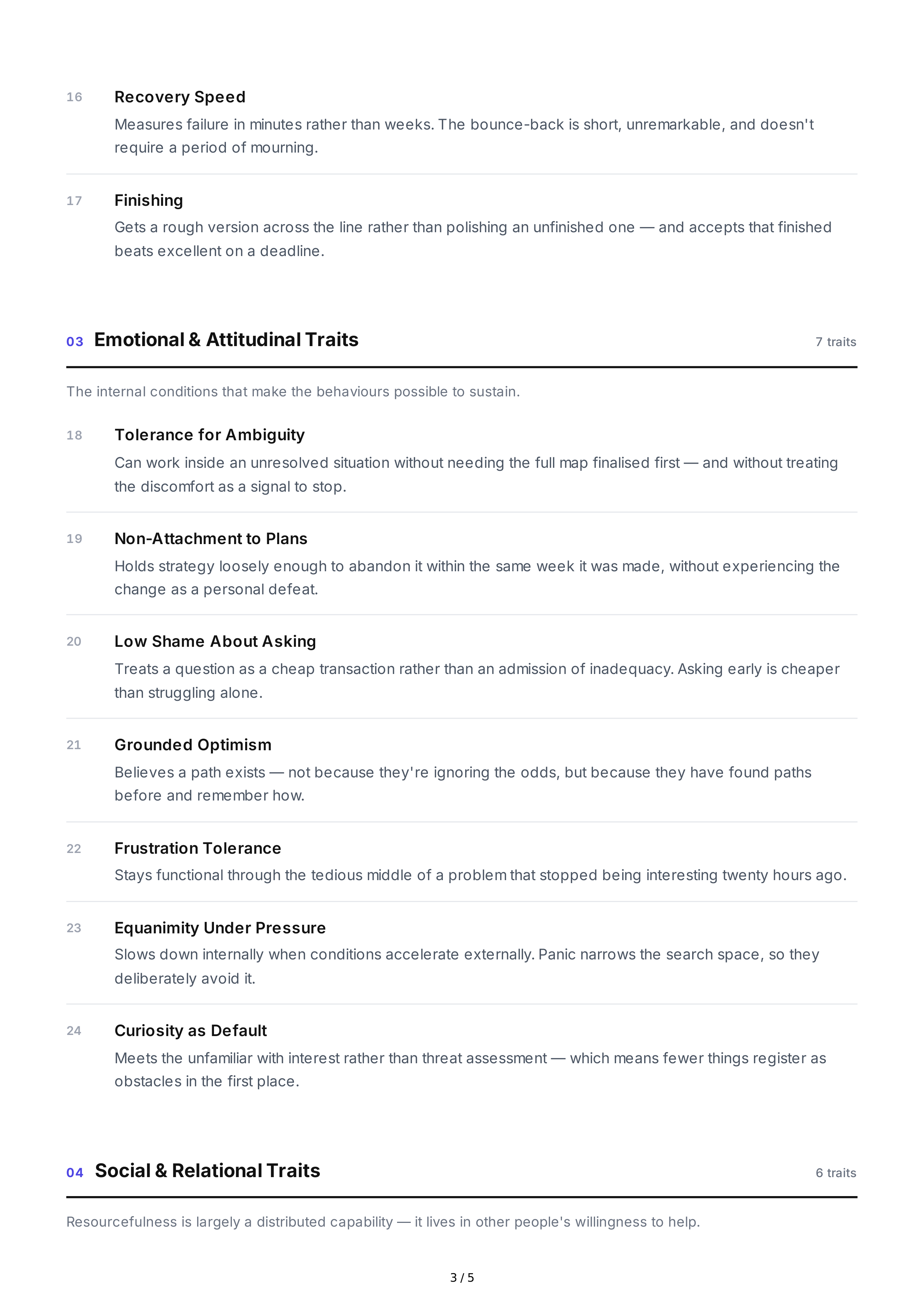
16
Recovery
Speed
Measures
failure
in
minutes
rather
than
weeks
.
The
bounce
-
back
is
short
,
unremarkable
,
and
doesn
'
t
require
a
period
of
mourning
.
17
Finishing
Gets
a
rough
version
across
the
line
rather
than
polishing
an
unfinished
one
—
and
accepts
that
finished
beats
excellent
on
a
deadline
.
03
Emotional
&
Attitudinal
Traits
7
traits
The
internal
conditions
that
make
the
behaviours
possible
to
sustain
.
18
Tolerance
for
Ambiguity
Can
work
inside
an
unresolved
situation
without
needing
the
full
map
finalised
first
—
and
without
treating
the
discomfort
as
a
signal
to
stop
.
19
Non
-
Attachment
to
Plans
Holds
strategy
loosely
enough
to
abandon
it
within
the
same
week
it
was
made
,
without
experiencing
the
change
as
a
personal
defeat
.
20
Low
Shame
About
Asking
Treats
a
question
as
a
cheap
transaction
rather
than
an
admission
of
inadequacy
.
Asking
early
is
cheaper
than
struggling
alone
.
21
Grounded
Optimism
Believes
a
path
exists
—
not
because
they
'
re
ignoring
the
odds
,
but
because
they
have
found
paths
before
and
remember
how
.
22
Frustration
Tolerance
Stays
functional
through
the
tedious
middle
of
a
problem
that
stopped
being
interesting
twenty
hours
ago
.
23
Equanimity
Under
Pressure
Slows
down
internally
when
conditions
accelerate
externally
.
Panic
narrows
the
search
space
,
so
they
deliberately
avoid
it
.
24
Curiosity
as
Default
Meets
the
unfamiliar
with
interest
rather
than
threat
assessment
—
which
means
fewer
things
register
as
obstacles
in
the
first
place
.
04
Social
&
Relational
Traits
6
traits
Resourcefulness
is
largely
a
distributed
capability
—
it
lives
in
other
people
'
s
willingness
to
help
.
3 / 5
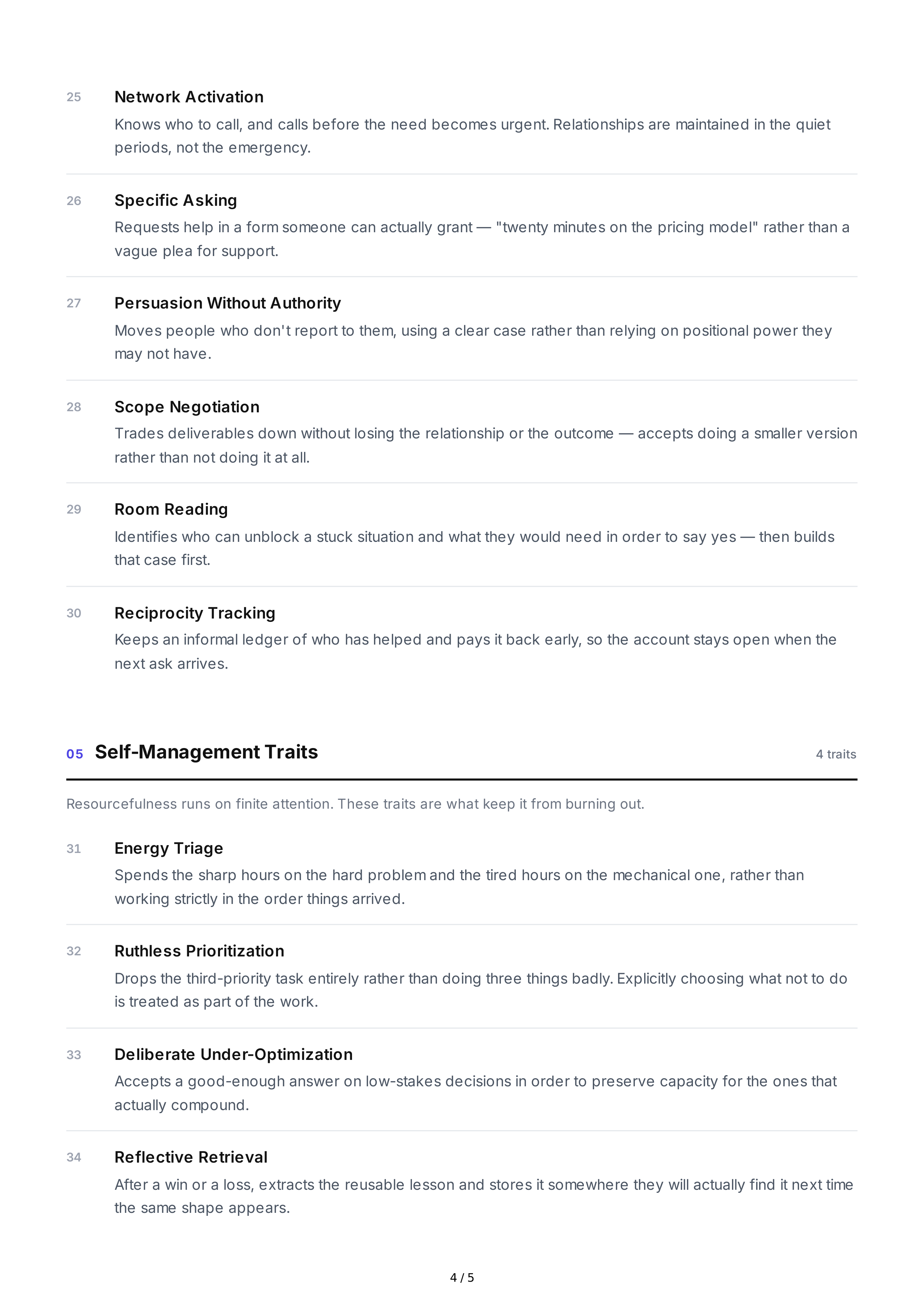
25
Network
Activation
Knows
who
to
call
,
and
calls
before
the
need
becomes
urgent
.
Relationships
are
maintained
in
the
quiet
periods
,
not
the
emergency
.
26
Specific
Asking
Requests
help
in
a
form
someone
can
actually
grant
— "
twenty
minutes
on
the
pricing
model
"
rather
than
a
vague
plea
for
support
.
27
Persuasion
Without
Authority
Moves
people
who
don
'
t
report
to
them
,
using
a
clear
case
rather
than
relying
on
positional
power
they
may
not
have
.
28
Scope
Negotiation
Trades
deliverables
down
without
losing
the
relationship
or
the
outcome
—
accepts
doing
a
smaller
version
rather
than
not
doing
it
at
all
.
29
Room
Reading
Identifies
who
can
unblock
a
stuck
situation
and
what
they
would
need
in
order
to
say
yes
—
then
builds
that
case
first
.
30
Reciprocity
Tracking
Keeps
an
informal
ledger
of
who
has
helped
and
pays
it
back
early
,
so
the
account
stays
open
when
the
next
ask
arrives
.
05
Self
-
Management
Traits
4
traits
Resourcefulness
runs
on
finite
attention
.
These
traits
are
what
keep
it
from
burning
out
.
31
Energy
Triage
Spends
the
sharp
hours
on
the
hard
problem
and
the
tired
hours
on
the
mechanical
one
,
rather
than
working
strictly
in
the
order
things
arrived
.
32
Ruthless
Prioritization
Drops
the
third
-
priority
task
entirely
rather
than
doing
three
things
badly
.
Explicitly
choosing
what
not
to
do
is
treated
as
part
of
the
work
.
33
Deliberate
Under
-
Optimization
Accepts
a
good
-
enough
answer
on
low
-
stakes
decisions
in
order
to
preserve
capacity
for
the
ones
that
actually
compound
.
34
Reflective
Retrieval
After
a
win
or
a
loss
,
extracts
the
reusable
lesson
and
stores
it
somewhere
they
will
actually
find
it
next
time
the
same
shape
appears
.
4 / 5