Self
-
Awareness
Personality
Traits
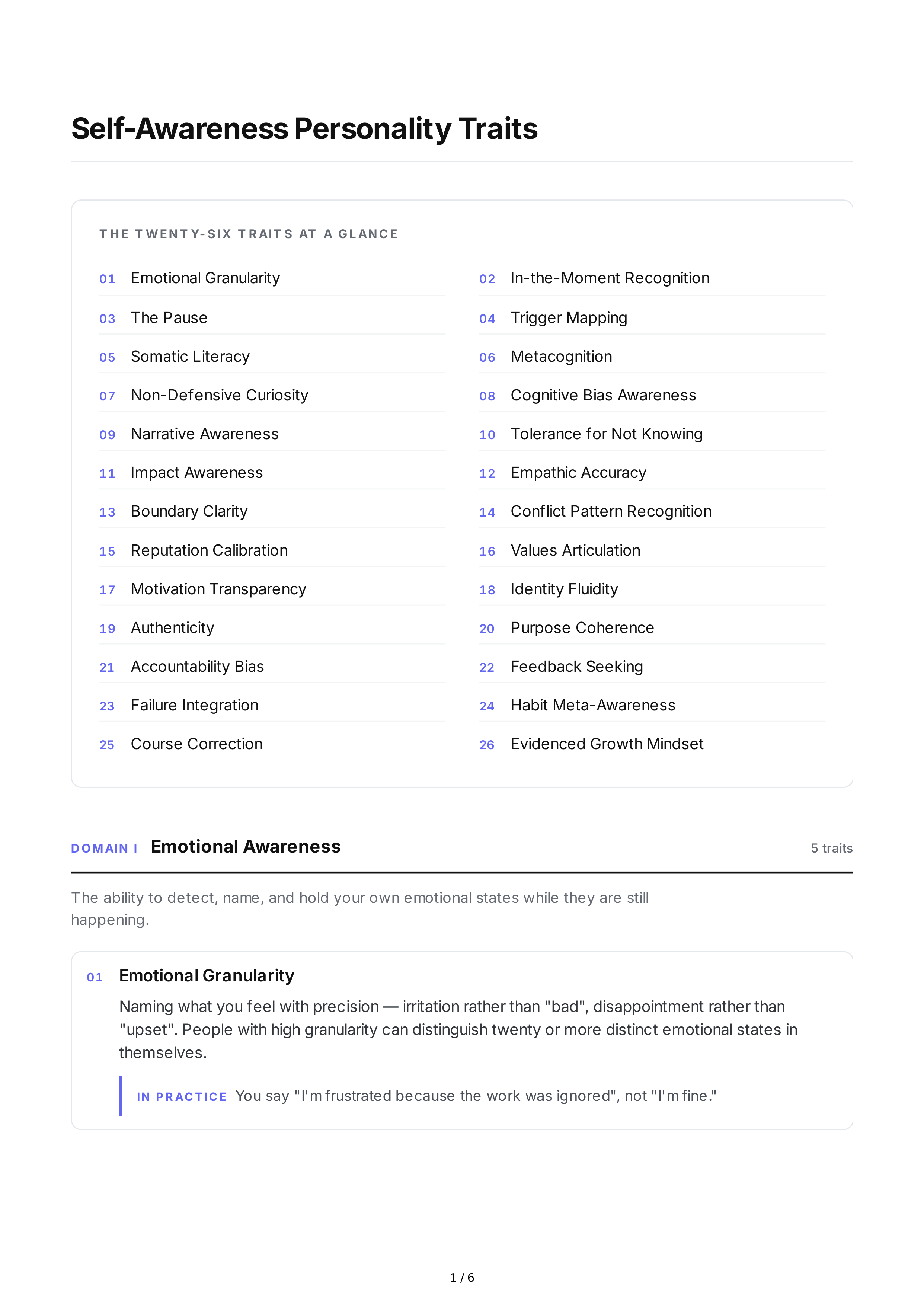
T H E
T WENT Y
-
S IX
T R AIT S
AT
A
G L ANC E
01
Emotional
Granularity
02
In
-
the
-
Moment
Recognition
03
The
Pause
04
Trigger
Mapping
05
Somatic
Literacy
06
Metacognition
07
Non
-
Defensive
Curiosity
08
Cognitive
Bias
Awareness
09
Narrative
Awareness
10
Tolerance
for
Not
Knowing
11
Impact
Awareness
12
Empathic
Accuracy
13
Boundary
Clarity
14
Conflict
Pattern
Recognition
15
Reputation
Calibration
16
Values
Articulation
17
Motivation
Transparency
18
Identity
Fluidity
19
Authenticity
20
Purpose
Coherence
21
Accountability
Bias
22
Feedback
Seeking
23
Failure
Integration
24
Habit
Meta
-
Awareness
25
Course
Correction
26
Evidenced
Growth
Mindset
D OMAIN
I
Emotional
Awareness
5
traits
The
ability
to
detect
,
name
,
and
hold
your
own
emotional
states
while
they
are
still
happening
.
01
Emotional
Granularity
Naming
what
you
feel
with
precision
—
irritation
rather
than
"
bad
",
disappointment
rather
than
"
upset
".
People
with
high
granularity
can
distinguish
twenty
or
more
distinct
emotional
states
in
themselves
.
IN
P R AC T IC E
You
say
"
I
'
m
frustrated
because
the
work
was
ignored
",
not
"
I
'
m
fine
."
1 / 6
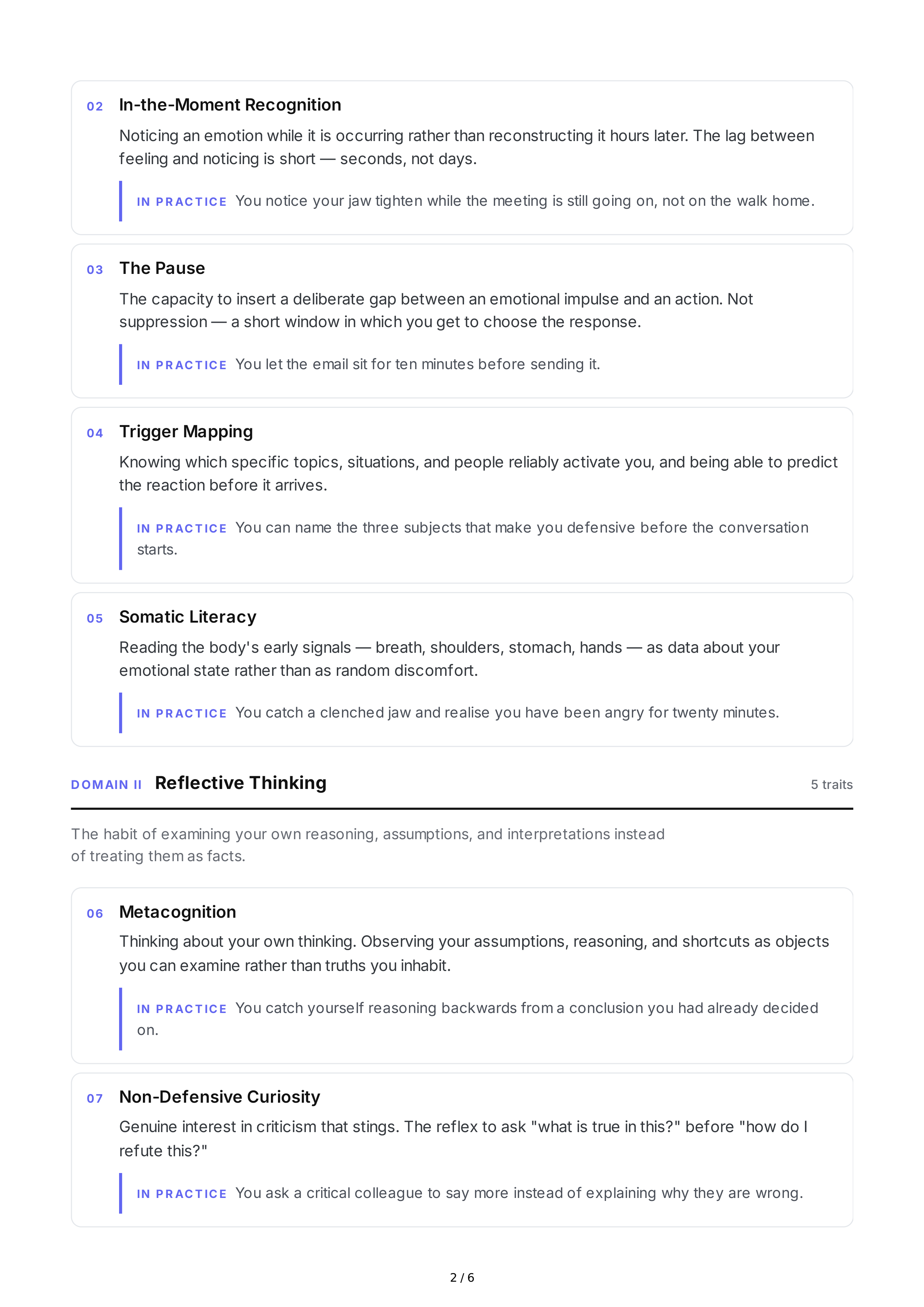
02
In
-
the
-
Moment
Recognition
Noticing
an
emotion
while
it
is
occurring
rather
than
reconstructing
it
hours
later
.
The
lag
between
feeling
and
noticing
is
short
—
seconds
,
not
days
.
IN
P R AC T IC E
You
notice
your
jaw
tighten
while
the
meeting
is
still
going
on
,
not
on
the
walk
home
.
03
The
Pause
The
capacity
to
insert
a
deliberate
gap
between
an
emotional
impulse
and
an
action
.
Not
suppression
—
a
short
window
in
which
you
get
to
choose
the
response
.
IN
P R AC T IC E
You
let
the
email
sit
for
ten
minutes
before
sending
it
.
04
Trigger
Mapping
Knowing
which
specific
topics
,
situations
,
and
people
reliably
activate
you
,
and
being
able
to
predict
the
reaction
before
it
arrives
.
IN
P R AC T IC E
You
can
name
the
three
subjects
that
make
you
defensive
before
the
conversation
starts
.
05
Somatic
Literacy
Reading
the
body
'
s
early
signals
—
breath
,
shoulders
,
stomach
,
hands
—
as
data
about
your
emotional
state
rather
than
as
random
discomfort
.
IN
P R AC T IC E
You
catch
a
clenched
jaw
and
realise
you
have
been
angry
for
twenty
minutes
.
D OMAIN
II
Reflective
Thinking
5
traits
The
habit
of
examining
your
own
reasoning
,
assumptions
,
and
interpretations
instead
of
treating
them
as
facts
.
06
Metacognition
Thinking
about
your
own
thinking
.
Observing
your
assumptions
,
reasoning
,
and
shortcuts
as
objects
you
can
examine
rather
than
truths
you
inhabit
.
IN
P R AC T IC E
You
catch
yourself
reasoning
backwards
from
a
conclusion
you
had
already
decided
on
.
07
Non
-
Defensive
Curiosity
Genuine
interest
in
criticism
that
stings
.
The
reflex
to
ask
"
what
is
true
in
this
?"
before
"
how
do
I
refute
this
?"
IN
P R AC T IC E
You
ask
a
critical
colleague
to
say
more
instead
of
explaining
why
they
are
wrong
.
2 / 6
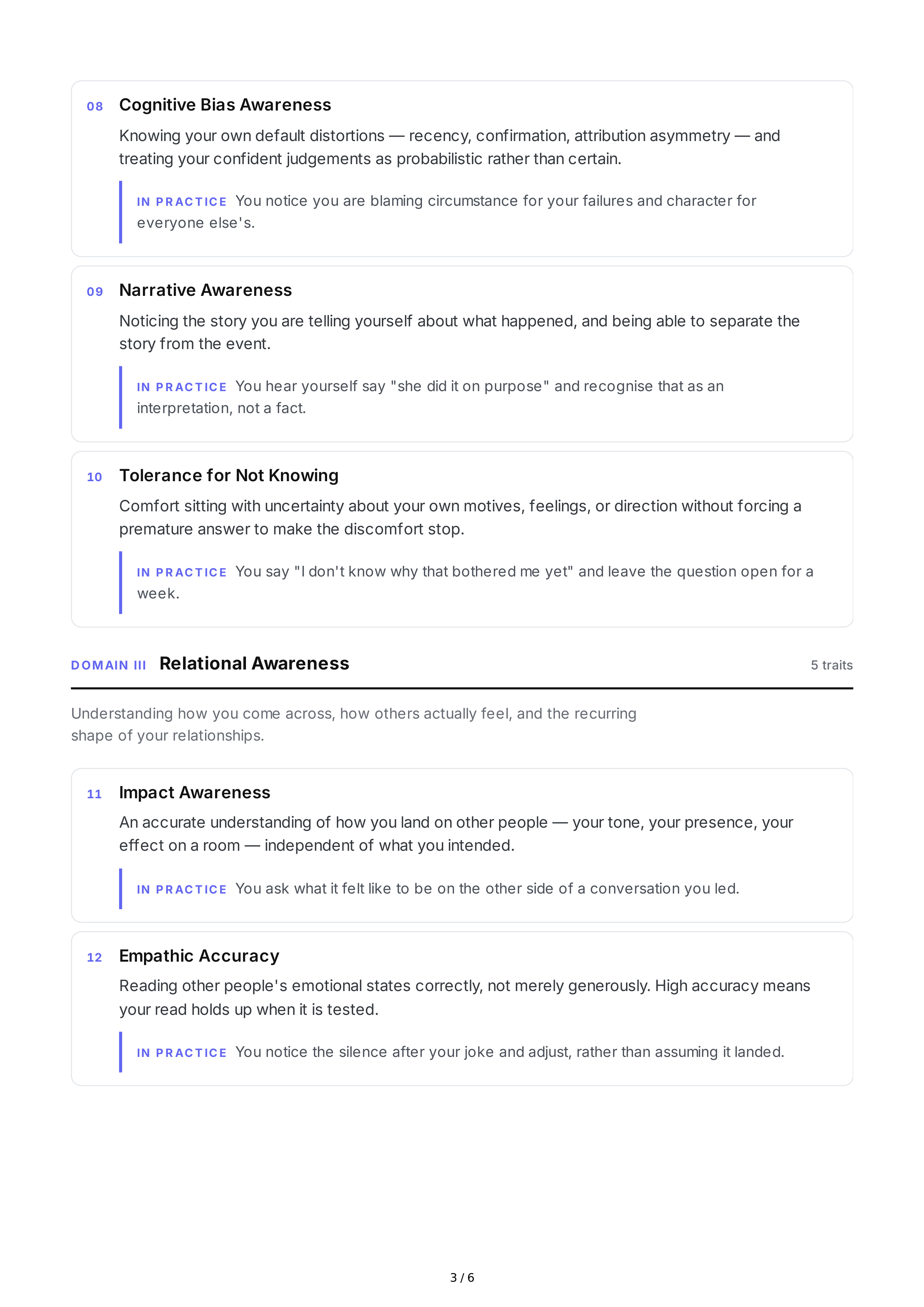
08
Cognitive
Bias
Awareness
Knowing
your
own
default
distortions
—
recency
,
confirmation
,
attribution
asymmetry
—
and
treating
your
confident
judgements
as
probabilistic
rather
than
certain
.
IN
P R AC T IC E
You
notice
you
are
blaming
circumstance
for
your
failures
and
character
for
everyone
else
'
s
.
09
Narrative
Awareness
Noticing
the
story
you
are
telling
yourself
about
what
happened
,
and
being
able
to
separate
the
story
from
the
event
.
IN
P R AC T IC E
You
hear
yourself
say
"
she
did
it
on
purpose
"
and
recognise
that
as
an
interpretation
,
not
a
fact
.
10
Tolerance
for
Not
Knowing
Comfort
sitting
with
uncertainty
about
your
own
motives
,
feelings
,
or
direction
without
forcing
a
premature
answer
to
make
the
discomfort
stop
.
IN
P R AC T IC E
You
say
"
I
don
'
t
know
why
that
bothered
me
yet
"
and
leave
the
question
open
for
a
week
.
D OMAIN
III
Relational
Awareness
5
traits
Understanding
how
you
come
across
,
how
others
actually
feel
,
and
the
recurring
shape
of
your
relationships
.
11
Impact
Awareness
An
accurate
understanding
of
how
you
land
on
other
people
—
your
tone
,
your
presence
,
your
effect
on
a
room
—
independent
of
what
you
intended
.
IN
P R AC T IC E
You
ask
what
it
felt
like
to
be
on
the
other
side
of
a
conversation
you
led
.
12
Empathic
Accuracy
Reading
other
people
'
s
emotional
states
correctly
,
not
merely
generously
.
High
accuracy
means
your
read
holds
up
when
it
is
tested
.
IN
P R AC T IC E
You
notice
the
silence
after
your
joke
and
adjust
,
rather
than
assuming
it
landed
.
3 / 6
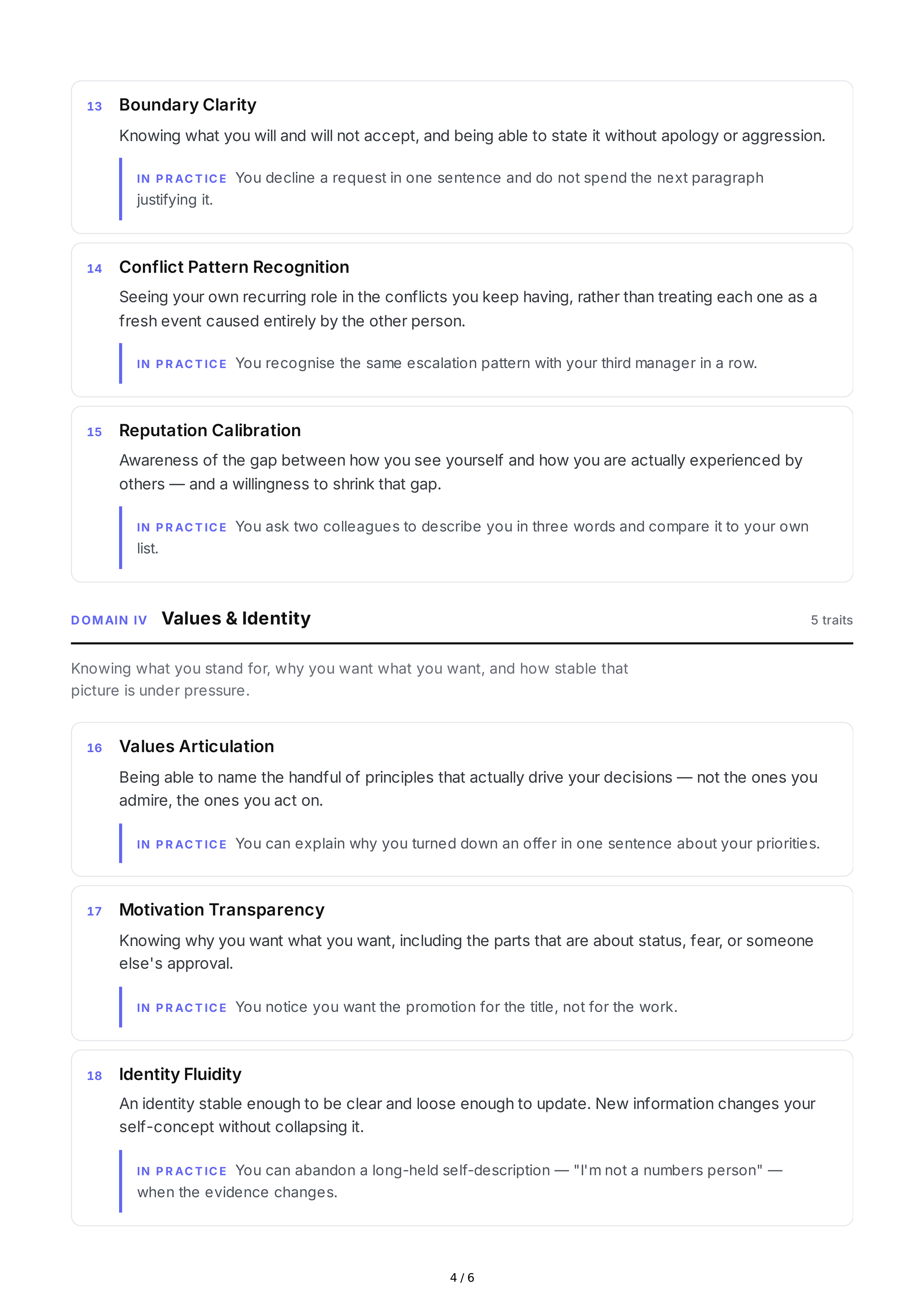
13
Boundary
Clarity
Knowing
what
you
will
and
will
not
accept
,
and
being
able
to
state
it
without
apology
or
aggression
.
IN
P R AC T IC E
You
decline
a
request
in
one
sentence
and
do
not
spend
the
next
paragraph
justifying
it
.
14
Conflict
Pattern
Recognition
Seeing
your
own
recurring
role
in
the
conflicts
you
keep
having
,
rather
than
treating
each
one
as
a
fresh
event
caused
entirely
by
the
other
person
.
IN
P R AC T IC E
You
recognise
the
same
escalation
pattern
with
your
third
manager
in
a
row
.
15
Reputation
Calibration
Awareness
of
the
gap
between
how
you
see
yourself
and
how
you
are
actually
experienced
by
others
—
and
a
willingness
to
shrink
that
gap
.
IN
P R AC T IC E
You
ask
two
colleagues
to
describe
you
in
three
words
and
compare
it
to
your
own
list
.
D OMAIN
IV
Values
&
Identity
5
traits
Knowing
what
you
stand
for
,
why
you
want
what
you
want
,
and
how
stable
that
picture
is
under
pressure
.
16
Values
Articulation
Being
able
to
name
the
handful
of
principles
that
actually
drive
your
decisions
—
not
the
ones
you
admire
,
the
ones
you
act
on
.
IN
P R AC T IC E
You
can
explain
why
you
turned
down
an
offer
in
one
sentence
about
your
priorities
.
17
Motivation
Transparency
Knowing
why
you
want
what
you
want
,
including
the
parts
that
are
about
status
,
fear
,
or
someone
else
'
s
approval
.
IN
P R AC T IC E
You
notice
you
want
the
promotion
for
the
title
,
not
for
the
work
.
18
Identity
Fluidity
An
identity
stable
enough
to
be
clear
and
loose
enough
to
update
.
New
information
changes
your
self
-
concept
without
collapsing
it
.
IN
P R AC T IC E
You
can
abandon
a
long
-
held
self
-
description
— "
I
'
m
not
a
numbers
person
" —
when
the
evidence
changes
.
4 / 6
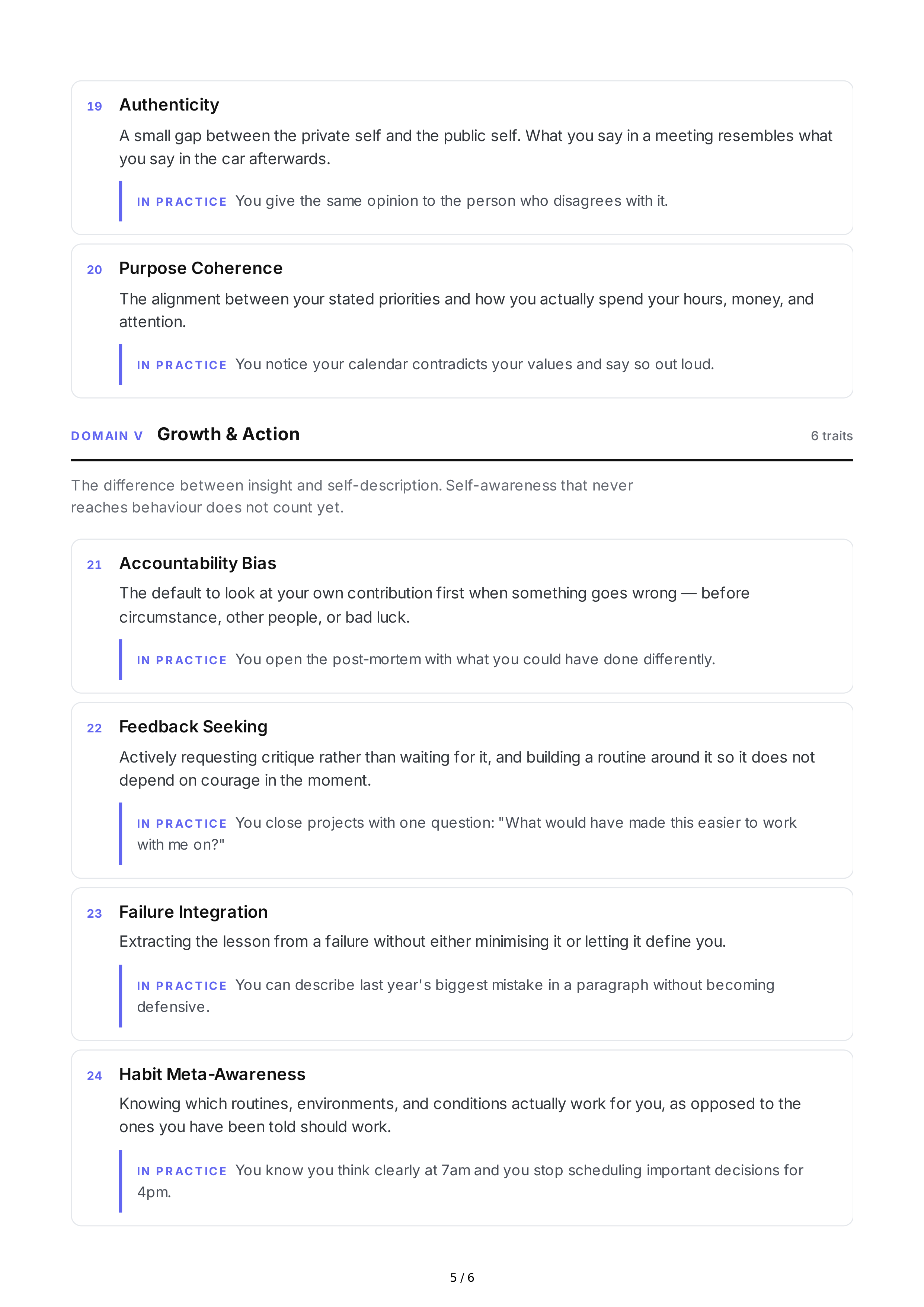
19
Authenticity
A
small
gap
between
the
private
self
and
the
public
self
.
What
you
say
in
a
meeting
resembles
what
you
say
in
the
car
afterwards
.
IN
P R AC T IC E
You
give
the
same
opinion
to
the
person
who
disagrees
with
it
.
20
Purpose
Coherence
The
alignment
between
your
stated
priorities
and
how
you
actually
spend
your
hours
,
money
,
and
attention
.
IN
P R AC T IC E
You
notice
your
calendar
contradicts
your
values
and
say
so
out
loud
.
D OMAIN
V
Growth
&
Action
6
traits
The
difference
between
insight
and
self
-
description
.
Self
-
awareness
that
never
reaches
behaviour
does
not
count
yet
.
21
Accountability
Bias
The
default
to
look
at
your
own
contribution
first
when
something
goes
wrong
—
before
circumstance
,
other
people
,
or
bad
luck
.
IN
P R AC T IC E
You
open
the
post
-
mortem
with
what
you
could
have
done
differently
.
22
Feedback
Seeking
Actively
requesting
critique
rather
than
waiting
for
it
,
and
building
a
routine
around
it
so
it
does
not
depend
on
courage
in
the
moment
.
IN
P R AC T IC E
You
close
projects
with
one
question
: "
What
would
have
made
this
easier
to
work
with
me
on
?"
23
Failure
Integration
Extracting
the
lesson
from
a
failure
without
either
minimising
it
or
letting
it
define
you
.
IN
P R AC T IC E
You
can
describe
last
year
'
s
biggest
mistake
in
a
paragraph
without
becoming
defensive
.
24
Habit
Meta
-
Awareness
Knowing
which
routines
,
environments
,
and
conditions
actually
work
for
you
,
as
opposed
to
the
ones
you
have
been
told
should
work
.
IN
P R AC T IC E
You
know
you
think
clearly
at
7
am
and
you
stop
scheduling
important
decisions
for
4
pm
.
5 / 6
25
Course
Correction
Changing
behaviour
after
you
have
seen
the
problem
.
Insight
without
behaviour
change
is
not
self
-
awareness
—
it
is
self
-
description
.
IN
P R AC T IC E
The
pattern
you
identified
in
January
has
visibly
changed
by
March
.
26
Evidenced
Growth
Mindset
A
belief
that
your
abilities
are
developable
,
demonstrated
by
what
you
attempt
rather
than
what
you
claim
to
believe
.
IN
P R AC T IC E
You
take
on
work
you
are
currently
bad
at
,
in
public
,
on
purpose
.
6 / 6