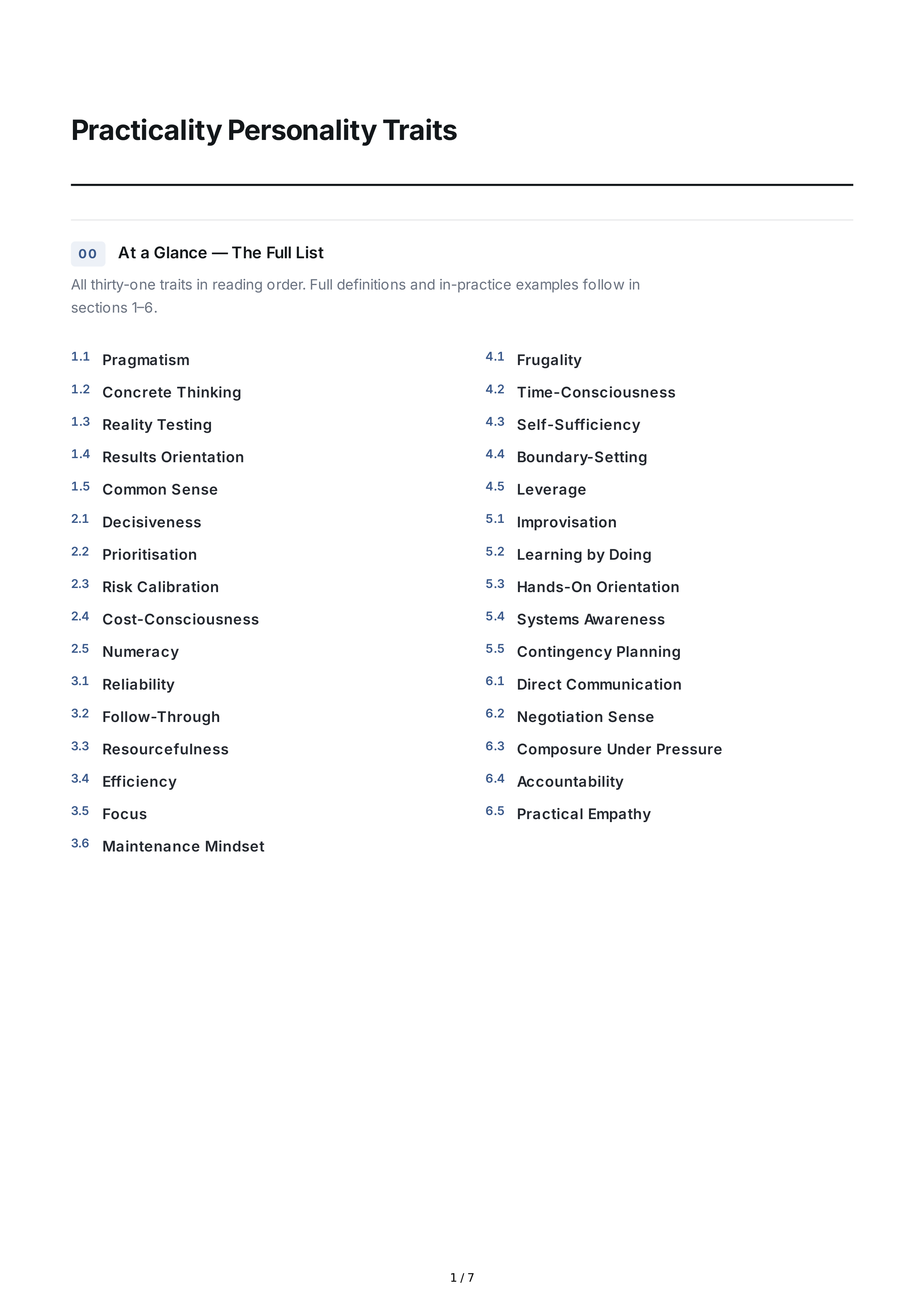
Practicality
Personality
Traits
00
At
a
Glance
—
The
Full
List
All
thirty
-
one
traits
in
reading
order
.
Full
definitions
and
in
-
practice
examples
follow
in
sections
1–6.
Pragmatism
1.1
Concrete
Thinking
1.2
Reality
Testing
1.3
Results
Orientation
1.4
Common
Sense
1.5
Decisiveness
2.1
Prioritisation
2.2
Risk
Calibration
2.3
Cost
-
Consciousness
2.4
Numeracy
2.5
Reliability
3.1
Follow
-
Through
3.2
Resourcefulness
3.3
Efficiency
3.4
Focus
3.5
Maintenance
Mindset
3.6
Frugality
4.1
Time
-
Consciousness
4.2
Self
-
Sufficiency
4.3
Boundary
-
Setting
4.4
Leverage
4.5
Improvisation
5.1
Learning
by
Doing
5.2
Hands
-
On
Orientation
5.3
Systems
Awareness
5.4
Contingency
Planning
5.5
Direct
Communication
6.1
Negotiation
Sense
6.2
Composure
Under
Pressure
6.3
Accountability
6.4
Practical
Empathy
6.5
1 / 7
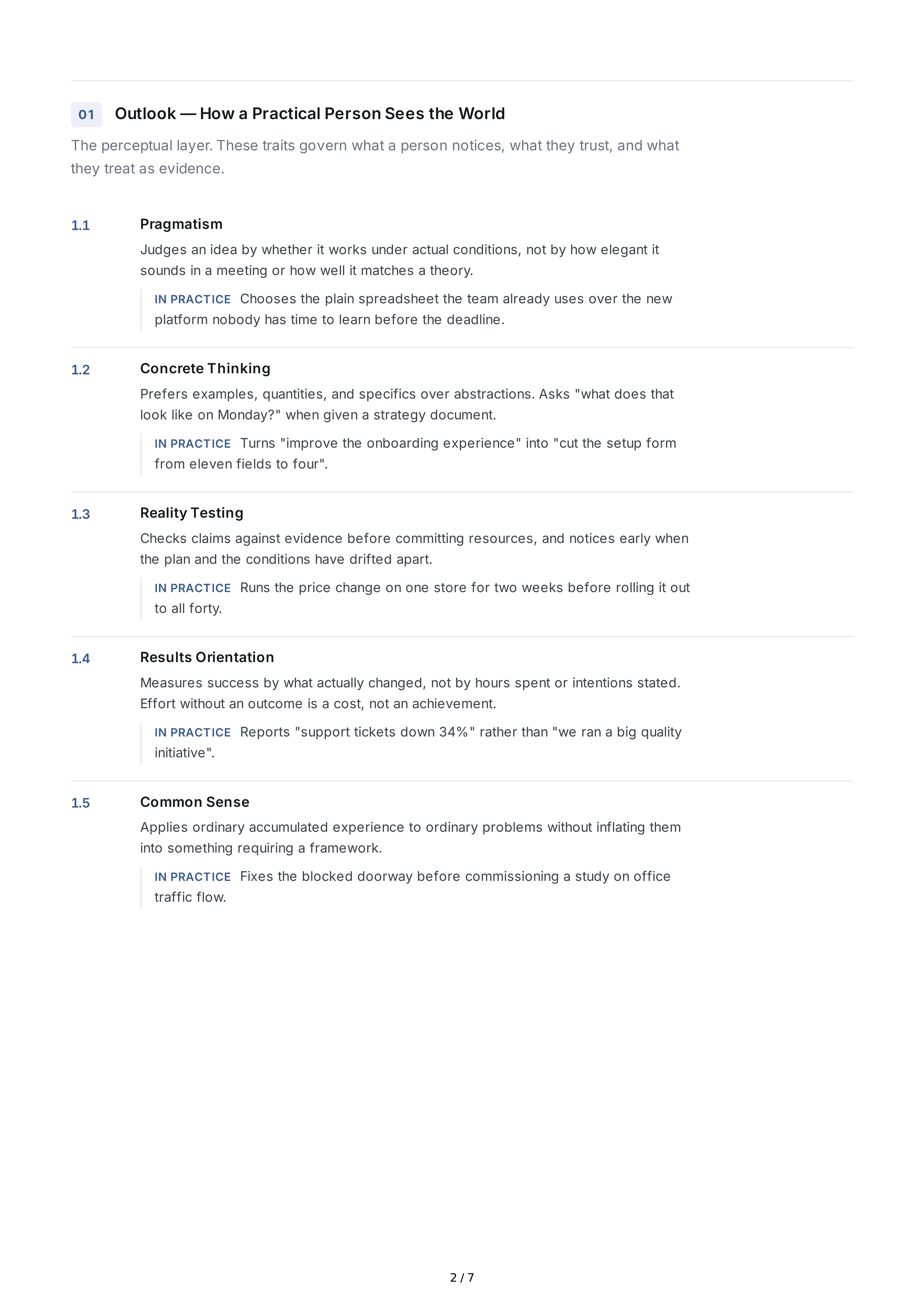
01
Outlook
—
How
a
Practical
Person
Sees
the
World
The
perceptual
layer
.
These
traits
govern
what
a
person
notices
,
what
they
trust
,
and
what
they
treat
as
evidence
.
1.1
Pragmatism
Judges
an
idea
by
whether
it
works
under
actual
conditions
,
not
by
how
elegant
it
sounds
in
a
meeting
or
how
well
it
matches
a
theory
.
IN
PRACTICE
Chooses
the
plain
spreadsheet
the
team
already
uses
over
the
new
platform
nobody
has
time
to
learn
before
the
deadline
.
1.2
Concrete
Thinking
Prefers
examples
,
quantities
,
and
specifics
over
abstractions
.
Asks
"
what
does
that
look
like
on
Monday
?"
when
given
a
strategy
document
.
IN
PRACTICE
Turns
"
improve
the
onboarding
experience
"
into
"
cut
the
setup
form
from
eleven
fields
to
four
".
1.3
Reality
Testing
Checks
claims
against
evidence
before
committing
resources
,
and
notices
early
when
the
plan
and
the
conditions
have
drifted
apart
.
IN
PRACTICE
Runs
the
price
change
on
one
store
for
two
weeks
before
rolling
it
out
to
all
forty
.
1.4
Results
Orientation
Measures
success
by
what
actually
changed
,
not
by
hours
spent
or
intentions
stated
.
Effort
without
an
outcome
is
a
cost
,
not
an
achievement
.
IN
PRACTICE
Reports
"
support
tickets
down
34%"
rather
than
"
we
ran
a
big
quality
initiative
".
1.5
Common
Sense
Applies
ordinary
accumulated
experience
to
ordinary
problems
without
inflating
them
into
something
requiring
a
framework
.
IN
PRACTICE
Fixes
the
blocked
doorway
before
commissioning
a
study
on
office
traffic
flow
.
2 / 7
02
Judgement
—
Deciding
With
Imperfect
Information
Practical
people
rarely
have
all
the
facts
.
These
traits
describe
how
they
commit
anyway
,
and
how
they
size
what
is
at
stake
.
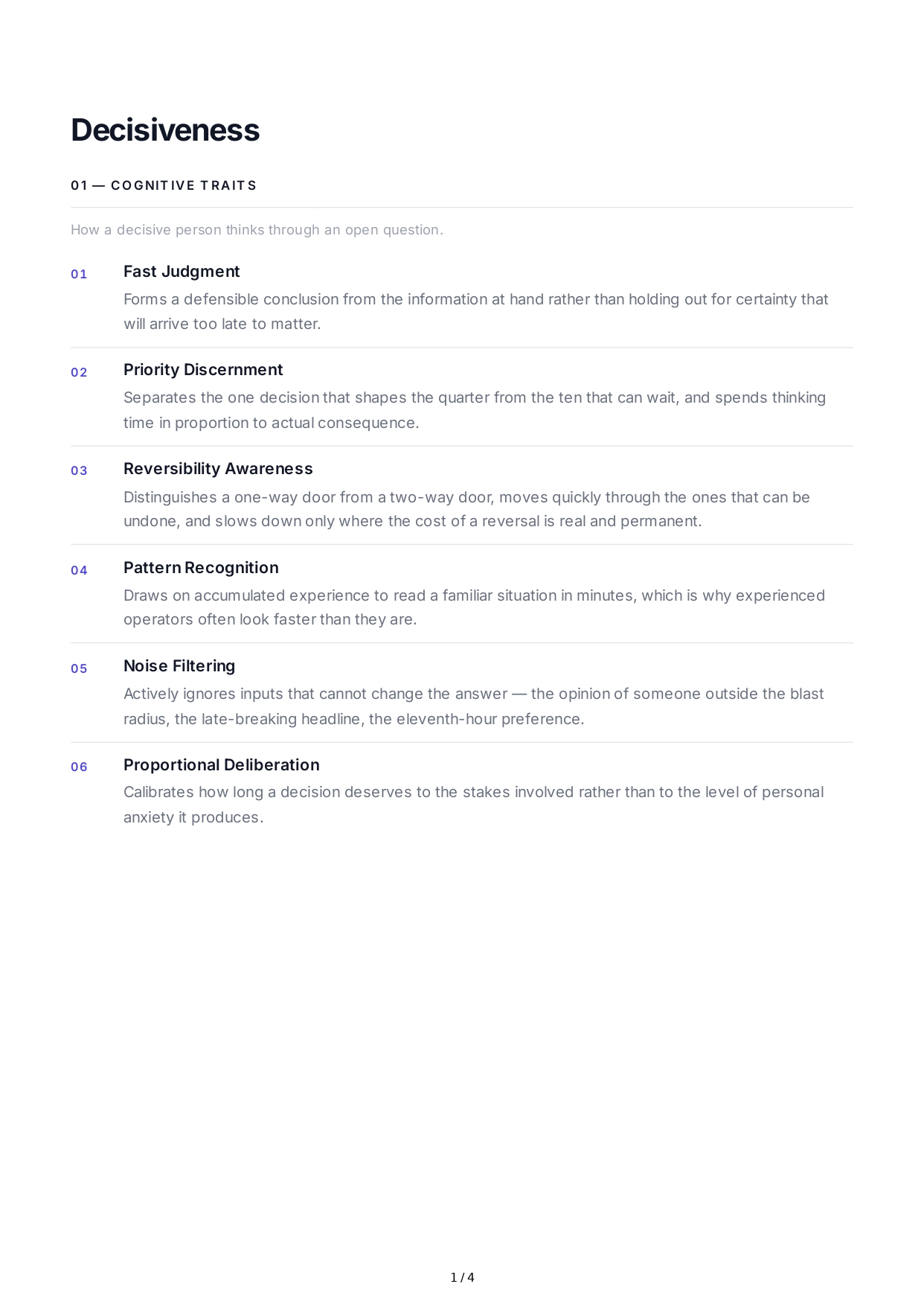
2.1
Decisiveness
Commits
to
a
workable
option
once
it
is
good
enough
,
rather
than
waiting
for
certainty
that
will
not
arrive
in
time
to
be
useful
.
IN
PRACTICE
Picks
the
second
-
best
supplier
on
Tuesday
instead
of
holding
out
for
the
ideal
one
until
the
project
slips
.
2.2
Prioritisation
Consistently
separates
what
matters
most
from
what
merely
feels
urgent
,
and
is
willing
to
do
the
important
thing
badly
on
time
rather
than
perfectly
late
.
IN
PRACTICE
Ships
the
compliance
fix
first
and
defers
the
dashboard
redesign
by
a
quarter
.
2.3
Risk
Calibration
Sizes
risk
by
likelihood
and
cost
rather
than
by
how
loudly
it
is
described
.
Reacts
proportionally
to
a
small
problem
and
seriously
to
a
large
one
.
IN
PRACTICE
Insists
on
a
backup
generator
for
the
cold
store
,
and
shrugs
at
a
slightly
late
file
delivery
.
2.4
Cost
-
Consciousness
Automatically
weighs
price
,
time
,
and
effort
against
the
value
returned
—
including
the
value
of
their
own
attention
.
IN
PRACTICE
Spends
£400
on
a
tool
that
saves
eight
hours
a
month
,
and
refuses
a
£40
subscription
nobody
opens
.
2.5
Numeracy
Reads
,
estimates
,
and
reasons
with
numbers
comfortably
,
including
rough
mental
arithmetic
and
quick
sanity
checks
on
figures
presented
to
them
.
IN
PRACTICE
Notices
immediately
that
a
quoted
12%
monthly
growth
implies
roughly
quadrupling
over
a
year
.
3 / 7
03
Execution
—
Turning
Decisions
Into
Finished
Work
The
layer
where
practicality
becomes
visible
to
other
people
.
Most
abandoned
projects
die
in
this
cluster
,
not
in
the
one
above
it
.
3.1
Reliability
Does
what
was
agreed
,
by
the
agreed
date
,
without
needing
to
be
reminded
.
Other
people
can
plan
around
them
without
a
buffer
.
IN
PRACTICE
Delivers
the
file
Thursday
morning
because
Thursday
morning
was
the
commitment
,
not
Friday
afternoon
.
3.2
Follow
-
Through
Finishes
the
last
10%
of
a
task
—
the
documentation
,
the
handover
,
the
invoice
,
the
cleanup
—
where
good
intentions
usually
stop
.
IN
PRACTICE
Closes
the
ticket
,
updates
the
shared
notes
,
and
tells
the
three
people
who
were
waiting
.
3.3
Resourcefulness
Finds
a
workable
route
with
the
tools
,
budget
,
and
people
already
on
hand
,
rather
than
declaring
the
problem
blocked
until
conditions
improve
.
IN
PRACTICE
Runs
the
launch
using
two
borrowed
laptops
and
a
phone
camera
instead
of
postponing
it
for
new
equipment
.
3.4
Efficiency
Removes
steps
rather
than
corners
—
arrives
at
the
same
result
with
less
movement
,
fewer
approvals
,
and
fewer
handoffs
.
IN
PRACTICE
Deletes
two
approval
stages
nobody
has
declined
anything
at
in
three
years
.
3.5
Focus
Works
on
one
thing
until
it
is
finished
rather
than
spreading
attention
across
five
,
and
treats
switching
costs
as
real
expenditure
.
IN
PRACTICE
Turns
off
notifications
for
ninety
minutes
and
finishes
the
report
before
opening
email
.
3.6
Maintenance
Mindset
Keeps
what
already
exists
working
instead
of
only
chasing
the
new
.
Recognises
that
unglamorous
upkeep
is
what
makes
ambition
possible
.
IN
PRACTICE
Replaces
the
failing
drive
this
month
so
that
next
quarter
'
s
launch
has
somewhere
to
run
.
4 / 7
04
Resources
—
Managing
Money
,
Time
,
and
Self
Practicality
shows
up
most
clearly
in
what
a
person
refuses
.
These
traits
describe
stewardship
of
finite
things
.
4.1
Frugality
Spends
deliberately
and
treats
money
as
a
tool
rather
than
a
scoreboard
.
Comfortable
spending
a
large
amount
on
the
right
thing
and
uncomfortable
wasting
a
small
amount
on
the
wrong
one
.
IN
PRACTICE
Buys
the
£900
chair
after
trying
three
,
instead
of
replacing
a
£90
chair
every
year
.
4.2
Time
-
Consciousness
Treats
other
people
'
s
time
as
a
real
cost
and
their
own
as
finite
and
non
-
renewable
.
Arrives
prepared
,
and
leaves
when
the
agenda
is
done
.
IN
PRACTICE
Cancels
a
meeting
that
could
be
a
three
-
line
message
.
4.3
Self
-
Sufficiency
Handles
routine
problems
alone
before
escalating
them
,
and
asks
for
help
when
the
problem
genuinely
exceeds
their
reach
—
not
before
,
not
never
.
IN
PRACTICE
Reads
the
manual
,
tries
two
fixes
,
then
brings
a
specific
question
rather
than
a
general
complaint
.
4.4
Boundary
-
Setting
Declines
commitments
that
cannot
be
done
well
,
and
does
so
early
enough
that
the
answer
is
still
useful
to
the
person
asking
.
IN
PRACTICE
Says
no
on
Tuesday
to
a
Friday
deliverable
instead
of
saying
yes
and
missing
it
.
4.5
Leverage
Knows
when
to
delegate
,
automate
,
or
buy
rather
than
do
it
personally
,
and
is
willing
to
pay
for
someone
else
'
s
expertise
instead
of
re
-
learning
it
.
IN
PRACTICE
Hires
the
accountant
for
four
hours
rather
than
spending
a
weekend
on
unfamiliar
tax
software
.
5 / 7
05
Adaptation
—
Handling
Change
and
the
Unexpected
Plans
meet
reality
.
These
traits
determine
whether
a
person
adjusts
the
plan
or
abandons
the
objective
.
5.1
Improvisation
Adjusts
the
plan
mid
-
course
when
conditions
move
,
without
losing
sight
of
the
objective
the
plan
was
meant
to
reach
.
IN
PRACTICE
Moves
the
outdoor
launch
inside
the
morning
the
venue
floods
,
and
keeps
the
date
.
5.2
Learning
by
Doing
Picks
up
skills
by
attempting
the
real
task
rather
than
studying
it
to
completion
first
.
Tolerates
the
discomfort
of
being
visibly
a
beginner
.
IN
PRACTICE
Builds
the
first
version
of
the
site
on
a
Sunday
rather
than
completing
an
eight
-
hour
course
on
web
design
.
5.3
Hands
-
On
Orientation
Comfortable
touching
the
actual
work
—
the
tools
,
the
stock
,
the
code
,
the
paperwork
—
rather
than
only
directing
people
who
do
.
IN
PRACTICE
The
operations
lead
who
still
works
a
Saturday
shift
when
the
rota
breaks
.
5.4
Systems
Awareness
Sees
how
one
change
ripples
through
a
process
,
and
plans
for
the
second
-
order
effect
rather
than
being
surprised
by
it
.
IN
PRACTICE
Notices
that
cutting
delivery
times
will
overload
the
packing
bench
before
announcing
the
new
promise
.
5.5
Contingency
Planning
Keeps
a
fallback
ready
for
the
two
or
three
things
most
likely
to
break
,
without
preparing
for
everything
at
the
cost
of
doing
anything
.
IN
PRACTICE
Carries
the
presentation
on
a
USB
stick
as
well
as
in
the
cloud
,
and
knows
who
to
call
if
the
projector
dies
.
6 / 7
06
Interaction
—
Practicality
With
Other
People
The
social
layer
.
Practicality
that
cannot
survive
contact
with
colleagues
,
clients
,
and
family
is
only
a
private
preference
.
6.1
Direct
Communication
Says
the
thing
plainly
,
early
,
and
without
padding
.
Prefers
an
uncomfortable
clarity
to
a
comfortable
ambiguity
that
costs
a
week
later
.
IN
PRACTICE
Opens
with
"
This
won
'
t
be
ready
by
the
14
th
—
here
are
two
options
"
rather
than
three
paragraphs
of
context
.
6.2
Negotiation
Sense
Trades
what
is
cheap
for
them
for
what
is
valuable
to
the
other
side
,
and
recognises
quickly
when
no
deal
exists
.
IN
PRACTICE
Swaps
a
later
delivery
date
for
a
larger
deposit
,
then
stops
negotiating
once
both
risks
are
covered
.
6.3
Composure
Under
Pressure
Keeps
functioning
during
a
crisis
instead
of
narrating
it
.
Lowers
their
voice
when
others
raise
theirs
and
acts
on
the
largest
solvable
problem
first
.
IN
PRACTICE
Triages
the
outage
,
tells
two
people
what
is
happening
,
and
stops
the
third
from
rewriting
anything
.
6.4
Accountability
Owns
the
outcome
regardless
of
whose
fault
the
cause
was
,
then
goes
on
to
fix
the
cause
.
Distinguishes
between
explaining
and
excusing
.
IN
PRACTICE
Says
"
I
missed
the
deadline
,
here
'
s
the
fix
and
the
new
date
"
without
the
preceding
three
-
minute
history
of
the
supplier
'
s
failures
.
6.5
Practical
Empathy
Helps
in
the
way
that
actually
helps
rather
than
the
way
that
looks
supportive
—
food
,
cover
,
a
lift
,
a
specific
introduction
,
a
fixed
problem
.
IN
PRACTICE
Takes
the
Thursday
shift
off
a
colleague
returning
from
leave
instead
of
sending
a
message
of
support
.
7 / 7