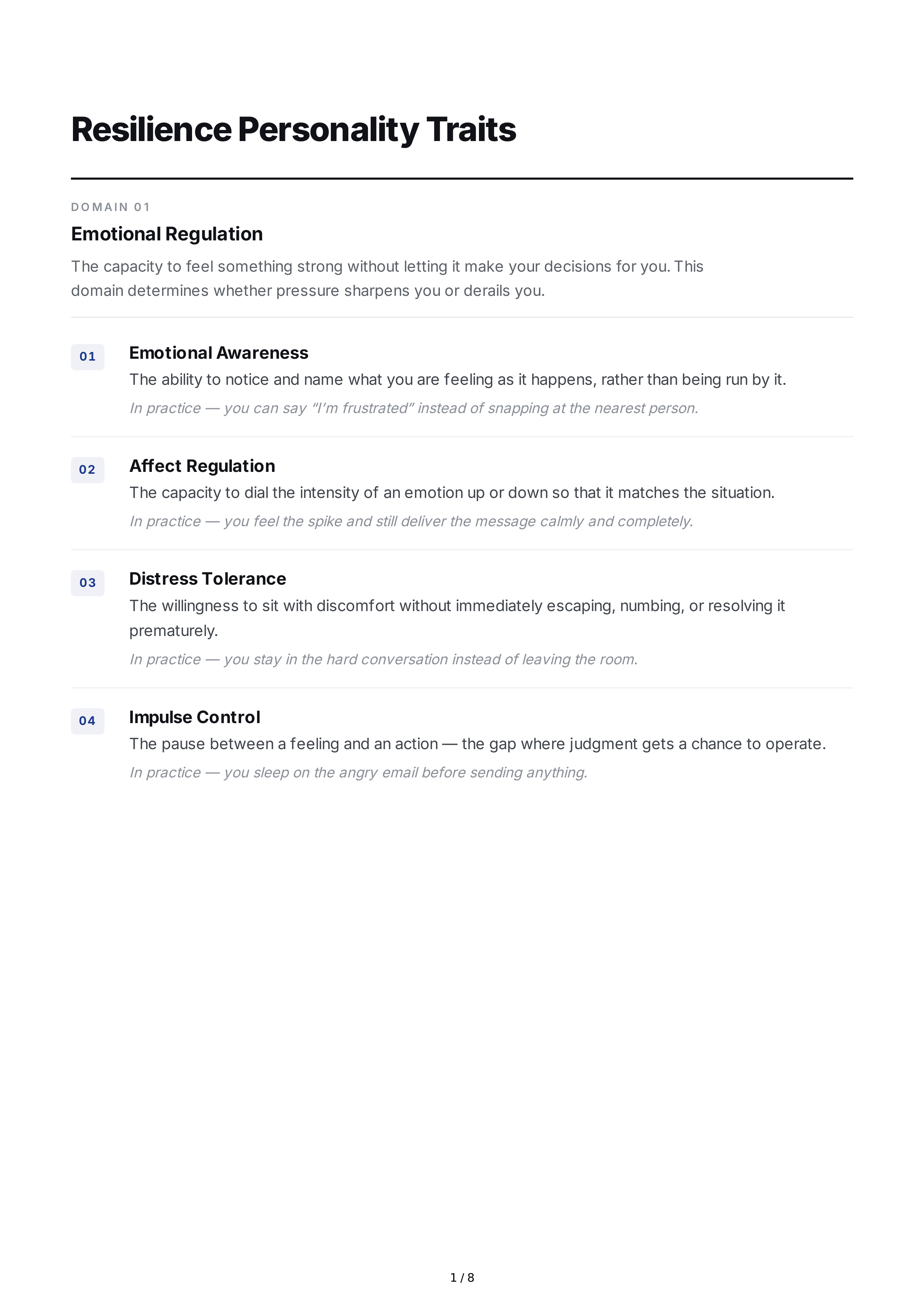
Resilience
Personality
Traits
D O M A I N
0 1
Emotional
Regulation
The
capacity
to
feel
something
strong
without
letting
it
make
your
decisions
for
you
.
This
domain
determines
whether
pressure
sharpens
you
or
derails
you
.
01
Emotional
Awareness
The
ability
to
notice
and
name
what
you
are
feeling
as
it
happens
,
rather
than
being
run
by
it
.
In
practice
—
you
can
say
“
I
’
m
frustrated
”
instead
of
snapping
at
the
nearest
person
.
02
Affect
Regulation
The
capacity
to
dial
the
intensity
of
an
emotion
up
or
down
so
that
it
matches
the
situation
.
In
practice
—
you
feel
the
spike
and
still
deliver
the
message
calmly
and
completely
.
03
Distress
Tolerance
The
willingness
to
sit
with
discomfort
without
immediately
escaping
,
numbing
,
or
resolving
it
prematurely
.
In
practice
—
you
stay
in
the
hard
conversation
instead
of
leaving
the
room
.
04
Impulse
Control
The
pause
between
a
feeling
and
an
action
—
the
gap
where
judgment
gets
a
chance
to
operate
.
In
practice
—
you
sleep
on
the
angry
email
before
sending
anything
.
1 / 8
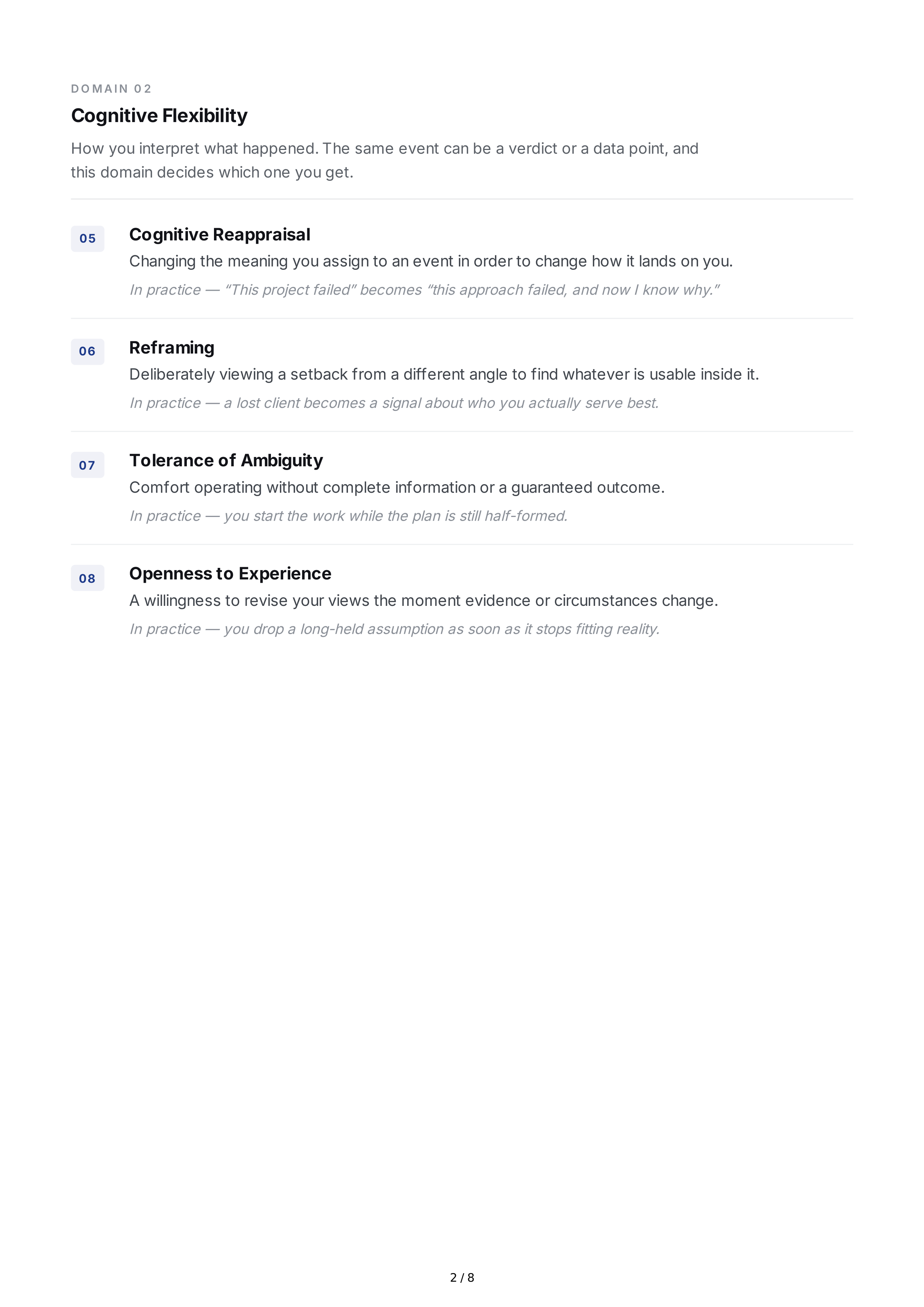
D O M A I N
0 2
Cognitive
Flexibility
How
you
interpret
what
happened
.
The
same
event
can
be
a
verdict
or
a
data
point
,
and
this
domain
decides
which
one
you
get
.
05
Cognitive
Reappraisal
Changing
the
meaning
you
assign
to
an
event
in
order
to
change
how
it
lands
on
you
.
In
practice
— “
This
project
failed
”
becomes
“
this
approach
failed
,
and
now
I
know
why
.”
06
Reframing
Deliberately
viewing
a
setback
from
a
different
angle
to
find
whatever
is
usable
inside
it
.
In
practice
—
a
lost
client
becomes
a
signal
about
who
you
actually
serve
best
.
07
Tolerance
of
Ambiguity
Comfort
operating
without
complete
information
or
a
guaranteed
outcome
.
In
practice
—
you
start
the
work
while
the
plan
is
still
half
-
formed
.
08
Openness
to
Experience
A
willingness
to
revise
your
views
the
moment
evidence
or
circumstances
change
.
In
practice
—
you
drop
a
long
-
held
assumption
as
soon
as
it
stops
fitting
reality
.
2 / 8
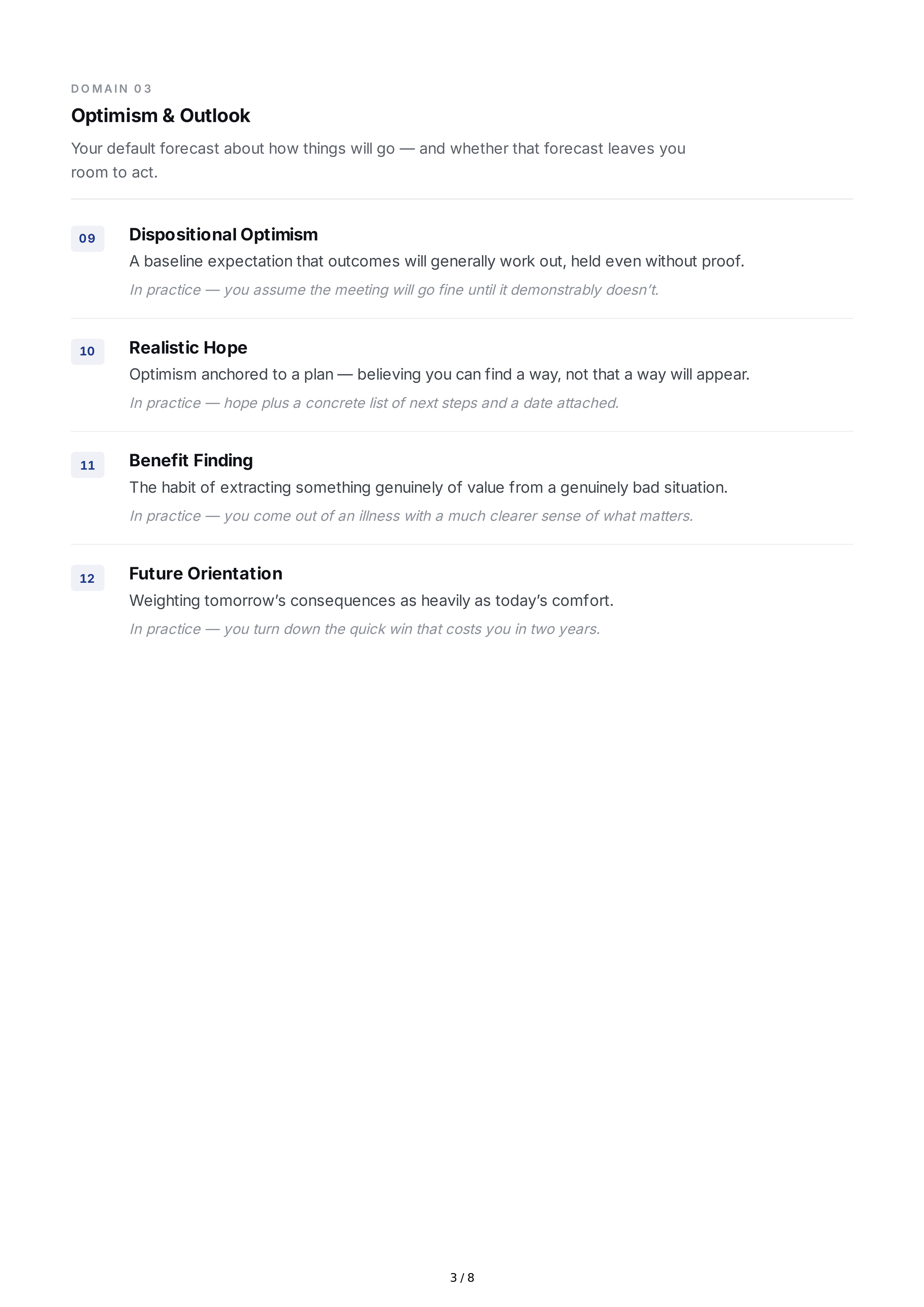
D O M A I N
0 3
Optimism
&
Outlook
Your
default
forecast
about
how
things
will
go
—
and
whether
that
forecast
leaves
you
room
to
act
.
09
Dispositional
Optimism
A
baseline
expectation
that
outcomes
will
generally
work
out
,
held
even
without
proof
.
In
practice
—
you
assume
the
meeting
will
go
fine
until
it
demonstrably
doesn
’
t
.
10
Realistic
Hope
Optimism
anchored
to
a
plan
—
believing
you
can
find
a
way
,
not
that
a
way
will
appear
.
In
practice
—
hope
plus
a
concrete
list
of
next
steps
and
a
date
attached
.
11
Benefit
Finding
The
habit
of
extracting
something
genuinely
of
value
from
a
genuinely
bad
situation
.
In
practice
—
you
come
out
of
an
illness
with
a
much
clearer
sense
of
what
matters
.
12
Future
Orientation
Weighting
tomorrow
’
s
consequences
as
heavily
as
today
’
s
comfort
.
In
practice
—
you
turn
down
the
quick
win
that
costs
you
in
two
years
.
3 / 8
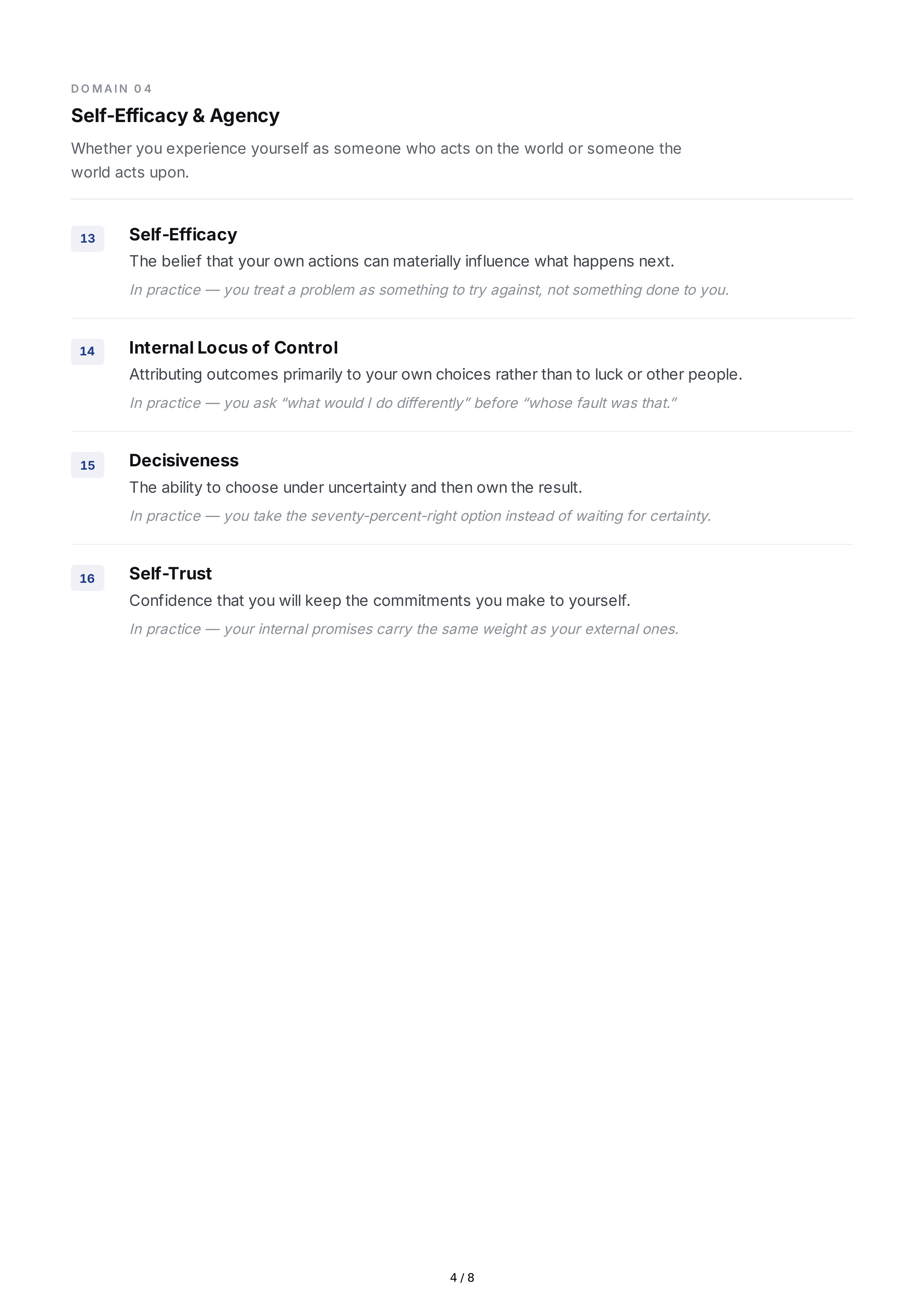
D O M A I N
0 4
Self
-
Efficacy
&
Agency
Whether
you
experience
yourself
as
someone
who
acts
on
the
world
or
someone
the
world
acts
upon
.
13
Self
-
Efficacy
The
belief
that
your
own
actions
can
materially
influence
what
happens
next
.
In
practice
—
you
treat
a
problem
as
something
to
try
against
,
not
something
done
to
you
.
14
Internal
Locus
of
Control
Attributing
outcomes
primarily
to
your
own
choices
rather
than
to
luck
or
other
people
.
In
practice
—
you
ask
“
what
would
I
do
differently
”
before
“
whose
fault
was
that
.”
15
Decisiveness
The
ability
to
choose
under
uncertainty
and
then
own
the
result
.
In
practice
—
you
take
the
seventy
-
percent
-
right
option
instead
of
waiting
for
certainty
.
16
Self
-
Trust
Confidence
that
you
will
keep
the
commitments
you
make
to
yourself
.
In
practice
—
your
internal
promises
carry
the
same
weight
as
your
external
ones
.
4 / 8
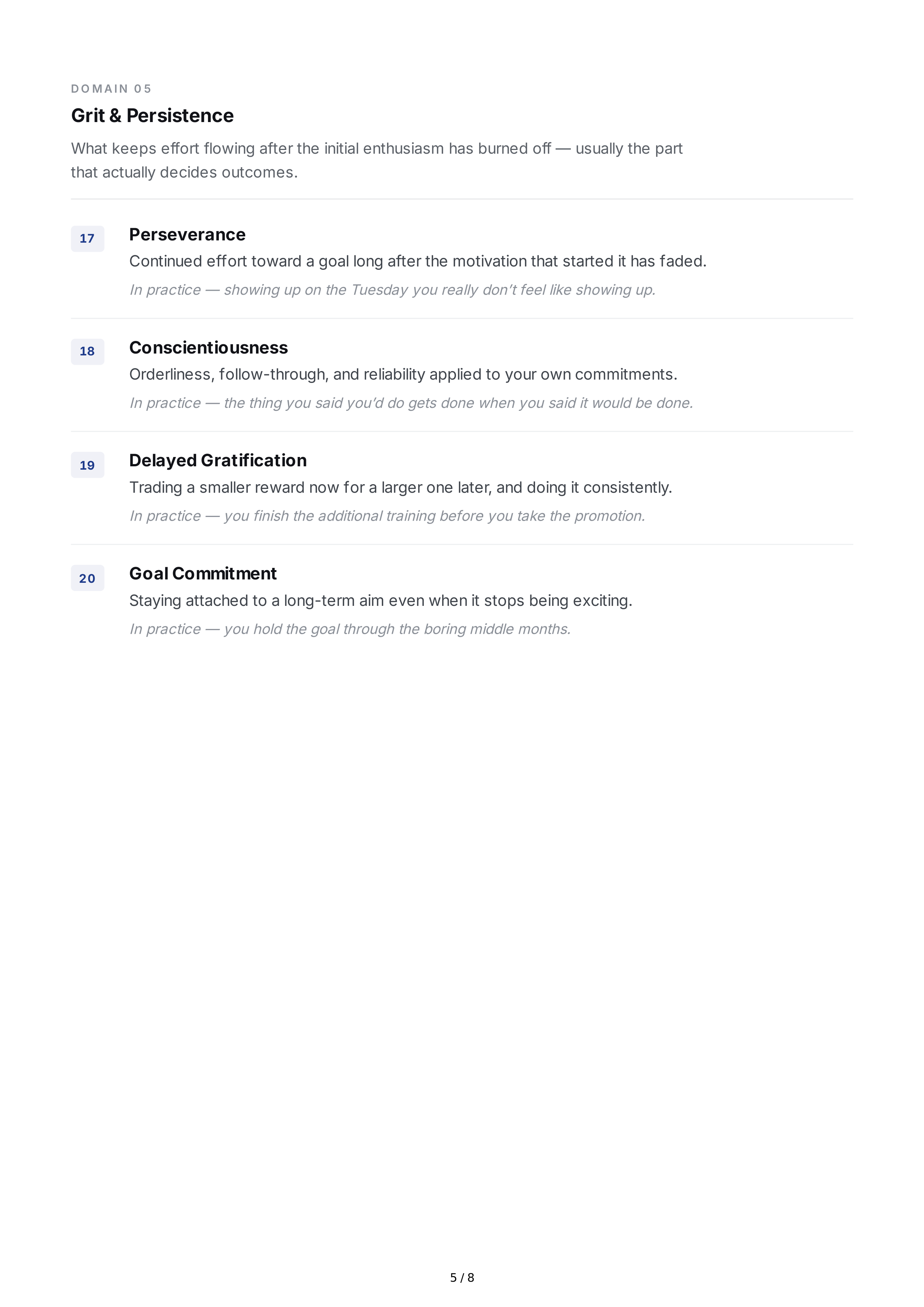
D O M A I N
0 5
Grit
&
Persistence
What
keeps
effort
flowing
after
the
initial
enthusiasm
has
burned
off
—
usually
the
part
that
actually
decides
outcomes
.
17
Perseverance
Continued
effort
toward
a
goal
long
after
the
motivation
that
started
it
has
faded
.
In
practice
—
showing
up
on
the
Tuesday
you
really
don
’
t
feel
like
showing
up
.
18
Conscientiousness
Orderliness
,
follow
-
through
,
and
reliability
applied
to
your
own
commitments
.
In
practice
—
the
thing
you
said
you
’
d
do
gets
done
when
you
said
it
would
be
done
.
19
Delayed
Gratification
Trading
a
smaller
reward
now
for
a
larger
one
later
,
and
doing
it
consistently
.
In
practice
—
you
finish
the
additional
training
before
you
take
the
promotion
.
20
Goal
Commitment
Staying
attached
to
a
long
-
term
aim
even
when
it
stops
being
exciting
.
In
practice
—
you
hold
the
goal
through
the
boring
middle
months
.
5 / 8
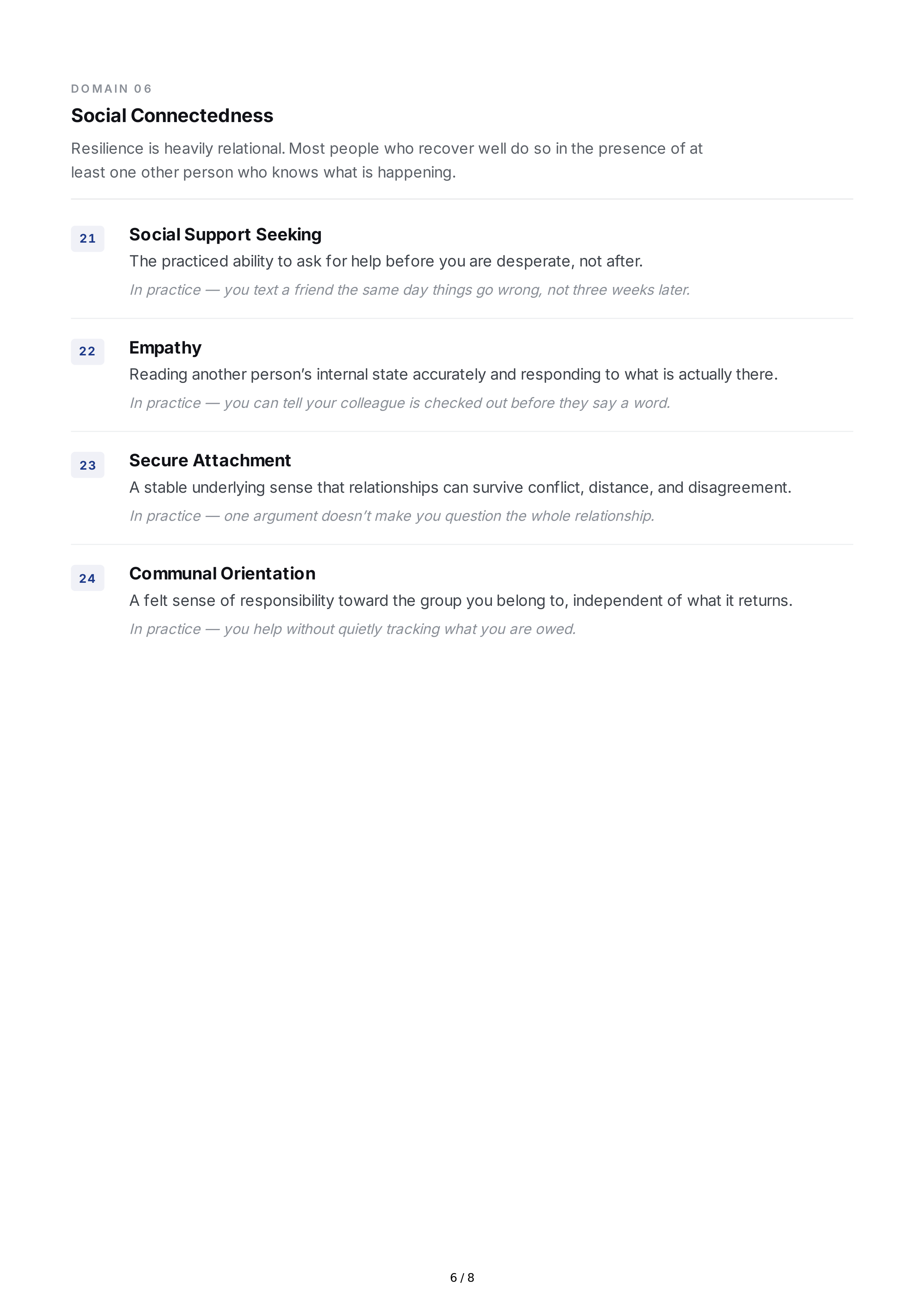
D O M A I N
0 6
Social
Connectedness
Resilience
is
heavily
relational
.
Most
people
who
recover
well
do
so
in
the
presence
of
at
least
one
other
person
who
knows
what
is
happening
.
21
Social
Support
Seeking
The
practiced
ability
to
ask
for
help
before
you
are
desperate
,
not
after
.
In
practice
—
you
text
a
friend
the
same
day
things
go
wrong
,
not
three
weeks
later
.
22
Empathy
Reading
another
person
’
s
internal
state
accurately
and
responding
to
what
is
actually
there
.
In
practice
—
you
can
tell
your
colleague
is
checked
out
before
they
say
a
word
.
23
Secure
Attachment
A
stable
underlying
sense
that
relationships
can
survive
conflict
,
distance
,
and
disagreement
.
In
practice
—
one
argument
doesn
’
t
make
you
question
the
whole
relationship
.
24
Communal
Orientation
A
felt
sense
of
responsibility
toward
the
group
you
belong
to
,
independent
of
what
it
returns
.
In
practice
—
you
help
without
quietly
tracking
what
you
are
owed
.
6 / 8
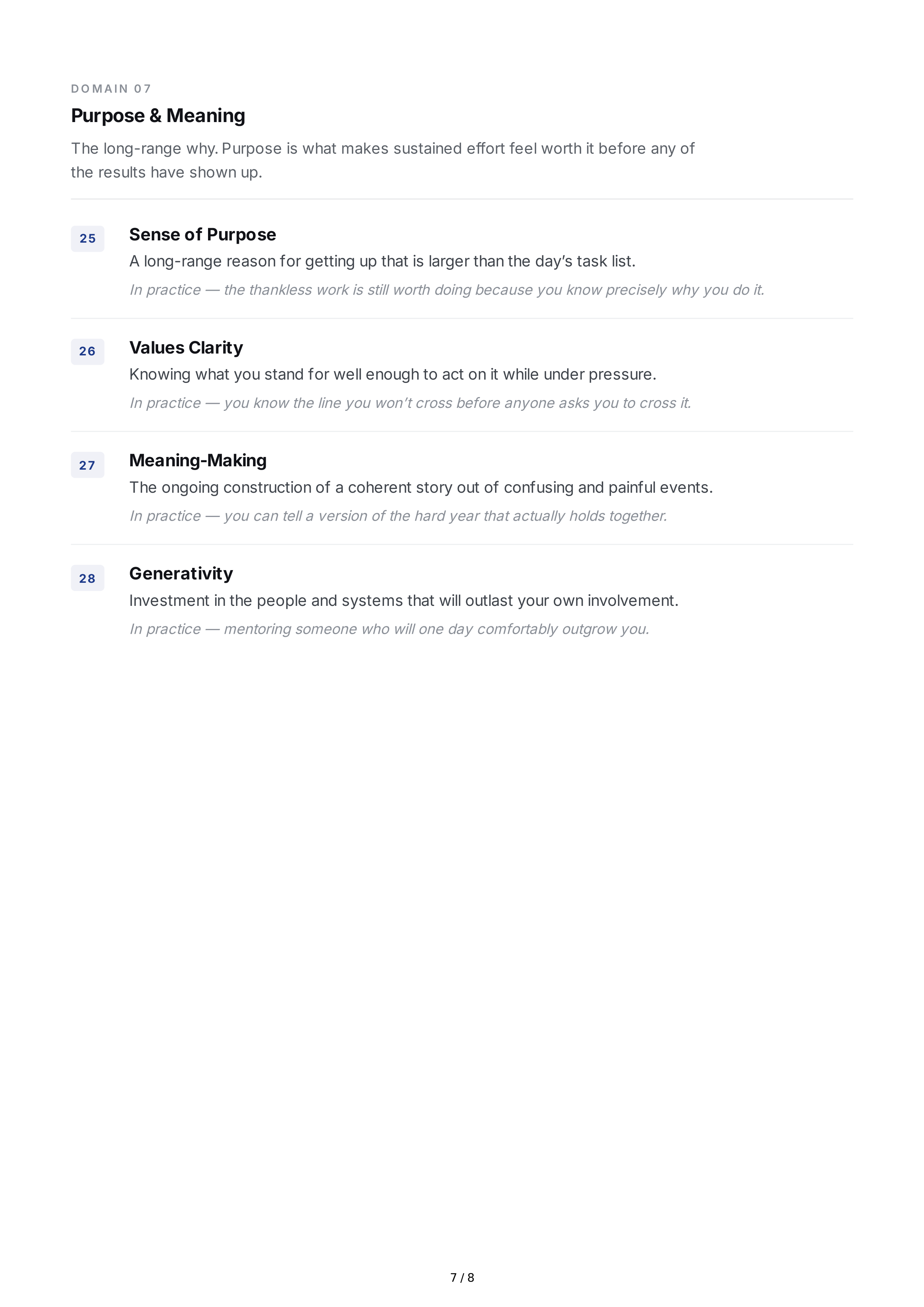
D O M A I N
0 7
Purpose
&
Meaning
The
long
-
range
why
.
Purpose
is
what
makes
sustained
effort
feel
worth
it
before
any
of
the
results
have
shown
up
.
25
Sense
of
Purpose
A
long
-
range
reason
for
getting
up
that
is
larger
than
the
day
’
s
task
list
.
In
practice
—
the
thankless
work
is
still
worth
doing
because
you
know
precisely
why
you
do
it
.
26
Values
Clarity
Knowing
what
you
stand
for
well
enough
to
act
on
it
while
under
pressure
.
In
practice
—
you
know
the
line
you
won
’
t
cross
before
anyone
asks
you
to
cross
it
.
27
Meaning
-
Making
The
ongoing
construction
of
a
coherent
story
out
of
confusing
and
painful
events
.
In
practice
—
you
can
tell
a
version
of
the
hard
year
that
actually
holds
together
.
28
Generativity
Investment
in
the
people
and
systems
that
will
outlast
your
own
involvement
.
In
practice
—
mentoring
someone
who
will
one
day
comfortably
outgrow
you
.
7 / 8
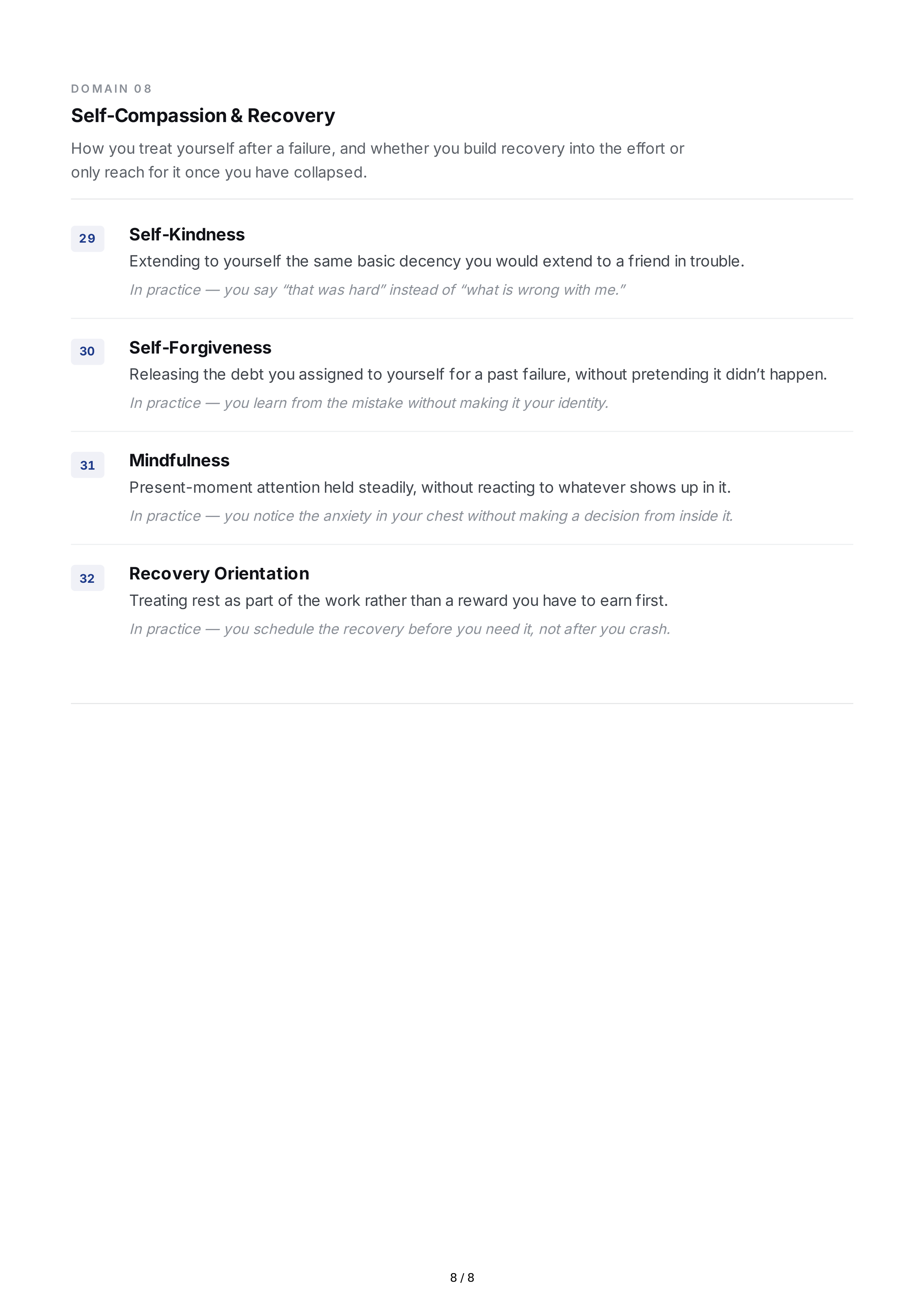
D O M A I N
0 8
Self
-
Compassion
&
Recovery
How
you
treat
yourself
after
a
failure
,
and
whether
you
build
recovery
into
the
effort
or
only
reach
for
it
once
you
have
collapsed
.
29
Self
-
Kindness
Extending
to
yourself
the
same
basic
decency
you
would
extend
to
a
friend
in
trouble
.
In
practice
—
you
say
“
that
was
hard
”
instead
of
“
what
is
wrong
with
me
.”
30
Self
-
Forgiveness
Releasing
the
debt
you
assigned
to
yourself
for
a
past
failure
,
without
pretending
it
didn
’
t
happen
.
In
practice
—
you
learn
from
the
mistake
without
making
it
your
identity
.
31
Mindfulness
Present
-
moment
attention
held
steadily
,
without
reacting
to
whatever
shows
up
in
it
.
In
practice
—
you
notice
the
anxiety
in
your
chest
without
making
a
decision
from
inside
it
.
32
Recovery
Orientation
Treating
rest
as
part
of
the
work
rather
than
a
reward
you
have
to
earn
first
.
In
practice
—
you
schedule
the
recovery
before
you
need
it
,
not
after
you
crash
.
8 / 8