Ambition
Personality
Traits
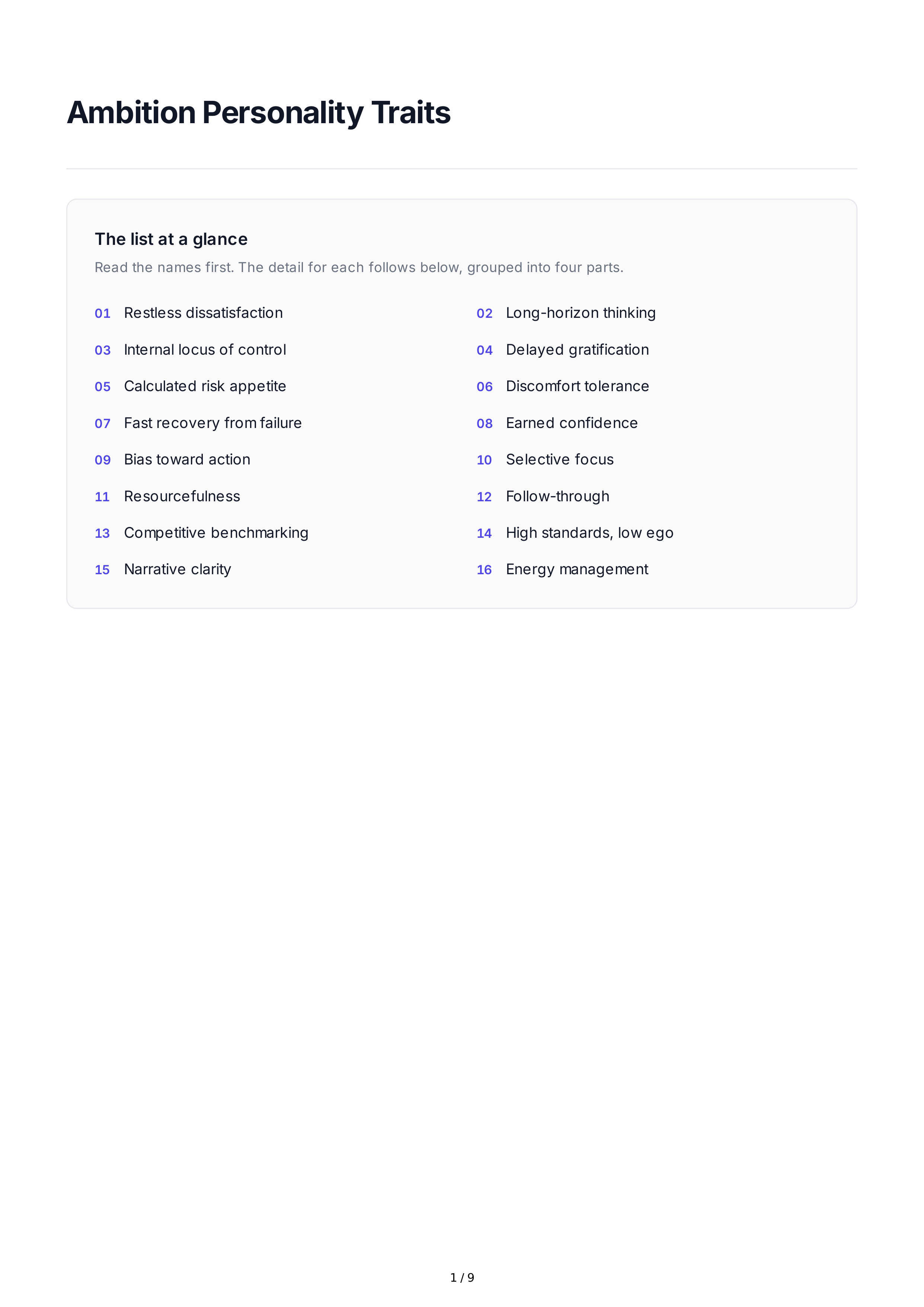
The
list
at
a
glance
Read
the
names
first
.
The
detail
for
each
follows
below
,
grouped
into
four
parts
.
01
Restless
dissatisfaction
02
Long
-
horizon
thinking
03
Internal
locus
of
control
04
Delayed
gratification
05
Calculated
risk
appetite
06
Discomfort
tolerance
07
Fast
recovery
from
failure
08
Earned
confidence
09
Bias
toward
action
10
Selective
focus
11
Resourcefulness
12
Follow
-
through
13
Competitive
benchmarking
14
High
standards
,
low
ego
15
Narrative
clarity
16
Energy
management
1 / 9
PAR T
O N E
D R IV E
What
pulls
them
forward
The
internal
pressure
that
makes
the
current
state
feel
temporary
—
and
the
time
frame
it
operates
on
.
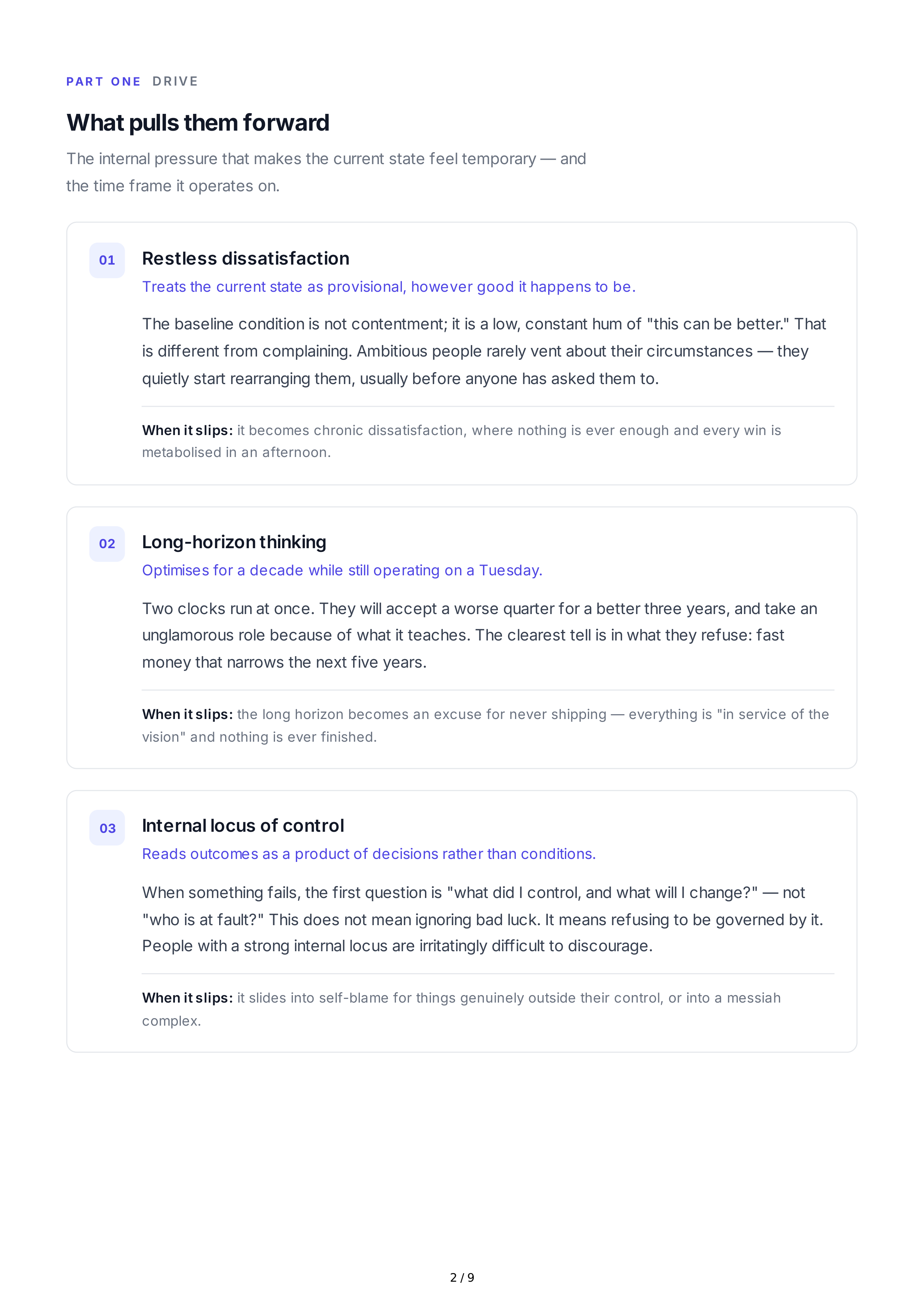
01
Restless
dissatisfaction
Treats
the
current
state
as
provisional
,
however
good
it
happens
to
be
.
The
baseline
condition
is
not
contentment
;
it
is
a
low
,
constant
hum
of
"
this
can
be
better
."
That
is
different
from
complaining
.
Ambitious
people
rarely
vent
about
their
circumstances
—
they
quietly
start
rearranging
them
,
usually
before
anyone
has
asked
them
to
.
When
it
slips
:
it
becomes
chronic
dissatisfaction
,
where
nothing
is
ever
enough
and
every
win
is
metabolised
in
an
afternoon
.
02
Long
-
horizon
thinking
Optimises
for
a
decade
while
still
operating
on
a
Tuesday
.
Two
clocks
run
at
once
.
They
will
accept
a
worse
quarter
for
a
better
three
years
,
and
take
an
unglamorous
role
because
of
what
it
teaches
.
The
clearest
tell
is
in
what
they
refuse
:
fast
money
that
narrows
the
next
five
years
.
When
it
slips
:
the
long
horizon
becomes
an
excuse
for
never
shipping
—
everything
is
"
in
service
of
the
vision
"
and
nothing
is
ever
finished
.
03
Internal
locus
of
control
Reads
outcomes
as
a
product
of
decisions
rather
than
conditions
.
When
something
fails
,
the
first
question
is
"
what
did
I
control
,
and
what
will
I
change
?" —
not
"
who
is
at
fault
?"
This
does
not
mean
ignoring
bad
luck
.
It
means
refusing
to
be
governed
by
it
.
People
with
a
strong
internal
locus
are
irritatingly
difficult
to
discourage
.
When
it
slips
:
it
slides
into
self
-
blame
for
things
genuinely
outside
their
control
,
or
into
a
messiah
complex
.
2 / 9

04
Delayed
gratification
Can
tolerate
a
worse
present
for
a
better
future
,
repeatedly
.
The
well
-
known
marshmallow
result
has
been
oversold
,
but
the
underlying
capacity
holds
.
Ambition
requires
sitting
in
discomfort
on
purpose
,
for
a
long
time
,
without
visible
reward
.
It
shows
up
as
staying
with
a
hard
skill
through
the
eighteen
months
before
it
compounds
.
When
it
slips
:
deferred
living
—
the
reward
is
always
one
milestone
away
,
and
life
keeps
being
postponed
.
3 / 9
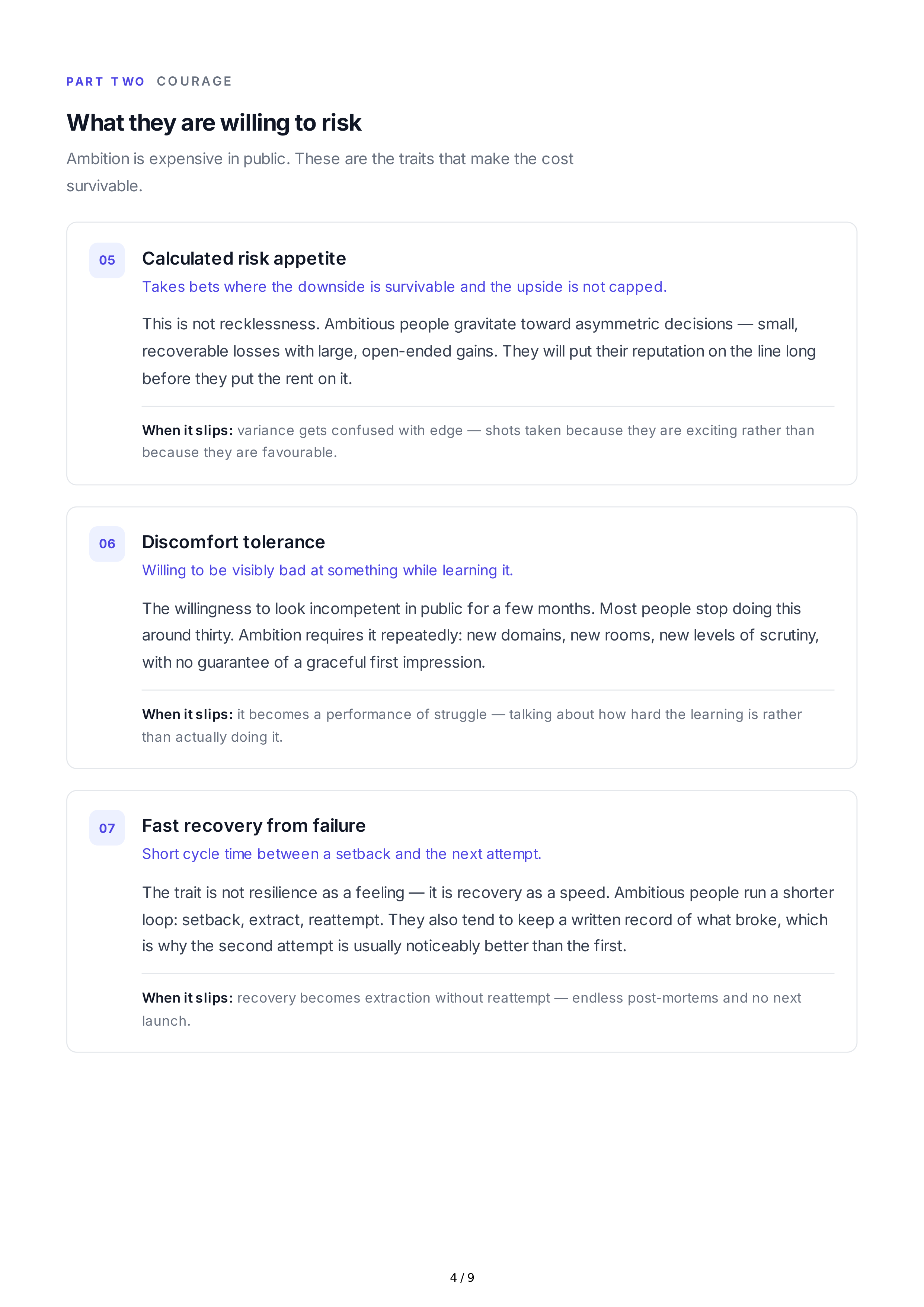
PAR T
T WO
C O U R A GE
What
they
are
willing
to
risk
Ambition
is
expensive
in
public
.
These
are
the
traits
that
make
the
cost
survivable
.
05
Calculated
risk
appetite
Takes
bets
where
the
downside
is
survivable
and
the
upside
is
not
capped
.
This
is
not
recklessness
.
Ambitious
people
gravitate
toward
asymmetric
decisions
—
small
,
recoverable
losses
with
large
,
open
-
ended
gains
.
They
will
put
their
reputation
on
the
line
long
before
they
put
the
rent
on
it
.
When
it
slips
:
variance
gets
confused
with
edge
—
shots
taken
because
they
are
exciting
rather
than
because
they
are
favourable
.
06
Discomfort
tolerance
Willing
to
be
visibly
bad
at
something
while
learning
it
.
The
willingness
to
look
incompetent
in
public
for
a
few
months
.
Most
people
stop
doing
this
around
thirty
.
Ambition
requires
it
repeatedly
:
new
domains
,
new
rooms
,
new
levels
of
scrutiny
,
with
no
guarantee
of
a
graceful
first
impression
.
When
it
slips
:
it
becomes
a
performance
of
struggle
—
talking
about
how
hard
the
learning
is
rather
than
actually
doing
it
.
07
Fast
recovery
from
failure
Short
cycle
time
between
a
setback
and
the
next
attempt
.
The
trait
is
not
resilience
as
a
feeling
—
it
is
recovery
as
a
speed
.
Ambitious
people
run
a
shorter
loop
:
setback
,
extract
,
reattempt
.
They
also
tend
to
keep
a
written
record
of
what
broke
,
which
is
why
the
second
attempt
is
usually
noticeably
better
than
the
first
.
When
it
slips
:
recovery
becomes
extraction
without
reattempt
—
endless
post
-
mortems
and
no
next
launch
.
4 / 9

08
Earned
confidence
Belief
calibrated
by
actual
evidence
of
past
performance
.
Distinct
from
bravado
.
It
accumulates
from
a
log
of
things
done
:
hard
conversations
had
,
launches
shipped
,
years
spent
in
a
craft
.
That
is
why
it
survives
being
wrong
in
public
,
and
why
it
is
so
difficult
to
fake
convincingly
for
long
.
When
it
slips
:
it
becomes
overconfidence
in
a
domain
where
the
evidence
is
stale
—
a
five
-
year
-
old
track
record
applied
to
a
new
field
.
5 / 9
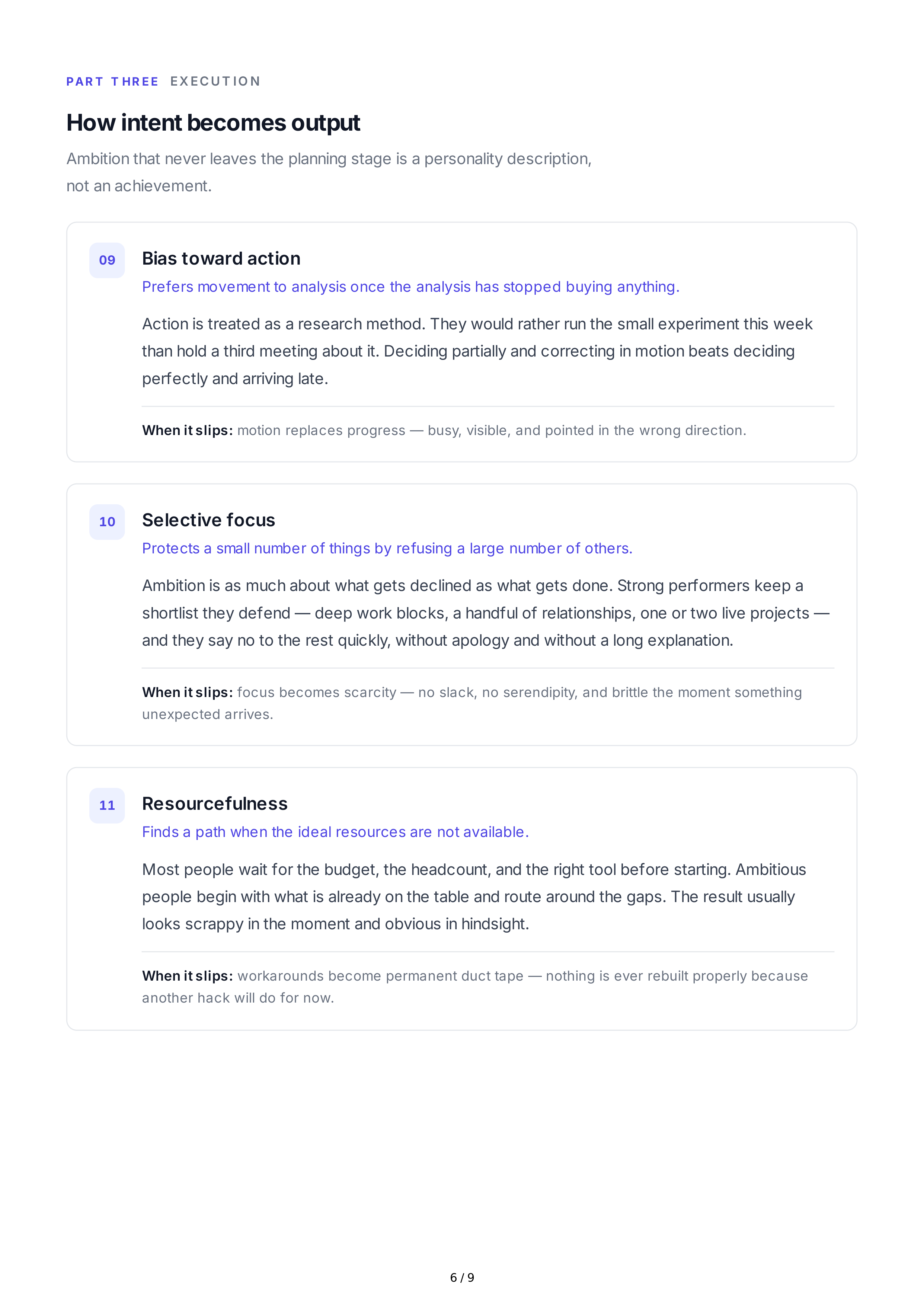
PAR T
T HR E E
EX EC U T IO N
How
intent
becomes
output
Ambition
that
never
leaves
the
planning
stage
is
a
personality
description
,
not
an
achievement
.
09
Bias
toward
action
Prefers
movement
to
analysis
once
the
analysis
has
stopped
buying
anything
.
Action
is
treated
as
a
research
method
.
They
would
rather
run
the
small
experiment
this
week
than
hold
a
third
meeting
about
it
.
Deciding
partially
and
correcting
in
motion
beats
deciding
perfectly
and
arriving
late
.
When
it
slips
:
motion
replaces
progress
—
busy
,
visible
,
and
pointed
in
the
wrong
direction
.
10
Selective
focus
Protects
a
small
number
of
things
by
refusing
a
large
number
of
others
.
Ambition
is
as
much
about
what
gets
declined
as
what
gets
done
.
Strong
performers
keep
a
shortlist
they
defend
—
deep
work
blocks
,
a
handful
of
relationships
,
one
or
two
live
projects
—
and
they
say
no
to
the
rest
quickly
,
without
apology
and
without
a
long
explanation
.
When
it
slips
:
focus
becomes
scarcity
—
no
slack
,
no
serendipity
,
and
brittle
the
moment
something
unexpected
arrives
.
11
Resourcefulness
Finds
a
path
when
the
ideal
resources
are
not
available
.
Most
people
wait
for
the
budget
,
the
headcount
,
and
the
right
tool
before
starting
.
Ambitious
people
begin
with
what
is
already
on
the
table
and
route
around
the
gaps
.
The
result
usually
looks
scrappy
in
the
moment
and
obvious
in
hindsight
.
When
it
slips
:
workarounds
become
permanent
duct
tape
—
nothing
is
ever
rebuilt
properly
because
another
hack
will
do
for
now
.
6 / 9

12
Follow
-
through
Closes
loops
,
especially
the
boring
ones
.
The
least
glamorous
trait
on
this
list
and
the
most
predictive
.
It
is
the
energy
to
finish
the
last
ten
percent
—
the
documentation
,
the
final
invoice
,
the
follow
-
up
email
nobody
would
have
chased
.
Ideas
are
cheap
;
seeing
one
through
the
uninteresting
middle
is
what
makes
a
person
credible
.
When
it
slips
:
it
becomes
perfectionism
on
the
wrong
items
—
polishing
what
is
visible
and
abandoning
what
is
tedious
but
load
-
bearing
.
7 / 9
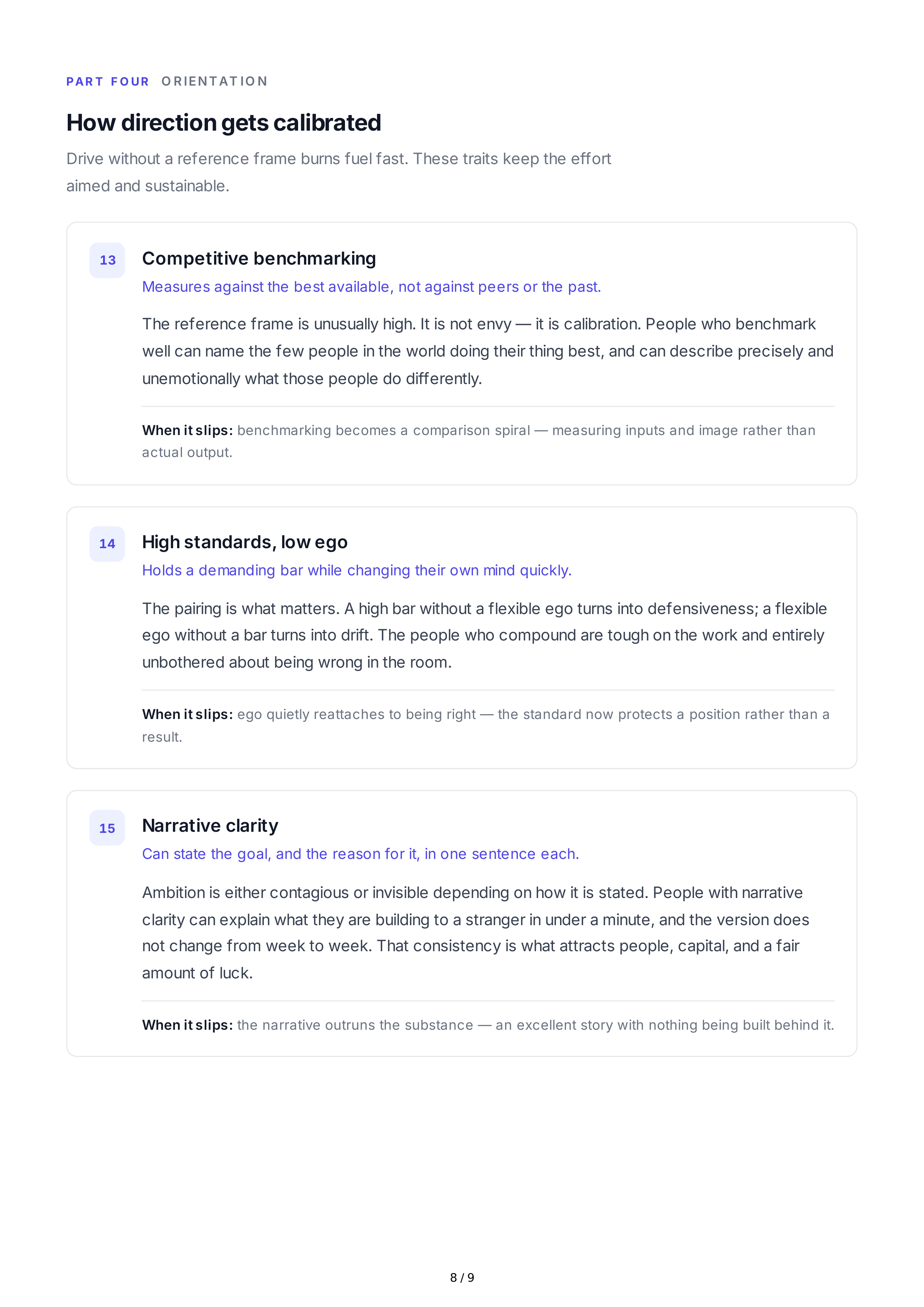
PAR T
F O UR
O R IENTAT IO N
How
direction
gets
calibrated
Drive
without
a
reference
frame
burns
fuel
fast
.
These
traits
keep
the
effort
aimed
and
sustainable
.
13
Competitive
benchmarking
Measures
against
the
best
available
,
not
against
peers
or
the
past
.
The
reference
frame
is
unusually
high
.
It
is
not
envy
—
it
is
calibration
.
People
who
benchmark
well
can
name
the
few
people
in
the
world
doing
their
thing
best
,
and
can
describe
precisely
and
unemotionally
what
those
people
do
differently
.
When
it
slips
:
benchmarking
becomes
a
comparison
spiral
—
measuring
inputs
and
image
rather
than
actual
output
.
14
High
standards
,
low
ego
Holds
a
demanding
bar
while
changing
their
own
mind
quickly
.
The
pairing
is
what
matters
.
A
high
bar
without
a
flexible
ego
turns
into
defensiveness
;
a
flexible
ego
without
a
bar
turns
into
drift
.
The
people
who
compound
are
tough
on
the
work
and
entirely
unbothered
about
being
wrong
in
the
room
.
When
it
slips
:
ego
quietly
reattaches
to
being
right
—
the
standard
now
protects
a
position
rather
than
a
result
.
15
Narrative
clarity
Can
state
the
goal
,
and
the
reason
for
it
,
in
one
sentence
each
.
Ambition
is
either
contagious
or
invisible
depending
on
how
it
is
stated
.
People
with
narrative
clarity
can
explain
what
they
are
building
to
a
stranger
in
under
a
minute
,
and
the
version
does
not
change
from
week
to
week
.
That
consistency
is
what
attracts
people
,
capital
,
and
a
fair
amount
of
luck
.
When
it
slips
:
the
narrative
outruns
the
substance
—
an
excellent
story
with
nothing
being
built
behind
it
.
8 / 9

16
Energy
management
Treats
stamina
as
infrastructure
rather
than
a
personal
failing
.
Long
-
horizon
ambition
without
physical
and
emotional
maintenance
ends
in
a
burnout
-
shaped
hole
.
Strong
performers
protect
sleep
,
exercise
,
and
recovery
as
deliberately
as
they
protect
their
calendar
.
Stamina
is
the
enabling
trait
—
every
other
trait
on
this
list
spends
it
.
When
it
slips
:
recovery
gets
treated
as
a
luxury
,
and
a
single
bad
quarter
wipes
out
several
years
of
compounding
.
9 / 9