Self
-
Control
Personality
Traits
T HE
L IST
AT
A
G L ANCE
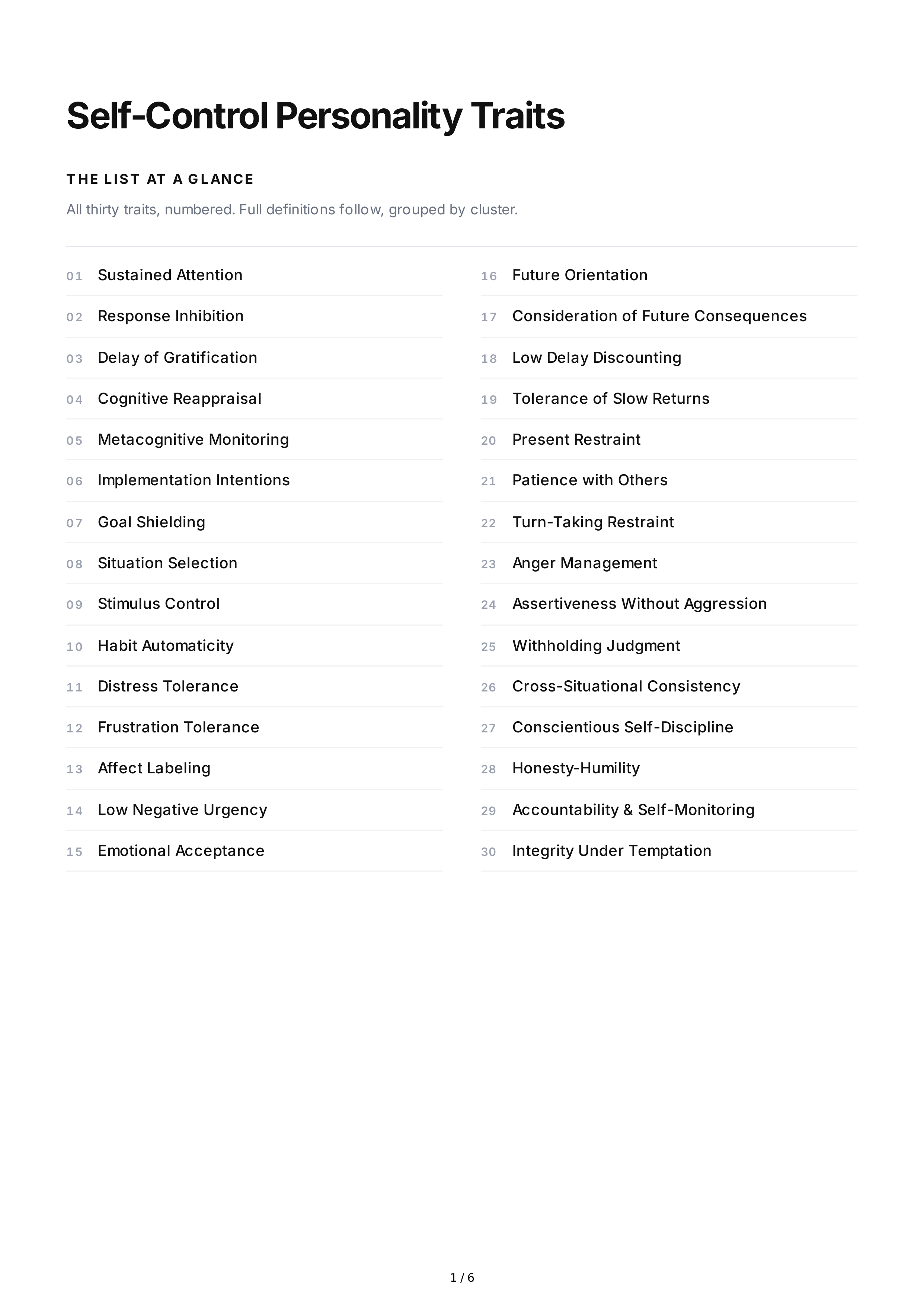
All
thirty
traits
,
numbered
.
Full
definitions
follow
,
grouped
by
cluster
.
01
Sustained
Attention
02
Response
Inhibition
03
Delay
of
Gratification
04
Cognitive
Reappraisal
05
Metacognitive
Monitoring
06
Implementation
Intentions
07
Goal
Shielding
08
Situation
Selection
09
Stimulus
Control
10
Habit
Automaticity
11
Distress
Tolerance
12
Frustration
Tolerance
13
Affect
Labeling
14
Low
Negative
Urgency
15
Emotional
Acceptance
16
Future
Orientation
17
Consideration
of
Future
Consequences
18
Low
Delay
Discounting
19
Tolerance
of
Slow
Returns
20
Present
Restraint
21
Patience
with
Others
22
Turn
-
Taking
Restraint
23
Anger
Management
24
Assertiveness
Without
Aggression
25
Withholding
Judgment
26
Cross
-
Situational
Consistency
27
Conscientious
Self
-
Discipline
28
Honesty
-
Humility
29
Accountability
&
Self
-
Monitoring
30
Integrity
Under
Temptation
1 / 6
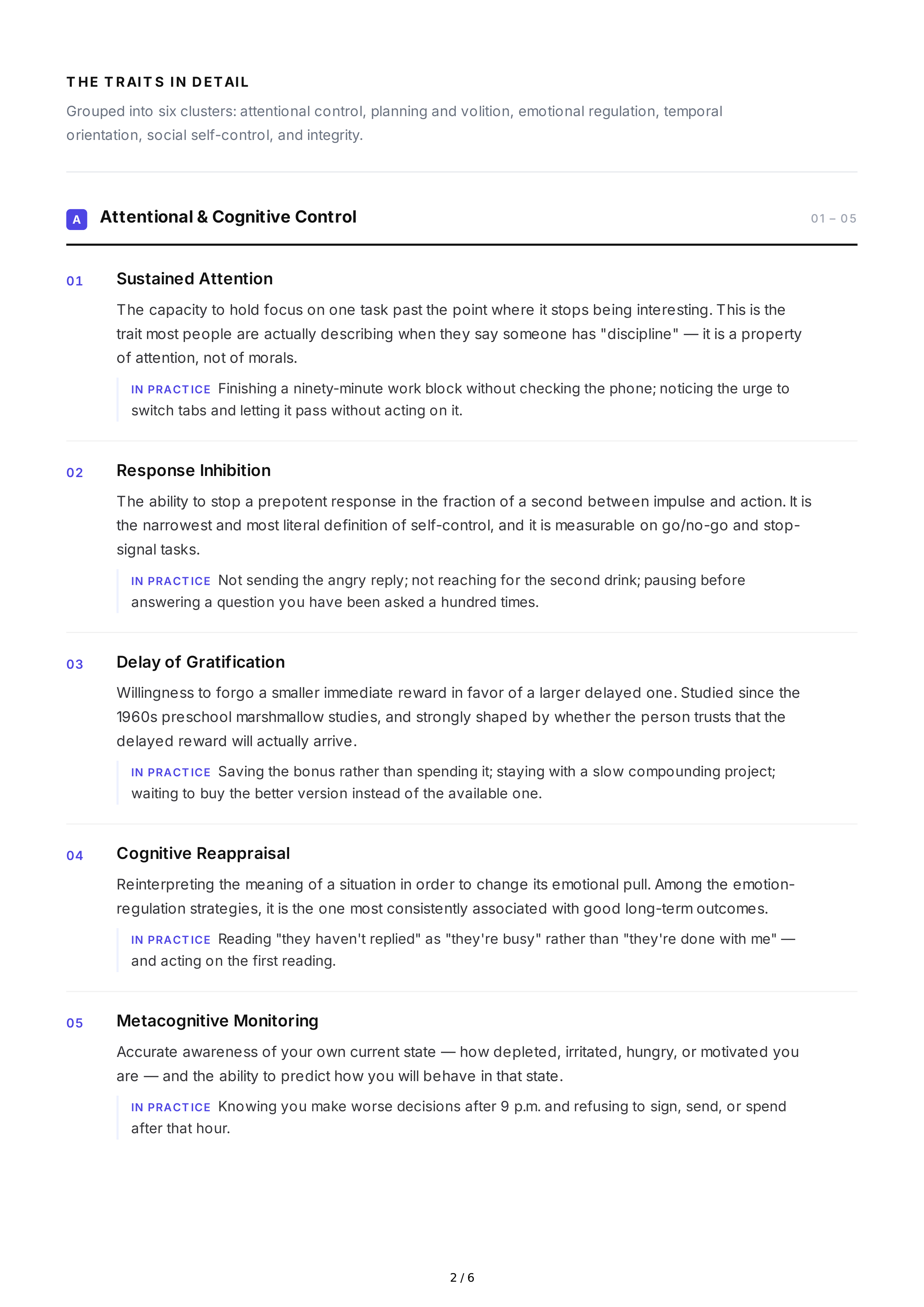
T HE
T RAIT S
IN
DETAIL
Grouped
into
six
clusters
:
attentional
control
,
planning
and
volition
,
emotional
regulation
,
temporal
orientation
,
social
self
-
control
,
and
integrity
.
Attentional
&
Cognitive
Control
01 – 05
01
Sustained
Attention
The
capacity
to
hold
focus
on
one
task
past
the
point
where
it
stops
being
interesting
.
This
is
the
trait
most
people
are
actually
describing
when
they
say
someone
has
"
discipline
" —
it
is
a
property
of
attention
,
not
of
morals
.
IN
PRACT ICE
Finishing
a
ninety
-
minute
work
block
without
checking
the
phone
;
noticing
the
urge
to
switch
tabs
and
letting
it
pass
without
acting
on
it
.
02
Response
Inhibition
The
ability
to
stop
a
prepotent
response
in
the
fraction
of
a
second
between
impulse
and
action
.
It
is
the
narrowest
and
most
literal
definition
of
self
-
control
,
and
it
is
measurable
on
go
/
no
-
go
and
stop
-
signal
tasks
.
IN
PRACT ICE
Not
sending
the
angry
reply
;
not
reaching
for
the
second
drink
;
pausing
before
answering
a
question
you
have
been
asked
a
hundred
times
.
03
Delay
of
Gratification
Willingness
to
forgo
a
smaller
immediate
reward
in
favor
of
a
larger
delayed
one
.
Studied
since
the
1960
s
preschool
marshmallow
studies
,
and
strongly
shaped
by
whether
the
person
trusts
that
the
delayed
reward
will
actually
arrive
.
IN
PRACT ICE
Saving
the
bonus
rather
than
spending
it
;
staying
with
a
slow
compounding
project
;
waiting
to
buy
the
better
version
instead
of
the
available
one
.
04
Cognitive
Reappraisal
Reinterpreting
the
meaning
of
a
situation
in
order
to
change
its
emotional
pull
.
Among
the
emotion
-
regulation
strategies
,
it
is
the
one
most
consistently
associated
with
good
long
-
term
outcomes
.
IN
PRACT ICE
Reading
"
they
haven
'
t
replied
"
as
"
they
'
re
busy
"
rather
than
"
they
'
re
done
with
me
" —
and
acting
on
the
first
reading
.
05
Metacognitive
Monitoring
Accurate
awareness
of
your
own
current
state
—
how
depleted
,
irritated
,
hungry
,
or
motivated
you
are
—
and
the
ability
to
predict
how
you
will
behave
in
that
state
.
IN
PRACT ICE
Knowing
you
make
worse
decisions
after
9
p
.
m
.
and
refusing
to
sign
,
send
,
or
spend
after
that
hour
.
A
2 / 6
Planning
&
Volition
06 – 10
06
Implementation
Intentions
Pre
-
decided
if
–
then
plans
that
hand
control
to
an
environmental
cue
instead
of
to
in
-
the
-
moment
willpower
.
Consistently
one
of
the
highest
-
yield
self
-
control
interventions
in
the
literature
.
IN
PRACT ICE
"
If
it
'
s
7
a
.
m
.,
then
I
'
m
at
the
pool
." "
If
dessert
is
offered
,
then
I
ask
for
tea
."
07
Goal
Shielding
Actively
protecting
a
committed
goal
from
competing
alternatives
,
especially
attractive
ones
.
It
is
a
volitional
trait
rather
than
a
motivational
one
—
it
shows
up
in
what
you
decline
,
not
in
what
you
want
.
IN
PRACT ICE
Turning
down
a
lucrative
side
project
that
would
stall
the
main
one
;
saying
no
to
a
good
opportunity
because
it
is
the
wrong
year
.
08
Situation
Selection
Choosing
environments
before
they
can
test
you
.
Because
it
happens
upstream
of
temptation
,
it
costs
almost
nothing
in
willpower
and
is
heavily
overrepresented
among
people
who
appear
to
have
extraordinary
self
-
control
.
IN
PRACT ICE
Not
keeping
the
ice
cream
in
the
house
;
taking
a
different
route
past
the
casino
;
joining
the
gym
on
the
walk
home
.
09
Stimulus
Control
Removing
cues
for
unwanted
behavior
and
adding
cues
for
wanted
behavior
,
so
the
desired
action
requires
less
deliberate
effort
each
time
.
IN
PRACT ICE
The
phone
charging
in
another
room
overnight
;
running
shoes
by
the
door
;
the
credit
card
stored
out
of
the
browser
.
10
Habit
Automaticity
Converting
repeated
effortful
choices
into
automatic
routines
.
Habits
reduce
the
total
number
of
self
-
control
decisions
a
day
demands
,
which
is
why
they
mediate
much
of
the
apparent
advantage
of
high
trait
self
-
control
.
IN
PRACT ICE
The
same
breakfast
;
the
same
training
time
;
the
same
weekly
review
on
the
same
afternoon
.
Emotional
Regulation
11 – 15
11
Distress
Tolerance
Staying
functional
while
an
unpleasant
emotion
is
present
,
without
needing
to
resolve
it
immediately
.
The
core
skill
in
dialectical
behavior
therapy
and
the
inverse
of
avoidance
-
driven
behavior
.
IN
PRACT ICE
Sitting
with
the
anxiety
before
a
difficult
call
instead
of
scrolling
it
away
.
B
C
3 / 6
12
Frustration
Tolerance
Absorbing
blocked
progress
without
abandoning
the
effort
or
turning
on
the
people
nearby
.
Distinct
from
distress
tolerance
:
it
is
specifically
about
obstruction
,
not
sadness
or
fear
.
IN
PRACT ICE
Continuing
after
the
third
failed
attempt
;
not
quitting
the
language
course
the
week
the
grammar
gets
hard
.
13
Affect
Labeling
Naming
an
emotion
precisely
,
which
reliably
reduces
its
intensity
and
its
grip
on
behavior
.
Precision
matters
— "
I
am
embarrassed
"
works
better
than
"
I
am
stressed
."
IN
PRACT ICE
"
This
is
embarrassment
,
not
anger
." "
This
is
envy
,
not
ambition
."
14
Low
Negative
Urgency
The
tendency
not
to
act
rashly
when
distressed
.
When
it
is
high
rather
than
low
,
it
is
one
of
the
strongest
known
predictors
of
substance
misuse
,
problem
gambling
,
and
impulsive
self
-
harm
.
This
trait
is
best
read
as
its
absence
.
IN
PRACT ICE
Not
quitting
the
job
,
ending
the
relationship
,
or
buying
the
car
inside
the
same
forty
-
minute
window
.
15
Emotional
Acceptance
Allowing
a
feeling
to
exist
without
arguing
with
it
or
building
a
story
around
it
.
Related
to
non
-
attachment
in
contemplative
traditions
and
to
acceptance
-
based
approaches
in
clinical
psychology
.
IN
PRACT ICE
"
This
is
disappointment
.
It
can
be
here
for
an
hour
."
Temporal
Orientation
16 – 20
16
Future
Orientation
A
default
attentional
bias
toward
long
-
horizon
outcomes
—
thinking
in
years
rather
than
in
afternoons
.
It
shapes
which
consequences
feel
real
enough
to
act
on
.
IN
PRACT ICE
Weighing
a
decision
that
feels
like
it
is
about
today
against
where
you
want
to
be
in
five
years
.
17
Consideration
of
Future
Consequences
The
measured
tendency
to
weigh
distant
outcomes
against
immediate
ones
.
It
is
a
standard
individual
-
difference
construct
with
its
own
instrument
,
and
it
correlates
with
health
behavior
,
saving
,
and
academic
persistence
.
IN
PRACT ICE
Reading
the
terms
;
checking
the
interest
rate
;
doing
the
follow
-
up
scan
even
though
nothing
hurts
yet
.
D
4 / 6
18
Low
Delay
Discounting
Valuing
delayed
rewards
nearly
as
much
as
immediate
ones
.
Steep
discounting
—
a
sharp
drop
in
perceived
value
over
time
—
is
the
quantitative
signature
of
weak
self
-
control
.
IN
PRACT ICE
An
extra
$
200
in
six
months
feels
roughly
as
real
and
as
motivating
as
$
200
today
.
19
Tolerance
of
Slow
Returns
Staying
with
compounding
efforts
that
produce
no
visible
payoff
for
months
.
It
is
the
trait
that
separates
people
who
finish
long
projects
from
people
who
start
many
.
IN
PRACT ICE
Writing
the
book
;
the
fourth
quarter
of
a
strength
program
;
holding
the
boring
index
fund
.
20
Present
Restraint
Low
present
-
hedonism
:
not
treating
the
current
moment
as
the
only
one
that
counts
.
Distinct
from
future
orientation
in
that
it
is
about
restraint
in
the
present
rather
than
planning
for
later
.
IN
PRACT ICE
Leaving
the
party
at
a
reasonable
hour
even
when
it
is
genuinely
good
.
Social
&
Interpersonal
Self
-
Control
21 – 25
21
Patience
with
Others
Extending
to
other
people
the
time
you
would
want
for
yourself
.
It
predicts
relationship
stability
about
as
well
as
any
other
single
trait
in
this
list
.
IN
PRACT ICE
Letting
a
colleague
finish
a
slow
sentence
instead
of
finishing
it
for
them
.
22
Turn
-
Taking
Restraint
Holding
back
the
interruption
.
A
small
,
highly
observable
behavior
that
signals
whether
someone
is
regulating
attention
or
just
waiting
for
their
turn
to
talk
.
IN
PRACT ICE
Waiting
two
full
seconds
after
someone
stops
speaking
before
you
start
.
23
Anger
Management
Down
-
regulating
anger
before
it
converts
into
speech
or
action
.
The
useful
measure
is
not
whether
you
feel
angry
—
it
is
how
much
of
the
anger
reaches
the
other
person
.
IN
PRACT ICE
The
walk
around
the
block
before
the
reply
;
the
draft
that
never
gets
sent
.
24
Assertiveness
Without
Aggression
Stating
a
boundary
clearly
while
keeping
the
other
person
'
s
dignity
intact
.
A
genuinely
hard
combination
,
and
the
one
most
often
mistaken
for
either
passivity
or
hostility
.
IN
PRACT ICE
"
I
can
'
t
take
that
on
this
week
" —
no
apology
spiral
,
no
blame
,
no
explanation
the
other
person
has
to
argue
with
.
E
5 / 6
25
Withholding
Judgment
Postponing
a
conclusion
until
you
have
the
information
.
The
social
form
of
response
inhibition
,
and
the
trait
most
damaged
by
fast
,
high
-
volume
communication
environments
.
IN
PRACT ICE
Asking
one
more
question
before
deciding
that
someone
is
careless
,
dishonest
,
or
lazy
.
Integrity
&
Consistency
26 – 30
26
Cross
-
Situational
Consistency
Behaving
the
same
way
whether
or
not
anyone
is
watching
.
The
defining
structural
feature
of
a
trait
,
and
the
reason
self
-
control
measured
in
a
lab
often
fails
to
predict
behavior
at
home
.
IN
PRACT ICE
The
same
expense
report
at
home
and
at
work
;
the
same
gym
attendance
whether
or
not
there
is
a
coach
.
27
Conscientious
Self
-
Discipline
The
orderliness
-
and
-
self
-
discipline
core
of
Conscientiousness
in
the
Big
Five
—
the
single
broad
trait
most
consistently
linked
to
health
,
academic
,
and
occupational
outcomes
.
IN
PRACT ICE
Keeping
the
commitments
on
your
own
calendar
,
with
no
one
to
enforce
them
.
28
Honesty
-
Humility
Low
willingness
to
exploit
others
for
personal
gain
,
even
when
it
would
go
undetected
.
A
factor
in
the
HEXACO
model
,
and
the
trait
most
predictive
of
the
absence
of
counterproductive
behavior
.
IN
PRACT ICE
Returning
the
overpayment
;
not
taking
credit
for
the
shared
idea
;
correcting
the
error
that
favored
you
.
29
Accountability
&
Self
-
Monitoring
Tracking
your
own
behavior
accurately
enough
that
drift
becomes
visible
early
,
rather
than
at
the
end
of
a
quarter
when
the
damage
is
set
.
IN
PRACT ICE
The
weekly
review
;
the
spending
log
;
the
honest
training
diary
that
records
the
session
you
almost
skipped
.
30
Integrity
Under
Temptation
Consistency
between
stated
values
and
actual
behavior
specifically
in
the
moments
when
violating
them
would
be
most
convenient
and
least
observable
.
The
final
test
of
the
whole
list
.
IN
PRACT ICE
The
value
you
keep
when
nobody
would
ever
know
you
didn
'
t
.
F
6 / 6