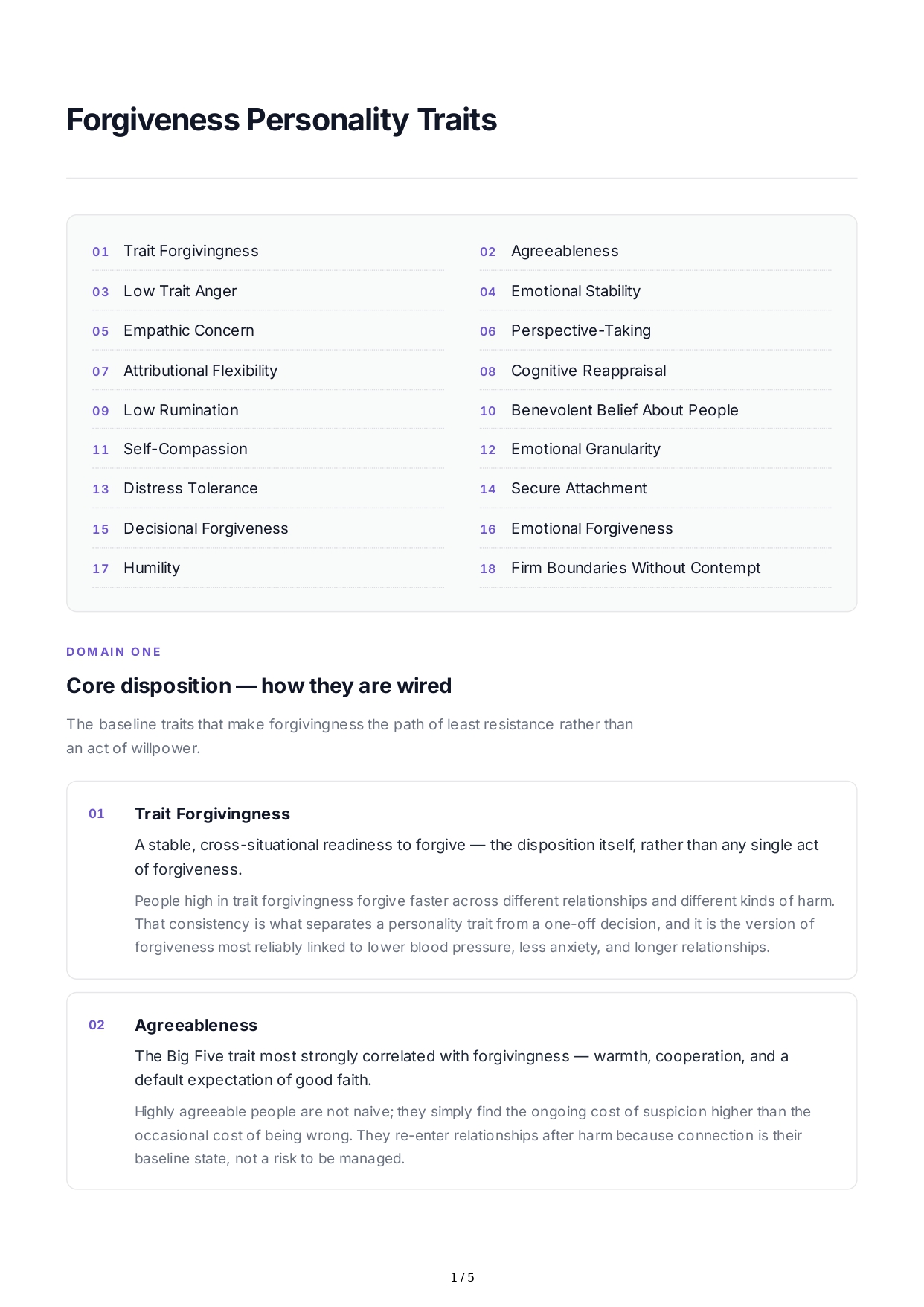
Forgiveness
Personality
Traits
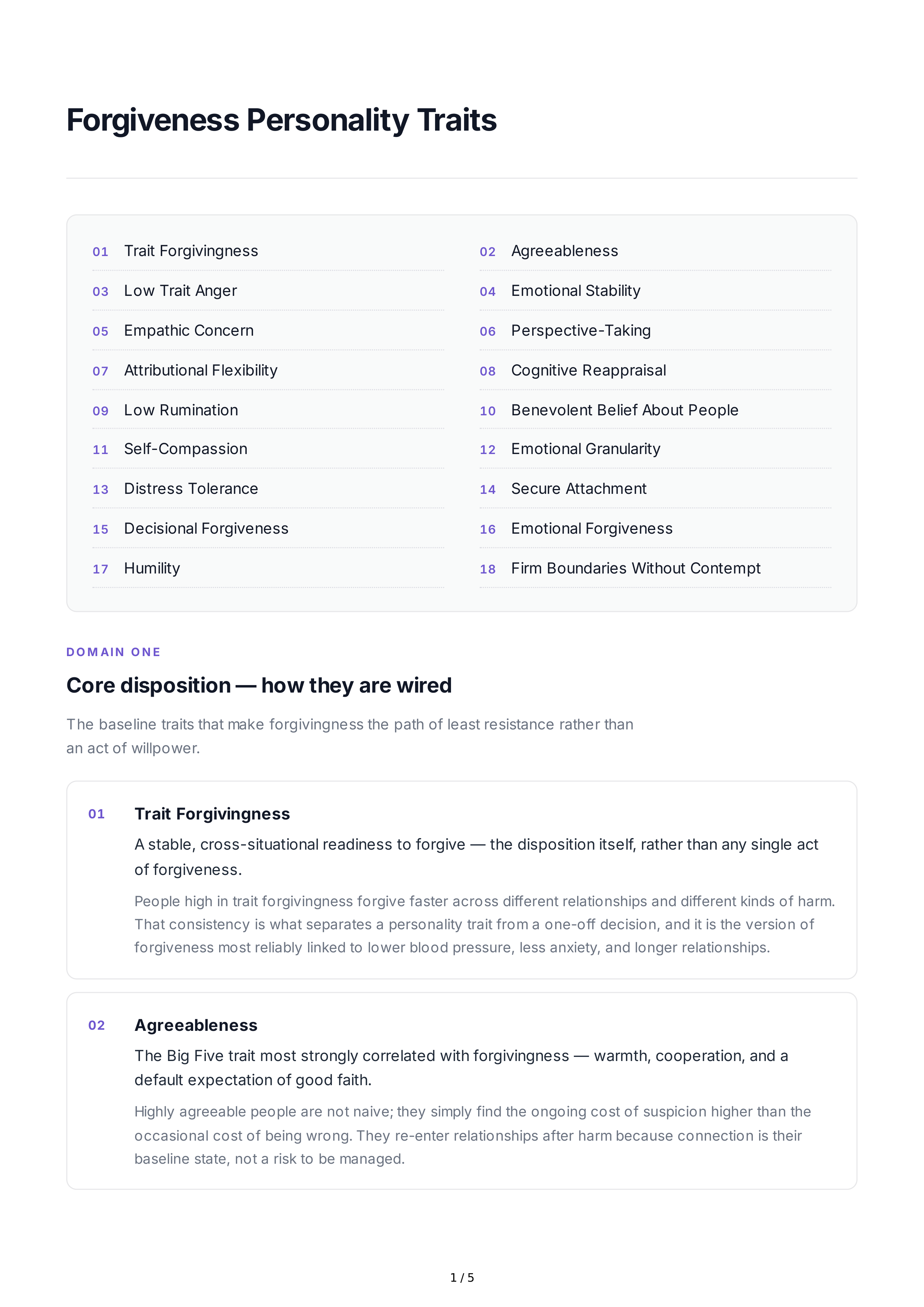
01
Trait
Forgivingness
02
Agreeableness
03
Low
Trait
Anger
04
Emotional
Stability
05
Empathic
Concern
06
Perspective
-
Taking
07
Attributional
Flexibility
08
Cognitive
Reappraisal
09
Low
Rumination
10
Benevolent
Belief
About
People
11
Self
-
Compassion
12
Emotional
Granularity
13
Distress
Tolerance
14
Secure
Attachment
15
Decisional
Forgiveness
16
Emotional
Forgiveness
17
Humility
18
Firm
Boundaries
Without
Contempt
DO M AIN
O N E
Core
disposition
—
how
they
are
wired
The
baseline
traits
that
make
forgivingness
the
path
of
least
resistance
rather
than
an
act
of
willpower
.
01
Trait
Forgivingness
A
stable
,
cross
-
situational
readiness
to
forgive
—
the
disposition
itself
,
rather
than
any
single
act
of
forgiveness
.
People
high
in
trait
forgivingness
forgive
faster
across
different
relationships
and
different
kinds
of
harm
.
That
consistency
is
what
separates
a
personality
trait
from
a
one
-
off
decision
,
and
it
is
the
version
of
forgiveness
most
reliably
linked
to
lower
blood
pressure
,
less
anxiety
,
and
longer
relationships
.
02
Agreeableness
The
Big
Five
trait
most
strongly
correlated
with
forgivingness
—
warmth
,
cooperation
,
and
a
default
expectation
of
good
faith
.
Highly
agreeable
people
are
not
naive
;
they
simply
find
the
ongoing
cost
of
suspicion
higher
than
the
occasional
cost
of
being
wrong
.
They
re
-
enter
relationships
after
harm
because
connection
is
their
baseline
state
,
not
a
risk
to
be
managed
.
1 / 5
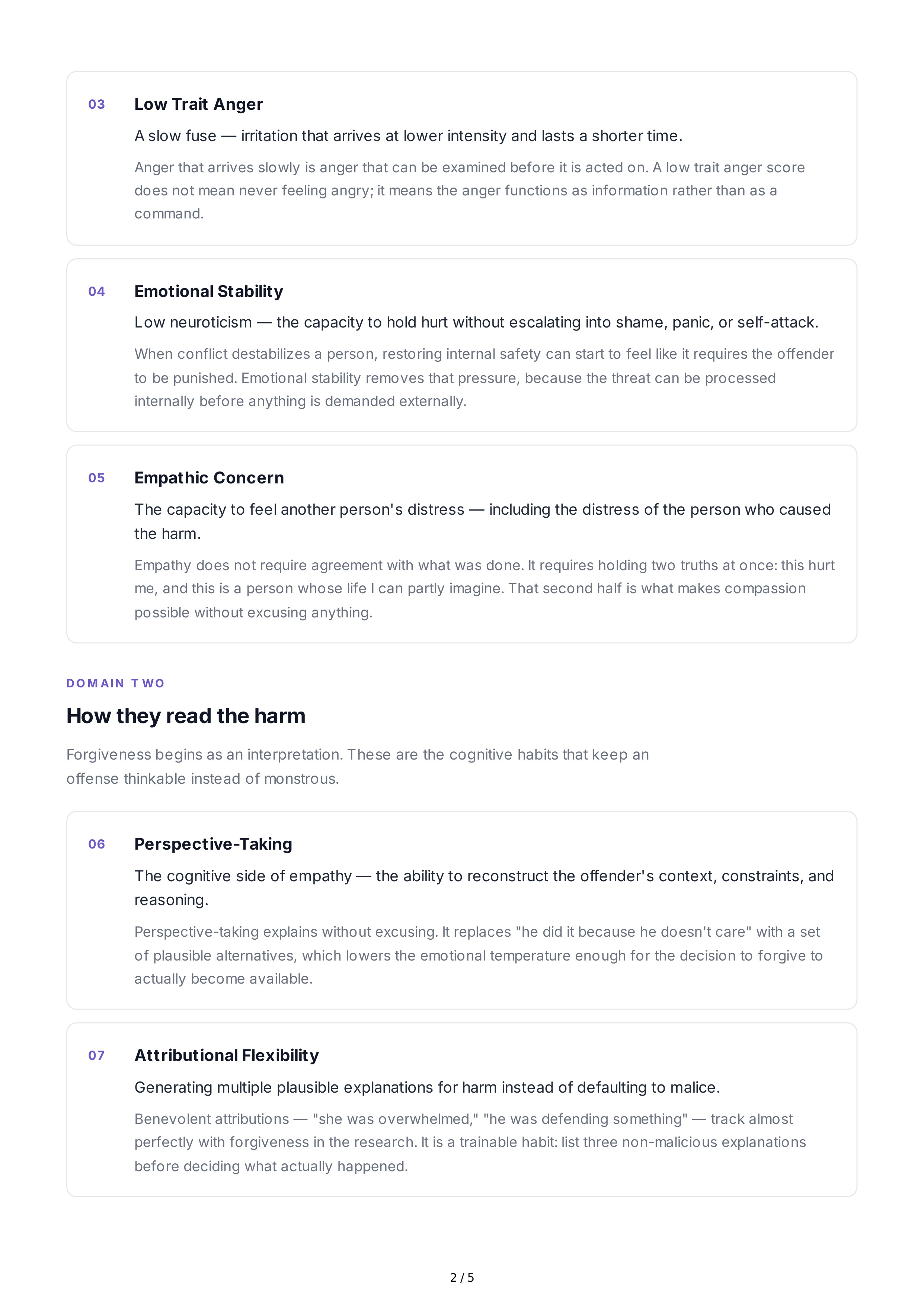
03
Low
Trait
Anger
A
slow
fuse
—
irritation
that
arrives
at
lower
intensity
and
lasts
a
shorter
time
.
Anger
that
arrives
slowly
is
anger
that
can
be
examined
before
it
is
acted
on
.
A
low
trait
anger
score
does
not
mean
never
feeling
angry
;
it
means
the
anger
functions
as
information
rather
than
as
a
command
.
04
Emotional
Stability
Low
neuroticism
—
the
capacity
to
hold
hurt
without
escalating
into
shame
,
panic
,
or
self
-
attack
.
When
conflict
destabilizes
a
person
,
restoring
internal
safety
can
start
to
feel
like
it
requires
the
offender
to
be
punished
.
Emotional
stability
removes
that
pressure
,
because
the
threat
can
be
processed
internally
before
anything
is
demanded
externally
.
05
Empathic
Concern
The
capacity
to
feel
another
person
'
s
distress
—
including
the
distress
of
the
person
who
caused
the
harm
.
Empathy
does
not
require
agreement
with
what
was
done
.
It
requires
holding
two
truths
at
once
:
this
hurt
me
,
and
this
is
a
person
whose
life
I
can
partly
imagine
.
That
second
half
is
what
makes
compassion
possible
without
excusing
anything
.
DO M AIN
T WO
How
they
read
the
harm
Forgiveness
begins
as
an
interpretation
.
These
are
the
cognitive
habits
that
keep
an
offense
thinkable
instead
of
monstrous
.
06
Perspective
-
Taking
The
cognitive
side
of
empathy
—
the
ability
to
reconstruct
the
offender
'
s
context
,
constraints
,
and
reasoning
.
Perspective
-
taking
explains
without
excusing
.
It
replaces
"
he
did
it
because
he
doesn
'
t
care
"
with
a
set
of
plausible
alternatives
,
which
lowers
the
emotional
temperature
enough
for
the
decision
to
forgive
to
actually
become
available
.
07
Attributional
Flexibility
Generating
multiple
plausible
explanations
for
harm
instead
of
defaulting
to
malice
.
Benevolent
attributions
— "
she
was
overwhelmed
," "
he
was
defending
something
" —
track
almost
perfectly
with
forgiveness
in
the
research
.
It
is
a
trainable
habit
:
list
three
non
-
malicious
explanations
before
deciding
what
actually
happened
.
2 / 5
08
Cognitive
Reappraisal
Reframing
a
grievance
into
a
bounded
story
rather
than
an
identity
-
defining
one
.
The
difference
between
"
my
brother
betrayed
me
"
and
"
my
brother
made
a
bad
decision
in
a
hard
year
"
is
not
denial
—
it
is
scale
.
Reappraisal
lowers
arousal
,
and
lower
arousal
is
what
allows
a
person
to
act
on
their
values
instead
of
their
adrenaline
.
09
Low
Rumination
The
ability
to
set
a
grievance
down
and
pick
it
up
deliberately
,
rather
than
replaying
it
automatically
.
Rumination
is
the
single
strongest
obstacle
to
forgiveness
—
every
replay
reopens
the
wound
and
rehearses
the
resentment
.
Forgiving
people
still
think
about
the
harm
;
they
simply
do
it
on
purpose
,
with
a
destination
in
mind
.
10
Benevolent
Belief
About
People
A
working
conviction
that
people
are
mostly
decent
and
worth
the
risk
of
trusting
.
This
is
a
generalized
optimism
rather
than
a
judgment
about
any
one
person
.
It
makes
forgiveness
the
cheaper
option
:
returning
to
the
default
assumption
costs
less
than
maintaining
a
permanent
exception
to
it
.
DO M AIN
T HR E E
How
they
hold
their
own
pain
A
person
can
only
release
hurt
they
are
able
to
feel
.
These
traits
govern
the
internal
capacity
to
process
injury
without
discharging
it
outward
.
11
Self
-
Compassion
Extending
the
same
mercy
inward
that
one
extends
outward
.
People
who
are
harsh
with
themselves
tend
to
be
harsh
with
everyone
,
because
the
standard
they
apply
is
uniform
.
Self
-
forgiveness
and
other
-
forgiveness
consistently
track
together
in
the
research
—
they
are
correlated
,
not
competing
.
12
Emotional
Granularity
Naming
the
specific
emotion
precisely
—
humiliation
,
disappointment
,
fear
,
or
grief
,
rather
than
a
general
sense
of
being
hurt
.
Vague
hurt
is
hard
to
process
,
so
it
lingers
.
Precise
hurt
is
workable
,
because
each
named
emotion
suggests
a
specific
response
.
Someone
who
can
say
"
I
felt
dismissed
"
is
already
closer
to
forgiving
than
someone
who
can
only
say
"
I
felt
awful
."
3 / 5
13
Distress
Tolerance
Staying
present
with
pain
long
enough
to
metabolize
it
,
instead
of
discharging
it
as
retaliation
.
Revenge
is
often
a
way
of
escaping
a
feeling
.
Distress
tolerance
is
the
capacity
that
makes
the
escape
unnecessary
—
the
feeling
hurts
,
but
it
does
not
have
to
be
moved
off
the
body
immediately
.
14
Secure
Attachment
An
internalized
expectation
that
relationships
can
survive
rupture
and
repair
.
Securely
attached
people
have
repeatedly
experienced
that
conflict
does
not
end
a
relationship
,
so
they
do
not
read
every
offense
as
a
final
verdict
.
It
is
the
developmental
trait
most
consistently
linked
to
early
and
durable
forgivingness
.
DO M AIN
F O UR
What
they
choose
to
do
next
Forgiveness
has
a
decision
component
and
an
emotional
component
.
Forgiving
people
usually
make
the
decision
long
before
the
feeling
catches
up
.
15
Decisional
Forgiveness
The
deliberate
choice
to
reduce
retaliation
and
stop
treating
the
debt
as
collectible
—
often
made
before
the
feelings
arrive
.
Decisional
forgiveness
is
a
commitment
about
behavior
,
not
a
report
about
emotion
,
which
is
why
it
can
come
first
.
It
governs
what
the
person
does
while
the
emotional
work
is
still
in
progress
—
the
sequence
used
in
Worthington
'
s
REACH
model
and
most
clinical
forgiveness
protocols
.
16
Emotional
Forgiveness
The
slower
replacement
of
resentment
with
empathy
,
compassion
,
or
neutral
goodwill
.
Emotional
forgiveness
lags
the
decision
,
sometimes
by
years
,
and
is
measured
by
what
a
person
feels
when
they
recall
the
offense
—
not
by
what
they
said
they
would
do
.
It
is
the
difference
between
forgiving
and
having
forgiven
.
17
Humility
An
accurate
,
unflattering
self
-
appraisal
—
a
clear
memory
of
one
'
s
own
need
for
grace
.
Humility
removes
the
asymmetry
that
makes
a
grudge
feel
just
:
the
offender
is
a
flawed
person
,
but
so
is
the
one
holding
the
ledger
.
It
is
nearly
impossible
to
be
both
genuinely
humble
and
permanently
contemptuous
.
4 / 5

18
Firm
Boundaries
Without
Contempt
The
ability
to
set
consequences
and
limits
while
refusing
to
treat
the
other
person
as
worthless
.
This
is
the
trait
that
separates
forgiveness
from
passivity
.
A
forgiving
person
can
end
a
relationship
,
report
a
crime
,
or
withhold
trust
and
still
carry
no
contempt
.
There
is
no
contradiction
:
forgiveness
releases
the
debt
;
it
does
not
erase
the
boundary
.
5 / 5