Patience
01
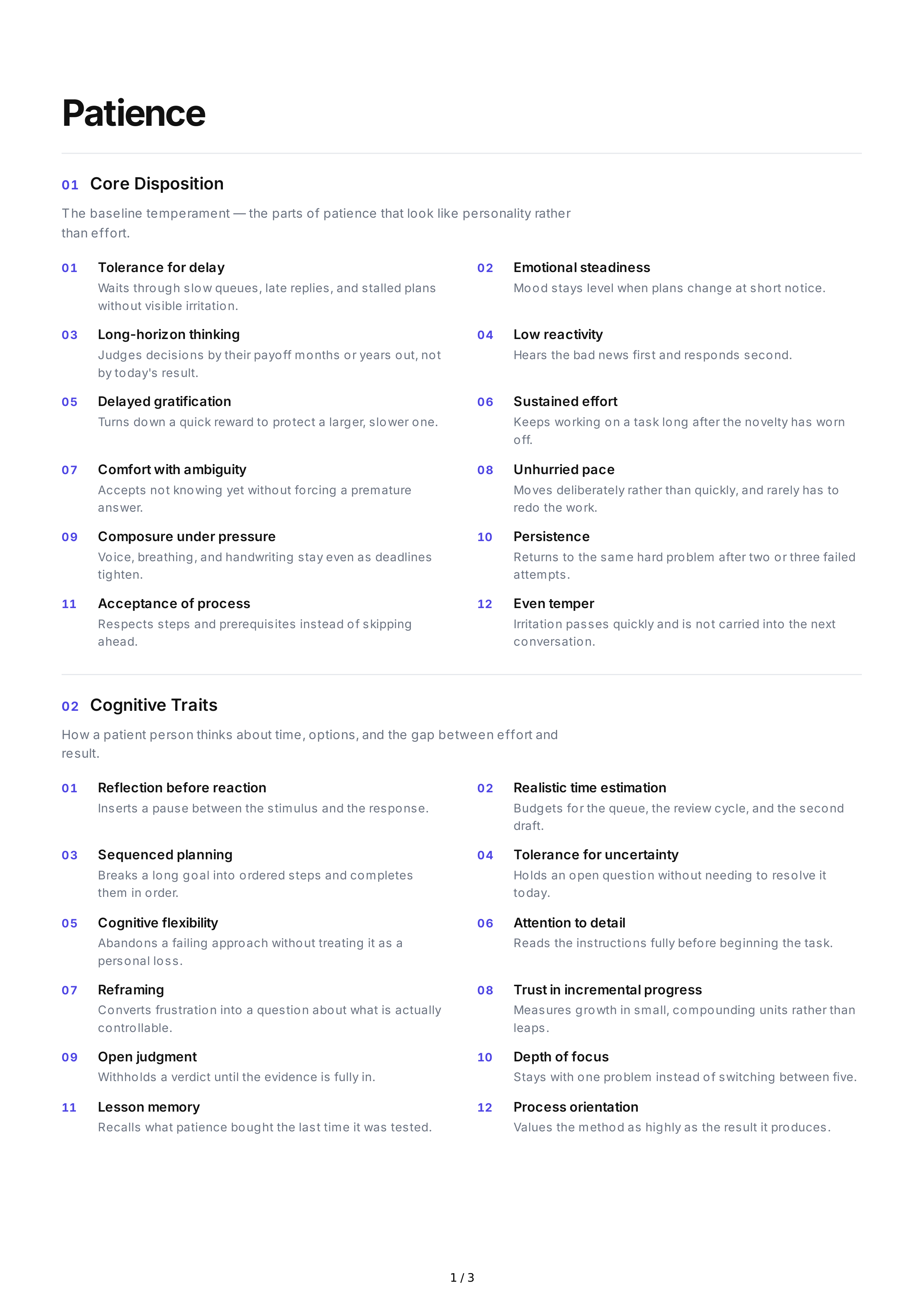
Core
Disposition
The
baseline
temperament
—
the
parts
of
patience
that
look
like
personality
rather
than
effort
.
02
Cognitive
Traits
How
a
patient
person
thinks
about
time
,
options
,
and
the
gap
between
effort
and
result
.
Tolerance
for
delay
Waits
through
slow
queues
,
late
replies
,
and
stalled
plans
without
visible
irritation
.
01
Emotional
steadiness
Mood
stays
level
when
plans
change
at
short
notice
.
02
Long
-
horizon
thinking
Judges
decisions
by
their
payoff
months
or
years
out
,
not
by
today
'
s
result
.
03
Low
reactivity
Hears
the
bad
news
first
and
responds
second
.
04
Delayed
gratification
Turns
down
a
quick
reward
to
protect
a
larger
,
slower
one
.
05
Sustained
effort
Keeps
working
on
a
task
long
after
the
novelty
has
worn
off
.
06
Comfort
with
ambiguity
Accepts
not
knowing
yet
without
forcing
a
premature
answer
.
07
Unhurried
pace
Moves
deliberately
rather
than
quickly
,
and
rarely
has
to
redo
the
work
.
08
Composure
under
pressure
Voice
,
breathing
,
and
handwriting
stay
even
as
deadlines
tighten
.
09
Persistence
Returns
to
the
same
hard
problem
after
two
or
three
failed
attempts
.
10
Acceptance
of
process
Respects
steps
and
prerequisites
instead
of
skipping
ahead
.
11
Even
temper
Irritation
passes
quickly
and
is
not
carried
into
the
next
conversation
.
12
Reflection
before
reaction
Inserts
a
pause
between
the
stimulus
and
the
response
.
01
Realistic
time
estimation
Budgets
for
the
queue
,
the
review
cycle
,
and
the
second
draft
.
02
Sequenced
planning
Breaks
a
long
goal
into
ordered
steps
and
completes
them
in
order
.
03
Tolerance
for
uncertainty
Holds
an
open
question
without
needing
to
resolve
it
today
.
04
Cognitive
flexibility
Abandons
a
failing
approach
without
treating
it
as
a
personal
loss
.
05
Attention
to
detail
Reads
the
instructions
fully
before
beginning
the
task
.
06
Reframing
Converts
frustration
into
a
question
about
what
is
actually
controllable
.
07
Trust
in
incremental
progress
Measures
growth
in
small
,
compounding
units
rather
than
leaps
.
08
Open
judgment
Withholds
a
verdict
until
the
evidence
is
fully
in
.
09
Depth
of
focus
Stays
with
one
problem
instead
of
switching
between
five
.
10
Lesson
memory
Recalls
what
patience
bought
the
last
time
it
was
tested
.
11
Process
orientation
Values
the
method
as
highly
as
the
result
it
produces
.
12
1 / 3
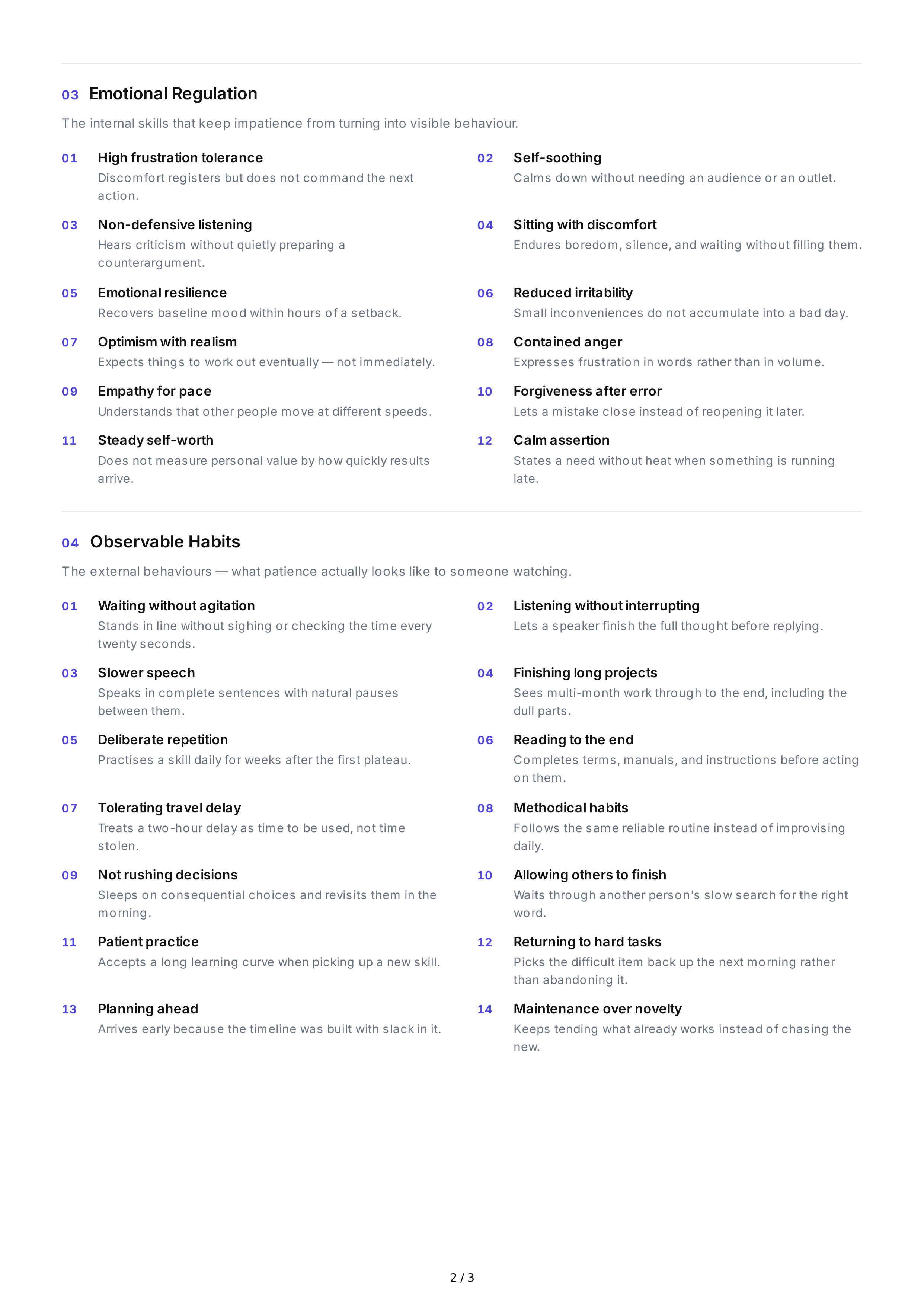
03
Emotional
Regulation
The
internal
skills
that
keep
impatience
from
turning
into
visible
behaviour
.
04
Observable
Habits
The
external
behaviours
—
what
patience
actually
looks
like
to
someone
watching
.
High
frustration
tolerance
Discomfort
registers
but
does
not
command
the
next
action
.
01
Self
-
soothing
Calms
down
without
needing
an
audience
or
an
outlet
.
02
Non
-
defensive
listening
Hears
criticism
without
quietly
preparing
a
counterargument
.
03
Sitting
with
discomfort
Endures
boredom
,
silence
,
and
waiting
without
filling
them
.
04
Emotional
resilience
Recovers
baseline
mood
within
hours
of
a
setback
.
05
Reduced
irritability
Small
inconveniences
do
not
accumulate
into
a
bad
day
.
06
Optimism
with
realism
Expects
things
to
work
out
eventually
—
not
immediately
.
07
Contained
anger
Expresses
frustration
in
words
rather
than
in
volume
.
08
Empathy
for
pace
Understands
that
other
people
move
at
different
speeds
.
09
Forgiveness
after
error
Lets
a
mistake
close
instead
of
reopening
it
later
.
10
Steady
self
-
worth
Does
not
measure
personal
value
by
how
quickly
results
arrive
.
11
Calm
assertion
States
a
need
without
heat
when
something
is
running
late
.
12
Waiting
without
agitation
Stands
in
line
without
sighing
or
checking
the
time
every
twenty
seconds
.
01
Listening
without
interrupting
Lets
a
speaker
finish
the
full
thought
before
replying
.
02
Slower
speech
Speaks
in
complete
sentences
with
natural
pauses
between
them
.
03
Finishing
long
projects
Sees
multi
-
month
work
through
to
the
end
,
including
the
dull
parts
.
04
Deliberate
repetition
Practises
a
skill
daily
for
weeks
after
the
first
plateau
.
05
Reading
to
the
end
Completes
terms
,
manuals
,
and
instructions
before
acting
on
them
.
06
Tolerating
travel
delay
Treats
a
two
-
hour
delay
as
time
to
be
used
,
not
time
stolen
.
07
Methodical
habits
Follows
the
same
reliable
routine
instead
of
improvising
daily
.
08
Not
rushing
decisions
Sleeps
on
consequential
choices
and
revisits
them
in
the
morning
.
09
Allowing
others
to
finish
Waits
through
another
person
'
s
slow
search
for
the
right
word
.
10
Patient
practice
Accepts
a
long
learning
curve
when
picking
up
a
new
skill
.
11
Returning
to
hard
tasks
Picks
the
difficult
item
back
up
the
next
morning
rather
than
abandoning
it
.
12
Planning
ahead
Arrives
early
because
the
timeline
was
built
with
slack
in
it
.
13
Maintenance
over
novelty
Keeps
tending
what
already
works
instead
of
chasing
the
new
.
14
2 / 3
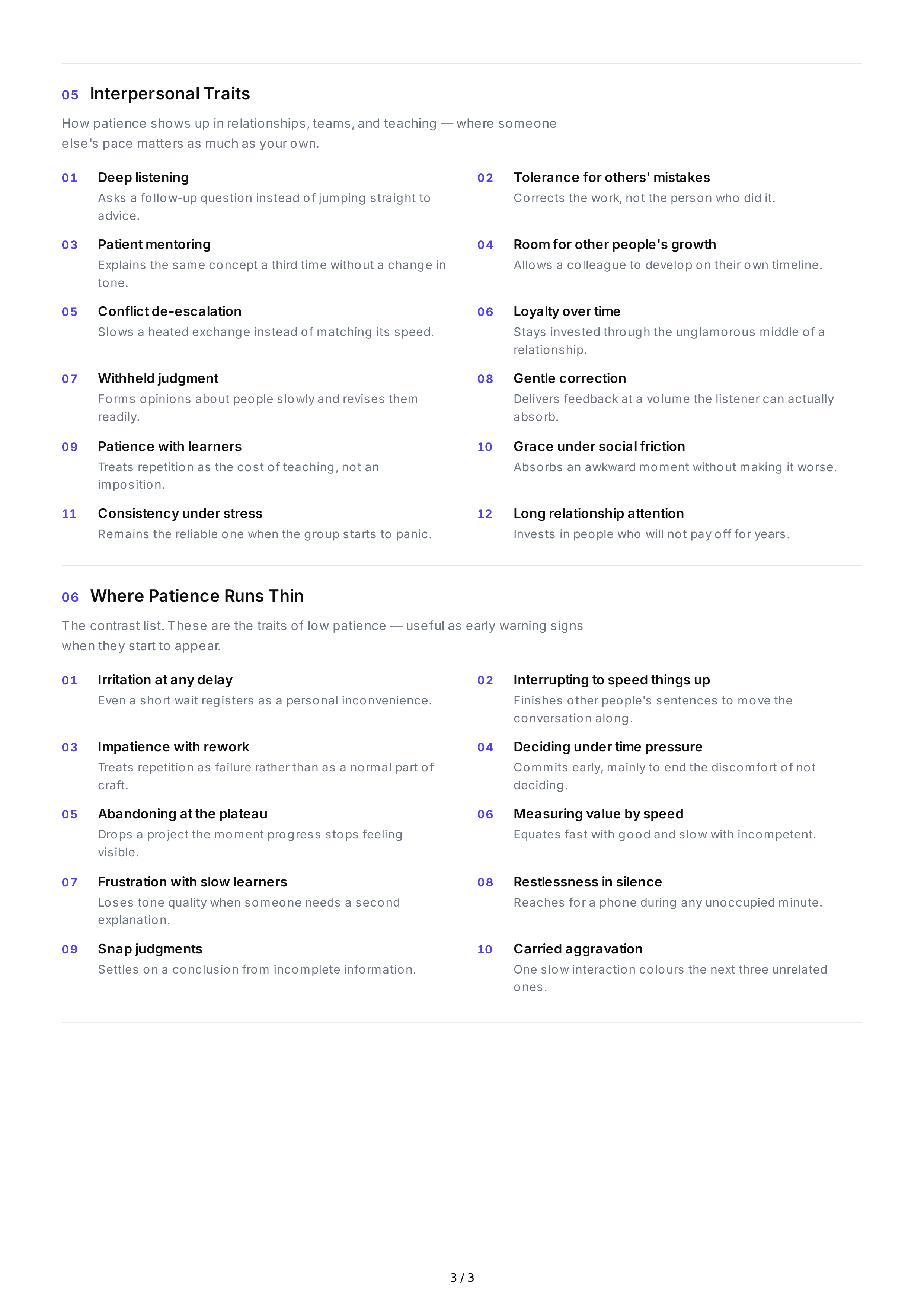
05
Interpersonal
Traits
How
patience
shows
up
in
relationships
,
teams
,
and
teaching
—
where
someone
else
'
s
pace
matters
as
much
as
your
own
.
06
Where
Patience
Runs
Thin
The
contrast
list
.
These
are
the
traits
of
low
patience
—
useful
as
early
warning
signs
when
they
start
to
appear
.
Deep
listening
Asks
a
follow
-
up
question
instead
of
jumping
straight
to
advice
.
01
Tolerance
for
others
'
mistakes
Corrects
the
work
,
not
the
person
who
did
it
.
02
Patient
mentoring
Explains
the
same
concept
a
third
time
without
a
change
in
tone
.
03
Room
for
other
people
'
s
growth
Allows
a
colleague
to
develop
on
their
own
timeline
.
04
Conflict
de
-
escalation
Slows
a
heated
exchange
instead
of
matching
its
speed
.
05
Loyalty
over
time
Stays
invested
through
the
unglamorous
middle
of
a
relationship
.
06
Withheld
judgment
Forms
opinions
about
people
slowly
and
revises
them
readily
.
07
Gentle
correction
Delivers
feedback
at
a
volume
the
listener
can
actually
absorb
.
08
Patience
with
learners
Treats
repetition
as
the
cost
of
teaching
,
not
an
imposition
.
09
Grace
under
social
friction
Absorbs
an
awkward
moment
without
making
it
worse
.
10
Consistency
under
stress
Remains
the
reliable
one
when
the
group
starts
to
panic
.
11
Long
relationship
attention
Invests
in
people
who
will
not
pay
off
for
years
.
12
Irritation
at
any
delay
Even
a
short
wait
registers
as
a
personal
inconvenience
.
01
Interrupting
to
speed
things
up
Finishes
other
people
'
s
sentences
to
move
the
conversation
along
.
02
Impatience
with
rework
Treats
repetition
as
failure
rather
than
as
a
normal
part
of
craft
.
03
Deciding
under
time
pressure
Commits
early
,
mainly
to
end
the
discomfort
of
not
deciding
.
04
Abandoning
at
the
plateau
Drops
a
project
the
moment
progress
stops
feeling
visible
.
05
Measuring
value
by
speed
Equates
fast
with
good
and
slow
with
incompetent
.
06
Frustration
with
slow
learners
Loses
tone
quality
when
someone
needs
a
second
explanation
.
07
Restlessness
in
silence
Reaches
for
a
phone
during
any
unoccupied
minute
.
08
Snap
judgments
Settles
on
a
conclusion
from
incomplete
information
.
09
Carried
aggravation
One
slow
interaction
colours
the
next
three
unrelated
ones
.
10
3 / 3