R EF ER EN C E
G UIDE
·
P ER S O N ALIT Y
P S Y C HO LO G Y
Understanding
Personality
Traits
1 / 7
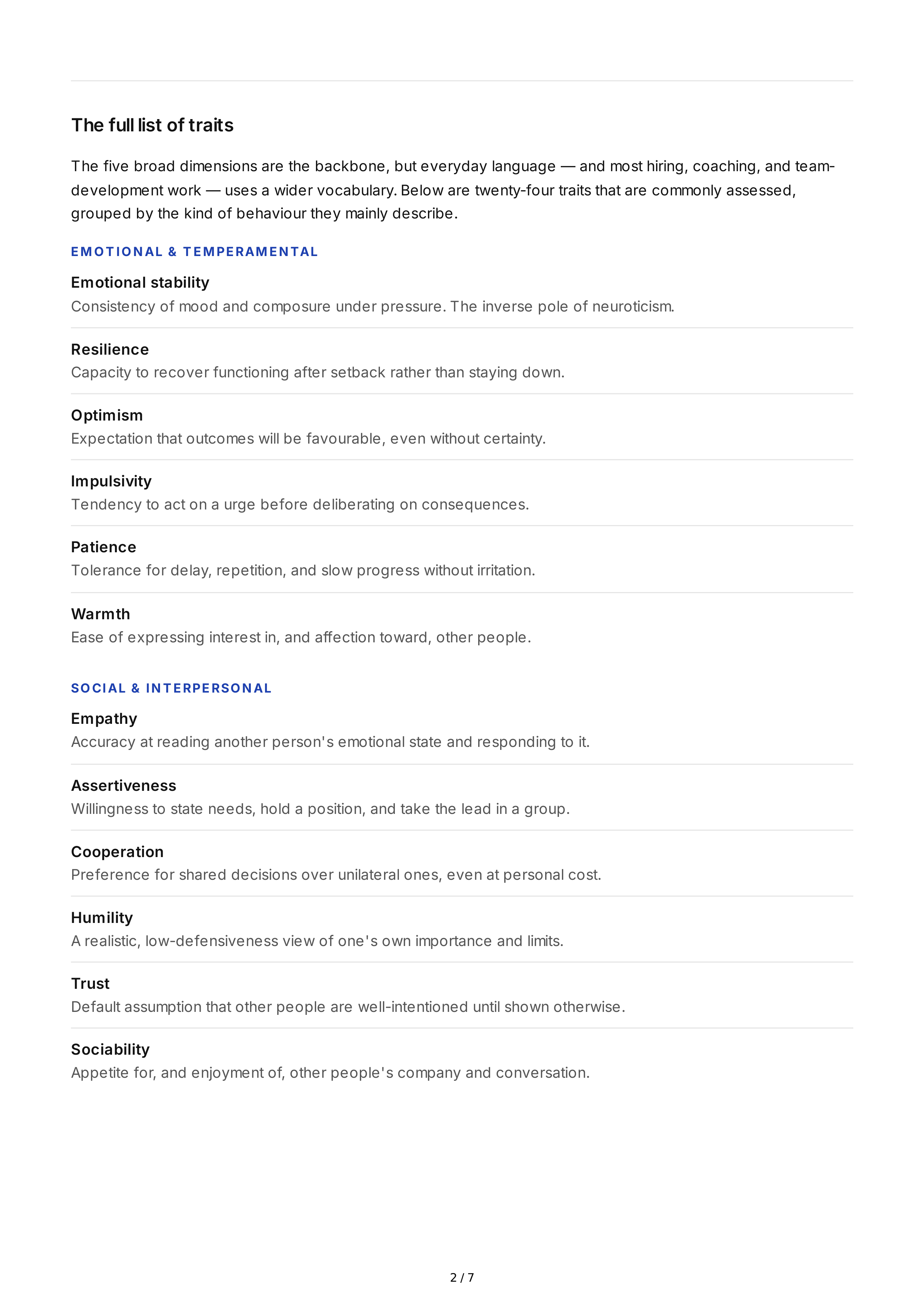
The
full
list
of
traits
The
five
broad
dimensions
are
the
backbone
,
but
everyday
language
—
and
most
hiring
,
coaching
,
and
team
-
development
work
—
uses
a
wider
vocabulary
.
Below
are
twenty
-
four
traits
that
are
commonly
assessed
,
grouped
by
the
kind
of
behaviour
they
mainly
describe
.
EM O T IO N AL
&
T EM PERAM EN TAL
Emotional
stability
Consistency
of
mood
and
composure
under
pressure
.
The
inverse
pole
of
neuroticism
.
Resilience
Capacity
to
recover
functioning
after
setback
rather
than
staying
down
.
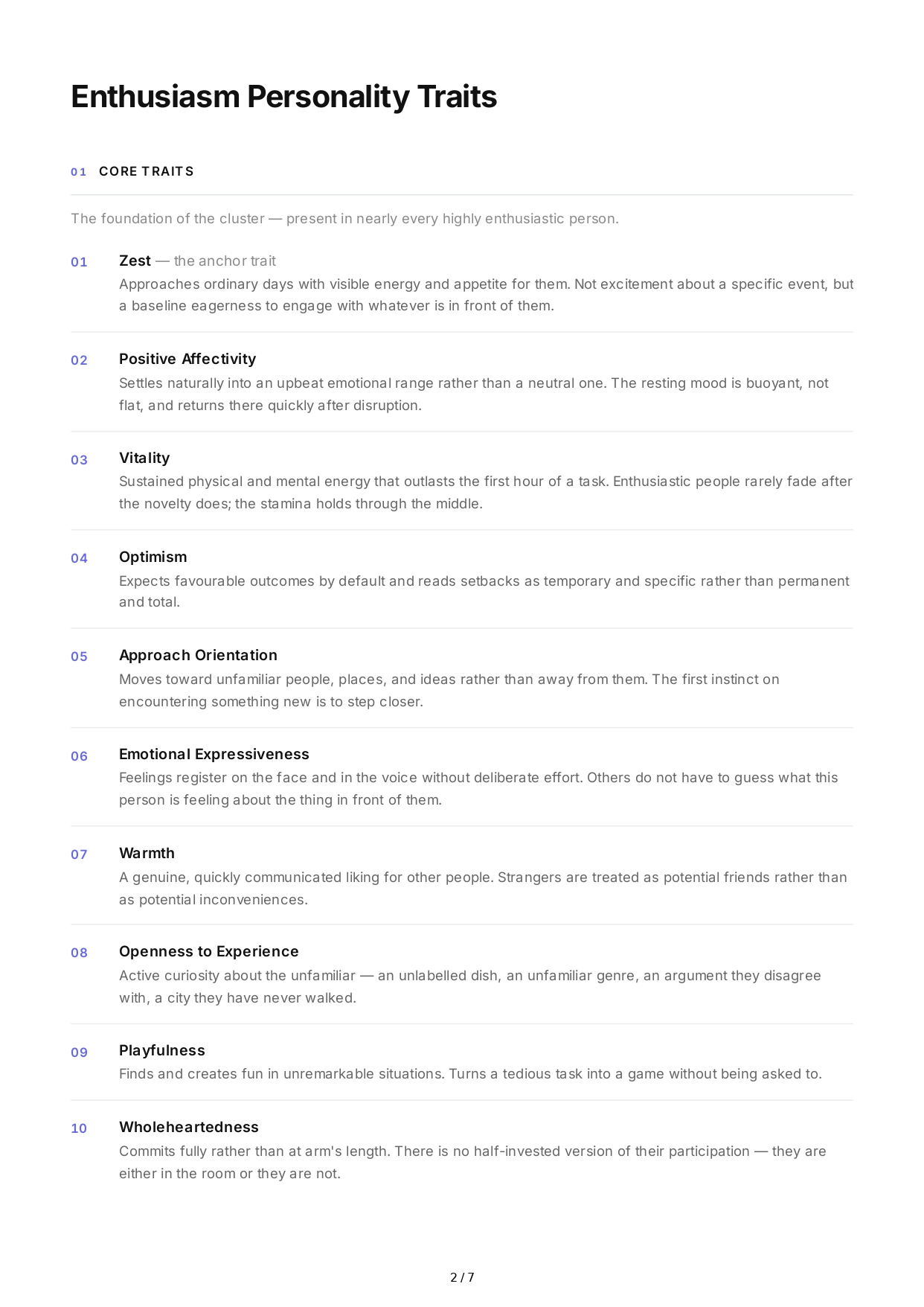
Optimism
Expectation
that
outcomes
will
be
favourable
,
even
without
certainty
.
Impulsivity
Tendency
to
act
on
a
urge
before
deliberating
on
consequences
.
Patience
Tolerance
for
delay
,
repetition
,
and
slow
progress
without
irritation
.
Warmth
Ease
of
expressing
interest
in
,
and
affection
toward
,
other
people
.
SO CIAL
&
IN T ERPERSO N AL
Empathy
Accuracy
at
reading
another
person
'
s
emotional
state
and
responding
to
it
.
Assertiveness
Willingness
to
state
needs
,
hold
a
position
,
and
take
the
lead
in
a
group
.
Cooperation
Preference
for
shared
decisions
over
unilateral
ones
,
even
at
personal
cost
.
Humility
A
realistic
,
low
-
defensiveness
view
of
one
'
s
own
importance
and
limits
.
Trust
Default
assumption
that
other
people
are
well
-
intentioned
until
shown
otherwise
.
Sociability
Appetite
for
,
and
enjoyment
of
,
other
people
'
s
company
and
conversation
.
2 / 7
M O T IVAT IO N AL
&
VO LIT IO N AL
Ambition
Strength
of
drive
toward
advancement
,
status
,
or
mastery
in
a
chosen
domain
.
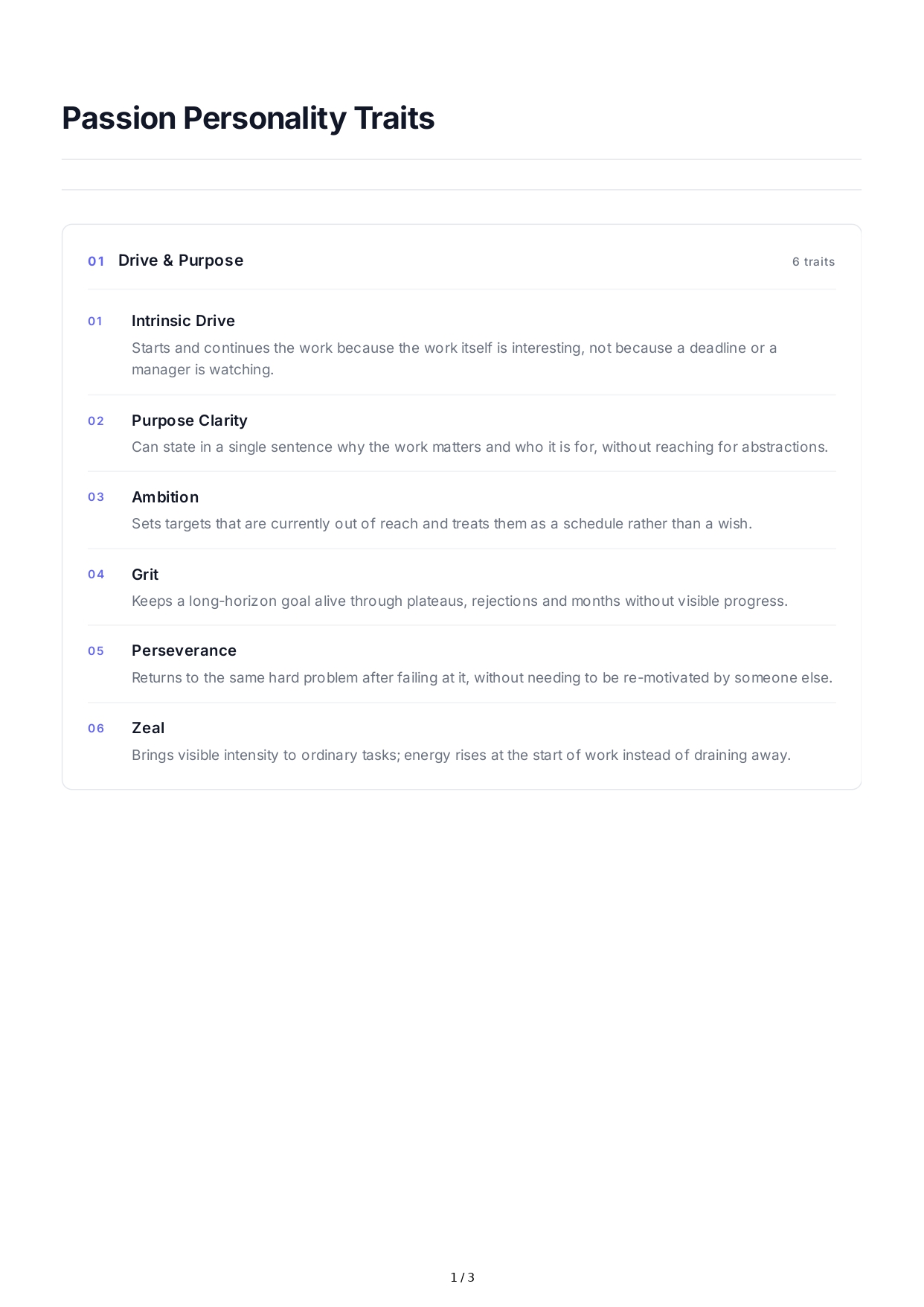
Grit
Persistence
toward
long
-
horizon
goals
that
give
slow
or
ambiguous
feedback
.
Self
-
discipline
Ability
to
begin
and
sustain
effort
without
external
structure
or
supervision
.
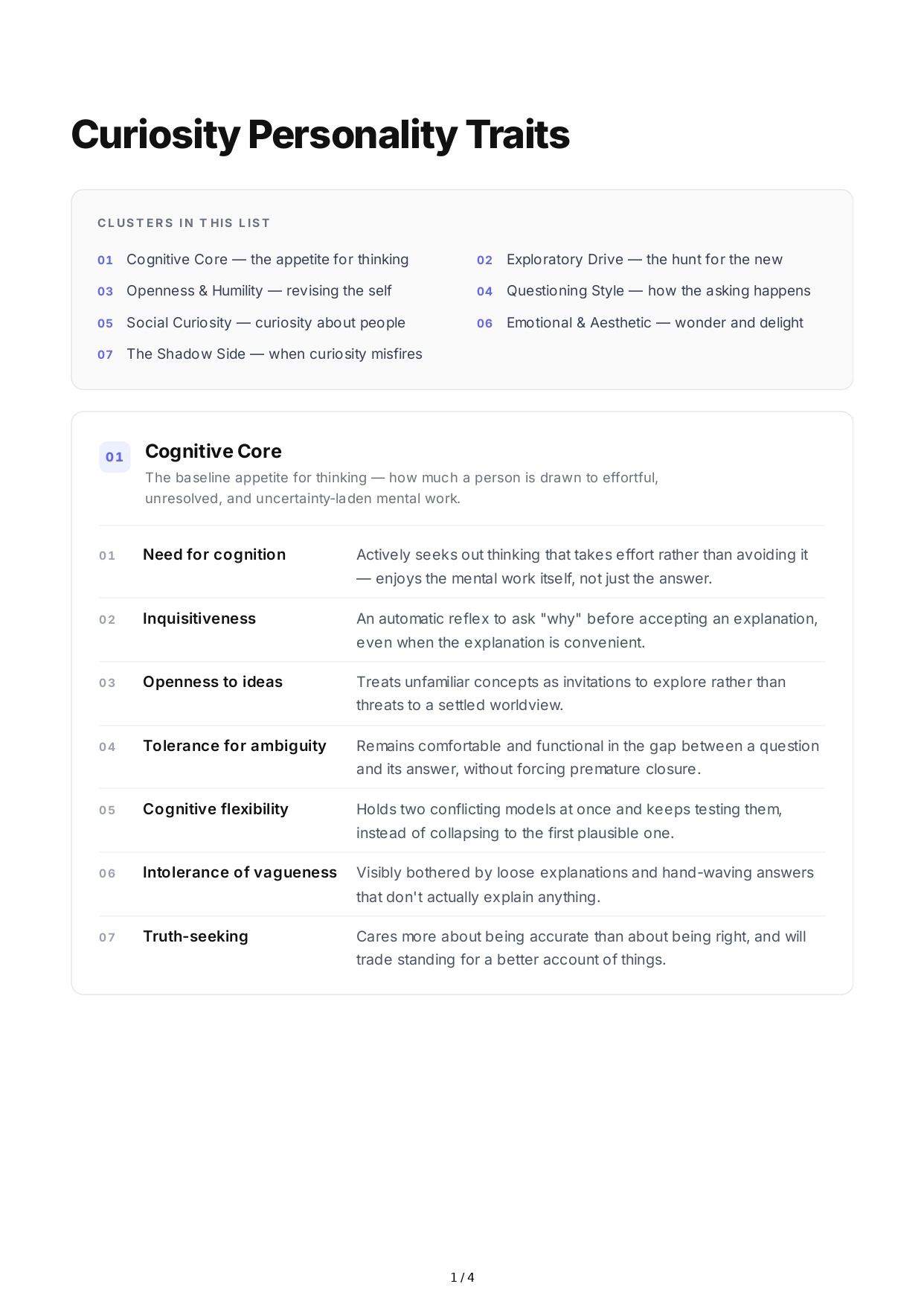
Curiosity
Attraction
to
new
information
,
questions
,
and
unexplored
territory
.
Risk
tolerance
Comfort
operating
with
uncertain
outcomes
and
incomplete
information
.
Perfectionism
Standards
set
high
enough
that
they
can
impede
finishing
or
shipping
.
CO G N IT IVE
&
ST YLIST IC
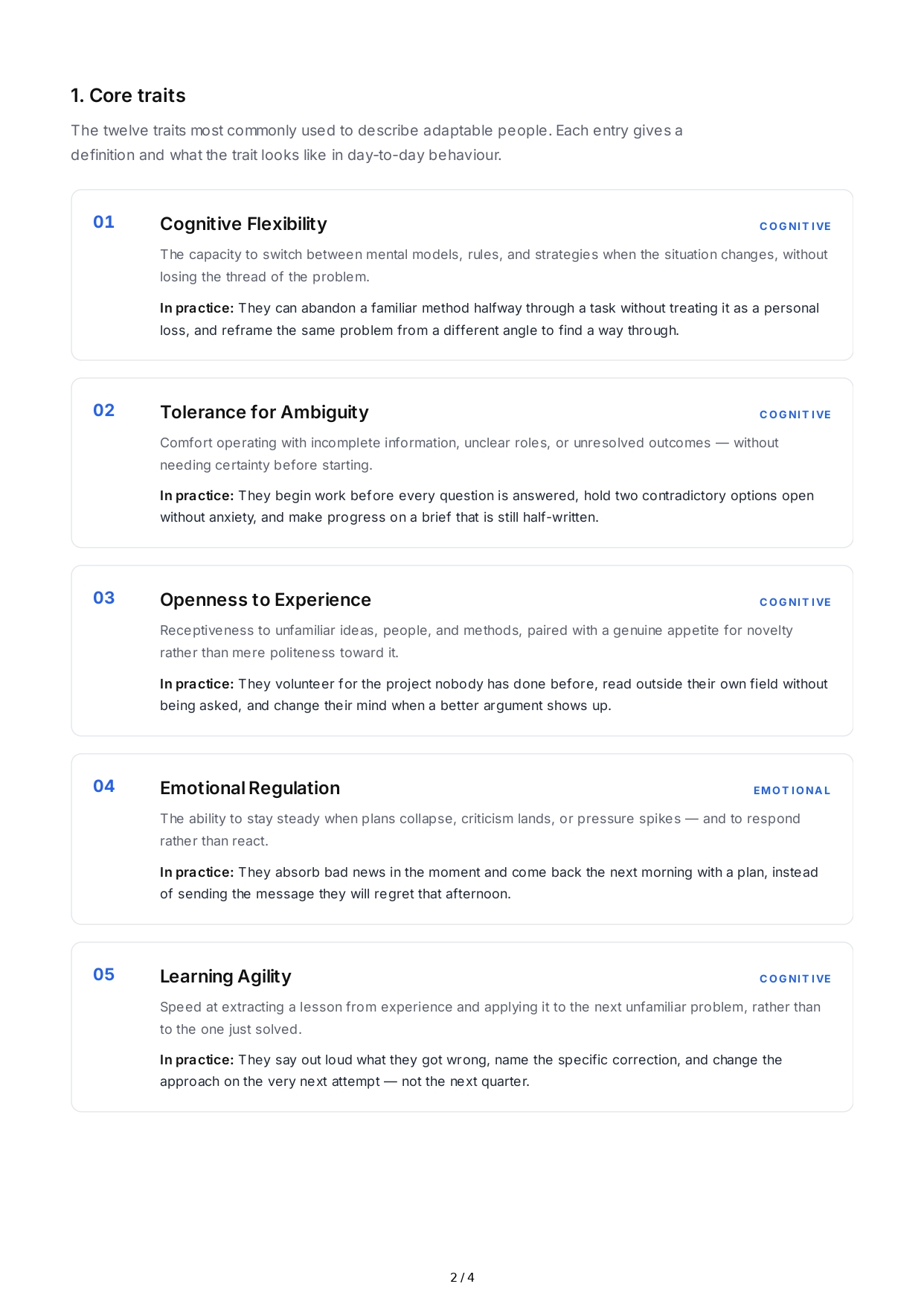
Openness
to
experience
Appetite
for
novelty
,
abstraction
,
and
aesthetic
or
intellectual
experience
.
Analytical
thinking
Preference
for
deliberate
reasoning
over
fast
intuition
when
deciding
.
Adaptability
Speed
at
which
behaviour
updates
when
conditions
or
rules
change
.
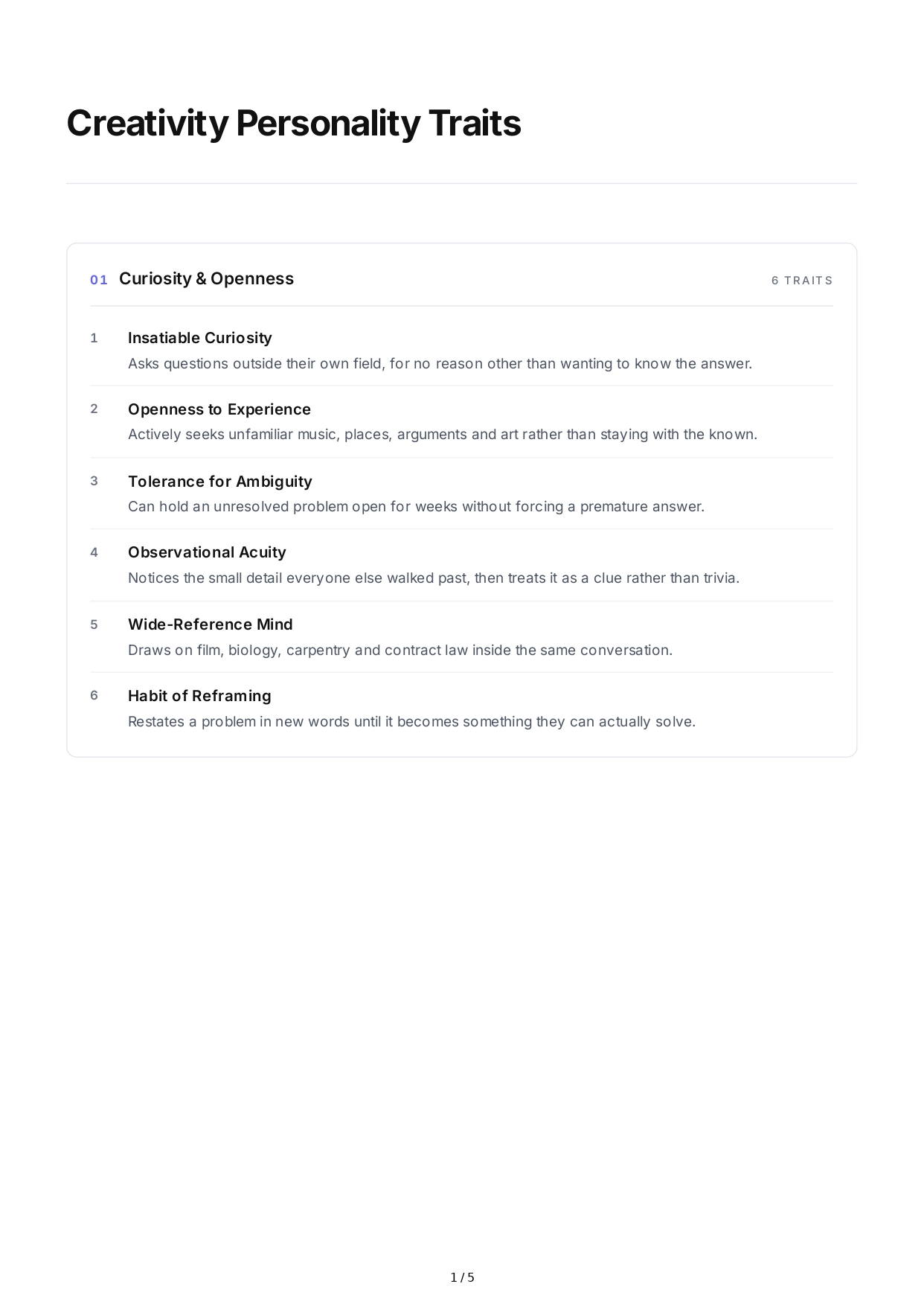
Creativity
Tendency
to
generate
unusual
combinations
and
pursue
the
promising
ones
.
Attention
to
detail
Allocation
of
effort
to
precision
,
accuracy
,
and
error
-
checking
.
Skepticism
Requirement
of
evidence
before
accepting
a
claim
,
including
a
confident
one
.
3 / 7
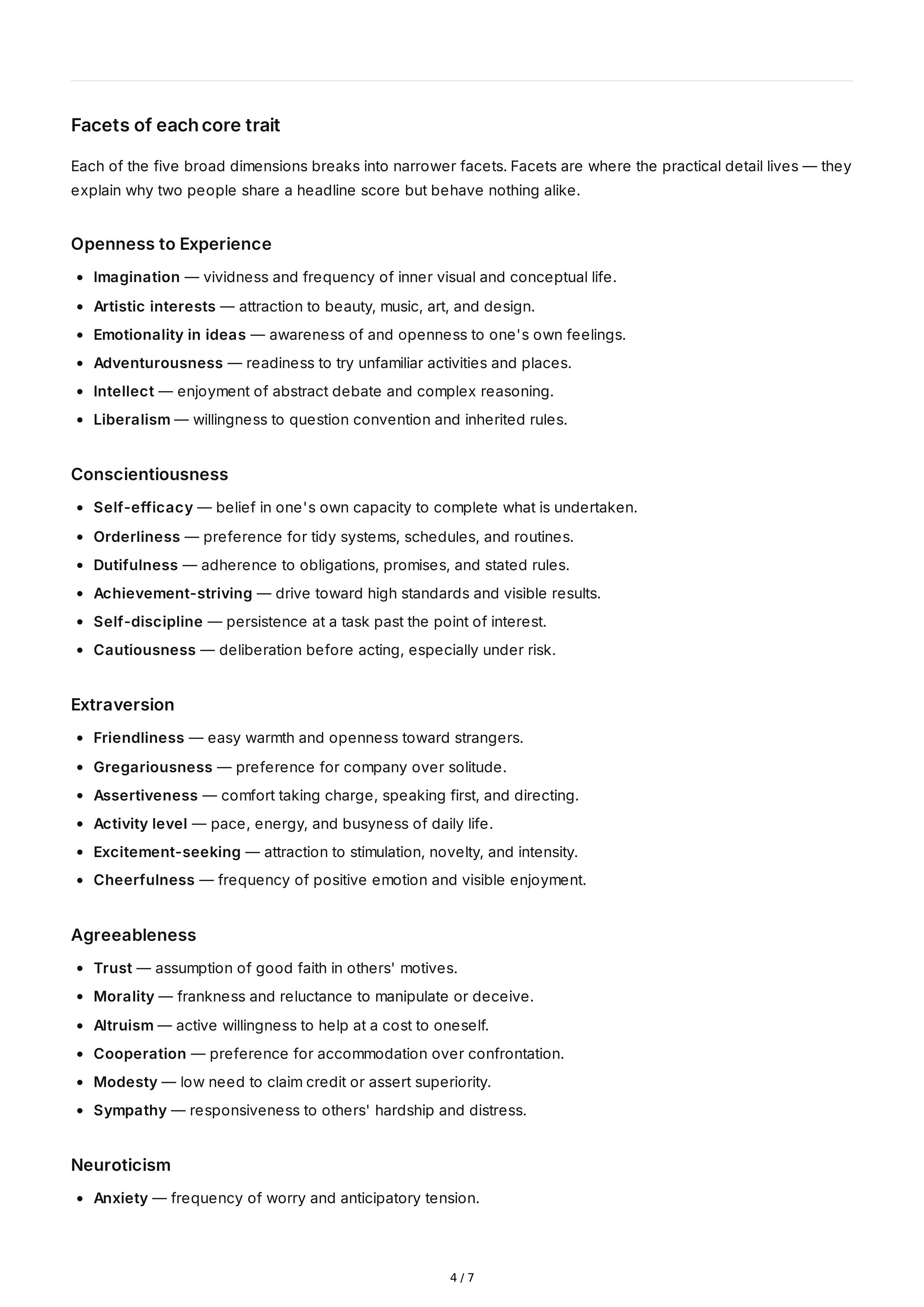
Facets
of
each
core
trait
Each
of
the
five
broad
dimensions
breaks
into
narrower
facets
.
Facets
are
where
the
practical
detail
lives
—
they
explain
why
two
people
share
a
headline
score
but
behave
nothing
alike
.
Openness
to
Experience
Imagination
—
vividness
and
frequency
of
inner
visual
and
conceptual
life
.
Artistic
interests
—
attraction
to
beauty
,
music
,
art
,
and
design
.
Emotionality
in
ideas
—
awareness
of
and
openness
to
one
'
s
own
feelings
.
Adventurousness
—
readiness
to
try
unfamiliar
activities
and
places
.
Intellect
—
enjoyment
of
abstract
debate
and
complex
reasoning
.
Liberalism
—
willingness
to
question
convention
and
inherited
rules
.
Conscientiousness
Self
-
efficacy
—
belief
in
one
'
s
own
capacity
to
complete
what
is
undertaken
.
Orderliness
—
preference
for
tidy
systems
,
schedules
,
and
routines
.
Dutifulness
—
adherence
to
obligations
,
promises
,
and
stated
rules
.
Achievement
-
striving
—
drive
toward
high
standards
and
visible
results
.
Self
-
discipline
—
persistence
at
a
task
past
the
point
of
interest
.
Cautiousness
—
deliberation
before
acting
,
especially
under
risk
.
Extraversion
Friendliness
—
easy
warmth
and
openness
toward
strangers
.
Gregariousness
—
preference
for
company
over
solitude
.
Assertiveness
—
comfort
taking
charge
,
speaking
first
,
and
directing
.
Activity
level
—
pace
,
energy
,
and
busyness
of
daily
life
.
Excitement
-
seeking
—
attraction
to
stimulation
,
novelty
,
and
intensity
.
Cheerfulness
—
frequency
of
positive
emotion
and
visible
enjoyment
.
Agreeableness
Trust
—
assumption
of
good
faith
in
others
'
motives
.
Morality
—
frankness
and
reluctance
to
manipulate
or
deceive
.
Altruism
—
active
willingness
to
help
at
a
cost
to
oneself
.
Cooperation
—
preference
for
accommodation
over
confrontation
.
Modesty
—
low
need
to
claim
credit
or
assert
superiority
.
Sympathy
—
responsiveness
to
others
'
hardship
and
distress
.
Neuroticism
Anxiety
—
frequency
of
worry
and
anticipatory
tension
.
4 / 7

Anger
—
readiness
to
feel
irritation
and
frustration
.
Depression
—
tendency
toward
low
mood
and
discouragement
.
Self
-
consciousness
—
sensitivity
to
judgment
and
evaluation
by
others
.
Immoderation
—
difficulty
resisting
urges
and
cravings
.
Vulnerability
—
susceptibility
to
stress
and
to
feeling
overwhelmed
.
5 / 7
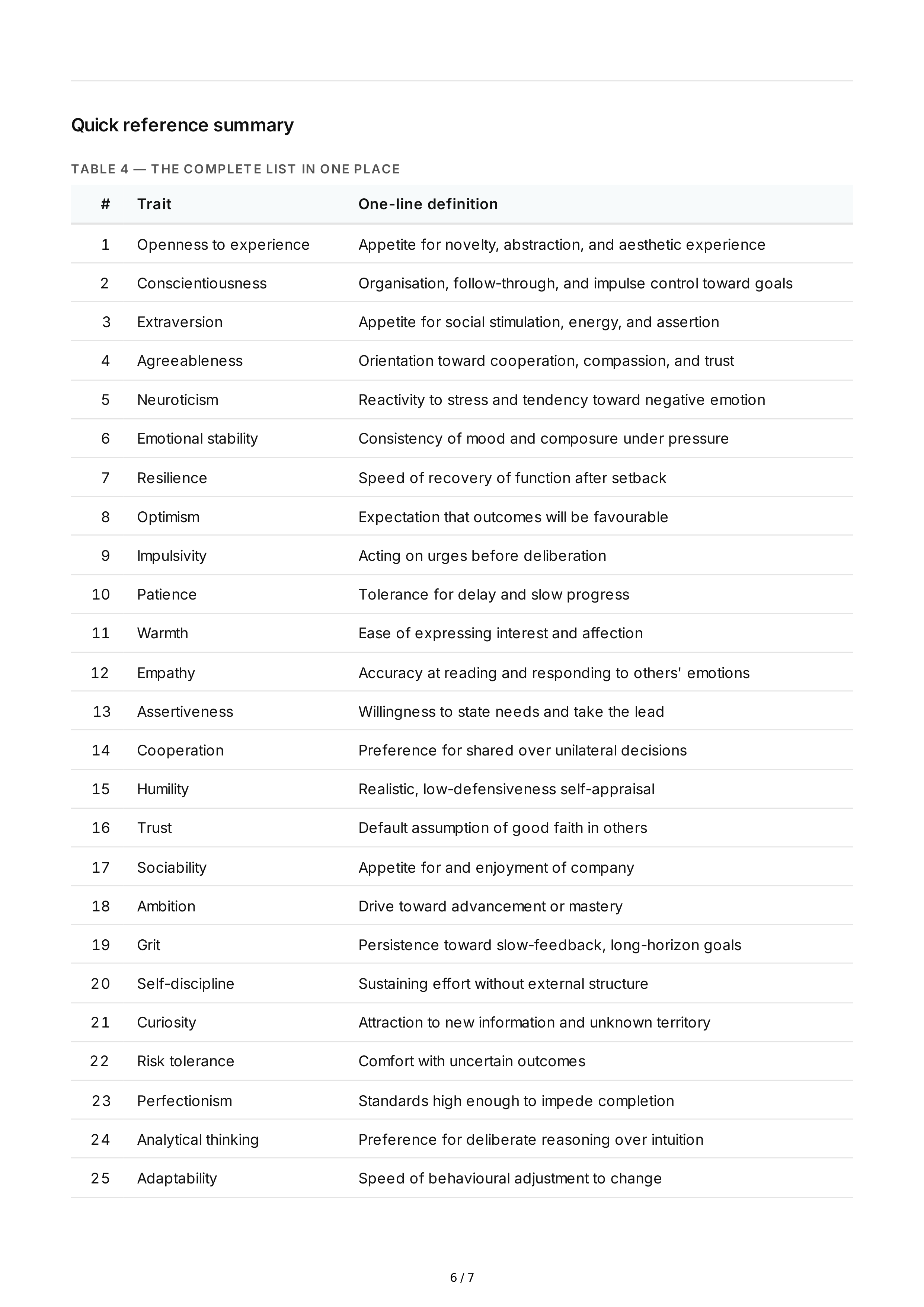
Quick
reference
summary
TABLE
4 —
T HE
COMPLET E
LIST
IN
ONE
PLACE
#
Trait
One
-
line
definition
1
Openness
to
experience
Appetite
for
novelty
,
abstraction
,
and
aesthetic
experience
2
Conscientiousness
Organisation
,
follow
-
through
,
and
impulse
control
toward
goals
3
Extraversion
Appetite
for
social
stimulation
,
energy
,
and
assertion
4
Agreeableness
Orientation
toward
cooperation
,
compassion
,
and
trust
5
Neuroticism
Reactivity
to
stress
and
tendency
toward
negative
emotion
6
Emotional
stability
Consistency
of
mood
and
composure
under
pressure
7
Resilience
Speed
of
recovery
of
function
after
setback
8
Optimism
Expectation
that
outcomes
will
be
favourable
9
Impulsivity
Acting
on
urges
before
deliberation
10
Patience
Tolerance
for
delay
and
slow
progress
11
Warmth
Ease
of
expressing
interest
and
affection
12
Empathy
Accuracy
at
reading
and
responding
to
others
'
emotions
13
Assertiveness
Willingness
to
state
needs
and
take
the
lead
14
Cooperation
Preference
for
shared
over
unilateral
decisions
15
Humility
Realistic
,
low
-
defensiveness
self
-
appraisal
16
Trust
Default
assumption
of
good
faith
in
others
17
Sociability
Appetite
for
and
enjoyment
of
company
18
Ambition
Drive
toward
advancement
or
mastery
19
Grit
Persistence
toward
slow
-
feedback
,
long
-
horizon
goals
20
Self
-
discipline
Sustaining
effort
without
external
structure
21
Curiosity
Attraction
to
new
information
and
unknown
territory
22
Risk
tolerance
Comfort
with
uncertain
outcomes
23
Perfectionism
Standards
high
enough
to
impede
completion
24
Analytical
thinking
Preference
for
deliberate
reasoning
over
intuition
25
Adaptability
Speed
of
behavioural
adjustment
to
change
6 / 7
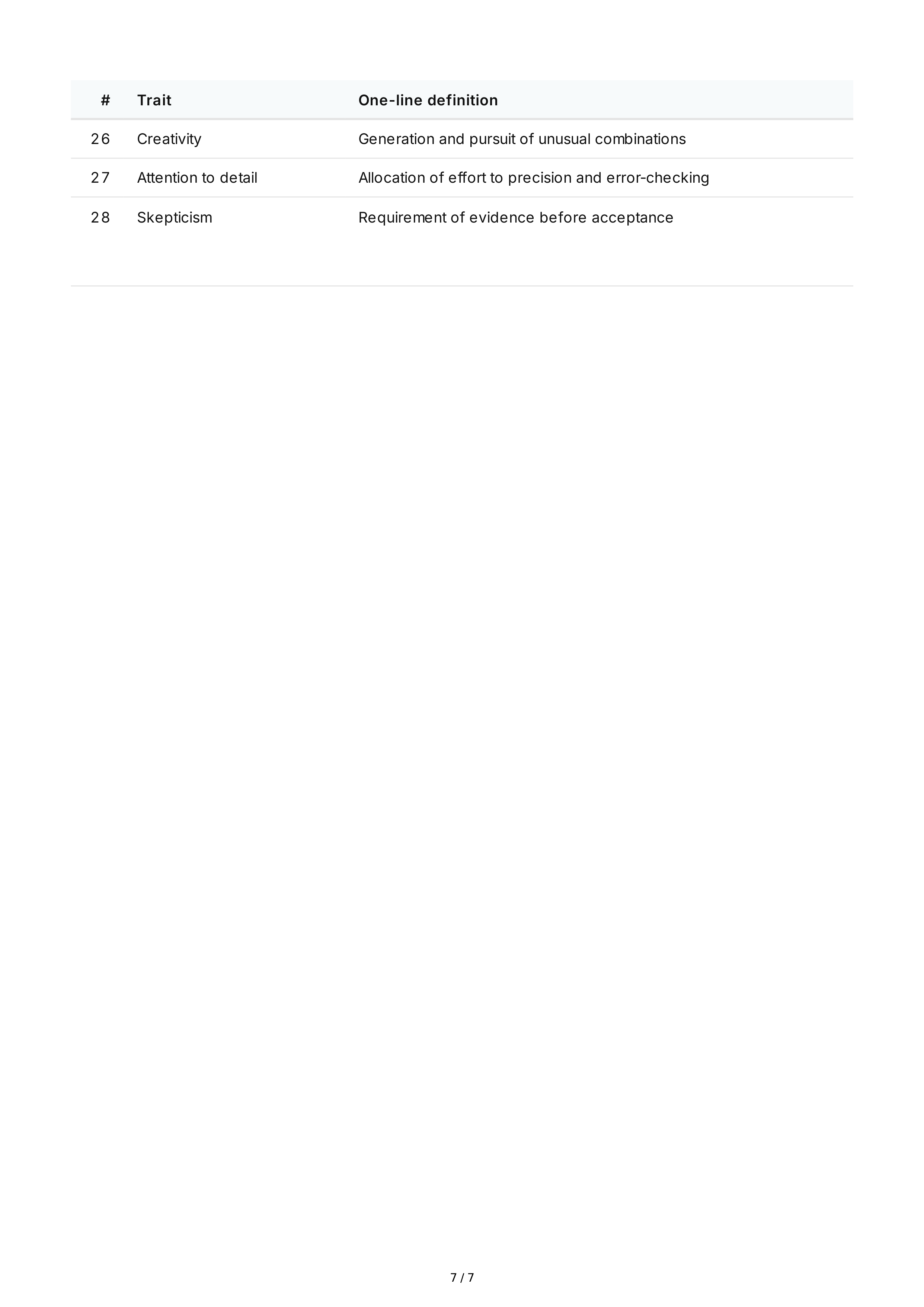
#
Trait
One
-
line
definition
26
Creativity
Generation
and
pursuit
of
unusual
combinations
27
Attention
to
detail
Allocation
of
effort
to
precision
and
error
-
checking
28
Skepticism
Requirement
of
evidence
before
acceptance
7 / 7