Leadership
Personality
Traits
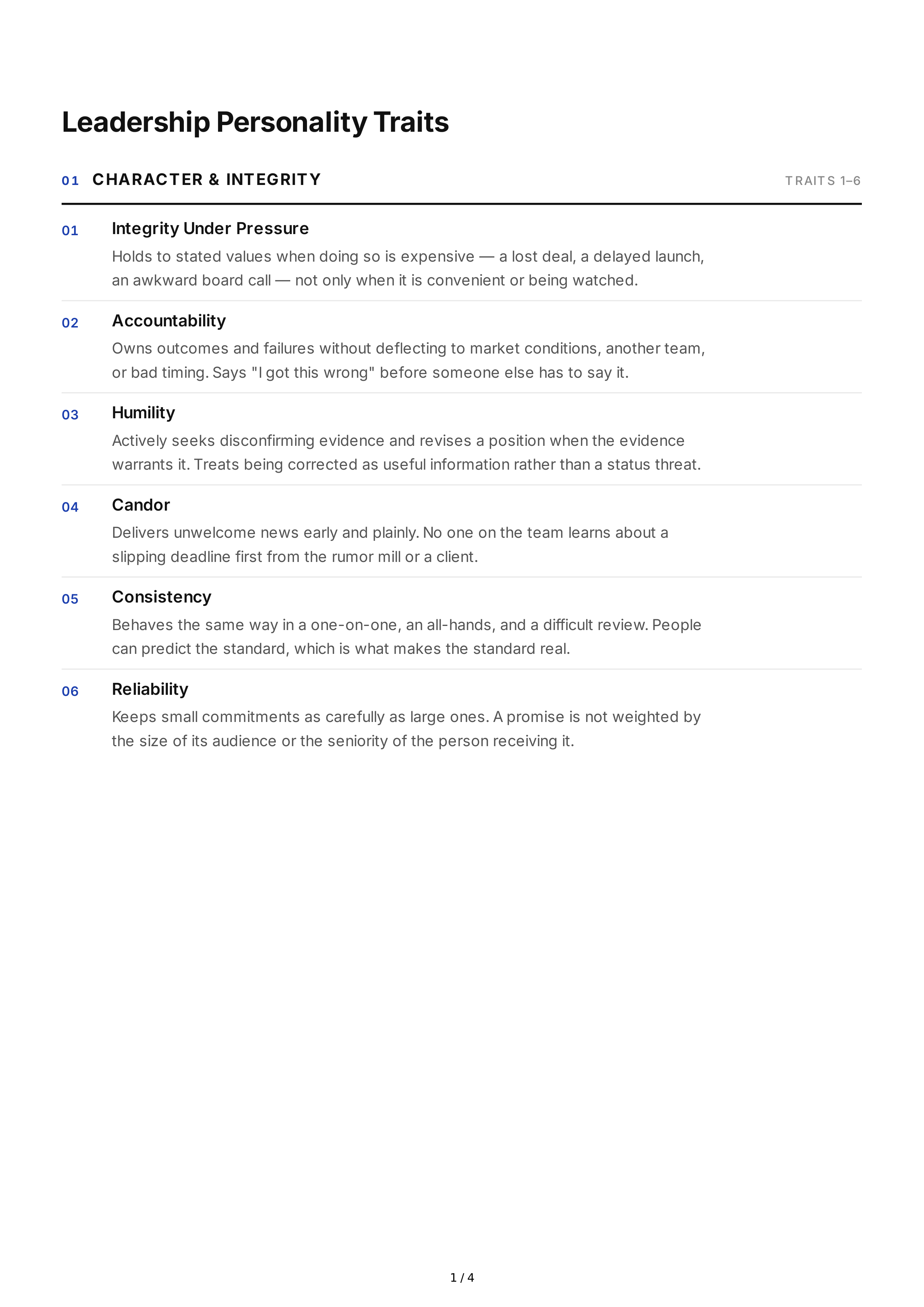
01
CHARACTER
&
INTEGRITY
T RAIT S
1–6
01
Integrity
Under
Pressure
Holds
to
stated
values
when
doing
so
is
expensive
—
a
lost
deal
,
a
delayed
launch
,
an
awkward
board
call
—
not
only
when
it
is
convenient
or
being
watched
.
02
Accountability
Owns
outcomes
and
failures
without
deflecting
to
market
conditions
,
another
team
,
or
bad
timing
.
Says
"
I
got
this
wrong
"
before
someone
else
has
to
say
it
.
03
Humility
Actively
seeks
disconfirming
evidence
and
revises
a
position
when
the
evidence
warrants
it
.
Treats
being
corrected
as
useful
information
rather
than
a
status
threat
.
04
Candor
Delivers
unwelcome
news
early
and
plainly
.
No
one
on
the
team
learns
about
a
slipping
deadline
first
from
the
rumor
mill
or
a
client
.
05
Consistency
Behaves
the
same
way
in
a
one
-
on
-
one
,
an
all
-
hands
,
and
a
difficult
review
.
People
can
predict
the
standard
,
which
is
what
makes
the
standard
real
.
06
Reliability
Keeps
small
commitments
as
carefully
as
large
ones
.
A
promise
is
not
weighted
by
the
size
of
its
audience
or
the
seniority
of
the
person
receiving
it
.
1 / 4
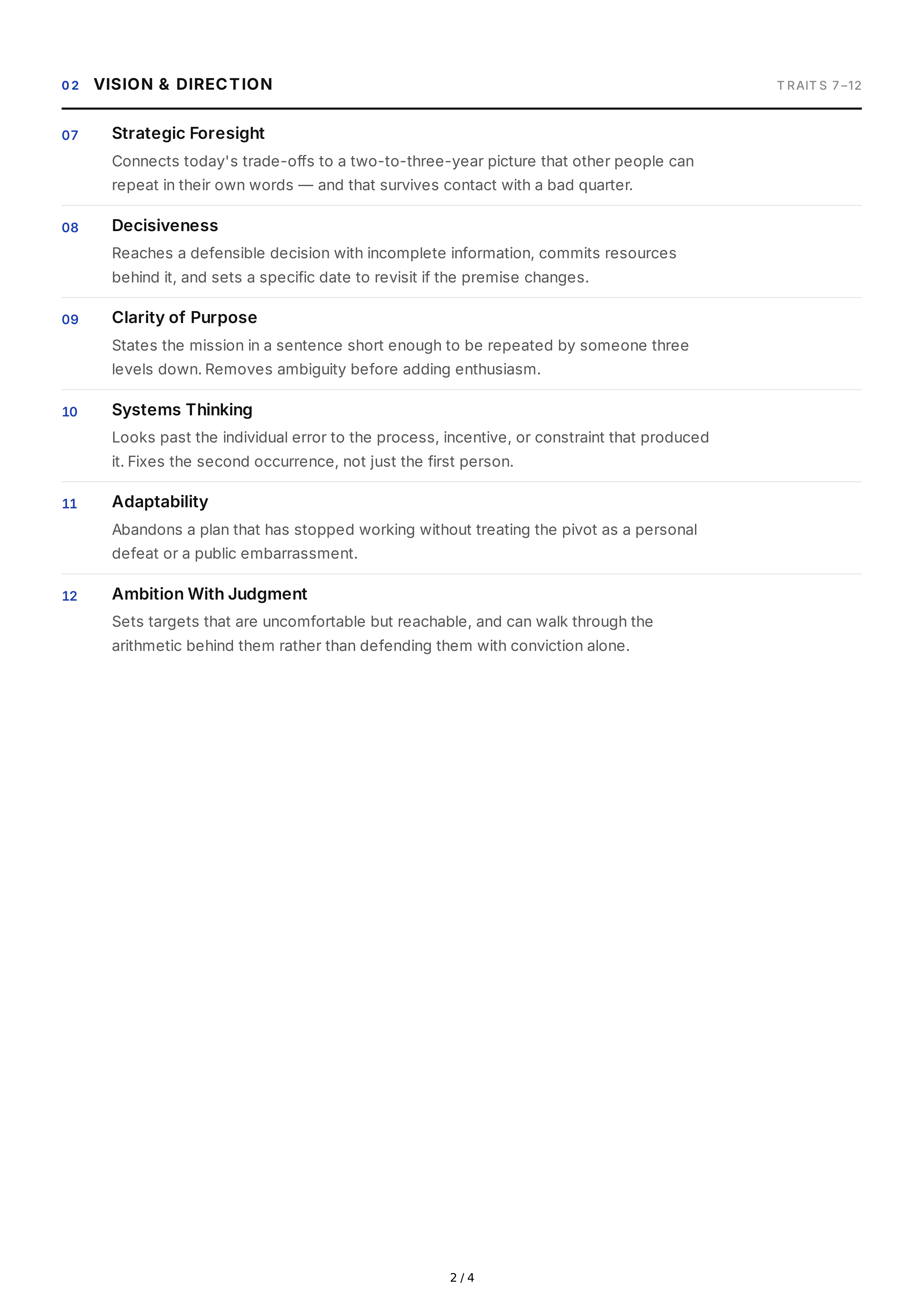
02
VISION
&
DIRECTION
T RAIT S
7 –12
07
Strategic
Foresight
Connects
today
'
s
trade
-
offs
to
a
two
-
to
-
three
-
year
picture
that
other
people
can
repeat
in
their
own
words
—
and
that
survives
contact
with
a
bad
quarter
.
08
Decisiveness
Reaches
a
defensible
decision
with
incomplete
information
,
commits
resources
behind
it
,
and
sets
a
specific
date
to
revisit
if
the
premise
changes
.
09
Clarity
of
Purpose
States
the
mission
in
a
sentence
short
enough
to
be
repeated
by
someone
three
levels
down
.
Removes
ambiguity
before
adding
enthusiasm
.
10
Systems
Thinking
Looks
past
the
individual
error
to
the
process
,
incentive
,
or
constraint
that
produced
it
.
Fixes
the
second
occurrence
,
not
just
the
first
person
.
11
Adaptability
Abandons
a
plan
that
has
stopped
working
without
treating
the
pivot
as
a
personal
defeat
or
a
public
embarrassment
.
12
Ambition
With
Judgment
Sets
targets
that
are
uncomfortable
but
reachable
,
and
can
walk
through
the
arithmetic
behind
them
rather
than
defending
them
with
conviction
alone
.
2 / 4
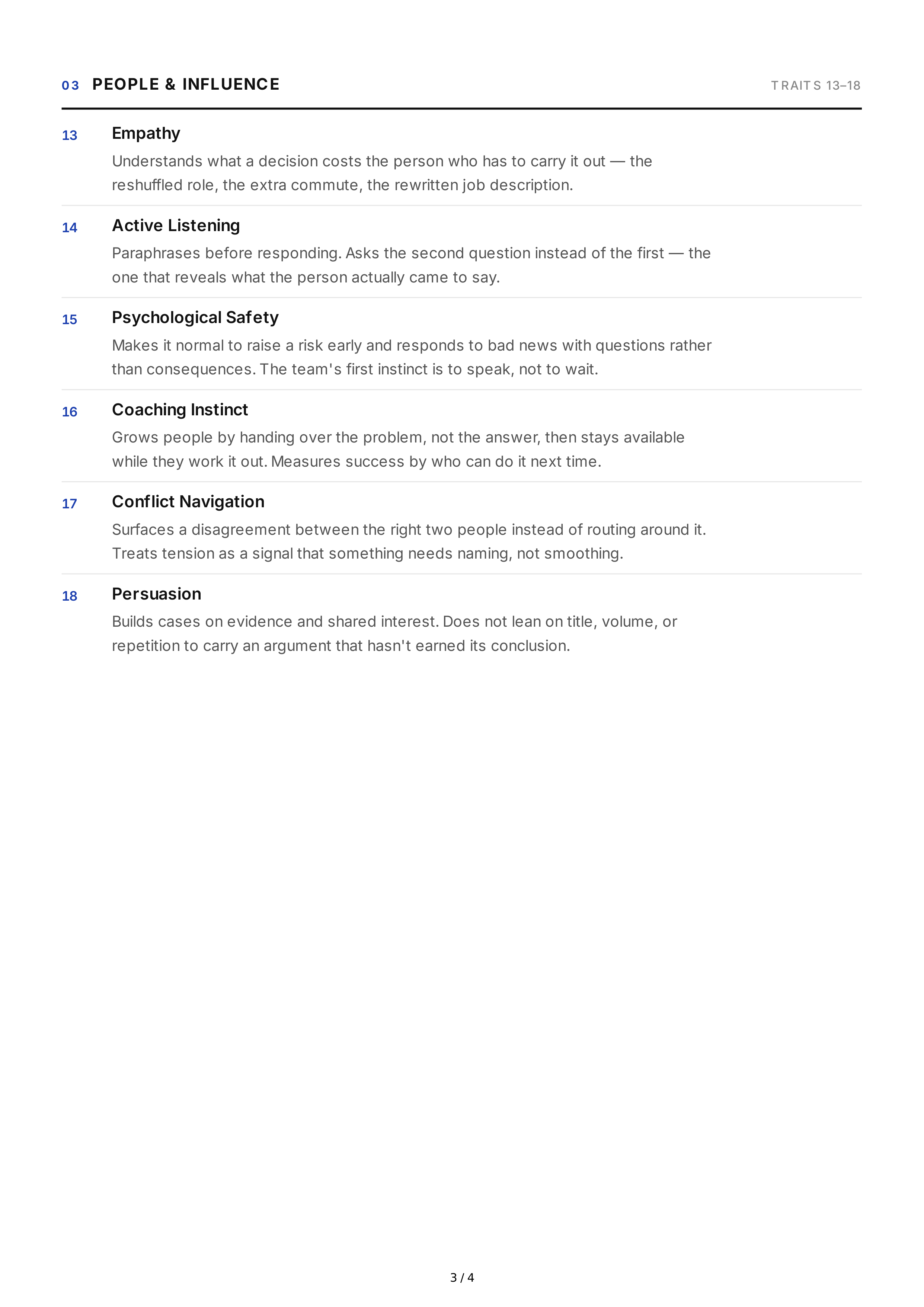
03
PEOPLE
&
INFLUENCE
T RAIT S
13–18
13
Empathy
Understands
what
a
decision
costs
the
person
who
has
to
carry
it
out
—
the
reshuffled
role
,
the
extra
commute
,
the
rewritten
job
description
.
14
Active
Listening
Paraphrases
before
responding
.
Asks
the
second
question
instead
of
the
first
—
the
one
that
reveals
what
the
person
actually
came
to
say
.
15
Psychological
Safety
Makes
it
normal
to
raise
a
risk
early
and
responds
to
bad
news
with
questions
rather
than
consequences
.
The
team
'
s
first
instinct
is
to
speak
,
not
to
wait
.
16
Coaching
Instinct
Grows
people
by
handing
over
the
problem
,
not
the
answer
,
then
stays
available
while
they
work
it
out
.
Measures
success
by
who
can
do
it
next
time
.
17
Conflict
Navigation
Surfaces
a
disagreement
between
the
right
two
people
instead
of
routing
around
it
.
Treats
tension
as
a
signal
that
something
needs
naming
,
not
smoothing
.
18
Persuasion
Builds
cases
on
evidence
and
shared
interest
.
Does
not
lean
on
title
,
volume
,
or
repetition
to
carry
an
argument
that
hasn
'
t
earned
its
conclusion
.
3 / 4
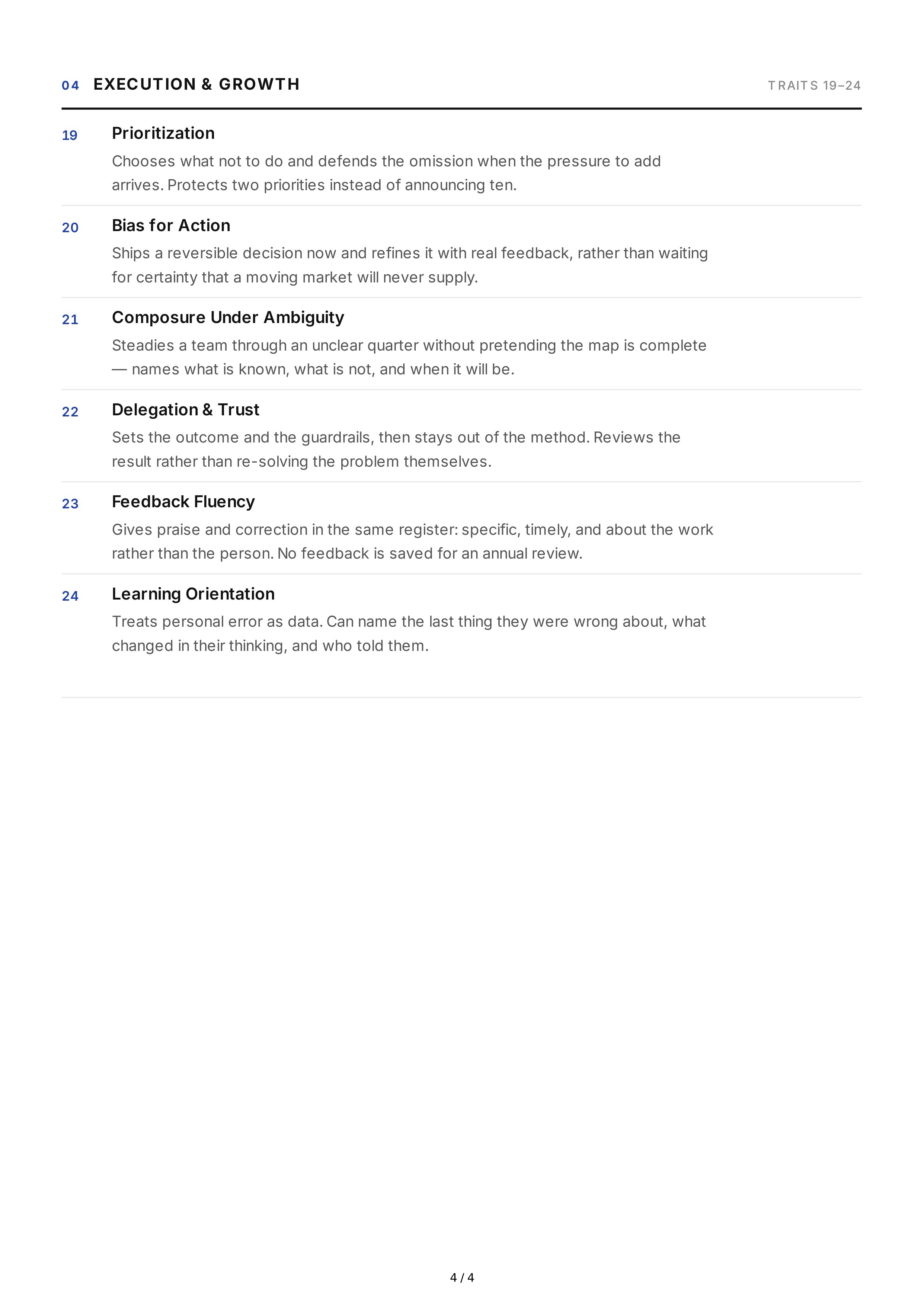
04
EXECUTION
&
GROWTH
T RAIT S
19–24
19
Prioritization
Chooses
what
not
to
do
and
defends
the
omission
when
the
pressure
to
add
arrives
.
Protects
two
priorities
instead
of
announcing
ten
.
20
Bias
for
Action
Ships
a
reversible
decision
now
and
refines
it
with
real
feedback
,
rather
than
waiting
for
certainty
that
a
moving
market
will
never
supply
.
21
Composure
Under
Ambiguity
Steadies
a
team
through
an
unclear
quarter
without
pretending
the
map
is
complete
—
names
what
is
known
,
what
is
not
,
and
when
it
will
be
.
22
Delegation
&
Trust
Sets
the
outcome
and
the
guardrails
,
then
stays
out
of
the
method
.
Reviews
the
result
rather
than
re
-
solving
the
problem
themselves
.
23
Feedback
Fluency
Gives
praise
and
correction
in
the
same
register
:
specific
,
timely
,
and
about
the
work
rather
than
the
person
.
No
feedback
is
saved
for
an
annual
review
.
24
Learning
Orientation
Treats
personal
error
as
data
.
Can
name
the
last
thing
they
were
wrong
about
,
what
changed
in
their
thinking
,
and
who
told
them
.
4 / 4