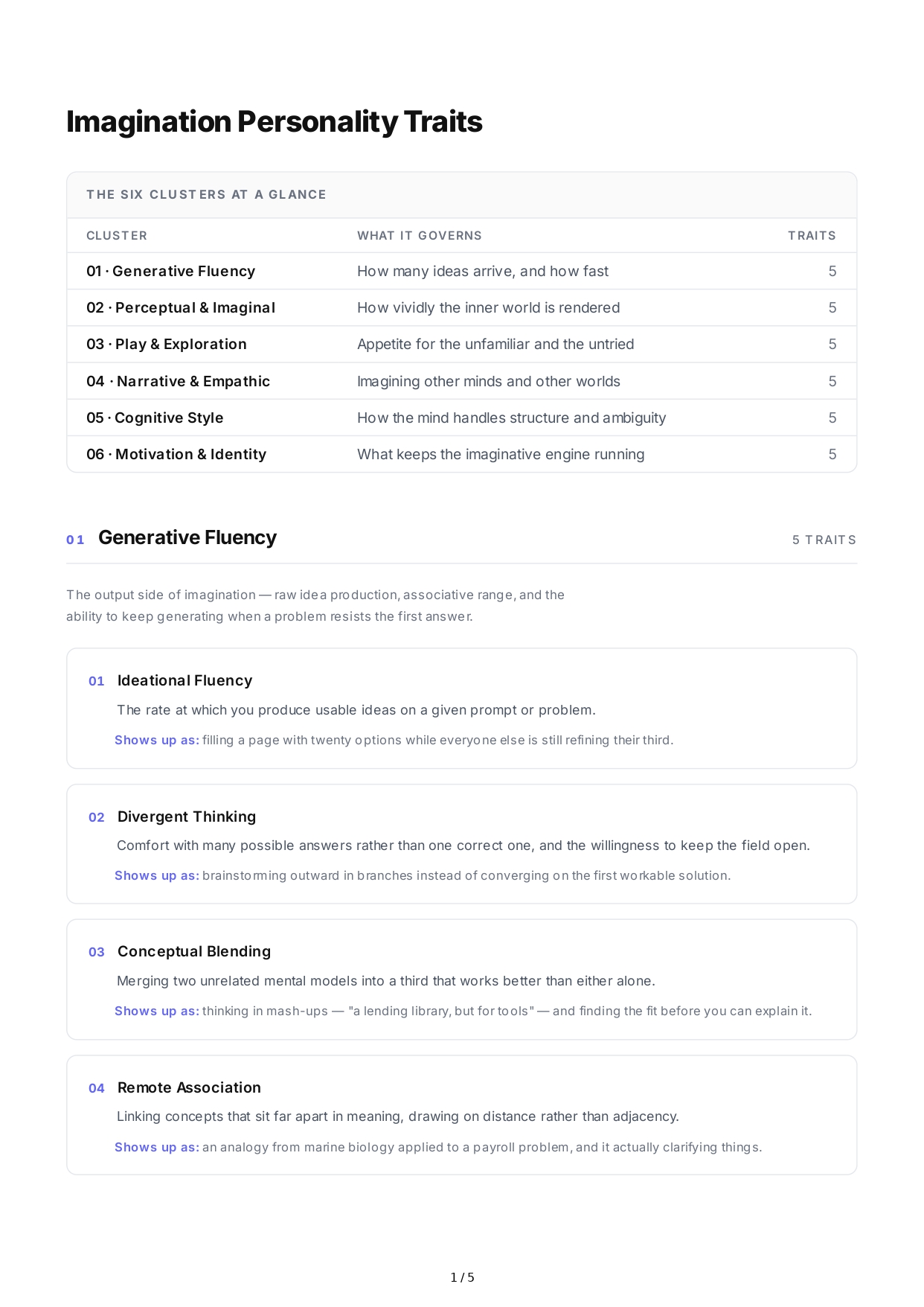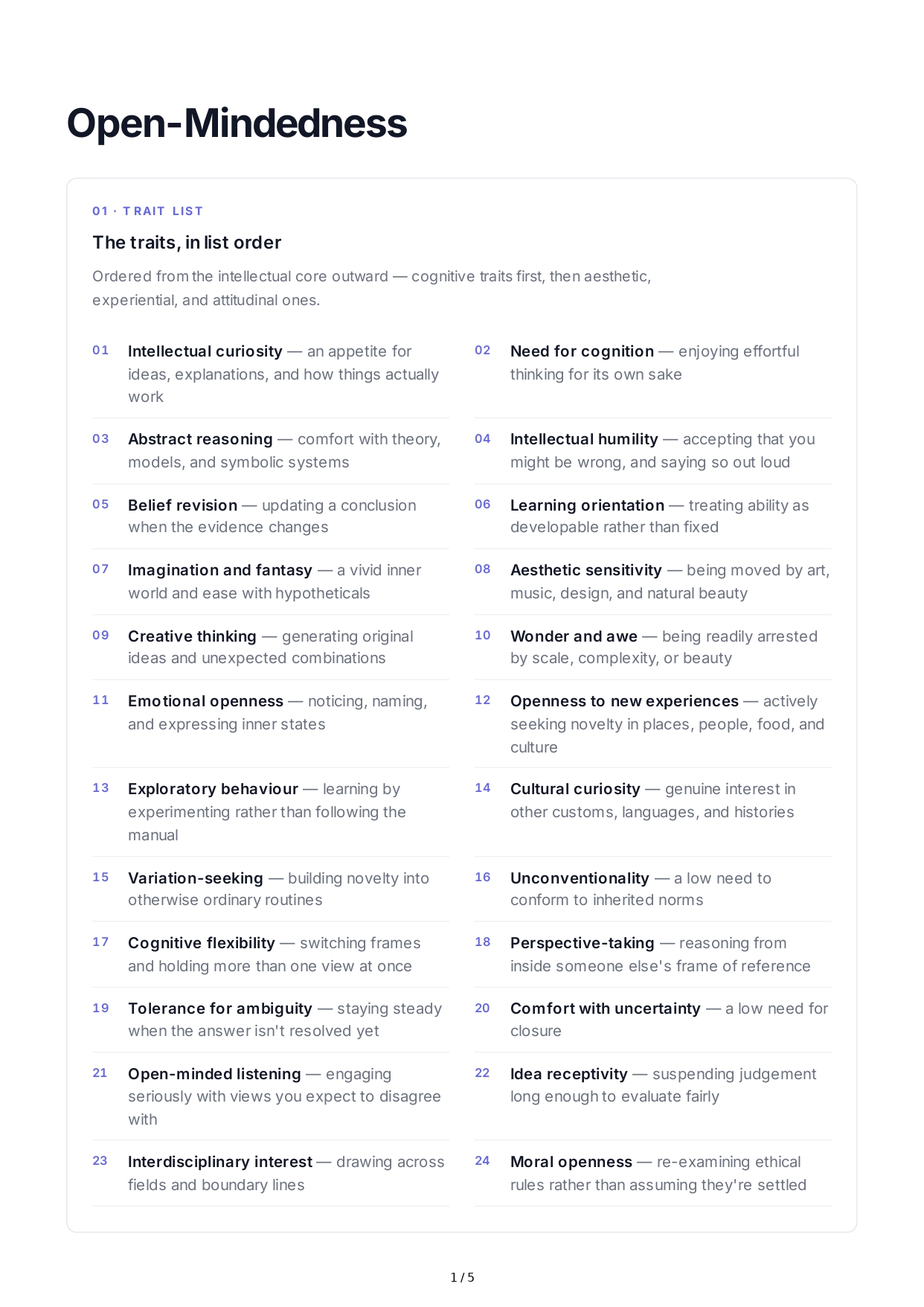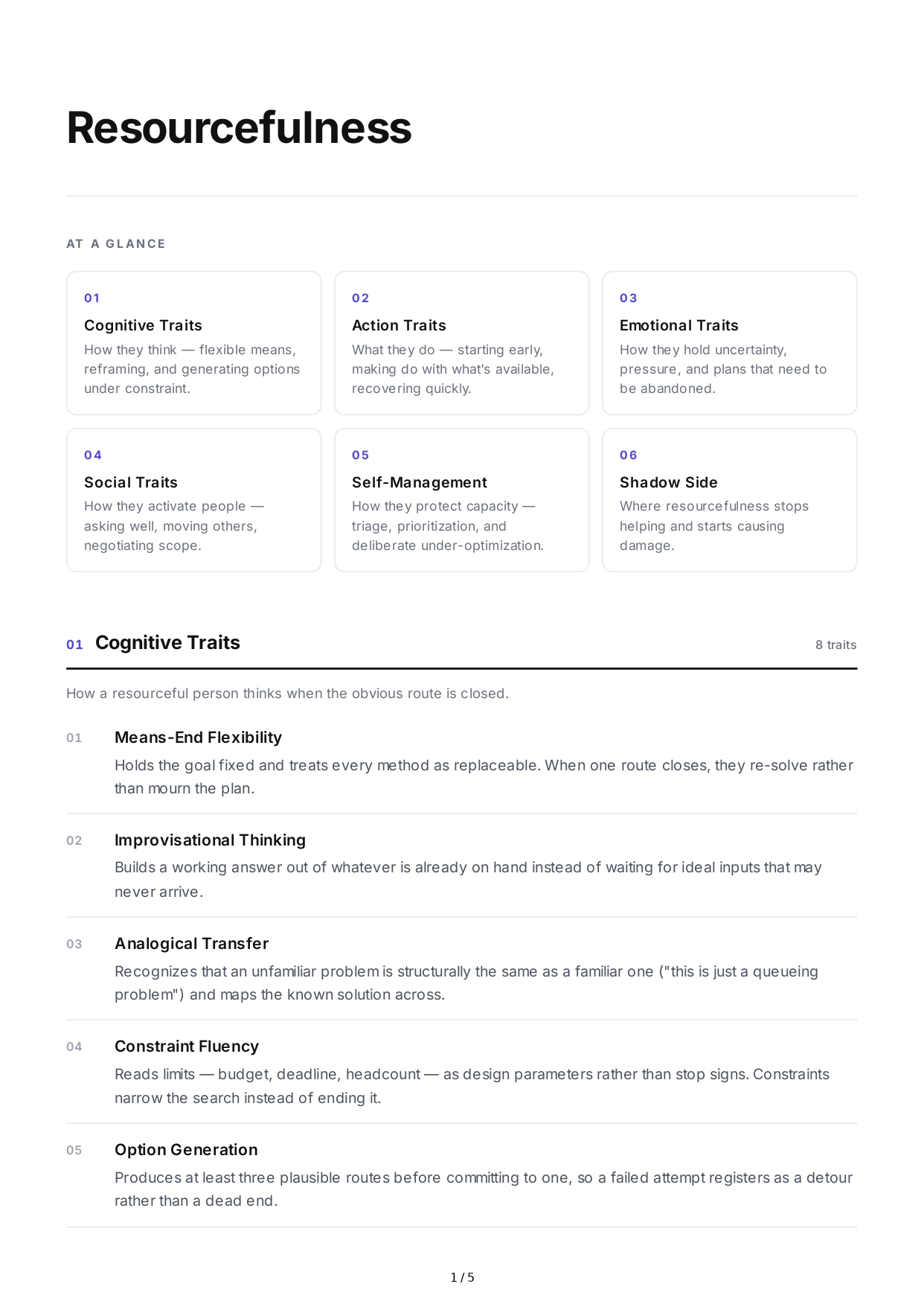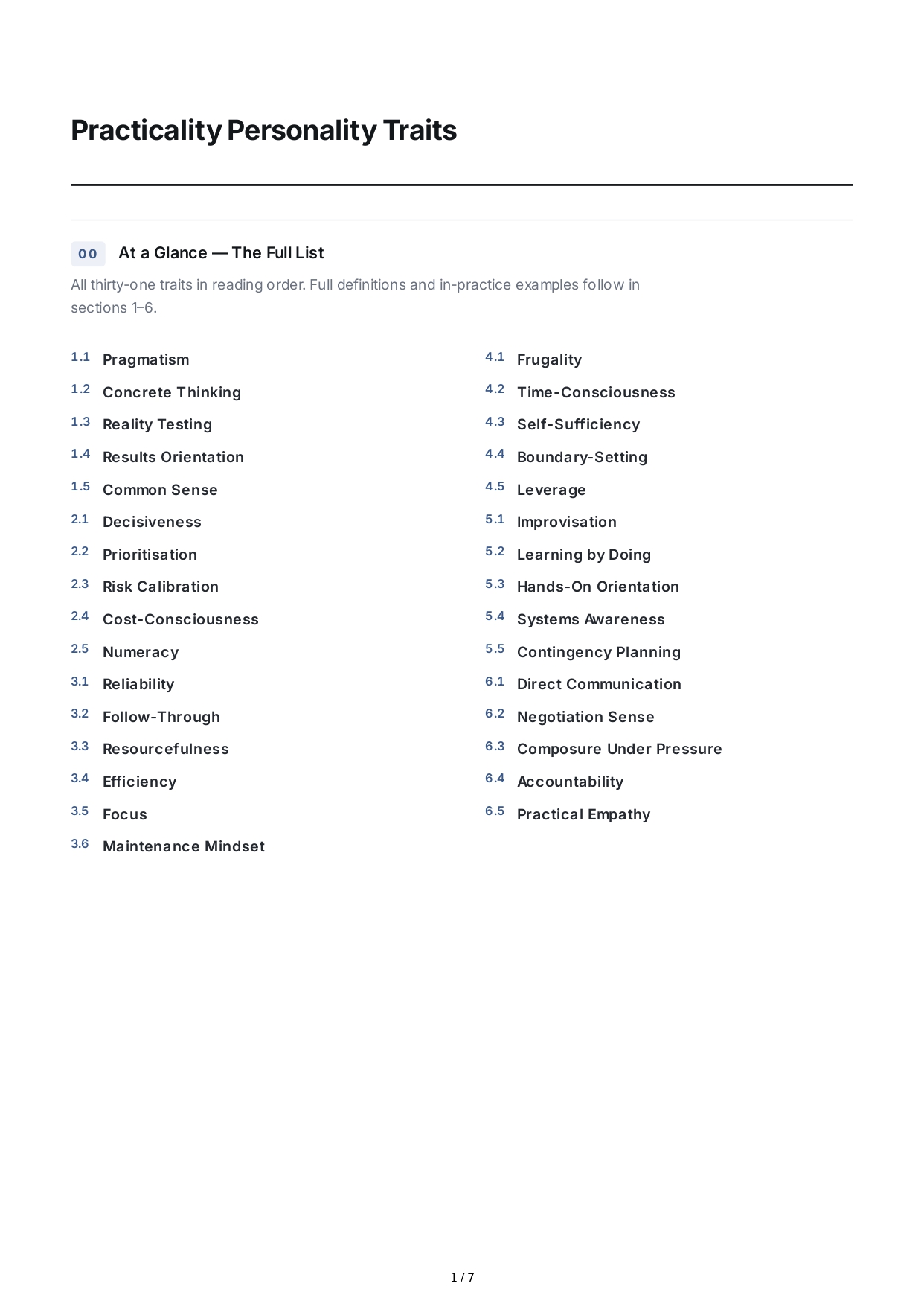
Authenticity
Personality
Traits
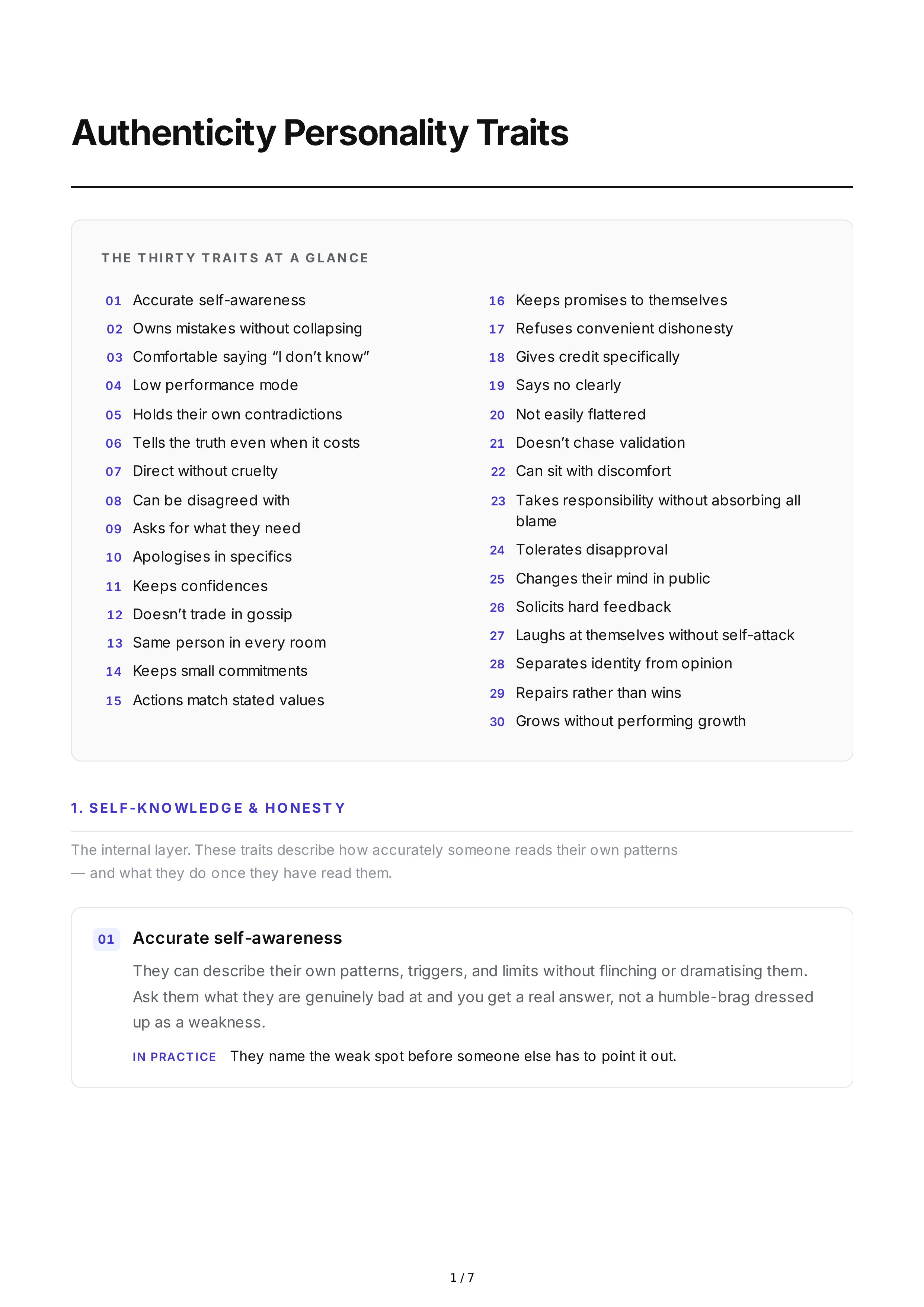
T HE
T HI RT Y
T RAI T S
AT
A
G LAN CE
01
Accurate
self
-
awareness
02
Owns
mistakes
without
collapsing
03
Comfortable
saying
“
I
don
’
t
know
”
04
Low
performance
mode
05
Holds
their
own
contradictions
06
Tells
the
truth
even
when
it
costs
07
Direct
without
cruelty
08
Can
be
disagreed
with
09
Asks
for
what
they
need
10
Apologises
in
specifics
11
Keeps
confidences
12
Doesn
’
t
trade
in
gossip
13
Same
person
in
every
room
14
Keeps
small
commitments
15
Actions
match
stated
values
16
Keeps
promises
to
themselves
17
Refuses
convenient
dishonesty
18
Gives
credit
specifically
19
Says
no
clearly
20
Not
easily
flattered
21
Doesn
’
t
chase
validation
22
Can
sit
with
discomfort
23
Takes
responsibility
without
absorbing
all
blame
24
Tolerates
disapproval
25
Changes
their
mind
in
public
26
Solicits
hard
feedback
27
Laughs
at
themselves
without
self
-
attack
28
Separates
identity
from
opinion
29
Repairs
rather
than
wins
30
Grows
without
performing
growth
1.
SEL F
-
K NO WL ED G E
&
HO NEST Y
The
internal
layer
.
These
traits
describe
how
accurately
someone
reads
their
own
patterns
—
and
what
they
do
once
they
have
read
them
.
01
Accurate
self
-
awareness
They
can
describe
their
own
patterns
,
triggers
,
and
limits
without
flinching
or
dramatising
them
.
Ask
them
what
they
are
genuinely
bad
at
and
you
get
a
real
answer
,
not
a
humble
-
brag
dressed
up
as
a
weakness
.
IN
PRACT ICE
They
name
the
weak
spot
before
someone
else
has
to
point
it
out
.
1 / 7
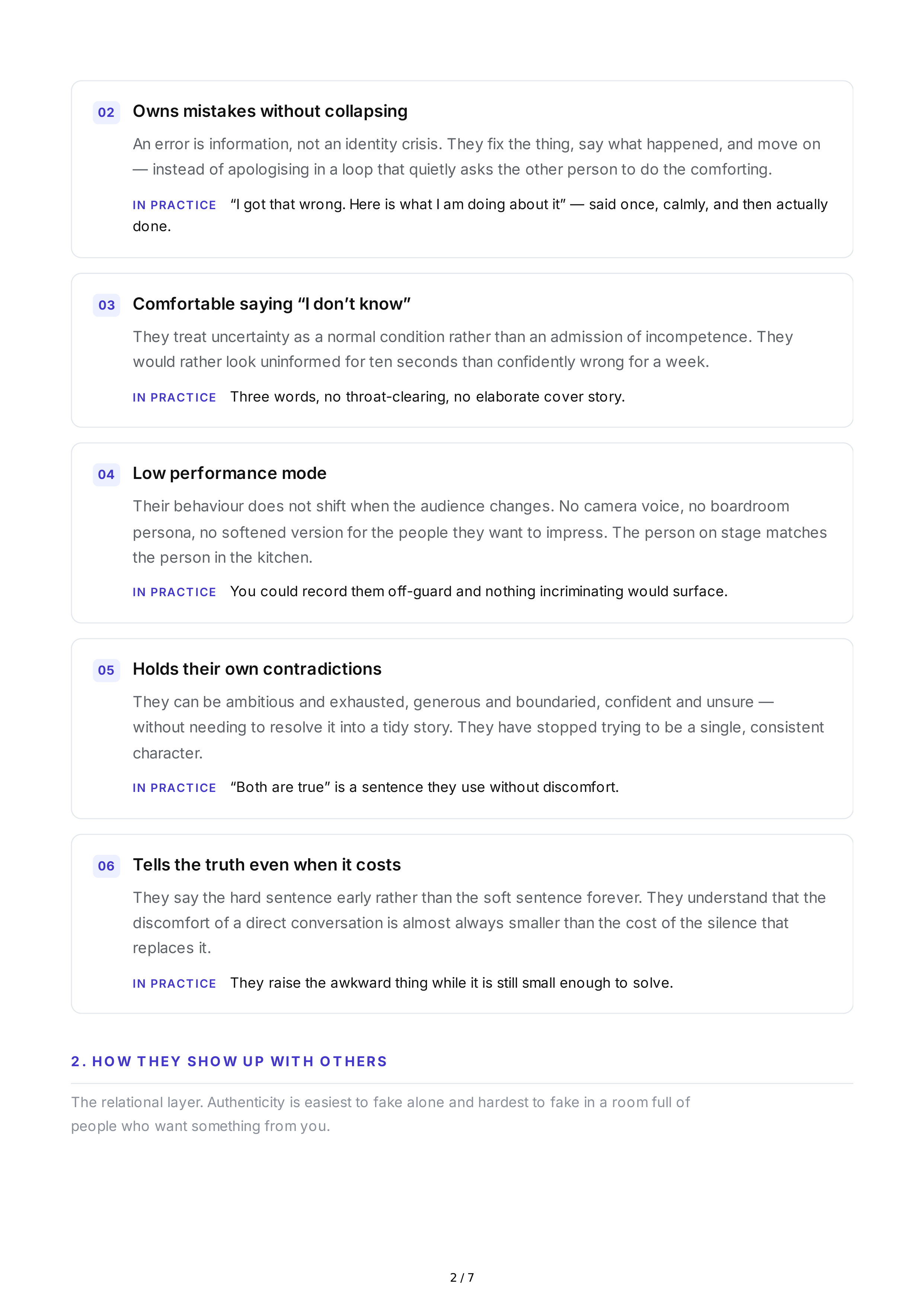
02
Owns
mistakes
without
collapsing
An
error
is
information
,
not
an
identity
crisis
.
They
fix
the
thing
,
say
what
happened
,
and
move
on
—
instead
of
apologising
in
a
loop
that
quietly
asks
the
other
person
to
do
the
comforting
.
IN
PRACT ICE
“
I
got
that
wrong
.
Here
is
what
I
am
doing
about
it
” —
said
once
,
calmly
,
and
then
actually
done
.
03
Comfortable
saying
“
I
don
’
t
know
”
They
treat
uncertainty
as
a
normal
condition
rather
than
an
admission
of
incompetence
.
They
would
rather
look
uninformed
for
ten
seconds
than
confidently
wrong
for
a
week
.
IN
PRACT ICE
Three
words
,
no
throat
-
clearing
,
no
elaborate
cover
story
.
04
Low
performance
mode
Their
behaviour
does
not
shift
when
the
audience
changes
.
No
camera
voice
,
no
boardroom
persona
,
no
softened
version
for
the
people
they
want
to
impress
.
The
person
on
stage
matches
the
person
in
the
kitchen
.
IN
PRACT ICE
You
could
record
them
off
-
guard
and
nothing
incriminating
would
surface
.
05
Holds
their
own
contradictions
They
can
be
ambitious
and
exhausted
,
generous
and
boundaried
,
confident
and
unsure
—
without
needing
to
resolve
it
into
a
tidy
story
.
They
have
stopped
trying
to
be
a
single
,
consistent
character
.
IN
PRACT ICE
“
Both
are
true
”
is
a
sentence
they
use
without
discomfort
.
06
Tells
the
truth
even
when
it
costs
They
say
the
hard
sentence
early
rather
than
the
soft
sentence
forever
.
They
understand
that
the
discomfort
of
a
direct
conversation
is
almost
always
smaller
than
the
cost
of
the
silence
that
replaces
it
.
IN
PRACT ICE
They
raise
the
awkward
thing
while
it
is
still
small
enough
to
solve
.
2 .
HO W
T HEY
SHO W
UP
WIT H
O T HERS
The
relational
layer
.
Authenticity
is
easiest
to
fake
alone
and
hardest
to
fake
in
a
room
full
of
people
who
want
something
from
you
.
2 / 7
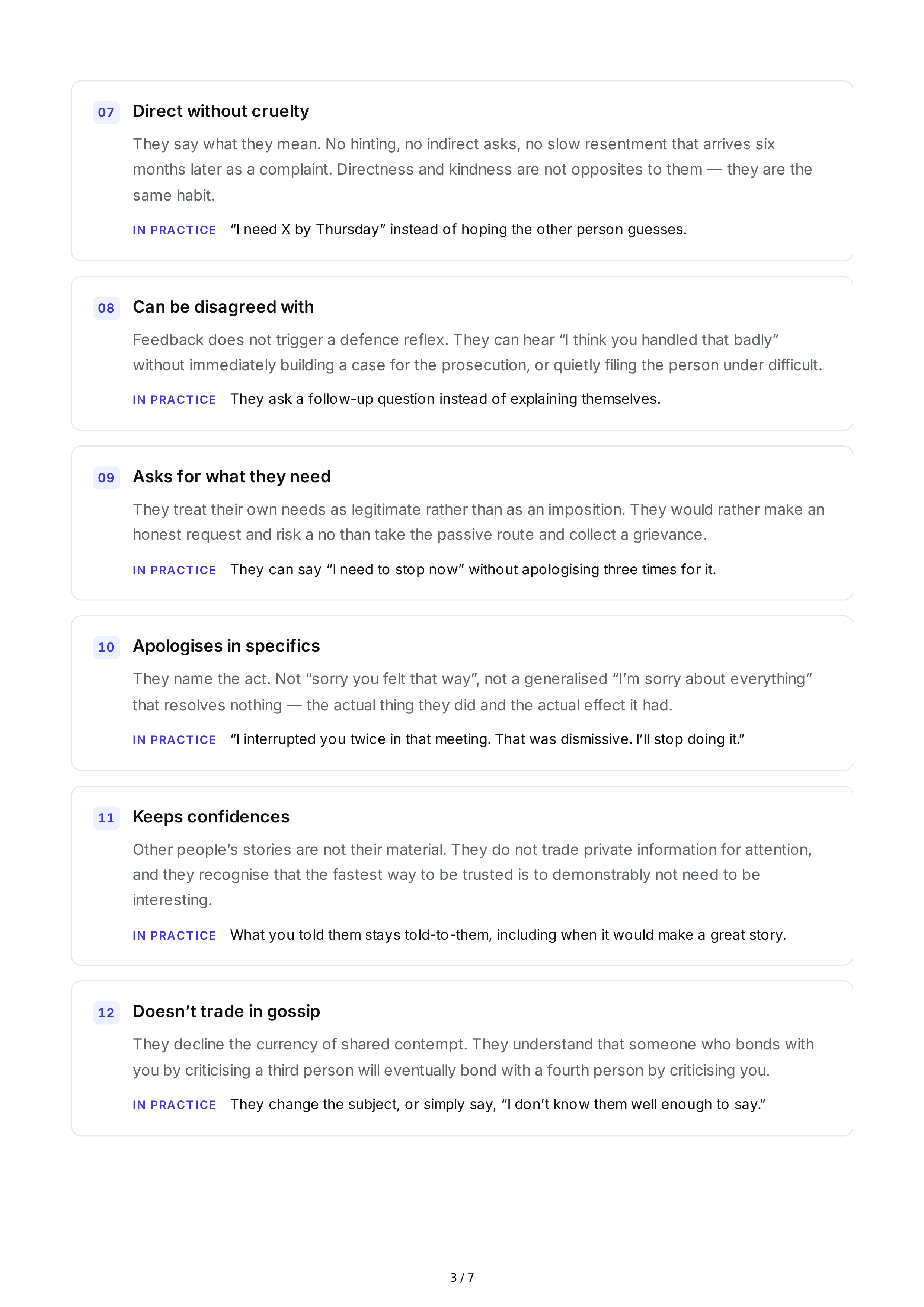
07
Direct
without
cruelty
They
say
what
they
mean
.
No
hinting
,
no
indirect
asks
,
no
slow
resentment
that
arrives
six
months
later
as
a
complaint
.
Directness
and
kindness
are
not
opposites
to
them
—
they
are
the
same
habit
.
IN
PRACT ICE
“
I
need
X
by
Thursday
”
instead
of
hoping
the
other
person
guesses
.
08
Can
be
disagreed
with
Feedback
does
not
trigger
a
defence
reflex
.
They
can
hear
“
I
think
you
handled
that
badly
”
without
immediately
building
a
case
for
the
prosecution
,
or
quietly
filing
the
person
under
difficult
.
IN
PRACT ICE
They
ask
a
follow
-
up
question
instead
of
explaining
themselves
.
09
Asks
for
what
they
need
They
treat
their
own
needs
as
legitimate
rather
than
as
an
imposition
.
They
would
rather
make
an
honest
request
and
risk
a
no
than
take
the
passive
route
and
collect
a
grievance
.
IN
PRACT ICE
They
can
say
“
I
need
to
stop
now
”
without
apologising
three
times
for
it
.
10
Apologises
in
specifics
They
name
the
act
.
Not
“
sorry
you
felt
that
way
”,
not
a
generalised
“
I
’
m
sorry
about
everything
”
that
resolves
nothing
—
the
actual
thing
they
did
and
the
actual
effect
it
had
.
IN
PRACT ICE
“
I
interrupted
you
twice
in
that
meeting
.
That
was
dismissive
.
I
’
ll
stop
doing
it
.”
11
Keeps
confidences
Other
people
’
s
stories
are
not
their
material
.
They
do
not
trade
private
information
for
attention
,
and
they
recognise
that
the
fastest
way
to
be
trusted
is
to
demonstrably
not
need
to
be
interesting
.
IN
PRACT ICE
What
you
told
them
stays
told
-
to
-
them
,
including
when
it
would
make
a
great
story
.
12
Doesn
’
t
trade
in
gossip
They
decline
the
currency
of
shared
contempt
.
They
understand
that
someone
who
bonds
with
you
by
criticising
a
third
person
will
eventually
bond
with
a
fourth
person
by
criticising
you
.
IN
PRACT ICE
They
change
the
subject
,
or
simply
say
, “
I
don
’
t
know
them
well
enough
to
say
.”
3 / 7
3 .
CO NSIST ENCY
&
INT EG RIT Y
The
structural
layer
.
This
is
where
authenticity
stops
being
a
feeling
and
becomes
a
track
record
.
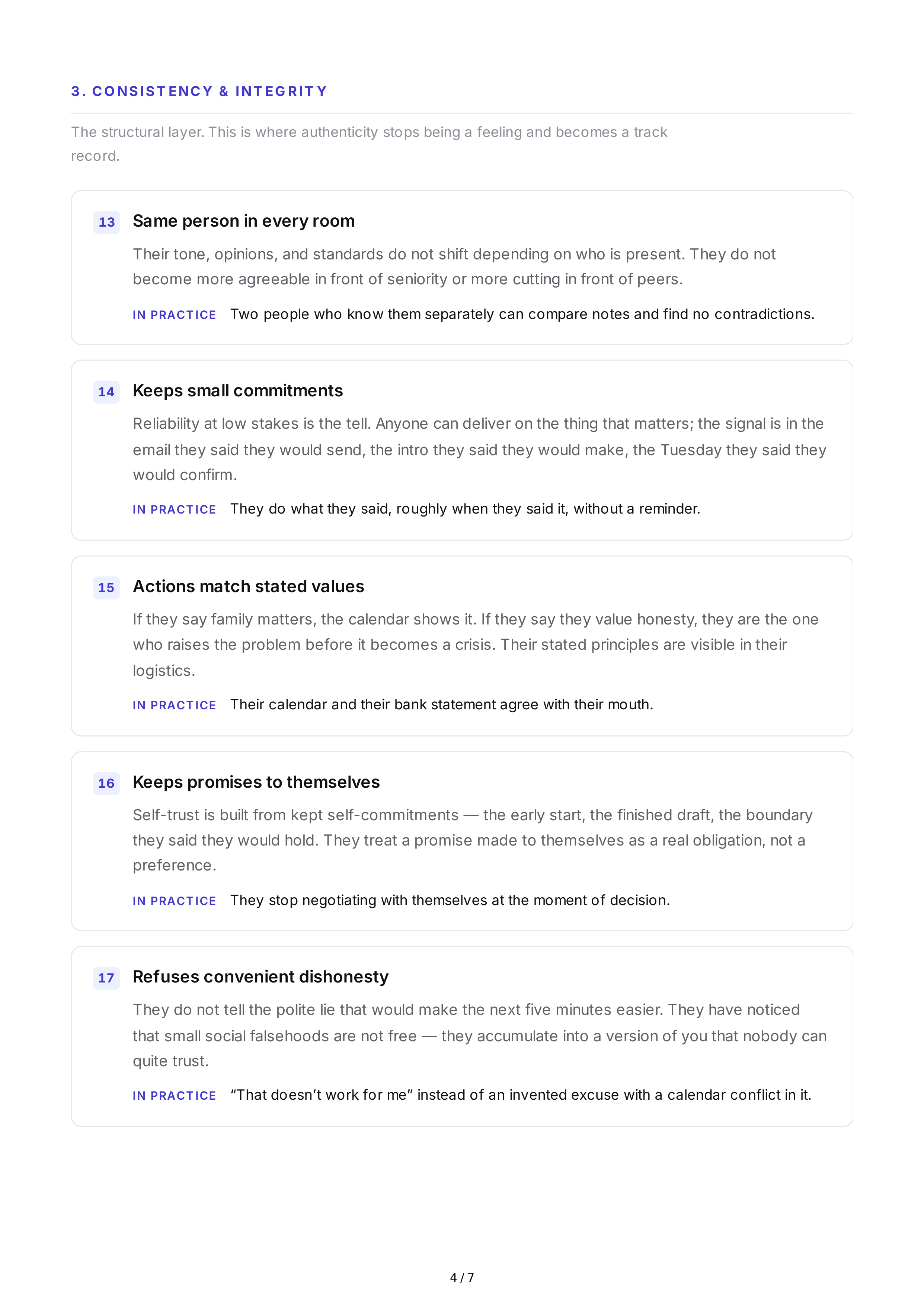
13
Same
person
in
every
room
Their
tone
,
opinions
,
and
standards
do
not
shift
depending
on
who
is
present
.
They
do
not
become
more
agreeable
in
front
of
seniority
or
more
cutting
in
front
of
peers
.
IN
PRACT ICE
Two
people
who
know
them
separately
can
compare
notes
and
find
no
contradictions
.
14
Keeps
small
commitments
Reliability
at
low
stakes
is
the
tell
.
Anyone
can
deliver
on
the
thing
that
matters
;
the
signal
is
in
the
email
they
said
they
would
send
,
the
intro
they
said
they
would
make
,
the
Tuesday
they
said
they
would
confirm
.
IN
PRACT ICE
They
do
what
they
said
,
roughly
when
they
said
it
,
without
a
reminder
.
15
Actions
match
stated
values
If
they
say
family
matters
,
the
calendar
shows
it
.
If
they
say
they
value
honesty
,
they
are
the
one
who
raises
the
problem
before
it
becomes
a
crisis
.
Their
stated
principles
are
visible
in
their
logistics
.
IN
PRACT ICE
Their
calendar
and
their
bank
statement
agree
with
their
mouth
.
16
Keeps
promises
to
themselves
Self
-
trust
is
built
from
kept
self
-
commitments
—
the
early
start
,
the
finished
draft
,
the
boundary
they
said
they
would
hold
.
They
treat
a
promise
made
to
themselves
as
a
real
obligation
,
not
a
preference
.
IN
PRACT ICE
They
stop
negotiating
with
themselves
at
the
moment
of
decision
.
17
Refuses
convenient
dishonesty
They
do
not
tell
the
polite
lie
that
would
make
the
next
five
minutes
easier
.
They
have
noticed
that
small
social
falsehoods
are
not
free
—
they
accumulate
into
a
version
of
you
that
nobody
can
quite
trust
.
IN
PRACT ICE
“
That
doesn
’
t
work
for
me
”
instead
of
an
invented
excuse
with
a
calendar
conflict
in
it
.
4 / 7
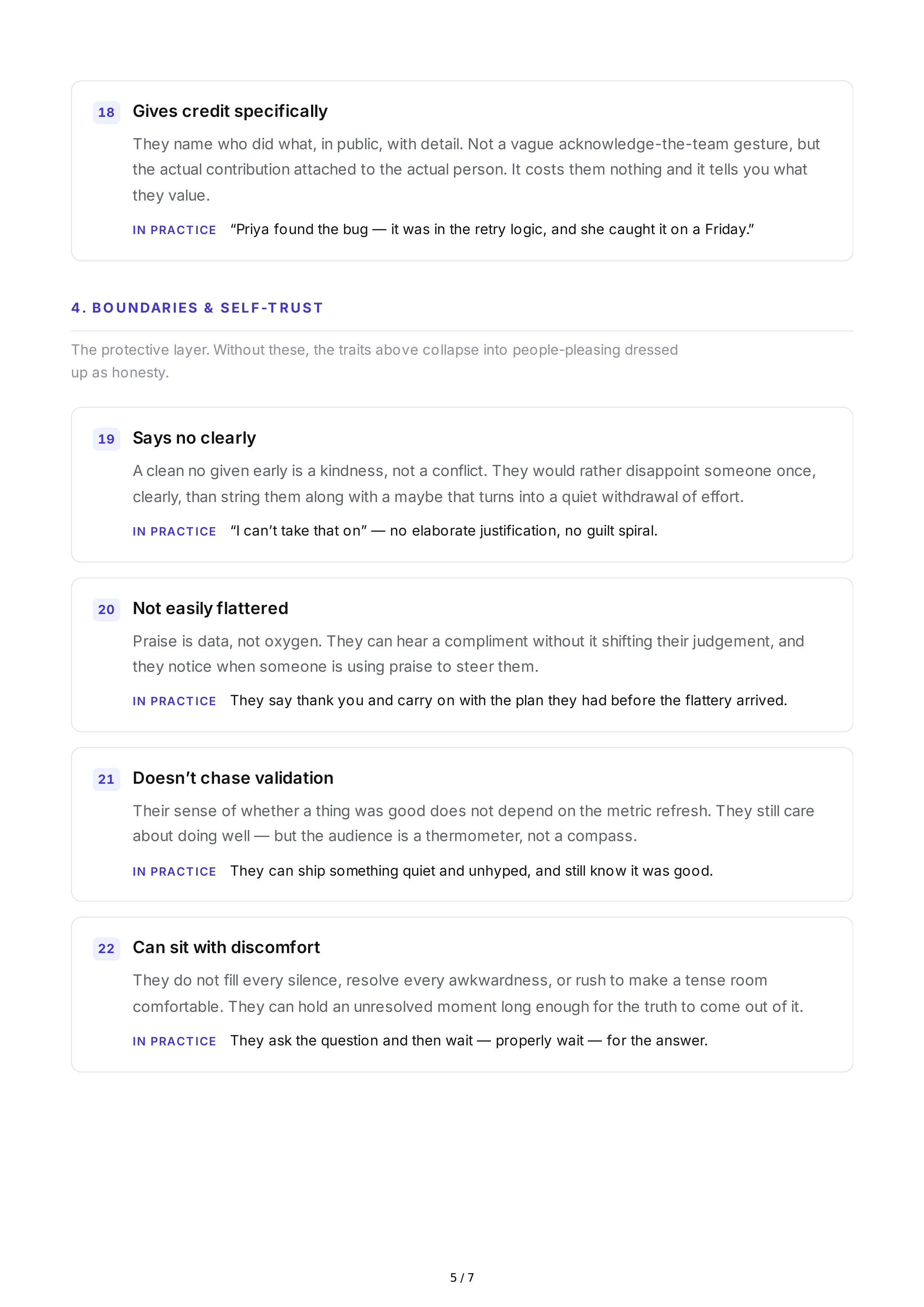
18
Gives
credit
specifically
They
name
who
did
what
,
in
public
,
with
detail
.
Not
a
vague
acknowledge
-
the
-
team
gesture
,
but
the
actual
contribution
attached
to
the
actual
person
.
It
costs
them
nothing
and
it
tells
you
what
they
value
.
IN
PRACT ICE
“
Priya
found
the
bug
—
it
was
in
the
retry
logic
,
and
she
caught
it
on
a
Friday
.”
4.
BO UNDARIES
&
SEL F
-
T RUST
The
protective
layer
.
Without
these
,
the
traits
above
collapse
into
people
-
pleasing
dressed
up
as
honesty
.
19
Says
no
clearly
A
clean
no
given
early
is
a
kindness
,
not
a
conflict
.
They
would
rather
disappoint
someone
once
,
clearly
,
than
string
them
along
with
a
maybe
that
turns
into
a
quiet
withdrawal
of
effort
.
IN
PRACT ICE
“
I
can
’
t
take
that
on
” —
no
elaborate
justification
,
no
guilt
spiral
.
20
Not
easily
flattered
Praise
is
data
,
not
oxygen
.
They
can
hear
a
compliment
without
it
shifting
their
judgement
,
and
they
notice
when
someone
is
using
praise
to
steer
them
.
IN
PRACT ICE
They
say
thank
you
and
carry
on
with
the
plan
they
had
before
the
flattery
arrived
.
21
Doesn
’
t
chase
validation
Their
sense
of
whether
a
thing
was
good
does
not
depend
on
the
metric
refresh
.
They
still
care
about
doing
well
—
but
the
audience
is
a
thermometer
,
not
a
compass
.
IN
PRACT ICE
They
can
ship
something
quiet
and
unhyped
,
and
still
know
it
was
good
.
22
Can
sit
with
discomfort
They
do
not
fill
every
silence
,
resolve
every
awkwardness
,
or
rush
to
make
a
tense
room
comfortable
.
They
can
hold
an
unresolved
moment
long
enough
for
the
truth
to
come
out
of
it
.
IN
PRACT ICE
They
ask
the
question
and
then
wait
—
properly
wait
—
for
the
answer
.
5 / 7
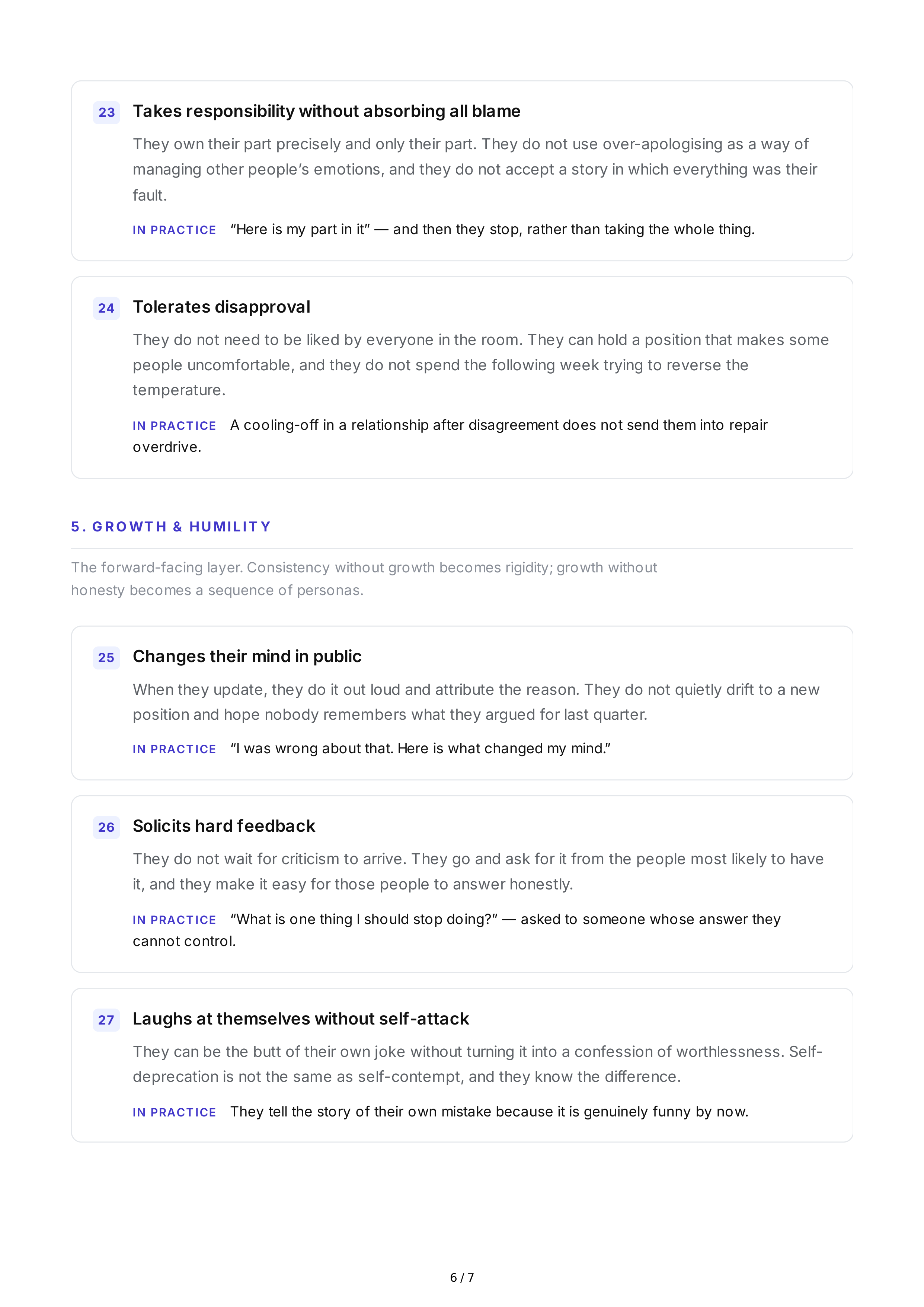
23
Takes
responsibility
without
absorbing
all
blame
They
own
their
part
precisely
and
only
their
part
.
They
do
not
use
over
-
apologising
as
a
way
of
managing
other
people
’
s
emotions
,
and
they
do
not
accept
a
story
in
which
everything
was
their
fault
.
IN
PRACT ICE
“
Here
is
my
part
in
it
” —
and
then
they
stop
,
rather
than
taking
the
whole
thing
.
24
Tolerates
disapproval
They
do
not
need
to
be
liked
by
everyone
in
the
room
.
They
can
hold
a
position
that
makes
some
people
uncomfortable
,
and
they
do
not
spend
the
following
week
trying
to
reverse
the
temperature
.
IN
PRACT ICE
A
cooling
-
off
in
a
relationship
after
disagreement
does
not
send
them
into
repair
overdrive
.
5 .
G RO WT H
&
HUMIL IT Y
The
forward
-
facing
layer
.
Consistency
without
growth
becomes
rigidity
;
growth
without
honesty
becomes
a
sequence
of
personas
.
25
Changes
their
mind
in
public
When
they
update
,
they
do
it
out
loud
and
attribute
the
reason
.
They
do
not
quietly
drift
to
a
new
position
and
hope
nobody
remembers
what
they
argued
for
last
quarter
.
IN
PRACT ICE
“
I
was
wrong
about
that
.
Here
is
what
changed
my
mind
.”
26
Solicits
hard
feedback
They
do
not
wait
for
criticism
to
arrive
.
They
go
and
ask
for
it
from
the
people
most
likely
to
have
it
,
and
they
make
it
easy
for
those
people
to
answer
honestly
.
IN
PRACT ICE
“
What
is
one
thing
I
should
stop
doing
?” —
asked
to
someone
whose
answer
they
cannot
control
.
27
Laughs
at
themselves
without
self
-
attack
They
can
be
the
butt
of
their
own
joke
without
turning
it
into
a
confession
of
worthlessness
.
Self
-
deprecation
is
not
the
same
as
self
-
contempt
,
and
they
know
the
difference
.
IN
PRACT ICE
They
tell
the
story
of
their
own
mistake
because
it
is
genuinely
funny
by
now
.
6 / 7
28
Separates
identity
from
opinion
Being
wrong
about
a
thing
is
not
the
same
as
being
wrong
as
a
person
.
They
can
have
an
idea
dismantled
in
a
meeting
without
needing
to
leave
the
room
with
their
self
-
image
intact
through
force
.
IN
PRACT ICE
“
Kill
the
idea
”
does
not
feel
to
them
like
“
kill
the
person
”.
29
Repairs
rather
than
wins
In
conflict
,
the
goal
is
to
restore
the
relationship
,
not
to
establish
who
was
right
.
They
will
concede
an
argument
they
could
have
won
if
winning
it
would
cost
more
than
the
point
is
worth
.
IN
PRACT ICE
They
ask
, “
What
do
you
need
from
me
here
?”
instead
of
building
another
layer
of
case
.
30
Grows
without
performing
growth
They
do
not
narrate
their
own
development
for
an
audience
.
No
optimisation
persona
,
no
public
journal
of
self
-
improvement
,
no
announcement
of
the
lesson
before
the
lesson
has
actually
been
learned
.
IN
PRACT ICE
You
notice
the
change
later
,
in
their
behaviour
—
not
earlier
,
in
their
posts
.
WHAT
AUT HE N T I CI T Y
I S
N O T
Not
unfiltered
honesty
.
Authenticity
includes
judgement
.
Telling
someone
every
passing
thought
is
not
integrity
—
it
is
impulsiveness
with
a
flattering
name
.
Not
consistency
at
all
costs
.
Refusing
to
change
your
mind
because
you
said
something
once
is
not
conviction
;
it
is
stubbornness
wearing
conviction
’
s
jacket
.
Not
a
personality
type
.
These
are
behaviours
,
not
traits
you
are
born
with
.
Most
people
hold
some
of
them
and
are
working
on
others
—
the
working
-
on
is
the
point
.
Not
a
personal
brand
.
If
the
main
evidence
of
someone
’
s
authenticity
is
what
they
say
about
their
own
authenticity
,
the
evidence
is
not
evidence
.
Not
the
absence
of
strategy
.
Authentic
people
still
make
calculated
choices
.
They
simply
do
not
make
dishonest
ones
to
protect
themselves
from
discomfort
.
7 / 7