

AI research tools are platforms that use artificial intelligence to help users find, analyze, and summarize information from large data sources. They simplify tasks like literature reviews, citations, and writing, making AI research faster and more efficient. As the volume of research grows, manual methods become time-consuming and difficult to manage. The best AI research tools solve this by using technologies like natural language processing to deliver accurate, relevant insights quickly.
These tools are widely used by students, researchers, and professionals to save time and improve the overall quality of their AI research workflow.
What Are AI Research Tools?
AI research tools are platforms that use artificial intelligence to help users find, understand, and summarize information from research papers and data sources. They make AI research faster by automating tasks like searching, summarizing, and organizing information.
Key Functions
- Find relevant research papers
- Summarize complex content
- Generate citations
- Assist in writing
Why They Matter
AI research tools save time, reduce manual effort, and help users get accurate insights quickly, making the research process more efficient.
Types of AI Research Tools
AI research tools are categorized based on the specific tasks they perform in the AI research process, such as discovering information, summarizing content, analyzing citations, and assisting with writing.
Main Types
- Discovery Tools
- Find relevant research papers and sources
- Examples: Elicit, Semantic Scholar
- Summarization Tools
- Convert long content into short insights
- Examples: Scholarcy, ChatPDF
- Citation and Analysis Tools
- Track citations and show paper connections
- Examples: Litmaps, Connected Papers
- Writing Tools
- Help draft and improve research content
- Examples: Paperpal, Paperguide
- All-in-One Tools
- Combine multiple research features in one platform
- Examples: SciSpace, NotebookLM
Best AI Research Tools (List)
- Elicit AI
- Consensus AI
- Semantic Scholar AI
- Research Rabbit AI
- Perplexity AI
- Litmaps AI
- Connected Papers AI
- Scite.ai
- SciSpace AI
- ChatPDF AI
- Scholarcy AI
- Paperpal AI
- Paperguide AI
- Jenni AI
- Julius AI
AI Research Tools Comparison Table
| Tool | Primary Function | Key Features | Best For | Pricing |
|---|---|---|---|---|
| Elicit AI | Literature discovery | Finds papers, extracts key info, summarization | Literature review | Free + paid |
| Consensus AI | Research search engine | Evidence-based answers from scientific papers | Quick research answers | Free + premium |
| Semantic Scholar AI | Academic search engine | 200M+ papers, AI summaries, citation tracking | Paper discovery | Free |
| Research Rabbit AI | Literature mapping | Visual paper networks, tracking updates | Exploring research topics | Free + freemium |
| Perplexity AI | AI answer engine | Real-time answers, citations, web + academic search | Quick research and insights | Free + premium |
| Litmaps AI | Citation mapping | Visual citation graphs, trend tracking | Citation analysis | Free + paid |
| Connected Papers AI | Paper relationships | Graph-based related paper discovery | Finding related studies | Free + paid |
| Scite.ai | Citation analysis | Supporting and contrasting citations | Evidence validation | Free + paid |
| SciSpace AI | Research assistant | PDF chat, literature review, writing tools | End-to-end AI research | Free + premium |
| ChatPDF AI | PDF interaction | Chat with PDFs, extract answers | Understanding papers | Free + paid |
| Scholarcy AI | Summarization | Flashcards, key insights extraction | Quick paper summaries | Free + paid |
| Paperpal AI | Writing assistant | Grammar, clarity, academic writing help | Research writing | Free + premium |
| Paperguide AI | Research assistant | Writing, citation, summarization | Academic workflow | Free + paid |
| Jenni AI | AI writing assistant | In-text citations, AI autocomplete | Academic writing | Free + premium |
| Julius AI | Data analysis | Statistical analysis, reports, datasets | Research data analysis | Free + paid |
Discovery AI Research Tools
1) Elicit AI
What Is Elicit AI?
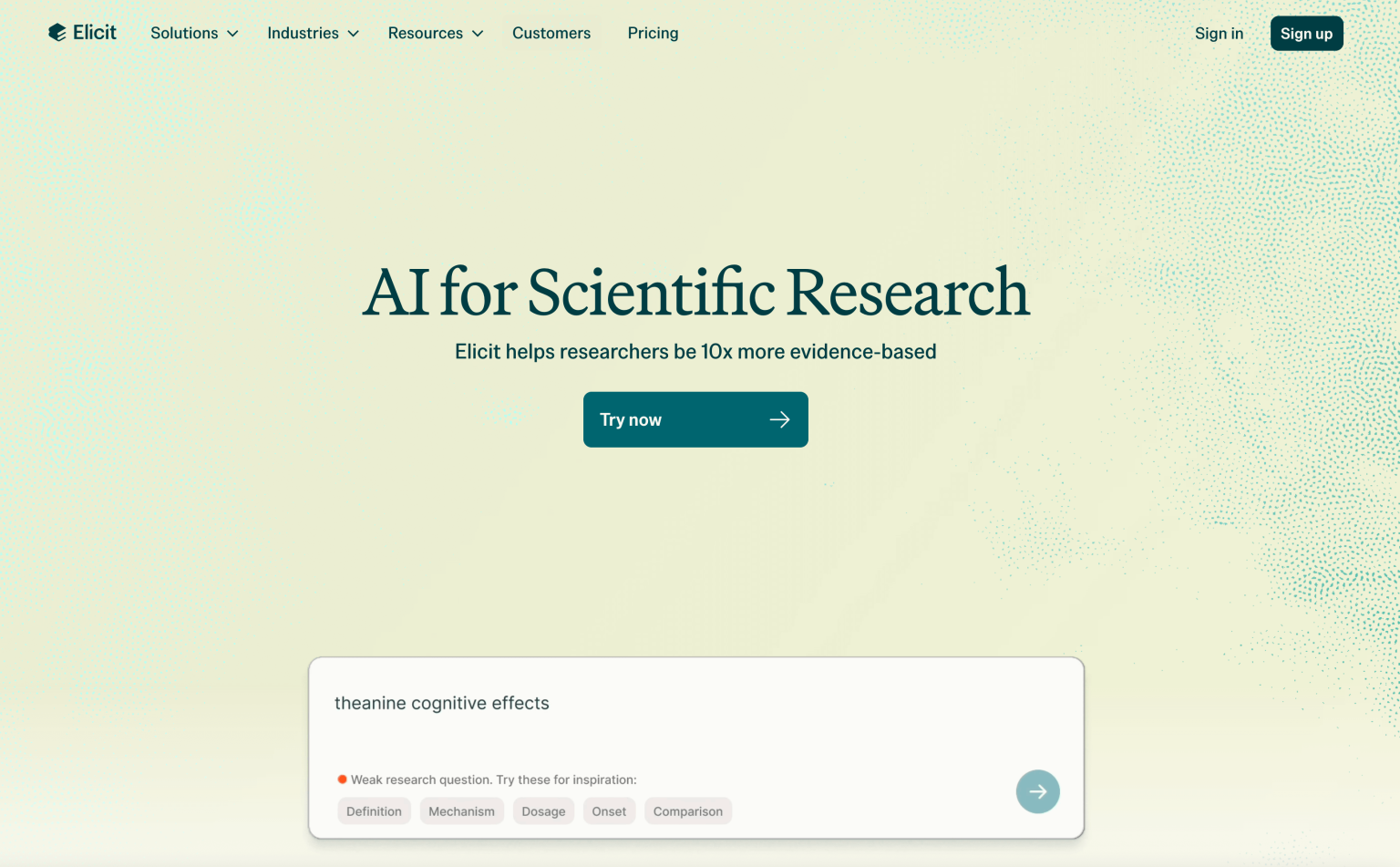
Elicit AI is an AI research assistant that helps users find and analyze academic papers. It uses natural language processing to understand research questions and deliver relevant results. It is widely used to automate literature reviews and improve the efficiency of AI research workflows.
How to Use Elicit AI for AI Research
- Enter your research question
- Review AI-generated paper results
- Analyze summaries and key insights
- Extract data into structured tables
- Refine results using filters
Key Features of Elicit AI
- Access to 125M+ research papers
- AI-powered summarization
- Data extraction and comparison
- Automated literature review
- Semantic search based on meaning
Use Cases of Elicit AI in AI Research
- Literature reviews
- Research paper discovery
- Data extraction from studies
- Identifying research gaps
- Evidence-based analysis
Who Should Use Elicit AI
- Students and researchers
- PhD scholars
- Academics and analysts
- Professionals doing AI research
Pricing
Free plan available; paid plans offer advanced features and higher usage limits.
2) Consensus AI
What Is Consensus AI?
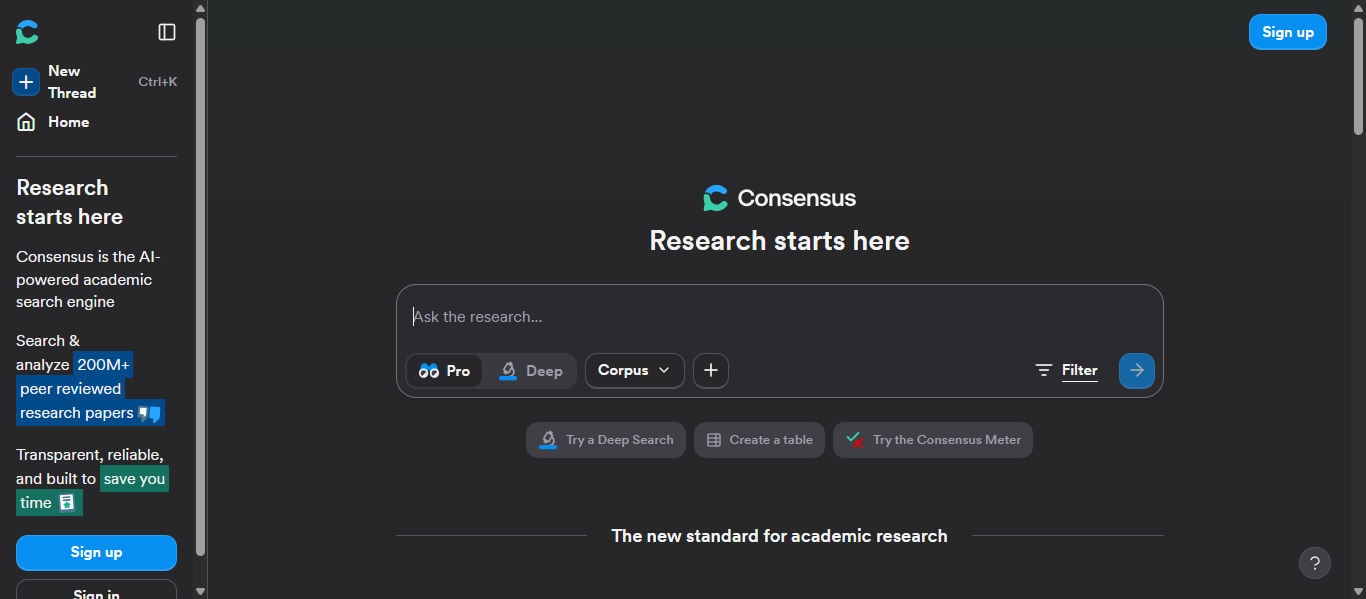
Consensus AI is an AI-powered search engine designed for scientific and academic research. It uses language models to search over 200 million peer-reviewed papers and provide evidence-based answers. It helps users quickly find, understand, and synthesize research with proper citations.
How to Use Consensus AI for AI Research
- Enter a research question in natural language
- Review AI-generated answers with supporting papers
- Explore summarized insights from multiple studies
- Use filters to refine results
- Access cited sources for deeper analysis
Key Features of Consensus AI
- Searches 200M+ peer-reviewed research papers
- Evidence-based answers with citations
- AI-generated summaries of research findings
- Consensus Meter to show agreement across studies
- Advanced filters for precise research
Use Cases of Consensus AI in AI Research
- Literature review and research discovery
- Finding evidence-based answers quickly
- Comparing research findings across studies
- Identifying scientific consensus
- Supporting academic and data-driven research
Who Should Use Consensus AI
- Students and academic researchers
- PhD scholars and scientists
- Analysts and professionals
- Anyone needing evidence-based AI research
Pricing
Free plan available; premium plans offer advanced features and higher usage limits.
3) Semantic Scholar AI
What Is Semantic Scholar AI?
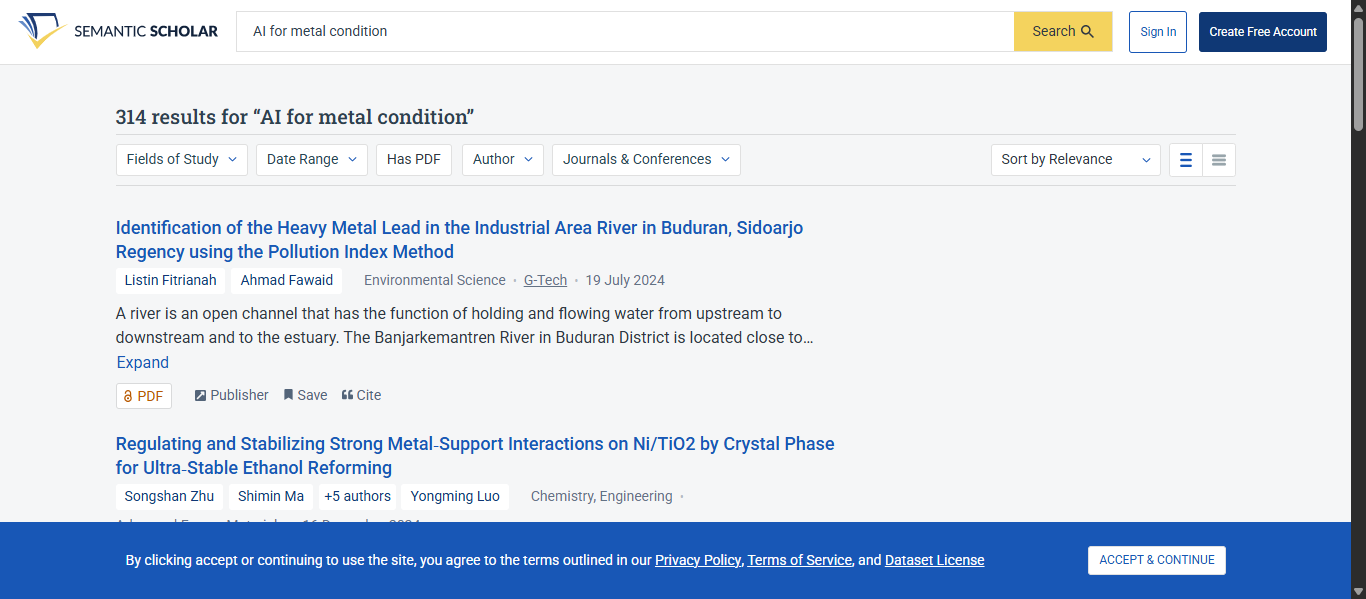
Semantic Scholar AI is an AI-powered academic search engine developed to help users find and understand scientific research papers. It uses machine learning to analyze millions of papers and deliver relevant, high-quality results. It is widely used to explore research topics, track citations, and simplify AI research workflows.
How to Use Semantic Scholar AI for AI Research
- Enter your research topic or question
- Browse relevant papers with AI-ranked results
- Read short summaries (TLDR) of papers
- Use filters like year, field, and author
- Save or cite papers for further research
Key Features of Semantic Scholar AI
- Access to 200M+ research papers
- AI-generated paper summaries (TLDR)
- Citation tracking and reference insights
- Advanced search filters
- Author and topic-based exploration
Use Cases of Semantic Scholar AI in AI Research
- Discovering academic papers
- Quick literature scanning
- Tracking citations and influence
- Exploring new research areas
- Supporting academic research work
Who Should Use Semantic Scholar AI
- Students and researchers
- Academics and scientists
- Data analysts
- Anyone doing AI research
Pricing
Completely free to use with full access to research features.
4) Research Rabbit AI
What Is Research Rabbit AI?
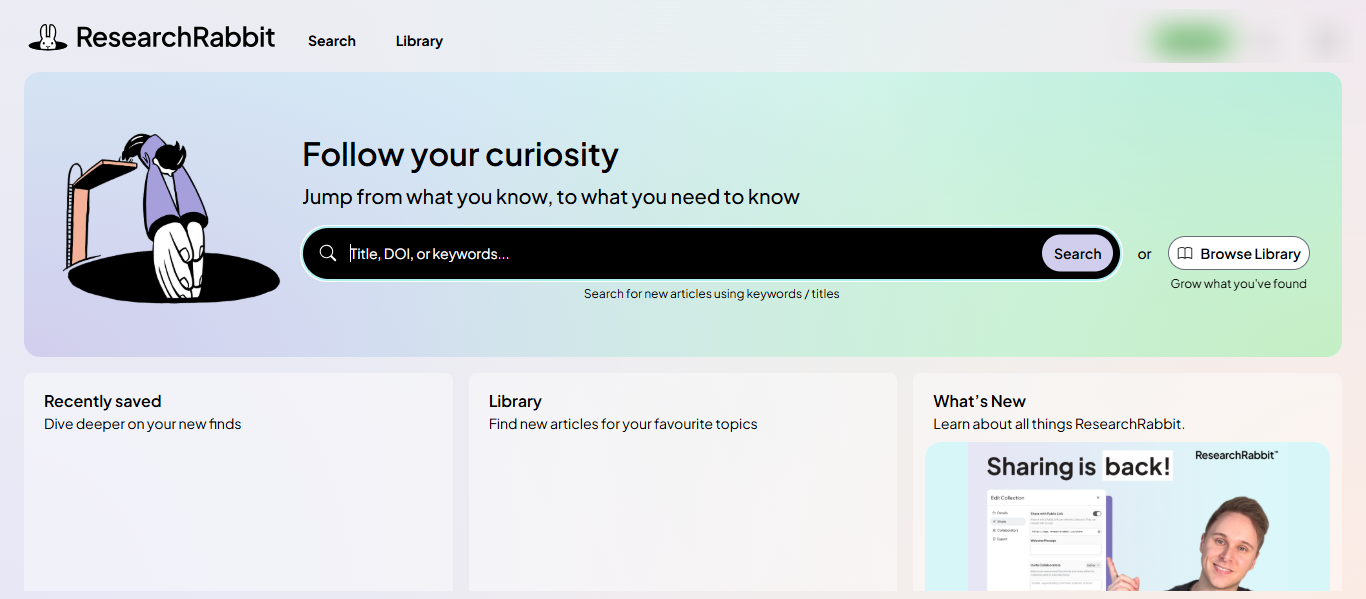
Research Rabbit AI is an AI-powered literature discovery tool that helps users explore and track academic research visually. It builds interactive networks of research papers based on citations and relevance. It is widely used to discover new studies and stay updated with ongoing AI research.
How to Use Research Rabbit AI for AI Research
- Create a free account and start a collection
- Add a few relevant research papers
- Explore AI-generated recommendations
- View visual maps of related papers
- Track new research updates automatically
Key Features of Research Rabbit AI
- Visual research paper mapping
- Personalized paper recommendations
- Citation-based discovery
- Collection and library management
- Alerts for new research papers
Use Cases of Research Rabbit AI in AI Research
- Discovering related research papers
- Exploring research networks
- Tracking latest publications
- Building literature collections
- Identifying research trends
Who Should Use Research Rabbit AI
- Students and academic researchers
- PhD scholars
- Scientists and analysts
- Anyone doing AI research
Pricing
Free to use with all core research features available.
5) Perplexity AI

What Is Perplexity AI?
Perplexity AI is an AI-powered answer engine that provides real-time, accurate answers with cited sources. It combines conversational AI with web search to deliver direct responses instead of a list of links. It is widely used for fast and reliable AI research and information discovery.
How to Use Perplexity AI for AI Research
- Enter your research question in natural language
- Get AI-generated answers with source citations
- Explore linked references for deeper research
- Ask follow-up questions in the same thread
- Save and organize research using collections
Key Features of Perplexity AI
- Real-time web search with AI answers
- Source-backed responses with citations
- Conversational search experience
- Follow-up question support
- Multiple AI model options (Pro feature)
Use Cases of Perplexity AI in AI Research
- Quick research and fact-checking
- Literature discovery and summaries
- Exploring recent information and trends
- Answering complex research questions
- Supporting academic and professional research
Who Should Use Perplexity AI
- Students and researchers
- Academics and analysts
- Content creators and professionals
- Anyone doing AI research
Pricing
Free plan available; Pro plan offers advanced models and additional features.
Citation and Mapping AI Research Tools
6) Litmaps AI
What Is Litmaps AI?
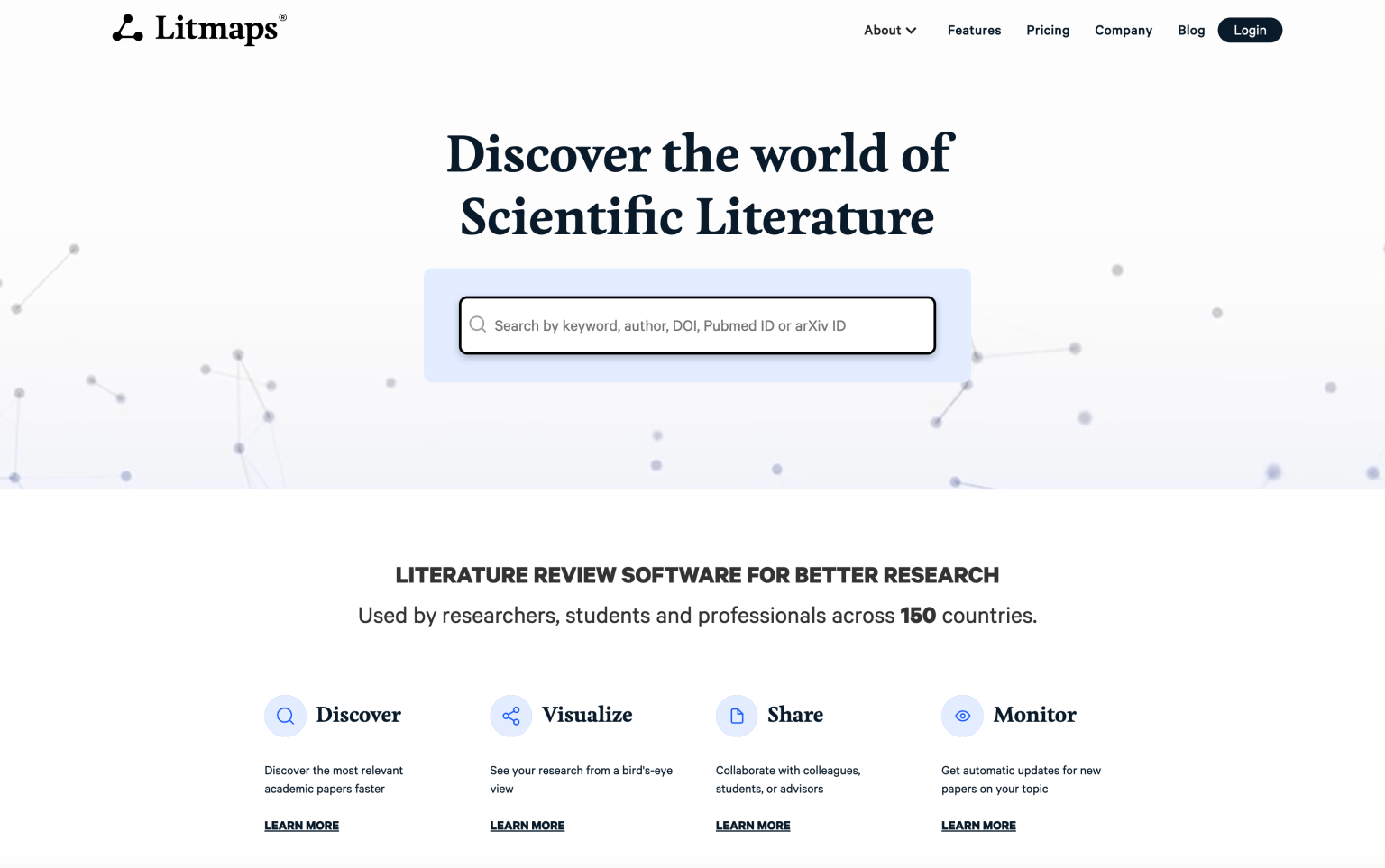
Litmaps AI is an AI research tool that helps users discover and visualize connections between academic papers. It creates interactive citation maps to show how research studies are related. It is widely used to speed up literature reviews and explore research trends in AI research.
How to Use Litmaps AI for AI Research
- Search using keywords, author, or research paper
- Select a few relevant papers as starting points
- Explore AI-generated citation maps
- Analyze connections between related studies
- Track new research updates automatically
Key Features of Litmaps AI
- Visual citation mapping of research papers
- Access to 270M+ academic papers
- AI-based paper discovery using citations
- Automatic alerts for new research
- Integration with tools like Zotero
Use Cases of Litmaps AI in AI Research
- Literature review and paper discovery
- Understanding research relationships
- Identifying key and high-impact papers
- Tracking latest research developments
- Finding research gaps
Who Should Use Litmaps AI
- Students and researchers
- PhD scholars
- Academics and scientists
- Professionals doing AI research
Pricing
Free plan available; paid plans start around $10 per month with advanced features.
7) Connected Papers AI
What Is Connected Papers AI?
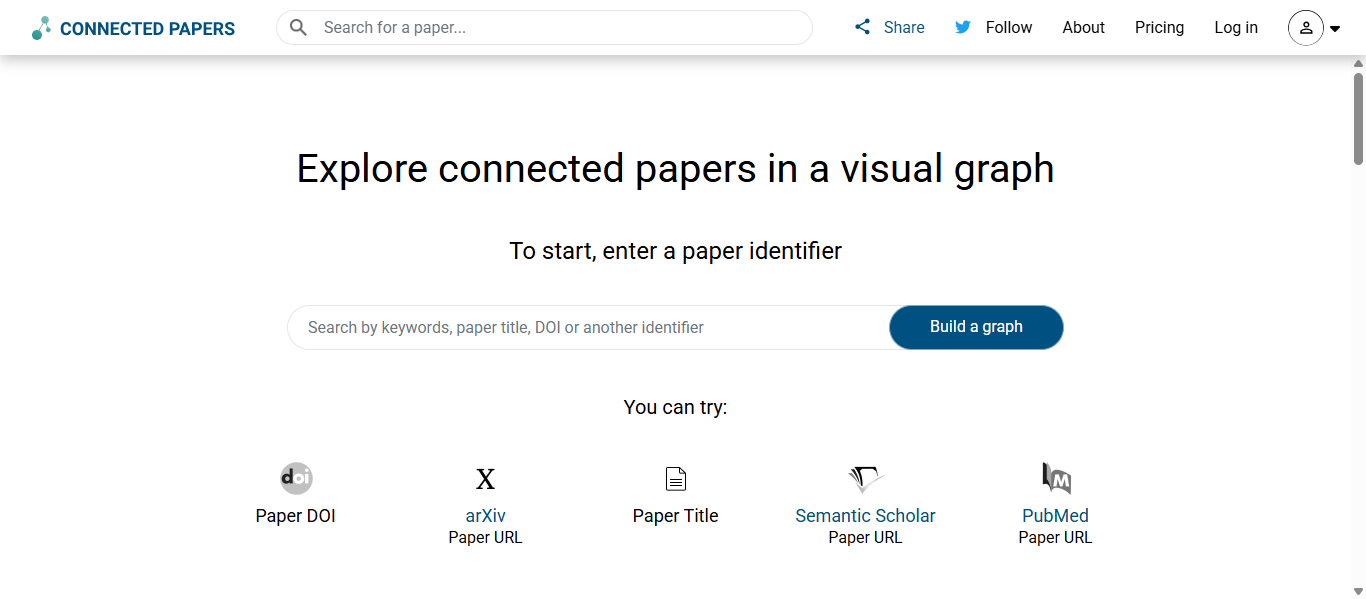
Connected Papers AI is a visual research tool that helps users find and explore academic papers through an interactive graph. It analyzes relationships between papers using similarity, co-citation, and shared references. It is widely used to understand research topics and discover important studies in AI research.
How to Use Connected Papers AI for AI Research
- Enter a research paper title, keyword, or DOI
- Generate a visual graph of related papers
- Explore connections between studies
- Identify important prior and recent works
- Navigate deeper by clicking connected papers
Key Features of Connected Papers AI
- Visual graph of research paper connections
- Similarity-based paper discovery (not just citations)
- Identifies prior and derivative works
- Uses co-citation and bibliographic coupling
- Interactive exploration of research networks
Use Cases of Connected Papers AI in AI Research
- Literature review and paper discovery
- Understanding research relationships
- Finding key and influential studies
- Exploring new research areas
- Building research context quickly
Who Should Use Connected Papers AI
- Students and academic researchers
- PhD scholars
- Scientists and analysts
- Anyone doing AI research
Pricing
Free to use with core features available for research exploration.
8) Scite.ai
What Is Scite.ai?
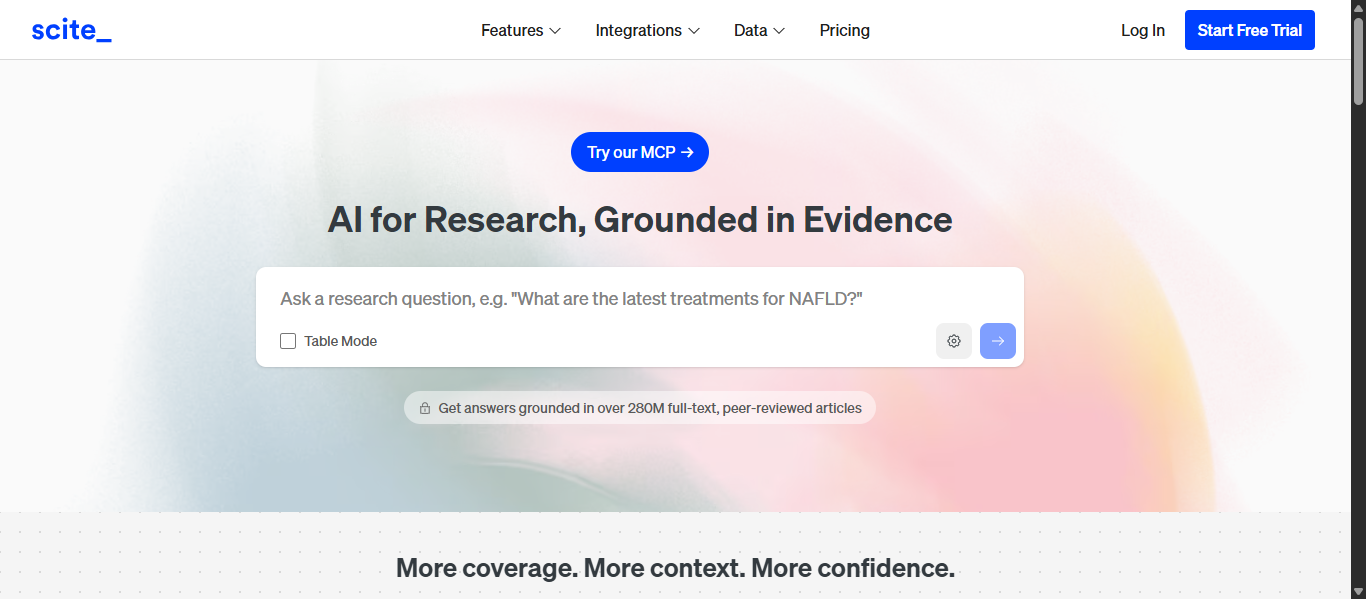
Scite.ai is an AI-powered research platform that helps users discover and evaluate scientific papers using Smart Citations. It analyzes how research papers are cited and shows whether they support, contradict, or mention a claim. It is widely used to improve the quality and reliability of AI research by providing citation context.
How to Use Scite.ai for AI Research
- Enter a research topic or question
- Explore papers with Smart Citation insights
- Check if studies support or contradict findings
- Use AI assistant to generate research summaries
- Analyze citation context for better understanding
Key Features of Scite.ai
- Smart Citations (supporting, contrasting, mentioning)
- AI-powered research assistant
- Citation context analysis
- Access to millions of research papers and citations
- Advanced search and filtering options
Use Cases of Scite.ai in AI Research
- Evaluating research credibility
- Literature review and citation analysis
- Identifying supporting or conflicting studies
- Improving research accuracy
- Evidence-based decision making
Who Should Use Scite.ai
- Students and researchers
- PhD scholars and academics
- Scientists and analysts
- Anyone doing AI research
Pricing
Free trial available; paid plans required for full access and advanced features.
All-in-One AI Research Tools
9) SciSpace AI
What Is SciSpace AI?
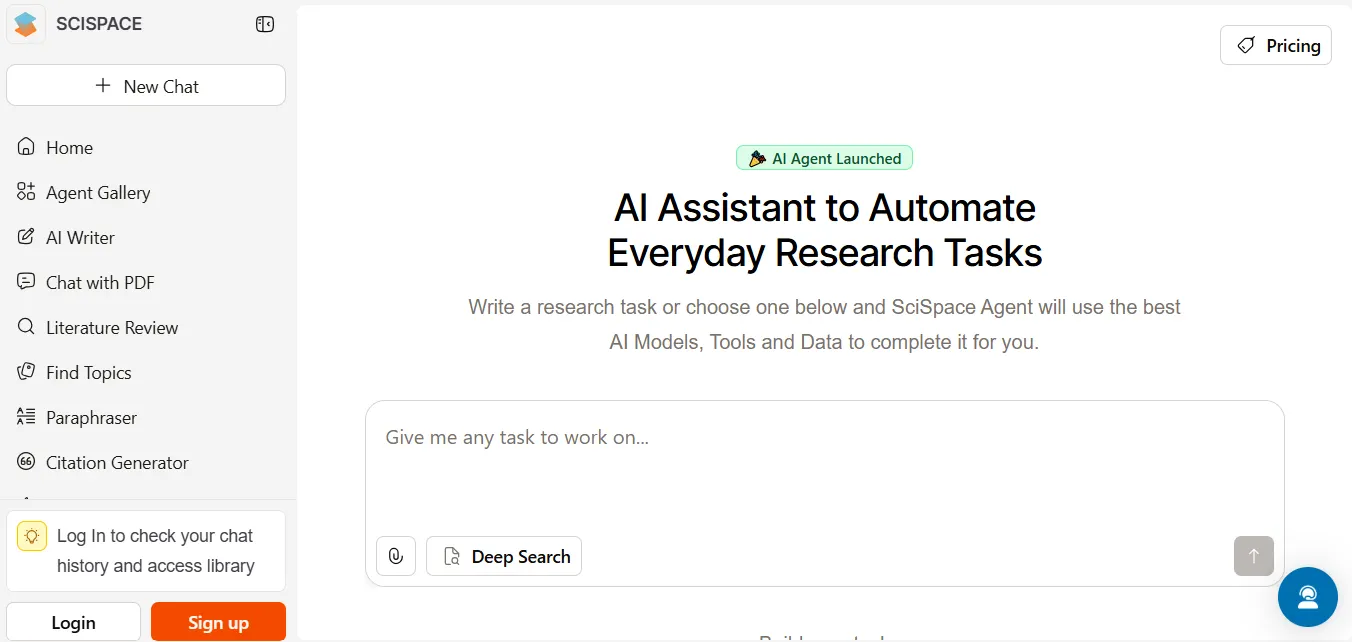
SciSpace AI is an all-in-one AI research platform that helps users search, analyze, and understand scientific papers. It uses artificial intelligence to simplify literature reviews, summarize research, and assist in writing. It is widely used to improve efficiency in AI research workflows.
How to Use SciSpace AI for AI Research
- Enter your research topic or question
- Explore AI-generated research papers
- Use “Chat with PDF” to understand papers
- Review summarized insights and comparisons
- Generate literature reviews and research content
Key Features of SciSpace AI
- Access to 280M+ research papers
- AI-powered literature review (Deep Review)
- Chat with PDF for paper understanding
- AI writing and citation tools
- Multi-tool integration for research workflows
Use Cases of SciSpace AI in AI Research
- Literature review and research discovery
- Understanding complex research papers
- Writing and structuring research content
- Comparing studies and extracting insights
- Managing end-to-end research workflows
Who Should Use SciSpace AI
- Students and academic researchers
- PhD scholars and scientists
- Analysts and professionals
- Anyone doing AI research
Pricing
Free plan available; paid plans start around $8–$20 per month depending on features.
Summarization AI Research Tools
10) ChatPDF AI
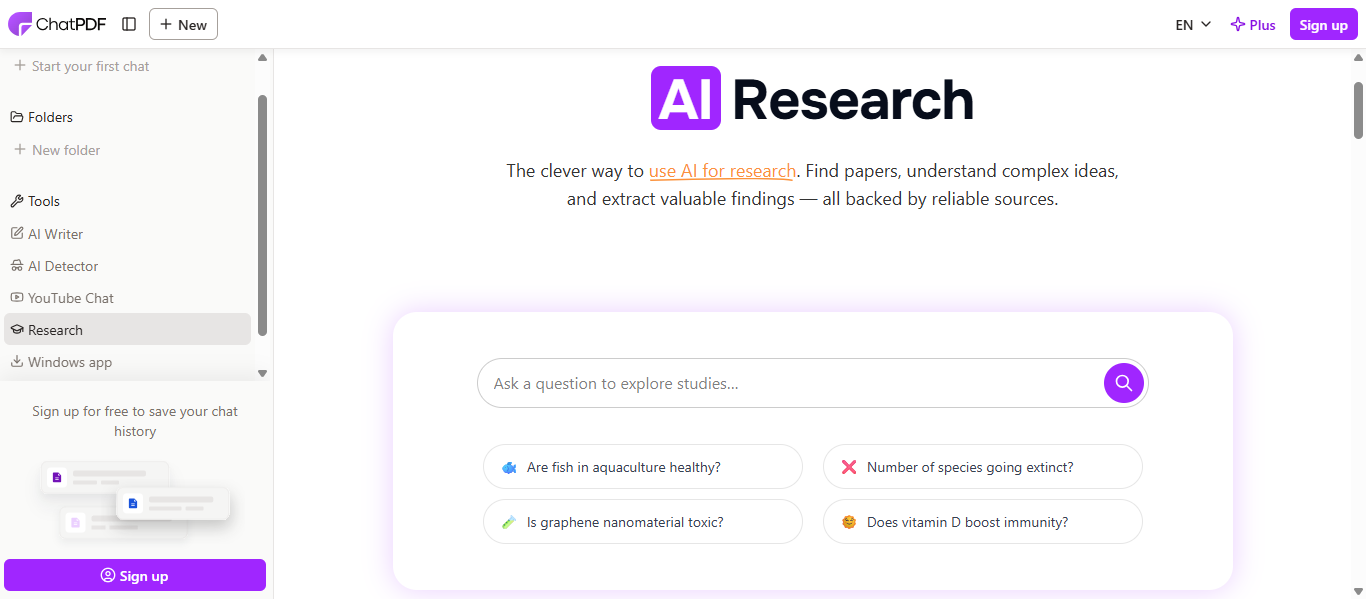
What Is ChatPDF AI?
ChatPDF AI is an AI-powered tool that allows users to interact with PDF documents using a chat-based interface. It uses natural language processing to understand and answer questions directly from the content of uploaded files. It is widely used to summarize, analyze, and extract insights from research papers in AI research.
How to Use ChatPDF AI for AI Research
- Upload a research paper or PDF file
- Ask questions about the document
- Get instant answers based on the content
- Generate summaries and key insights
- Analyze multiple PDFs for deeper research
Key Features of ChatPDF AI
- Chat with PDF documents in real time
- AI-powered summarization of long documents
- Extract specific data and insights quickly
- Multi-document analysis support
- Works with multiple languages
Use Cases of ChatPDF AI in AI Research
- Understanding research papers quickly
- Extracting key insights from PDFs
- Literature review support
- Comparing multiple studies
- Simplifying complex documents
Who Should Use ChatPDF AI
- Students and researchers
- Academics and PhD scholars
- Professionals handling documents
- Anyone doing AI research
Pricing
Free plan available; premium plans offer higher limits and advanced features.
11) Scholarcy AI

What Is Scholarcy AI?
Scholarcy AI is an AI-powered research tool that helps users summarize, analyze, and organize academic papers. It converts complex documents into structured flashcard summaries for quick understanding. It is widely used to simplify reading and improve efficiency in AI research workflows.
How to Use Scholarcy AI for AI Research
- Upload a research paper or document
- Generate AI-powered summary flashcards
- Review key insights and important sections
- Highlight and organize findings
- Export summaries for further use
Key Features of Scholarcy AI
- AI-generated flashcard summaries
- Extracts key insights and references
- Smart highlighting and analysis
- Personal research library
- Export and citation support
Use Cases of Scholarcy AI in AI Research
- Summarizing research papers quickly
- Extracting key findings from studies
- Supporting literature reviews
- Organizing research materials
- Understanding complex academic content
Who Should Use Scholarcy AI
- Students and researchers
- PhD scholars
- Academics and scientists
- Anyone doing AI research
Pricing
Free plan available; paid plans offer advanced features and higher usage limits.
Writing AI Research Tools
12) Paperpal AI
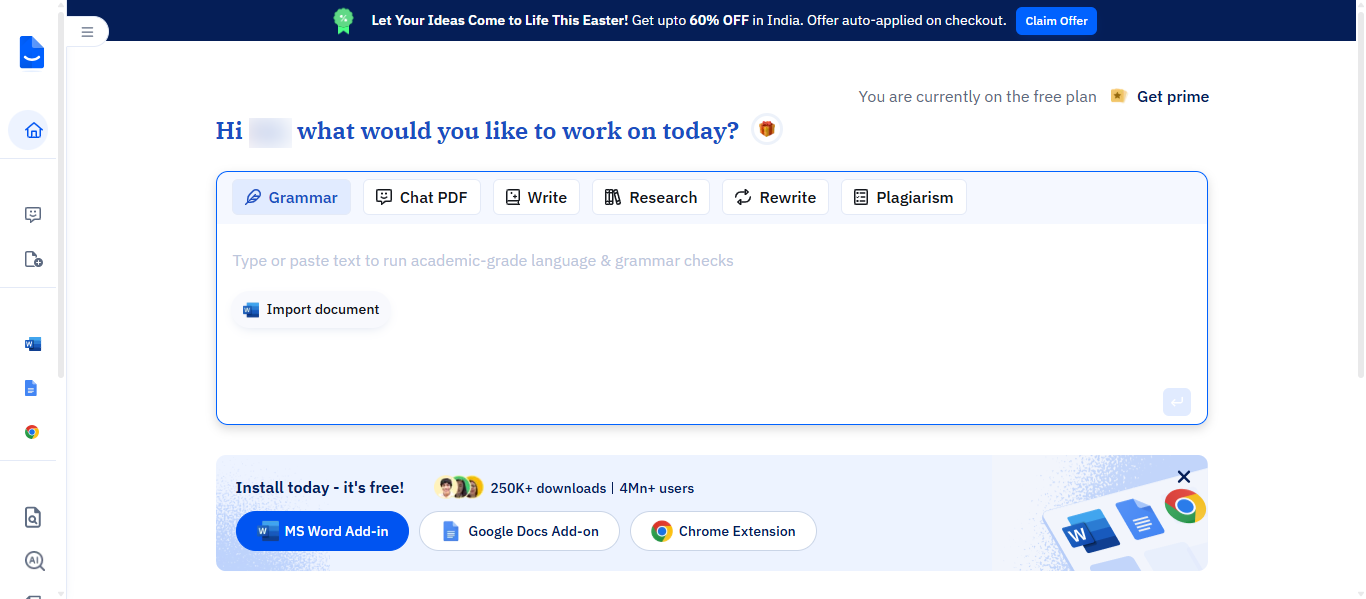
What Is Paperpal AI?
Paperpal AI is an AI-powered academic writing assistant designed to help users improve research writing and language quality. It uses advanced AI to provide grammar correction, paraphrasing, and citation support. It is widely used to enhance clarity, accuracy, and efficiency in AI research writing workflows.
How to Use Paperpal AI for AI Research
- Write or upload your research content
- Get real-time grammar and language suggestions
- Use AI tools for paraphrasing and rewriting
- Generate citations and improve structure
- Review and finalize your research document
Key Features of Paperpal AI
- AI-powered grammar and language correction
- Paraphrasing and rewriting tools
- Citation generation and formatting
- Plagiarism and submission readiness checks
- Research and writing support in one platform
Use Cases of Paperpal AI in AI Research
- Writing and editing research papers
- Improving academic language quality
- Formatting citations and references
- Preparing manuscripts for submission
- Enhancing clarity and readability
Who Should Use Paperpal AI
- Students and researchers
- PhD scholars and academics
- Scientists and professionals
- Anyone doing AI research
Pricing
Free plan available; paid plans provide advanced writing and research features.
13) Paperguide AI
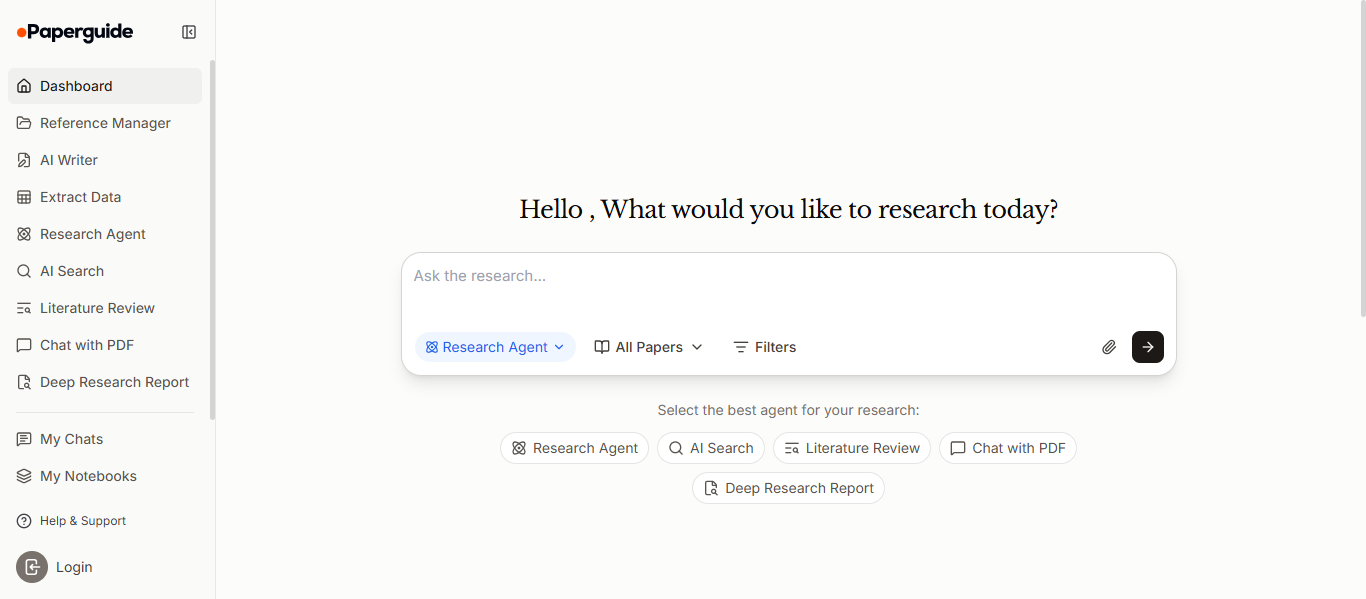
What Is Paperguide AI?
Paperguide AI is an all-in-one AI research assistant that helps users find, analyze, and write research content. It uses artificial intelligence to search academic papers, generate insights, and manage references. It is widely used to streamline the entire AI research workflow from discovery to writing.
How to Use Paperguide AI for AI Research
- Enter your research question or topic
- Explore AI-generated answers with citations
- Analyze research papers and extract key data
- Use AI tools to generate research content
- Organize references and manage documents
Key Features of Paperguide AI
- AI-powered research search across millions of papers
- Literature review and deep research reports
- AI writing and document generation
- Reference management and citation support
- Chat with PDF and data extraction tools
Use Cases of Paperguide AI in AI Research
- Literature review and research discovery
- Generating research papers and reports
- Managing citations and references
- Extracting insights from multiple studies
- End-to-end research workflow management
Who Should Use Paperguide AI
- Students and researchers
- PhD scholars and academics
- Scientists and professionals
Anyone doing AI research
Pricing
Free plan available; paid plans offer advanced features and higher usage limits.
14) Jenni AI
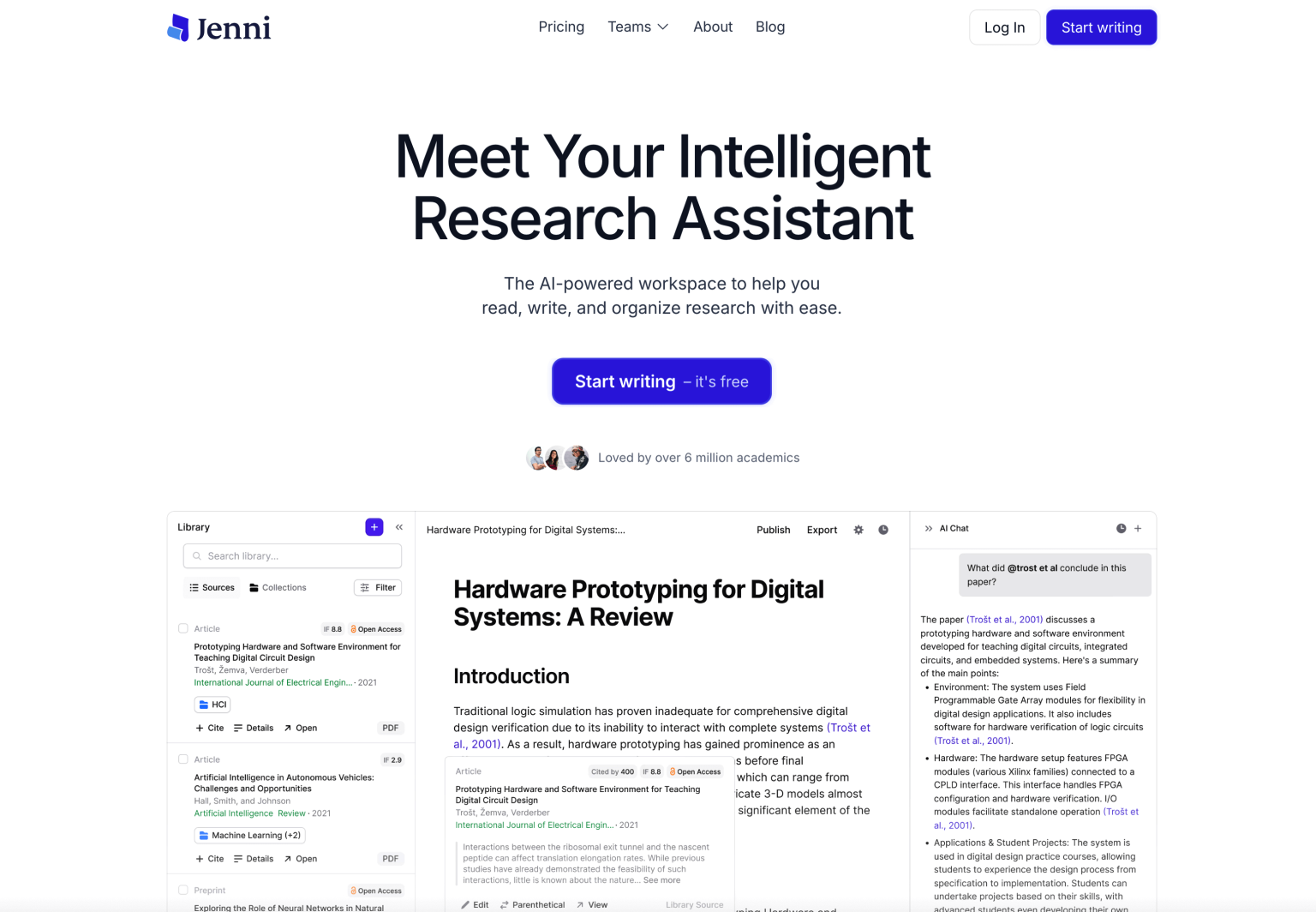
What Is Jenni AI?
Jenni AI is an AI-powered academic writing assistant that helps users create, edit, and cite research content. It uses artificial intelligence to generate text, suggest ideas, and provide in-text citations from research sources. It is widely used to improve writing quality and speed in AI research workflows.
How to Use Jenni AI for AI Research
- Enter your research topic or start writing
- Use AI autocomplete to generate content
- Add in-text citations from research sources
- Upload PDFs to use as reference material
- Edit and refine your research document
Key Features of Jenni AI
AI autocomplete for writing assistance
In-text citations with multiple styles
AI chat for research and summarization
Works with uploaded PDFs and sources
Paraphrasing and rewriting tools
Use Cases of Jenni AI in AI Research
- Writing research papers and essays
- Generating content with citations
- Summarizing research documents
- Improving writing clarity and structure
- Supporting academic writing workflows
Who Should Use Jenni AI
- Students and researchers
- PhD scholars and academics
- Writers and professionals
- Anyone doing AI research
Pricing
Free plan available; paid plans offer advanced writing features and higher usage limits.
Data Analysis AI Research Tools
15) Julius AI
What Is Julius AI?
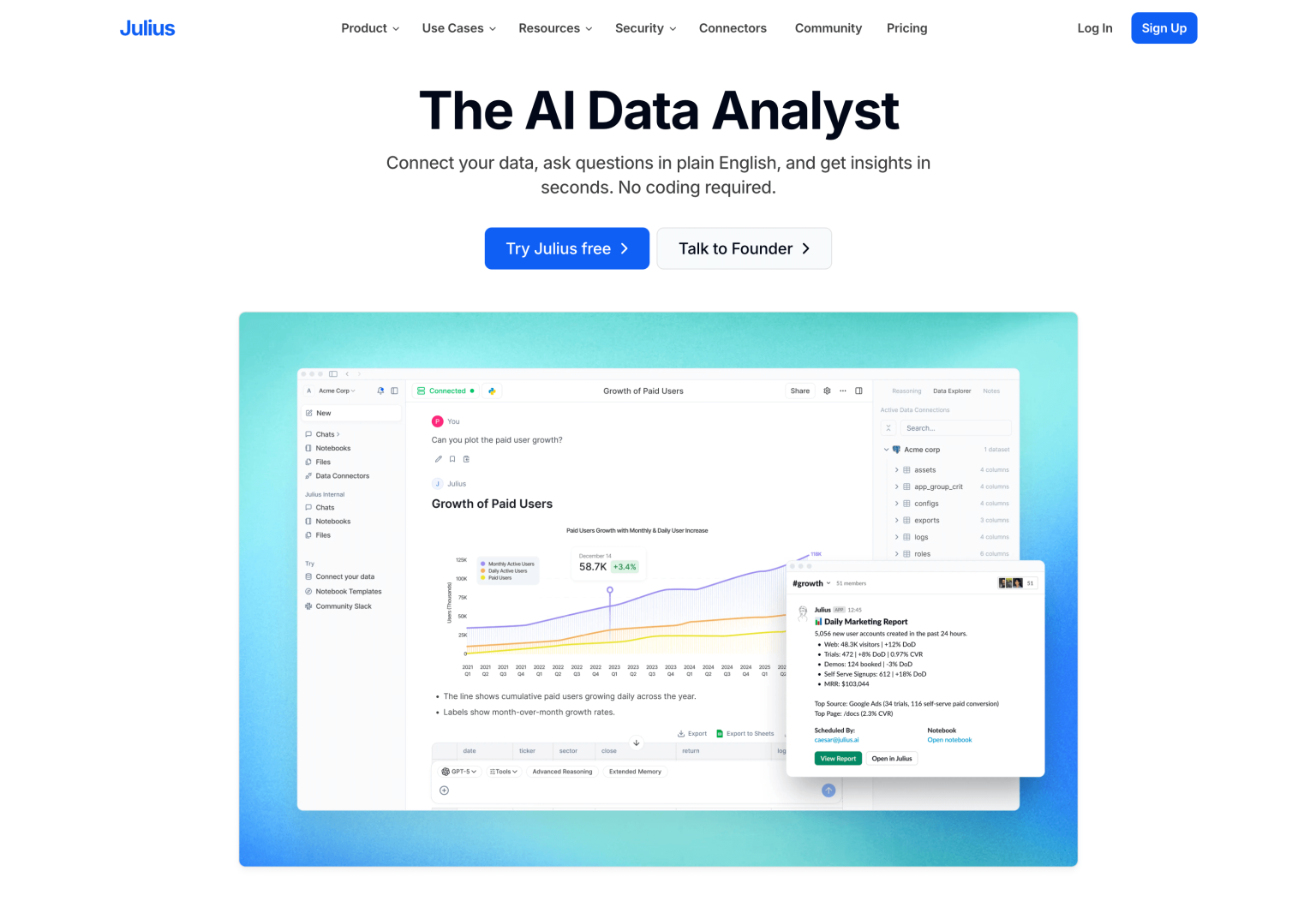
Julius AI is an AI-powered data analysis platform that helps users analyze, visualize, and understand data using natural language. It allows users to upload datasets and get insights without writing code. It is widely used to simplify data-driven AI research and decision-making.
How to Use Julius AI for AI Research
- Upload your dataset (CSV, Excel, or other formats)
- Ask questions in natural language
- Get instant insights, charts, and summaries
- Generate reports and visualizations
- Refine analysis with follow-up queries
Key Features of Julius AI
- Chat with data using natural language
- Automatic data analysis and visualization
- Generates charts, reports, and insights instantly
- Supports multiple data formats and integrations
- No coding required for analysis
Use Cases of Julius AI in AI Research
- Data analysis for research projects
- Visualizing datasets and trends
- Generating research reports
- Exploring patterns and insights
- Supporting data-driven decision making
Who Should Use Julius AI
- Students and researchers
- Data analysts and scientists
- Business professionals
- Anyone working with data in AI research
Pricing
Free plan available; paid plans offer advanced features and higher usage limits.
AI Research Agents
What Are AI Research Agents?
AI research agents are intelligent systems that can perform research tasks automatically with minimal human input. They use artificial intelligence to search, analyze, and summarize information from multiple sources. They are designed to handle complex AI research workflows more efficiently.
How AI Research Agents Are Changing AI Research Workflows
- Automate literature reviews and data collection
- Provide real-time, context-based research insights
- Reduce manual effort in searching and analysis
- Improve speed and accuracy of research tasks
- Enable end-to-end research assistance
Examples of AI Research Agents
- Perplexity AI
- SciSpace AI
- Paperguide AI
- Elicit AI
Tools Offering AI Research Agent Capabilities
- Perplexity AI for real-time answers with sources
- SciSpace AI for literature review and paper analysis
- Paperguide AI for end-to-end research workflows
- Elicit AI for automated research and data extraction
Benefits of AI Research Tools
AI research tools help users complete research tasks faster by automating processes like searching, summarizing, and analyzing information. They improve accuracy, reduce manual effort, and make AI research more efficient and structured.
Key Benefits
Saves Time – Quickly finds and summarizes large volumes of research data
- Improves Accuracy – Uses AI to deliver relevant and context-based results
- Reduces Manual Work – Automates repetitive tasks like reading and note-taking
- Enhances Productivity – Helps focus more on analysis instead of data collection
- Supports Better Decision Making – Provides clear insights from multiple research sources
- Simplifies Complex Information – Converts lengthy research papers into easy-to-understand summaries
Limitations of AI Research Tools
AI research tools improve efficiency but still have limitations in accuracy, context understanding, and reliability. They should be used as support tools, not as complete replacements for human judgment in AI research.
Key Limitations
- Risk of Inaccurate Information – AI may generate incomplete or incorrect insights
- Dependence on Data Sources – Results depend on the quality of available data
- Limited Context Understanding – May not fully interpret complex research topics
- Possible Bias in Results – AI models can reflect bias from training data
- Over-Reliance on Automation – Users may skip critical thinking and verification
- Access Restrictions – Some tools require paid plans for full features
How to Choose the Right AI Research Tool
Choosing the right AI research tool depends on your research goal, workflow, and the type of tasks you want to perform. The best tool is not the one with the most features, but the one that fits your AI research needs effectively.
Identify Your Research Goal
- Start by understanding what you need the tool for.
- Use tools like Elicit AI or Semantic Scholar AI for literature discovery and finding research papers.
- Choose tools like ChatPDF AI or Scholarcy AI for summarizing and understanding research content.
- Use tools like Paperpal AI or Jenni AI for writing and improving research documents.
Check Data Quality and Sources
- The quality of research depends on the sources used.
- Choose tools that rely on academic databases and peer-reviewed papers.
- Tools like Consensus AI and Scite.ai provide evidence-based insights with proper citations.
Evaluate Features and Workflow
- Different tools support different research workflows.
- Some tools focus on discovery, while others support writing, analysis, or full research workflows.
- Choose a tool that matches how you work, whether it is searching, summarizing, or writing.
Consider Accuracy and Citations
- Accuracy is critical in AI research.
- Prefer tools that provide source-backed answers and citation support.
- This helps in verifying information and avoiding incorrect insights.
Look for Ease of Use
- Simple tools are better for faster research.
- Tools like Perplexity AI and ChatPDF AI offer easy interfaces and quick results.
- Advanced tools may provide more features but can take time to learn.
Check Scalability and Performance
- For large research projects, scalability matters.
- Tools like SciSpace AI and Paperguide AI support handling multiple papers and complex workflows.
- Choose tools that can manage your research efficiently as it grows.
Review Pricing and Value
- Compare tools based on your usage and requirements.
- Free tools are useful for basic research tasks and testing.
- Paid tools offer advanced features, better accuracy, and higher usage limits.
Future of AI Research
The future of AI research is moving toward faster, smarter, and more automated workflows. AI tools are evolving beyond assistance and are becoming active contributors in research processes. This transformation will make AI research more efficient, scalable, and accessible.
Automation of Research Workflows – AI will automate multiple stages of the research process, including literature review, data analysis, and report generation. This reduces manual effort and allows researchers to focus more on critical thinking and innovation.
Improved Accuracy and Understanding – AI tools will become better at understanding context and complex topics. This will lead to more accurate results, fewer errors, and improved reliability in AI research outputs.
Growth of AI Research Agents – AI research agents will handle complete workflows such as searching, analyzing, and summarizing information. This will simplify complex research tasks and improve overall efficiency.
Real-Time Research Capabilities – AI tools will provide real-time updates and insights from new research. This helps users stay updated without spending time on manual searches.
Expansion Across Industries – AI research will expand beyond academia into industries like healthcare, finance, and technology. This will increase its role in decision-making and innovation.
Better Collaboration and Productivity – AI research tools will enable better collaboration by allowing teams to work on shared platforms and access the same data. This improves coordination, reduces duplication of work, and increases overall productivity.
Conclusion
AI research tools have transformed how users discover, analyze, and create research by making the process faster and more efficient. From literature discovery to writing and data analysis, these tools support every stage of AI research. Choosing the right tool based on your needs can improve accuracy, save time, and enhance overall research quality.
FAQs
What are the best AI research tools?
The best AI research tools include Elicit AI, Consensus AI, Semantic Scholar AI, and SciSpace AI, which help with literature discovery, summarization, citation analysis, and research writing.
How do AI research tools work?
AI research tools use machine learning and natural language processing to analyze queries, search academic databases, and provide summarized, relevant, and citation-backed research insights quickly.
Are AI research tools accurate?
AI research tools can be accurate when they use reliable data sources and citations, but users should always verify information to avoid errors or incomplete research insights.
Can AI research tools replace manual research?
AI research tools cannot fully replace manual research, but they significantly reduce effort by automating tasks like searching, summarizing, and organizing research data.
Which AI tool is best for literature review?
Elicit AI and SciSpace AI are among the best tools for literature reviews, as they help find relevant papers, summarize content, and organize research efficiently.