
![Square Root from 1 to 50 – Value of Square Root from 1 to 100 [PDF]](https://images.examples.com/wp-content/uploads/2024/05/Square-Root-1-to-50-.png)
Square roots are numbers that produce a given value when multiplied by themselves. The square roots from 1 to 50 help students understand number patterns and calculations. Learning square roots strengthens arithmetic, algebra, and mathematical reasoning.
Download Square Root 1 to 50 in PDF
Square roots of numbers from 1 to 50 include both rational (perfect squares) and irrational values. In algebra, they relate to solving quadratic equations, and in statistics, they play a role in the least squares method. Understanding square roots is essential for grasping relationships between numbers in various mathematical contexts.
Square Roots 1 to 50
In exponential form: (x)¹/²
Where x is any number between 1 to 50.
Square Root from 1 to 50 Chart
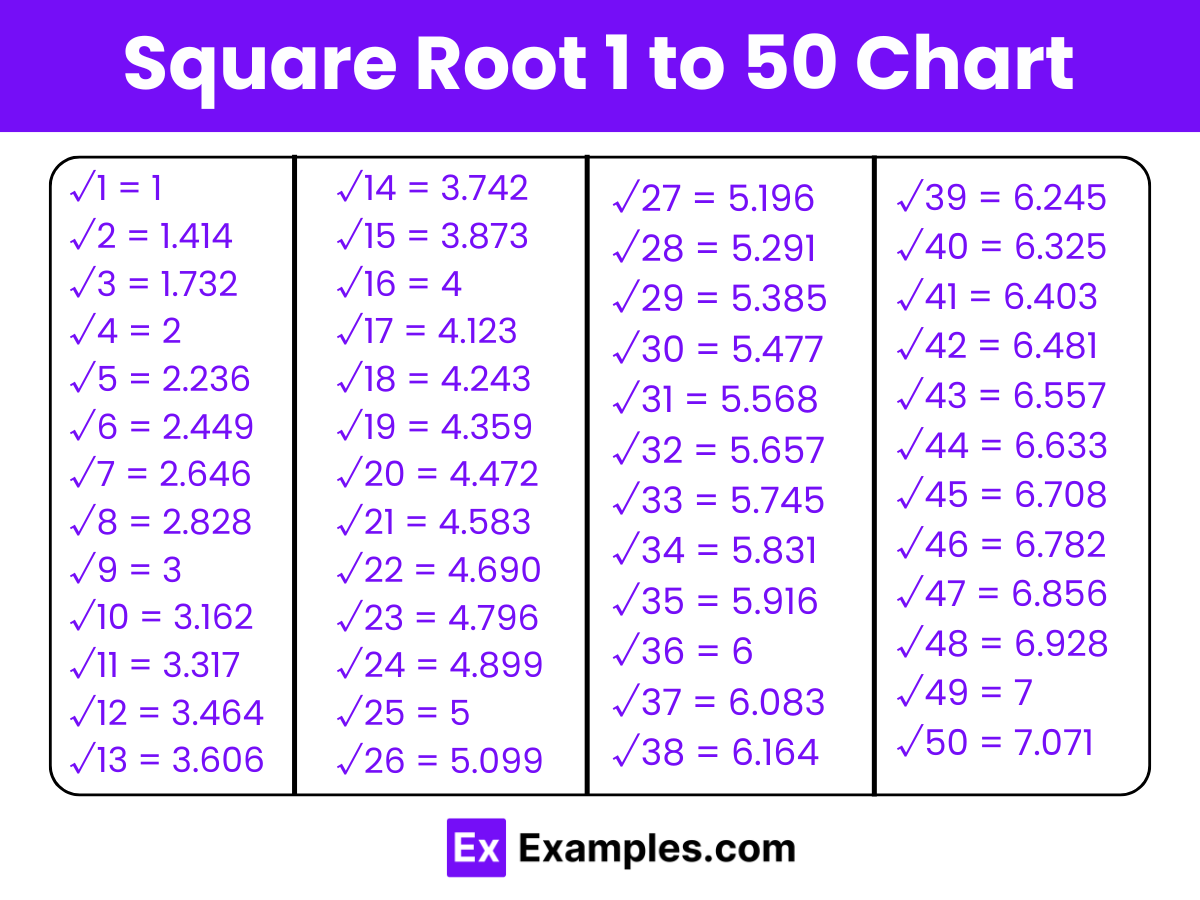
Download Square Root 1 to 50 in PDF
| Square Root | Value |
|---|---|
| √1 | 1 |
| √2 | 1.414 |
| √3 | 1.732 |
| √4 | 2 |
| √5 | 2.236 |
| √6 | 2.449 |
| √7 | 2.646 |
| √8 | 2.828 |
| √9 | 3 |
| √10 | 3.162 |
| √11 | 3.317 |
| √12 | 3.464 |
| √13 | 3.606 |
| √14 | 3.742 |
| √15 | 3.873 |
| √16 | 4 |
| √17 | 4.123 |
| √18 | 4.243 |
| √19 | 4.359 |
| √20 | 4.472 |
| √21 | 4.583 |
| √22 | 4.69 |
| √23 | 4.796 |
| √24 | 4.899 |
| √25 | 5 |
| √26 | 5.099 |
| √27 | 5.196 |
| √28 | 5.292 |
| √29 | 5.385 |
| √30 | 5.477 |
| √31 | 5.568 |
| √32 | 5.657 |
| √33 | 5.745 |
| √34 | 5.831 |
| √35 | 5.916 |
| √36 | 6 |
| √37 | 6.083 |
| √38 | 6.164 |
| √39 | 6.245 |
| √40 | 6.325 |
| √41 | 6.403 |
| √42 | 6.481 |
| √43 | 6.557 |
| √44 | 6.633 |
| √45 | 6.708 |
| √46 | 6.782 |
| √47 | 6.855 |
| √48 | 6.928 |
| √49 | 7 |
| √50 | 7.071 |
This list shows approximate square root values from √1 to √50, identifying both rational and irrational numbers. Perfect squares have whole number square roots, while others provide approximate decimal values that help in practical calculations and understanding the magnitude of these numbers.
More About Square Root 1 to 50
| Square Root of 1 | Square Root of 2 | Square Root of 3 | Square Rootof 4 | Square Root of 5 |
| Square Root of 6 | Square Root of 7 | Square Root of 8 | Square Root of 9 | Square Root of 10 |
| Square Root of 11 | Square Root of 12 | Square Root of 13 | Square Root of 14 | Square Root of 15 |
| Square Root of 16 | Square Root of 17 | Square Root of 18 | Square Root of 19 | Square Root of 20 |
| Square Root of 21 | Square Root of 22 | Square Root of 23 | Square Root of 24 | Square Root of 25 |
| Square Root of 26 | Square Root of 27 | Square Root of 28 | Square Root of 29 | Square Root of 30 |
| Square Root of 31 | Square Root of 32 | Square Root of 33 | Square Root of 34 | Square Root of 35 |
| Square Root of 36 | Square Root of 37 | Square Root of 38 | Square Root of 39 | Square Root of 40 |
| Square Root of 41 | Square Root of 42 | Square Root of 43 | Square Root of 44 | Square Root of 45 |
| Square Root of 46 | Square Root of 47 | Square Root of 48 | Square Root of 49 | Square Root of 50 |
Square Root 1 to 50 for Perfect Squares
| Number | Square Root |
|---|---|
| √1 | 1 |
| √4 | 2 |
| √9 | 3 |
| √16 | 4 |
| √25 | 5 |
| √36 | 6 |
| √49 | 7 |
This table lists the perfect square numbers from 1 to 50 alongside their respective square roots. Perfect squares are numbers that result from multiplying an integer by itself, thus their square roots are integers.
Square Root 1 to 50 for Non-Perfect Squares
| Number | Square Root |
|---|---|
| √2 | 1.414 |
| √3 | 1.732 |
| √5 | 2.236 |
| √6 | 2.449 |
| √7 | 2.646 |
| √8 | 2.828 |
| √10 | 3.162 |
| √11 | 3.317 |
| √12 | 3.464 |
| √13 | 3.606 |
| √14 | 3.742 |
| √15 | 3.873 |
| √17 | 4.123 |
| √18 | 4.243 |
| √19 | 4.359 |
| √20 | 4.472 |
| √21 | 4.583 |
| √22 | 4.69 |
| √23 | 4.796 |
| √24 | 4.899 |
| √26 | 5.099 |
| √27 | 5.196 |
| √28 | 5.292 |
| √29 | 5.385 |
| √30 | 5.477 |
| √31 | 5.568 |
| √32 | 5.657 |
| √33 | 5.745 |
| √34 | 5.831 |
| √35 | 5.916 |
| √37 | 6.083 |
| √38 | 6.164 |
| √39 | 6.245 |
| √40 | 6.325 |
| √41 | 6.403 |
| √42 | 6.481 |
| √43 | 6.557 |
| √44 | 6.633 |
| √45 | 6.708 |
| √46 | 6.782 |
| √47 | 6.855 |
| √48 | 6.928 |
| √50 | 7.071 |
This table provides the square roots of non-perfect squares from 1 to 25. Each entry shows a number and its corresponding square root value.
How to Calculate Square Root from 1 to 50?
To calculate the square roots from 1 to 50, you can use these methods:
- Using a Calculator: The simplest way to get the square root of any number is to use a scientific calculator or a calculator app on a computer or smartphone.
- Using the Long Division Method: This manual method is accurate and works well for larger numbers. It involves dividing the number into pairs of digits starting from the decimal point and then finding the largest digit that, when squared, does not exceed the pair.
- Using Approximation: For numbers that aren’t perfect squares, estimate the square root using interpolation between known perfect squares. For example, to estimate √17, it’s between √16 (4) and √25 (5), so its value is a little above 4.
- Using Algorithms: There are algorithms like the Babylonian method or Newton’s method that iteratively approximate the square root of a number.
- Tables and Memorization: For quick references, memorizing square roots of common numbers (e.g., 1 to 25) or using pre-calculated tables helps save time.
FAQs
What is the simplest way to calculate square roots for numbers between 1 and 50?
The simplest way to calculate square roots is by using a scientific calculator or a calculator app, which provides immediate and accurate results.
How does the Long Division method work for calculating square roots?
The Long Division method involves dividing the number into pairs of digits from the decimal point and iteratively finding digits that, when squared, don’t exceed the pair, which approximates the square root.
What are some good ways to approximate square roots of numbers that aren’t perfect squares?
For approximations, you can interpolate between known perfect squares or use numerical algorithms like the Babylonian method to iteratively refine the estimate.
How do you identify if a number has a rational or irrational square root?
A number has a rational square root if it is a perfect square (e.g., 1, 4, 9), otherwise, it has an irrational square root.
What is the significance of square roots in statistics and regression analysis?
In statistics, square roots are used in the least squares method to minimize the sum of squared deviations, aiding in linear regression and measuring data spread (standard deviation).