APM Integrated Project Management Plan Action Plan
1
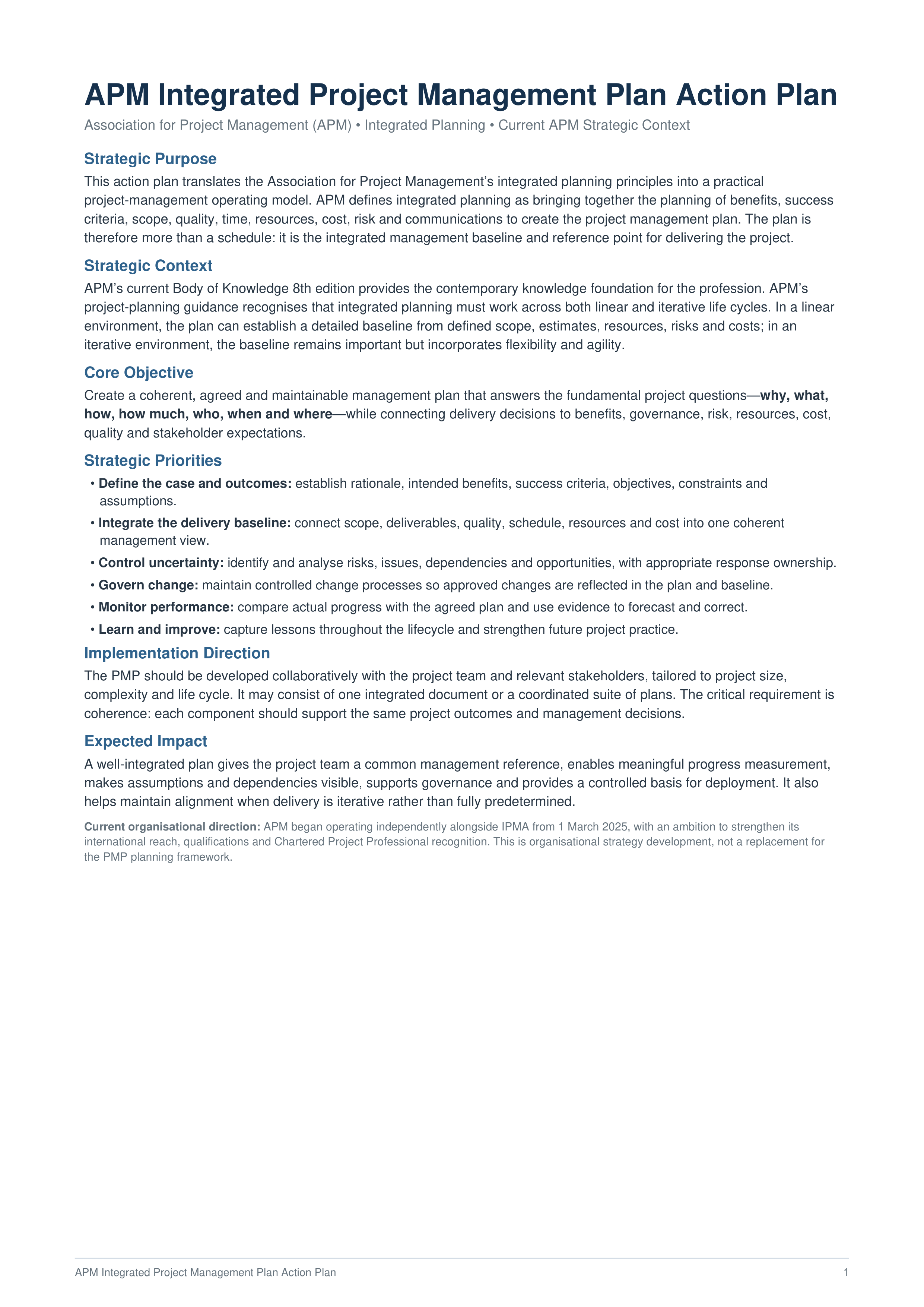
APM Integrated Project Management Plan Action Plan
Association for Project Management (APM) • Integrated Planning • Current APM Strategic Context
Strategic Purpose
This action plan translates the Association for Project Management’s integrated planning principles into a practical
project-management operating model. APM defines integrated planning as bringing together the planning of benefits, success
criteria, scope, quality, time, resources, cost, risk and communications to create the project management plan. The plan is
therefore more than a schedule: it is the integrated management baseline and reference point for delivering the project.
Strategic Context
APM’s current Body of Knowledge 8th edition provides the contemporary knowledge foundation for the profession. APM’s
project-planning guidance recognises that integrated planning must work across both linear and iterative life cycles. In a linear
environment, the plan can establish a detailed baseline from defined scope, estimates, resources, risks and costs; in an
iterative environment, the baseline remains important but incorporates flexibility and agility.
Core Objective
Create a coherent, agreed and maintainable management plan that answers the fundamental project questions—
why, what,
how, how much, who, when and where
—while connecting delivery decisions to benefits, governance, risk, resources, cost,
quality and stakeholder expectations.
Strategic Priorities
•
Define the case and outcomes:
establish rationale, intended benefits, success criteria, objectives, constraints and
assumptions.
•
Integrate the delivery baseline:
connect scope, deliverables, quality, schedule, resources and cost into one coherent
management view.
•
Control uncertainty:
identify and analyse risks, issues, dependencies and opportunities, with appropriate response ownership.
•
Govern change:
maintain controlled change processes so approved changes are reflected in the plan and baseline.
•
Monitor performance:
compare actual progress with the agreed plan and use evidence to forecast and correct.
•
Learn and improve:
capture lessons throughout the lifecycle and strengthen future project practice.
Implementation Direction
The PMP should be developed collaboratively with the project team and relevant stakeholders, tailored to project size,
complexity and life cycle. It may consist of one integrated document or a coordinated suite of plans. The critical requirement is
coherence: each component should support the same project outcomes and management decisions.
Expected Impact
A well-integrated plan gives the project team a common management reference, enables meaningful progress measurement,
makes assumptions and dependencies visible, supports governance and provides a controlled basis for deployment. It also
helps maintain alignment when delivery is iterative rather than fully predetermined.
Current organisational direction:
APM began operating independently alongside IPMA from 1 March 2025, with an ambition to strengthen its
international reach, qualifications and Chartered Project Professional recognition. This is organisational strategy development, not a replacement for
the PMP planning framework.
APM Integrated Project Management Plan Action Plan
2
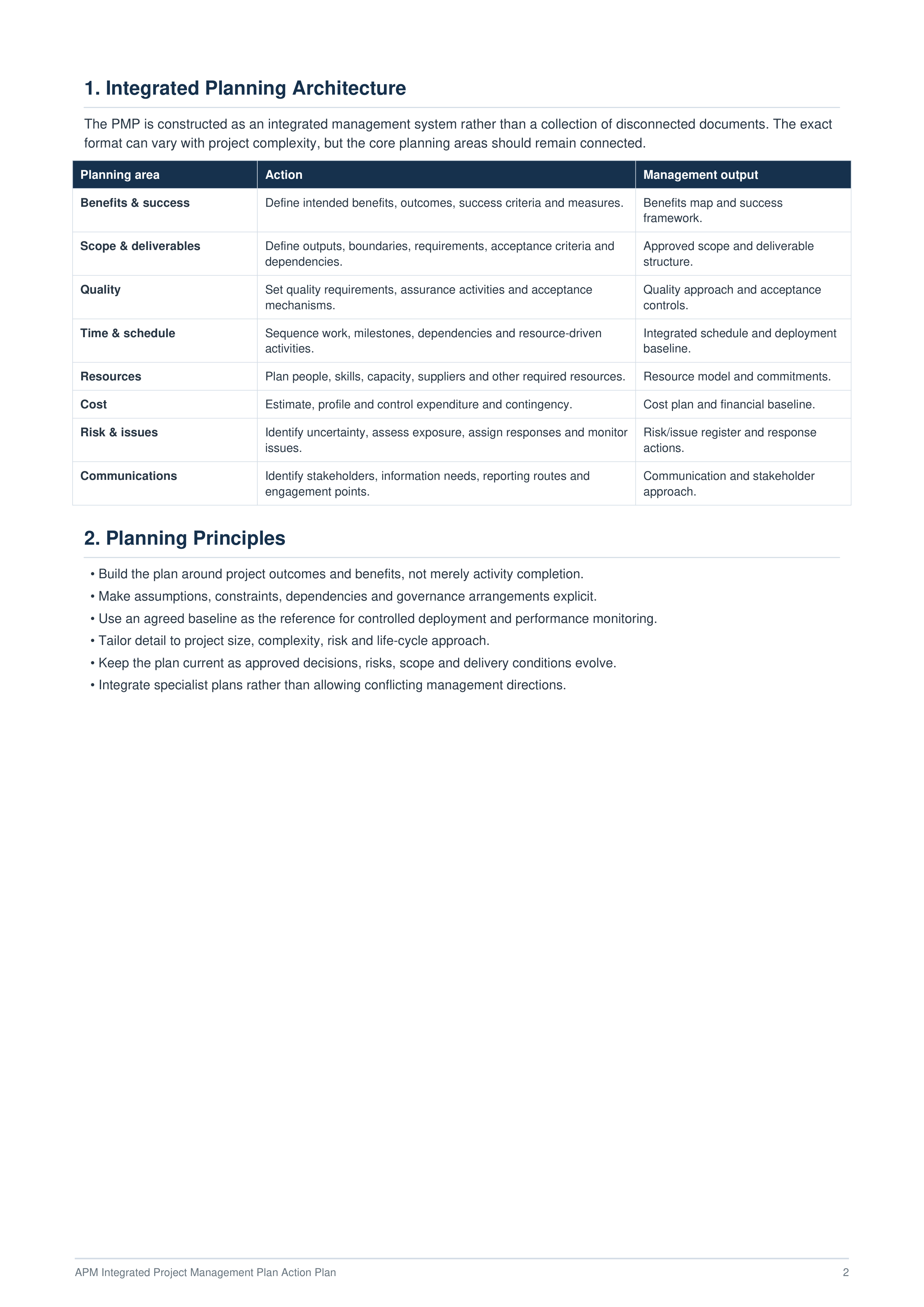
1. Integrated Planning Architecture
The PMP is constructed as an integrated management system rather than a collection of disconnected documents. The exact
format can vary with project complexity, but the core planning areas should remain connected.
Planning area
Action
Management output
Benefits & success
Define intended benefits, outcomes, success criteria and measures.
Benefits map and success
framework.
Scope & deliverables
Define outputs, boundaries, requirements, acceptance criteria and
dependencies.
Approved scope and deliverable
structure.
Quality
Set quality requirements, assurance activities and acceptance
mechanisms.
Quality approach and acceptance
controls.
Time & schedule
Sequence work, milestones, dependencies and resource-driven
activities.
Integrated schedule and deployment
baseline.
Resources
Plan people, skills, capacity, suppliers and other required resources.
Resource model and commitments.
Cost
Estimate, profile and control expenditure and contingency.
Cost plan and financial baseline.
Risk & issues
Identify uncertainty, assess exposure, assign responses and monitor
issues.
Risk/issue register and response
actions.
Communications
Identify stakeholders, information needs, reporting routes and
engagement points.
Communication and stakeholder
approach.
2. Planning Principles
• Build the plan around project outcomes and benefits, not merely activity completion.
• Make assumptions, constraints, dependencies and governance arrangements explicit.
• Use an agreed baseline as the reference for controlled deployment and performance monitoring.
• Tailor detail to project size, complexity, risk and life-cycle approach.
• Keep the plan current as approved decisions, risks, scope and delivery conditions evolve.
• Integrate specialist plans rather than allowing conflicting management directions.
APM Integrated Project Management Plan Action Plan
3
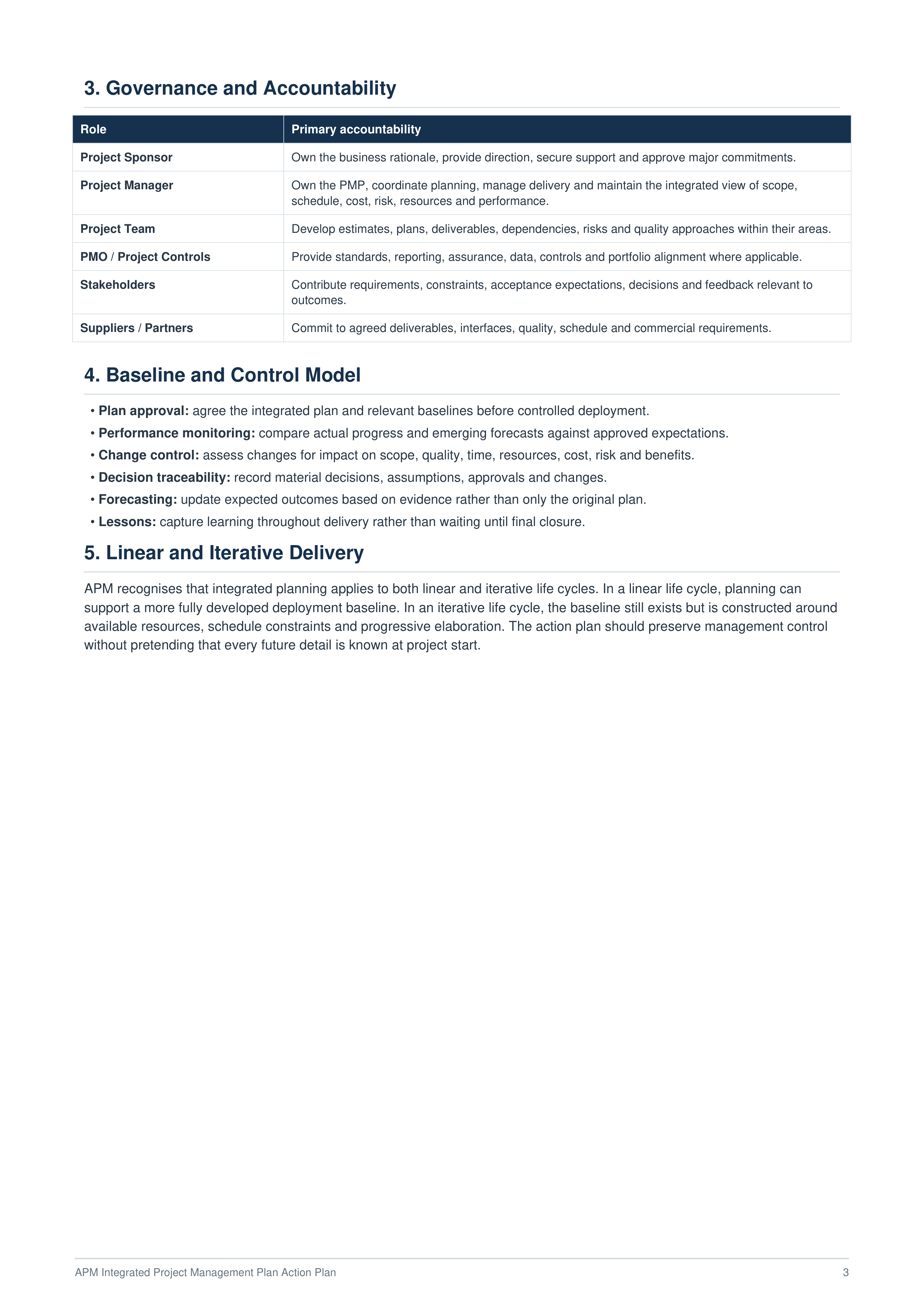
3. Governance and Accountability
Role
Primary accountability
Project Sponsor
Own the business rationale, provide direction, secure support and approve major commitments.
Project Manager
Own the PMP, coordinate planning, manage delivery and maintain the integrated view of scope,
schedule, cost, risk, resources and performance.
Project Team
Develop estimates, plans, deliverables, dependencies, risks and quality approaches within their areas.
PMO / Project Controls
Provide standards, reporting, assurance, data, controls and portfolio alignment where applicable.
Stakeholders
Contribute requirements, constraints, acceptance expectations, decisions and feedback relevant to
outcomes.
Suppliers / Partners
Commit to agreed deliverables, interfaces, quality, schedule and commercial requirements.
4. Baseline and Control Model
•
Plan approval:
agree the integrated plan and relevant baselines before controlled deployment.
•
Performance monitoring:
compare actual progress and emerging forecasts against approved expectations.
•
Change control:
assess changes for impact on scope, quality, time, resources, cost, risk and benefits.
•
Decision traceability:
record material decisions, assumptions, approvals and changes.
•
Forecasting:
update expected outcomes based on evidence rather than only the original plan.
•
Lessons:
capture learning throughout delivery rather than waiting until final closure.
5. Linear and Iterative Delivery
APM recognises that integrated planning applies to both linear and iterative life cycles. In a linear life cycle, planning can
support a more fully developed deployment baseline. In an iterative life cycle, the baseline still exists but is constructed around
available resources, schedule constraints and progressive elaboration. The action plan should preserve management control
without pretending that every future detail is known at project start.
APM Integrated Project Management Plan Action Plan
4
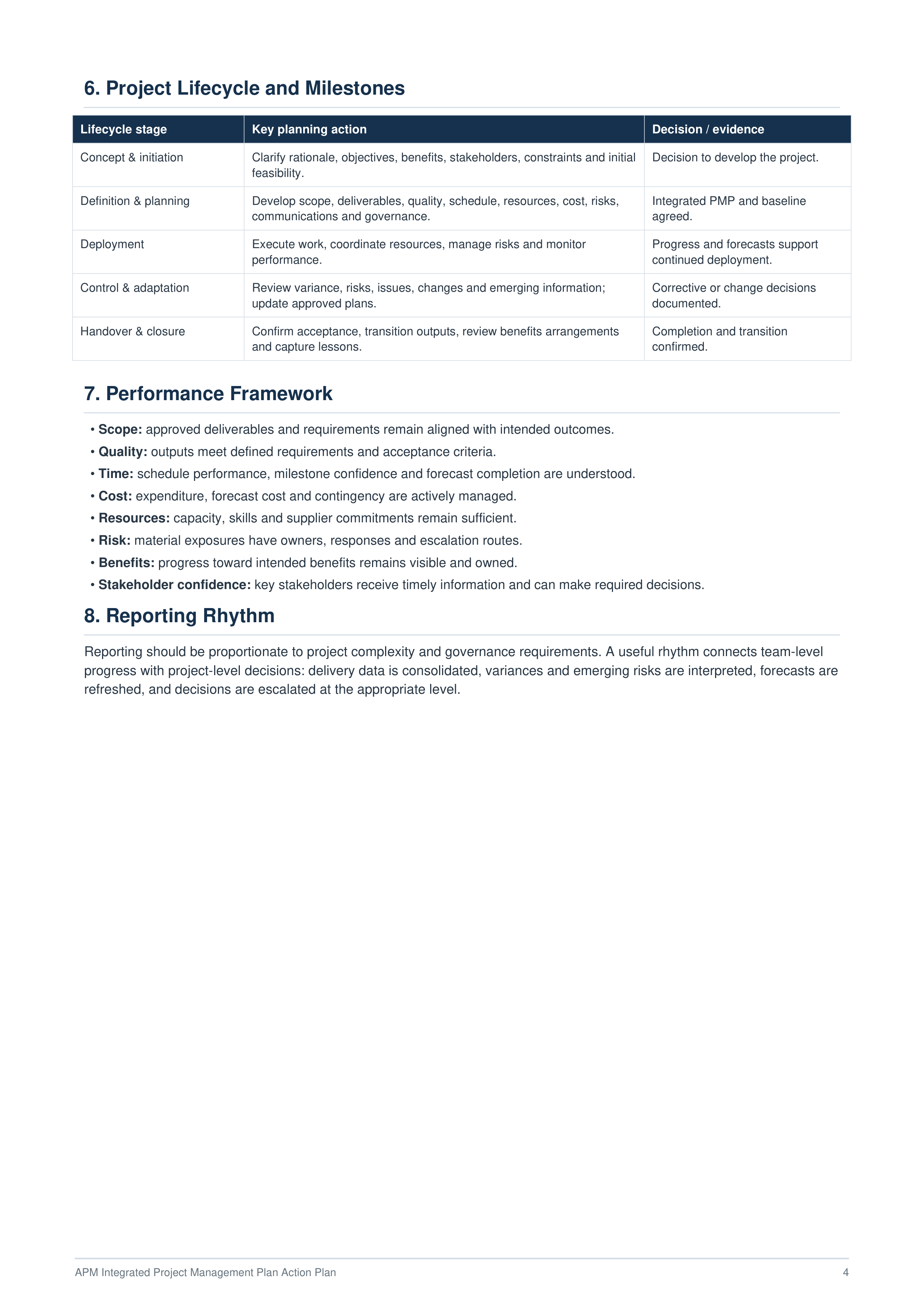
6. Project Lifecycle and Milestones
Lifecycle stage
Key planning action
Decision / evidence
Concept & initiation
Clarify rationale, objectives, benefits, stakeholders, constraints and initial
feasibility.
Decision to develop the project.
Definition & planning
Develop scope, deliverables, quality, schedule, resources, cost, risks,
communications and governance.
Integrated PMP and baseline
agreed.
Deployment
Execute work, coordinate resources, manage risks and monitor
performance.
Progress and forecasts support
continued deployment.
Control & adaptation
Review variance, risks, issues, changes and emerging information;
update approved plans.
Corrective or change decisions
documented.
Handover & closure
Confirm acceptance, transition outputs, review benefits arrangements
and capture lessons.
Completion and transition
confirmed.
7. Performance Framework
•
Scope:
approved deliverables and requirements remain aligned with intended outcomes.
•
Quality:
outputs meet defined requirements and acceptance criteria.
•
Time:
schedule performance, milestone confidence and forecast completion are understood.
•
Cost:
expenditure, forecast cost and contingency are actively managed.
•
Resources:
capacity, skills and supplier commitments remain sufficient.
•
Risk:
material exposures have owners, responses and escalation routes.
•
Benefits:
progress toward intended benefits remains visible and owned.
•
Stakeholder confidence:
key stakeholders receive timely information and can make required decisions.
8. Reporting Rhythm
Reporting should be proportionate to project complexity and governance requirements. A useful rhythm connects team-level
progress with project-level decisions: delivery data is consolidated, variances and emerging risks are interpreted, forecasts are
refreshed, and decisions are escalated at the appropriate level.
APM Integrated Project Management Plan Action Plan
5
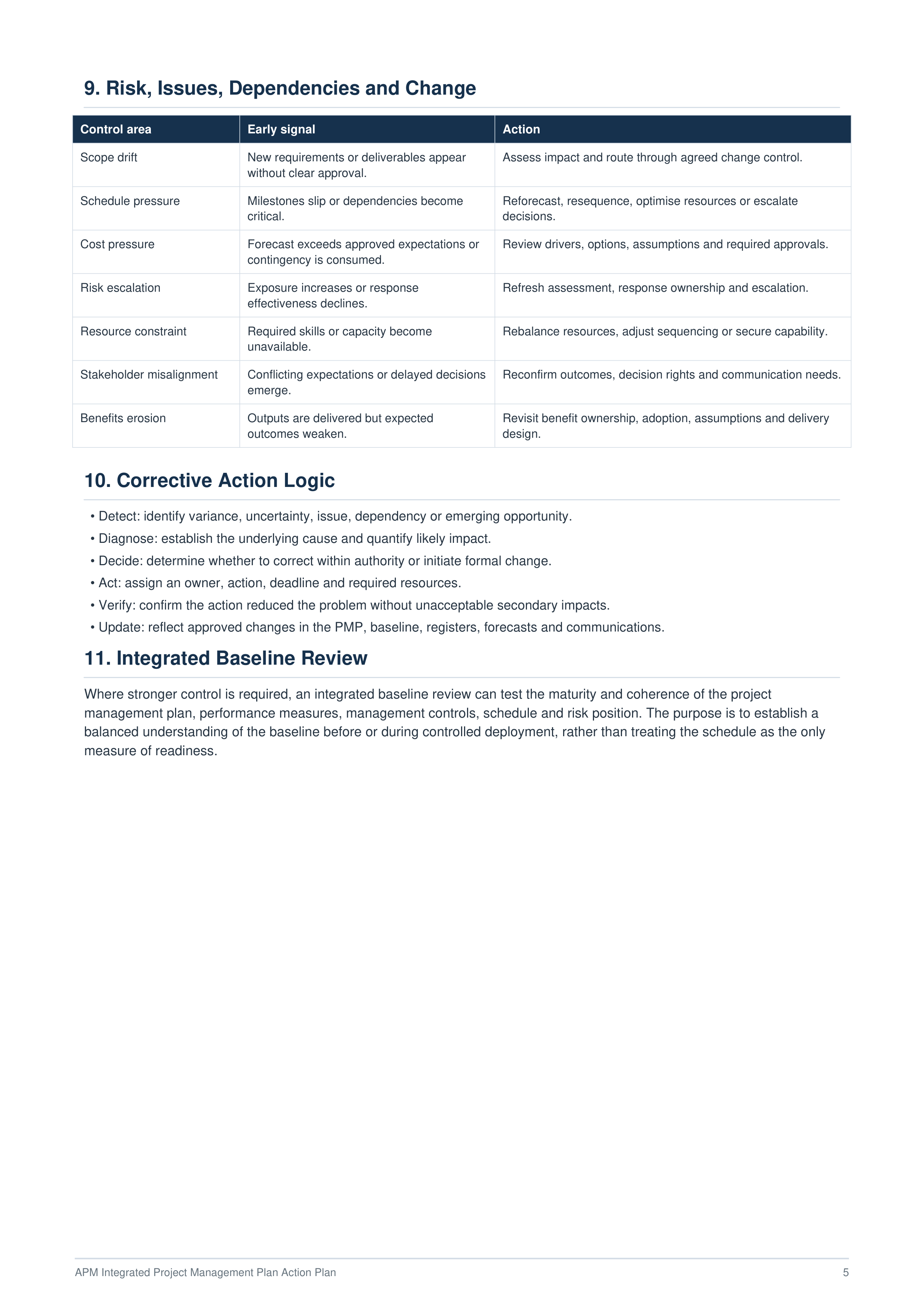
9. Risk, Issues, Dependencies and Change
Control area
Early signal
Action
Scope drift
New requirements or deliverables appear
without clear approval.
Assess impact and route through agreed change control.
Schedule pressure
Milestones slip or dependencies become
critical.
Reforecast, resequence, optimise resources or escalate
decisions.
Cost pressure
Forecast exceeds approved expectations or
contingency is consumed.
Review drivers, options, assumptions and required approvals.
Risk escalation
Exposure increases or response
effectiveness declines.
Refresh assessment, response ownership and escalation.
Resource constraint
Required skills or capacity become
unavailable.
Rebalance resources, adjust sequencing or secure capability.
Stakeholder misalignment
Conflicting expectations or delayed decisions
emerge.
Reconfirm outcomes, decision rights and communication needs.
Benefits erosion
Outputs are delivered but expected
outcomes weaken.
Revisit benefit ownership, adoption, assumptions and delivery
design.
10. Corrective Action Logic
• Detect: identify variance, uncertainty, issue, dependency or emerging opportunity.
• Diagnose: establish the underlying cause and quantify likely impact.
• Decide: determine whether to correct within authority or initiate formal change.
• Act: assign an owner, action, deadline and required resources.
• Verify: confirm the action reduced the problem without unacceptable secondary impacts.
• Update: reflect approved changes in the PMP, baseline, registers, forecasts and communications.
11. Integrated Baseline Review
Where stronger control is required, an integrated baseline review can test the maturity and coherence of the project
management plan, performance measures, management controls, schedule and risk position. The purpose is to establish a
balanced understanding of the baseline before or during controlled deployment, rather than treating the schedule as the only
measure of readiness.
APM Integrated Project Management Plan Action Plan
6
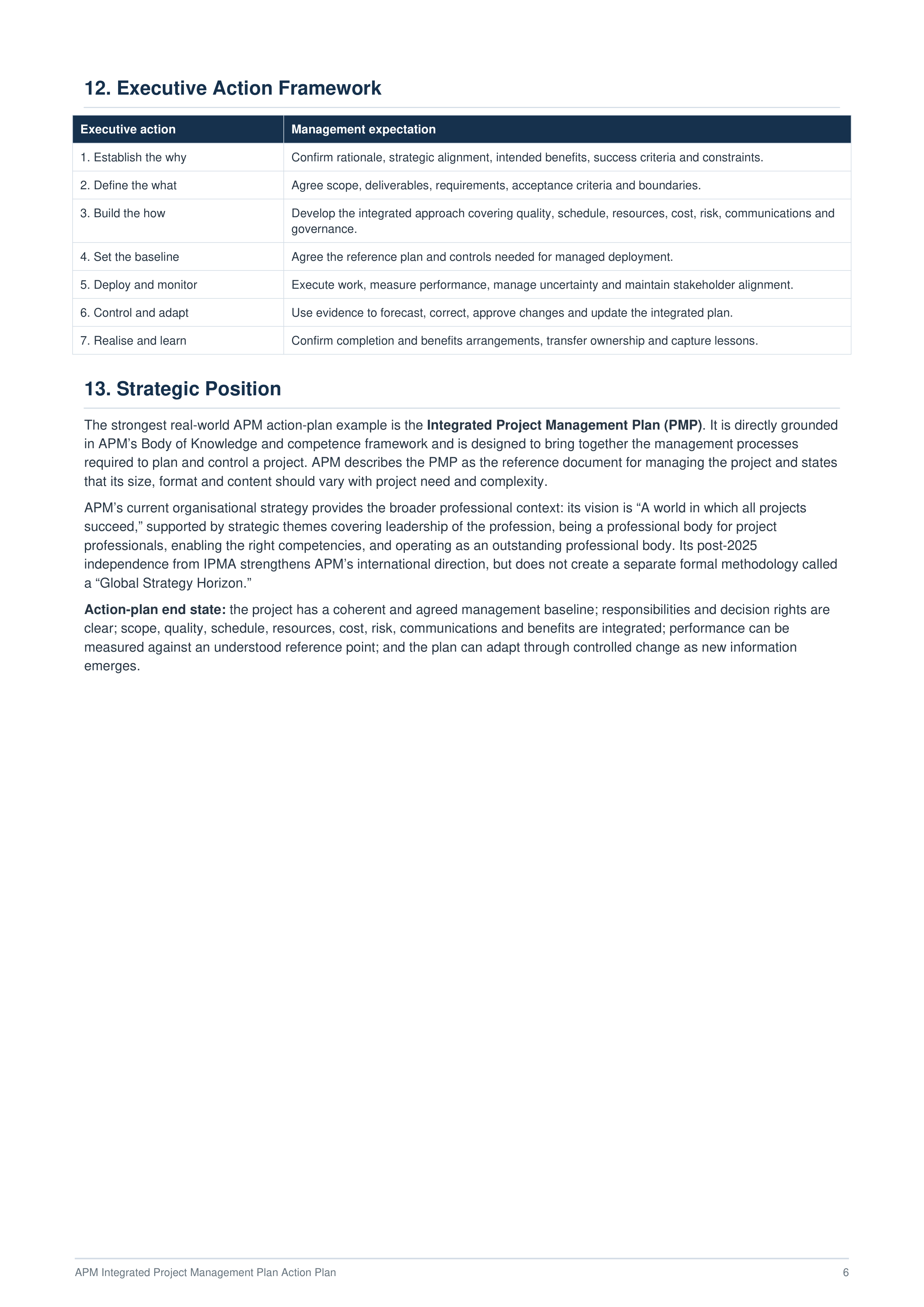
12. Executive Action Framework
Executive action
Management expectation
1. Establish the why
Confirm rationale, strategic alignment, intended benefits, success criteria and constraints.
2. Define the what
Agree scope, deliverables, requirements, acceptance criteria and boundaries.
3. Build the how
Develop the integrated approach covering quality, schedule, resources, cost, risk, communications and
governance.
4. Set the baseline
Agree the reference plan and controls needed for managed deployment.
5. Deploy and monitor
Execute work, measure performance, manage uncertainty and maintain stakeholder alignment.
6. Control and adapt
Use evidence to forecast, correct, approve changes and update the integrated plan.
7. Realise and learn
Confirm completion and benefits arrangements, transfer ownership and capture lessons.
13. Strategic Position
The strongest real-world APM action-plan example is the
Integrated Project Management Plan (PMP)
. It is directly grounded
in APM’s Body of Knowledge and competence framework and is designed to bring together the management processes
required to plan and control a project. APM describes the PMP as the reference document for managing the project and states
that its size, format and content should vary with project need and complexity.
APM’s current organisational strategy provides the broader professional context: its vision is “A world in which all projects
succeed,” supported by strategic themes covering leadership of the profession, being a professional body for project
professionals, enabling the right competencies, and operating as an outstanding professional body. Its post-2025
independence from IPMA strengthens APM’s international direction, but does not create a separate formal methodology called
a “Global Strategy Horizon.”
Action-plan end state:
the project has a coherent and agreed management baseline; responsibilities and decision rights are
clear; scope, quality, schedule, resources, cost, risk, communications and benefits are integrated; performance can be
measured against an understood reference point; and the plan can adapt through controlled change as new information
emerges.