TOYOTA | 7TH ENVIRONMENTAL ACTION PLAN
Environmental Action Plan • Five-year 2025 Target / FY2022–FY2026 implementation horizon
Page 1
TOYOTA MOTOR CORPORATION
Toyota 7th Environmental Action Plan
2025 Target • Five-Year Environmental Roadmap Supporting Toyota Environmental Challenge 2050
Strategic Foundation
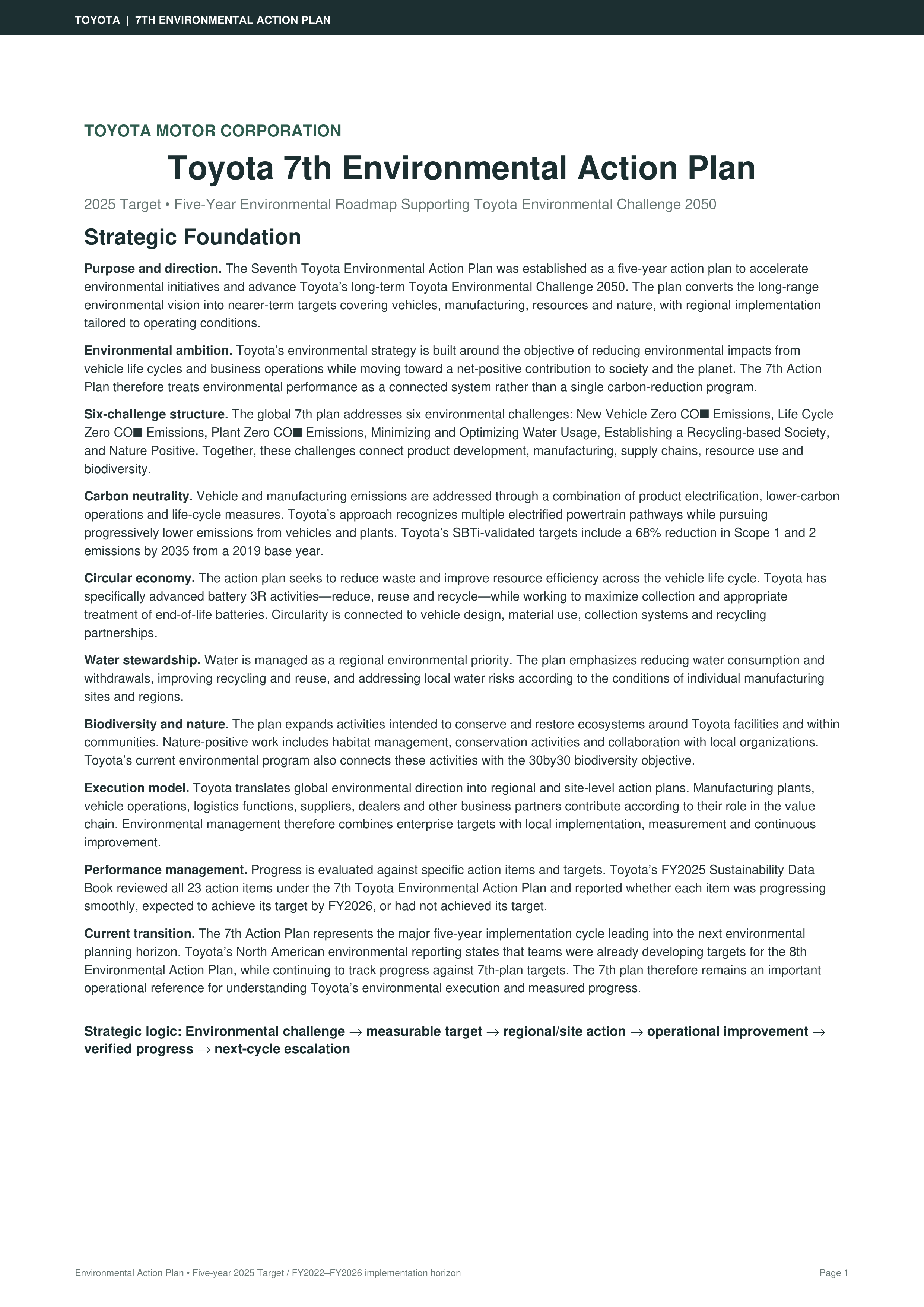
Purpose and direction.
The Seventh Toyota Environmental Action Plan was established as a five-year action plan to accelerate
environmental initiatives and advance Toyota’s long-term Toyota Environmental Challenge 2050. The plan converts the long-range
environmental vision into nearer-term targets covering vehicles, manufacturing, resources and nature, with regional implementation
tailored to operating conditions.
Environmental ambition.
Toyota’s environmental strategy is built around the objective of reducing environmental impacts from
vehicle life cycles and business operations while moving toward a net-positive contribution to society and the planet. The 7th Action
Plan therefore treats environmental performance as a connected system rather than a single carbon-reduction program.
Six-challenge structure.
The global 7th plan addresses six environmental challenges: New Vehicle Zero CO
I
Emissions, Life Cycle
Zero CO
I
Emissions, Plant Zero CO
I
Emissions, Minimizing and Optimizing Water Usage, Establishing a Recycling-based Society,
and Nature Positive. Together, these challenges connect product development, manufacturing, supply chains, resource use and
biodiversity.
Carbon neutrality.
Vehicle and manufacturing emissions are addressed through a combination of product electrification, lower-carbon
operations and life-cycle measures. Toyota’s approach recognizes multiple electrified powertrain pathways while pursuing
progressively lower emissions from vehicles and plants. Toyota’s SBTi-validated targets include a 68% reduction in Scope 1 and 2
emissions by 2035 from a 2019 base year.
Circular economy.
The action plan seeks to reduce waste and improve resource efficiency across the vehicle life cycle. Toyota has
specifically advanced battery 3R activities—reduce, reuse and recycle—while working to maximize collection and appropriate
treatment of end-of-life batteries. Circularity is connected to vehicle design, material use, collection systems and recycling
partnerships.
Water stewardship.
Water is managed as a regional environmental priority. The plan emphasizes reducing water consumption and
withdrawals, improving recycling and reuse, and addressing local water risks according to the conditions of individual manufacturing
sites and regions.
Biodiversity and nature.
The plan expands activities intended to conserve and restore ecosystems around Toyota facilities and within
communities. Nature-positive work includes habitat management, conservation activities and collaboration with local organizations.
Toyota’s current environmental program also connects these activities with the 30by30 biodiversity objective.
Execution model.
Toyota translates global environmental direction into regional and site-level action plans. Manufacturing plants,
vehicle operations, logistics functions, suppliers, dealers and other business partners contribute according to their role in the value
chain. Environmental management therefore combines enterprise targets with local implementation, measurement and continuous
improvement.
Performance management.
Progress is evaluated against specific action items and targets. Toyota’s FY2025 Sustainability Data
Book reviewed all 23 action items under the 7th Toyota Environmental Action Plan and reported whether each item was progressing
smoothly, expected to achieve its target by FY2026, or had not achieved its target.
Current transition.
The 7th Action Plan represents the major five-year implementation cycle leading into the next environmental
planning horizon. Toyota’s North American environmental reporting states that teams were already developing targets for the 8th
Environmental Action Plan, while continuing to track progress against 7th-plan targets. The 7th plan therefore remains an important
operational reference for understanding Toyota’s environmental execution and measured progress.
Strategic logic: Environmental challenge
→
measurable target
→
regional/site action
→
operational improvement
→
verified progress
→
next-cycle escalation
TOYOTA | 7TH ENVIRONMENTAL ACTION PLAN
Environmental Action Plan • Five-year 2025 Target / FY2022–FY2026 implementation horizon
Page 2
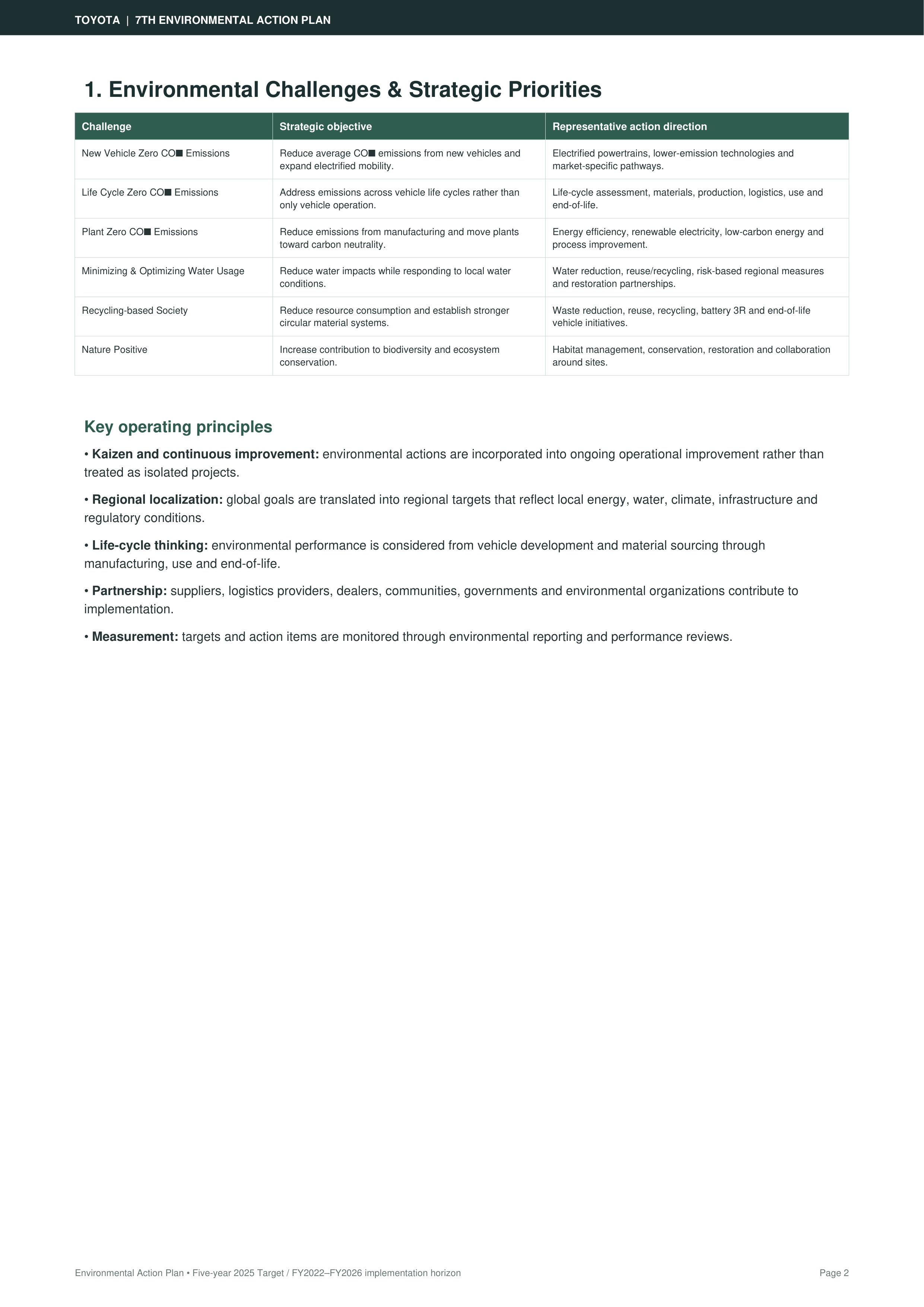
1. Environmental Challenges & Strategic Priorities
Challenge
Strategic objective
Representative action direction
New Vehicle Zero CO
I
Emissions
Reduce average CO
I
emissions from new vehicles and
expand electrified mobility.
Electrified powertrains, lower-emission technologies and
market-specific pathways.
Life Cycle Zero CO
I
Emissions
Address emissions across vehicle life cycles rather than
only vehicle operation.
Life-cycle assessment, materials, production, logistics, use and
end-of-life.
Plant Zero CO
I
Emissions
Reduce emissions from manufacturing and move plants
toward carbon neutrality.
Energy efficiency, renewable electricity, low-carbon energy and
process improvement.
Minimizing & Optimizing Water Usage
Reduce water impacts while responding to local water
conditions.
Water reduction, reuse/recycling, risk-based regional measures
and restoration partnerships.
Recycling-based Society
Reduce resource consumption and establish stronger
circular material systems.
Waste reduction, reuse, recycling, battery 3R and end-of-life
vehicle initiatives.
Nature Positive
Increase contribution to biodiversity and ecosystem
conservation.
Habitat management, conservation, restoration and collaboration
around sites.
Key operating principles
•
Kaizen and continuous improvement:
environmental actions are incorporated into ongoing operational improvement rather than
treated as isolated projects.
•
Regional localization:
global goals are translated into regional targets that reflect local energy, water, climate, infrastructure and
regulatory conditions.
•
Life-cycle thinking:
environmental performance is considered from vehicle development and material sourcing through
manufacturing, use and end-of-life.
•
Partnership:
suppliers, logistics providers, dealers, communities, governments and environmental organizations contribute to
implementation.
•
Measurement:
targets and action items are monitored through environmental reporting and performance reviews.
TOYOTA | 7TH ENVIRONMENTAL ACTION PLAN
Environmental Action Plan • Five-year 2025 Target / FY2022–FY2026 implementation horizon
Page 3
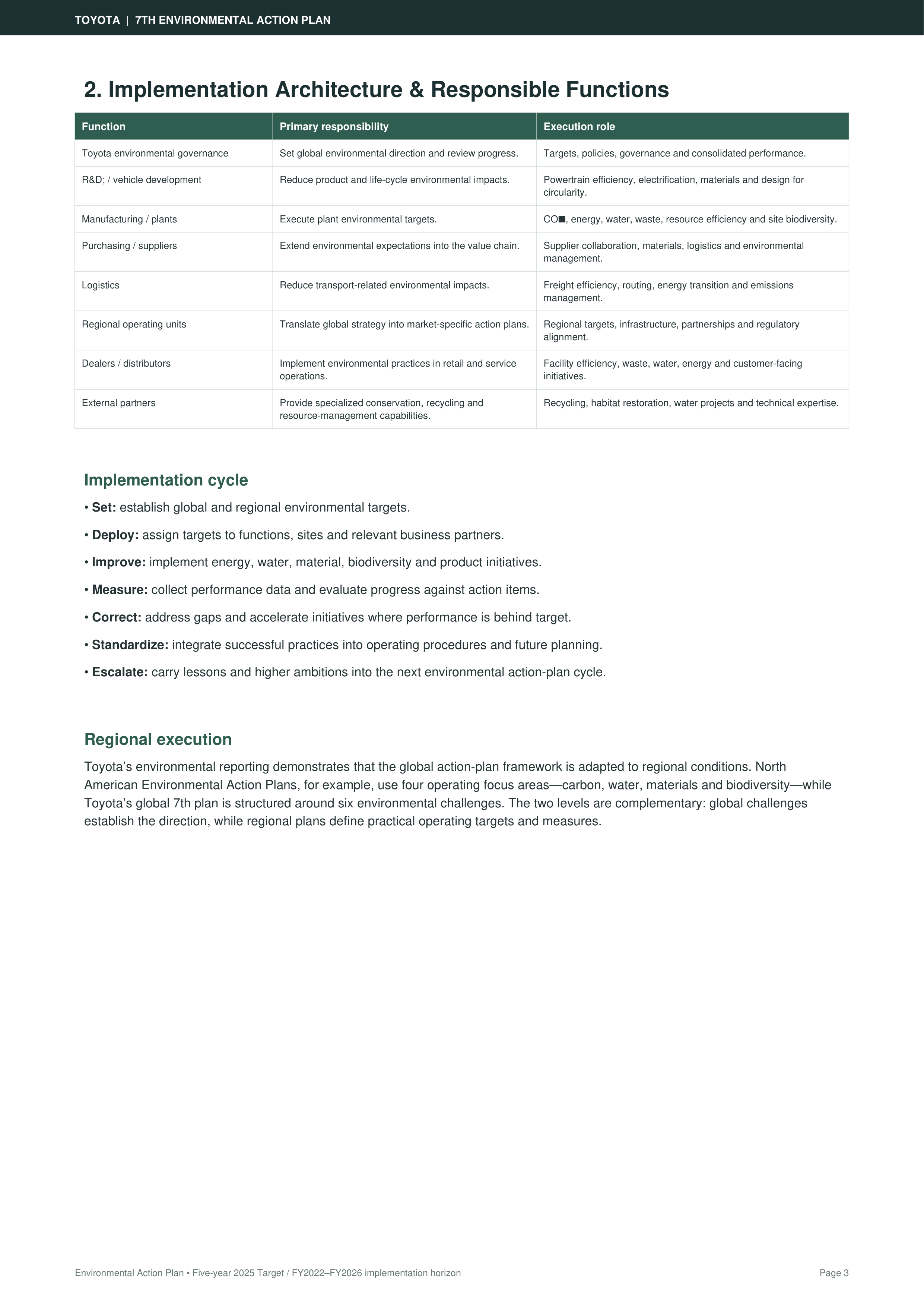
2. Implementation Architecture & Responsible Functions
Function
Primary responsibility
Execution role
Toyota environmental governance
Set global environmental direction and review progress.
Targets, policies, governance and consolidated performance.
R&D; / vehicle development
Reduce product and life-cycle environmental impacts.
Powertrain efficiency, electrification, materials and design for
circularity.
Manufacturing / plants
Execute plant environmental targets.
CO
I
, energy, water, waste, resource efficiency and site biodiversity.
Purchasing / suppliers
Extend environmental expectations into the value chain.
Supplier collaboration, materials, logistics and environmental
management.
Logistics
Reduce transport-related environmental impacts.
Freight efficiency, routing, energy transition and emissions
management.
Regional operating units
Translate global strategy into market-specific action plans.
Regional targets, infrastructure, partnerships and regulatory
alignment.
Dealers / distributors
Implement environmental practices in retail and service
operations.
Facility efficiency, waste, water, energy and customer-facing
initiatives.
External partners
Provide specialized conservation, recycling and
resource-management capabilities.
Recycling, habitat restoration, water projects and technical expertise.
Implementation cycle
•
Set:
establish global and regional environmental targets.
•
Deploy:
assign targets to functions, sites and relevant business partners.
•
Improve:
implement energy, water, material, biodiversity and product initiatives.
•
Measure:
collect performance data and evaluate progress against action items.
•
Correct:
address gaps and accelerate initiatives where performance is behind target.
•
Standardize:
integrate successful practices into operating procedures and future planning.
•
Escalate:
carry lessons and higher ambitions into the next environmental action-plan cycle.
Regional execution
Toyota’s environmental reporting demonstrates that the global action-plan framework is adapted to regional conditions. North
American Environmental Action Plans, for example, use four operating focus areas—carbon, water, materials and biodiversity—while
Toyota’s global 7th plan is structured around six environmental challenges. The two levels are complementary: global challenges
establish the direction, while regional plans define practical operating targets and measures.
TOYOTA | 7TH ENVIRONMENTAL ACTION PLAN
Environmental Action Plan • Five-year 2025 Target / FY2022–FY2026 implementation horizon
Page 4
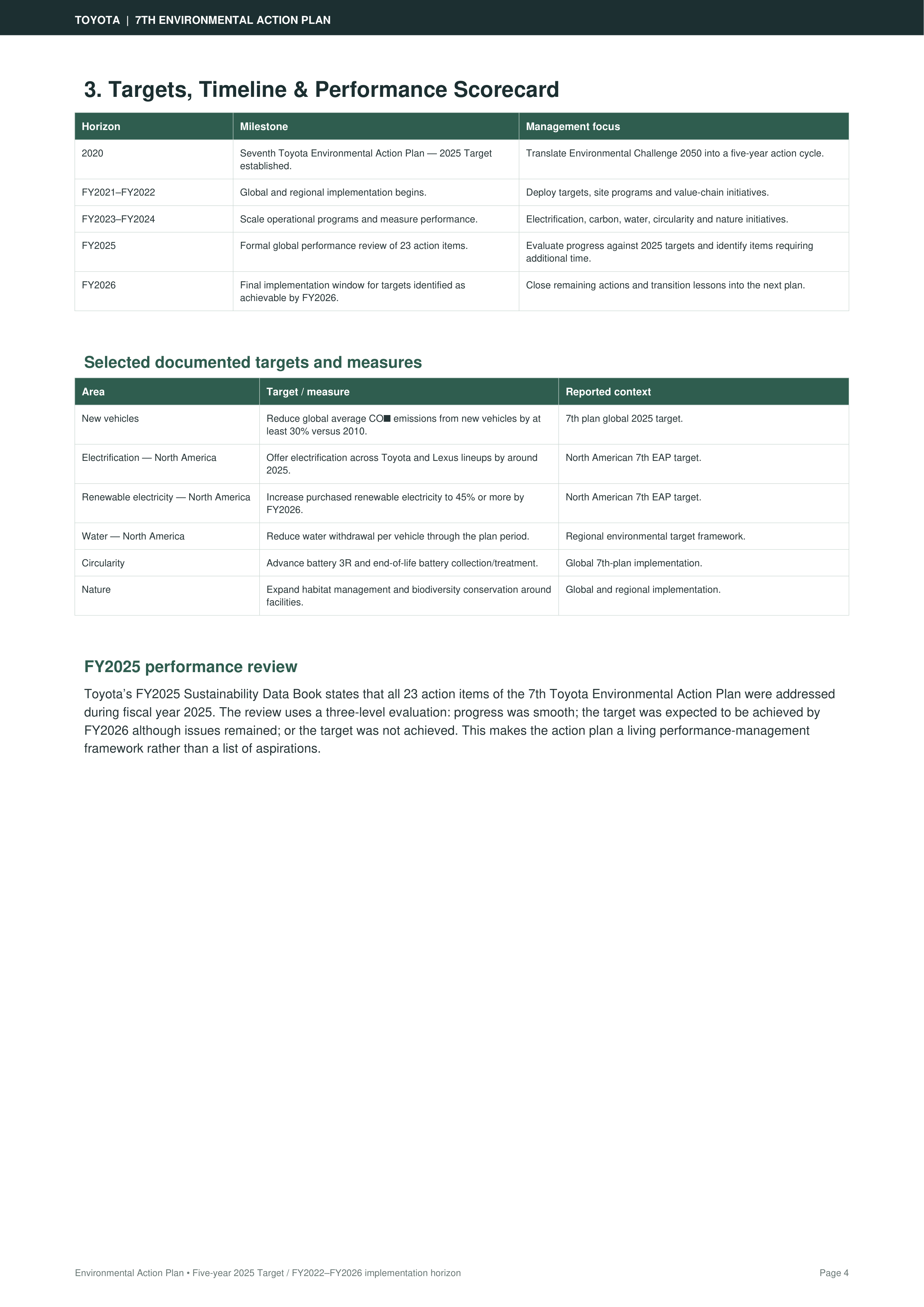
3. Targets, Timeline & Performance Scorecard
Horizon
Milestone
Management focus
2020
Seventh Toyota Environmental Action Plan — 2025 Target
established.
Translate Environmental Challenge 2050 into a five-year action cycle.
FY2021–FY2022
Global and regional implementation begins.
Deploy targets, site programs and value-chain initiatives.
FY2023–FY2024
Scale operational programs and measure performance.
Electrification, carbon, water, circularity and nature initiatives.
FY2025
Formal global performance review of 23 action items.
Evaluate progress against 2025 targets and identify items requiring
additional time.
FY2026
Final implementation window for targets identified as
achievable by FY2026.
Close remaining actions and transition lessons into the next plan.
Selected documented targets and measures
Area
Target / measure
Reported context
New vehicles
Reduce global average CO
I
emissions from new vehicles by at
least 30% versus 2010.
7th plan global 2025 target.
Electrification — North America
Offer electrification across Toyota and Lexus lineups by around
2025.
North American 7th EAP target.
Renewable electricity — North America
Increase purchased renewable electricity to 45% or more by
FY2026.
North American 7th EAP target.
Water — North America
Reduce water withdrawal per vehicle through the plan period.
Regional environmental target framework.
Circularity
Advance battery 3R and end-of-life battery collection/treatment.
Global 7th-plan implementation.
Nature
Expand habitat management and biodiversity conservation around
facilities.
Global and regional implementation.
FY2025 performance review
Toyota’s FY2025 Sustainability Data Book states that all 23 action items of the 7th Toyota Environmental Action Plan were addressed
during fiscal year 2025. The review uses a three-level evaluation: progress was smooth; the target was expected to be achieved by
FY2026 although issues remained; or the target was not achieved. This makes the action plan a living performance-management
framework rather than a list of aspirations.
TOYOTA | 7TH ENVIRONMENTAL ACTION PLAN
Environmental Action Plan • Five-year 2025 Target / FY2022–FY2026 implementation horizon
Page 5
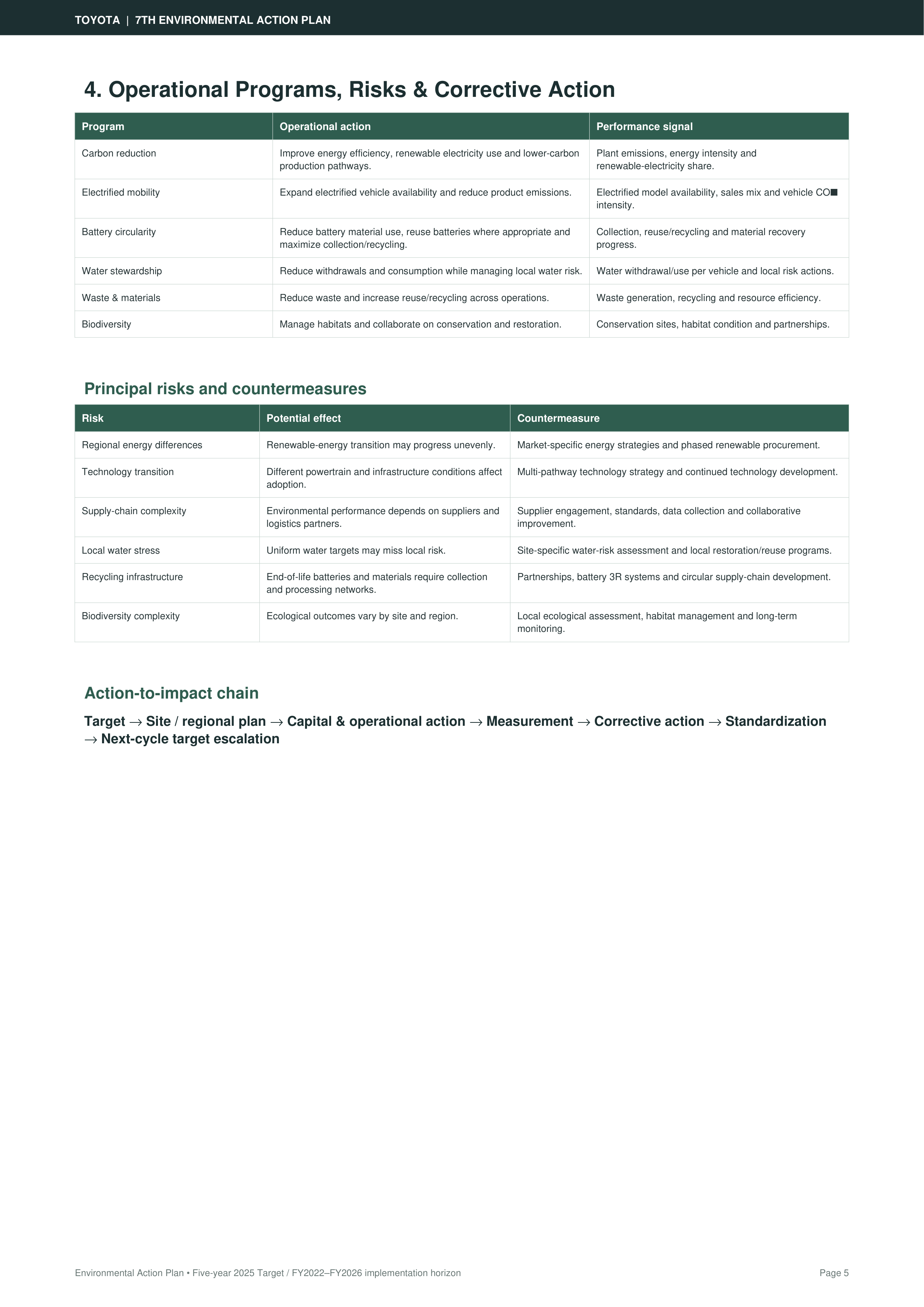
4. Operational Programs, Risks & Corrective Action
Program
Operational action
Performance signal
Carbon reduction
Improve energy efficiency, renewable electricity use and lower-carbon
production pathways.
Plant emissions, energy intensity and
renewable-electricity share.
Electrified mobility
Expand electrified vehicle availability and reduce product emissions.
Electrified model availability, sales mix and vehicle CO
I
intensity.
Battery circularity
Reduce battery material use, reuse batteries where appropriate and
maximize collection/recycling.
Collection, reuse/recycling and material recovery
progress.
Water stewardship
Reduce withdrawals and consumption while managing local water risk.
Water withdrawal/use per vehicle and local risk actions.
Waste & materials
Reduce waste and increase reuse/recycling across operations.
Waste generation, recycling and resource efficiency.
Biodiversity
Manage habitats and collaborate on conservation and restoration.
Conservation sites, habitat condition and partnerships.
Principal risks and countermeasures
Risk
Potential effect
Countermeasure
Regional energy differences
Renewable-energy transition may progress unevenly.
Market-specific energy strategies and phased renewable procurement.
Technology transition
Different powertrain and infrastructure conditions affect
adoption.
Multi-pathway technology strategy and continued technology development.
Supply-chain complexity
Environmental performance depends on suppliers and
logistics partners.
Supplier engagement, standards, data collection and collaborative
improvement.
Local water stress
Uniform water targets may miss local risk.
Site-specific water-risk assessment and local restoration/reuse programs.
Recycling infrastructure
End-of-life batteries and materials require collection
and processing networks.
Partnerships, battery 3R systems and circular supply-chain development.
Biodiversity complexity
Ecological outcomes vary by site and region.
Local ecological assessment, habitat management and long-term
monitoring.
Action-to-impact chain
Target
→
Site / regional plan
→
Capital & operational action
→
Measurement
→
Corrective action
→
Standardization
→
Next-cycle target escalation
TOYOTA | 7TH ENVIRONMENTAL ACTION PLAN
Environmental Action Plan • Five-year 2025 Target / FY2022–FY2026 implementation horizon
Page 6
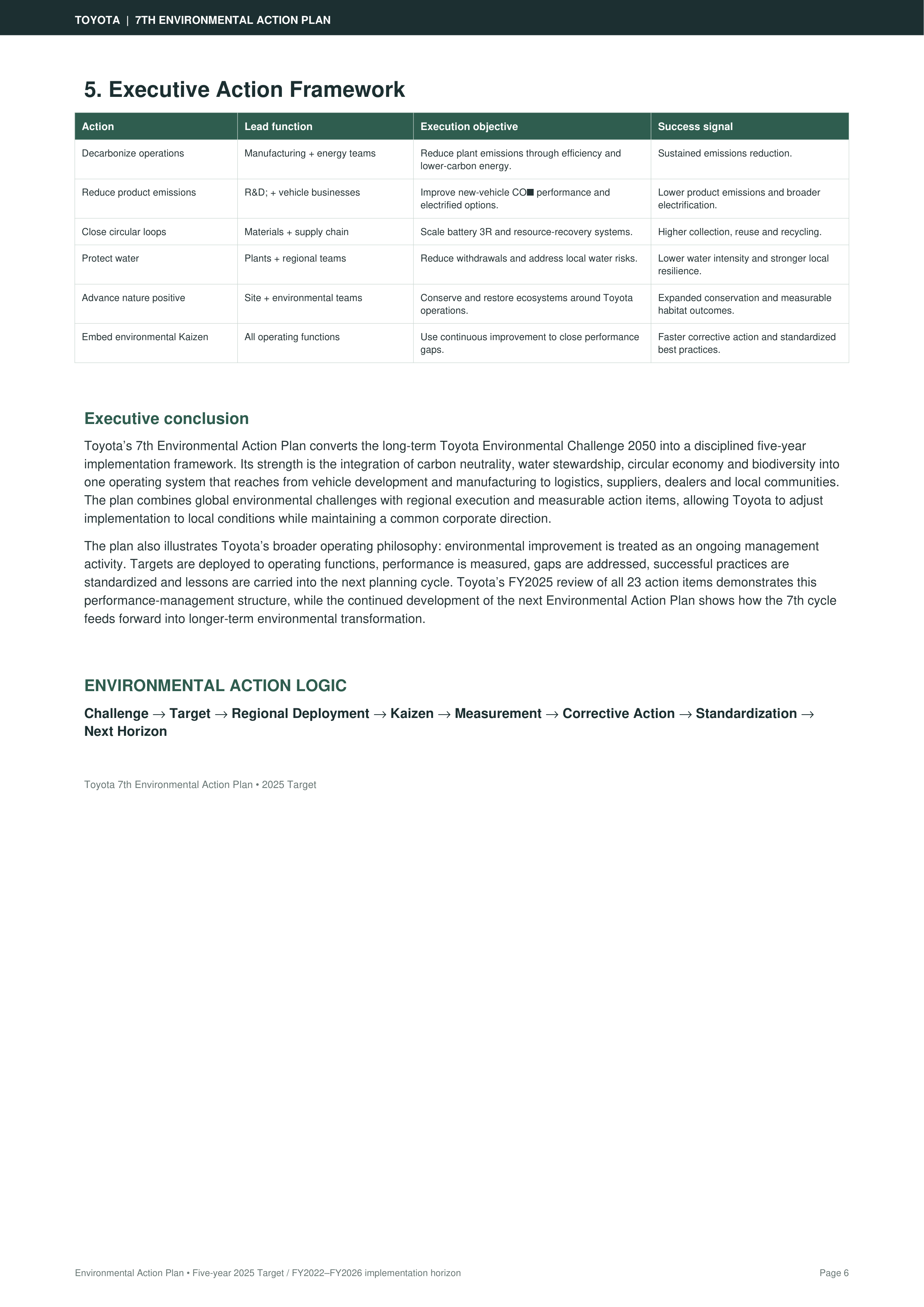
5. Executive Action Framework
Action
Lead function
Execution objective
Success signal
Decarbonize operations
Manufacturing + energy teams
Reduce plant emissions through efficiency and
lower-carbon energy.
Sustained emissions reduction.
Reduce product emissions
R&D; + vehicle businesses
Improve new-vehicle CO
I
performance and
electrified options.
Lower product emissions and broader
electrification.
Close circular loops
Materials + supply chain
Scale battery 3R and resource-recovery systems.
Higher collection, reuse and recycling.
Protect water
Plants + regional teams
Reduce withdrawals and address local water risks.
Lower water intensity and stronger local
resilience.
Advance nature positive
Site + environmental teams
Conserve and restore ecosystems around Toyota
operations.
Expanded conservation and measurable
habitat outcomes.
Embed environmental Kaizen
All operating functions
Use continuous improvement to close performance
gaps.
Faster corrective action and standardized
best practices.
Executive conclusion
Toyota’s 7th Environmental Action Plan converts the long-term Toyota Environmental Challenge 2050 into a disciplined five-year
implementation framework. Its strength is the integration of carbon neutrality, water stewardship, circular economy and biodiversity into
one operating system that reaches from vehicle development and manufacturing to logistics, suppliers, dealers and local communities.
The plan combines global environmental challenges with regional execution and measurable action items, allowing Toyota to adjust
implementation to local conditions while maintaining a common corporate direction.
The plan also illustrates Toyota’s broader operating philosophy: environmental improvement is treated as an ongoing management
activity. Targets are deployed to operating functions, performance is measured, gaps are addressed, successful practices are
standardized and lessons are carried into the next planning cycle. Toyota’s FY2025 review of all 23 action items demonstrates this
performance-management structure, while the continued development of the next Environmental Action Plan shows how the 7th cycle
feeds forward into longer-term environmental transformation.
ENVIRONMENTAL ACTION LOGIC
Challenge
→
Target
→
Regional Deployment
→
Kaizen
→
Measurement
→
Corrective Action
→
Standardization
→
Next Horizon
Toyota 7th Environmental Action Plan • 2025 Target