EPA WRAP 2.0 — Research-Based Action Plan
Page 5
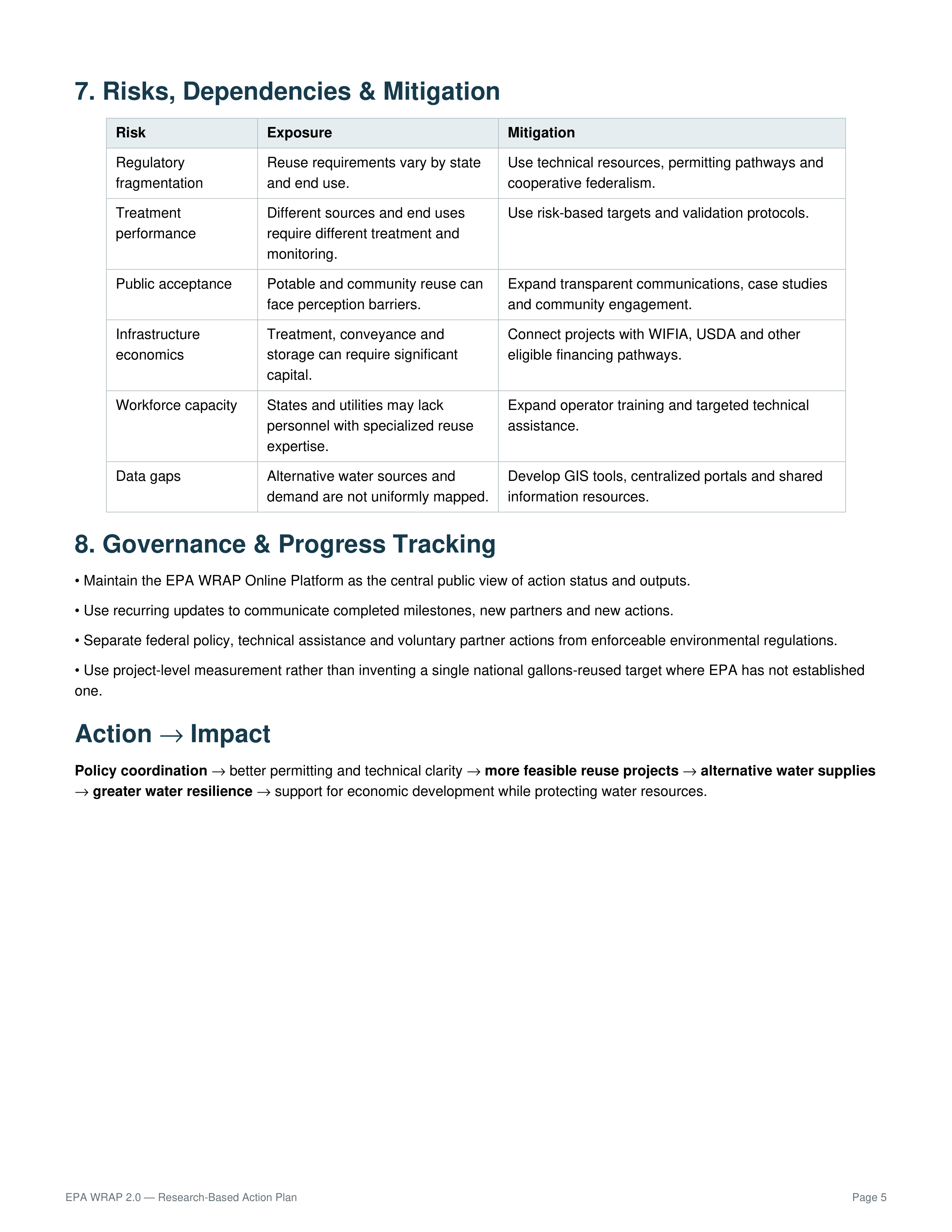
7. Risks, Dependencies & Mitigation
Risk
Exposure
Mitigation
Regulatory
fragmentation
Reuse requirements vary by state
and end use.
Use technical resources, permitting pathways and
cooperative federalism.
Treatment
performance
Different sources and end uses
require different treatment and
monitoring.
Use risk-based targets and validation protocols.
Public acceptance
Potable and community reuse can
face perception barriers.
Expand transparent communications, case studies
and community engagement.
Infrastructure
economics
Treatment, conveyance and
storage can require significant
capital.
Connect projects with WIFIA, USDA and other
eligible financing pathways.
Workforce capacity
States and utilities may lack
personnel with specialized reuse
expertise.
Expand operator training and targeted technical
assistance.
Data gaps
Alternative water sources and
demand are not uniformly mapped.
Develop GIS tools, centralized portals and shared
information resources.
8. Governance & Progress Tracking
• Maintain the EPA WRAP Online Platform as the central public view of action status and outputs.
• Use recurring updates to communicate completed milestones, new partners and new actions.
• Separate federal policy, technical assistance and voluntary partner actions from enforceable environmental regulations.
• Use project-level measurement rather than inventing a single national gallons-reused target where EPA has not established
one.
Action
→
Impact
Policy coordination
→
better permitting and technical clarity
→
more feasible reuse projects
→
alternative water supplies
→
greater water resilience
→
support for economic development while protecting water resources.