UNITED NATIONS | DECADE ON ECOSYSTEM RESTORATION
Research-based synthesized Action Plan • Current through September 2026 • Not an official UN publication
Page 1
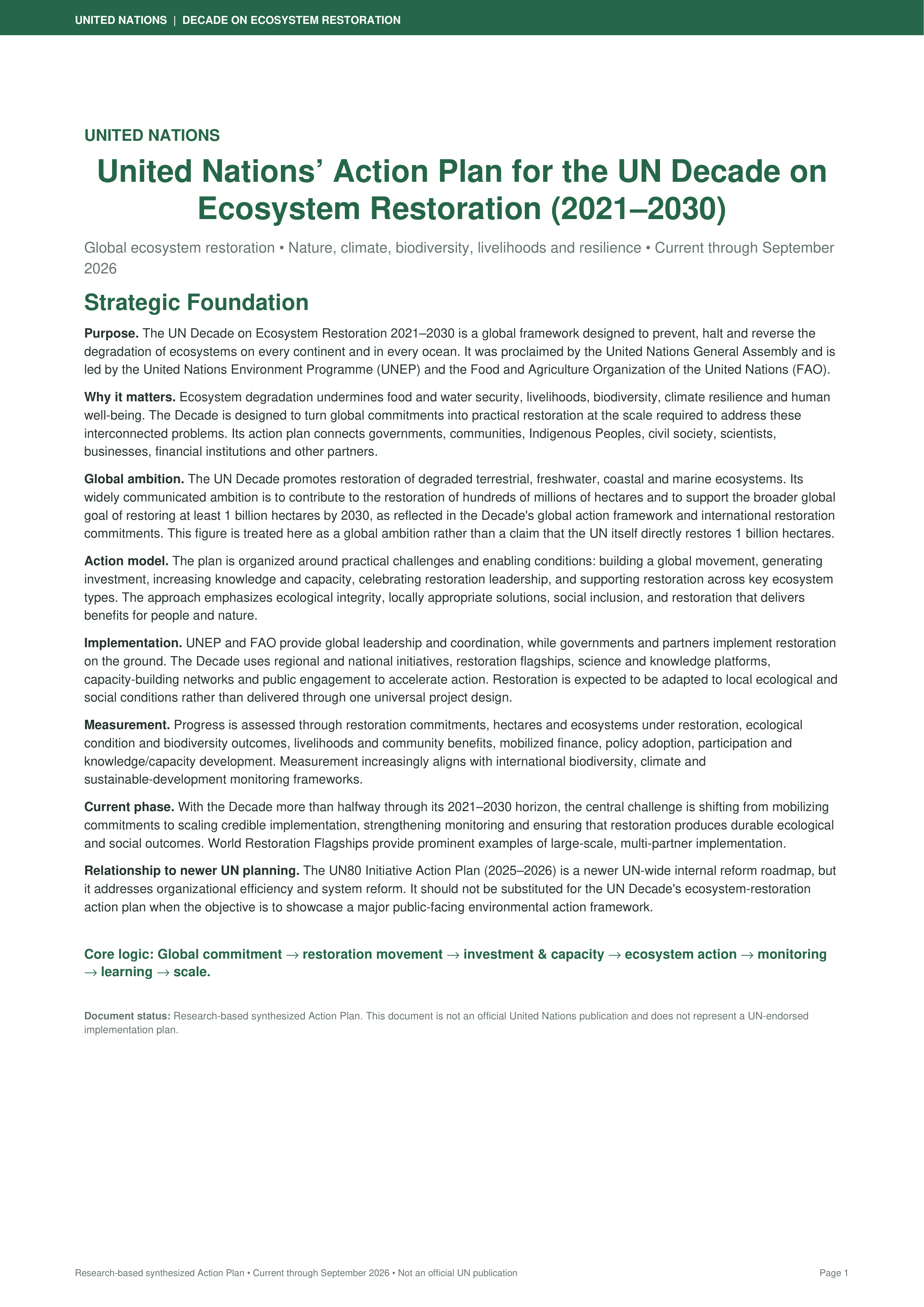
UNITED NATIONS
United Nations’ Action Plan for the UN Decade on
Ecosystem Restoration (2021–2030)
Global ecosystem restoration • Nature, climate, biodiversity, livelihoods and resilience • Current through September
2026
Strategic Foundation
Purpose.
The UN Decade on Ecosystem Restoration 2021–2030 is a global framework designed to prevent, halt and reverse the
degradation of ecosystems on every continent and in every ocean. It was proclaimed by the United Nations General Assembly and is
led by the United Nations Environment Programme (UNEP) and the Food and Agriculture Organization of the United Nations (FAO).
Why it matters.
Ecosystem degradation undermines food and water security, livelihoods, biodiversity, climate resilience and human
well-being. The Decade is designed to turn global commitments into practical restoration at the scale required to address these
interconnected problems. Its action plan connects governments, communities, Indigenous Peoples, civil society, scientists,
businesses, financial institutions and other partners.
Global ambition.
The UN Decade promotes restoration of degraded terrestrial, freshwater, coastal and marine ecosystems. Its
widely communicated ambition is to contribute to the restoration of hundreds of millions of hectares and to support the broader global
goal of restoring at least 1 billion hectares by 2030, as reflected in the Decade's global action framework and international restoration
commitments. This figure is treated here as a global ambition rather than a claim that the UN itself directly restores 1 billion hectares.
Action model.
The plan is organized around practical challenges and enabling conditions: building a global movement, generating
investment, increasing knowledge and capacity, celebrating restoration leadership, and supporting restoration across key ecosystem
types. The approach emphasizes ecological integrity, locally appropriate solutions, social inclusion, and restoration that delivers
benefits for people and nature.
Implementation.
UNEP and FAO provide global leadership and coordination, while governments and partners implement restoration
on the ground. The Decade uses regional and national initiatives, restoration flagships, science and knowledge platforms,
capacity-building networks and public engagement to accelerate action. Restoration is expected to be adapted to local ecological and
social conditions rather than delivered through one universal project design.
Measurement.
Progress is assessed through restoration commitments, hectares and ecosystems under restoration, ecological
condition and biodiversity outcomes, livelihoods and community benefits, mobilized finance, policy adoption, participation and
knowledge/capacity development. Measurement increasingly aligns with international biodiversity, climate and
sustainable-development monitoring frameworks.
Current phase.
With the Decade more than halfway through its 2021–2030 horizon, the central challenge is shifting from mobilizing
commitments to scaling credible implementation, strengthening monitoring and ensuring that restoration produces durable ecological
and social outcomes. World Restoration Flagships provide prominent examples of large-scale, multi-partner implementation.
Relationship to newer UN planning.
The UN80 Initiative Action Plan (2025–2026) is a newer UN-wide internal reform roadmap, but
it addresses organizational efficiency and system reform. It should not be substituted for the UN Decade's ecosystem-restoration
action plan when the objective is to showcase a major public-facing environmental action framework.
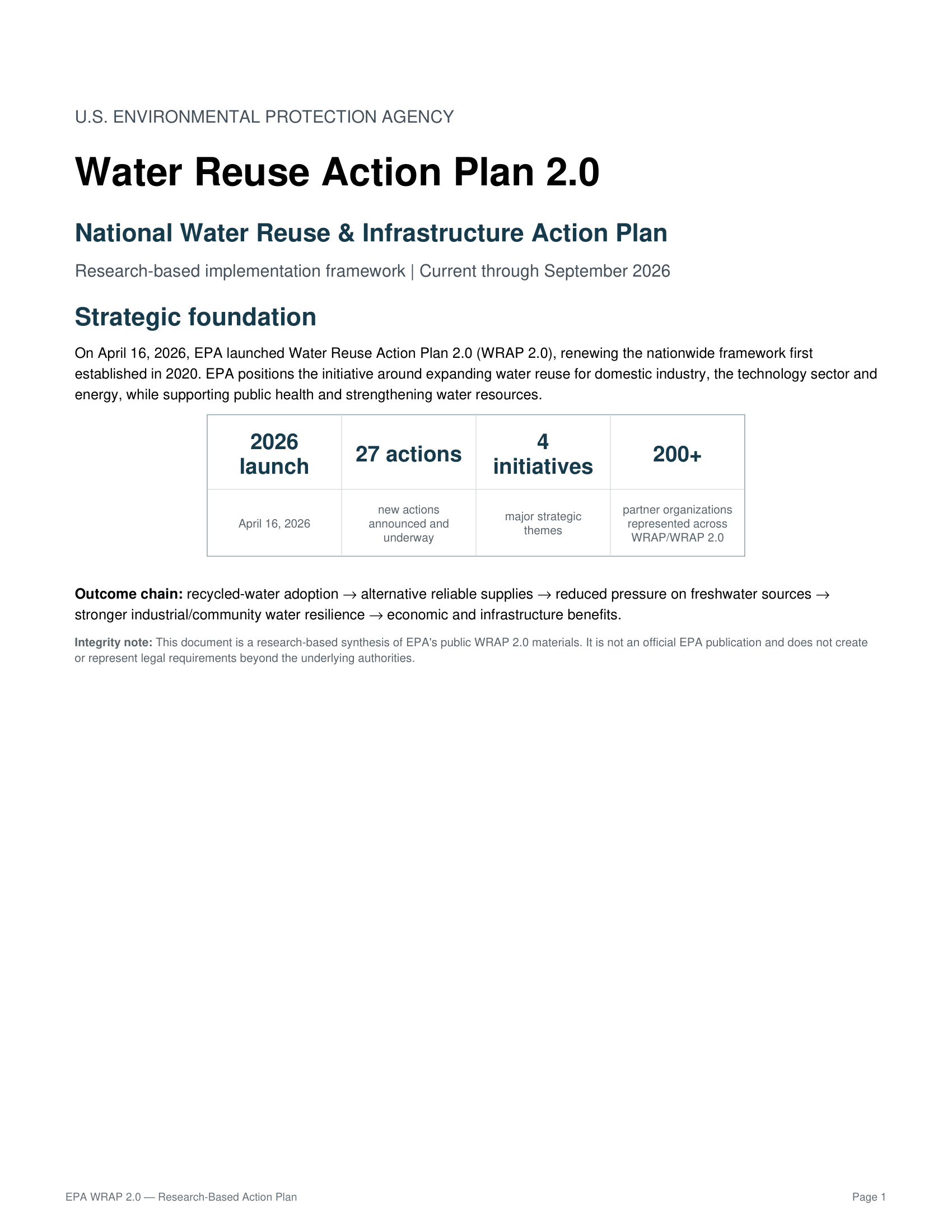
Core logic: Global commitment
→
restoration movement
→
investment & capacity
→
ecosystem action
→
monitoring
→
learning
→
scale.
Document status:
Research-based synthesized Action Plan. This document is not an official United Nations publication and does not represent a UN-endorsed
implementation plan.
UNITED NATIONS | DECADE ON ECOSYSTEM RESTORATION
Research-based synthesized Action Plan • Current through September 2026 • Not an official UN publication
Page 2
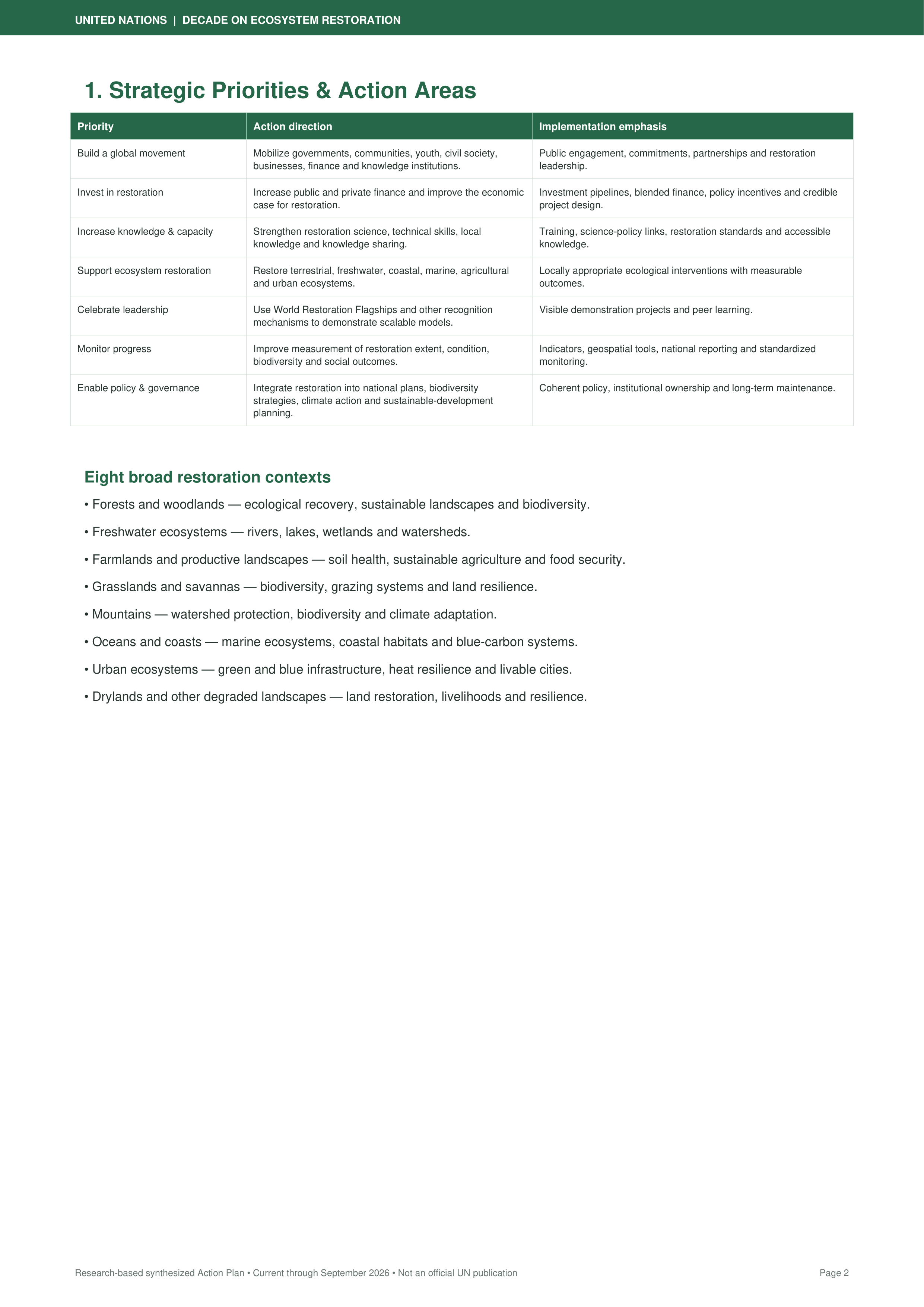
1. Strategic Priorities & Action Areas
Priority
Action direction
Implementation emphasis
Build a global movement
Mobilize governments, communities, youth, civil society,
businesses, finance and knowledge institutions.
Public engagement, commitments, partnerships and restoration
leadership.
Invest in restoration
Increase public and private finance and improve the economic
case for restoration.
Investment pipelines, blended finance, policy incentives and credible
project design.
Increase knowledge & capacity
Strengthen restoration science, technical skills, local
knowledge and knowledge sharing.
Training, science-policy links, restoration standards and accessible
knowledge.
Support ecosystem restoration
Restore terrestrial, freshwater, coastal, marine, agricultural
and urban ecosystems.
Locally appropriate ecological interventions with measurable
outcomes.
Celebrate leadership
Use World Restoration Flagships and other recognition
mechanisms to demonstrate scalable models.
Visible demonstration projects and peer learning.
Monitor progress
Improve measurement of restoration extent, condition,
biodiversity and social outcomes.
Indicators, geospatial tools, national reporting and standardized
monitoring.
Enable policy & governance
Integrate restoration into national plans, biodiversity
strategies, climate action and sustainable-development
planning.
Coherent policy, institutional ownership and long-term maintenance.
Eight broad restoration contexts
• Forests and woodlands — ecological recovery, sustainable landscapes and biodiversity.
• Freshwater ecosystems — rivers, lakes, wetlands and watersheds.
• Farmlands and productive landscapes — soil health, sustainable agriculture and food security.
• Grasslands and savannas — biodiversity, grazing systems and land resilience.
• Mountains — watershed protection, biodiversity and climate adaptation.
• Oceans and coasts — marine ecosystems, coastal habitats and blue-carbon systems.
• Urban ecosystems — green and blue infrastructure, heat resilience and livable cities.
• Drylands and other degraded landscapes — land restoration, livelihoods and resilience.
UNITED NATIONS | DECADE ON ECOSYSTEM RESTORATION
Research-based synthesized Action Plan • Current through September 2026 • Not an official UN publication
Page 3
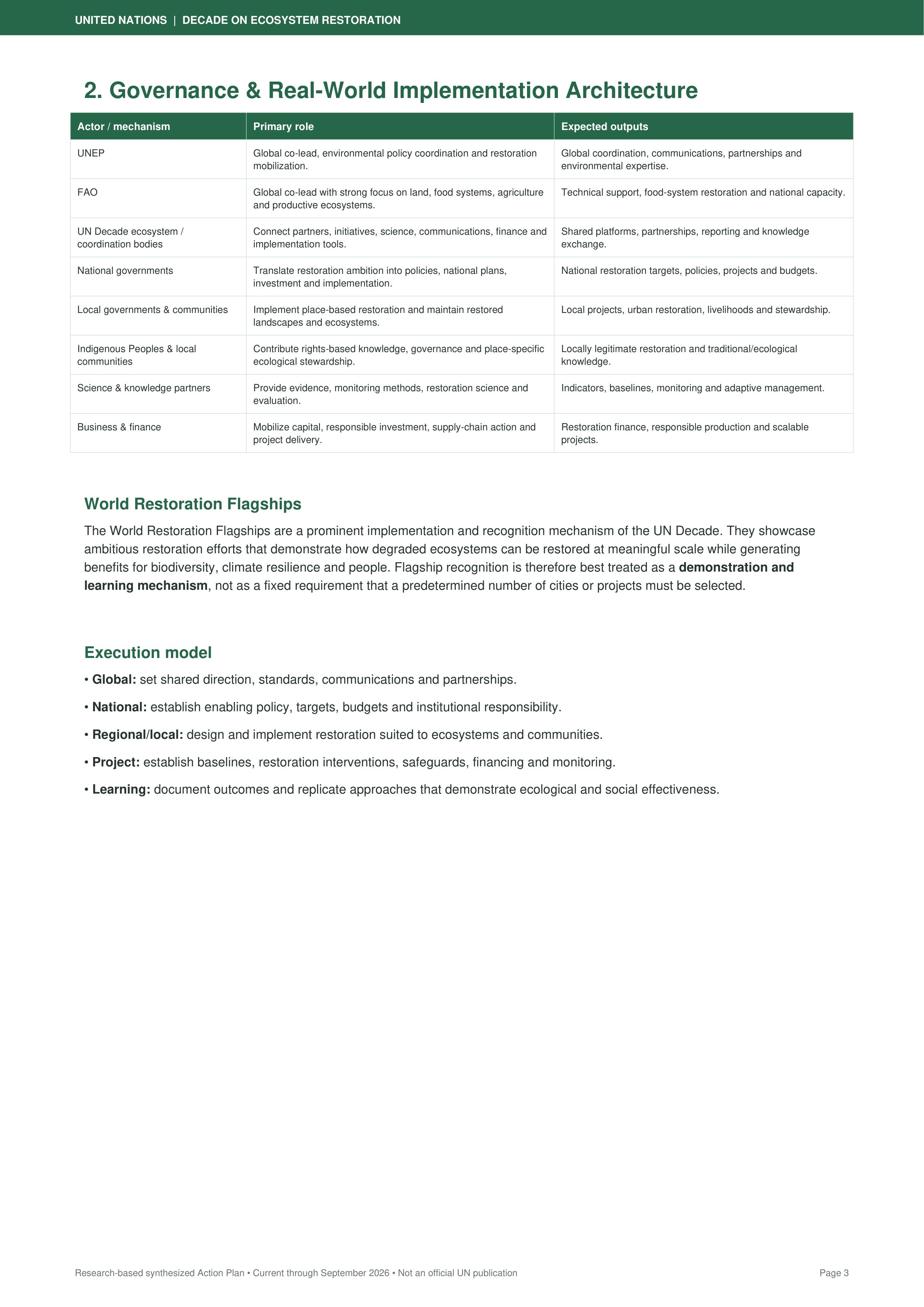
2. Governance & Real-World Implementation Architecture
Actor / mechanism
Primary role
Expected outputs
UNEP
Global co-lead, environmental policy coordination and restoration
mobilization.
Global coordination, communications, partnerships and
environmental expertise.
FAO
Global co-lead with strong focus on land, food systems, agriculture
and productive ecosystems.
Technical support, food-system restoration and national capacity.
UN Decade ecosystem /
coordination bodies
Connect partners, initiatives, science, communications, finance and
implementation tools.
Shared platforms, partnerships, reporting and knowledge
exchange.
National governments
Translate restoration ambition into policies, national plans,
investment and implementation.
National restoration targets, policies, projects and budgets.
Local governments & communities
Implement place-based restoration and maintain restored
landscapes and ecosystems.
Local projects, urban restoration, livelihoods and stewardship.
Indigenous Peoples & local
communities
Contribute rights-based knowledge, governance and place-specific
ecological stewardship.
Locally legitimate restoration and traditional/ecological
knowledge.
Science & knowledge partners
Provide evidence, monitoring methods, restoration science and
evaluation.
Indicators, baselines, monitoring and adaptive management.
Business & finance
Mobilize capital, responsible investment, supply-chain action and
project delivery.
Restoration finance, responsible production and scalable
projects.
World Restoration Flagships
The World Restoration Flagships are a prominent implementation and recognition mechanism of the UN Decade. They showcase
ambitious restoration efforts that demonstrate how degraded ecosystems can be restored at meaningful scale while generating
benefits for biodiversity, climate resilience and people. Flagship recognition is therefore best treated as a
demonstration and
learning mechanism
, not as a fixed requirement that a predetermined number of cities or projects must be selected.
Execution model
•
Global:
set shared direction, standards, communications and partnerships.
•
National:
establish enabling policy, targets, budgets and institutional responsibility.
•
Regional/local:
design and implement restoration suited to ecosystems and communities.
•
Project:
establish baselines, restoration interventions, safeguards, financing and monitoring.
•
Learning:
document outcomes and replicate approaches that demonstrate ecological and social effectiveness.
UNITED NATIONS | DECADE ON ECOSYSTEM RESTORATION
Research-based synthesized Action Plan • Current through September 2026 • Not an official UN publication
Page 4
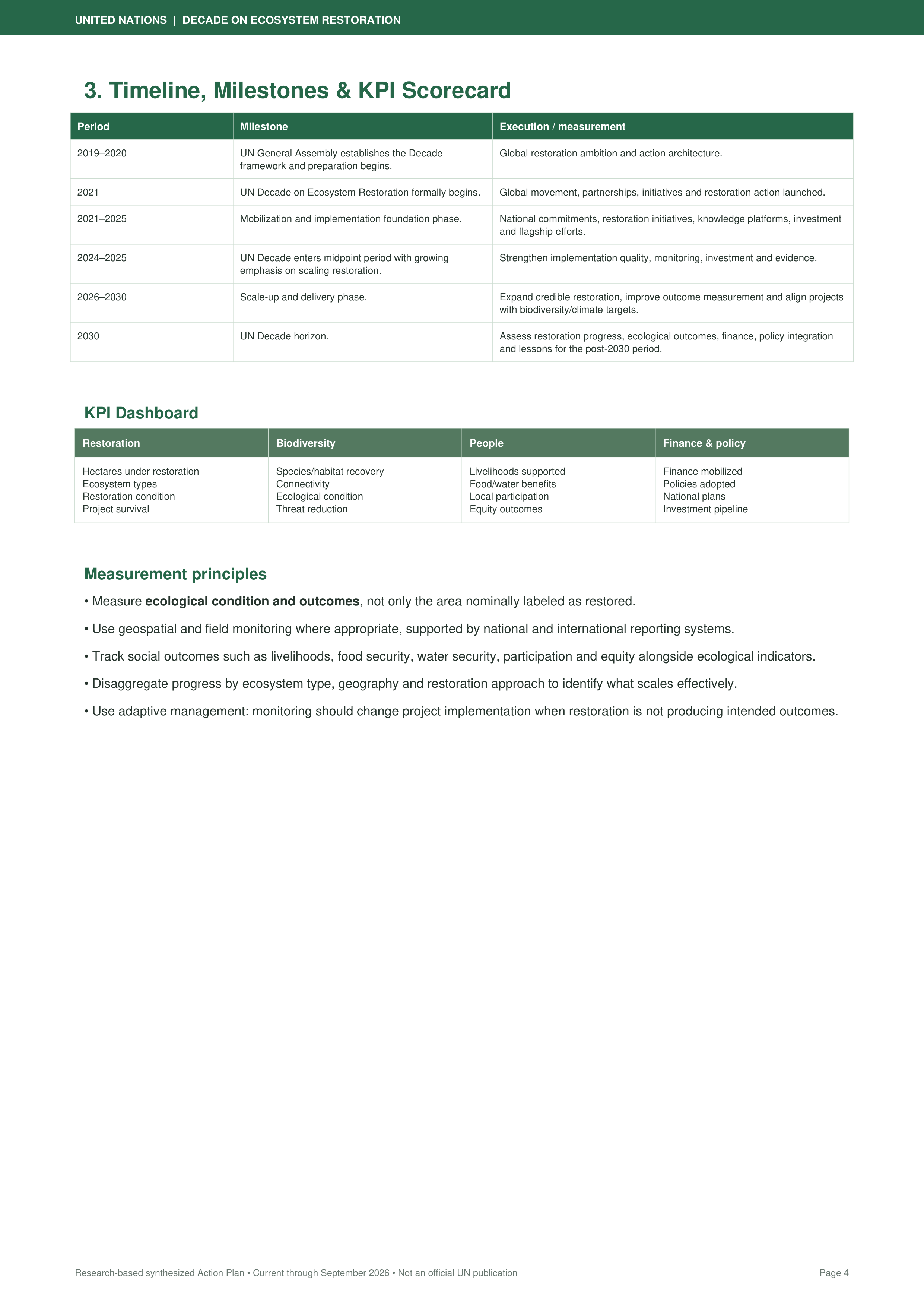
3. Timeline, Milestones & KPI Scorecard
Period
Milestone
Execution / measurement
2019–2020
UN General Assembly establishes the Decade
framework and preparation begins.
Global restoration ambition and action architecture.
2021
UN Decade on Ecosystem Restoration formally begins.
Global movement, partnerships, initiatives and restoration action launched.
2021–2025
Mobilization and implementation foundation phase.
National commitments, restoration initiatives, knowledge platforms, investment
and flagship efforts.
2024–2025
UN Decade enters midpoint period with growing
emphasis on scaling restoration.
Strengthen implementation quality, monitoring, investment and evidence.
2026–2030
Scale-up and delivery phase.
Expand credible restoration, improve outcome measurement and align projects
with biodiversity/climate targets.
2030
UN Decade horizon.
Assess restoration progress, ecological outcomes, finance, policy integration
and lessons for the post-2030 period.
KPI Dashboard
Restoration
Biodiversity
People
Finance & policy
Hectares under restoration
Ecosystem types
Restoration condition
Project survival
Species/habitat recovery
Connectivity
Ecological condition
Threat reduction
Livelihoods supported
Food/water benefits
Local participation
Equity outcomes
Finance mobilized
Policies adopted
National plans
Investment pipeline
Measurement principles
• Measure
ecological condition and outcomes
, not only the area nominally labeled as restored.
• Use geospatial and field monitoring where appropriate, supported by national and international reporting systems.
• Track social outcomes such as livelihoods, food security, water security, participation and equity alongside ecological indicators.
• Disaggregate progress by ecosystem type, geography and restoration approach to identify what scales effectively.
• Use adaptive management: monitoring should change project implementation when restoration is not producing intended outcomes.
UNITED NATIONS | DECADE ON ECOSYSTEM RESTORATION
Research-based synthesized Action Plan • Current through September 2026 • Not an official UN publication
Page 5
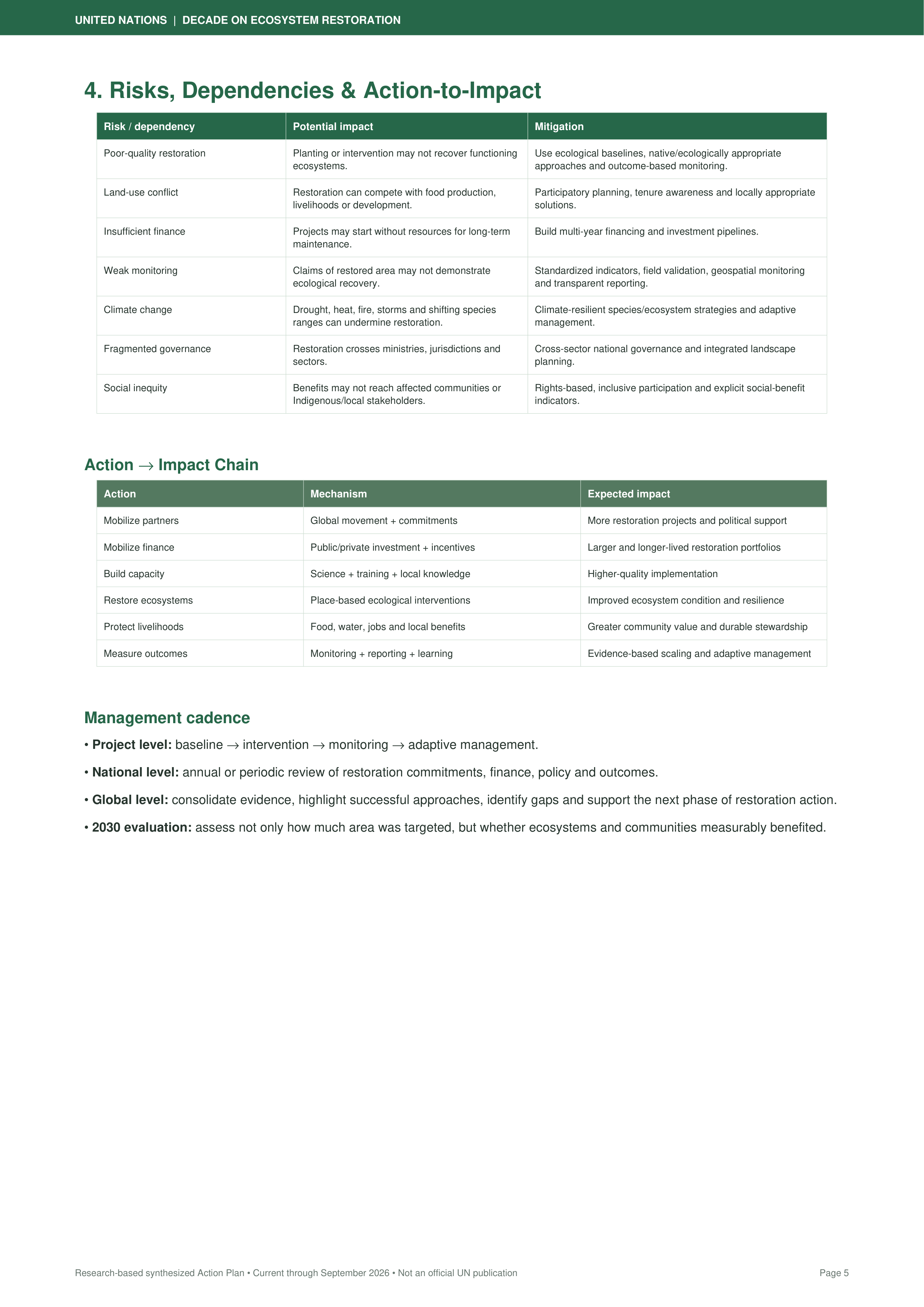
4. Risks, Dependencies & Action-to-Impact
Risk / dependency
Potential impact
Mitigation
Poor-quality restoration
Planting or intervention may not recover functioning
ecosystems.
Use ecological baselines, native/ecologically appropriate
approaches and outcome-based monitoring.
Land-use conflict
Restoration can compete with food production,
livelihoods or development.
Participatory planning, tenure awareness and locally appropriate
solutions.
Insufficient finance
Projects may start without resources for long-term
maintenance.
Build multi-year financing and investment pipelines.
Weak monitoring
Claims of restored area may not demonstrate
ecological recovery.
Standardized indicators, field validation, geospatial monitoring
and transparent reporting.
Climate change
Drought, heat, fire, storms and shifting species
ranges can undermine restoration.
Climate-resilient species/ecosystem strategies and adaptive
management.
Fragmented governance
Restoration crosses ministries, jurisdictions and
sectors.
Cross-sector national governance and integrated landscape
planning.
Social inequity
Benefits may not reach affected communities or
Indigenous/local stakeholders.
Rights-based, inclusive participation and explicit social-benefit
indicators.
Action
→
Impact Chain
Action
Mechanism
Expected impact
Mobilize partners
Global movement + commitments
More restoration projects and political support
Mobilize finance
Public/private investment + incentives
Larger and longer-lived restoration portfolios
Build capacity
Science + training + local knowledge
Higher-quality implementation
Restore ecosystems
Place-based ecological interventions
Improved ecosystem condition and resilience
Protect livelihoods
Food, water, jobs and local benefits
Greater community value and durable stewardship
Measure outcomes
Monitoring + reporting + learning
Evidence-based scaling and adaptive management
Management cadence
•
Project level:
baseline
→
intervention
→
monitoring
→
adaptive management.
•
National level:
annual or periodic review of restoration commitments, finance, policy and outcomes.
•
Global level:
consolidate evidence, highlight successful approaches, identify gaps and support the next phase of restoration action.
•
2030 evaluation:
assess not only how much area was targeted, but whether ecosystems and communities measurably benefited.
UNITED NATIONS | DECADE ON ECOSYSTEM RESTORATION
Research-based synthesized Action Plan • Current through September 2026 • Not an official UN publication
Page 6
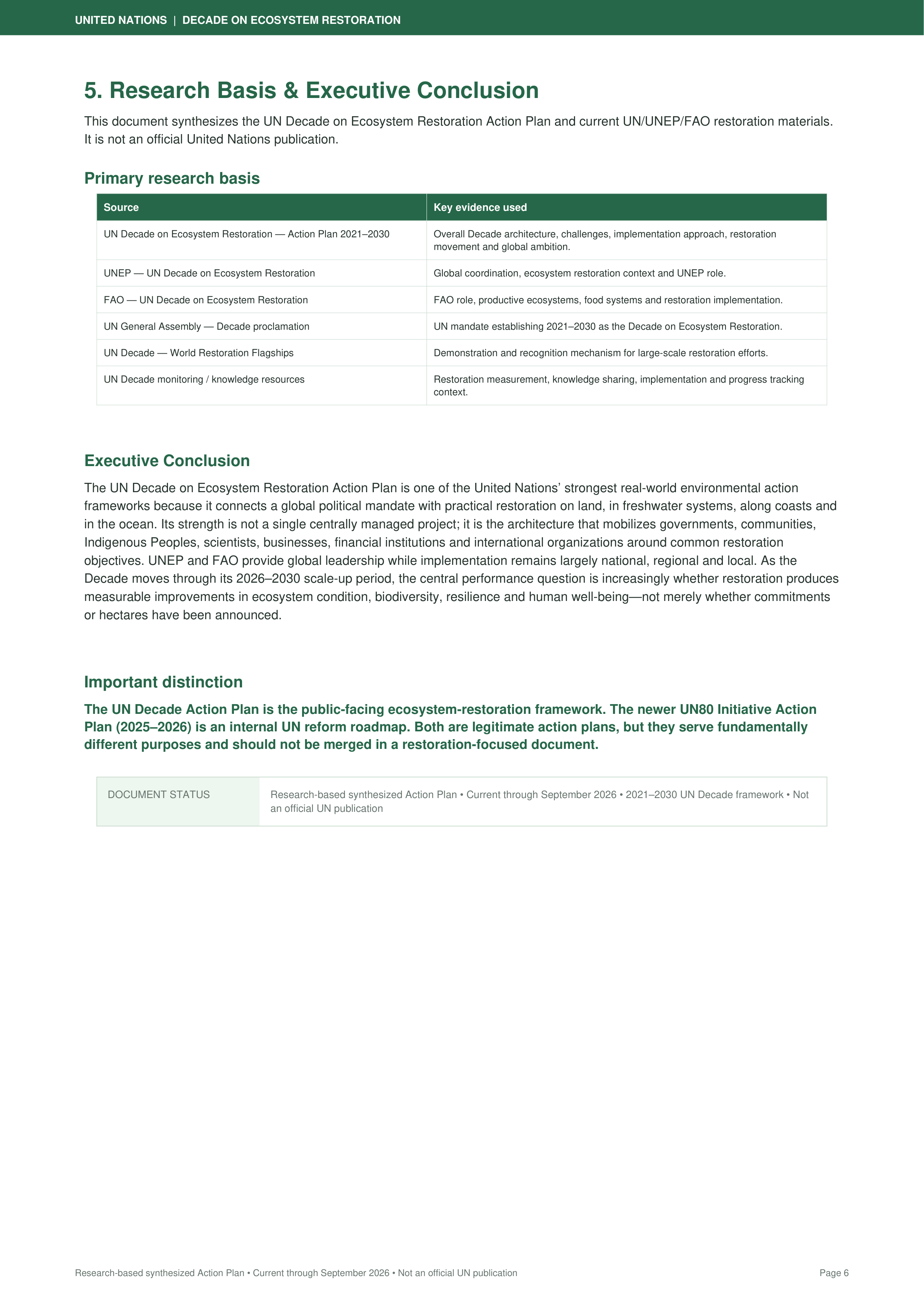
5. Research Basis & Executive Conclusion
This document synthesizes the UN Decade on Ecosystem Restoration Action Plan and current UN/UNEP/FAO restoration materials.
It is not an official United Nations publication.
Primary research basis
Source
Key evidence used
UN Decade on Ecosystem Restoration — Action Plan 2021–2030
Overall Decade architecture, challenges, implementation approach, restoration
movement and global ambition.
UNEP — UN Decade on Ecosystem Restoration
Global coordination, ecosystem restoration context and UNEP role.
FAO — UN Decade on Ecosystem Restoration
FAO role, productive ecosystems, food systems and restoration implementation.
UN General Assembly — Decade proclamation
UN mandate establishing 2021–2030 as the Decade on Ecosystem Restoration.
UN Decade — World Restoration Flagships
Demonstration and recognition mechanism for large-scale restoration efforts.
UN Decade monitoring / knowledge resources
Restoration measurement, knowledge sharing, implementation and progress tracking
context.
Executive Conclusion
The UN Decade on Ecosystem Restoration Action Plan is one of the United Nations’ strongest real-world environmental action
frameworks because it connects a global political mandate with practical restoration on land, in freshwater systems, along coasts and
in the ocean. Its strength is not a single centrally managed project; it is the architecture that mobilizes governments, communities,
Indigenous Peoples, scientists, businesses, financial institutions and international organizations around common restoration
objectives. UNEP and FAO provide global leadership while implementation remains largely national, regional and local. As the
Decade moves through its 2026–2030 scale-up period, the central performance question is increasingly whether restoration produces
measurable improvements in ecosystem condition, biodiversity, resilience and human well-being—not merely whether commitments
or hectares have been announced.
Important distinction
The UN Decade Action Plan is the public-facing ecosystem-restoration framework. The newer UN80 Initiative Action
Plan (2025–2026) is an internal UN reform roadmap. Both are legitimate action plans, but they serve fundamentally
different purposes and should not be merged in a restoration-focused document.
DOCUMENT STATUS
Research-based synthesized Action Plan • Current through September 2026 • 2021–2030 UN Decade framework • Not
an official UN publication