Research-based synthesized Action Plan • Not an official Phillips 66 publication
Page 1
PHILLIPS 66
Phillips 66’s NGL Integrated Value Chain
Expansion and Refining Optimization Action
Plan
Strategic Execution Framework • 2026–2028
I
STRATEGIC FOUNDATION
Phillips 66’s latest strategic execution is centered on building an integrated NGL value chain from the Permian wellhead through processing,
pipelines, fractionation and market access, while selectively improving the economics of its refining portfolio. The 2026 capital program
provides the clearest current foundation: approximately
$2.4 billion
of total capital, including approximately
$1.3 billion of growth capital
.
The growth program is increasingly concentrated in assets that connect production to premium markets. Iron Mesa and the newly sanctioned
Zeus gas-processing projects expand Permian capability, while the Coastal Bend system links NGL supply with Gulf Coast fractionation and
market outlets. A third Coastal Bend fractionator is planned to add another 100,000 barrels per day of fractionation capacity.
The downstream component is deliberately selective. Phillips 66 is investing in the Humber gasoline-quality improvement project and more
than 100 low-capital, high-return refining initiatives while continuing to optimize its global refinery footprint. The integration of selected Lindsey
assets with Humber demonstrates the preference for strengthening advantaged infrastructure rather than simply maintaining standalone
capacity.
Market access is another strategic layer. In August 2026, Phillips 66, Kinder Morgan and HF Sinclair reached final investment decision on the
Western Gateway Pipeline, designed to strengthen refined-products connectivity between Midcontinent/Gulf Coast supply and western
markets.
DIGITAL & OPERATING OPTIMIZATION
Phillips 66 is also applying digital tools such as Advanced Process Control across the Coastal Bend system to improve throughput, stability
and operating flexibility. Digital execution should therefore be measured through asset performance rather than through unsupported
enterprise-wide AI claims.
SUSTAINABILITY FOUNDATION
Environmental performance remains integrated into operations through greenhouse-gas, methane, water, energy-efficiency, renewable-fuels
and safety programs. These priorities complement the core economic strategy; they should not be represented as replacing Phillips 66’s
current emphasis on returns and portfolio optimization.
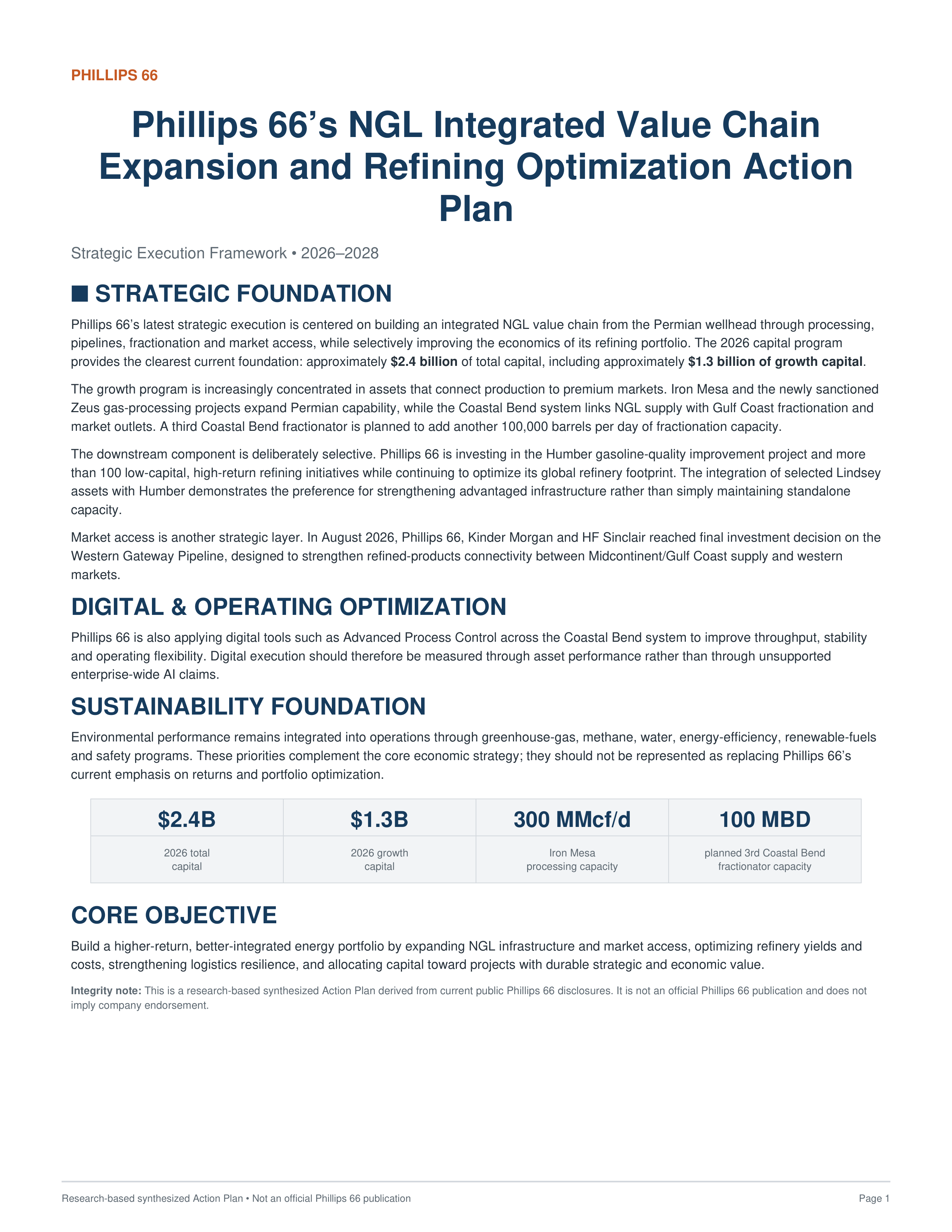
$2.4B
$1.3B
300 MMcf/d
100 MBD
2026 total
capital
2026 growth
capital
Iron Mesa
processing capacity
planned 3rd Coastal Bend
fractionator capacity
CORE OBJECTIVE
Build a higher-return, better-integrated energy portfolio by expanding NGL infrastructure and market access, optimizing refinery yields and
costs, strengthening logistics resilience, and allocating capital toward projects with durable strategic and economic value.
Integrity note:
This is a research-based synthesized Action Plan derived from current public Phillips 66 disclosures. It is not an official Phillips 66 publication and does not
imply company endorsement.
Research-based synthesized Action Plan • Not an official Phillips 66 publication
Page 2
1. Strategic Priorities & Verified Baseline
NGL Wellhead-to-Market Expansion
Develop a connected Permian-to-Gulf-Coast chain spanning gathering, gas processing, NGL transportation, fractionation and commercial
market access.
Coastal Bend Integration
Use the integrated Coastal Bend system to increase NGL transportation and fractionation capacity and improve utilization through operating
optimization and digital controls.
Refining Yield & Margin Optimization
Focus growth capital on the Humber gasoline-quality project and a broad portfolio of low-capital, high-return refinery initiatives that improve
crude/feedstock flexibility and product economics.
Portfolio Integration & Right-Sizing
Integrate strategically valuable infrastructure while exiting or restructuring assets that do not meet long-term return and competitiveness
requirements.
Western Market Connectivity
Advance Western Gateway to improve refined-product logistics, supply optionality and access to western demand centers.
Capital Discipline
Balance growth investments with sustaining capital and shareholder returns, using project economics, market resilience and execution risk as
allocation gates.
Operational & Environmental Performance
Improve reliability, throughput, energy efficiency, emissions performance, water stewardship and process safety through asset-level
execution.
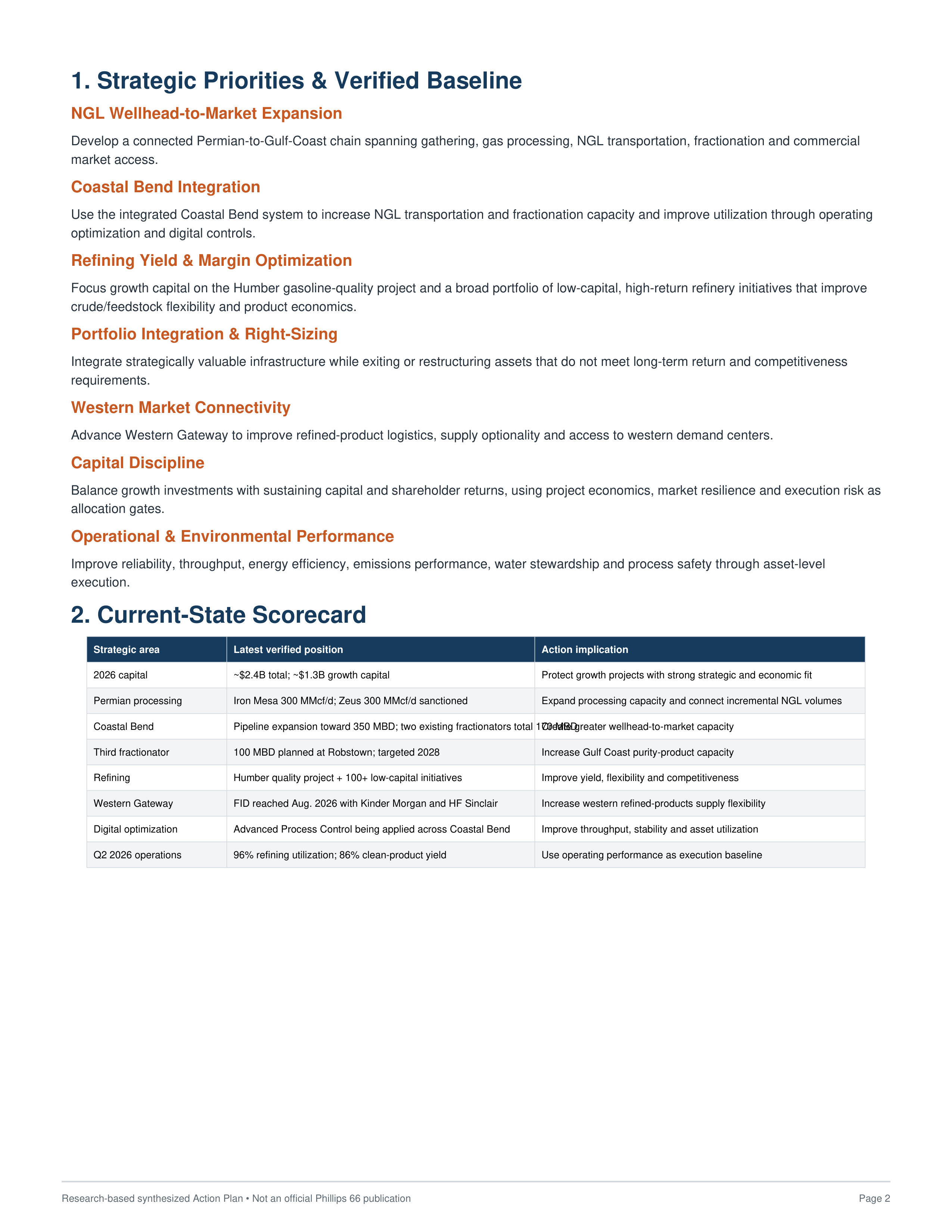
2. Current-State Scorecard
Strategic area
Latest verified position
Action implication
2026 capital
~$2.4B total; ~$1.3B growth capital
Protect growth projects with strong strategic and economic fit
Permian processing
Iron Mesa 300 MMcf/d; Zeus 300 MMcf/d sanctioned
Expand processing capacity and connect incremental NGL volumes
Coastal Bend
Pipeline expansion toward 350 MBD; two existing fractionators total 170 MBD
Create greater wellhead-to-market capacity
Third fractionator
100 MBD planned at Robstown; targeted 2028
Increase Gulf Coast purity-product capacity
Refining
Humber quality project + 100+ low-capital initiatives
Improve yield, flexibility and competitiveness
Western Gateway
FID reached Aug. 2026 with Kinder Morgan and HF Sinclair
Increase western refined-products supply flexibility
Digital optimization
Advanced Process Control being applied across Coastal Bend
Improve throughput, stability and asset utilization
Q2 2026 operations
96% refining utilization; 86% clean-product yield
Use operating performance as execution baseline
Research-based synthesized Action Plan • Not an official Phillips 66 publication
Page 3
3. Comprehensive Execution Framework
A. Permian Processing Scale
Advance Iron Mesa toward Q1 2027 startup and execute Zeus development toward 2028. Coordinate gathering, processing and downstream
NGL logistics so new capacity is matched with market access.
B. Coastal Bend Capacity Expansion
Complete the pipeline expansion toward 350 MBD, maximize integration of acquired infrastructure and prepare the 100 MBD third fractionator
for its targeted 2028 startup.
C. Fractionation & Purity-Product Capture
Coordinate fractionation, storage, transportation and export infrastructure to improve the ability to separate and market ethane, propane,
butane and other NGL products.
D. Refinery Yield Tuning
Deliver the Humber gasoline-quality improvement project and manage the portfolio of more than 100 low-capital initiatives through defined
economics, construction gates and post-startup validation.
E. Portfolio Integration
Capture the operational value of selected Lindsey infrastructure through Humber integration while maintaining disciplined evaluation of
refinery assets against competitiveness and long-term returns.
F. Western Gateway Delivery
Translate the 2026 final investment decision into permitting, engineering, construction and commercial-readiness milestones, with explicit
supply-resilience and market-access objectives.
G. Digital Operating Layer
Expand proven process-control and analytics practices where measurable throughput, stability, energy or reliability benefits can be
demonstrated. Establish baseline-versus-post-implementation measurement.
H. Reliability & Turnaround Discipline
Integrate inspection, maintenance, turnaround schedules, contractor readiness, process-safety controls and restart planning into critical-path
execution.
I. Environmental Integration
Track GHG and methane intensity, water, energy efficiency, spills, safety and renewable-fuels performance alongside financial and operating
KPIs.
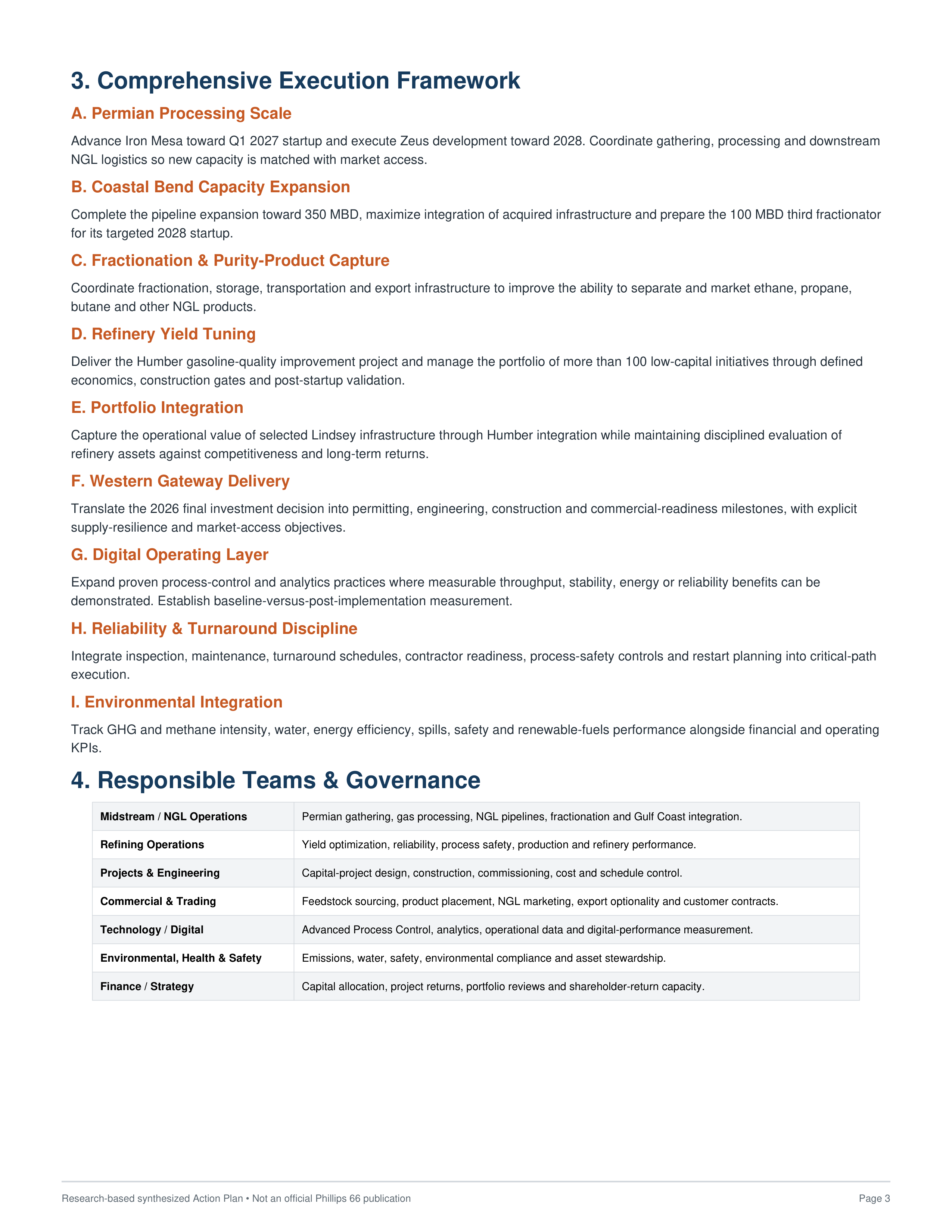
4. Responsible Teams & Governance
Midstream / NGL Operations
Permian gathering, gas processing, NGL pipelines, fractionation and Gulf Coast integration.
Refining Operations
Yield optimization, reliability, process safety, production and refinery performance.
Projects & Engineering
Capital-project design, construction, commissioning, cost and schedule control.
Commercial & Trading
Feedstock sourcing, product placement, NGL marketing, export optionality and customer contracts.
Technology / Digital
Advanced Process Control, analytics, operational data and digital-performance measurement.
Environmental, Health & Safety
Emissions, water, safety, environmental compliance and asset stewardship.
Finance / Strategy
Capital allocation, project returns, portfolio reviews and shareholder-return capacity.
Research-based synthesized Action Plan • Not an official Phillips 66 publication
Page 4
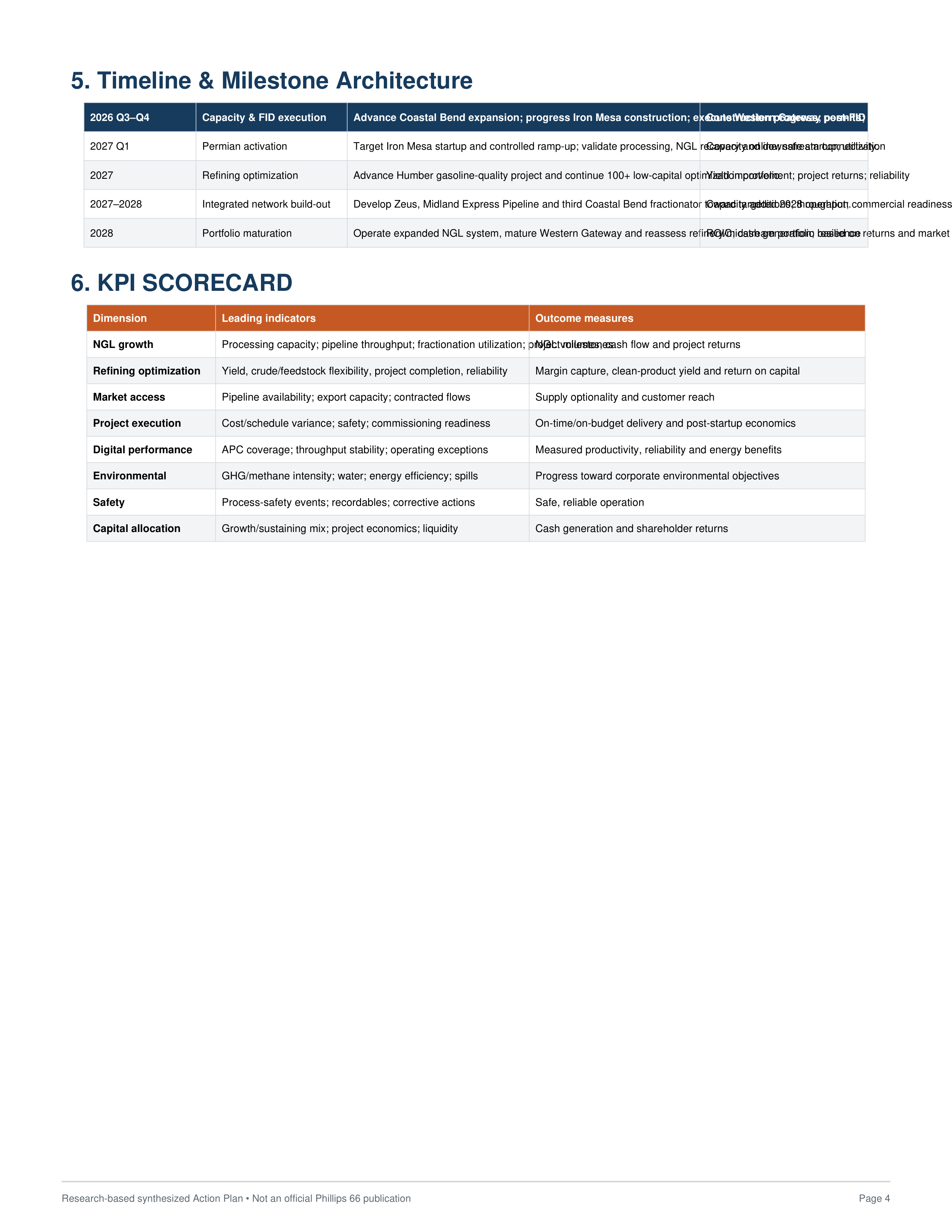
5. Timeline & Milestone Architecture
2026 Q3–Q4
Capacity & FID execution
Advance Coastal Bend expansion; progress Iron Mesa construction; execute Western Gateway post-FID work; prepare Ze
Construction progress; permits; spend vs. plan
2027 Q1
Permian activation
Target Iron Mesa startup and controlled ramp-up; validate processing, NGL recovery and downstream connectivity.
Capacity online; safe startup; utilization
2027
Refining optimization
Advance Humber gasoline-quality project and continue 100+ low-capital optimization portfolio.
Yield improvement; project returns; reliability
2027–2028
Integrated network build-out
Develop Zeus, Midland Express Pipeline and third Coastal Bend fractionator toward targeted 2028 operation.
Capacity additions; throughput; commercial readiness
2028
Portfolio maturation
Operate expanded NGL system, mature Western Gateway and reassess refinery/midstream portfolio based on returns and market
ROIC; cash generation; resilience
6. KPI SCORECARD
Dimension
Leading indicators
Outcome measures
NGL growth
Processing capacity; pipeline throughput; fractionation utilization; project milestones
NGL volumes, cash flow and project returns
Refining optimization
Yield, crude/feedstock flexibility, project completion, reliability
Margin capture, clean-product yield and return on capital
Market access
Pipeline availability; export capacity; contracted flows
Supply optionality and customer reach
Project execution
Cost/schedule variance; safety; commissioning readiness
On-time/on-budget delivery and post-startup economics
Digital performance
APC coverage; throughput stability; operating exceptions
Measured productivity, reliability and energy benefits
Environmental
GHG/methane intensity; water; energy efficiency; spills
Progress toward corporate environmental objectives
Safety
Process-safety events; recordables; corrective actions
Safe, reliable operation
Capital allocation
Growth/sustaining mix; project economics; liquidity
Cash generation and shareholder returns
Research-based synthesized Action Plan • Not an official Phillips 66 publication
Page 5
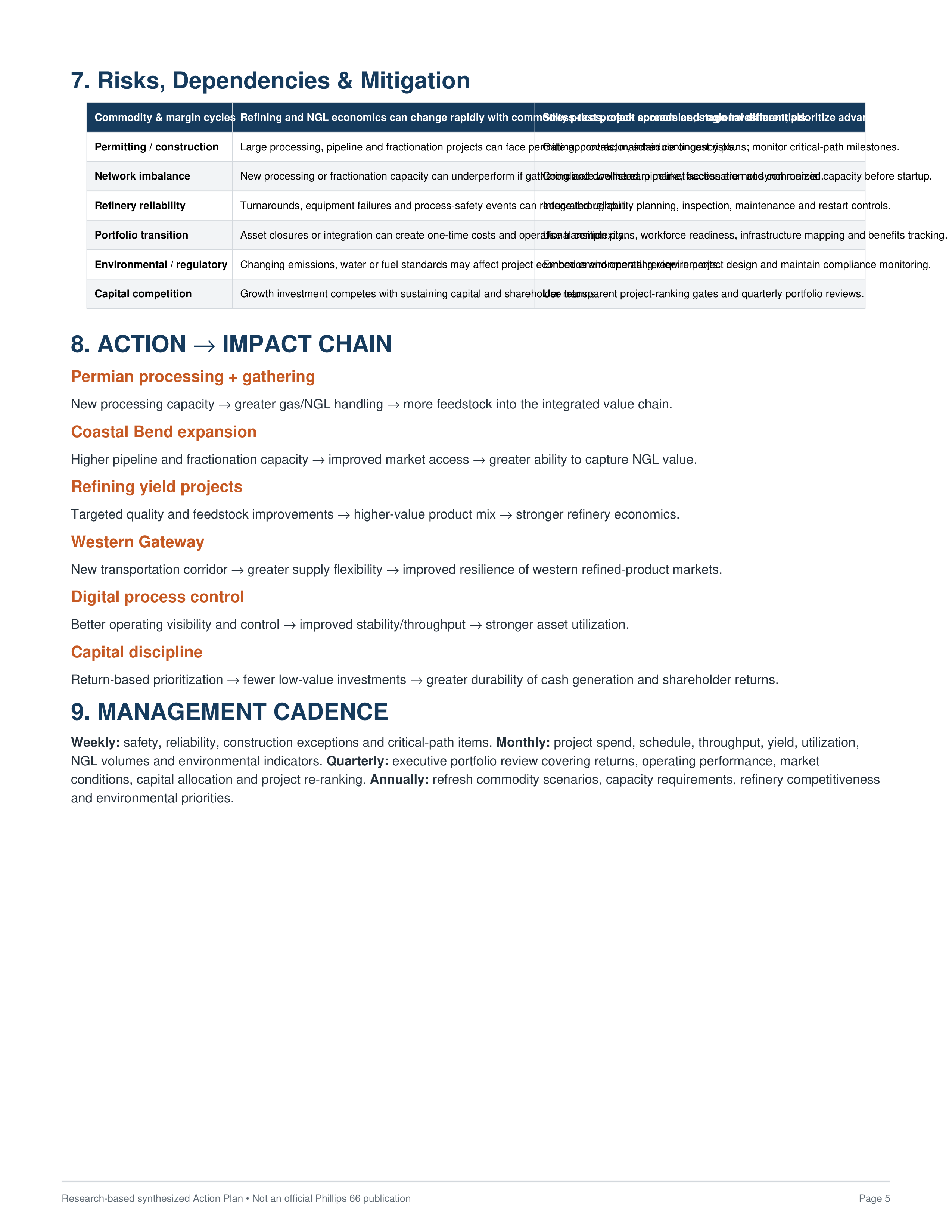
7. Risks, Dependencies & Mitigation
Commodity & margin cycles
Refining and NGL economics can change rapidly with commodity prices, crack spreads and regional differentials.
Stress-test project economics; stage investment; prioritize advantaged infrastruct
Permitting / construction
Large processing, pipeline and fractionation projects can face permitting, contractor, schedule or cost risks.
Gate approvals; maintain contingency plans; monitor critical-path milestones.
Network imbalance
New processing or fractionation capacity can underperform if gathering and downstream market access are not synchronized.
Coordinate wellhead, pipeline, fractionation and commercial capacity before startup.
Refinery reliability
Turnarounds, equipment failures and process-safety events can reduce throughput.
Integrated reliability planning, inspection, maintenance and restart controls.
Portfolio transition
Asset closures or integration can create one-time costs and operational complexity.
Use transition plans, workforce readiness, infrastructure mapping and benefits tracking.
Environmental / regulatory
Changing emissions, water or fuel standards may affect project economics and operating requirements.
Embed environmental review in project design and maintain compliance monitoring.
Capital competition
Growth investment competes with sustaining capital and shareholder returns.
Use transparent project-ranking gates and quarterly portfolio reviews.
8. ACTION
→
IMPACT CHAIN
Permian processing + gathering
New processing capacity
→
greater gas/NGL handling
→
more feedstock into the integrated value chain.
Coastal Bend expansion
Higher pipeline and fractionation capacity
→
improved market access
→
greater ability to capture NGL value.
Refining yield projects
Targeted quality and feedstock improvements
→
higher-value product mix
→
stronger refinery economics.
Western Gateway
New transportation corridor
→
greater supply flexibility
→
improved resilience of western refined-product markets.
Digital process control
Better operating visibility and control
→
improved stability/throughput
→
stronger asset utilization.
Capital discipline
Return-based prioritization
→
fewer low-value investments
→
greater durability of cash generation and shareholder returns.
9. MANAGEMENT CADENCE
Weekly:
safety, reliability, construction exceptions and critical-path items.
Monthly:
project spend, schedule, throughput, yield, utilization,
NGL volumes and environmental indicators.
Quarterly:
executive portfolio review covering returns, operating performance, market
conditions, capital allocation and project re-ranking.
Annually:
refresh commodity scenarios, capacity requirements, refinery competitiveness
and environmental priorities.
Research-based synthesized Action Plan • Not an official Phillips 66 publication
Page 6
10. Research Basis & Executive Conclusion
This action plan synthesizes the latest publicly disclosed Phillips 66 strategic, capital, operating and project information available through
September 2026. Current verified figures are separated from recommended execution mechanisms, and unsupported claims from earlier
formulations have been excluded.
Primary evidence reflected in this framework
• Phillips 66’s 2026 capital budget is approximately $2.4 billion, including approximately $1.3 billion of growth capital.
• Iron Mesa is a 300 MMcf/d Permian gas-processing project targeted for Q1 2027 startup.
• Zeus is a newly sanctioned 300 MMcf/d Permian gas plant with associated Midland Express Pipeline infrastructure, targeted for 2028.
• Coastal Bend pipeline capacity is being expanded toward 350 MBD; a third 100 MBD fractionator is planned in Robstown for 2028.
• The Humber gasoline-quality improvement project and more than 100 low-capital, high-return refining initiatives form a core part of the 2026
refining growth program.
• Western Gateway reached final investment decision in August 2026 with Kinder Morgan and HF Sinclair.
• Q2 2026 operating results included 96% Refining utilization and 86% clean-product yield, providing a current performance baseline.
• Advanced Process Control is being applied across Coastal Bend to improve throughput, stability and operating flexibility.
SOURCE BASIS
Primary sources: Phillips 66 Investor Relations — 2026 Capital Budget; Phillips 66 Q2 2026 Results; Phillips 66 newsroom releases on Coastal Bend, Iron Mesa, Zeus and
Western Gateway; Phillips 66 operating, sustainability and investor materials. Supplemental context was used only where it did not override primary-company disclosures.
FINAL EXECUTIVE TAKEAWAY
Phillips 66’s latest real-world strategy is best represented as an
integrated value-chain optimization program
. The company is expanding
advantaged NGL infrastructure from the Permian to Gulf Coast markets, improving fractionation and logistics connectivity, selectively
upgrading refining assets, integrating strategically useful infrastructure, and strengthening western-market supply optionality. The winning
execution model is therefore not maximum capacity at any cost; it is
connected capacity + higher-value yields + market access +
disciplined capital allocation
.
Research-based synthesized Action Plan • Not an official Phillips 66 publication • Prepared September 2026