BOSTON CONSULTING GROUP | NET-ZERO ACTION PLAN
Research-based synthesized Action Plan • Not an official BCG publication
Page 1
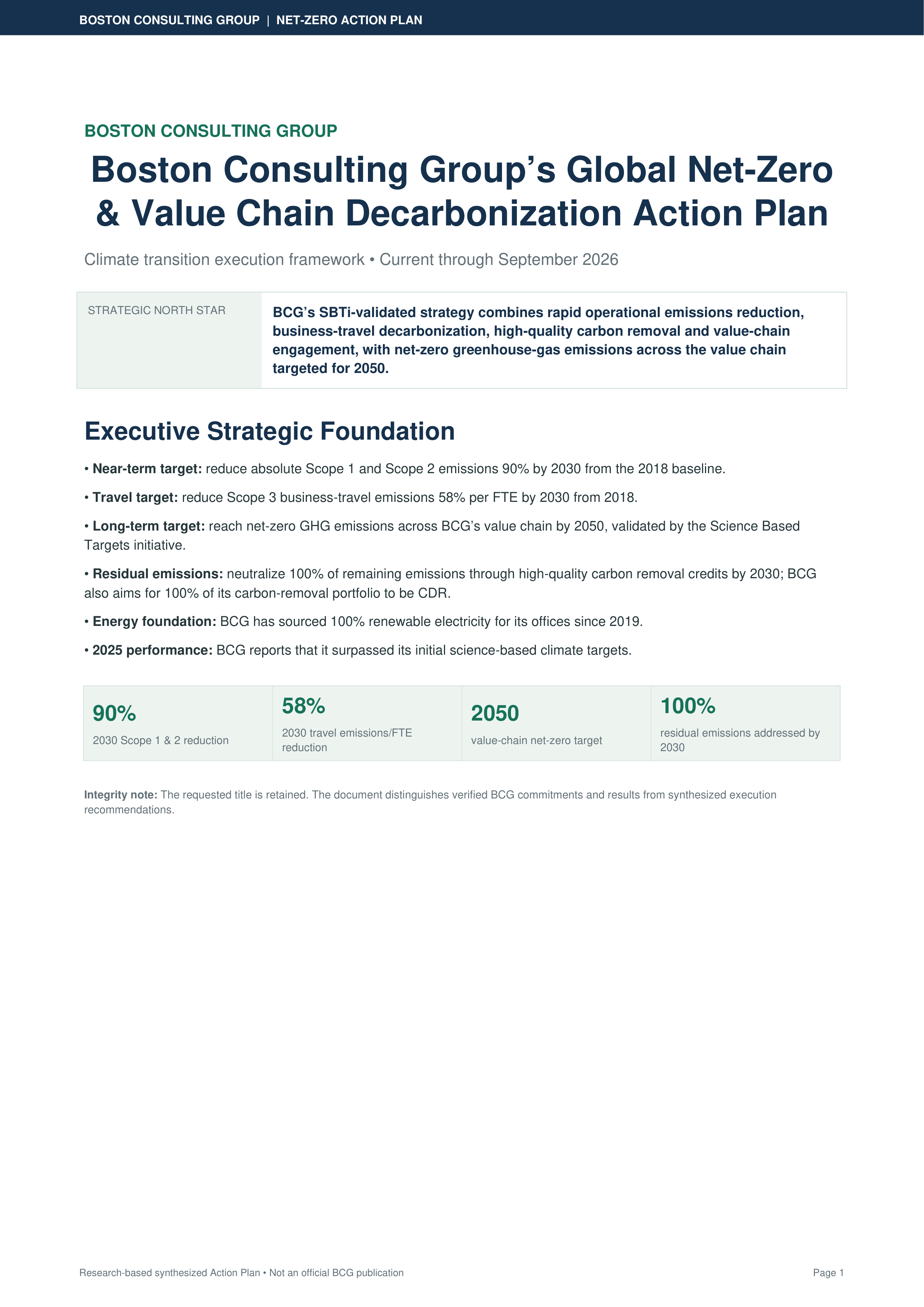
BOSTON CONSULTING GROUP
Boston Consulting Group’s Global Net-Zero
& Value Chain Decarbonization Action Plan
Climate transition execution framework • Current through September 2026
STRATEGIC NORTH STAR
BCG’s SBTi-validated strategy combines rapid operational emissions reduction,
business-travel decarbonization, high-quality carbon removal and value-chain
engagement, with net-zero greenhouse-gas emissions across the value chain
targeted for 2050.
Executive Strategic Foundation
•
Near-term target:
reduce absolute Scope 1 and Scope 2 emissions 90% by 2030 from the 2018 baseline.
•
Travel target:
reduce Scope 3 business-travel emissions 58% per FTE by 2030 from 2018.
•
Long-term target:
reach net-zero GHG emissions across BCG’s value chain by 2050, validated by the Science Based
Targets initiative.
•
Residual emissions:
neutralize 100% of remaining emissions through high-quality carbon removal credits by 2030; BCG
also aims for 100% of its carbon-removal portfolio to be CDR.
•
Energy foundation:
BCG has sourced 100% renewable electricity for its offices since 2019.
•
2025 performance:
BCG reports that it surpassed its initial science-based climate targets.
90%
2030 Scope 1 & 2 reduction
58%
2030 travel emissions/FTE
reduction
2050
value-chain net-zero target
100%
residual emissions addressed by
2030
Integrity note:
The requested title is retained. The document distinguishes verified BCG commitments and results from synthesized execution
recommendations.
BOSTON CONSULTING GROUP | NET-ZERO ACTION PLAN
Research-based synthesized Action Plan • Not an official BCG publication
Page 2
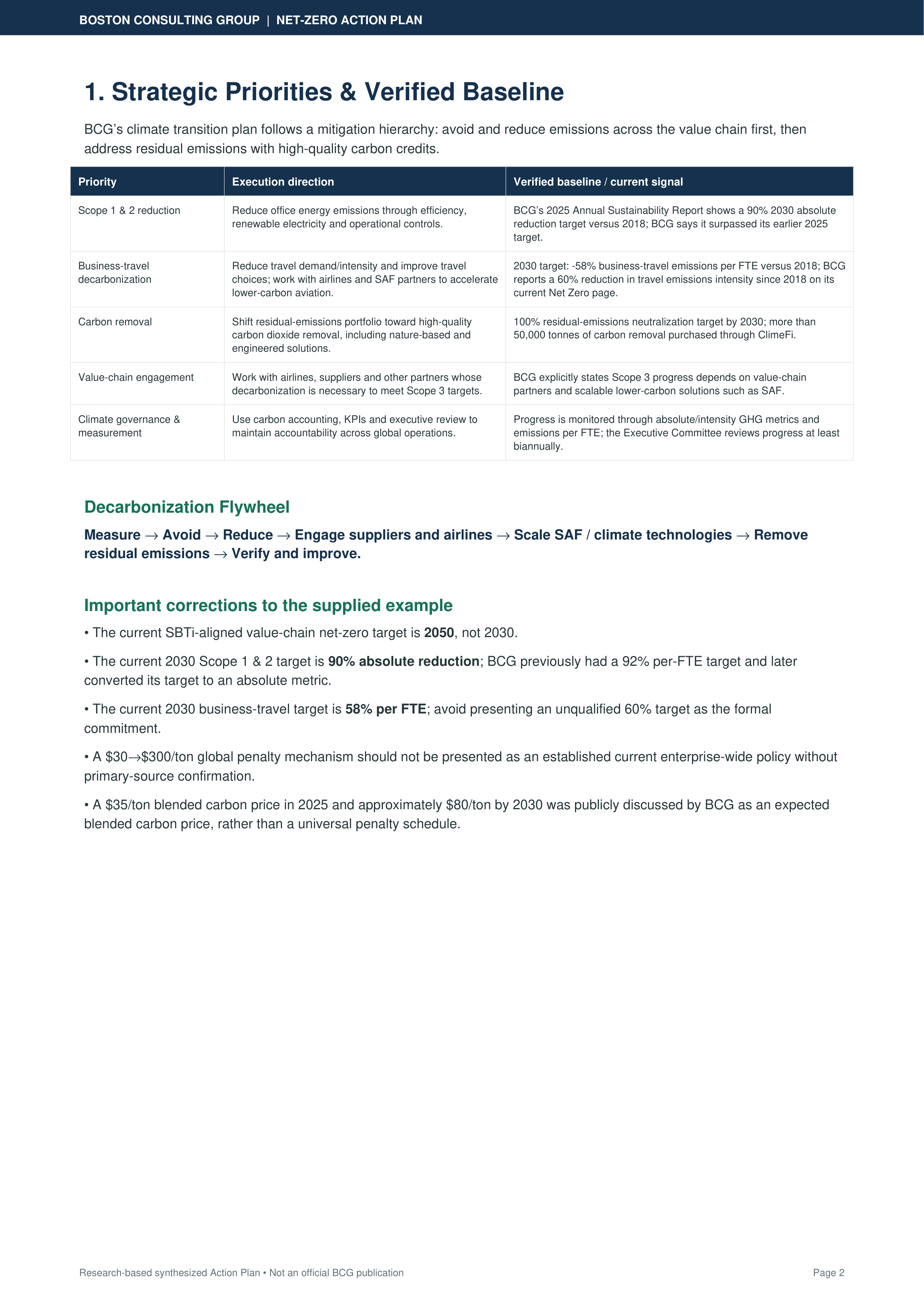
1. Strategic Priorities & Verified Baseline
BCG’s climate transition plan follows a mitigation hierarchy: avoid and reduce emissions across the value chain first, then
address residual emissions with high-quality carbon credits.
Priority
Execution direction
Verified baseline / current signal
Scope 1 & 2 reduction
Reduce office energy emissions through efficiency,
renewable electricity and operational controls.
BCG’s 2025 Annual Sustainability Report shows a 90% 2030 absolute
reduction target versus 2018; BCG says it surpassed its earlier 2025
target.
Business-travel
decarbonization
Reduce travel demand/intensity and improve travel
choices; work with airlines and SAF partners to accelerate
lower-carbon aviation.
2030 target: -58% business-travel emissions per FTE versus 2018; BCG
reports a 60% reduction in travel emissions intensity since 2018 on its
current Net Zero page.
Carbon removal
Shift residual-emissions portfolio toward high-quality
carbon dioxide removal, including nature-based and
engineered solutions.
100% residual-emissions neutralization target by 2030; more than
50,000 tonnes of carbon removal purchased through ClimeFi.
Value-chain engagement
Work with airlines, suppliers and other partners whose
decarbonization is necessary to meet Scope 3 targets.
BCG explicitly states Scope 3 progress depends on value-chain
partners and scalable lower-carbon solutions such as SAF.
Climate governance &
measurement
Use carbon accounting, KPIs and executive review to
maintain accountability across global operations.
Progress is monitored through absolute/intensity GHG metrics and
emissions per FTE; the Executive Committee reviews progress at least
biannually.
Decarbonization Flywheel
Measure
→
Avoid
→
Reduce
→
Engage suppliers and airlines
→
Scale SAF / climate technologies
→
Remove
residual emissions
→
Verify and improve.
Important corrections to the supplied example
• The current SBTi-aligned value-chain net-zero target is
2050
, not 2030.
• The current 2030 Scope 1 & 2 target is
90% absolute reduction
; BCG previously had a 92% per-FTE target and later
converted its target to an absolute metric.
• The current 2030 business-travel target is
58% per FTE
; avoid presenting an unqualified 60% target as the formal
commitment.
• A $30
→
$300/ton global penalty mechanism should not be presented as an established current enterprise-wide policy without
primary-source confirmation.
• A $35/ton blended carbon price in 2025 and approximately $80/ton by 2030 was publicly discussed by BCG as an expected
blended carbon price, rather than a universal penalty schedule.
BOSTON CONSULTING GROUP | NET-ZERO ACTION PLAN
Research-based synthesized Action Plan • Not an official BCG publication
Page 3
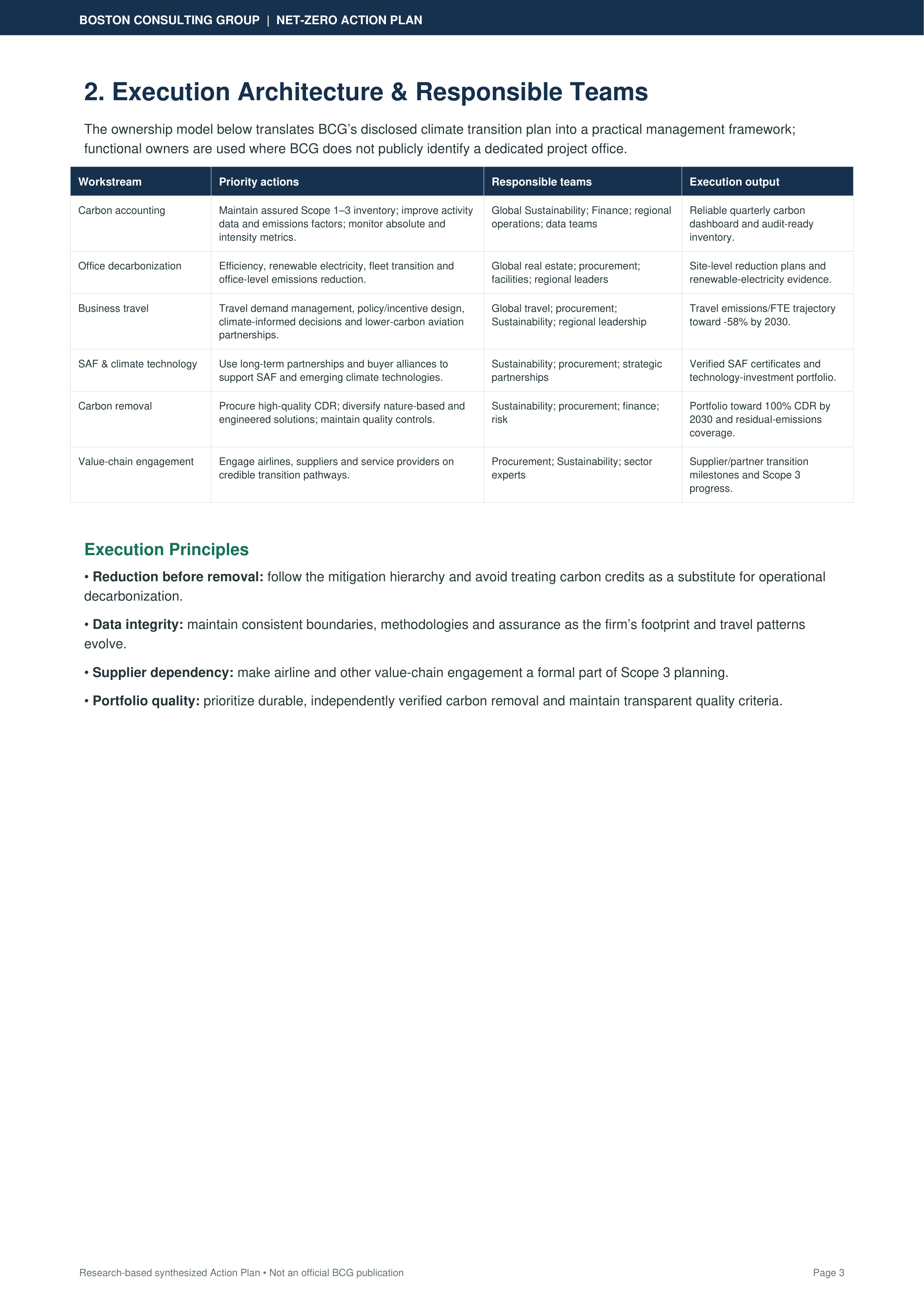
2. Execution Architecture & Responsible Teams
The ownership model below translates BCG’s disclosed climate transition plan into a practical management framework;
functional owners are used where BCG does not publicly identify a dedicated project office.
Workstream
Priority actions
Responsible teams
Execution output
Carbon accounting
Maintain assured Scope 1–3 inventory; improve activity
data and emissions factors; monitor absolute and
intensity metrics.
Global Sustainability; Finance; regional
operations; data teams
Reliable quarterly carbon
dashboard and audit-ready
inventory.
Office decarbonization
Efficiency, renewable electricity, fleet transition and
office-level emissions reduction.
Global real estate; procurement;
facilities; regional leaders
Site-level reduction plans and
renewable-electricity evidence.
Business travel
Travel demand management, policy/incentive design,
climate-informed decisions and lower-carbon aviation
partnerships.
Global travel; procurement;
Sustainability; regional leadership
Travel emissions/FTE trajectory
toward -58% by 2030.
SAF & climate technology
Use long-term partnerships and buyer alliances to
support SAF and emerging climate technologies.
Sustainability; procurement; strategic
partnerships
Verified SAF certificates and
technology-investment portfolio.
Carbon removal
Procure high-quality CDR; diversify nature-based and
engineered solutions; maintain quality controls.
Sustainability; procurement; finance;
risk
Portfolio toward 100% CDR by
2030 and residual-emissions
coverage.
Value-chain engagement
Engage airlines, suppliers and service providers on
credible transition pathways.
Procurement; Sustainability; sector
experts
Supplier/partner transition
milestones and Scope 3
progress.
Execution Principles
•
Reduction before removal:
follow the mitigation hierarchy and avoid treating carbon credits as a substitute for operational
decarbonization.
•
Data integrity:
maintain consistent boundaries, methodologies and assurance as the firm’s footprint and travel patterns
evolve.
•
Supplier dependency:
make airline and other value-chain engagement a formal part of Scope 3 planning.
•
Portfolio quality:
prioritize durable, independently verified carbon removal and maintain transparent quality criteria.
BOSTON CONSULTING GROUP | NET-ZERO ACTION PLAN
Research-based synthesized Action Plan • Not an official BCG publication
Page 4
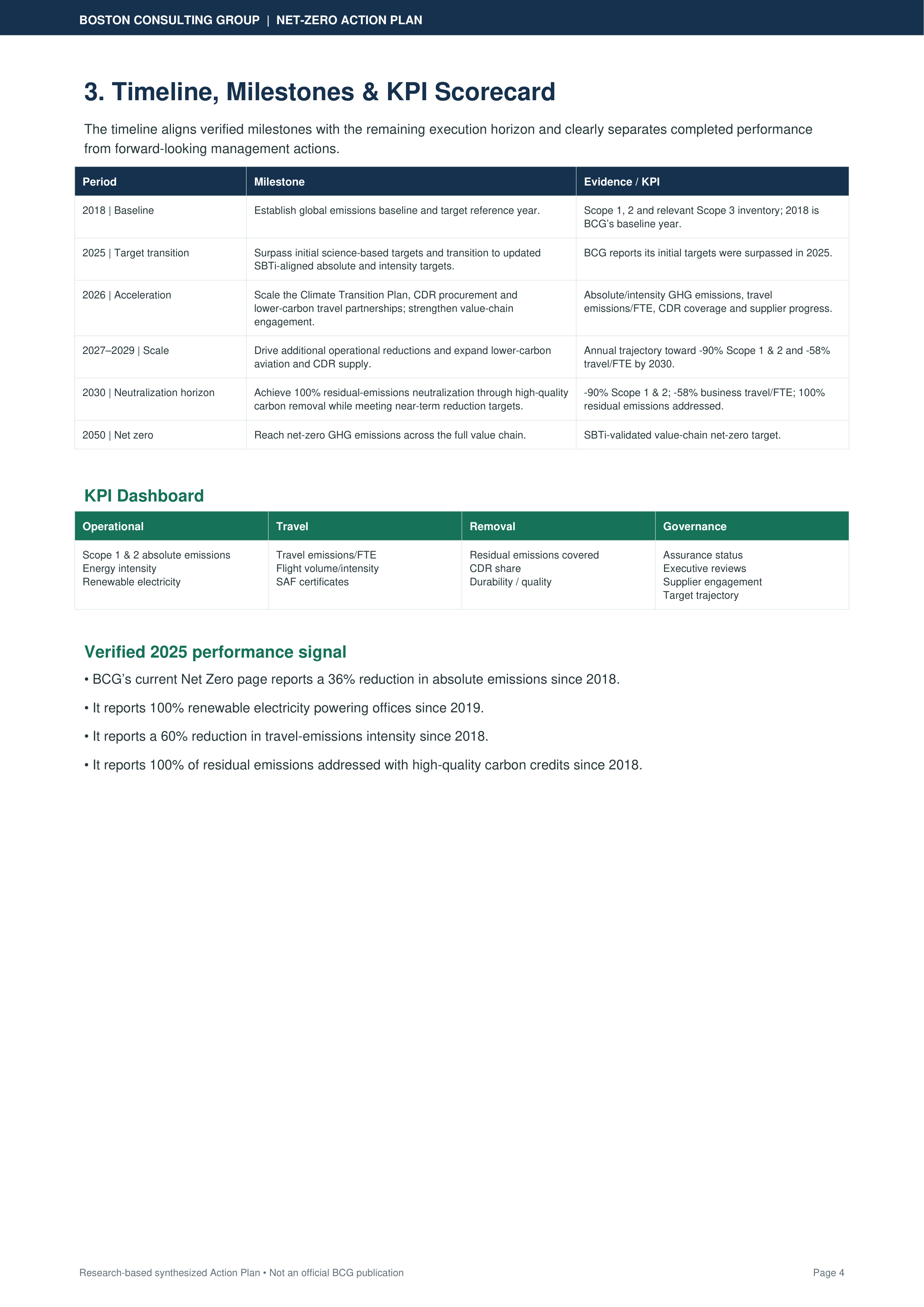
3. Timeline, Milestones & KPI Scorecard
The timeline aligns verified milestones with the remaining execution horizon and clearly separates completed performance
from forward-looking management actions.
Period
Milestone
Evidence / KPI
2018 | Baseline
Establish global emissions baseline and target reference year.
Scope 1, 2 and relevant Scope 3 inventory; 2018 is
BCG’s baseline year.
2025 | Target transition
Surpass initial science-based targets and transition to updated
SBTi-aligned absolute and intensity targets.
BCG reports its initial targets were surpassed in 2025.
2026 | Acceleration
Scale the Climate Transition Plan, CDR procurement and
lower-carbon travel partnerships; strengthen value-chain
engagement.
Absolute/intensity GHG emissions, travel
emissions/FTE, CDR coverage and supplier progress.
2027–2029 | Scale
Drive additional operational reductions and expand lower-carbon
aviation and CDR supply.
Annual trajectory toward -90% Scope 1 & 2 and -58%
travel/FTE by 2030.
2030 | Neutralization horizon
Achieve 100% residual-emissions neutralization through high-quality
carbon removal while meeting near-term reduction targets.
-90% Scope 1 & 2; -58% business travel/FTE; 100%
residual emissions addressed.
2050 | Net zero
Reach net-zero GHG emissions across the full value chain.
SBTi-validated value-chain net-zero target.
KPI Dashboard
Operational
Travel
Removal
Governance
Scope 1 & 2 absolute emissions
Energy intensity
Renewable electricity
Travel emissions/FTE
Flight volume/intensity
SAF certificates
Residual emissions covered
CDR share
Durability / quality
Assurance status
Executive reviews
Supplier engagement
Target trajectory
Verified 2025 performance signal
• BCG’s current Net Zero page reports a 36% reduction in absolute emissions since 2018.
• It reports 100% renewable electricity powering offices since 2019.
• It reports a 60% reduction in travel-emissions intensity since 2018.
• It reports 100% of residual emissions addressed with high-quality carbon credits since 2018.
BOSTON CONSULTING GROUP | NET-ZERO ACTION PLAN
Research-based synthesized Action Plan • Not an official BCG publication
Page 5
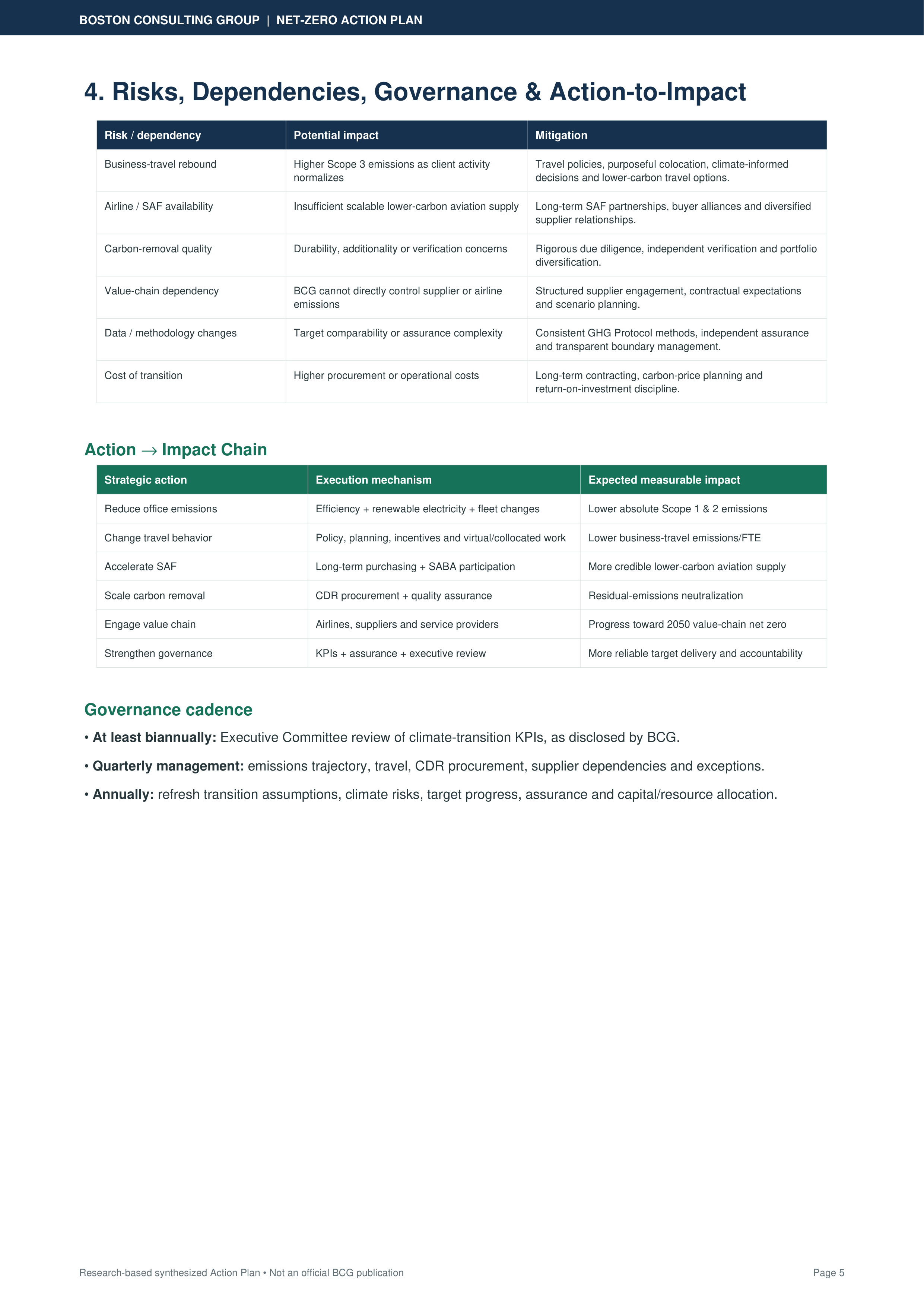
4. Risks, Dependencies, Governance & Action-to-Impact
Risk / dependency
Potential impact
Mitigation
Business-travel rebound
Higher Scope 3 emissions as client activity
normalizes
Travel policies, purposeful colocation, climate-informed
decisions and lower-carbon travel options.
Airline / SAF availability
Insufficient scalable lower-carbon aviation supply
Long-term SAF partnerships, buyer alliances and diversified
supplier relationships.
Carbon-removal quality
Durability, additionality or verification concerns
Rigorous due diligence, independent verification and portfolio
diversification.
Value-chain dependency
BCG cannot directly control supplier or airline
emissions
Structured supplier engagement, contractual expectations
and scenario planning.
Data / methodology changes
Target comparability or assurance complexity
Consistent GHG Protocol methods, independent assurance
and transparent boundary management.
Cost of transition
Higher procurement or operational costs
Long-term contracting, carbon-price planning and
return-on-investment discipline.
Action
→
Impact Chain
Strategic action
Execution mechanism
Expected measurable impact
Reduce office emissions
Efficiency + renewable electricity + fleet changes
Lower absolute Scope 1 & 2 emissions
Change travel behavior
Policy, planning, incentives and virtual/collocated work
Lower business-travel emissions/FTE
Accelerate SAF
Long-term purchasing + SABA participation
More credible lower-carbon aviation supply
Scale carbon removal
CDR procurement + quality assurance
Residual-emissions neutralization
Engage value chain
Airlines, suppliers and service providers
Progress toward 2050 value-chain net zero
Strengthen governance
KPIs + assurance + executive review
More reliable target delivery and accountability
Governance cadence
•
At least biannually:
Executive Committee review of climate-transition KPIs, as disclosed by BCG.
•
Quarterly management:
emissions trajectory, travel, CDR procurement, supplier dependencies and exceptions.
•
Annually:
refresh transition assumptions, climate risks, target progress, assurance and capital/resource allocation.
BOSTON CONSULTING GROUP | NET-ZERO ACTION PLAN
Research-based synthesized Action Plan • Not an official BCG publication
Page 6
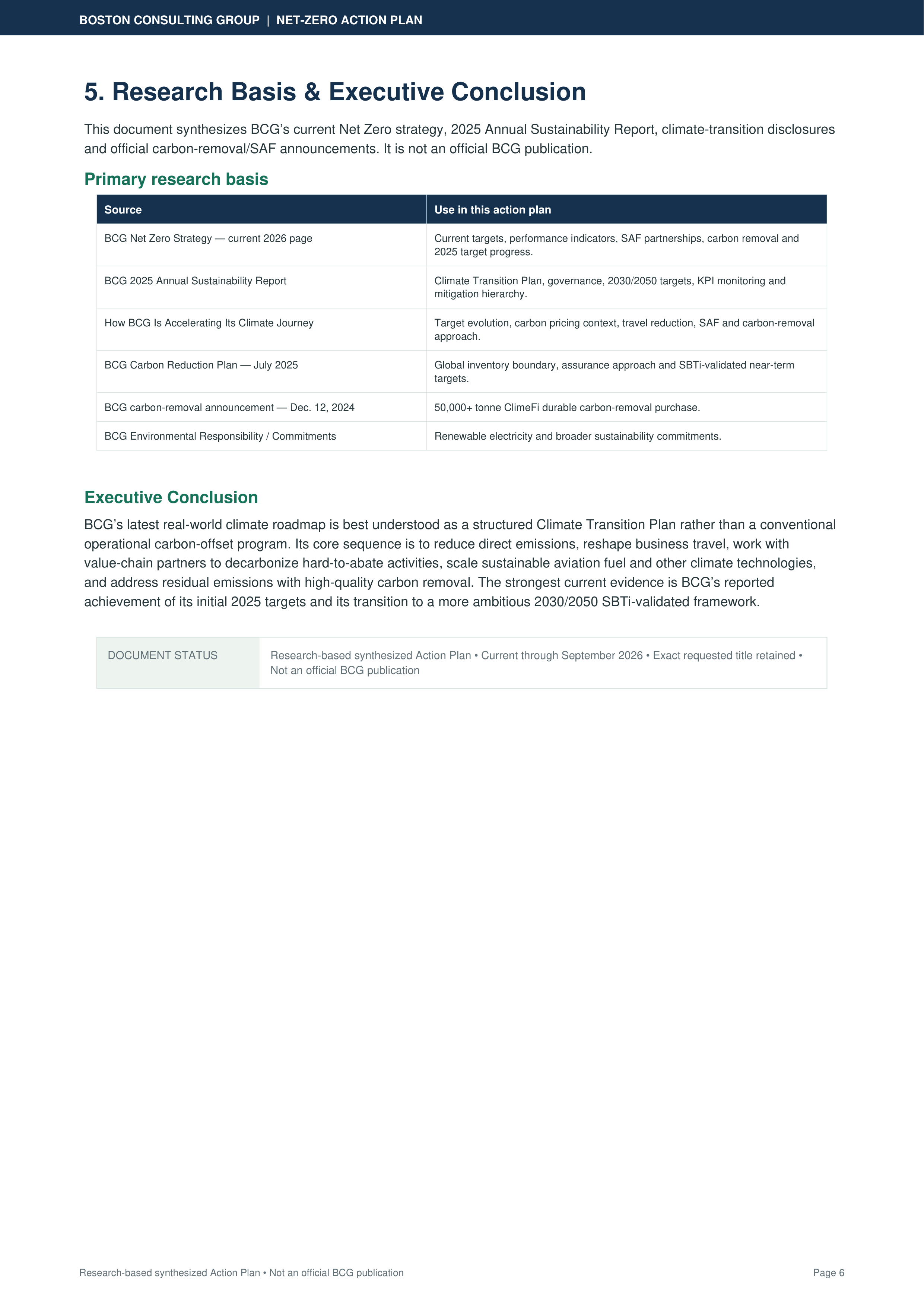
5. Research Basis & Executive Conclusion
This document synthesizes BCG’s current Net Zero strategy, 2025 Annual Sustainability Report, climate-transition disclosures
and official carbon-removal/SAF announcements. It is not an official BCG publication.
Primary research basis
Source
Use in this action plan
BCG Net Zero Strategy — current 2026 page
Current targets, performance indicators, SAF partnerships, carbon removal and
2025 target progress.
BCG 2025 Annual Sustainability Report
Climate Transition Plan, governance, 2030/2050 targets, KPI monitoring and
mitigation hierarchy.
How BCG Is Accelerating Its Climate Journey
Target evolution, carbon pricing context, travel reduction, SAF and carbon-removal
approach.
BCG Carbon Reduction Plan — July 2025
Global inventory boundary, assurance approach and SBTi-validated near-term
targets.
BCG carbon-removal announcement — Dec. 12, 2024
50,000+ tonne ClimeFi durable carbon-removal purchase.
BCG Environmental Responsibility / Commitments
Renewable electricity and broader sustainability commitments.
Executive Conclusion
BCG’s latest real-world climate roadmap is best understood as a structured Climate Transition Plan rather than a conventional
operational carbon-offset program. Its core sequence is to reduce direct emissions, reshape business travel, work with
value-chain partners to decarbonize hard-to-abate activities, scale sustainable aviation fuel and other climate technologies,
and address residual emissions with high-quality carbon removal. The strongest current evidence is BCG’s reported
achievement of its initial 2025 targets and its transition to a more ambitious 2030/2050 SBTi-validated framework.
DOCUMENT STATUS
Research-based synthesized Action Plan • Current through September 2026 • Exact requested title retained •
Not an official BCG publication