SCALED AGILE | PROGRAM INCREMENT PLANNING FRAMEWORK
Program Increment Planning • Agile Release Train • Business Agility
Page 1
SCALED AGILE
Program Increment (PI) Planning Framework
Action Plan
Enterprise alignment • Agile Release Train • PI Objectives • Dependency management • Continuous delivery
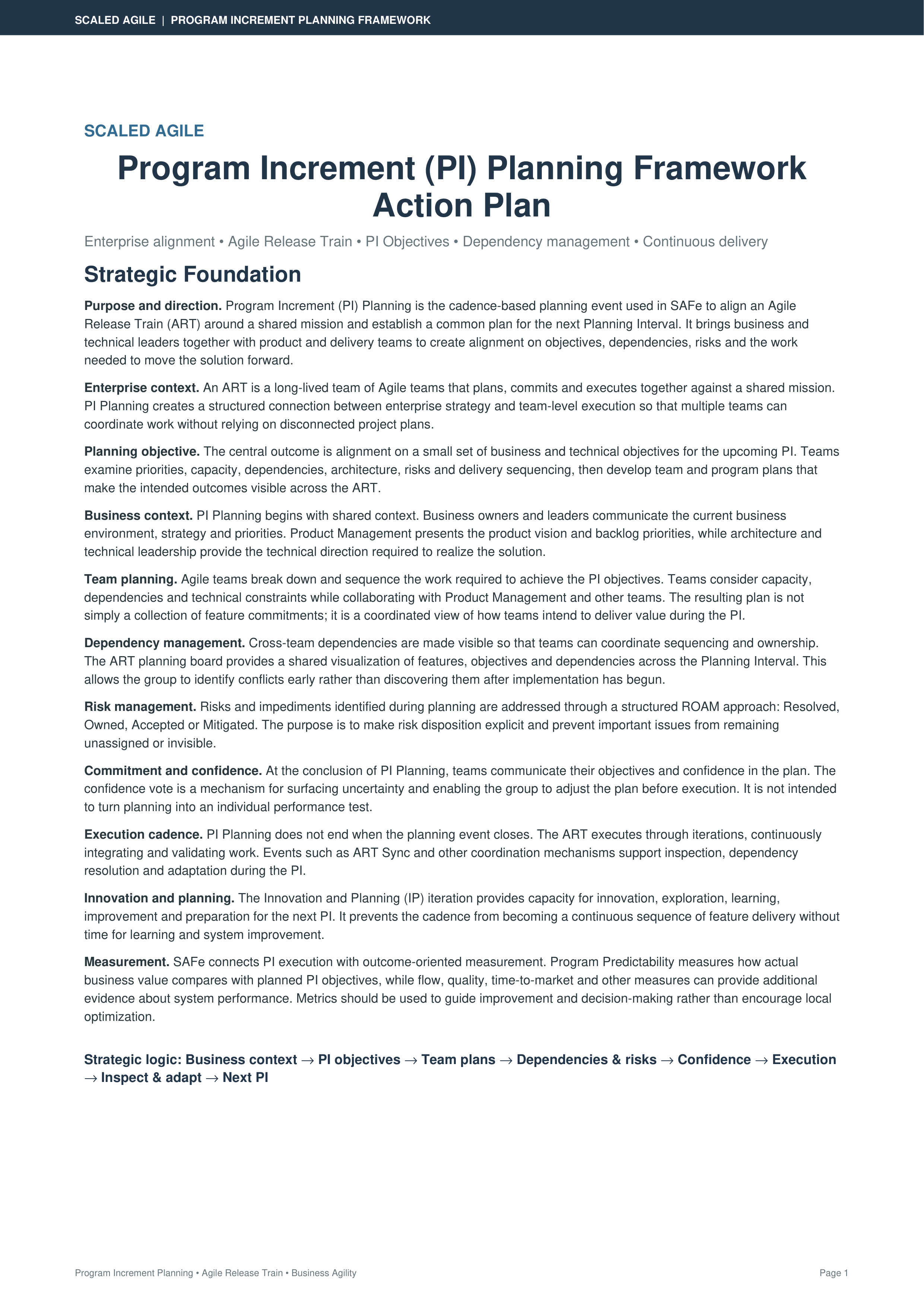
Strategic Foundation
Purpose and direction.
Program Increment (PI) Planning is the cadence-based planning event used in SAFe to align an Agile
Release Train (ART) around a shared mission and establish a common plan for the next Planning Interval. It brings business and
technical leaders together with product and delivery teams to create alignment on objectives, dependencies, risks and the work
needed to move the solution forward.
Enterprise context.
An ART is a long-lived team of Agile teams that plans, commits and executes together against a shared mission.
PI Planning creates a structured connection between enterprise strategy and team-level execution so that multiple teams can
coordinate work without relying on disconnected project plans.
Planning objective.
The central outcome is alignment on a small set of business and technical objectives for the upcoming PI. Teams
examine priorities, capacity, dependencies, architecture, risks and delivery sequencing, then develop team and program plans that
make the intended outcomes visible across the ART.
Business context.
PI Planning begins with shared context. Business owners and leaders communicate the current business
environment, strategy and priorities. Product Management presents the product vision and backlog priorities, while architecture and
technical leadership provide the technical direction required to realize the solution.
Team planning.
Agile teams break down and sequence the work required to achieve the PI objectives. Teams consider capacity,
dependencies and technical constraints while collaborating with Product Management and other teams. The resulting plan is not
simply a collection of feature commitments; it is a coordinated view of how teams intend to deliver value during the PI.
Dependency management.
Cross-team dependencies are made visible so that teams can coordinate sequencing and ownership.
The ART planning board provides a shared visualization of features, objectives and dependencies across the Planning Interval. This
allows the group to identify conflicts early rather than discovering them after implementation has begun.
Risk management.
Risks and impediments identified during planning are addressed through a structured ROAM approach: Resolved,
Owned, Accepted or Mitigated. The purpose is to make risk disposition explicit and prevent important issues from remaining
unassigned or invisible.
Commitment and confidence.
At the conclusion of PI Planning, teams communicate their objectives and confidence in the plan. The
confidence vote is a mechanism for surfacing uncertainty and enabling the group to adjust the plan before execution. It is not intended
to turn planning into an individual performance test.
Execution cadence.
PI Planning does not end when the planning event closes. The ART executes through iterations, continuously
integrating and validating work. Events such as ART Sync and other coordination mechanisms support inspection, dependency
resolution and adaptation during the PI.
Innovation and planning.
The Innovation and Planning (IP) iteration provides capacity for innovation, exploration, learning,
improvement and preparation for the next PI. It prevents the cadence from becoming a continuous sequence of feature delivery without
time for learning and system improvement.
Measurement.
SAFe connects PI execution with outcome-oriented measurement. Program Predictability measures how actual
business value compares with planned PI objectives, while flow, quality, time-to-market and other measures can provide additional
evidence about system performance. Metrics should be used to guide improvement and decision-making rather than encourage local
optimization.
Strategic logic: Business context
→
PI objectives
→
Team plans
→
Dependencies & risks
→
Confidence
→
Execution
→
Inspect & adapt
→
Next PI
SCALED AGILE | PROGRAM INCREMENT PLANNING FRAMEWORK
Program Increment Planning • Agile Release Train • Business Agility
Page 2
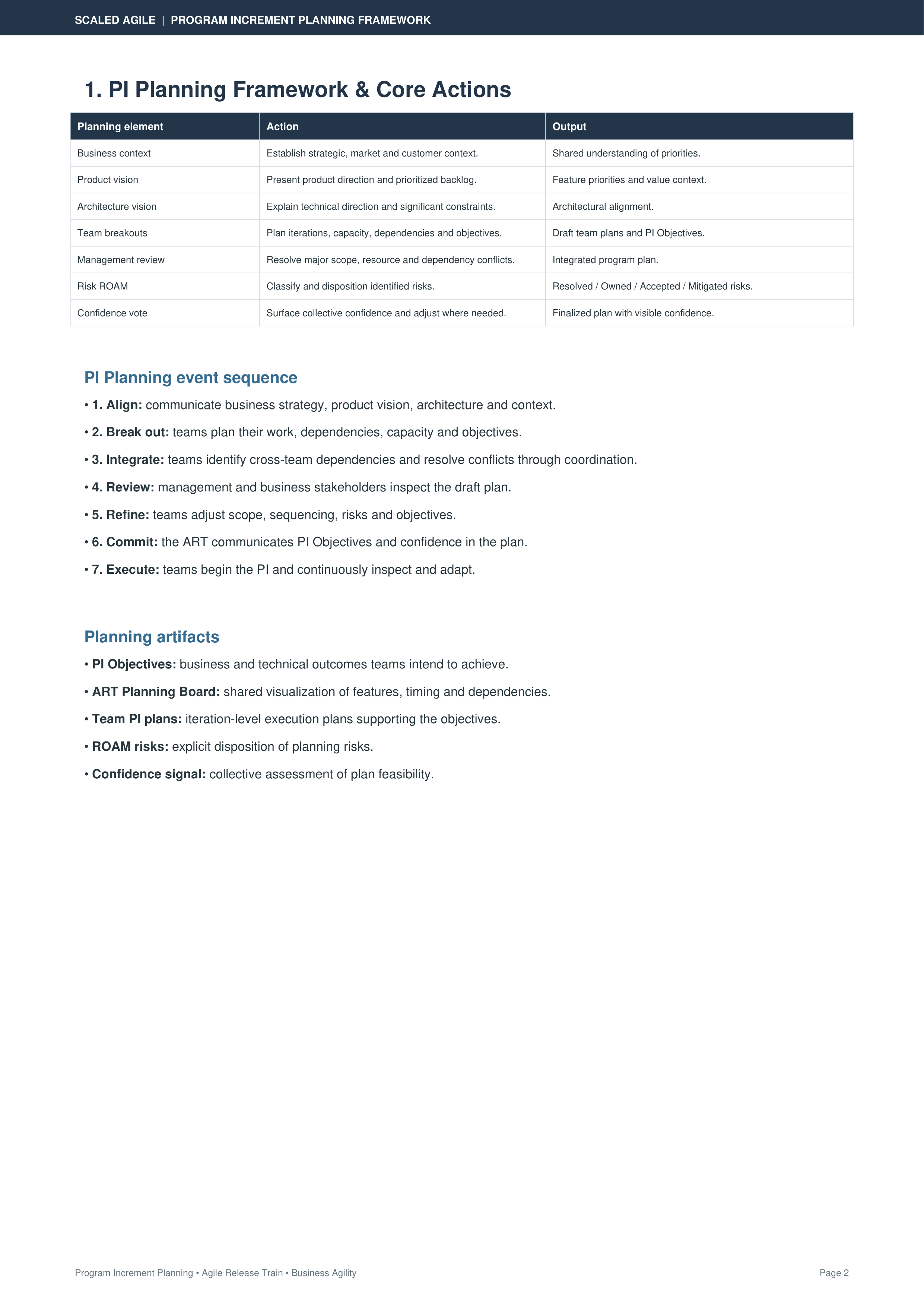
1. PI Planning Framework & Core Actions
Planning element
Action
Output
Business context
Establish strategic, market and customer context.
Shared understanding of priorities.
Product vision
Present product direction and prioritized backlog.
Feature priorities and value context.
Architecture vision
Explain technical direction and significant constraints.
Architectural alignment.
Team breakouts
Plan iterations, capacity, dependencies and objectives.
Draft team plans and PI Objectives.
Management review
Resolve major scope, resource and dependency conflicts.
Integrated program plan.
Risk ROAM
Classify and disposition identified risks.
Resolved / Owned / Accepted / Mitigated risks.
Confidence vote
Surface collective confidence and adjust where needed.
Finalized plan with visible confidence.
PI Planning event sequence
•
1. Align:
communicate business strategy, product vision, architecture and context.
•
2. Break out:
teams plan their work, dependencies, capacity and objectives.
•
3. Integrate:
teams identify cross-team dependencies and resolve conflicts through coordination.
•
4. Review:
management and business stakeholders inspect the draft plan.
•
5. Refine:
teams adjust scope, sequencing, risks and objectives.
•
6. Commit:
the ART communicates PI Objectives and confidence in the plan.
•
7. Execute:
teams begin the PI and continuously inspect and adapt.
Planning artifacts
•
PI Objectives:
business and technical outcomes teams intend to achieve.
•
ART Planning Board:
shared visualization of features, timing and dependencies.
•
Team PI plans:
iteration-level execution plans supporting the objectives.
•
ROAM risks:
explicit disposition of planning risks.
•
Confidence signal:
collective assessment of plan feasibility.
SCALED AGILE | PROGRAM INCREMENT PLANNING FRAMEWORK
Program Increment Planning • Agile Release Train • Business Agility
Page 3
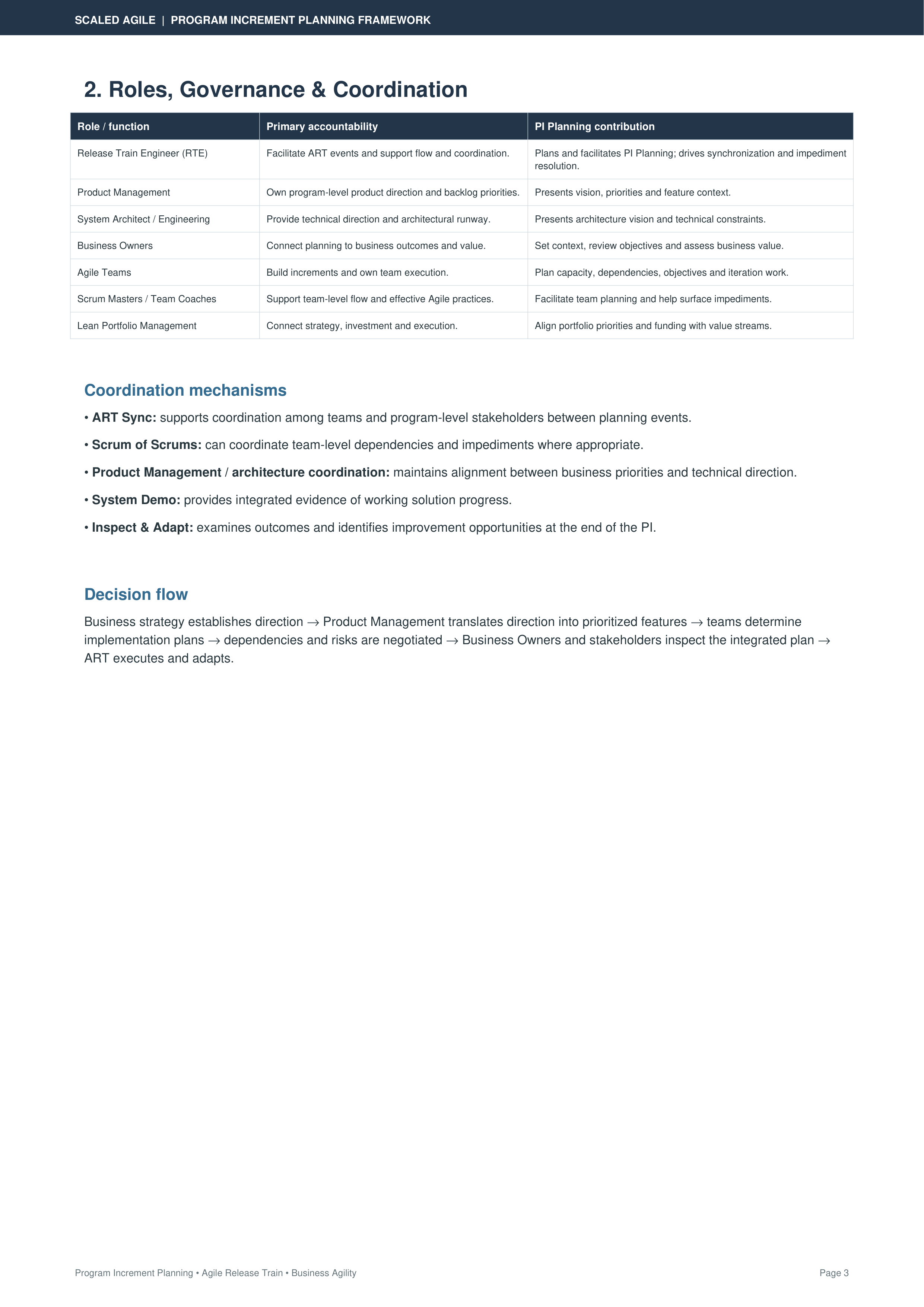
2. Roles, Governance & Coordination
Role / function
Primary accountability
PI Planning contribution
Release Train Engineer (RTE)
Facilitate ART events and support flow and coordination.
Plans and facilitates PI Planning; drives synchronization and impediment
resolution.
Product Management
Own program-level product direction and backlog priorities.
Presents vision, priorities and feature context.
System Architect / Engineering
Provide technical direction and architectural runway.
Presents architecture vision and technical constraints.
Business Owners
Connect planning to business outcomes and value.
Set context, review objectives and assess business value.
Agile Teams
Build increments and own team execution.
Plan capacity, dependencies, objectives and iteration work.
Scrum Masters / Team Coaches
Support team-level flow and effective Agile practices.
Facilitate team planning and help surface impediments.
Lean Portfolio Management
Connect strategy, investment and execution.
Align portfolio priorities and funding with value streams.
Coordination mechanisms
•
ART Sync:
supports coordination among teams and program-level stakeholders between planning events.
•
Scrum of Scrums:
can coordinate team-level dependencies and impediments where appropriate.
•
Product Management / architecture coordination:
maintains alignment between business priorities and technical direction.
•
System Demo:
provides integrated evidence of working solution progress.
•
Inspect & Adapt:
examines outcomes and identifies improvement opportunities at the end of the PI.
Decision flow
Business strategy establishes direction
→
Product Management translates direction into prioritized features
→
teams determine
implementation plans
→
dependencies and risks are negotiated
→
Business Owners and stakeholders inspect the integrated plan
→
ART executes and adapts.
SCALED AGILE | PROGRAM INCREMENT PLANNING FRAMEWORK
Program Increment Planning • Agile Release Train • Business Agility
Page 4
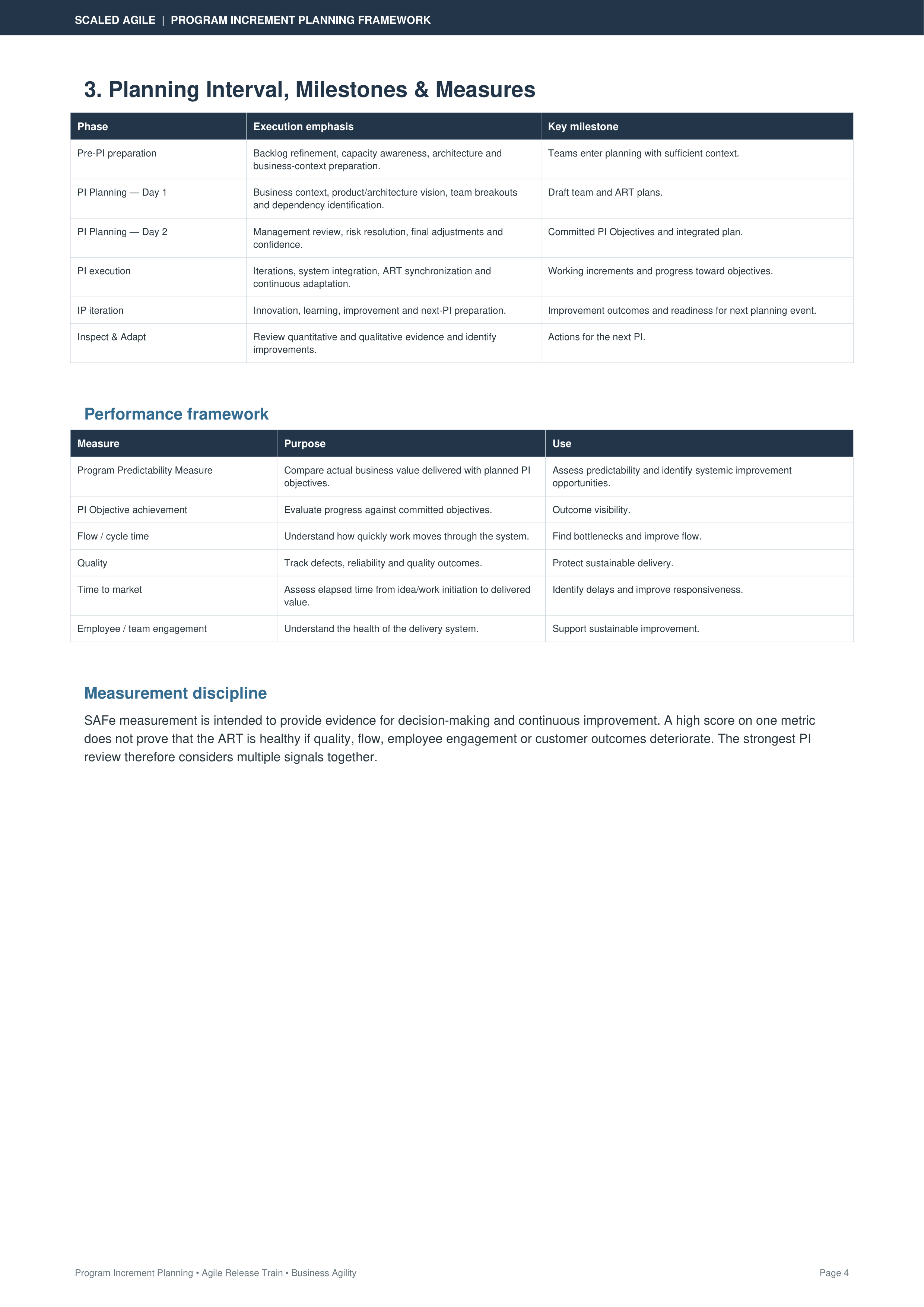
3. Planning Interval, Milestones & Measures
Phase
Execution emphasis
Key milestone
Pre-PI preparation
Backlog refinement, capacity awareness, architecture and
business-context preparation.
Teams enter planning with sufficient context.
PI Planning — Day 1
Business context, product/architecture vision, team breakouts
and dependency identification.
Draft team and ART plans.
PI Planning — Day 2
Management review, risk resolution, final adjustments and
confidence.
Committed PI Objectives and integrated plan.
PI execution
Iterations, system integration, ART synchronization and
continuous adaptation.
Working increments and progress toward objectives.
IP iteration
Innovation, learning, improvement and next-PI preparation.
Improvement outcomes and readiness for next planning event.
Inspect & Adapt
Review quantitative and qualitative evidence and identify
improvements.
Actions for the next PI.
Performance framework
Measure
Purpose
Use
Program Predictability Measure
Compare actual business value delivered with planned PI
objectives.
Assess predictability and identify systemic improvement
opportunities.
PI Objective achievement
Evaluate progress against committed objectives.
Outcome visibility.
Flow / cycle time
Understand how quickly work moves through the system.
Find bottlenecks and improve flow.
Quality
Track defects, reliability and quality outcomes.
Protect sustainable delivery.
Time to market
Assess elapsed time from idea/work initiation to delivered
value.
Identify delays and improve responsiveness.
Employee / team engagement
Understand the health of the delivery system.
Support sustainable improvement.
Measurement discipline
SAFe measurement is intended to provide evidence for decision-making and continuous improvement. A high score on one metric
does not prove that the ART is healthy if quality, flow, employee engagement or customer outcomes deteriorate. The strongest PI
review therefore considers multiple signals together.
SCALED AGILE | PROGRAM INCREMENT PLANNING FRAMEWORK
Program Increment Planning • Agile Release Train • Business Agility
Page 5
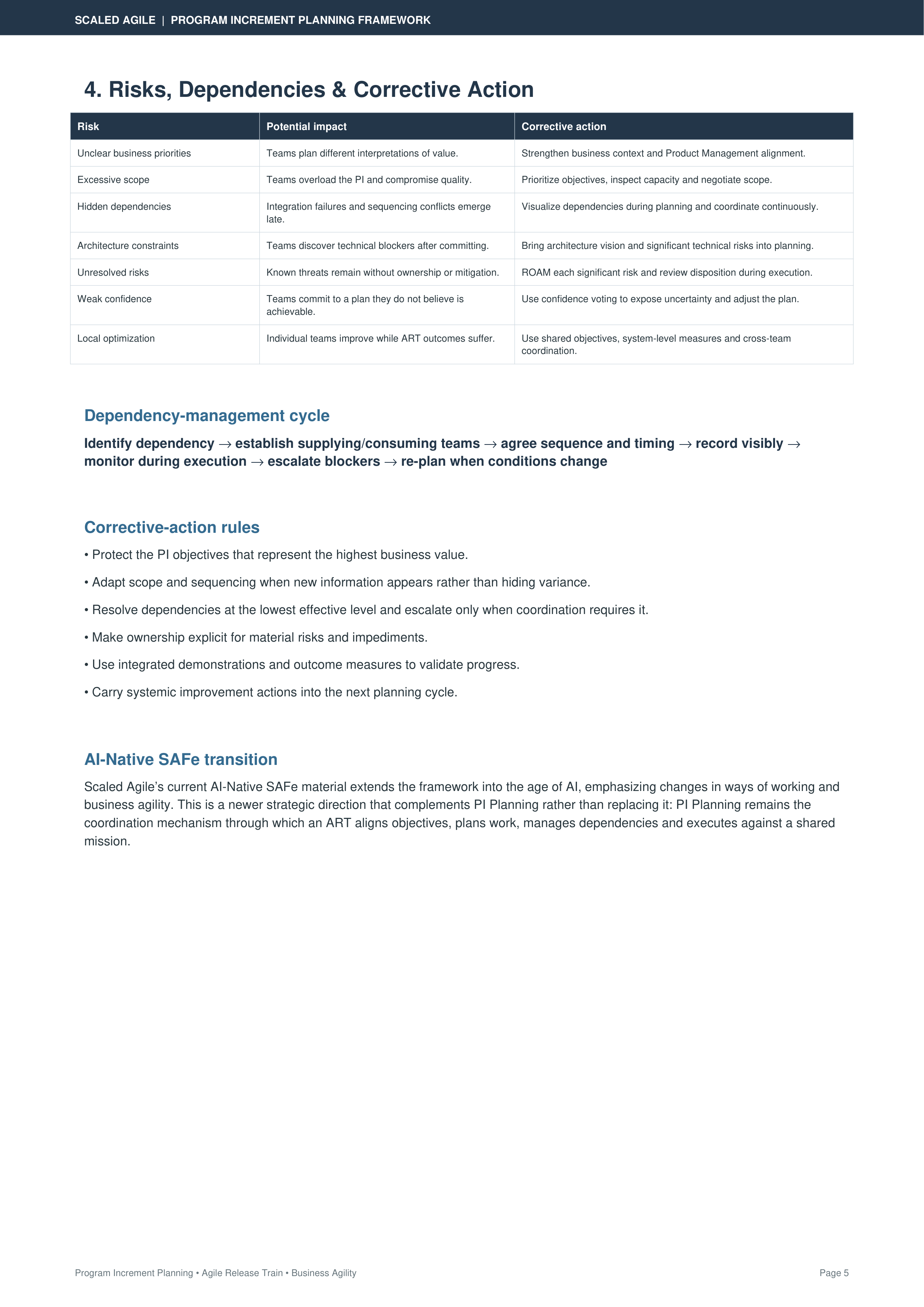
4. Risks, Dependencies & Corrective Action
Risk
Potential impact
Corrective action
Unclear business priorities
Teams plan different interpretations of value.
Strengthen business context and Product Management alignment.
Excessive scope
Teams overload the PI and compromise quality.
Prioritize objectives, inspect capacity and negotiate scope.
Hidden dependencies
Integration failures and sequencing conflicts emerge
late.
Visualize dependencies during planning and coordinate continuously.
Architecture constraints
Teams discover technical blockers after committing.
Bring architecture vision and significant technical risks into planning.
Unresolved risks
Known threats remain without ownership or mitigation.
ROAM each significant risk and review disposition during execution.
Weak confidence
Teams commit to a plan they do not believe is
achievable.
Use confidence voting to expose uncertainty and adjust the plan.
Local optimization
Individual teams improve while ART outcomes suffer.
Use shared objectives, system-level measures and cross-team
coordination.
Dependency-management cycle
Identify dependency
→
establish supplying/consuming teams
→
agree sequence and timing
→
record visibly
→
monitor during execution
→
escalate blockers
→
re-plan when conditions change
Corrective-action rules
• Protect the PI objectives that represent the highest business value.
• Adapt scope and sequencing when new information appears rather than hiding variance.
• Resolve dependencies at the lowest effective level and escalate only when coordination requires it.
• Make ownership explicit for material risks and impediments.
• Use integrated demonstrations and outcome measures to validate progress.
• Carry systemic improvement actions into the next planning cycle.
AI-Native SAFe transition
Scaled Agile’s current AI-Native SAFe material extends the framework into the age of AI, emphasizing changes in ways of working and
business agility. This is a newer strategic direction that complements PI Planning rather than replacing it: PI Planning remains the
coordination mechanism through which an ART aligns objectives, plans work, manages dependencies and executes against a shared
mission.
SCALED AGILE | PROGRAM INCREMENT PLANNING FRAMEWORK
Program Increment Planning • Agile Release Train • Business Agility
Page 6
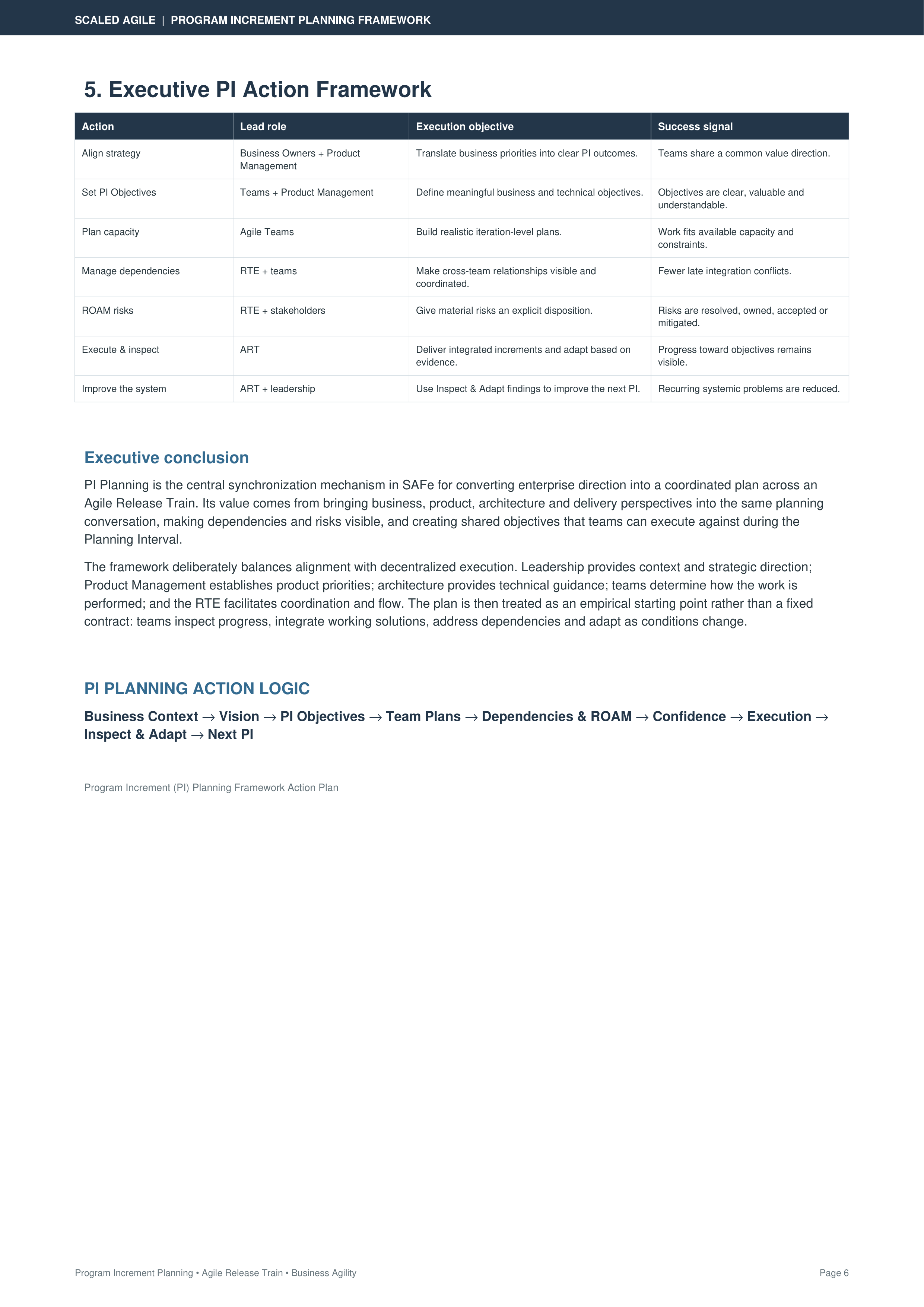
5. Executive PI Action Framework
Action
Lead role
Execution objective
Success signal
Align strategy
Business Owners + Product
Management
Translate business priorities into clear PI outcomes.
Teams share a common value direction.
Set PI Objectives
Teams + Product Management
Define meaningful business and technical objectives.
Objectives are clear, valuable and
understandable.
Plan capacity
Agile Teams
Build realistic iteration-level plans.
Work fits available capacity and
constraints.
Manage dependencies
RTE + teams
Make cross-team relationships visible and
coordinated.
Fewer late integration conflicts.
ROAM risks
RTE + stakeholders
Give material risks an explicit disposition.
Risks are resolved, owned, accepted or
mitigated.
Execute & inspect
ART
Deliver integrated increments and adapt based on
evidence.
Progress toward objectives remains
visible.
Improve the system
ART + leadership
Use Inspect & Adapt findings to improve the next PI.
Recurring systemic problems are reduced.
Executive conclusion
PI Planning is the central synchronization mechanism in SAFe for converting enterprise direction into a coordinated plan across an
Agile Release Train. Its value comes from bringing business, product, architecture and delivery perspectives into the same planning
conversation, making dependencies and risks visible, and creating shared objectives that teams can execute against during the
Planning Interval.
The framework deliberately balances alignment with decentralized execution. Leadership provides context and strategic direction;
Product Management establishes product priorities; architecture provides technical guidance; teams determine how the work is
performed; and the RTE facilitates coordination and flow. The plan is then treated as an empirical starting point rather than a fixed
contract: teams inspect progress, integrate working solutions, address dependencies and adapt as conditions change.
PI PLANNING ACTION LOGIC
Business Context
→
Vision
→
PI Objectives
→
Team Plans
→
Dependencies & ROAM
→
Confidence
→
Execution
→
Inspect & Adapt
→
Next PI
Program Increment (PI) Planning Framework Action Plan