MAYO CLINIC | BOLD. FORWARD. UNBOUND.
Research-based synthesized Action Plan • Not an official Mayo Clinic publication
Page 1
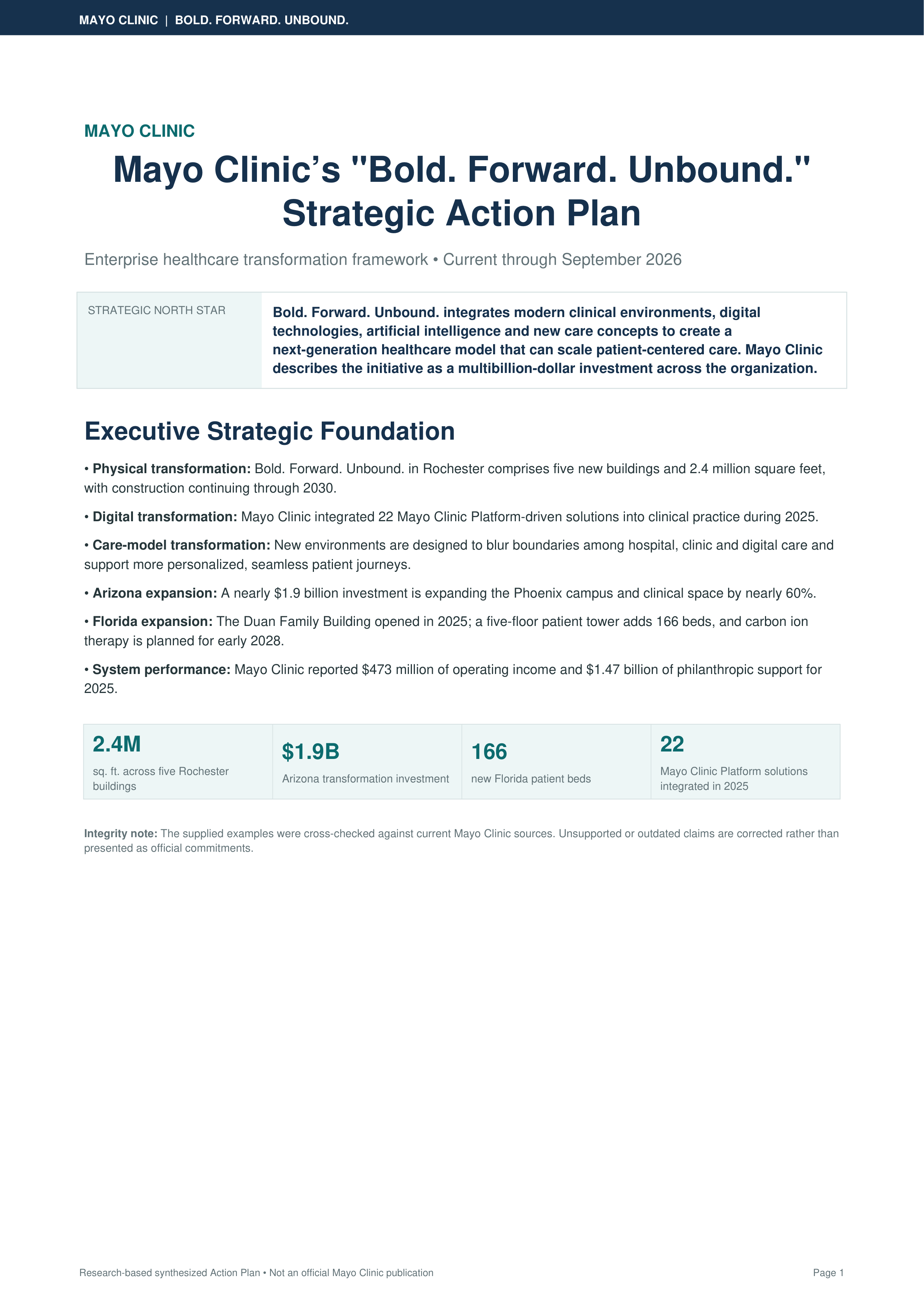
MAYO CLINIC
Mayo Clinic’s "Bold. Forward. Unbound."
Strategic Action Plan
Enterprise healthcare transformation framework • Current through September 2026
STRATEGIC NORTH STAR
Bold. Forward. Unbound. integrates modern clinical environments, digital
technologies, artificial intelligence and new care concepts to create a
next-generation healthcare model that can scale patient-centered care. Mayo Clinic
describes the initiative as a multibillion-dollar investment across the organization.
Executive Strategic Foundation
•
Physical transformation:
Bold. Forward. Unbound. in Rochester comprises five new buildings and 2.4 million square feet,
with construction continuing through 2030.
•
Digital transformation:
Mayo Clinic integrated 22 Mayo Clinic Platform-driven solutions into clinical practice during 2025.
•
Care-model transformation:
New environments are designed to blur boundaries among hospital, clinic and digital care and
support more personalized, seamless patient journeys.
•
Arizona expansion:
A nearly $1.9 billion investment is expanding the Phoenix campus and clinical space by nearly 60%.
•
Florida expansion:
The Duan Family Building opened in 2025; a five-floor patient tower adds 166 beds, and carbon ion
therapy is planned for early 2028.
•
System performance:
Mayo Clinic reported $473 million of operating income and $1.47 billion of philanthropic support for
2025.
2.4M
sq. ft. across five Rochester
buildings
$1.9B
Arizona transformation investment
166
new Florida patient beds
22
Mayo Clinic Platform solutions
integrated in 2025
Integrity note:
The supplied examples were cross-checked against current Mayo Clinic sources. Unsupported or outdated claims are corrected rather than
presented as official commitments.
MAYO CLINIC | BOLD. FORWARD. UNBOUND.
Research-based synthesized Action Plan • Not an official Mayo Clinic publication
Page 2
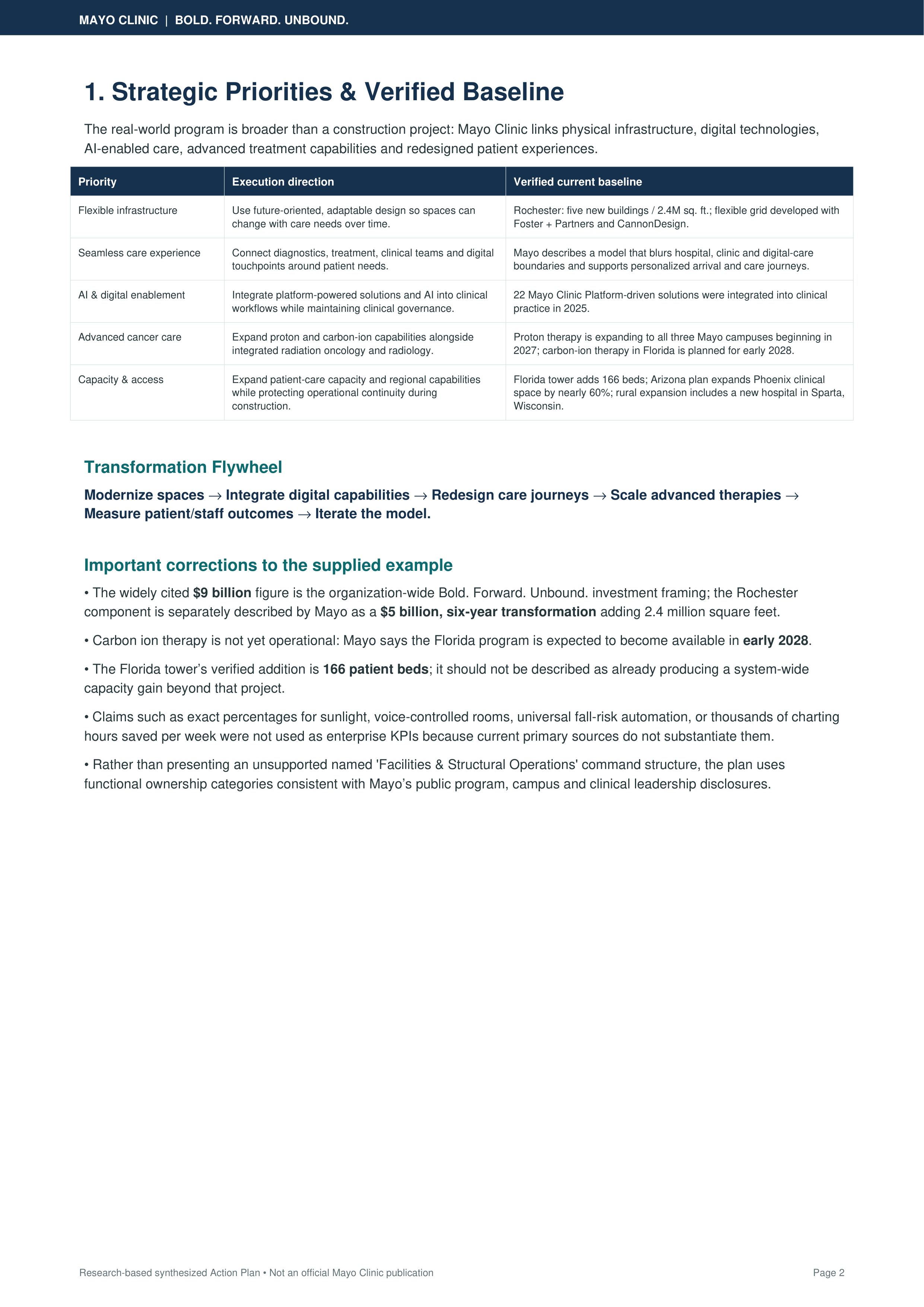
1. Strategic Priorities & Verified Baseline
The real-world program is broader than a construction project: Mayo Clinic links physical infrastructure, digital technologies,
AI-enabled care, advanced treatment capabilities and redesigned patient experiences.
Priority
Execution direction
Verified current baseline
Flexible infrastructure
Use future-oriented, adaptable design so spaces can
change with care needs over time.
Rochester: five new buildings / 2.4M sq. ft.; flexible grid developed with
Foster + Partners and CannonDesign.
Seamless care experience
Connect diagnostics, treatment, clinical teams and digital
touchpoints around patient needs.
Mayo describes a model that blurs hospital, clinic and digital-care
boundaries and supports personalized arrival and care journeys.
AI & digital enablement
Integrate platform-powered solutions and AI into clinical
workflows while maintaining clinical governance.
22 Mayo Clinic Platform-driven solutions were integrated into clinical
practice in 2025.
Advanced cancer care
Expand proton and carbon-ion capabilities alongside
integrated radiation oncology and radiology.
Proton therapy is expanding to all three Mayo campuses beginning in
2027; carbon-ion therapy in Florida is planned for early 2028.
Capacity & access
Expand patient-care capacity and regional capabilities
while protecting operational continuity during
construction.
Florida tower adds 166 beds; Arizona plan expands Phoenix clinical
space by nearly 60%; rural expansion includes a new hospital in Sparta,
Wisconsin.
Transformation Flywheel
Modernize spaces
→
Integrate digital capabilities
→
Redesign care journeys
→
Scale advanced therapies
→
Measure patient/staff outcomes
→
Iterate the model.
Important corrections to the supplied example
• The widely cited
$9 billion
figure is the organization-wide Bold. Forward. Unbound. investment framing; the Rochester
component is separately described by Mayo as a
$5 billion, six-year transformation
adding 2.4 million square feet.
• Carbon ion therapy is not yet operational: Mayo says the Florida program is expected to become available in
early 2028
.
• The Florida tower’s verified addition is
166 patient beds
; it should not be described as already producing a system-wide
capacity gain beyond that project.
• Claims such as exact percentages for sunlight, voice-controlled rooms, universal fall-risk automation, or thousands of charting
hours saved per week were not used as enterprise KPIs because current primary sources do not substantiate them.
• Rather than presenting an unsupported named 'Facilities & Structural Operations' command structure, the plan uses
functional ownership categories consistent with Mayo’s public program, campus and clinical leadership disclosures.
MAYO CLINIC | BOLD. FORWARD. UNBOUND.
Research-based synthesized Action Plan • Not an official Mayo Clinic publication
Page 3
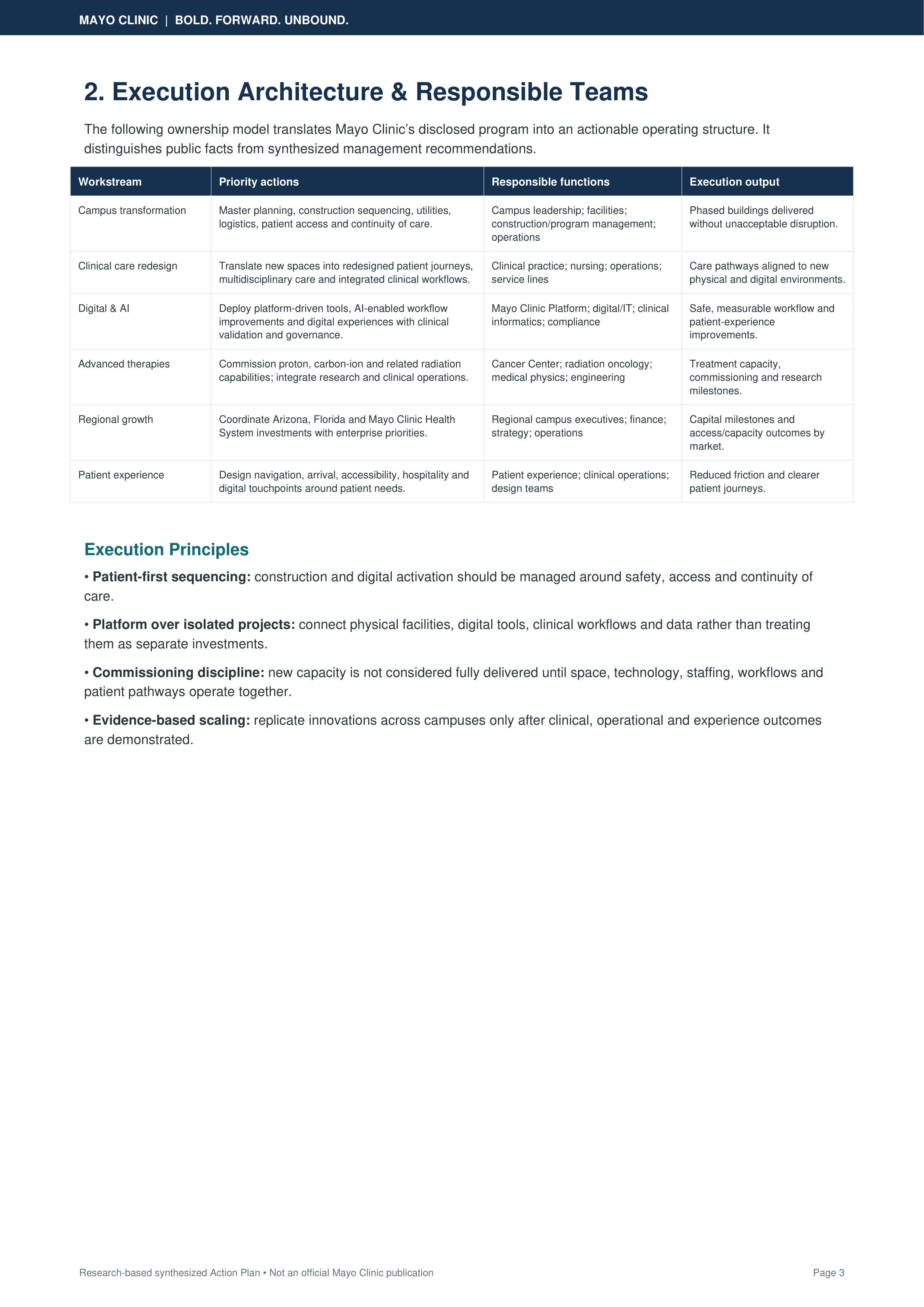
2. Execution Architecture & Responsible Teams
The following ownership model translates Mayo Clinic’s disclosed program into an actionable operating structure. It
distinguishes public facts from synthesized management recommendations.
Workstream
Priority actions
Responsible functions
Execution output
Campus transformation
Master planning, construction sequencing, utilities,
logistics, patient access and continuity of care.
Campus leadership; facilities;
construction/program management;
operations
Phased buildings delivered
without unacceptable disruption.
Clinical care redesign
Translate new spaces into redesigned patient journeys,
multidisciplinary care and integrated clinical workflows.
Clinical practice; nursing; operations;
service lines
Care pathways aligned to new
physical and digital environments.
Digital & AI
Deploy platform-driven tools, AI-enabled workflow
improvements and digital experiences with clinical
validation and governance.
Mayo Clinic Platform; digital/IT; clinical
informatics; compliance
Safe, measurable workflow and
patient-experience
improvements.
Advanced therapies
Commission proton, carbon-ion and related radiation
capabilities; integrate research and clinical operations.
Cancer Center; radiation oncology;
medical physics; engineering
Treatment capacity,
commissioning and research
milestones.
Regional growth
Coordinate Arizona, Florida and Mayo Clinic Health
System investments with enterprise priorities.
Regional campus executives; finance;
strategy; operations
Capital milestones and
access/capacity outcomes by
market.
Patient experience
Design navigation, arrival, accessibility, hospitality and
digital touchpoints around patient needs.
Patient experience; clinical operations;
design teams
Reduced friction and clearer
patient journeys.
Execution Principles
•
Patient-first sequencing:
construction and digital activation should be managed around safety, access and continuity of
care.
•
Platform over isolated projects:
connect physical facilities, digital tools, clinical workflows and data rather than treating
them as separate investments.
•
Commissioning discipline:
new capacity is not considered fully delivered until space, technology, staffing, workflows and
patient pathways operate together.
•
Evidence-based scaling:
replicate innovations across campuses only after clinical, operational and experience outcomes
are demonstrated.
MAYO CLINIC | BOLD. FORWARD. UNBOUND.
Research-based synthesized Action Plan • Not an official Mayo Clinic publication
Page 4
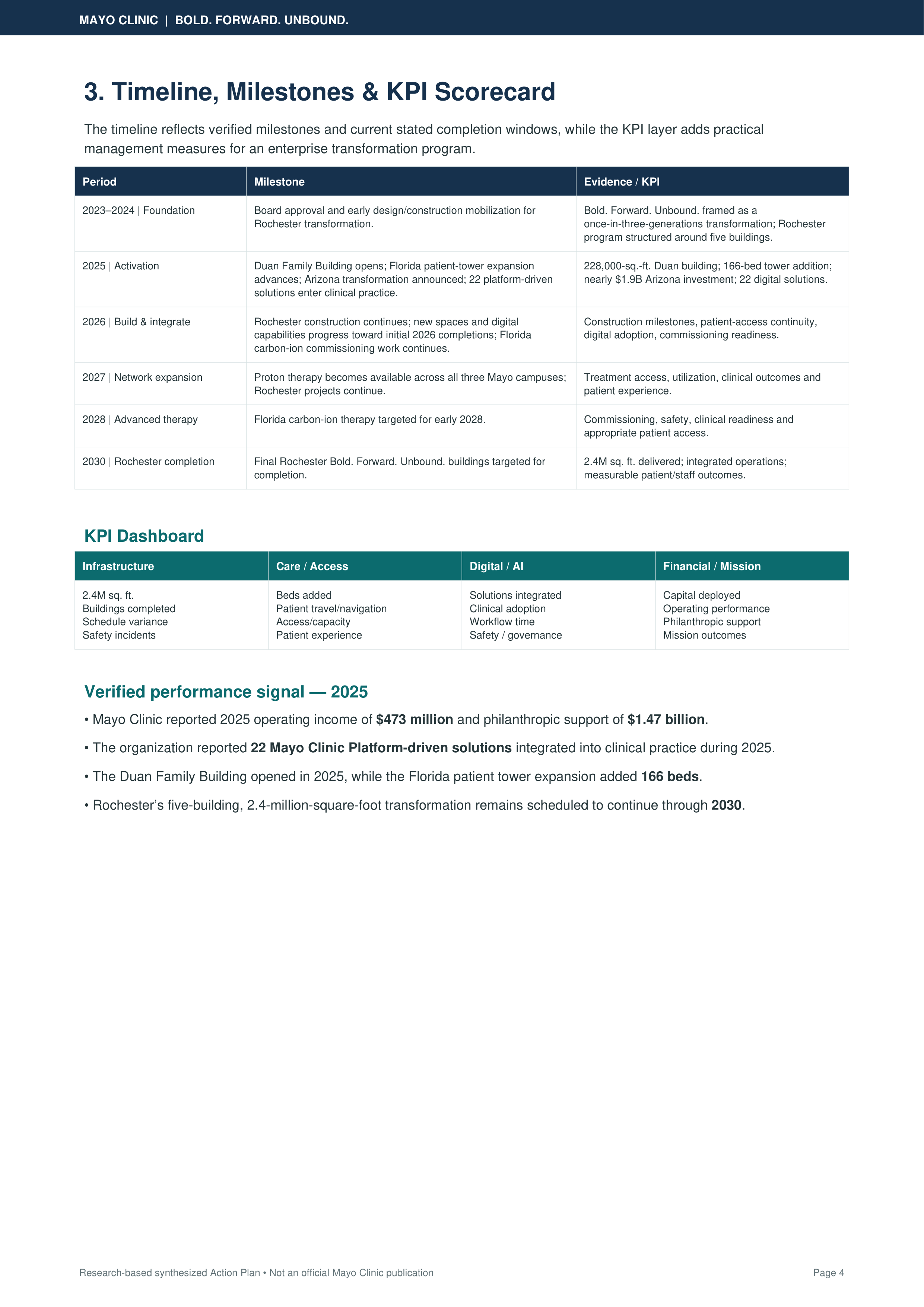
3. Timeline, Milestones & KPI Scorecard
The timeline reflects verified milestones and current stated completion windows, while the KPI layer adds practical
management measures for an enterprise transformation program.
Period
Milestone
Evidence / KPI
2023–2024 | Foundation
Board approval and early design/construction mobilization for
Rochester transformation.
Bold. Forward. Unbound. framed as a
once-in-three-generations transformation; Rochester
program structured around five buildings.
2025 | Activation
Duan Family Building opens; Florida patient-tower expansion
advances; Arizona transformation announced; 22 platform-driven
solutions enter clinical practice.
228,000-sq.-ft. Duan building; 166-bed tower addition;
nearly $1.9B Arizona investment; 22 digital solutions.
2026 | Build & integrate
Rochester construction continues; new spaces and digital
capabilities progress toward initial 2026 completions; Florida
carbon-ion commissioning work continues.
Construction milestones, patient-access continuity,
digital adoption, commissioning readiness.
2027 | Network expansion
Proton therapy becomes available across all three Mayo campuses;
Rochester projects continue.
Treatment access, utilization, clinical outcomes and
patient experience.
2028 | Advanced therapy
Florida carbon-ion therapy targeted for early 2028.
Commissioning, safety, clinical readiness and
appropriate patient access.
2030 | Rochester completion
Final Rochester Bold. Forward. Unbound. buildings targeted for
completion.
2.4M sq. ft. delivered; integrated operations;
measurable patient/staff outcomes.
KPI Dashboard
Infrastructure
Care / Access
Digital / AI
Financial / Mission
2.4M sq. ft.
Buildings completed
Schedule variance
Safety incidents
Beds added
Patient travel/navigation
Access/capacity
Patient experience
Solutions integrated
Clinical adoption
Workflow time
Safety / governance
Capital deployed
Operating performance
Philanthropic support
Mission outcomes
Verified performance signal — 2025
• Mayo Clinic reported 2025 operating income of
$473 million
and philanthropic support of
$1.47 billion
.
• The organization reported
22 Mayo Clinic Platform-driven solutions
integrated into clinical practice during 2025.
• The Duan Family Building opened in 2025, while the Florida patient tower expansion added
166 beds
.
• Rochester’s five-building, 2.4-million-square-foot transformation remains scheduled to continue through
2030
.
MAYO CLINIC | BOLD. FORWARD. UNBOUND.
Research-based synthesized Action Plan • Not an official Mayo Clinic publication
Page 5
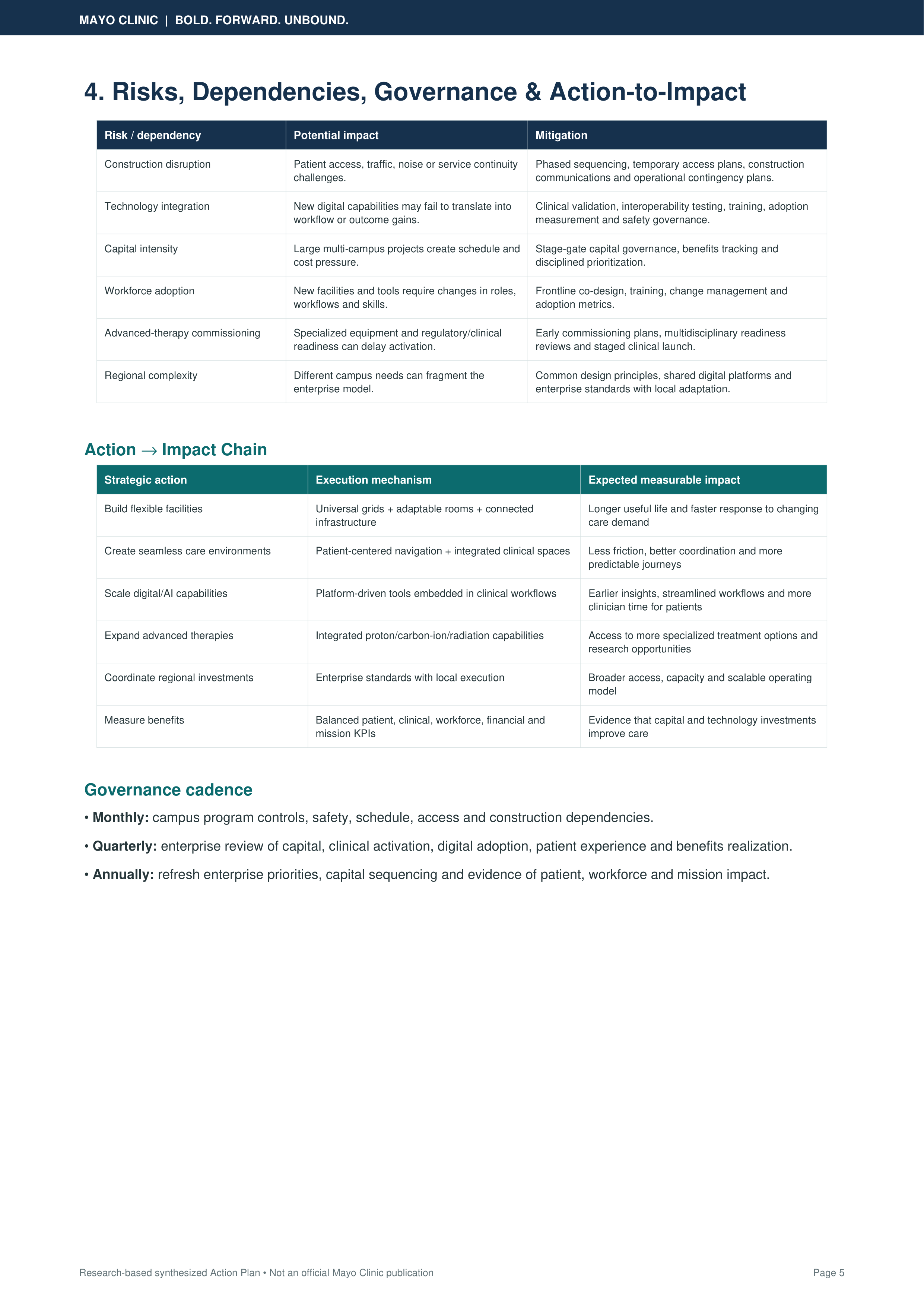
4. Risks, Dependencies, Governance & Action-to-Impact
Risk / dependency
Potential impact
Mitigation
Construction disruption
Patient access, traffic, noise or service continuity
challenges.
Phased sequencing, temporary access plans, construction
communications and operational contingency plans.
Technology integration
New digital capabilities may fail to translate into
workflow or outcome gains.
Clinical validation, interoperability testing, training, adoption
measurement and safety governance.
Capital intensity
Large multi-campus projects create schedule and
cost pressure.
Stage-gate capital governance, benefits tracking and
disciplined prioritization.
Workforce adoption
New facilities and tools require changes in roles,
workflows and skills.
Frontline co-design, training, change management and
adoption metrics.
Advanced-therapy commissioning
Specialized equipment and regulatory/clinical
readiness can delay activation.
Early commissioning plans, multidisciplinary readiness
reviews and staged clinical launch.
Regional complexity
Different campus needs can fragment the
enterprise model.
Common design principles, shared digital platforms and
enterprise standards with local adaptation.
Action
→
Impact Chain
Strategic action
Execution mechanism
Expected measurable impact
Build flexible facilities
Universal grids + adaptable rooms + connected
infrastructure
Longer useful life and faster response to changing
care demand
Create seamless care environments
Patient-centered navigation + integrated clinical spaces
Less friction, better coordination and more
predictable journeys
Scale digital/AI capabilities
Platform-driven tools embedded in clinical workflows
Earlier insights, streamlined workflows and more
clinician time for patients
Expand advanced therapies
Integrated proton/carbon-ion/radiation capabilities
Access to more specialized treatment options and
research opportunities
Coordinate regional investments
Enterprise standards with local execution
Broader access, capacity and scalable operating
model
Measure benefits
Balanced patient, clinical, workforce, financial and
mission KPIs
Evidence that capital and technology investments
improve care
Governance cadence
•
Monthly:
campus program controls, safety, schedule, access and construction dependencies.
•
Quarterly:
enterprise review of capital, clinical activation, digital adoption, patient experience and benefits realization.
•
Annually:
refresh enterprise priorities, capital sequencing and evidence of patient, workforce and mission impact.
MAYO CLINIC | BOLD. FORWARD. UNBOUND.
Research-based synthesized Action Plan • Not an official Mayo Clinic publication
Page 6
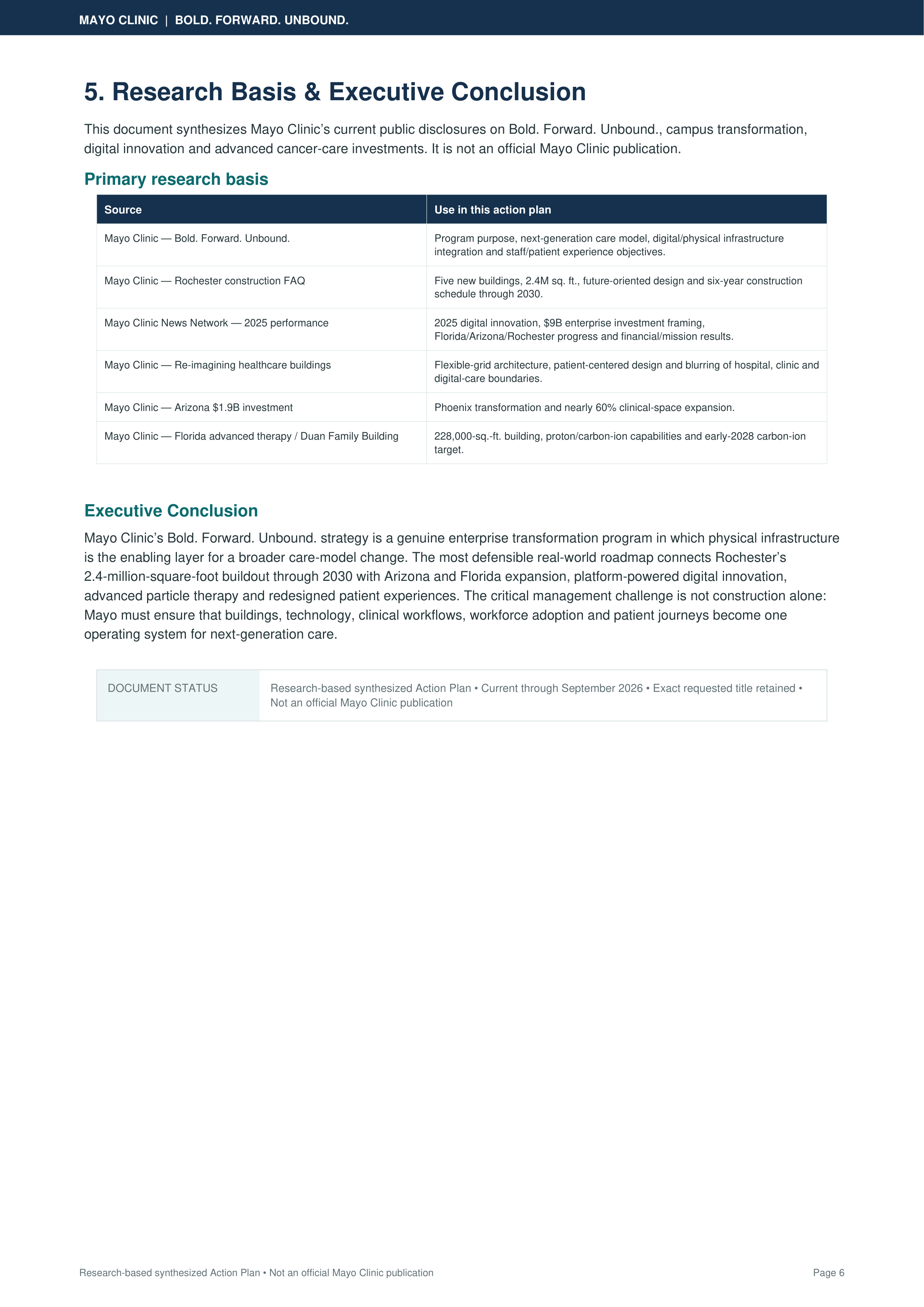
5. Research Basis & Executive Conclusion
This document synthesizes Mayo Clinic’s current public disclosures on Bold. Forward. Unbound., campus transformation,
digital innovation and advanced cancer-care investments. It is not an official Mayo Clinic publication.
Primary research basis
Source
Use in this action plan
Mayo Clinic — Bold. Forward. Unbound.
Program purpose, next-generation care model, digital/physical infrastructure
integration and staff/patient experience objectives.
Mayo Clinic — Rochester construction FAQ
Five new buildings, 2.4M sq. ft., future-oriented design and six-year construction
schedule through 2030.
Mayo Clinic News Network — 2025 performance
2025 digital innovation, $9B enterprise investment framing,
Florida/Arizona/Rochester progress and financial/mission results.
Mayo Clinic — Re-imagining healthcare buildings
Flexible-grid architecture, patient-centered design and blurring of hospital, clinic and
digital-care boundaries.
Mayo Clinic — Arizona $1.9B investment
Phoenix transformation and nearly 60% clinical-space expansion.
Mayo Clinic — Florida advanced therapy / Duan Family Building
228,000-sq.-ft. building, proton/carbon-ion capabilities and early-2028 carbon-ion
target.
Executive Conclusion
Mayo Clinic’s Bold. Forward. Unbound. strategy is a genuine enterprise transformation program in which physical infrastructure
is the enabling layer for a broader care-model change. The most defensible real-world roadmap connects Rochester’s
2.4-million-square-foot buildout through 2030 with Arizona and Florida expansion, platform-powered digital innovation,
advanced particle therapy and redesigned patient experiences. The critical management challenge is not construction alone:
Mayo must ensure that buildings, technology, clinical workflows, workforce adoption and patient journeys become one
operating system for next-generation care.
DOCUMENT STATUS
Research-based synthesized Action Plan • Current through September 2026 • Exact requested title retained •
Not an official Mayo Clinic publication