Atlassian Corporation | Data Center End-of-Life & Cloud Migration
Page 1
ATLASSIAN CORPORATION
Atlassian Data Center End-of-Life & Cloud Migration
Action Plan
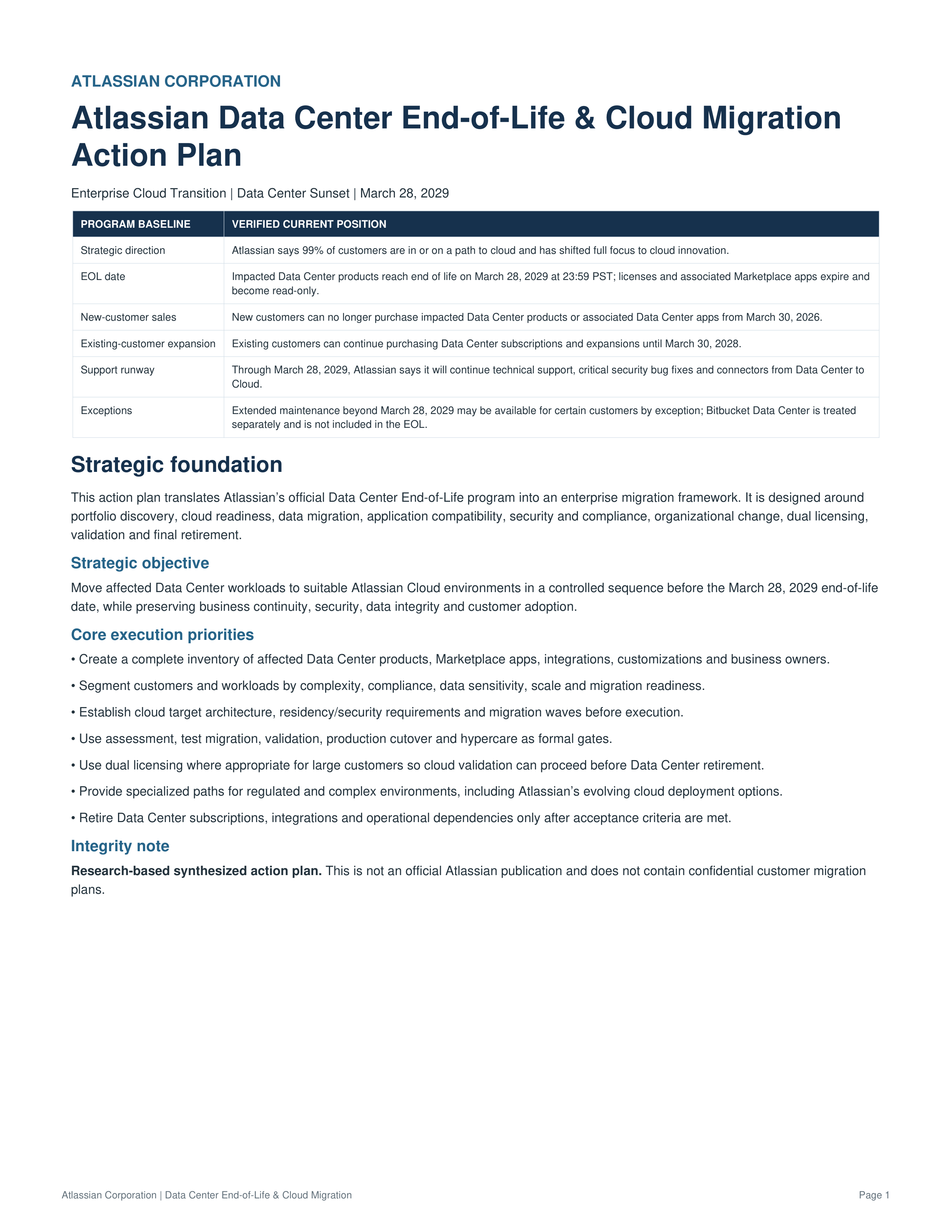
Enterprise Cloud Transition | Data Center Sunset | March 28, 2029
PROGRAM BASELINE
VERIFIED CURRENT POSITION
Strategic direction
Atlassian says 99% of customers are in or on a path to cloud and has shifted full focus to cloud innovation.
EOL date
Impacted Data Center products reach end of life on March 28, 2029 at 23:59 PST; licenses and associated Marketplace apps expire and
become read-only.
New-customer sales
New customers can no longer purchase impacted Data Center products or associated Data Center apps from March 30, 2026.
Existing-customer expansion
Existing customers can continue purchasing Data Center subscriptions and expansions until March 30, 2028.
Support runway
Through March 28, 2029, Atlassian says it will continue technical support, critical security bug fixes and connectors from Data Center to
Cloud.
Exceptions
Extended maintenance beyond March 28, 2029 may be available for certain customers by exception; Bitbucket Data Center is treated
separately and is not included in the EOL.
Strategic foundation
This action plan translates Atlassian’s official Data Center End-of-Life program into an enterprise migration framework. It is designed around
portfolio discovery, cloud readiness, data migration, application compatibility, security and compliance, organizational change, dual licensing,
validation and final retirement.
Strategic objective
Move affected Data Center workloads to suitable Atlassian Cloud environments in a controlled sequence before the March 28, 2029 end-of-life
date, while preserving business continuity, security, data integrity and customer adoption.
Core execution priorities
• Create a complete inventory of affected Data Center products, Marketplace apps, integrations, customizations and business owners.
• Segment customers and workloads by complexity, compliance, data sensitivity, scale and migration readiness.
• Establish cloud target architecture, residency/security requirements and migration waves before execution.
• Use assessment, test migration, validation, production cutover and hypercare as formal gates.
• Use dual licensing where appropriate for large customers so cloud validation can proceed before Data Center retirement.
• Provide specialized paths for regulated and complex environments, including Atlassian’s evolving cloud deployment options.
• Retire Data Center subscriptions, integrations and operational dependencies only after acceptance criteria are met.
Integrity note
Research-based synthesized action plan.
This is not an official Atlassian publication and does not contain confidential customer migration
plans.
Atlassian Corporation | Data Center End-of-Life & Cloud Migration
Page 2
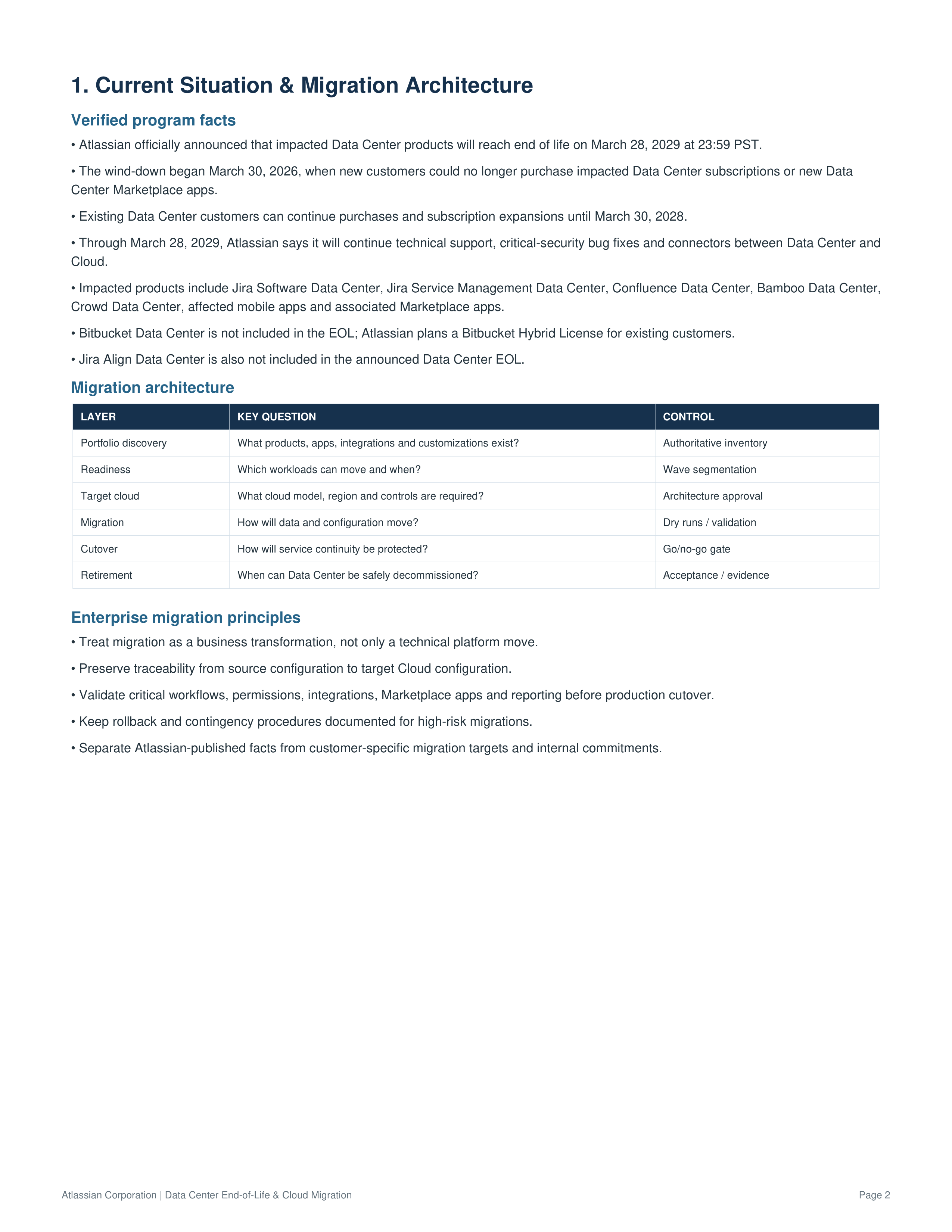
1. Current Situation & Migration Architecture
Verified program facts
• Atlassian officially announced that impacted Data Center products will reach end of life on March 28, 2029 at 23:59 PST.
• The wind-down began March 30, 2026, when new customers could no longer purchase impacted Data Center subscriptions or new Data
Center Marketplace apps.
• Existing Data Center customers can continue purchases and subscription expansions until March 30, 2028.
• Through March 28, 2029, Atlassian says it will continue technical support, critical-security bug fixes and connectors between Data Center and
Cloud.
• Impacted products include Jira Software Data Center, Jira Service Management Data Center, Confluence Data Center, Bamboo Data Center,
Crowd Data Center, affected mobile apps and associated Marketplace apps.
• Bitbucket Data Center is not included in the EOL; Atlassian plans a Bitbucket Hybrid License for existing customers.
• Jira Align Data Center is also not included in the announced Data Center EOL.
Migration architecture
LAYER
KEY QUESTION
CONTROL
Portfolio discovery
What products, apps, integrations and customizations exist?
Authoritative inventory
Readiness
Which workloads can move and when?
Wave segmentation
Target cloud
What cloud model, region and controls are required?
Architecture approval
Migration
How will data and configuration move?
Dry runs / validation
Cutover
How will service continuity be protected?
Go/no-go gate
Retirement
When can Data Center be safely decommissioned?
Acceptance / evidence
Enterprise migration principles
• Treat migration as a business transformation, not only a technical platform move.
• Preserve traceability from source configuration to target Cloud configuration.
• Validate critical workflows, permissions, integrations, Marketplace apps and reporting before production cutover.
• Keep rollback and contingency procedures documented for high-risk migrations.
• Separate Atlassian-published facts from customer-specific migration targets and internal commitments.
Atlassian Corporation | Data Center End-of-Life & Cloud Migration
Page 3
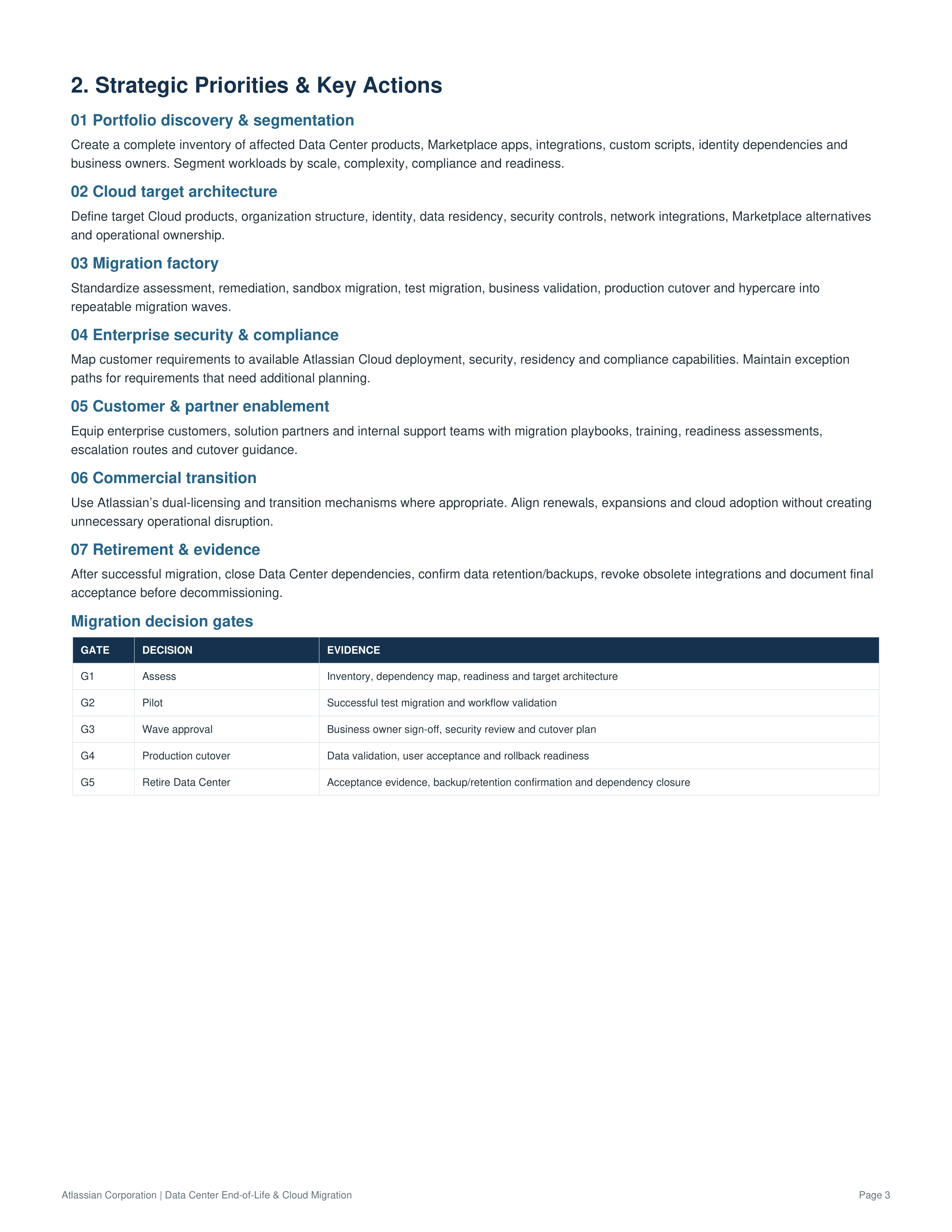
2. Strategic Priorities & Key Actions
01 Portfolio discovery & segmentation
Create a complete inventory of affected Data Center products, Marketplace apps, integrations, custom scripts, identity dependencies and
business owners. Segment workloads by scale, complexity, compliance and readiness.
02 Cloud target architecture
Define target Cloud products, organization structure, identity, data residency, security controls, network integrations, Marketplace alternatives
and operational ownership.
03 Migration factory
Standardize assessment, remediation, sandbox migration, test migration, business validation, production cutover and hypercare into
repeatable migration waves.
04 Enterprise security & compliance
Map customer requirements to available Atlassian Cloud deployment, security, residency and compliance capabilities. Maintain exception
paths for requirements that need additional planning.
05 Customer & partner enablement
Equip enterprise customers, solution partners and internal support teams with migration playbooks, training, readiness assessments,
escalation routes and cutover guidance.
06 Commercial transition
Use Atlassian’s dual-licensing and transition mechanisms where appropriate. Align renewals, expansions and cloud adoption without creating
unnecessary operational disruption.
07 Retirement & evidence
After successful migration, close Data Center dependencies, confirm data retention/backups, revoke obsolete integrations and document final
acceptance before decommissioning.
Migration decision gates
GATE
DECISION
EVIDENCE
G1
Assess
Inventory, dependency map, readiness and target architecture
G2
Pilot
Successful test migration and workflow validation
G3
Wave approval
Business owner sign-off, security review and cutover plan
G4
Production cutover
Data validation, user acceptance and rollback readiness
G5
Retire Data Center
Acceptance evidence, backup/retention confirmation and dependency closure
Atlassian Corporation | Data Center End-of-Life & Cloud Migration
Page 4
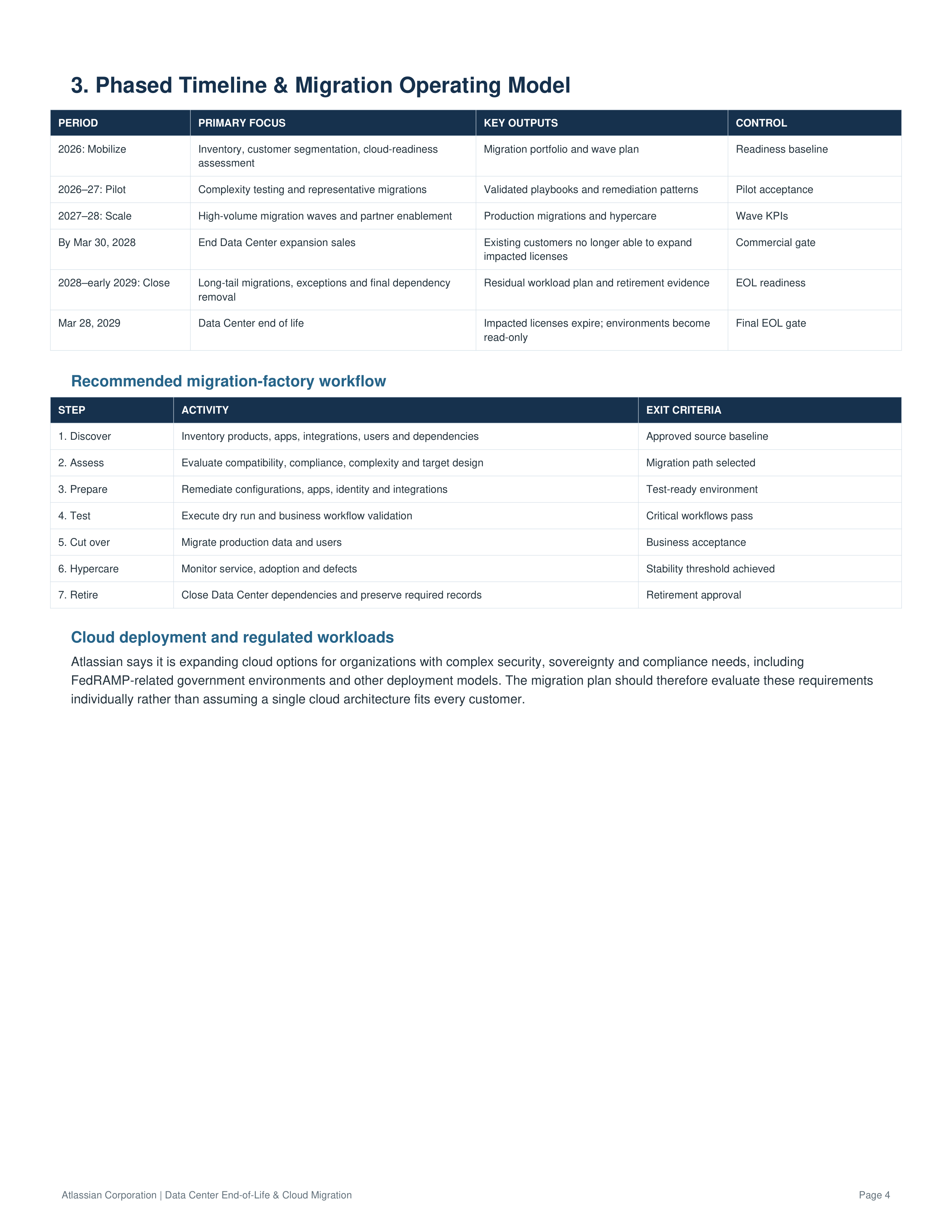
3. Phased Timeline & Migration Operating Model
PERIOD
PRIMARY FOCUS
KEY OUTPUTS
CONTROL
2026: Mobilize
Inventory, customer segmentation, cloud-readiness
assessment
Migration portfolio and wave plan
Readiness baseline
2026–27: Pilot
Complexity testing and representative migrations
Validated playbooks and remediation patterns
Pilot acceptance
2027–28: Scale
High-volume migration waves and partner enablement
Production migrations and hypercare
Wave KPIs
By Mar 30, 2028
End Data Center expansion sales
Existing customers no longer able to expand
impacted licenses
Commercial gate
2028–early 2029: Close
Long-tail migrations, exceptions and final dependency
removal
Residual workload plan and retirement evidence
EOL readiness
Mar 28, 2029
Data Center end of life
Impacted licenses expire; environments become
read-only
Final EOL gate
Recommended migration-factory workflow
STEP
ACTIVITY
EXIT CRITERIA
1. Discover
Inventory products, apps, integrations, users and dependencies
Approved source baseline
2. Assess
Evaluate compatibility, compliance, complexity and target design
Migration path selected
3. Prepare
Remediate configurations, apps, identity and integrations
Test-ready environment
4. Test
Execute dry run and business workflow validation
Critical workflows pass
5. Cut over
Migrate production data and users
Business acceptance
6. Hypercare
Monitor service, adoption and defects
Stability threshold achieved
7. Retire
Close Data Center dependencies and preserve required records
Retirement approval
Cloud deployment and regulated workloads
Atlassian says it is expanding cloud options for organizations with complex security, sovereignty and compliance needs, including
FedRAMP-related government environments and other deployment models. The migration plan should therefore evaluate these requirements
individually rather than assuming a single cloud architecture fits every customer.
Atlassian Corporation | Data Center End-of-Life & Cloud Migration
Page 5
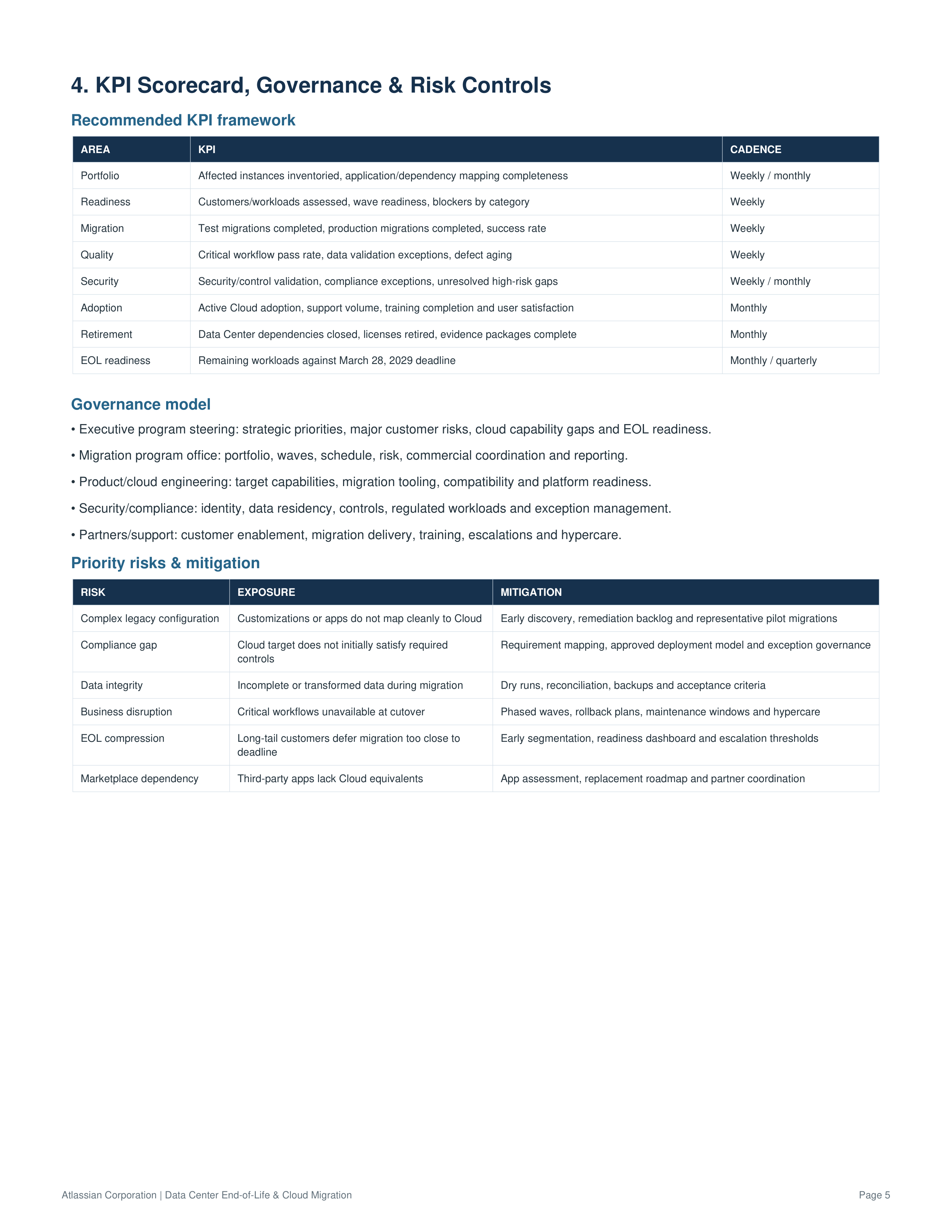
4. KPI Scorecard, Governance & Risk Controls
Recommended KPI framework
AREA
KPI
CADENCE
Portfolio
Affected instances inventoried, application/dependency mapping completeness
Weekly / monthly
Readiness
Customers/workloads assessed, wave readiness, blockers by category
Weekly
Migration
Test migrations completed, production migrations completed, success rate
Weekly
Quality
Critical workflow pass rate, data validation exceptions, defect aging
Weekly
Security
Security/control validation, compliance exceptions, unresolved high-risk gaps
Weekly / monthly
Adoption
Active Cloud adoption, support volume, training completion and user satisfaction
Monthly
Retirement
Data Center dependencies closed, licenses retired, evidence packages complete
Monthly
EOL readiness
Remaining workloads against March 28, 2029 deadline
Monthly / quarterly
Governance model
• Executive program steering: strategic priorities, major customer risks, cloud capability gaps and EOL readiness.
• Migration program office: portfolio, waves, schedule, risk, commercial coordination and reporting.
• Product/cloud engineering: target capabilities, migration tooling, compatibility and platform readiness.
• Security/compliance: identity, data residency, controls, regulated workloads and exception management.
• Partners/support: customer enablement, migration delivery, training, escalations and hypercare.
Priority risks & mitigation
RISK
EXPOSURE
MITIGATION
Complex legacy configuration
Customizations or apps do not map cleanly to Cloud
Early discovery, remediation backlog and representative pilot migrations
Compliance gap
Cloud target does not initially satisfy required
controls
Requirement mapping, approved deployment model and exception governance
Data integrity
Incomplete or transformed data during migration
Dry runs, reconciliation, backups and acceptance criteria
Business disruption
Critical workflows unavailable at cutover
Phased waves, rollback plans, maintenance windows and hypercare
EOL compression
Long-tail customers defer migration too close to
deadline
Early segmentation, readiness dashboard and escalation thresholds
Marketplace dependency
Third-party apps lack Cloud equivalents
App assessment, replacement roadmap and partner coordination
Atlassian Corporation | Data Center End-of-Life & Cloud Migration
Page 6
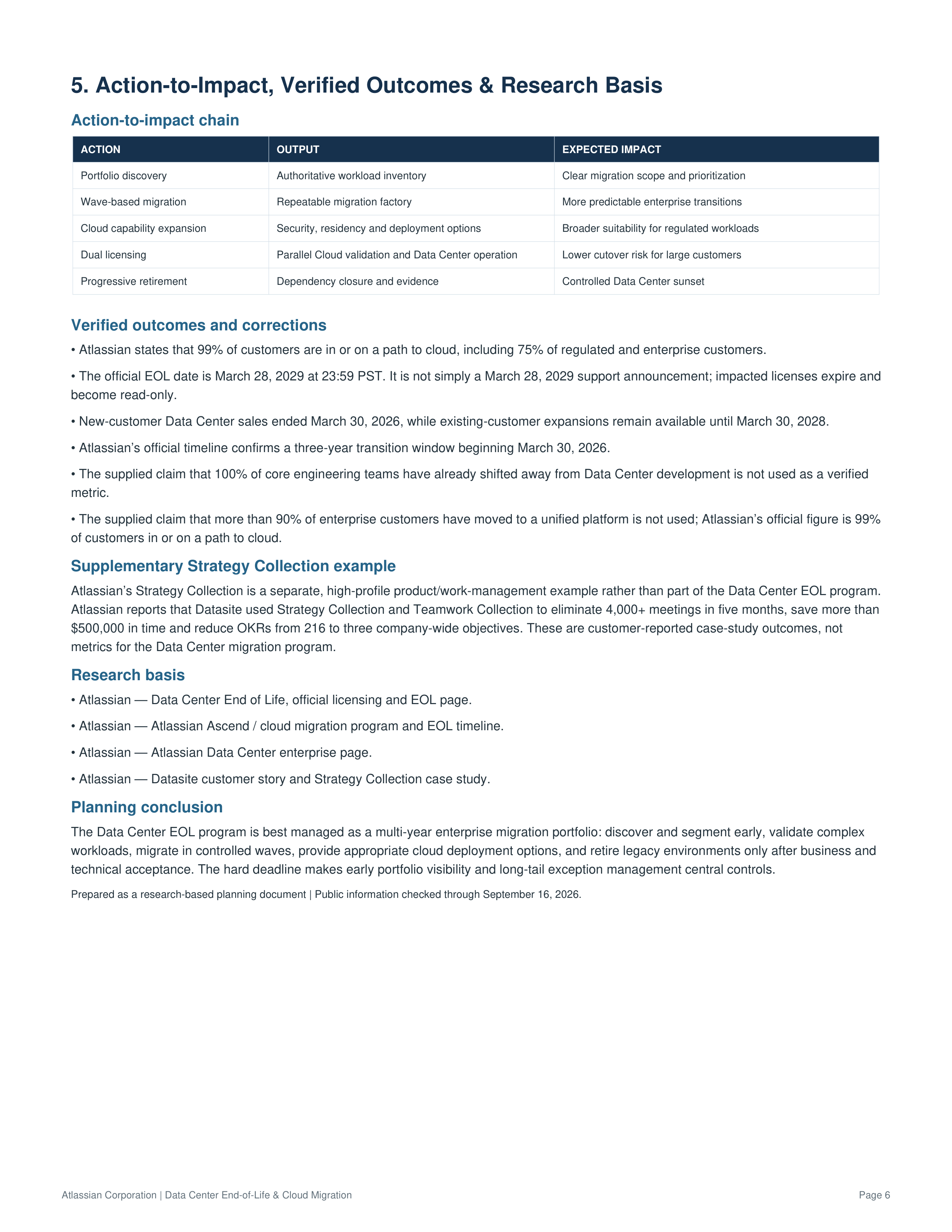
5. Action-to-Impact, Verified Outcomes & Research Basis
Action-to-impact chain
ACTION
OUTPUT
EXPECTED IMPACT
Portfolio discovery
Authoritative workload inventory
Clear migration scope and prioritization
Wave-based migration
Repeatable migration factory
More predictable enterprise transitions
Cloud capability expansion
Security, residency and deployment options
Broader suitability for regulated workloads
Dual licensing
Parallel Cloud validation and Data Center operation
Lower cutover risk for large customers
Progressive retirement
Dependency closure and evidence
Controlled Data Center sunset
Verified outcomes and corrections
• Atlassian states that 99% of customers are in or on a path to cloud, including 75% of regulated and enterprise customers.
• The official EOL date is March 28, 2029 at 23:59 PST. It is not simply a March 28, 2029 support announcement; impacted licenses expire and
become read-only.
• New-customer Data Center sales ended March 30, 2026, while existing-customer expansions remain available until March 30, 2028.
• Atlassian’s official timeline confirms a three-year transition window beginning March 30, 2026.
• The supplied claim that 100% of core engineering teams have already shifted away from Data Center development is not used as a verified
metric.
• The supplied claim that more than 90% of enterprise customers have moved to a unified platform is not used; Atlassian’s official figure is 99%
of customers in or on a path to cloud.
Supplementary Strategy Collection example
Atlassian’s Strategy Collection is a separate, high-profile product/work-management example rather than part of the Data Center EOL program.
Atlassian reports that Datasite used Strategy Collection and Teamwork Collection to eliminate 4,000+ meetings in five months, save more than
$500,000 in time and reduce OKRs from 216 to three company-wide objectives. These are customer-reported case-study outcomes, not
metrics for the Data Center migration program.
Research basis
• Atlassian — Data Center End of Life, official licensing and EOL page.
• Atlassian — Atlassian Ascend / cloud migration program and EOL timeline.
• Atlassian — Atlassian Data Center enterprise page.
• Atlassian — Datasite customer story and Strategy Collection case study.
Planning conclusion
The Data Center EOL program is best managed as a multi-year enterprise migration portfolio: discover and segment early, validate complex
workloads, migrate in controlled waves, provide appropriate cloud deployment options, and retire legacy environments only after business and
technical acceptance. The hard deadline makes early portfolio visibility and long-tail exception management central controls.
Prepared as a research-based planning document | Public information checked through September 16, 2026.