PROJECT MANAGEMENT INSTITUTE | GLOBAL STRATEGIC ACTION PLAN
Strategic planning framework • 2021–2025
Page 1
PROJECT MANAGEMENT INSTITUTE
Global Strategic Action Plan
Shaping the Future Together • Strategic Plan 2021–2025
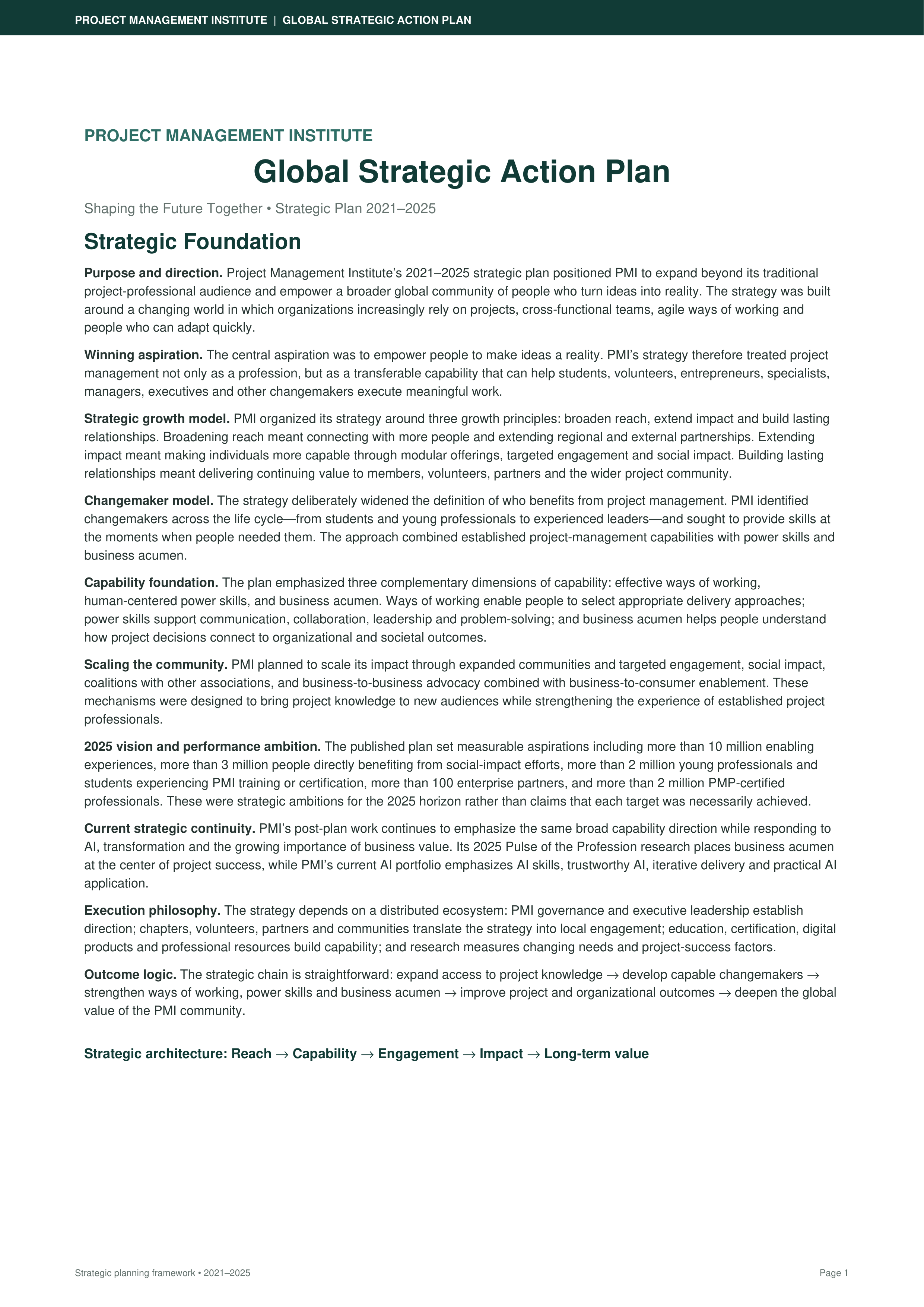
Strategic Foundation
Purpose and direction.
Project Management Institute’s 2021–2025 strategic plan positioned PMI to expand beyond its traditional
project-professional audience and empower a broader global community of people who turn ideas into reality. The strategy was built
around a changing world in which organizations increasingly rely on projects, cross-functional teams, agile ways of working and
people who can adapt quickly.
Winning aspiration.
The central aspiration was to empower people to make ideas a reality. PMI’s strategy therefore treated project
management not only as a profession, but as a transferable capability that can help students, volunteers, entrepreneurs, specialists,
managers, executives and other changemakers execute meaningful work.
Strategic growth model.
PMI organized its strategy around three growth principles: broaden reach, extend impact and build lasting
relationships. Broadening reach meant connecting with more people and extending regional and external partnerships. Extending
impact meant making individuals more capable through modular offerings, targeted engagement and social impact. Building lasting
relationships meant delivering continuing value to members, volunteers, partners and the wider project community.
Changemaker model.
The strategy deliberately widened the definition of who benefits from project management. PMI identified
changemakers across the life cycle—from students and young professionals to experienced leaders—and sought to provide skills at
the moments when people needed them. The approach combined established project-management capabilities with power skills and
business acumen.
Capability foundation.
The plan emphasized three complementary dimensions of capability: effective ways of working,
human-centered power skills, and business acumen. Ways of working enable people to select appropriate delivery approaches;
power skills support communication, collaboration, leadership and problem-solving; and business acumen helps people understand
how project decisions connect to organizational and societal outcomes.
Scaling the community.
PMI planned to scale its impact through expanded communities and targeted engagement, social impact,
coalitions with other associations, and business-to-business advocacy combined with business-to-consumer enablement. These
mechanisms were designed to bring project knowledge to new audiences while strengthening the experience of established project
professionals.
2025 vision and performance ambition.
The published plan set measurable aspirations including more than 10 million enabling
experiences, more than 3 million people directly benefiting from social-impact efforts, more than 2 million young professionals and
students experiencing PMI training or certification, more than 100 enterprise partners, and more than 2 million PMP-certified
professionals. These were strategic ambitions for the 2025 horizon rather than claims that each target was necessarily achieved.
Current strategic continuity.
PMI’s post-plan work continues to emphasize the same broad capability direction while responding to
AI, transformation and the growing importance of business value. Its 2025 Pulse of the Profession research places business acumen
at the center of project success, while PMI’s current AI portfolio emphasizes AI skills, trustworthy AI, iterative delivery and practical AI
application.
Execution philosophy.
The strategy depends on a distributed ecosystem: PMI governance and executive leadership establish
direction; chapters, volunteers, partners and communities translate the strategy into local engagement; education, certification, digital
products and professional resources build capability; and research measures changing needs and project-success factors.
Outcome logic.
The strategic chain is straightforward: expand access to project knowledge
→
develop capable changemakers
→
strengthen ways of working, power skills and business acumen
→
improve project and organizational outcomes
→
deepen the global
value of the PMI community.
Strategic architecture: Reach
→
Capability
→
Engagement
→
Impact
→
Long-term value
PROJECT MANAGEMENT INSTITUTE | GLOBAL STRATEGIC ACTION PLAN
Strategic planning framework • 2021–2025
Page 2
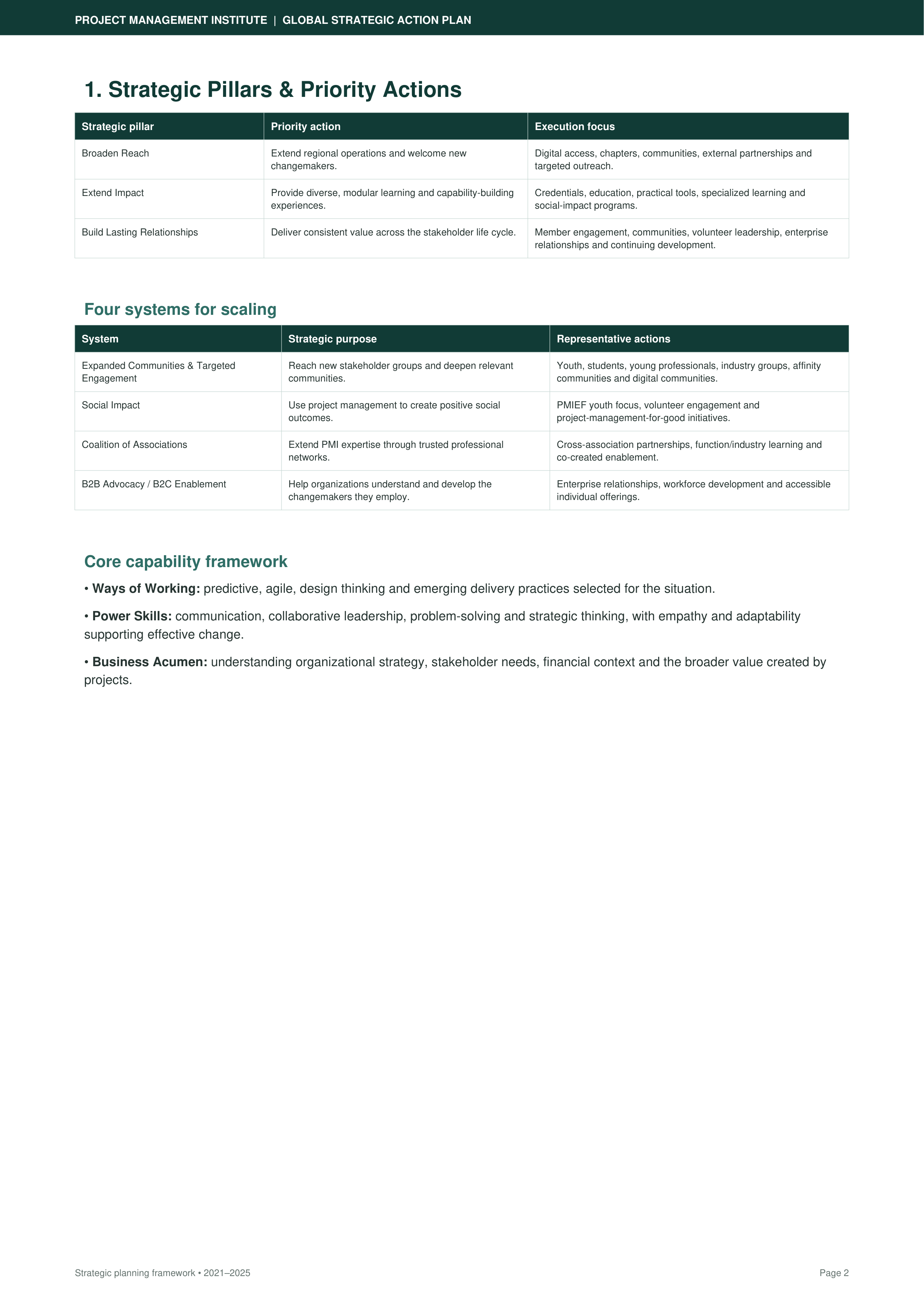
1. Strategic Pillars & Priority Actions
Strategic pillar
Priority action
Execution focus
Broaden Reach
Extend regional operations and welcome new
changemakers.
Digital access, chapters, communities, external partnerships and
targeted outreach.
Extend Impact
Provide diverse, modular learning and capability-building
experiences.
Credentials, education, practical tools, specialized learning and
social-impact programs.
Build Lasting Relationships
Deliver consistent value across the stakeholder life cycle.
Member engagement, communities, volunteer leadership, enterprise
relationships and continuing development.
Four systems for scaling
System
Strategic purpose
Representative actions
Expanded Communities & Targeted
Engagement
Reach new stakeholder groups and deepen relevant
communities.
Youth, students, young professionals, industry groups, affinity
communities and digital communities.
Social Impact
Use project management to create positive social
outcomes.
PMIEF youth focus, volunteer engagement and
project-management-for-good initiatives.
Coalition of Associations
Extend PMI expertise through trusted professional
networks.
Cross-association partnerships, function/industry learning and
co-created enablement.
B2B Advocacy / B2C Enablement
Help organizations understand and develop the
changemakers they employ.
Enterprise relationships, workforce development and accessible
individual offerings.
Core capability framework
•
Ways of Working:
predictive, agile, design thinking and emerging delivery practices selected for the situation.
•
Power Skills:
communication, collaborative leadership, problem-solving and strategic thinking, with empathy and adaptability
supporting effective change.
•
Business Acumen:
understanding organizational strategy, stakeholder needs, financial context and the broader value created by
projects.
PROJECT MANAGEMENT INSTITUTE | GLOBAL STRATEGIC ACTION PLAN
Strategic planning framework • 2021–2025
Page 3
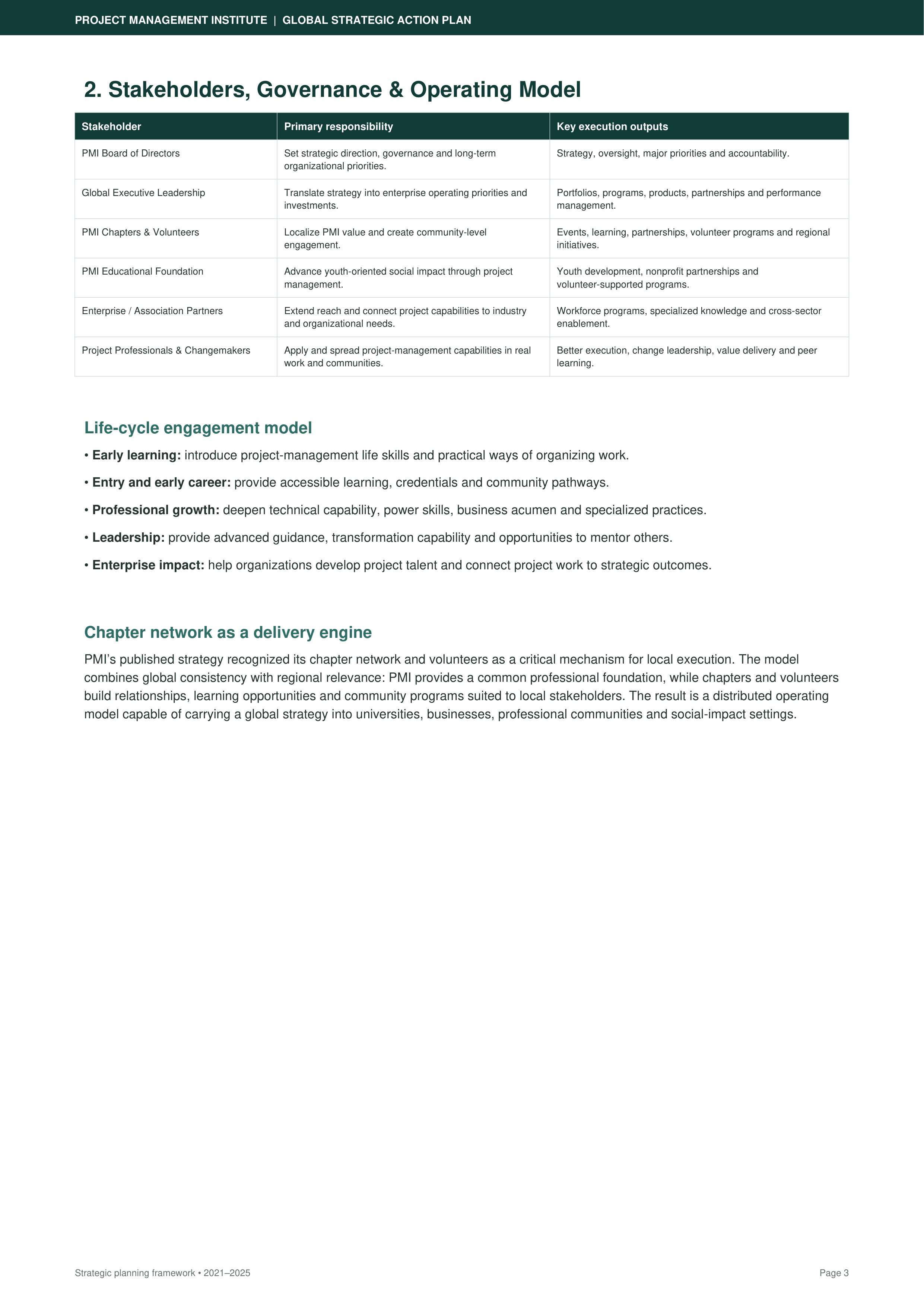
2. Stakeholders, Governance & Operating Model
Stakeholder
Primary responsibility
Key execution outputs
PMI Board of Directors
Set strategic direction, governance and long-term
organizational priorities.
Strategy, oversight, major priorities and accountability.
Global Executive Leadership
Translate strategy into enterprise operating priorities and
investments.
Portfolios, programs, products, partnerships and performance
management.
PMI Chapters & Volunteers
Localize PMI value and create community-level
engagement.
Events, learning, partnerships, volunteer programs and regional
initiatives.
PMI Educational Foundation
Advance youth-oriented social impact through project
management.
Youth development, nonprofit partnerships and
volunteer-supported programs.
Enterprise / Association Partners
Extend reach and connect project capabilities to industry
and organizational needs.
Workforce programs, specialized knowledge and cross-sector
enablement.
Project Professionals & Changemakers
Apply and spread project-management capabilities in real
work and communities.
Better execution, change leadership, value delivery and peer
learning.
Life-cycle engagement model
•
Early learning:
introduce project-management life skills and practical ways of organizing work.
•
Entry and early career:
provide accessible learning, credentials and community pathways.
•
Professional growth:
deepen technical capability, power skills, business acumen and specialized practices.
•
Leadership:
provide advanced guidance, transformation capability and opportunities to mentor others.
•
Enterprise impact:
help organizations develop project talent and connect project work to strategic outcomes.
Chapter network as a delivery engine
PMI’s published strategy recognized its chapter network and volunteers as a critical mechanism for local execution. The model
combines global consistency with regional relevance: PMI provides a common professional foundation, while chapters and volunteers
build relationships, learning opportunities and community programs suited to local stakeholders. The result is a distributed operating
model capable of carrying a global strategy into universities, businesses, professional communities and social-impact settings.
PROJECT MANAGEMENT INSTITUTE | GLOBAL STRATEGIC ACTION PLAN
Strategic planning framework • 2021–2025
Page 4
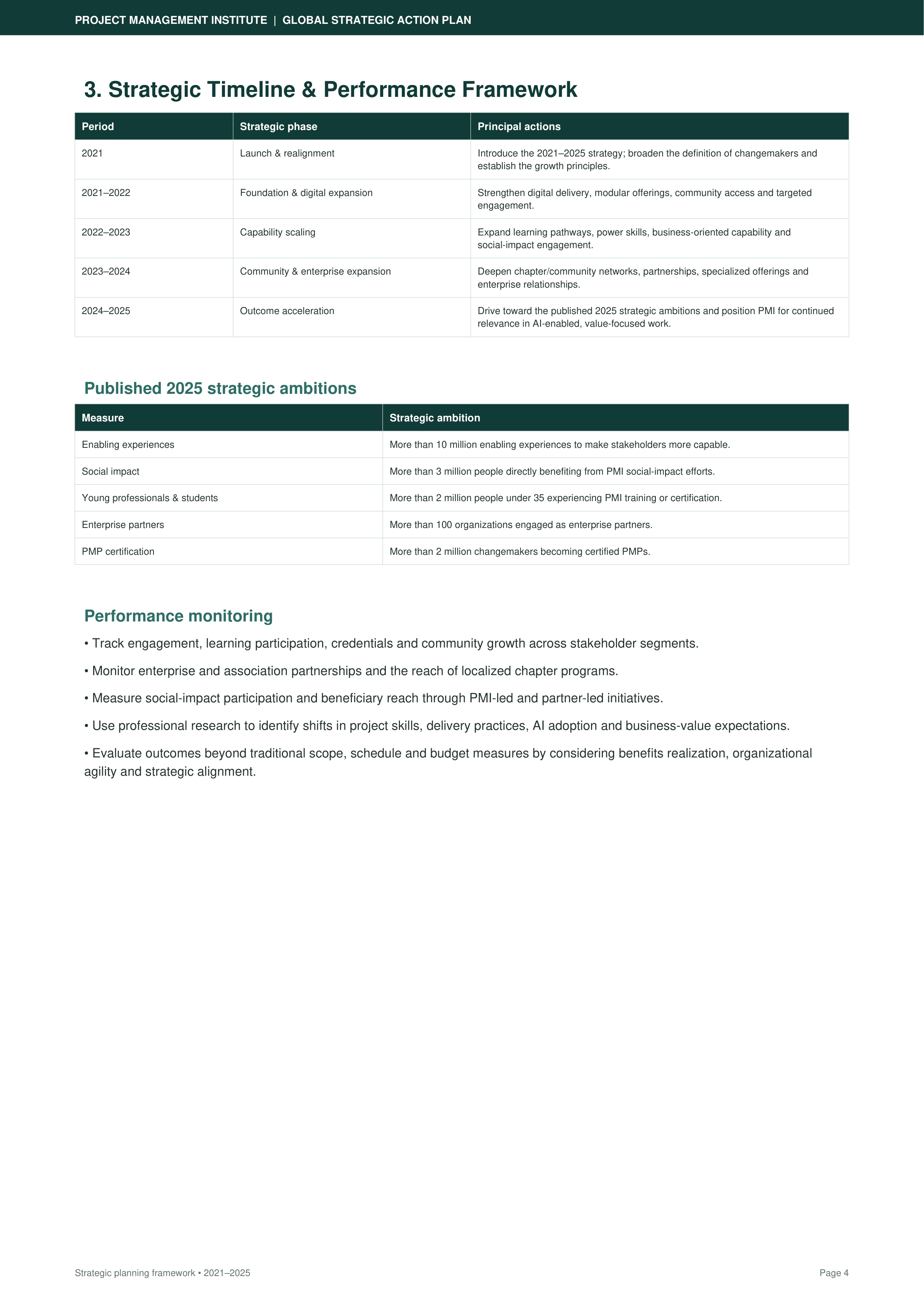
3. Strategic Timeline & Performance Framework
Period
Strategic phase
Principal actions
2021
Launch & realignment
Introduce the 2021–2025 strategy; broaden the definition of changemakers and
establish the growth principles.
2021–2022
Foundation & digital expansion
Strengthen digital delivery, modular offerings, community access and targeted
engagement.
2022–2023
Capability scaling
Expand learning pathways, power skills, business-oriented capability and
social-impact engagement.
2023–2024
Community & enterprise expansion
Deepen chapter/community networks, partnerships, specialized offerings and
enterprise relationships.
2024–2025
Outcome acceleration
Drive toward the published 2025 strategic ambitions and position PMI for continued
relevance in AI-enabled, value-focused work.
Published 2025 strategic ambitions
Measure
Strategic ambition
Enabling experiences
More than 10 million enabling experiences to make stakeholders more capable.
Social impact
More than 3 million people directly benefiting from PMI social-impact efforts.
Young professionals & students
More than 2 million people under 35 experiencing PMI training or certification.
Enterprise partners
More than 100 organizations engaged as enterprise partners.
PMP certification
More than 2 million changemakers becoming certified PMPs.
Performance monitoring
• Track engagement, learning participation, credentials and community growth across stakeholder segments.
• Monitor enterprise and association partnerships and the reach of localized chapter programs.
• Measure social-impact participation and beneficiary reach through PMI-led and partner-led initiatives.
• Use professional research to identify shifts in project skills, delivery practices, AI adoption and business-value expectations.
• Evaluate outcomes beyond traditional scope, schedule and budget measures by considering benefits realization, organizational
agility and strategic alignment.
PROJECT MANAGEMENT INSTITUTE | GLOBAL STRATEGIC ACTION PLAN
Strategic planning framework • 2021–2025
Page 5
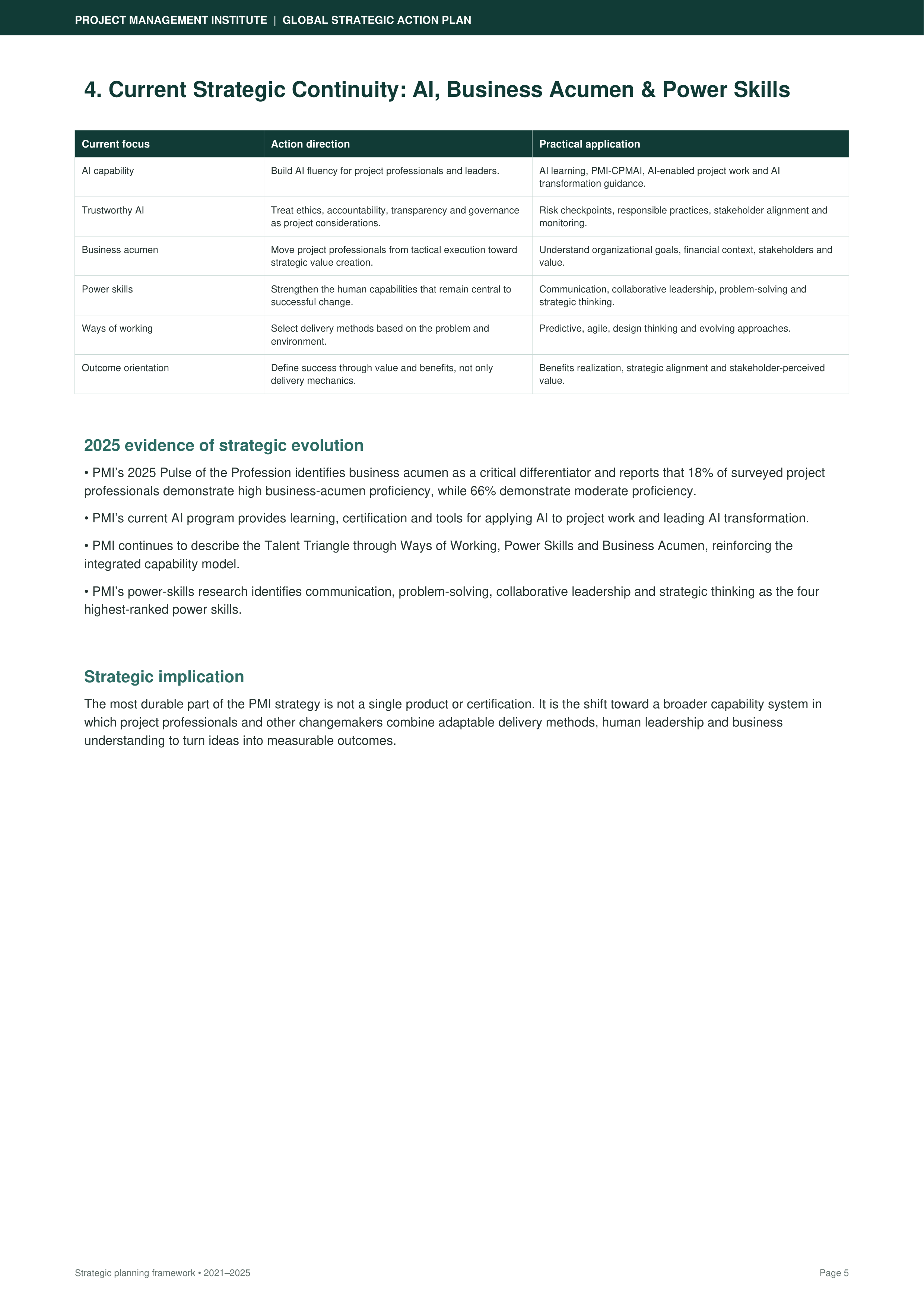
4. Current Strategic Continuity: AI, Business Acumen & Power Skills
Current focus
Action direction
Practical application
AI capability
Build AI fluency for project professionals and leaders.
AI learning, PMI-CPMAI, AI-enabled project work and AI
transformation guidance.
Trustworthy AI
Treat ethics, accountability, transparency and governance
as project considerations.
Risk checkpoints, responsible practices, stakeholder alignment and
monitoring.
Business acumen
Move project professionals from tactical execution toward
strategic value creation.
Understand organizational goals, financial context, stakeholders and
value.
Power skills
Strengthen the human capabilities that remain central to
successful change.
Communication, collaborative leadership, problem-solving and
strategic thinking.
Ways of working
Select delivery methods based on the problem and
environment.
Predictive, agile, design thinking and evolving approaches.
Outcome orientation
Define success through value and benefits, not only
delivery mechanics.
Benefits realization, strategic alignment and stakeholder-perceived
value.
2025 evidence of strategic evolution
• PMI’s 2025 Pulse of the Profession identifies business acumen as a critical differentiator and reports that 18% of surveyed project
professionals demonstrate high business-acumen proficiency, while 66% demonstrate moderate proficiency.
• PMI’s current AI program provides learning, certification and tools for applying AI to project work and leading AI transformation.
• PMI continues to describe the Talent Triangle through Ways of Working, Power Skills and Business Acumen, reinforcing the
integrated capability model.
• PMI’s power-skills research identifies communication, problem-solving, collaborative leadership and strategic thinking as the four
highest-ranked power skills.
Strategic implication
The most durable part of the PMI strategy is not a single product or certification. It is the shift toward a broader capability system in
which project professionals and other changemakers combine adaptable delivery methods, human leadership and business
understanding to turn ideas into measurable outcomes.
PROJECT MANAGEMENT INSTITUTE | GLOBAL STRATEGIC ACTION PLAN
Strategic planning framework • 2021–2025
Page 6
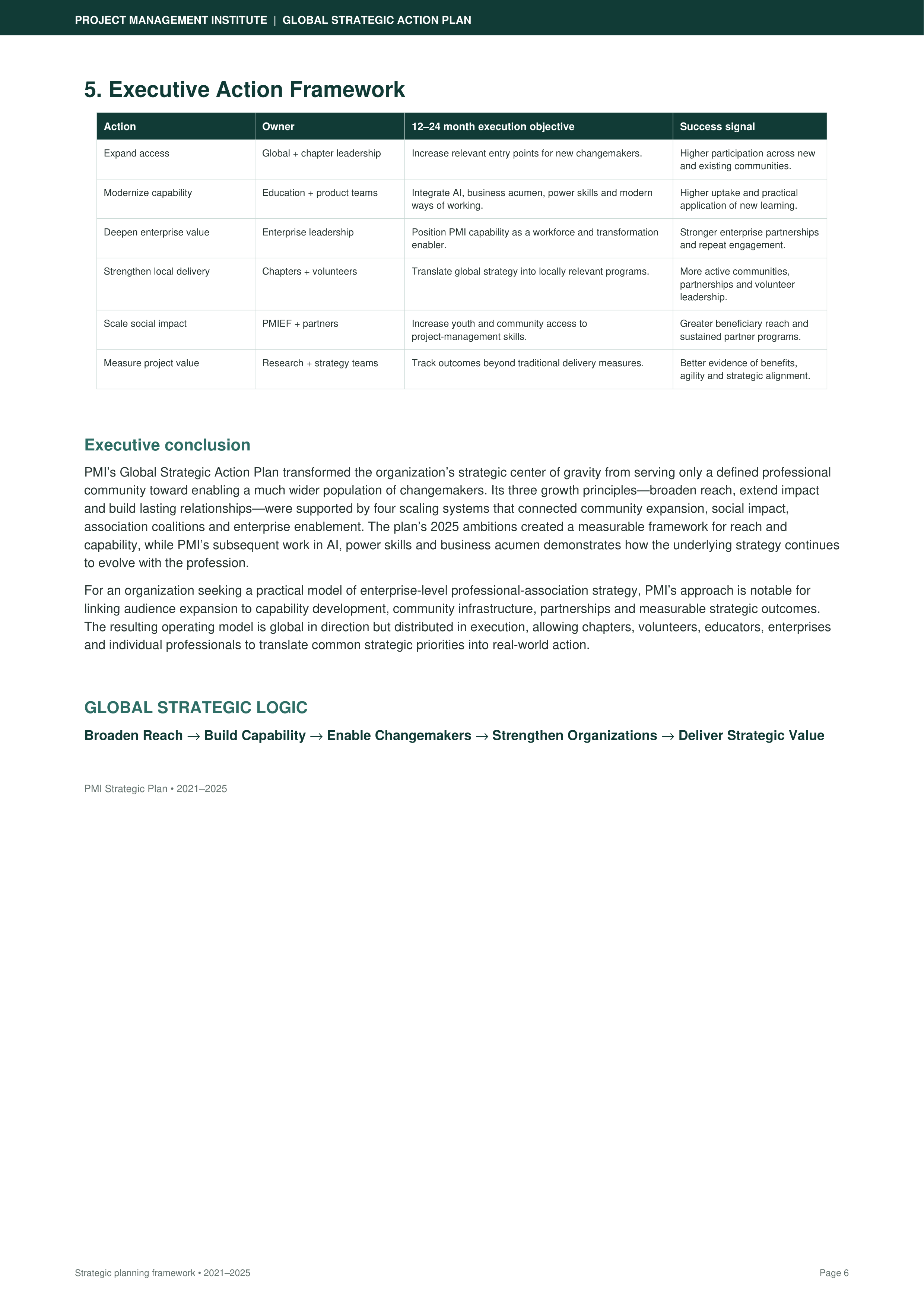
5. Executive Action Framework
Action
Owner
12–24 month execution objective
Success signal
Expand access
Global + chapter leadership
Increase relevant entry points for new changemakers.
Higher participation across new
and existing communities.
Modernize capability
Education + product teams
Integrate AI, business acumen, power skills and modern
ways of working.
Higher uptake and practical
application of new learning.
Deepen enterprise value
Enterprise leadership
Position PMI capability as a workforce and transformation
enabler.
Stronger enterprise partnerships
and repeat engagement.
Strengthen local delivery
Chapters + volunteers
Translate global strategy into locally relevant programs.
More active communities,
partnerships and volunteer
leadership.
Scale social impact
PMIEF + partners
Increase youth and community access to
project-management skills.
Greater beneficiary reach and
sustained partner programs.
Measure project value
Research + strategy teams
Track outcomes beyond traditional delivery measures.
Better evidence of benefits,
agility and strategic alignment.
Executive conclusion
PMI’s Global Strategic Action Plan transformed the organization’s strategic center of gravity from serving only a defined professional
community toward enabling a much wider population of changemakers. Its three growth principles—broaden reach, extend impact
and build lasting relationships—were supported by four scaling systems that connected community expansion, social impact,
association coalitions and enterprise enablement. The plan’s 2025 ambitions created a measurable framework for reach and
capability, while PMI’s subsequent work in AI, power skills and business acumen demonstrates how the underlying strategy continues
to evolve with the profession.
For an organization seeking a practical model of enterprise-level professional-association strategy, PMI’s approach is notable for
linking audience expansion to capability development, community infrastructure, partnerships and measurable strategic outcomes.
The resulting operating model is global in direction but distributed in execution, allowing chapters, volunteers, educators, enterprises
and individual professionals to translate common strategic priorities into real-world action.
GLOBAL STRATEGIC LOGIC
Broaden Reach
→
Build Capability
→
Enable Changemakers
→
Strengthen Organizations
→
Deliver Strategic Value
PMI Strategic Plan • 2021–2025