Boeing Comprehensive Safety & Quality Action Plan • Research-based synthesis
1
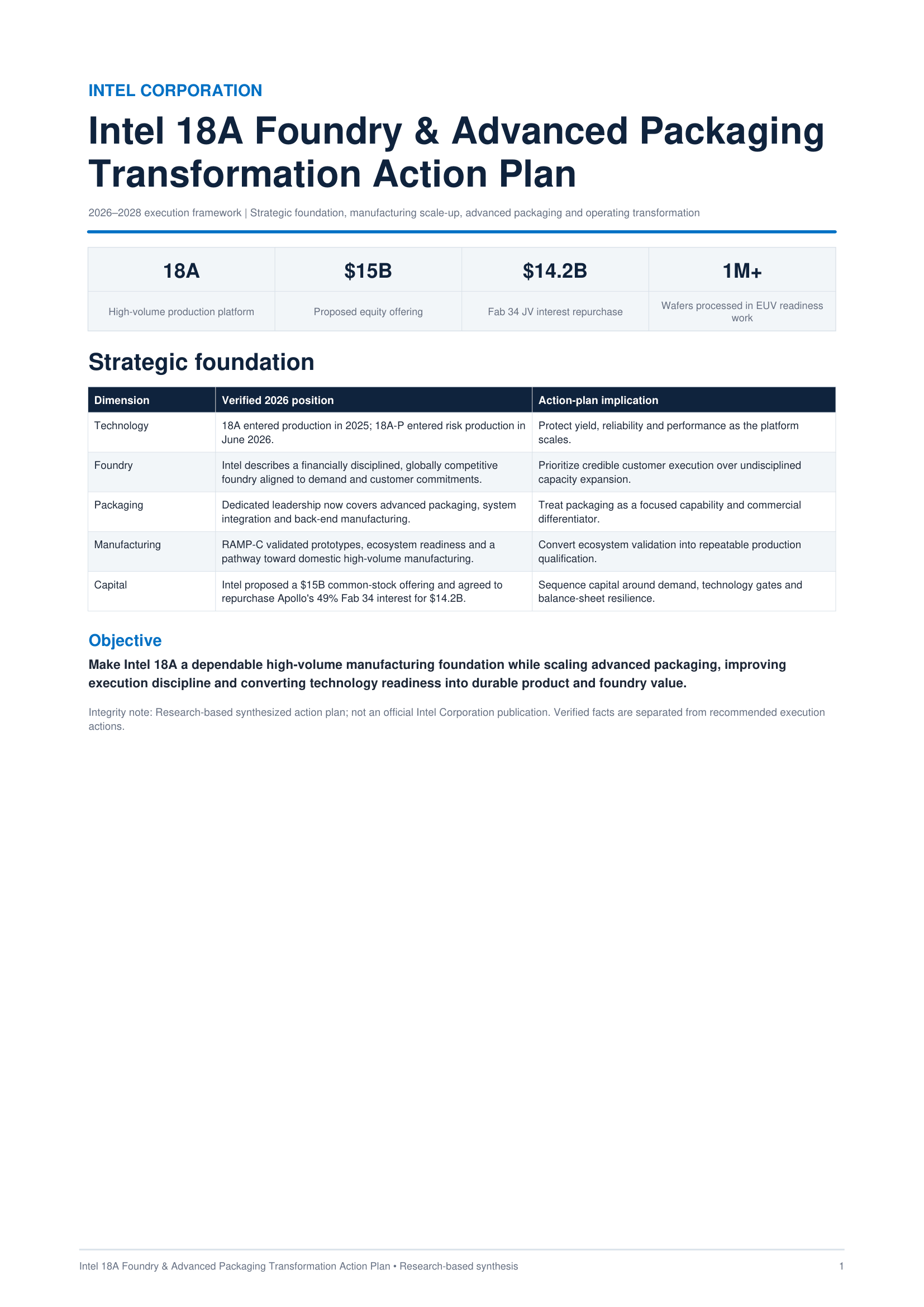
THE BOEING COMPANY
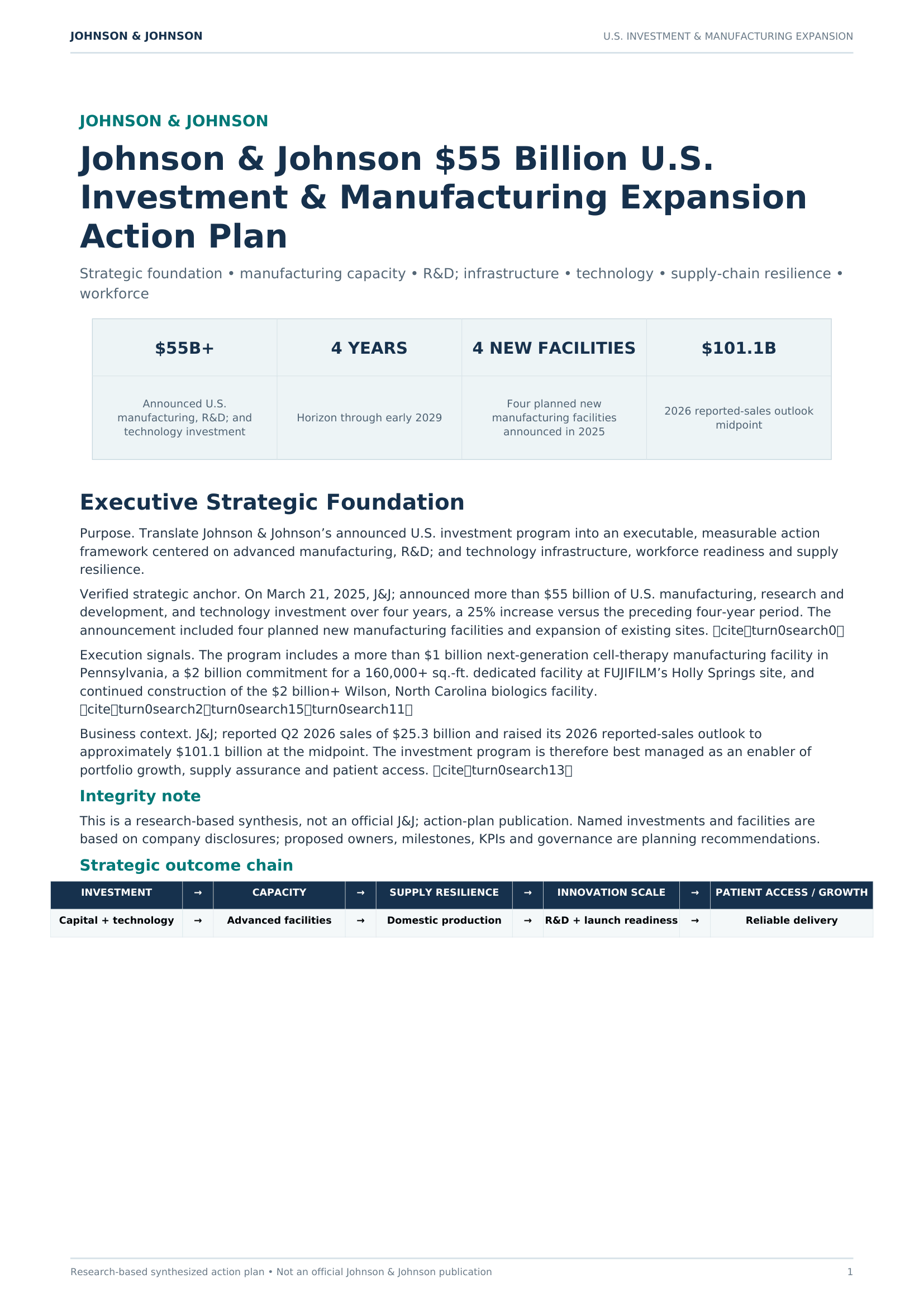
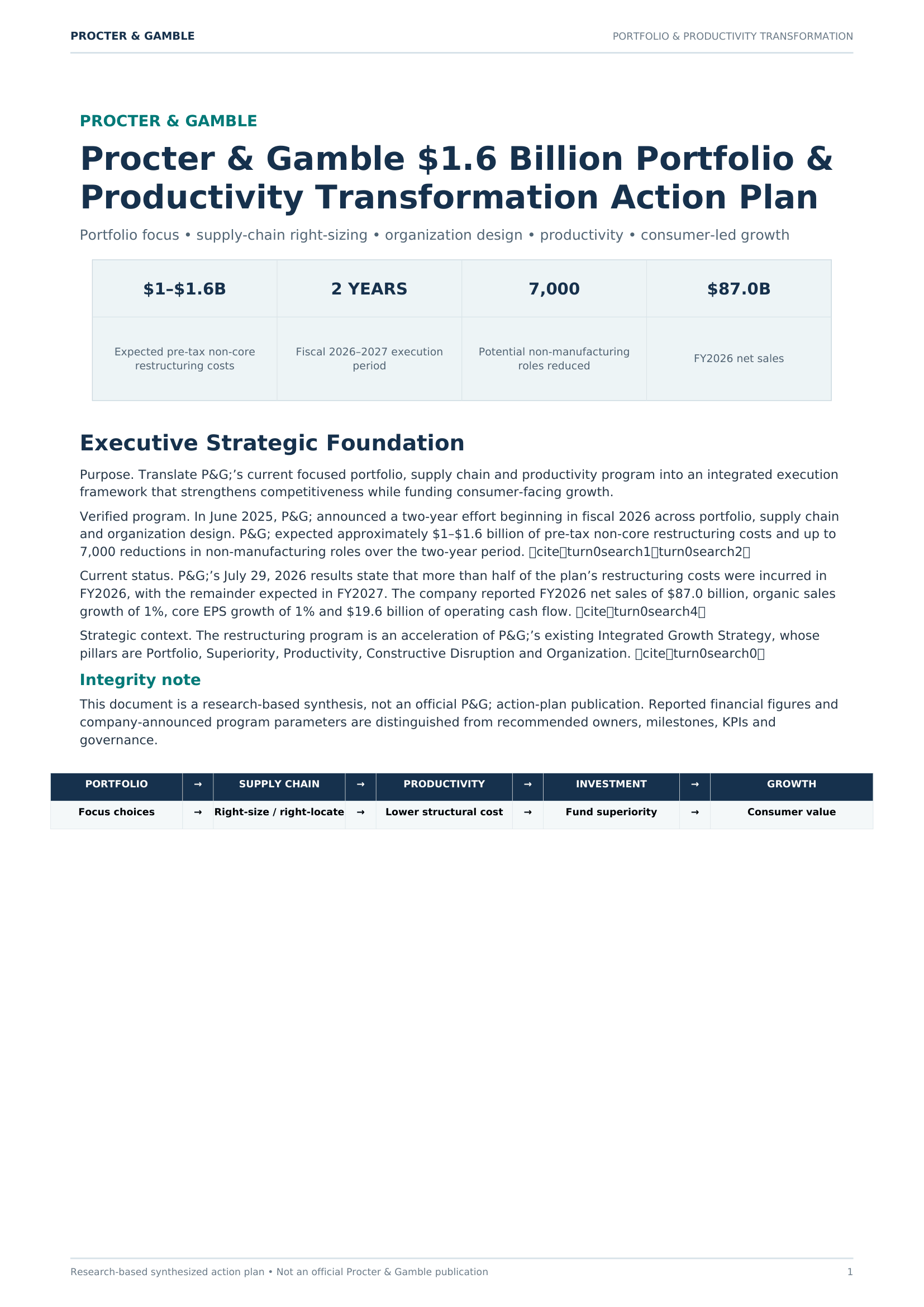
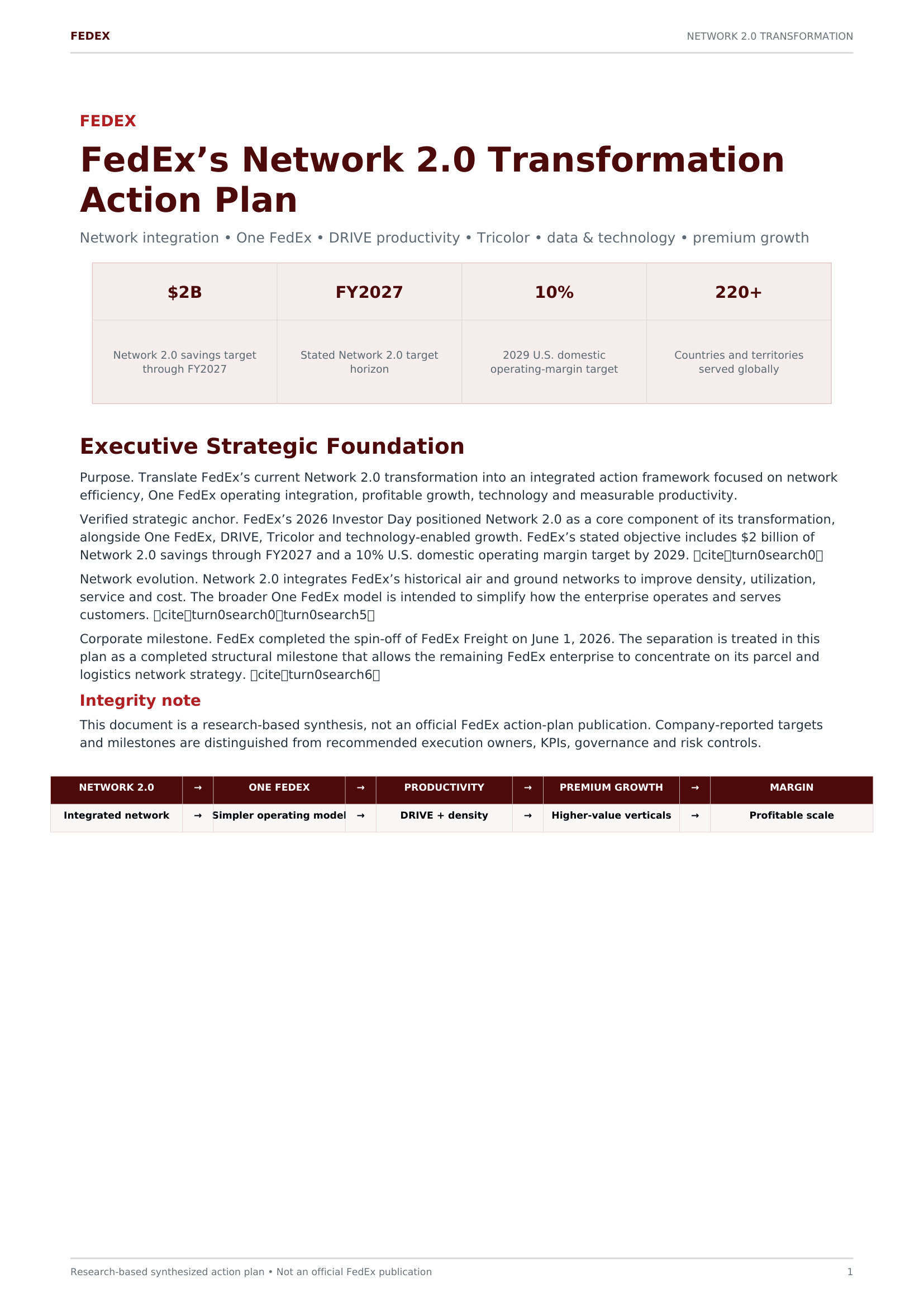
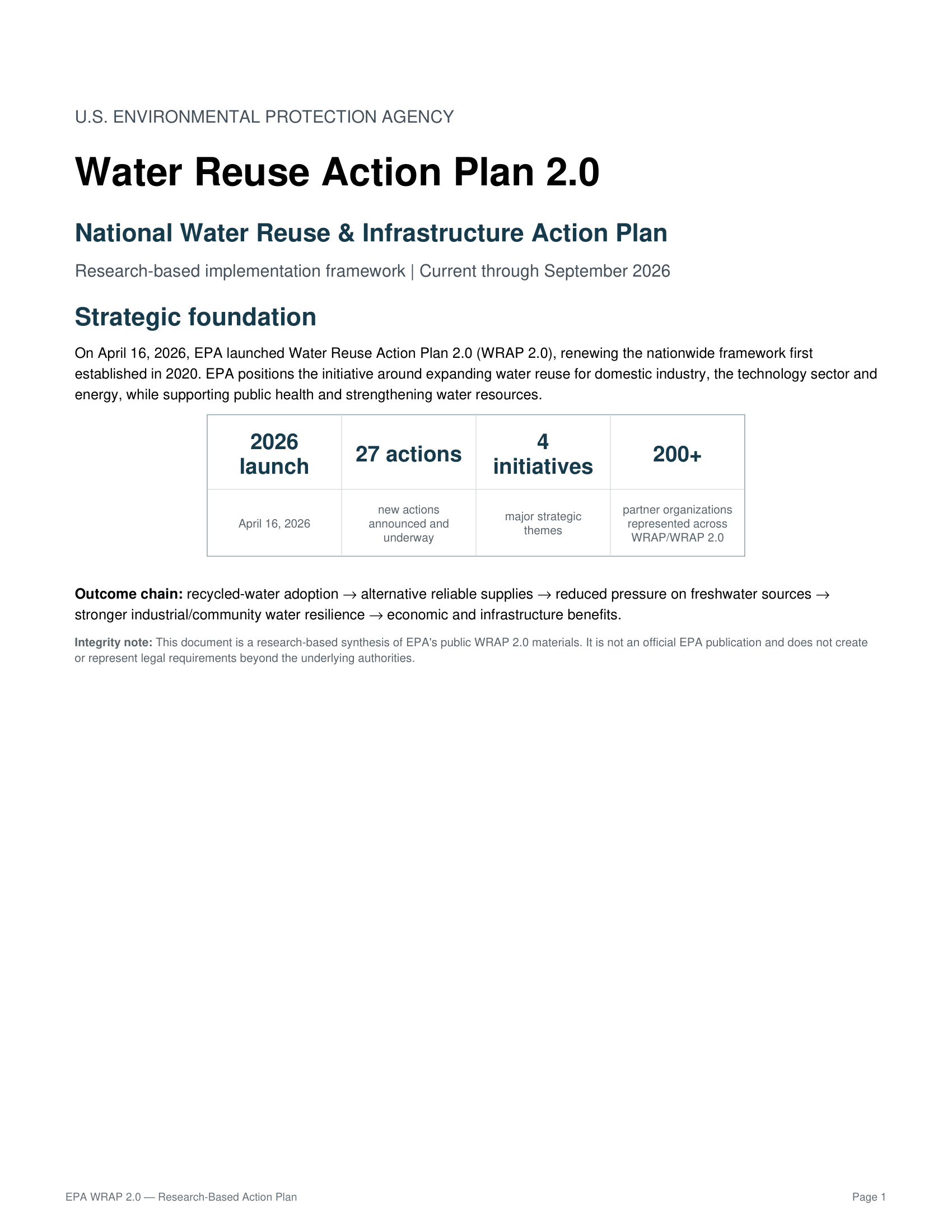
Boeing's Comprehensive
Safety & Quality Action Plan
2024–2028 operational transformation framework | Safety, quality, manufacturing control and production-system stabilization
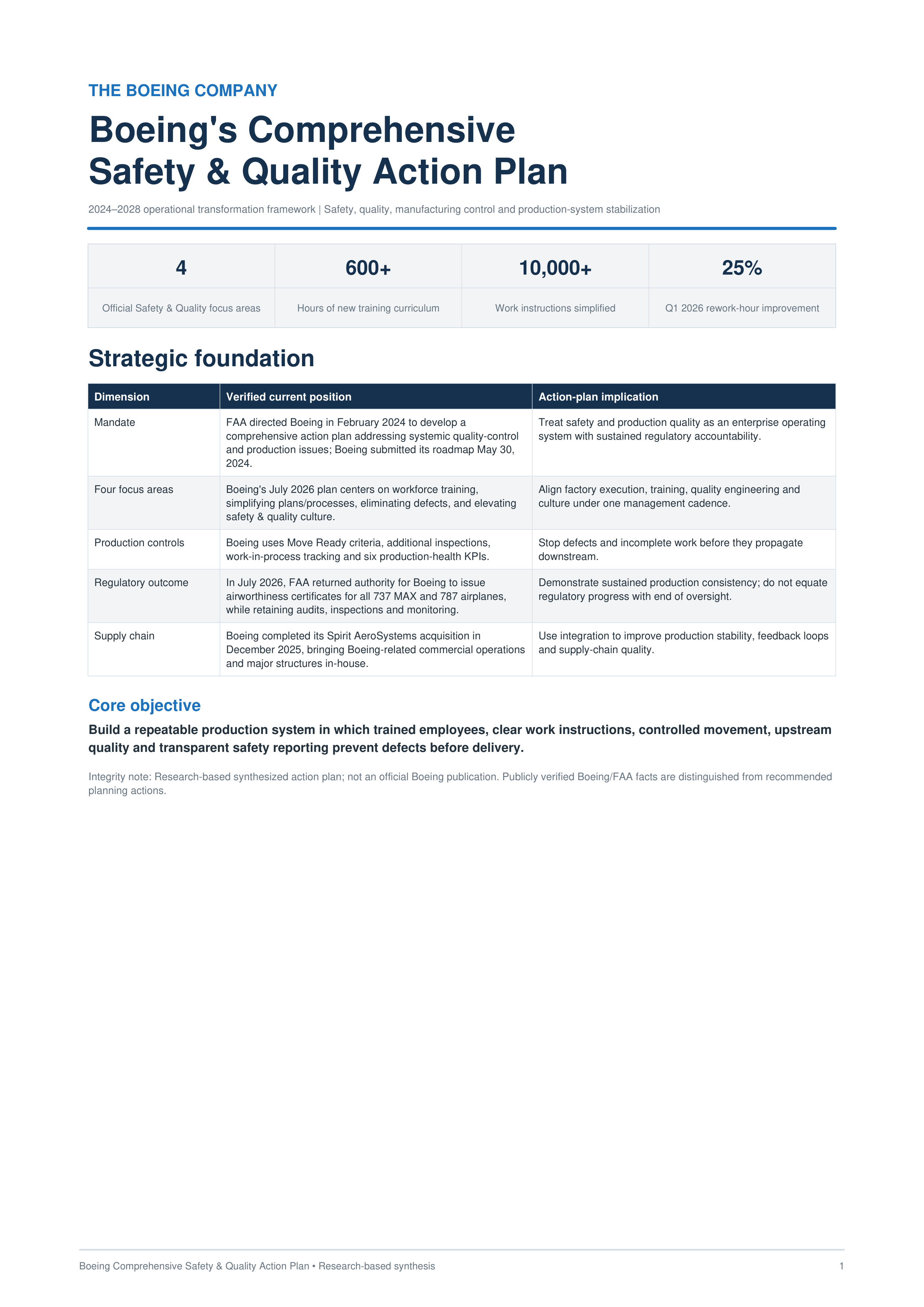
4
600+
10,000+
25%
Official Safety & Quality focus areas
Hours of new training curriculum
Work instructions simplified
Q1 2026 rework-hour improvement
Strategic foundation
Dimension
Verified current position
Action-plan implication
Mandate
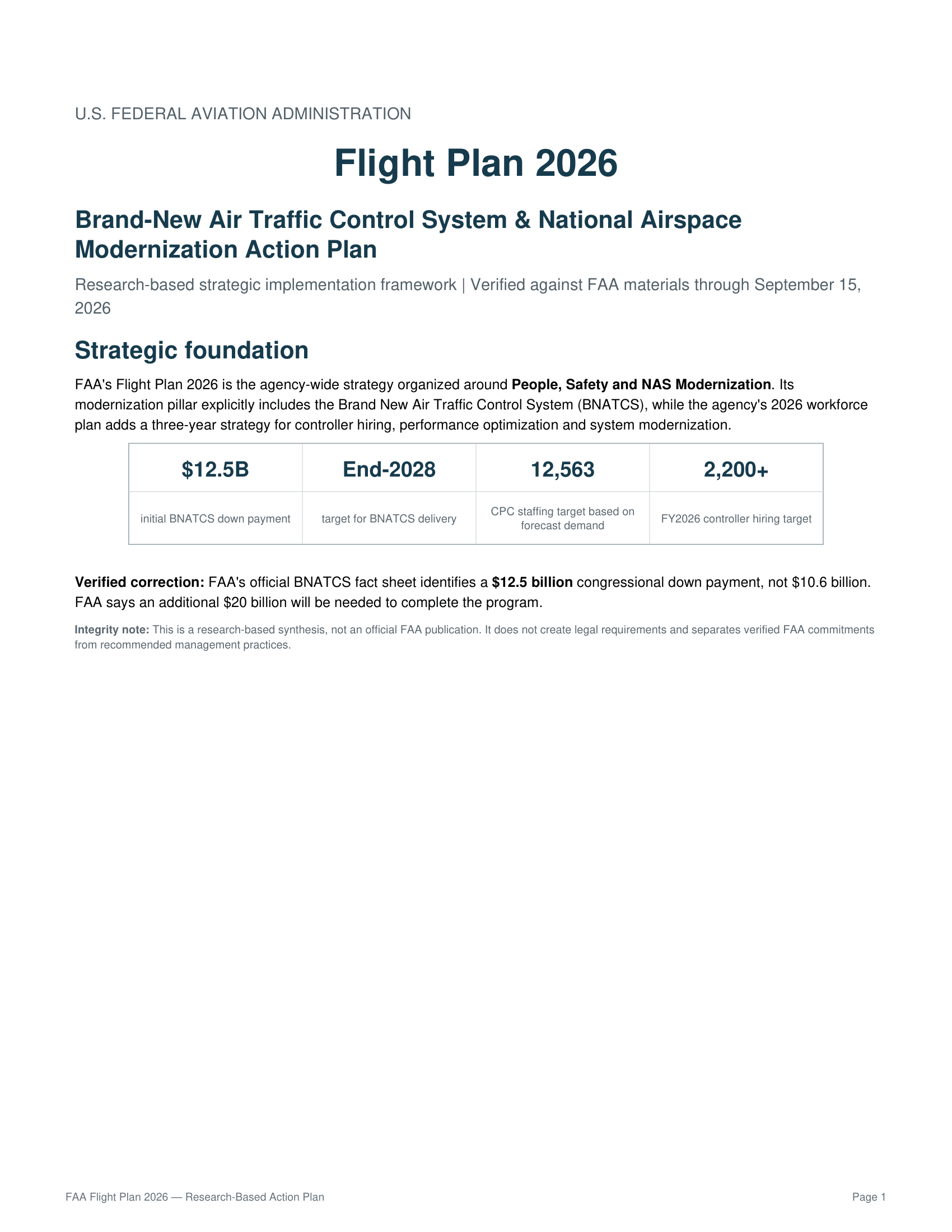
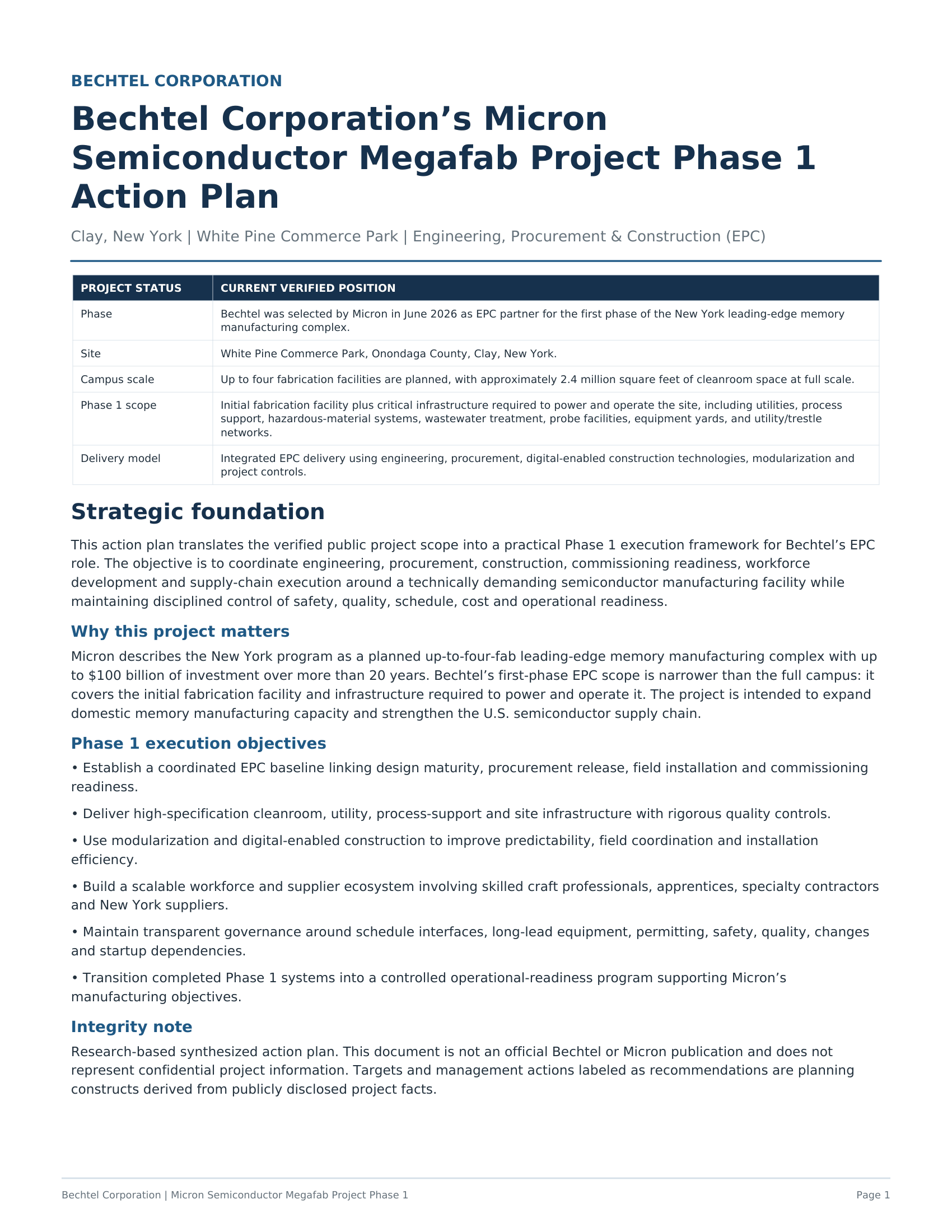
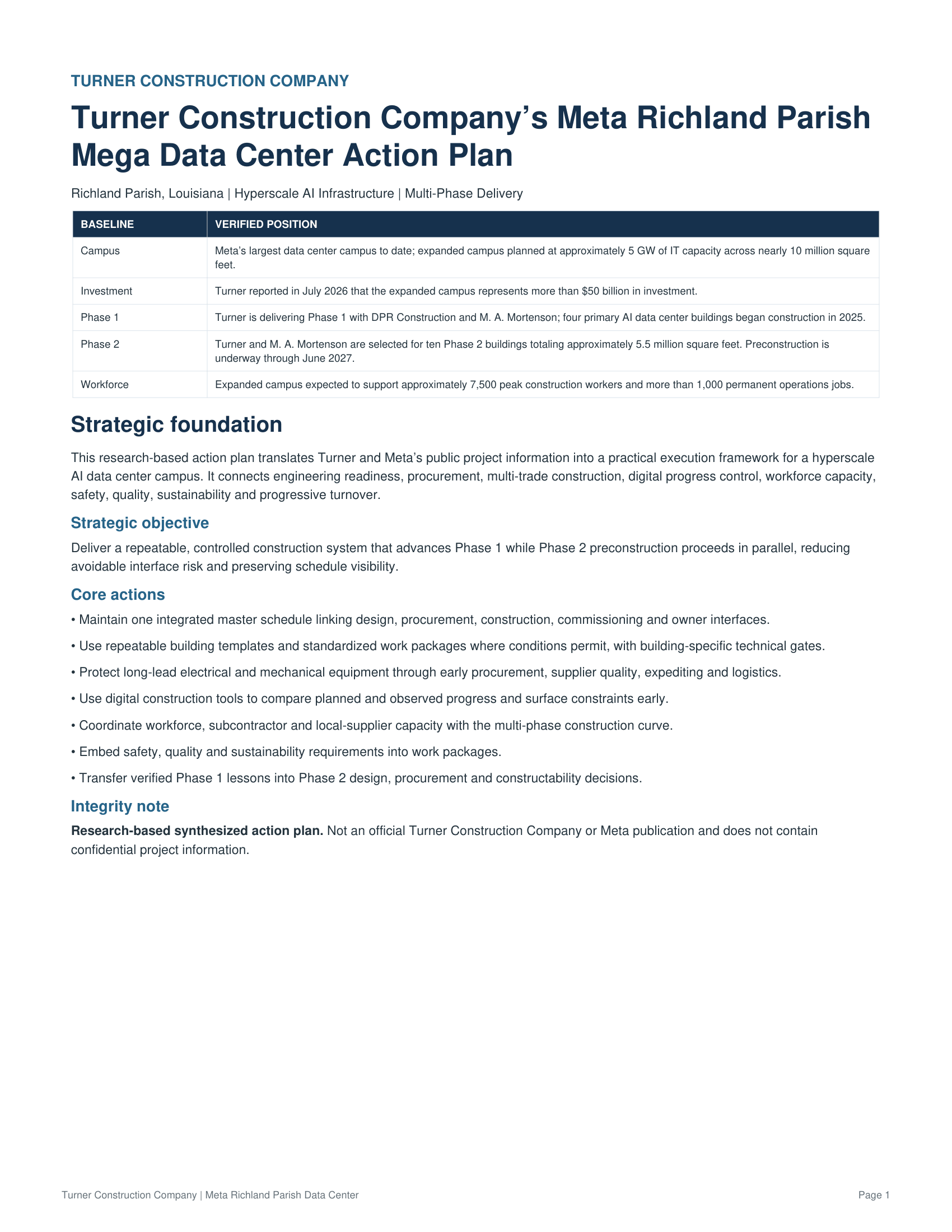
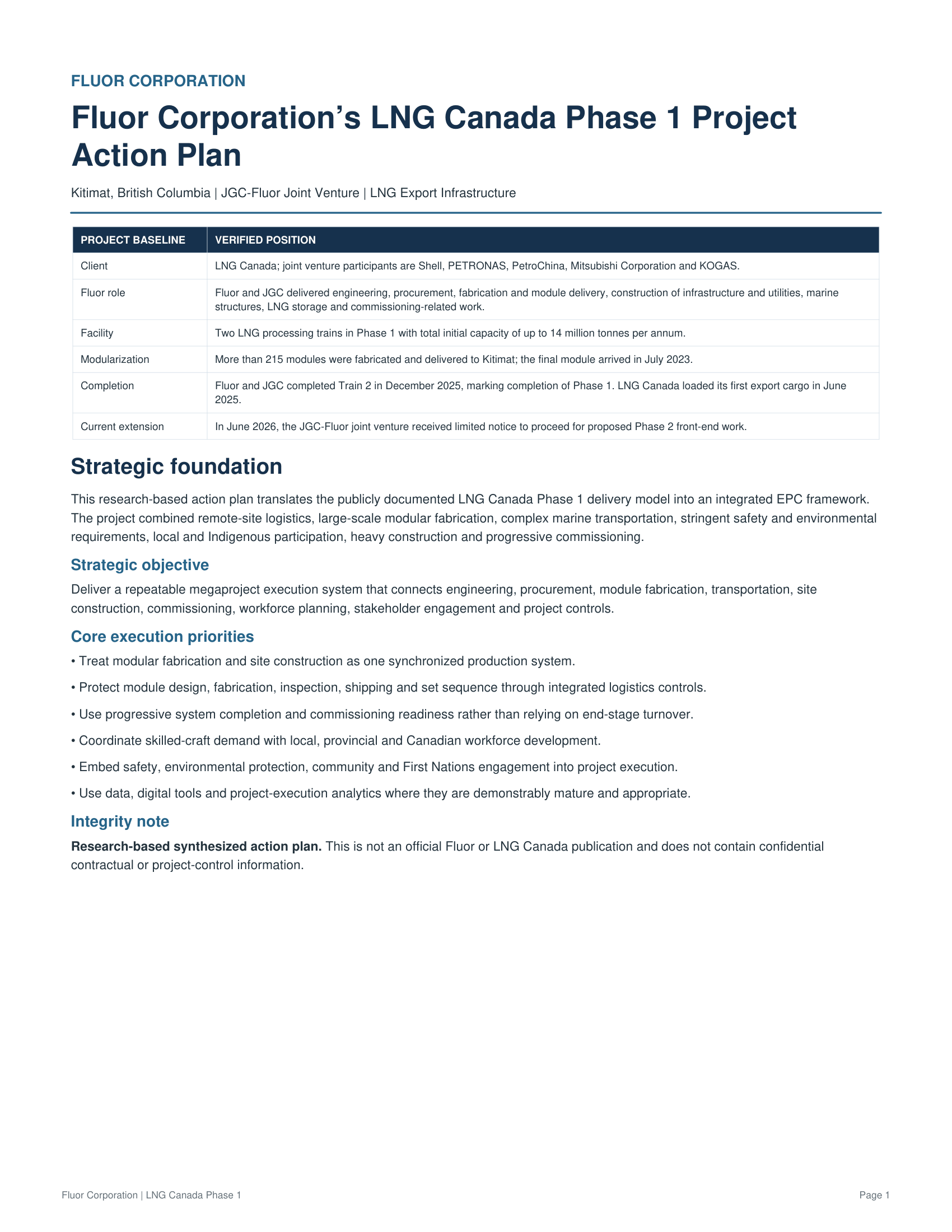
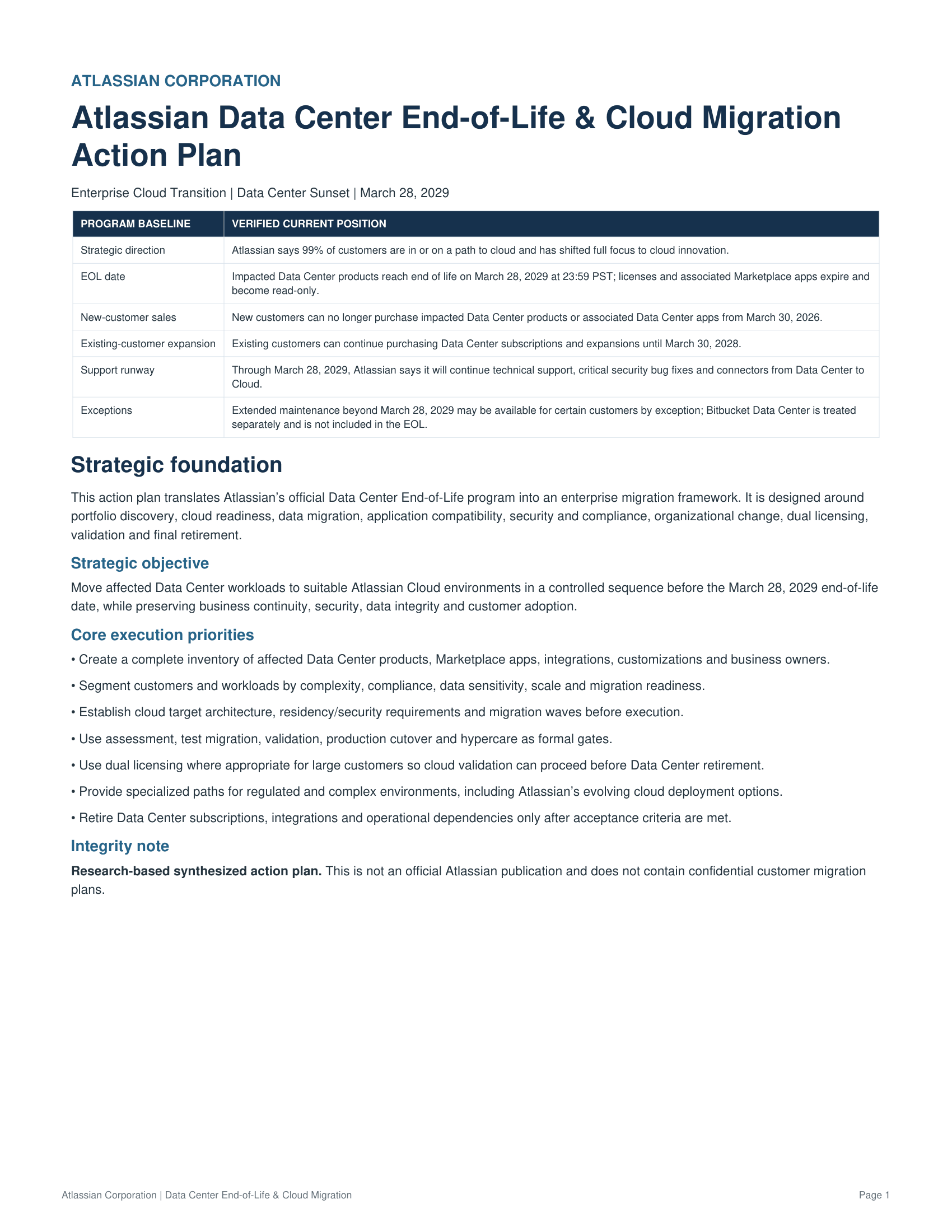
FAA directed Boeing in February 2024 to develop a
comprehensive action plan addressing systemic quality-control
and production issues; Boeing submitted its roadmap May 30,
2024.
Treat safety and production quality as an enterprise operating
system with sustained regulatory accountability.
Four focus areas
Boeing's July 2026 plan centers on workforce training,
simplifying plans/processes, eliminating defects, and elevating
safety & quality culture.
Align factory execution, training, quality engineering and
culture under one management cadence.
Production controls
Boeing uses Move Ready criteria, additional inspections,
work-in-process tracking and six production-health KPIs.
Stop defects and incomplete work before they propagate
downstream.
Regulatory outcome
In July 2026, FAA returned authority for Boeing to issue
airworthiness certificates for all 737 MAX and 787 airplanes,
while retaining audits, inspections and monitoring.
Demonstrate sustained production consistency; do not equate
regulatory progress with end of oversight.
Supply chain
Boeing completed its Spirit AeroSystems acquisition in
December 2025, bringing Boeing-related commercial operations
and major structures in-house.
Use integration to improve production stability, feedback loops
and supply-chain quality.
Core objective
Build a repeatable production system in which trained employees, clear work instructions, controlled movement, upstream
quality and transparent safety reporting prevent defects before delivery.
Integrity note: Research-based synthesized action plan; not an official Boeing publication. Publicly verified Boeing/FAA facts are distinguished from recommended
planning actions.
Boeing Comprehensive Safety & Quality Action Plan • Research-based synthesis
2
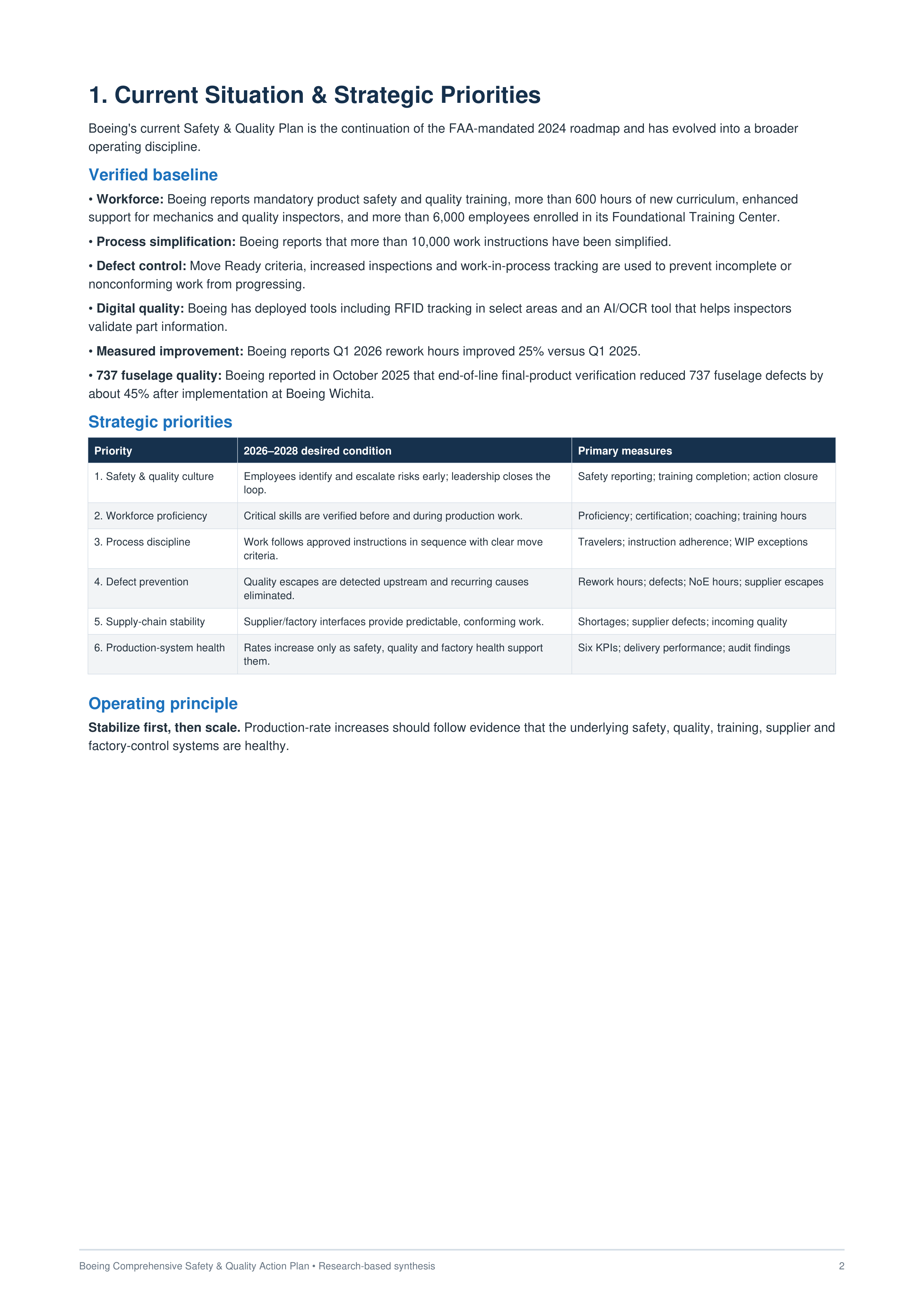
1. Current Situation & Strategic Priorities
Boeing's current Safety & Quality Plan is the continuation of the FAA-mandated 2024 roadmap and has evolved into a broader
operating discipline.
Verified baseline
•
Workforce:
Boeing reports mandatory product safety and quality training, more than 600 hours of new curriculum, enhanced
support for mechanics and quality inspectors, and more than 6,000 employees enrolled in its Foundational Training Center.
•
Process simplification:
Boeing reports that more than 10,000 work instructions have been simplified.
•
Defect control:
Move Ready criteria, increased inspections and work-in-process tracking are used to prevent incomplete or
nonconforming work from progressing.
•
Digital quality:
Boeing has deployed tools including RFID tracking in select areas and an AI/OCR tool that helps inspectors
validate part information.
•
Measured improvement:
Boeing reports Q1 2026 rework hours improved 25% versus Q1 2025.
•
737 fuselage quality:
Boeing reported in October 2025 that end-of-line final-product verification reduced 737 fuselage defects by
about 45% after implementation at Boeing Wichita.
Strategic priorities
Priority
2026–2028 desired condition
Primary measures
1. Safety & quality culture
Employees identify and escalate risks early; leadership closes the
loop.
Safety reporting; training completion; action closure
2. Workforce proficiency
Critical skills are verified before and during production work.
Proficiency; certification; coaching; training hours
3. Process discipline
Work follows approved instructions in sequence with clear move
criteria.
Travelers; instruction adherence; WIP exceptions
4. Defect prevention
Quality escapes are detected upstream and recurring causes
eliminated.
Rework hours; defects; NoE hours; supplier escapes
5. Supply-chain stability
Supplier/factory interfaces provide predictable, conforming work.
Shortages; supplier defects; incoming quality
6. Production-system health
Rates increase only as safety, quality and factory health support
them.
Six KPIs; delivery performance; audit findings
Operating principle
Stabilize first, then scale.
Production-rate increases should follow evidence that the underlying safety, quality, training, supplier and
factory-control systems are healthy.
Boeing Comprehensive Safety & Quality Action Plan • Research-based synthesis
3
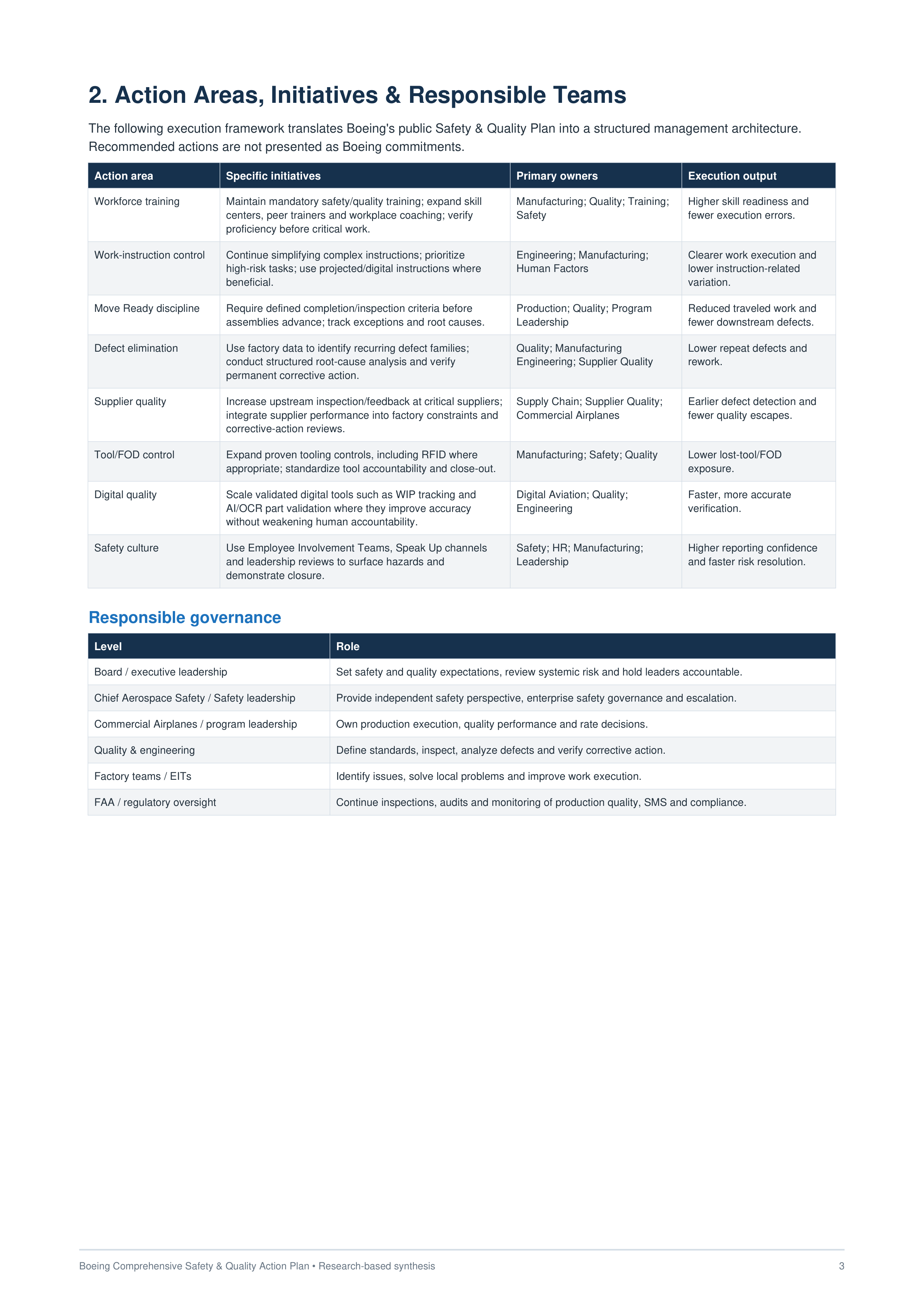
2. Action Areas, Initiatives & Responsible Teams
The following execution framework translates Boeing's public Safety & Quality Plan into a structured management architecture.
Recommended actions are not presented as Boeing commitments.
Action area
Specific initiatives
Primary owners
Execution output
Workforce training
Maintain mandatory safety/quality training; expand skill
centers, peer trainers and workplace coaching; verify
proficiency before critical work.
Manufacturing; Quality; Training;
Safety
Higher skill readiness and
fewer execution errors.
Work-instruction control
Continue simplifying complex instructions; prioritize
high-risk tasks; use projected/digital instructions where
beneficial.
Engineering; Manufacturing;
Human Factors
Clearer work execution and
lower instruction-related
variation.
Move Ready discipline
Require defined completion/inspection criteria before
assemblies advance; track exceptions and root causes.
Production; Quality; Program
Leadership
Reduced traveled work and
fewer downstream defects.
Defect elimination
Use factory data to identify recurring defect families;
conduct structured root-cause analysis and verify
permanent corrective action.
Quality; Manufacturing
Engineering; Supplier Quality
Lower repeat defects and
rework.
Supplier quality
Increase upstream inspection/feedback at critical suppliers;
integrate supplier performance into factory constraints and
corrective-action reviews.
Supply Chain; Supplier Quality;
Commercial Airplanes
Earlier defect detection and
fewer quality escapes.
Tool/FOD control
Expand proven tooling controls, including RFID where
appropriate; standardize tool accountability and close-out.
Manufacturing; Safety; Quality
Lower lost-tool/FOD
exposure.
Digital quality
Scale validated digital tools such as WIP tracking and
AI/OCR part validation where they improve accuracy
without weakening human accountability.
Digital Aviation; Quality;
Engineering
Faster, more accurate
verification.
Safety culture
Use Employee Involvement Teams, Speak Up channels
and leadership reviews to surface hazards and
demonstrate closure.
Safety; HR; Manufacturing;
Leadership
Higher reporting confidence
and faster risk resolution.
Responsible governance
Level
Role
Board / executive leadership
Set safety and quality expectations, review systemic risk and hold leaders accountable.
Chief Aerospace Safety / Safety leadership
Provide independent safety perspective, enterprise safety governance and escalation.
Commercial Airplanes / program leadership
Own production execution, quality performance and rate decisions.
Quality & engineering
Define standards, inspect, analyze defects and verify corrective action.
Factory teams / EITs
Identify issues, solve local problems and improve work execution.
FAA / regulatory oversight
Continue inspections, audits and monitoring of production quality, SMS and compliance.
Boeing Comprehensive Safety & Quality Action Plan • Research-based synthesis
4
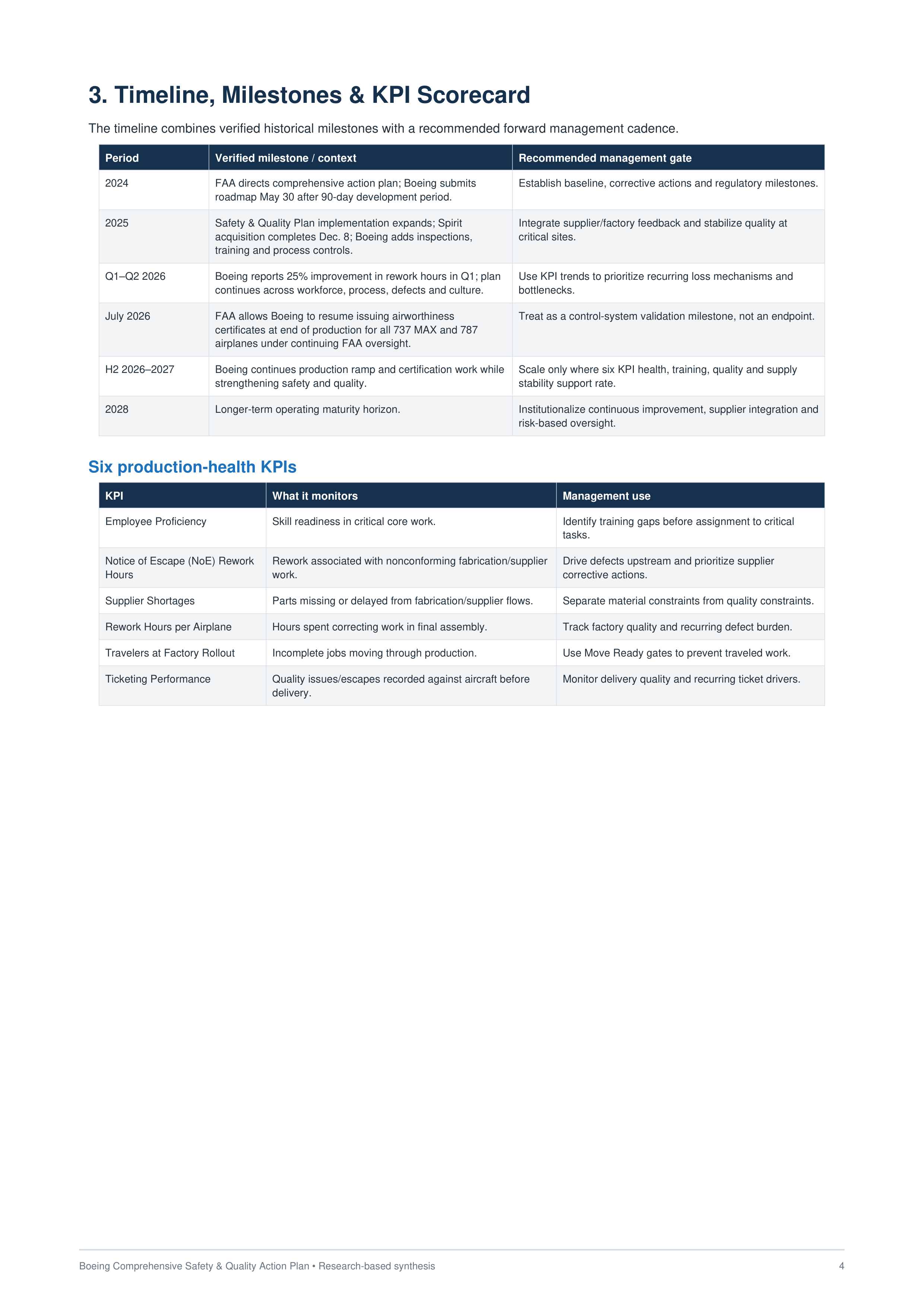
3. Timeline, Milestones & KPI Scorecard
The timeline combines verified historical milestones with a recommended forward management cadence.
Period
Verified milestone / context
Recommended management gate
2024
FAA directs comprehensive action plan; Boeing submits
roadmap May 30 after 90-day development period.
Establish baseline, corrective actions and regulatory milestones.
2025
Safety & Quality Plan implementation expands; Spirit
acquisition completes Dec. 8; Boeing adds inspections,
training and process controls.
Integrate supplier/factory feedback and stabilize quality at
critical sites.
Q1–Q2 2026
Boeing reports 25% improvement in rework hours in Q1; plan
continues across workforce, process, defects and culture.
Use KPI trends to prioritize recurring loss mechanisms and
bottlenecks.
July 2026
FAA allows Boeing to resume issuing airworthiness
certificates at end of production for all 737 MAX and 787
airplanes under continuing FAA oversight.
Treat as a control-system validation milestone, not an endpoint.
H2 2026–2027
Boeing continues production ramp and certification work while
strengthening safety and quality.
Scale only where six KPI health, training, quality and supply
stability support rate.
2028
Longer-term operating maturity horizon.
Institutionalize continuous improvement, supplier integration and
risk-based oversight.
Six production-health KPIs
KPI
What it monitors
Management use
Employee Proficiency
Skill readiness in critical core work.
Identify training gaps before assignment to critical
tasks.
Notice of Escape (NoE) Rework
Hours
Rework associated with nonconforming fabrication/supplier
work.
Drive defects upstream and prioritize supplier
corrective actions.
Supplier Shortages
Parts missing or delayed from fabrication/supplier flows.
Separate material constraints from quality constraints.
Rework Hours per Airplane
Hours spent correcting work in final assembly.
Track factory quality and recurring defect burden.
Travelers at Factory Rollout
Incomplete jobs moving through production.
Use Move Ready gates to prevent traveled work.
Ticketing Performance
Quality issues/escapes recorded against aircraft before
delivery.
Monitor delivery quality and recurring ticket drivers.
Boeing Comprehensive Safety & Quality Action Plan • Research-based synthesis
5
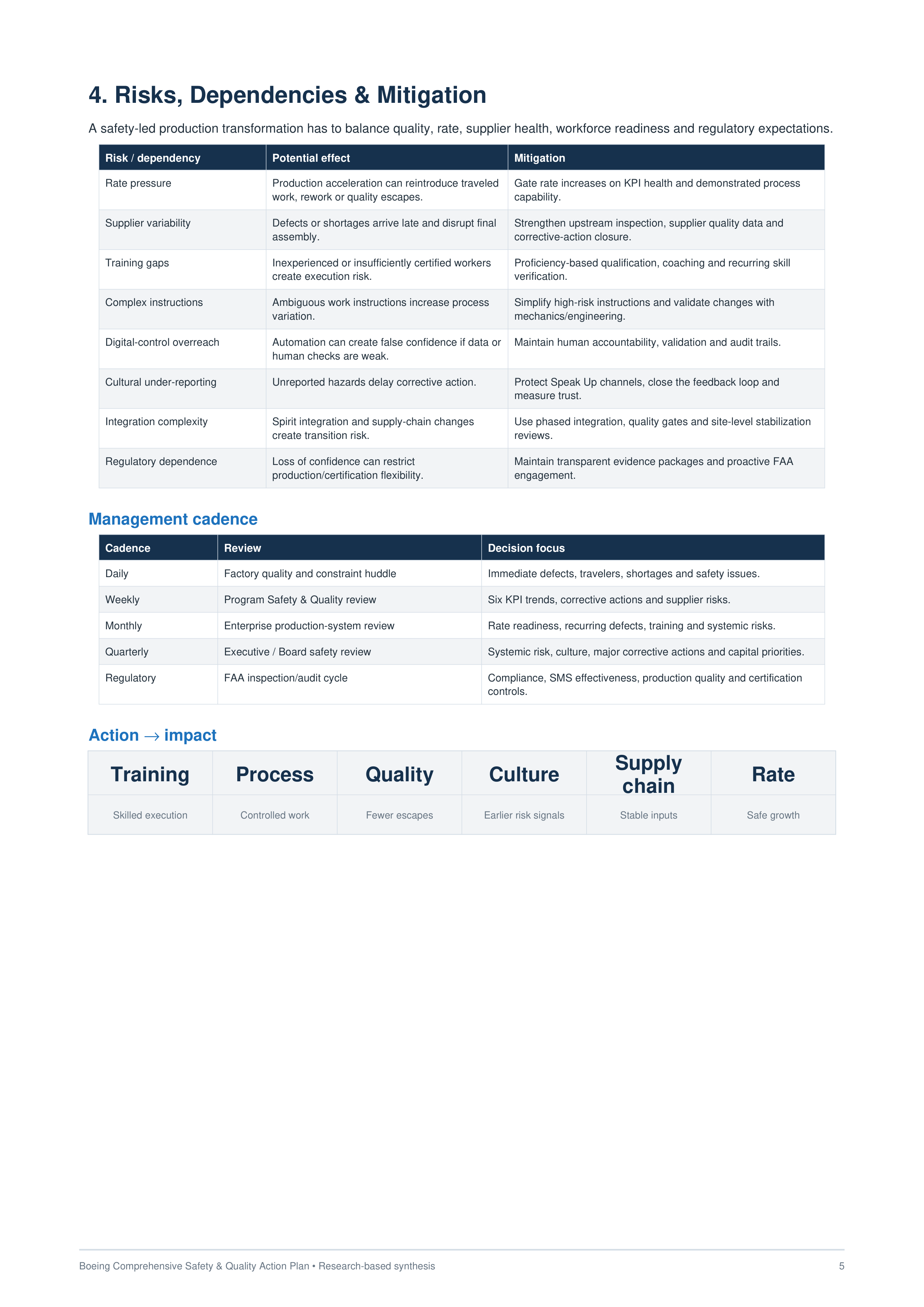
4. Risks, Dependencies & Mitigation
A safety-led production transformation has to balance quality, rate, supplier health, workforce readiness and regulatory expectations.
Risk / dependency
Potential effect
Mitigation
Rate pressure
Production acceleration can reintroduce traveled
work, rework or quality escapes.
Gate rate increases on KPI health and demonstrated process
capability.
Supplier variability
Defects or shortages arrive late and disrupt final
assembly.
Strengthen upstream inspection, supplier quality data and
corrective-action closure.
Training gaps
Inexperienced or insufficiently certified workers
create execution risk.
Proficiency-based qualification, coaching and recurring skill
verification.
Complex instructions
Ambiguous work instructions increase process
variation.
Simplify high-risk instructions and validate changes with
mechanics/engineering.
Digital-control overreach
Automation can create false confidence if data or
human checks are weak.
Maintain human accountability, validation and audit trails.
Cultural under-reporting
Unreported hazards delay corrective action.
Protect Speak Up channels, close the feedback loop and
measure trust.
Integration complexity
Spirit integration and supply-chain changes
create transition risk.
Use phased integration, quality gates and site-level stabilization
reviews.
Regulatory dependence
Loss of confidence can restrict
production/certification flexibility.
Maintain transparent evidence packages and proactive FAA
engagement.
Management cadence
Cadence
Review
Decision focus
Daily
Factory quality and constraint huddle
Immediate defects, travelers, shortages and safety issues.
Weekly
Program Safety & Quality review
Six KPI trends, corrective actions and supplier risks.
Monthly
Enterprise production-system review
Rate readiness, recurring defects, training and systemic risks.
Quarterly
Executive / Board safety review
Systemic risk, culture, major corrective actions and capital priorities.
Regulatory
FAA inspection/audit cycle
Compliance, SMS effectiveness, production quality and certification
controls.
Action
→
impact
Training
Process
Quality
Culture
Supply
chain
Rate
Skilled execution
Controlled work
Fewer escapes
Earlier risk signals
Stable inputs
Safe growth
Boeing Comprehensive Safety & Quality Action Plan • Research-based synthesis
6
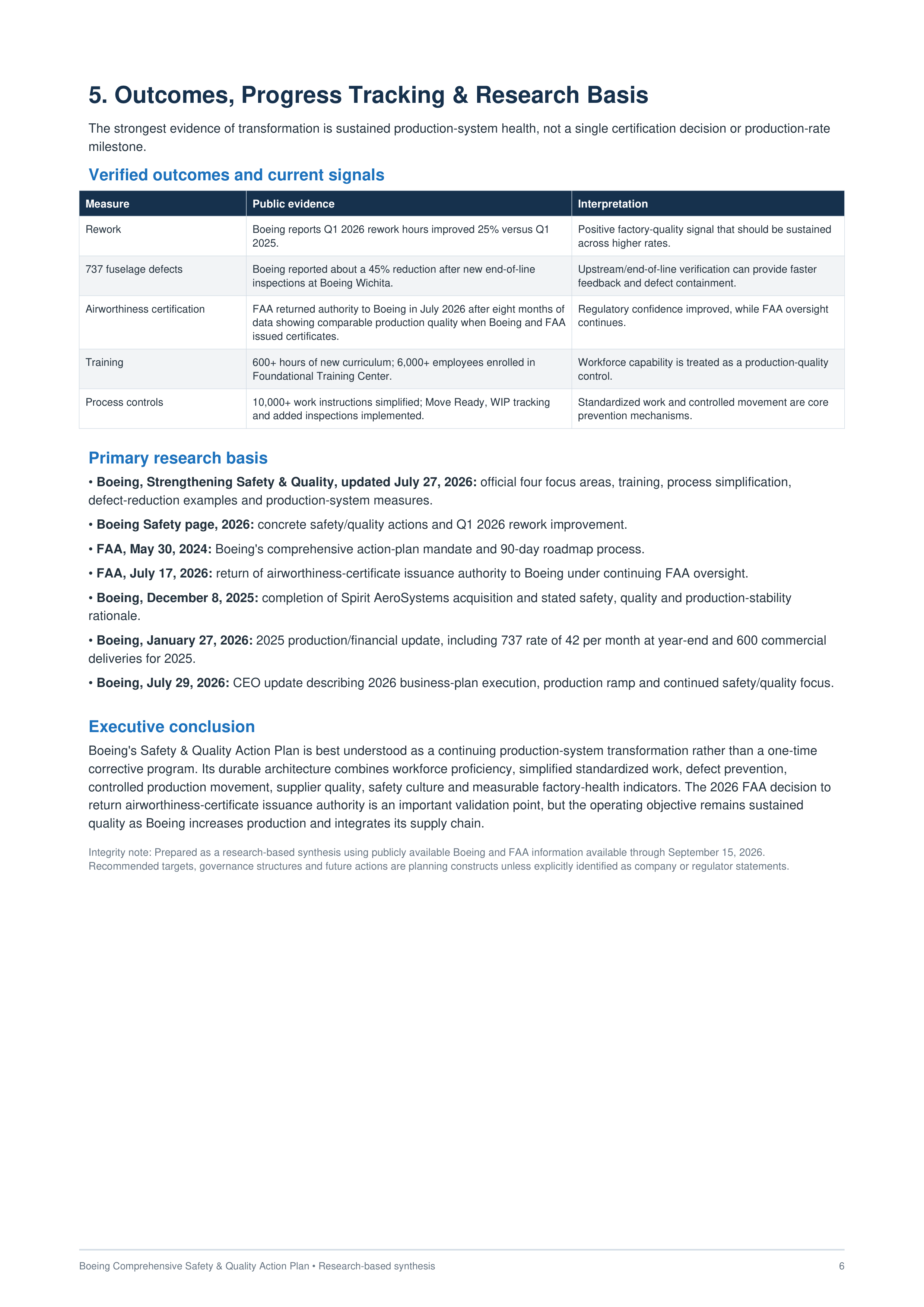
5. Outcomes, Progress Tracking & Research Basis
The strongest evidence of transformation is sustained production-system health, not a single certification decision or production-rate
milestone.
Verified outcomes and current signals
Measure
Public evidence
Interpretation
Rework
Boeing reports Q1 2026 rework hours improved 25% versus Q1
2025.
Positive factory-quality signal that should be sustained
across higher rates.
737 fuselage defects
Boeing reported about a 45% reduction after new end-of-line
inspections at Boeing Wichita.
Upstream/end-of-line verification can provide faster
feedback and defect containment.
Airworthiness certification
FAA returned authority to Boeing in July 2026 after eight months of
data showing comparable production quality when Boeing and FAA
issued certificates.
Regulatory confidence improved, while FAA oversight
continues.
Training
600+ hours of new curriculum; 6,000+ employees enrolled in
Foundational Training Center.
Workforce capability is treated as a production-quality
control.
Process controls
10,000+ work instructions simplified; Move Ready, WIP tracking
and added inspections implemented.
Standardized work and controlled movement are core
prevention mechanisms.
Primary research basis
•
Boeing, Strengthening Safety & Quality, updated July 27, 2026:
official four focus areas, training, process simplification,
defect-reduction examples and production-system measures.
•
Boeing Safety page, 2026:
concrete safety/quality actions and Q1 2026 rework improvement.
•
FAA, May 30, 2024:
Boeing's comprehensive action-plan mandate and 90-day roadmap process.
•
FAA, July 17, 2026:
return of airworthiness-certificate issuance authority to Boeing under continuing FAA oversight.
•
Boeing, December 8, 2025:
completion of Spirit AeroSystems acquisition and stated safety, quality and production-stability
rationale.
•
Boeing, January 27, 2026:
2025 production/financial update, including 737 rate of 42 per month at year-end and 600 commercial
deliveries for 2025.
•
Boeing, July 29, 2026:
CEO update describing 2026 business-plan execution, production ramp and continued safety/quality focus.
Executive conclusion
Boeing's Safety & Quality Action Plan is best understood as a continuing production-system transformation rather than a one-time
corrective program. Its durable architecture combines workforce proficiency, simplified standardized work, defect prevention,
controlled production movement, supplier quality, safety culture and measurable factory-health indicators. The 2026 FAA decision to
return airworthiness-certificate issuance authority is an important validation point, but the operating objective remains sustained
quality as Boeing increases production and integrates its supply chain.
Integrity note: Prepared as a research-based synthesis using publicly available Boeing and FAA information available through September 15, 2026.
Recommended targets, governance structures and future actions are planning constructs unless explicitly identified as company or regulator statements.