Intel 18A Foundry & Advanced Packaging Transformation Action Plan • Research-based synthesis
1
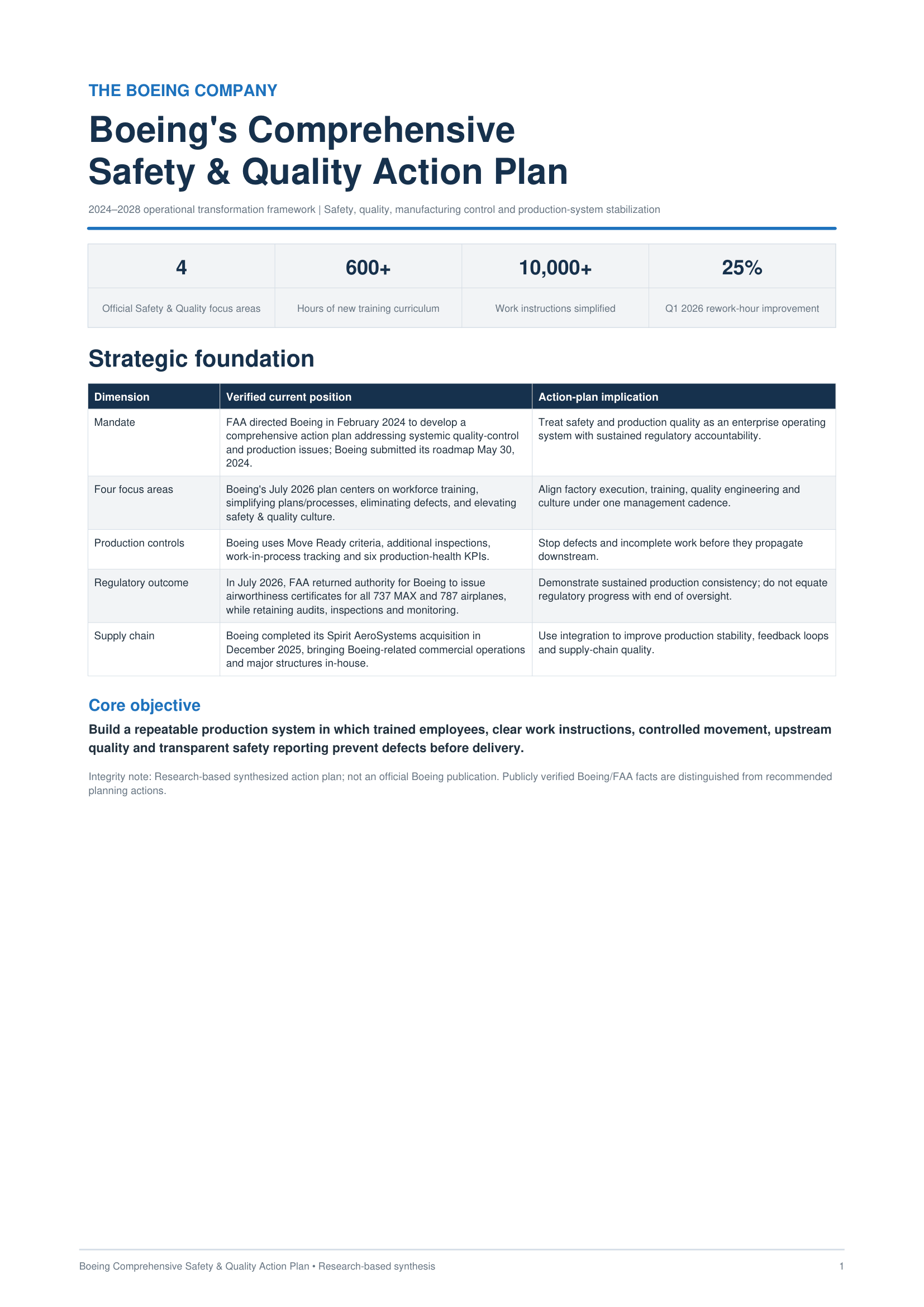
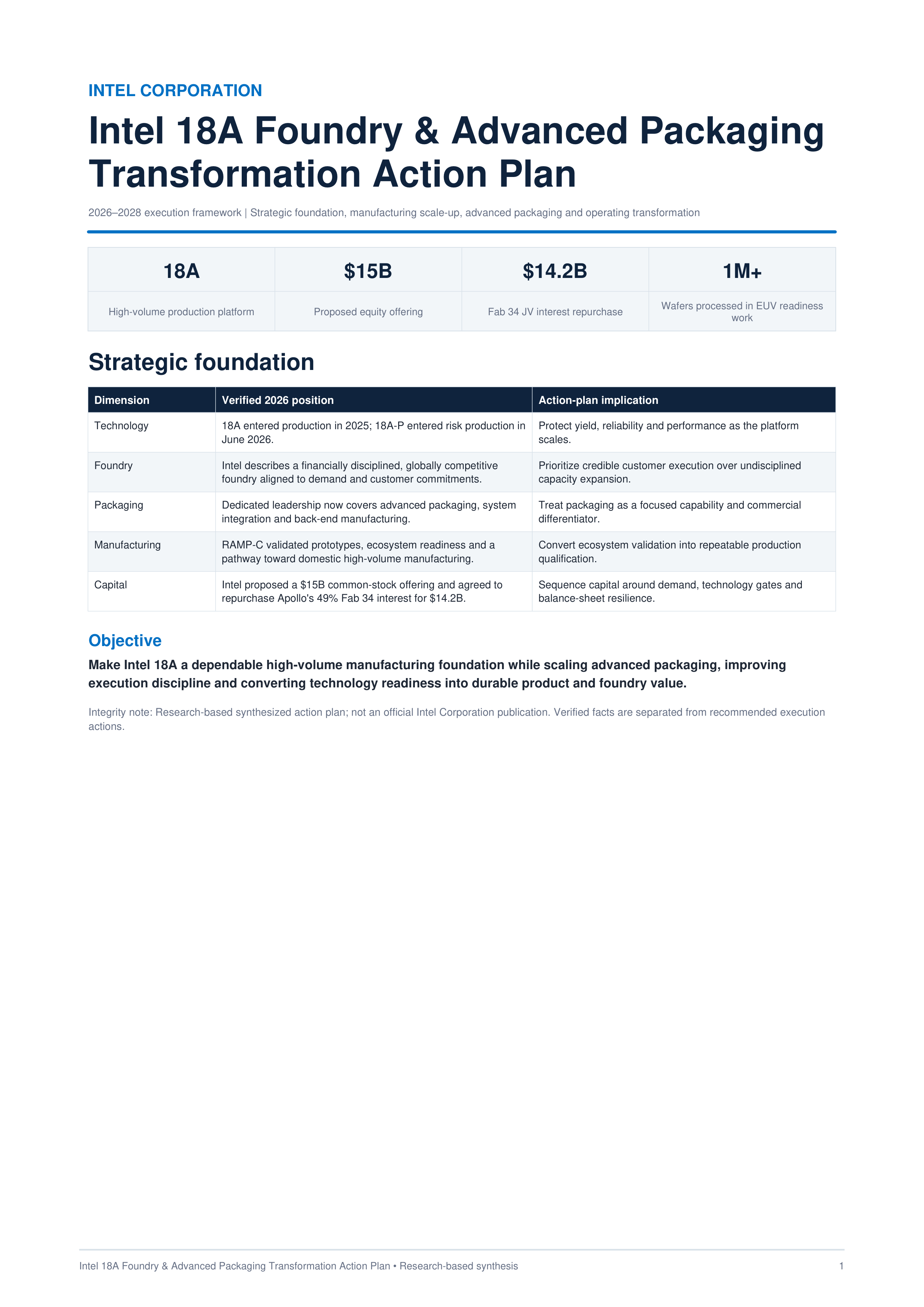
INTEL CORPORATION
Intel 18A Foundry & Advanced Packaging
Transformation Action Plan
2026–2028 execution framework | Strategic foundation, manufacturing scale-up, advanced packaging and operating transformation
18A
$15B
$14.2B
1M+
High-volume production platform
Proposed equity offering
Fab 34 JV interest repurchase
Wafers processed in EUV readiness
work
Strategic foundation
Dimension
Verified 2026 position
Action-plan implication
Technology
18A entered production in 2025; 18A-P entered risk production in
June 2026.
Protect yield, reliability and performance as the platform
scales.
Foundry
Intel describes a financially disciplined, globally competitive
foundry aligned to demand and customer commitments.
Prioritize credible customer execution over undisciplined
capacity expansion.
Packaging
Dedicated leadership now covers advanced packaging, system
integration and back-end manufacturing.
Treat packaging as a focused capability and commercial
differentiator.
Manufacturing
RAMP-C validated prototypes, ecosystem readiness and a
pathway toward domestic high-volume manufacturing.
Convert ecosystem validation into repeatable production
qualification.
Capital
Intel proposed a $15B common-stock offering and agreed to
repurchase Apollo's 49% Fab 34 interest for $14.2B.
Sequence capital around demand, technology gates and
balance-sheet resilience.
Objective
Make Intel 18A a dependable high-volume manufacturing foundation while scaling advanced packaging, improving
execution discipline and converting technology readiness into durable product and foundry value.
Integrity note: Research-based synthesized action plan; not an official Intel Corporation publication. Verified facts are separated from recommended execution
actions.
Intel 18A Foundry & Advanced Packaging Transformation Action Plan • Research-based synthesis
2
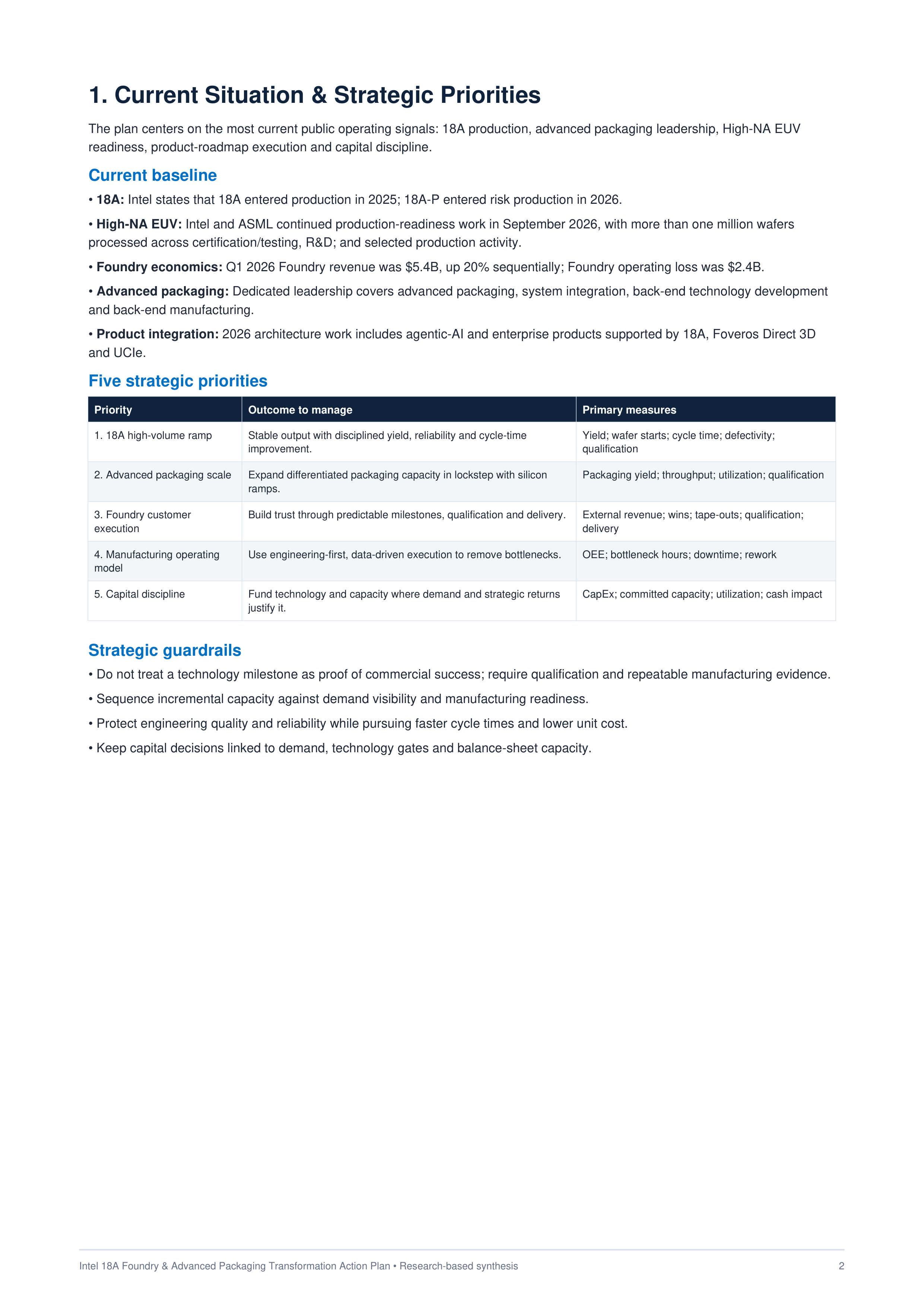
1. Current Situation & Strategic Priorities
The plan centers on the most current public operating signals: 18A production, advanced packaging leadership, High-NA EUV
readiness, product-roadmap execution and capital discipline.
Current baseline
•
18A:
Intel states that 18A entered production in 2025; 18A-P entered risk production in 2026.
•
High-NA EUV:
Intel and ASML continued production-readiness work in September 2026, with more than one million wafers
processed across certification/testing, R&D; and selected production activity.
•
Foundry economics:
Q1 2026 Foundry revenue was $5.4B, up 20% sequentially; Foundry operating loss was $2.4B.
•
Advanced packaging:
Dedicated leadership covers advanced packaging, system integration, back-end technology development
and back-end manufacturing.
•
Product integration:
2026 architecture work includes agentic-AI and enterprise products supported by 18A, Foveros Direct 3D
and UCIe.
Five strategic priorities
Priority
Outcome to manage
Primary measures
1. 18A high-volume ramp
Stable output with disciplined yield, reliability and cycle-time
improvement.
Yield; wafer starts; cycle time; defectivity;
qualification
2. Advanced packaging scale
Expand differentiated packaging capacity in lockstep with silicon
ramps.
Packaging yield; throughput; utilization; qualification
3. Foundry customer
execution
Build trust through predictable milestones, qualification and delivery.
External revenue; wins; tape-outs; qualification;
delivery
4. Manufacturing operating
model
Use engineering-first, data-driven execution to remove bottlenecks.
OEE; bottleneck hours; downtime; rework
5. Capital discipline
Fund technology and capacity where demand and strategic returns
justify it.
CapEx; committed capacity; utilization; cash impact
Strategic guardrails
• Do not treat a technology milestone as proof of commercial success; require qualification and repeatable manufacturing evidence.
• Sequence incremental capacity against demand visibility and manufacturing readiness.
• Protect engineering quality and reliability while pursuing faster cycle times and lower unit cost.
• Keep capital decisions linked to demand, technology gates and balance-sheet capacity.
Intel 18A Foundry & Advanced Packaging Transformation Action Plan • Research-based synthesis
3
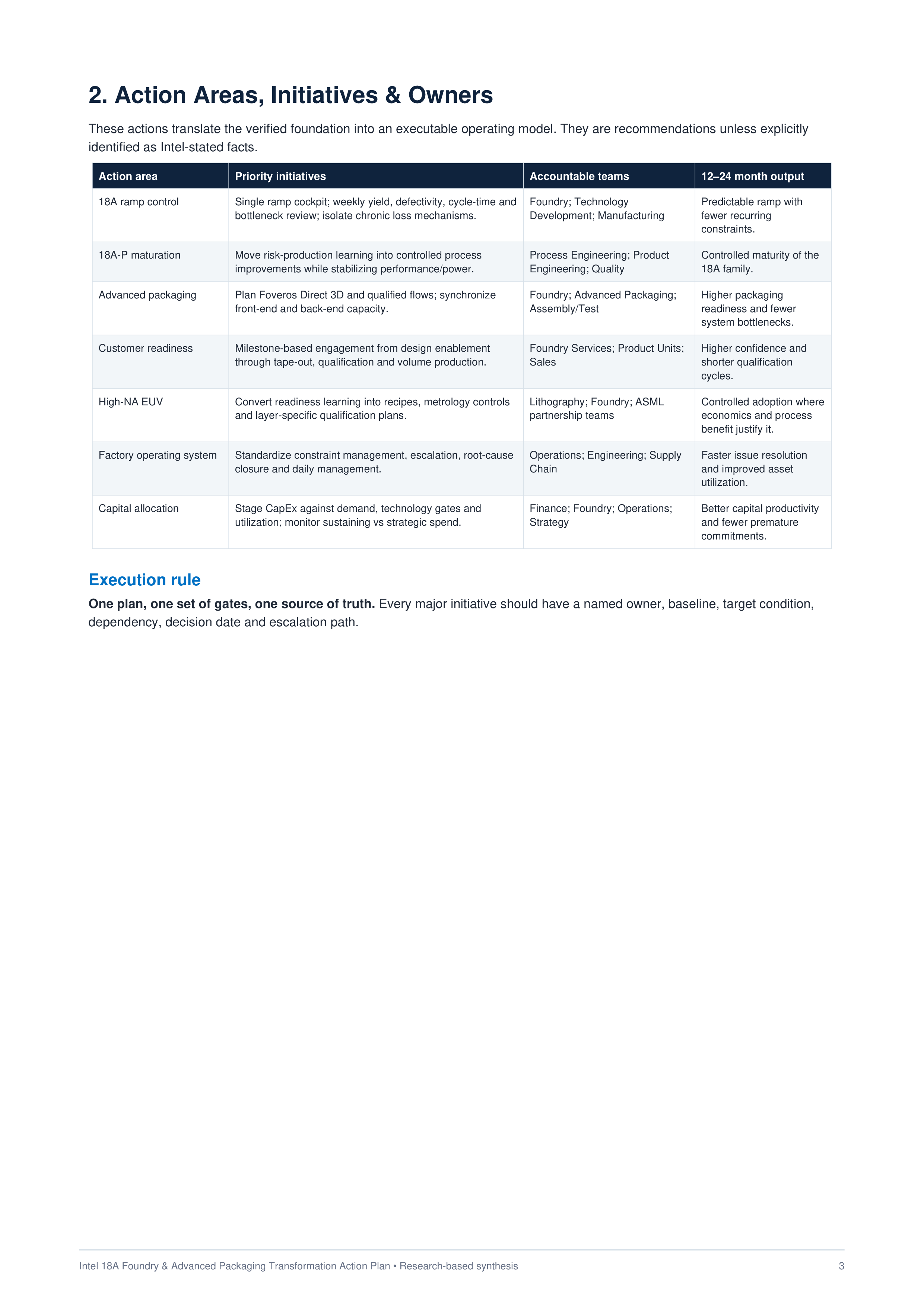
2. Action Areas, Initiatives & Owners
These actions translate the verified foundation into an executable operating model. They are recommendations unless explicitly
identified as Intel-stated facts.
Action area
Priority initiatives
Accountable teams
12–24 month output
18A ramp control
Single ramp cockpit; weekly yield, defectivity, cycle-time and
bottleneck review; isolate chronic loss mechanisms.
Foundry; Technology
Development; Manufacturing
Predictable ramp with
fewer recurring
constraints.
18A-P maturation
Move risk-production learning into controlled process
improvements while stabilizing performance/power.
Process Engineering; Product
Engineering; Quality
Controlled maturity of the
18A family.
Advanced packaging
Plan Foveros Direct 3D and qualified flows; synchronize
front-end and back-end capacity.
Foundry; Advanced Packaging;
Assembly/Test
Higher packaging
readiness and fewer
system bottlenecks.
Customer readiness
Milestone-based engagement from design enablement
through tape-out, qualification and volume production.
Foundry Services; Product Units;
Sales
Higher confidence and
shorter qualification
cycles.
High-NA EUV
Convert readiness learning into recipes, metrology controls
and layer-specific qualification plans.
Lithography; Foundry; ASML
partnership teams
Controlled adoption where
economics and process
benefit justify it.
Factory operating system
Standardize constraint management, escalation, root-cause
closure and daily management.
Operations; Engineering; Supply
Chain
Faster issue resolution
and improved asset
utilization.
Capital allocation
Stage CapEx against demand, technology gates and
utilization; monitor sustaining vs strategic spend.
Finance; Foundry; Operations;
Strategy
Better capital productivity
and fewer premature
commitments.
Execution rule
One plan, one set of gates, one source of truth.
Every major initiative should have a named owner, baseline, target condition,
dependency, decision date and escalation path.
Intel 18A Foundry & Advanced Packaging Transformation Action Plan • Research-based synthesis
4
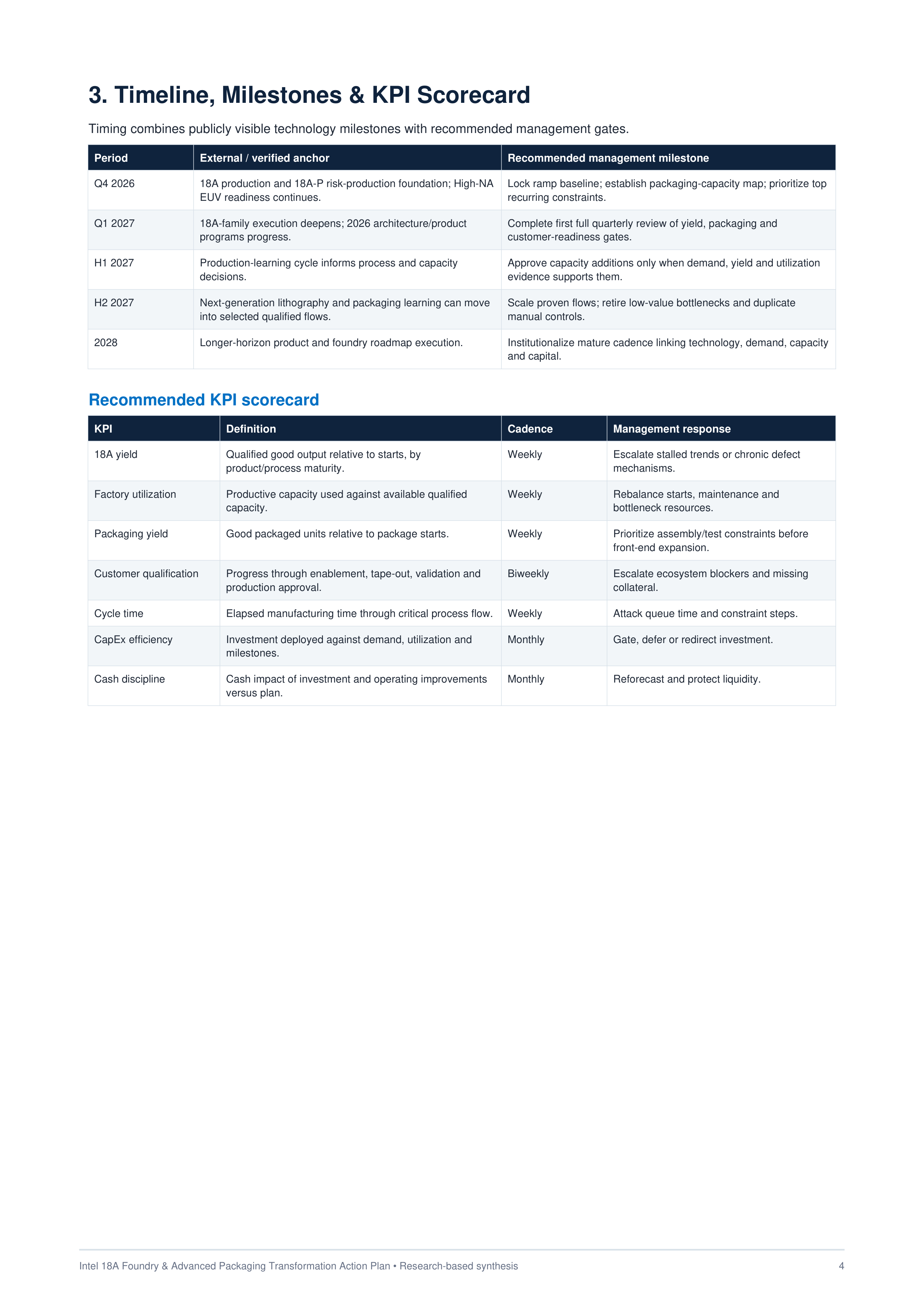
3. Timeline, Milestones & KPI Scorecard
Timing combines publicly visible technology milestones with recommended management gates.
Period
External / verified anchor
Recommended management milestone
Q4 2026
18A production and 18A-P risk-production foundation; High-NA
EUV readiness continues.
Lock ramp baseline; establish packaging-capacity map; prioritize top
recurring constraints.
Q1 2027
18A-family execution deepens; 2026 architecture/product
programs progress.
Complete first full quarterly review of yield, packaging and
customer-readiness gates.
H1 2027
Production-learning cycle informs process and capacity
decisions.
Approve capacity additions only when demand, yield and utilization
evidence supports them.
H2 2027
Next-generation lithography and packaging learning can move
into selected qualified flows.
Scale proven flows; retire low-value bottlenecks and duplicate
manual controls.
2028
Longer-horizon product and foundry roadmap execution.
Institutionalize mature cadence linking technology, demand, capacity
and capital.
Recommended KPI scorecard
KPI
Definition
Cadence
Management response
18A yield
Qualified good output relative to starts, by
product/process maturity.
Weekly
Escalate stalled trends or chronic defect
mechanisms.
Factory utilization
Productive capacity used against available qualified
capacity.
Weekly
Rebalance starts, maintenance and
bottleneck resources.
Packaging yield
Good packaged units relative to package starts.
Weekly
Prioritize assembly/test constraints before
front-end expansion.
Customer qualification
Progress through enablement, tape-out, validation and
production approval.
Biweekly
Escalate ecosystem blockers and missing
collateral.
Cycle time
Elapsed manufacturing time through critical process flow.
Weekly
Attack queue time and constraint steps.
CapEx efficiency
Investment deployed against demand, utilization and
milestones.
Monthly
Gate, defer or redirect investment.
Cash discipline
Cash impact of investment and operating improvements
versus plan.
Monthly
Reforecast and protect liquidity.
Intel 18A Foundry & Advanced Packaging Transformation Action Plan • Research-based synthesis
5
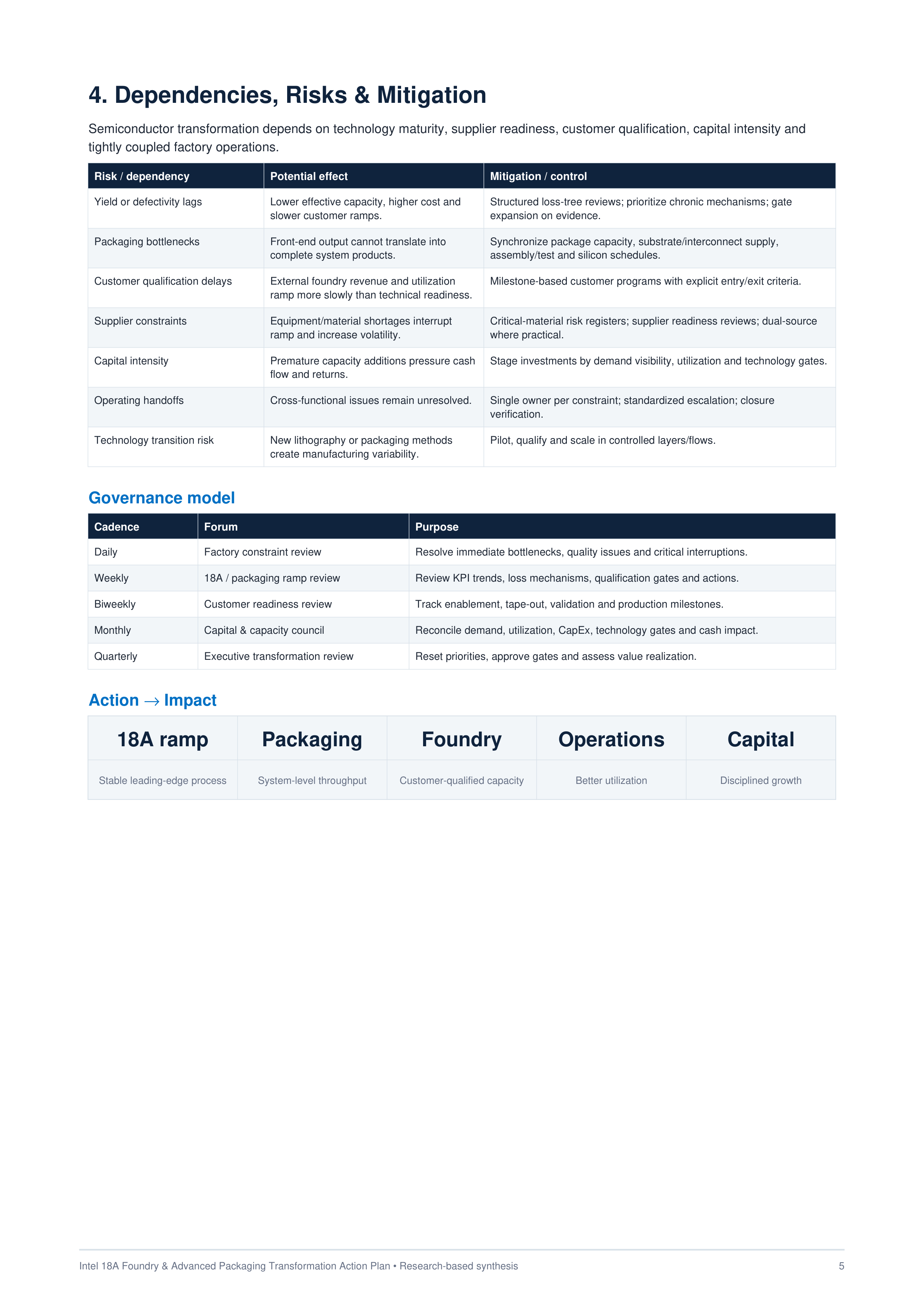
4. Dependencies, Risks & Mitigation
Semiconductor transformation depends on technology maturity, supplier readiness, customer qualification, capital intensity and
tightly coupled factory operations.
Risk / dependency
Potential effect
Mitigation / control
Yield or defectivity lags
Lower effective capacity, higher cost and
slower customer ramps.
Structured loss-tree reviews; prioritize chronic mechanisms; gate
expansion on evidence.
Packaging bottlenecks
Front-end output cannot translate into
complete system products.
Synchronize package capacity, substrate/interconnect supply,
assembly/test and silicon schedules.
Customer qualification delays
External foundry revenue and utilization
ramp more slowly than technical readiness.
Milestone-based customer programs with explicit entry/exit criteria.
Supplier constraints
Equipment/material shortages interrupt
ramp and increase volatility.
Critical-material risk registers; supplier readiness reviews; dual-source
where practical.
Capital intensity
Premature capacity additions pressure cash
flow and returns.
Stage investments by demand visibility, utilization and technology gates.
Operating handoffs
Cross-functional issues remain unresolved.
Single owner per constraint; standardized escalation; closure
verification.
Technology transition risk
New lithography or packaging methods
create manufacturing variability.
Pilot, qualify and scale in controlled layers/flows.
Governance model
Cadence
Forum
Purpose
Daily
Factory constraint review
Resolve immediate bottlenecks, quality issues and critical interruptions.
Weekly
18A / packaging ramp review
Review KPI trends, loss mechanisms, qualification gates and actions.
Biweekly
Customer readiness review
Track enablement, tape-out, validation and production milestones.
Monthly
Capital & capacity council
Reconcile demand, utilization, CapEx, technology gates and cash impact.
Quarterly
Executive transformation review
Reset priorities, approve gates and assess value realization.
Action
→
Impact
18A ramp
Packaging
Foundry
Operations
Capital
Stable leading-edge process
System-level throughput
Customer-qualified capacity
Better utilization
Disciplined growth
Intel 18A Foundry & Advanced Packaging Transformation Action Plan • Research-based synthesis
6
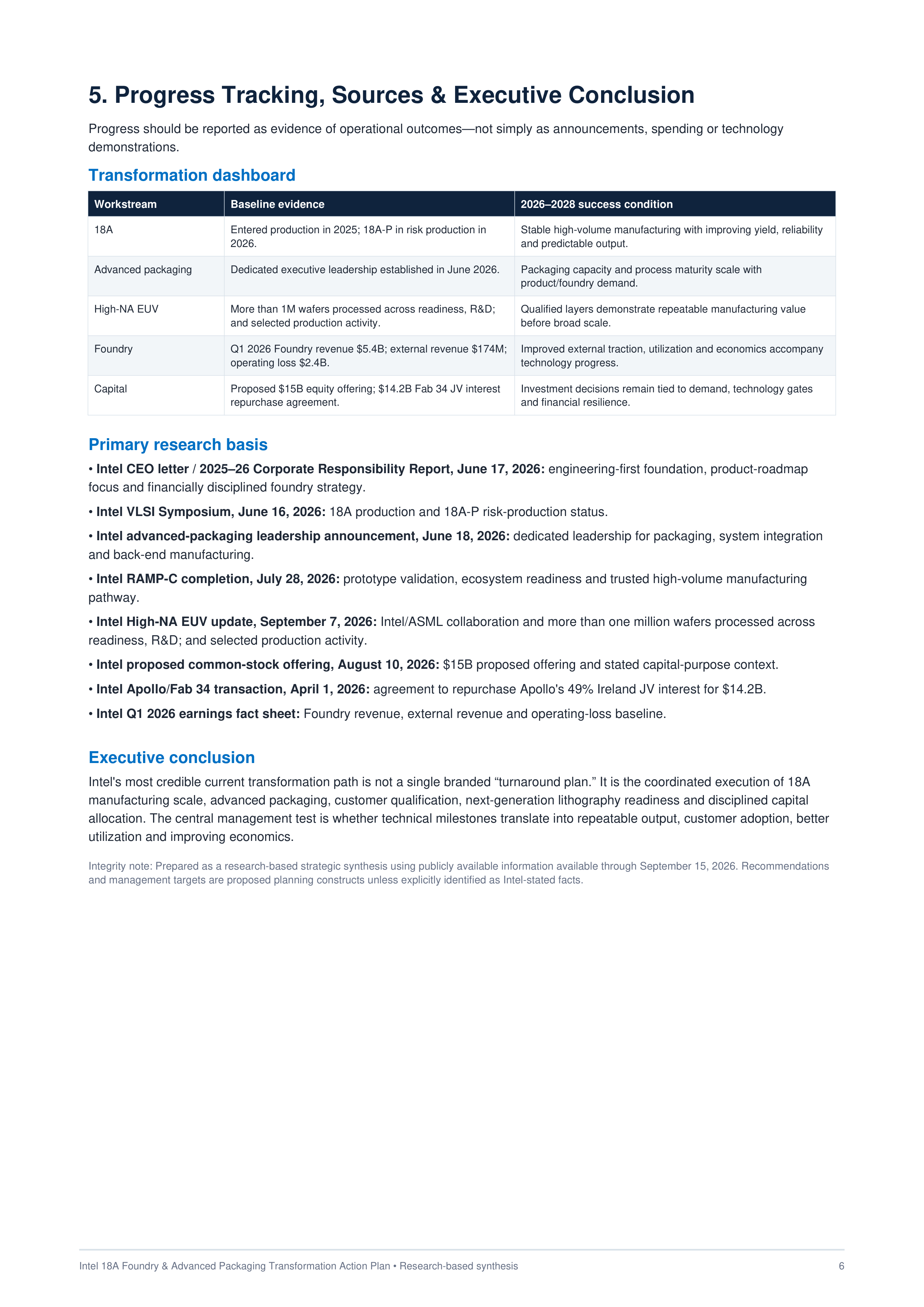
5. Progress Tracking, Sources & Executive Conclusion
Progress should be reported as evidence of operational outcomes—not simply as announcements, spending or technology
demonstrations.
Transformation dashboard
Workstream
Baseline evidence
2026–2028 success condition
18A
Entered production in 2025; 18A-P in risk production in
2026.
Stable high-volume manufacturing with improving yield, reliability
and predictable output.
Advanced packaging
Dedicated executive leadership established in June 2026.
Packaging capacity and process maturity scale with
product/foundry demand.
High-NA EUV
More than 1M wafers processed across readiness, R&D;
and selected production activity.
Qualified layers demonstrate repeatable manufacturing value
before broad scale.
Foundry
Q1 2026 Foundry revenue $5.4B; external revenue $174M;
operating loss $2.4B.
Improved external traction, utilization and economics accompany
technology progress.
Capital
Proposed $15B equity offering; $14.2B Fab 34 JV interest
repurchase agreement.
Investment decisions remain tied to demand, technology gates
and financial resilience.
Primary research basis
•
Intel CEO letter / 2025–26 Corporate Responsibility Report, June 17, 2026:
engineering-first foundation, product-roadmap
focus and financially disciplined foundry strategy.
•
Intel VLSI Symposium, June 16, 2026:
18A production and 18A-P risk-production status.
•
Intel advanced-packaging leadership announcement, June 18, 2026:
dedicated leadership for packaging, system integration
and back-end manufacturing.
•
Intel RAMP-C completion, July 28, 2026:
prototype validation, ecosystem readiness and trusted high-volume manufacturing
pathway.
•
Intel High-NA EUV update, September 7, 2026:
Intel/ASML collaboration and more than one million wafers processed across
readiness, R&D; and selected production activity.
•
Intel proposed common-stock offering, August 10, 2026:
$15B proposed offering and stated capital-purpose context.
•
Intel Apollo/Fab 34 transaction, April 1, 2026:
agreement to repurchase Apollo's 49% Ireland JV interest for $14.2B.
•
Intel Q1 2026 earnings fact sheet:
Foundry revenue, external revenue and operating-loss baseline.
Executive conclusion
Intel's most credible current transformation path is not a single branded “turnaround plan.” It is the coordinated execution of 18A
manufacturing scale, advanced packaging, customer qualification, next-generation lithography readiness and disciplined capital
allocation. The central management test is whether technical milestones translate into repeatable output, customer adoption, better
utilization and improving economics.
Integrity note: Prepared as a research-based strategic synthesis using publicly available information available through September 15, 2026. Recommendations
and management targets are proposed planning constructs unless explicitly identified as Intel-stated facts.