Clinical Healthcare | Standardized Pediatric Asthma Action Plan
Page 1
CLINICAL HEALTHCARE
Standardized Pediatric Asthma Action Plan
Research-based clinical framework | Updated September 16, 2026
Purpose.
Provide a clear, individualized written plan that helps a child’s caregivers recognize worsening asthma, follow prescribed
treatment, and know when professional or emergency care is needed. CDC states that everyone with asthma should have an
individualized Asthma Action Plan developed with a health care provider.
I
cite
I
turn0search1
I
turn0search5
I
Clinical status.
This document is a planning framework, not a patient-specific prescription. Medication names, doses, device type,
peak-flow thresholds, emergency instructions and follow-up intervals must be individualized by the child’s clinician.
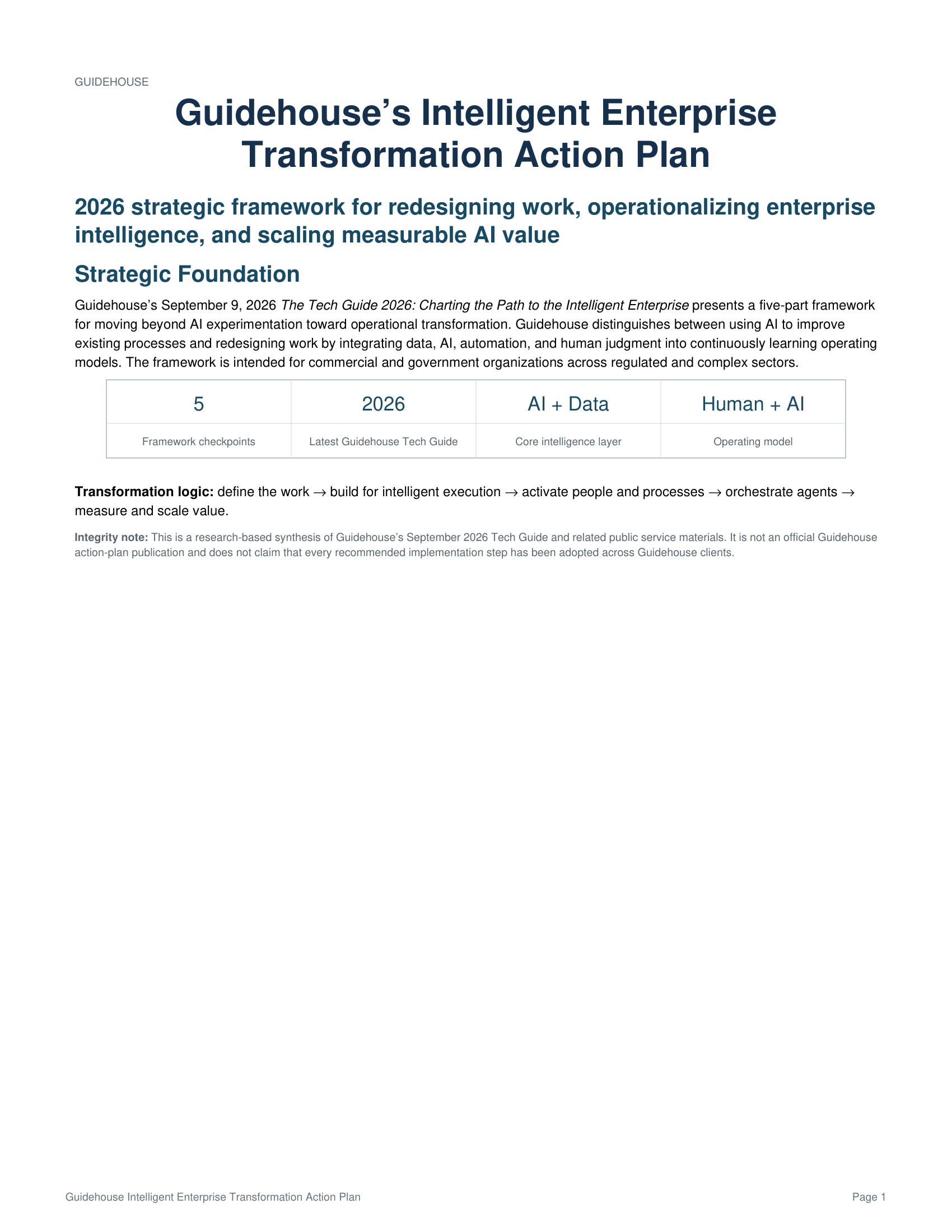
1. Standard Traffic-Light Framework
GREEN ZONE
YELLOW ZONE
RED ZONE
Doing well
No cough, wheeze, chest tightness or breathing
difficulty; usual activity is possible. When peak
flow is used, CDC's sample framework uses
>80% of personal best.
Caution
Asthma symptoms are beginning or worsening.
The child may cough, wheeze, have chest
tightness, breathe harder/faster or wake
because of symptoms. Follow the individualized
plan immediately.
Danger / medical alert
Severe or rapidly worsening breathing difficulty,
inability to speak normally, blue/gray lips or
severe symptoms not relieved by the prescribed
reliever require urgent emergency action.
2. Individualized Green-Zone Plan
•
Daily control:
Continue the child's prescribed controller medicines exactly as directed. Do not stop or change long-term therapy solely
because symptoms have improved.
•
Trigger management:
Identify and reduce the child's known triggers, including environmental exposures identified by the care team.
•
Activity:
Support normal play and physical activity. If exercise-related symptoms occur, follow the clinician's individualized pre-exercise
reliever instructions.
•
Monitoring:
Record symptoms, medication use and, when clinically appropriate, peak-flow readings against the child's personal best.
3. Yellow-Zone Response
•
Act early:
Follow the exact quick-relief medication and dose written by the child's clinician. The appropriate regimen varies by age,
severity, inhaler/device and treatment strategy.
•
Continue baseline care:
Follow the prescribed controller plan unless the child's clinician has given different written instructions.
•
Reassess:
Monitor the child's response according to the individualized action plan and contact the clinician when the plan's escalation
threshold is reached.
Clinical Healthcare | Standardized Pediatric Asthma Action Plan
Page 2
4. Red-Zone Emergency Response
•
Follow the written emergency instructions immediately.
Give the prescribed quick-relief treatment exactly as specified in the child's
plan.
•
Escalate urgently when indicated.
NHLBI advises emergency care for serious attacks or symptoms that do not improve soon after
at-home reliever treatment. For young children, emergency services are indicated for signs such as drowsiness/confusion or blue
discoloration of the skin or lips.
I
cite
I
turn0search10
I
turn0search2
I
•
Systemic corticosteroids:
Include oral corticosteroids only when specifically prescribed as part of the child's individualized action plan.
This framework does not prescribe a dose.
•
Emergency information:
Keep emergency contacts, clinician information, medication details and the child's identification information
current.
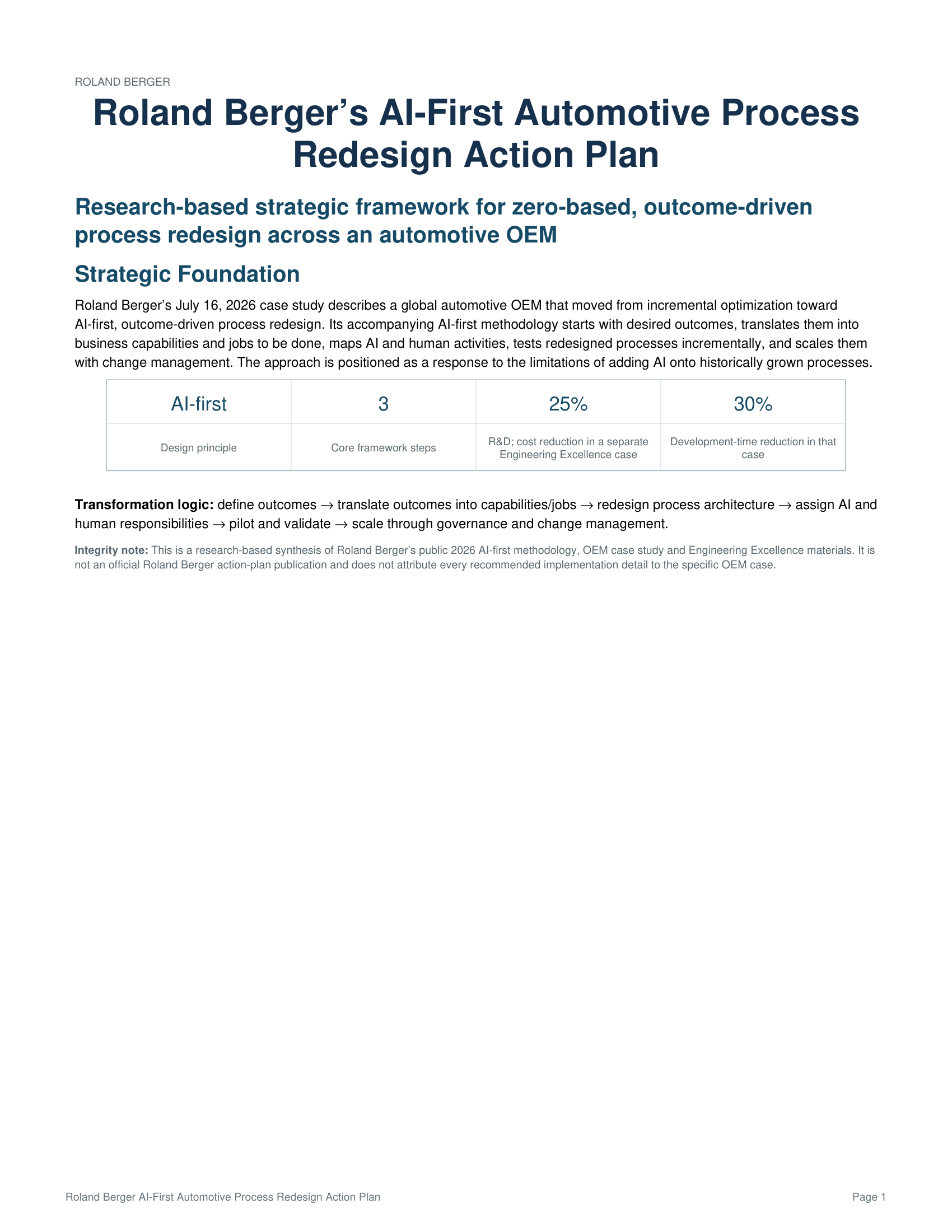
5. Clinical Plan Fields
Field
Information to document
Child
Name, date of birth, caregiver contacts and relevant identifiers
Asthma baseline
Typical symptoms, severity/control assessment and known triggers
Green zone
Daily medicines, device/inhaler instructions, activity guidance and monitoring criteria
Yellow zone
Child-specific symptoms/signs, prescribed quick-relief instructions, reassessment and clinician-contact threshold
Red zone
Emergency symptoms, prescribed rescue instructions, emergency contact and when to call emergency services
Peak flow
Personal best and individualized zone thresholds, if peak-flow monitoring is appropriate for the child
Care team
Primary clinician, asthma specialist if applicable, pharmacy and emergency contacts
School/caregivers
Authorized medication access, school nurse/caregiver copies and communication permissions
6. Responsible Stakeholders
Plan creators:
Pediatric primary-care clinicians, pediatric pulmonologists/allergists, nurse practitioners and other qualified members of the
child's asthma-care team, working with the family.
Plan users:
Parents/guardians, school nurses, trained school staff, daycare/camp
personnel and other caregivers as authorized. NHLBI and AAP emphasize sharing current action plans with schools and caregivers.
I
cite
I
turn0search2
I
turn0search8
I
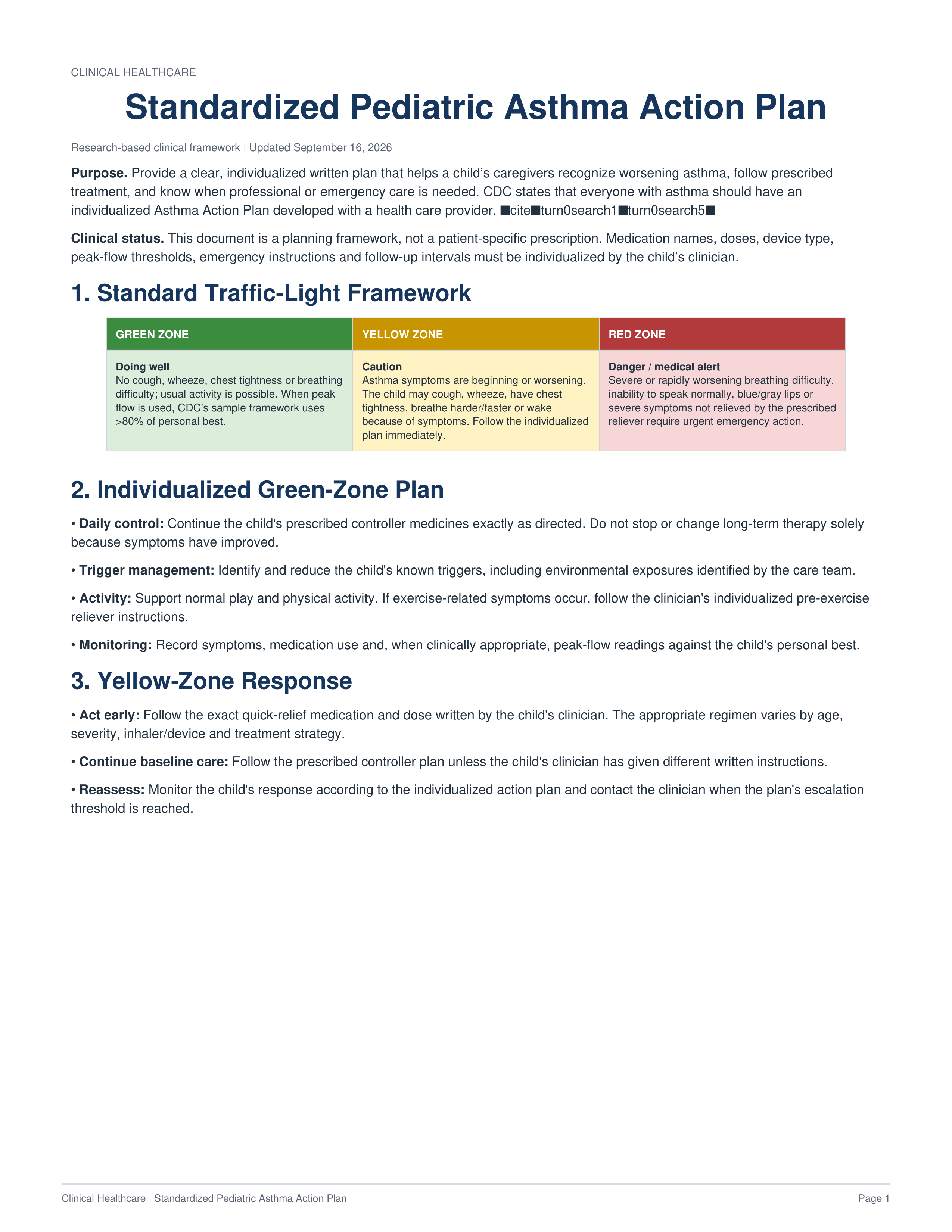
7. Implementation & Review Cycle
Event
Action
Control point
Initial creation
Create an individualized written plan with the child's clinician.
Medication, symptoms, triggers and
emergency instructions documented
Medication/treatment
change
Update the plan whenever the child's treatment or relevant clinical circumstances
change.
Current version replaces obsolete
copies
School/caregiver transition
Provide the current plan to appropriate school staff and caregivers.
Access and emergency permissions
confirmed
Periodic review
Review periodically and whenever control changes; AAP school guidance
recommends periodic evaluation of plans.
Current contacts and medicines
verified
Acute-care discharge
Reconcile medications and provide an updated plan after an acute asthma encounter
when clinically appropriate.
Post-discharge follow-up arranged
Clinical Healthcare | Standardized Pediatric Asthma Action Plan
Page 3
8. Evidence-Based Outcome Framework
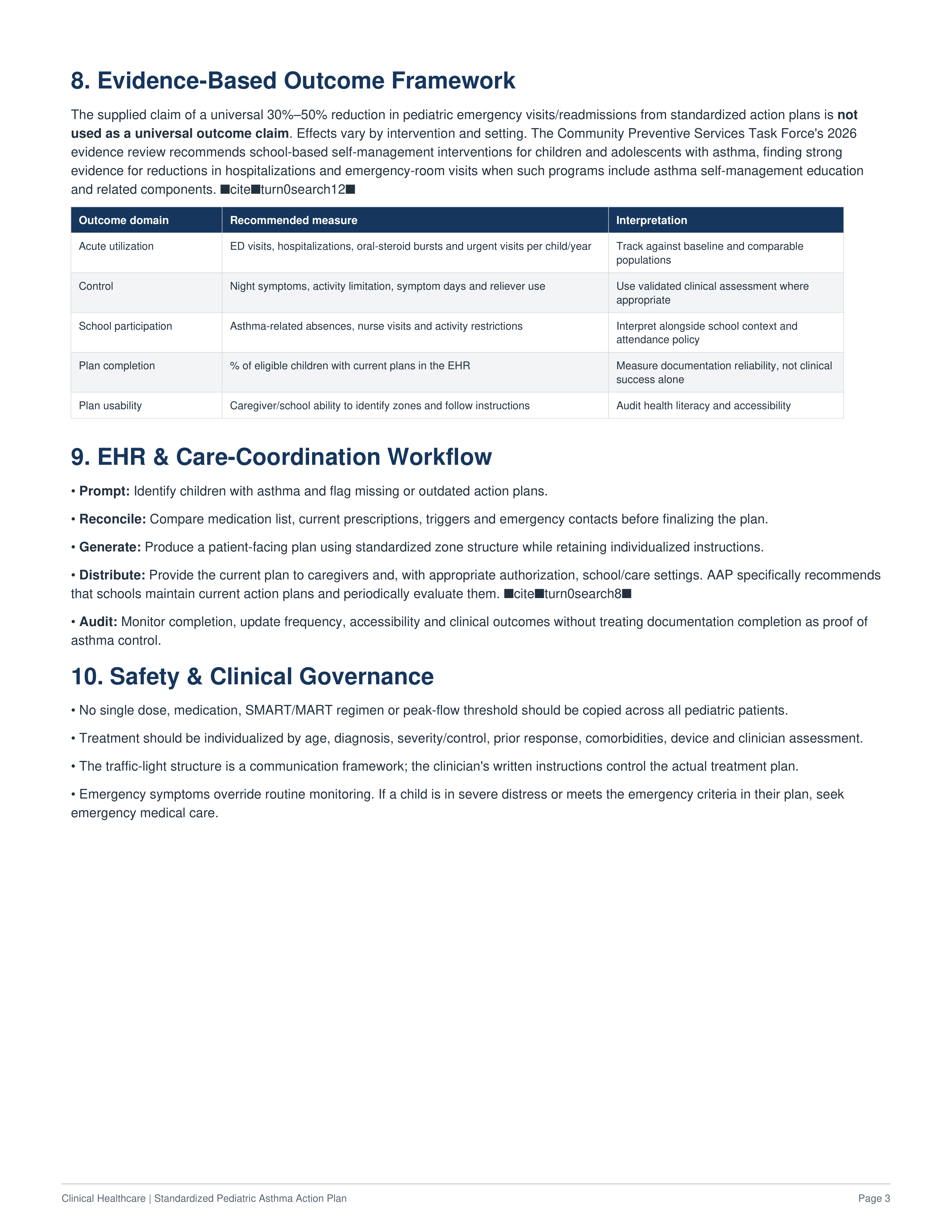
The supplied claim of a universal 30%–50% reduction in pediatric emergency visits/readmissions from standardized action plans is
not
used as a universal outcome claim
. Effects vary by intervention and setting. The Community Preventive Services Task Force's 2026
evidence review recommends school-based self-management interventions for children and adolescents with asthma, finding strong
evidence for reductions in hospitalizations and emergency-room visits when such programs include asthma self-management education
and related components.
I
cite
I
turn0search12
I
Outcome domain
Recommended measure
Interpretation
Acute utilization
ED visits, hospitalizations, oral-steroid bursts and urgent visits per child/year
Track against baseline and comparable
populations
Control
Night symptoms, activity limitation, symptom days and reliever use
Use validated clinical assessment where
appropriate
School participation
Asthma-related absences, nurse visits and activity restrictions
Interpret alongside school context and
attendance policy
Plan completion
% of eligible children with current plans in the EHR
Measure documentation reliability, not clinical
success alone
Plan usability
Caregiver/school ability to identify zones and follow instructions
Audit health literacy and accessibility
9. EHR & Care-Coordination Workflow
•
Prompt:
Identify children with asthma and flag missing or outdated action plans.
•
Reconcile:
Compare medication list, current prescriptions, triggers and emergency contacts before finalizing the plan.
•
Generate:
Produce a patient-facing plan using standardized zone structure while retaining individualized instructions.
•
Distribute:
Provide the current plan to caregivers and, with appropriate authorization, school/care settings. AAP specifically recommends
that schools maintain current action plans and periodically evaluate them.
I
cite
I
turn0search8
I
•
Audit:
Monitor completion, update frequency, accessibility and clinical outcomes without treating documentation completion as proof of
asthma control.
10. Safety & Clinical Governance
• No single dose, medication, SMART/MART regimen or peak-flow threshold should be copied across all pediatric patients.
• Treatment should be individualized by age, diagnosis, severity/control, prior response, comorbidities, device and clinician assessment.
• The traffic-light structure is a communication framework; the clinician's written instructions control the actual treatment plan.
• Emergency symptoms override routine monitoring. If a child is in severe distress or meets the emergency criteria in their plan, seek
emergency medical care.
Clinical Healthcare | Standardized Pediatric Asthma Action Plan
Page 4
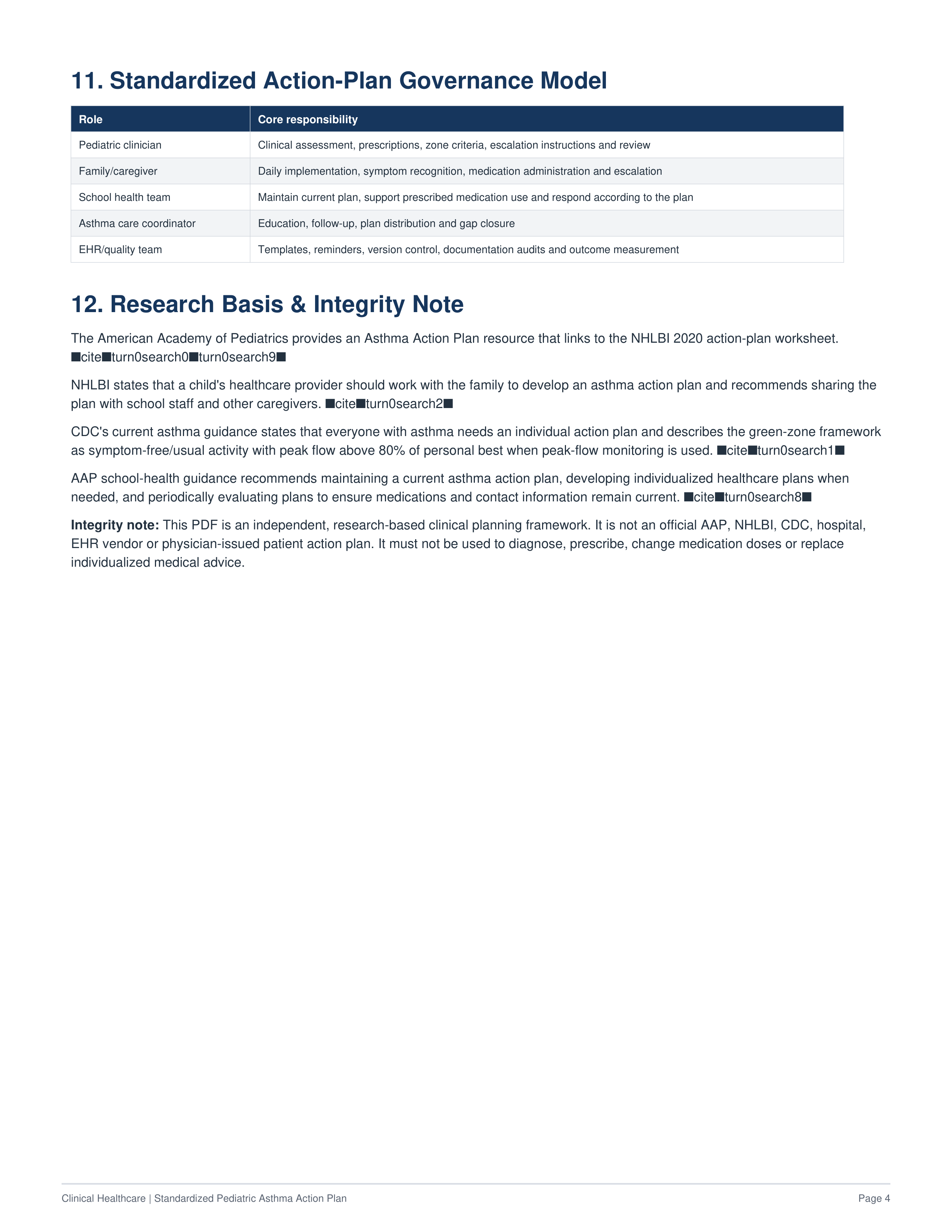
11. Standardized Action-Plan Governance Model
Role
Core responsibility
Pediatric clinician
Clinical assessment, prescriptions, zone criteria, escalation instructions and review
Family/caregiver
Daily implementation, symptom recognition, medication administration and escalation
School health team
Maintain current plan, support prescribed medication use and respond according to the plan
Asthma care coordinator
Education, follow-up, plan distribution and gap closure
EHR/quality team
Templates, reminders, version control, documentation audits and outcome measurement
12. Research Basis & Integrity Note
The American Academy of Pediatrics provides an Asthma Action Plan resource that links to the NHLBI 2020 action-plan worksheet.
I
cite
I
turn0search0
I
turn0search9
I
NHLBI states that a child's healthcare provider should work with the family to develop an asthma action plan and recommends sharing the
plan with school staff and other caregivers.
I
cite
I
turn0search2
I
CDC's current asthma guidance states that everyone with asthma needs an individual action plan and describes the green-zone framework
as symptom-free/usual activity with peak flow above 80% of personal best when peak-flow monitoring is used.
I
cite
I
turn0search1
I
AAP school-health guidance recommends maintaining a current asthma action plan, developing individualized healthcare plans when
needed, and periodically evaluating plans to ensure medications and contact information remain current.
I
cite
I
turn0search8
I
Integrity note:
This PDF is an independent, research-based clinical planning framework. It is not an official AAP, NHLBI, CDC, hospital,
EHR vendor or physician-issued patient action plan. It must not be used to diagnose, prescribe, change medication doses or replace
individualized medical advice.