INTERNATIONAL ORGANIZATION FOR STANDARDIZATION | ACTION PLAN
Action Plan for Developing Countries • 2026–2030
Page 1
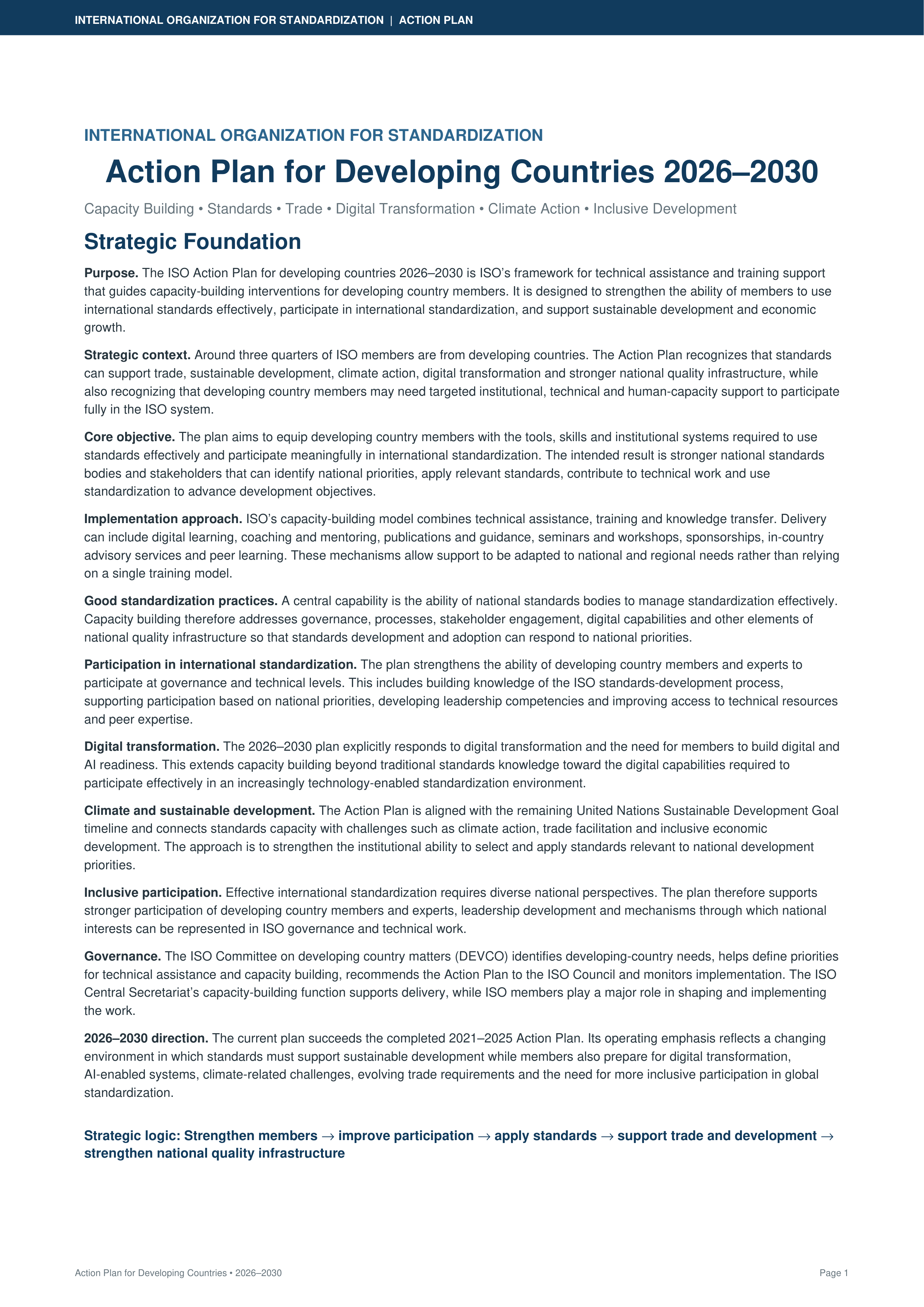
INTERNATIONAL ORGANIZATION FOR STANDARDIZATION
Action Plan for Developing Countries 2026–2030
Capacity Building • Standards • Trade • Digital Transformation • Climate Action • Inclusive Development
Strategic Foundation
Purpose.
The ISO Action Plan for developing countries 2026–2030 is ISO’s framework for technical assistance and training support
that guides capacity-building interventions for developing country members. It is designed to strengthen the ability of members to use
international standards effectively, participate in international standardization, and support sustainable development and economic
growth.
Strategic context.
Around three quarters of ISO members are from developing countries. The Action Plan recognizes that standards
can support trade, sustainable development, climate action, digital transformation and stronger national quality infrastructure, while
also recognizing that developing country members may need targeted institutional, technical and human-capacity support to participate
fully in the ISO system.
Core objective.
The plan aims to equip developing country members with the tools, skills and institutional systems required to use
standards effectively and participate meaningfully in international standardization. The intended result is stronger national standards
bodies and stakeholders that can identify national priorities, apply relevant standards, contribute to technical work and use
standardization to advance development objectives.
Implementation approach.
ISO’s capacity-building model combines technical assistance, training and knowledge transfer. Delivery
can include digital learning, coaching and mentoring, publications and guidance, seminars and workshops, sponsorships, in-country
advisory services and peer learning. These mechanisms allow support to be adapted to national and regional needs rather than relying
on a single training model.
Good standardization practices.
A central capability is the ability of national standards bodies to manage standardization effectively.
Capacity building therefore addresses governance, processes, stakeholder engagement, digital capabilities and other elements of
national quality infrastructure so that standards development and adoption can respond to national priorities.
Participation in international standardization.
The plan strengthens the ability of developing country members and experts to
participate at governance and technical levels. This includes building knowledge of the ISO standards-development process,
supporting participation based on national priorities, developing leadership competencies and improving access to technical resources
and peer expertise.
Digital transformation.
The 2026–2030 plan explicitly responds to digital transformation and the need for members to build digital and
AI readiness. This extends capacity building beyond traditional standards knowledge toward the digital capabilities required to
participate effectively in an increasingly technology-enabled standardization environment.
Climate and sustainable development.
The Action Plan is aligned with the remaining United Nations Sustainable Development Goal
timeline and connects standards capacity with challenges such as climate action, trade facilitation and inclusive economic
development. The approach is to strengthen the institutional ability to select and apply standards relevant to national development
priorities.
Inclusive participation.
Effective international standardization requires diverse national perspectives. The plan therefore supports
stronger participation of developing country members and experts, leadership development and mechanisms through which national
interests can be represented in ISO governance and technical work.
Governance.
The ISO Committee on developing country matters (DEVCO) identifies developing-country needs, helps define priorities
for technical assistance and capacity building, recommends the Action Plan to the ISO Council and monitors implementation. The ISO
Central Secretariat’s capacity-building function supports delivery, while ISO members play a major role in shaping and implementing
the work.
2026–2030 direction.
The current plan succeeds the completed 2021–2025 Action Plan. Its operating emphasis reflects a changing
environment in which standards must support sustainable development while members also prepare for digital transformation,
AI-enabled systems, climate-related challenges, evolving trade requirements and the need for more inclusive participation in global
standardization.
Strategic logic: Strengthen members
→
improve participation
→
apply standards
→
support trade and development
→
strengthen national quality infrastructure
INTERNATIONAL ORGANIZATION FOR STANDARDIZATION | ACTION PLAN
Action Plan for Developing Countries • 2026–2030
Page 2
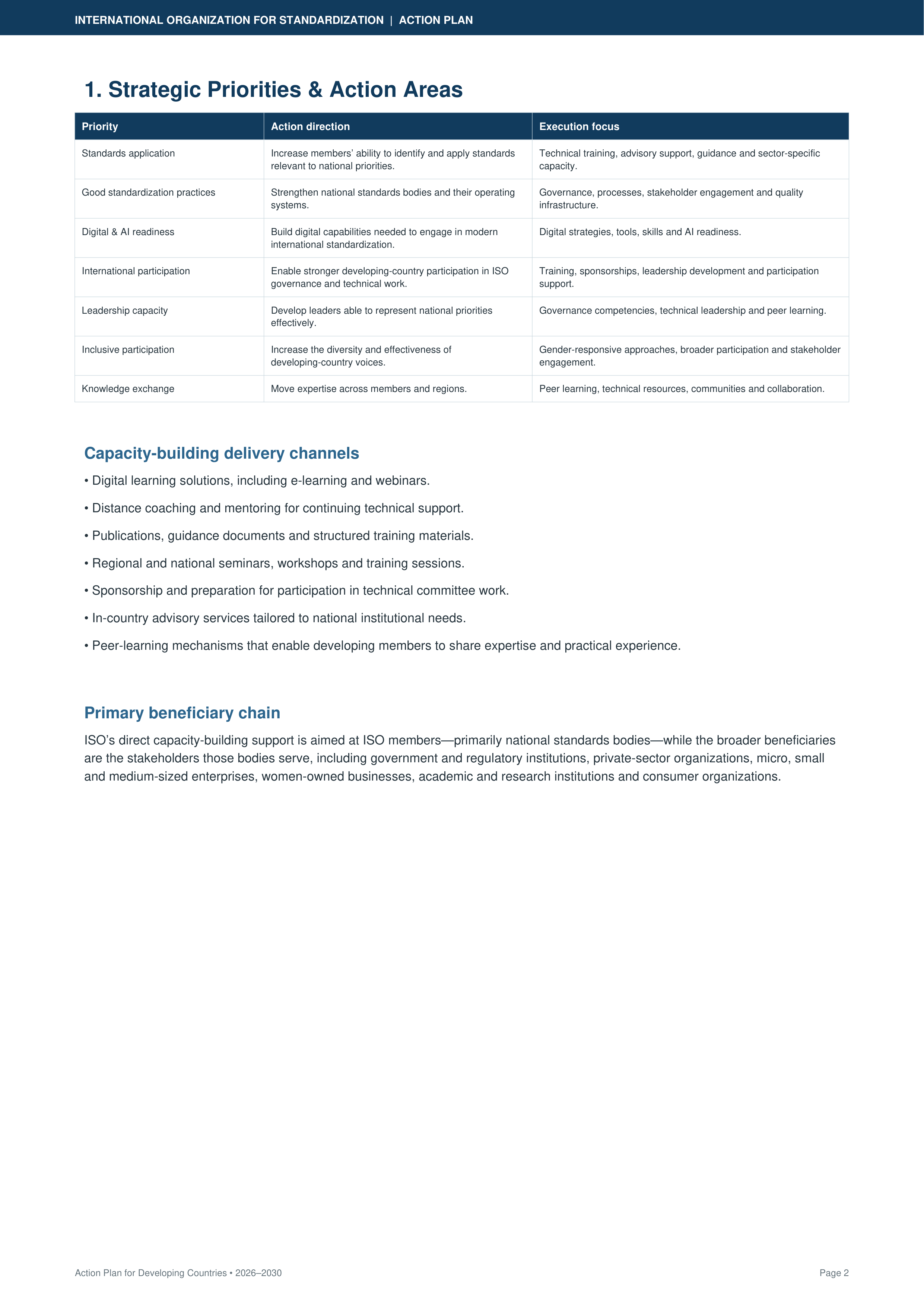
1. Strategic Priorities & Action Areas
Priority
Action direction
Execution focus
Standards application
Increase members’ ability to identify and apply standards
relevant to national priorities.
Technical training, advisory support, guidance and sector-specific
capacity.
Good standardization practices
Strengthen national standards bodies and their operating
systems.
Governance, processes, stakeholder engagement and quality
infrastructure.
Digital & AI readiness
Build digital capabilities needed to engage in modern
international standardization.
Digital strategies, tools, skills and AI readiness.
International participation
Enable stronger developing-country participation in ISO
governance and technical work.
Training, sponsorships, leadership development and participation
support.
Leadership capacity
Develop leaders able to represent national priorities
effectively.
Governance competencies, technical leadership and peer learning.
Inclusive participation
Increase the diversity and effectiveness of
developing-country voices.
Gender-responsive approaches, broader participation and stakeholder
engagement.
Knowledge exchange
Move expertise across members and regions.
Peer learning, technical resources, communities and collaboration.
Capacity-building delivery channels
• Digital learning solutions, including e-learning and webinars.
• Distance coaching and mentoring for continuing technical support.
• Publications, guidance documents and structured training materials.
• Regional and national seminars, workshops and training sessions.
• Sponsorship and preparation for participation in technical committee work.
• In-country advisory services tailored to national institutional needs.
• Peer-learning mechanisms that enable developing members to share expertise and practical experience.
Primary beneficiary chain
ISO’s direct capacity-building support is aimed at ISO members—primarily national standards bodies—while the broader beneficiaries
are the stakeholders those bodies serve, including government and regulatory institutions, private-sector organizations, micro, small
and medium-sized enterprises, women-owned businesses, academic and research institutions and consumer organizations.
INTERNATIONAL ORGANIZATION FOR STANDARDIZATION | ACTION PLAN
Action Plan for Developing Countries • 2026–2030
Page 3
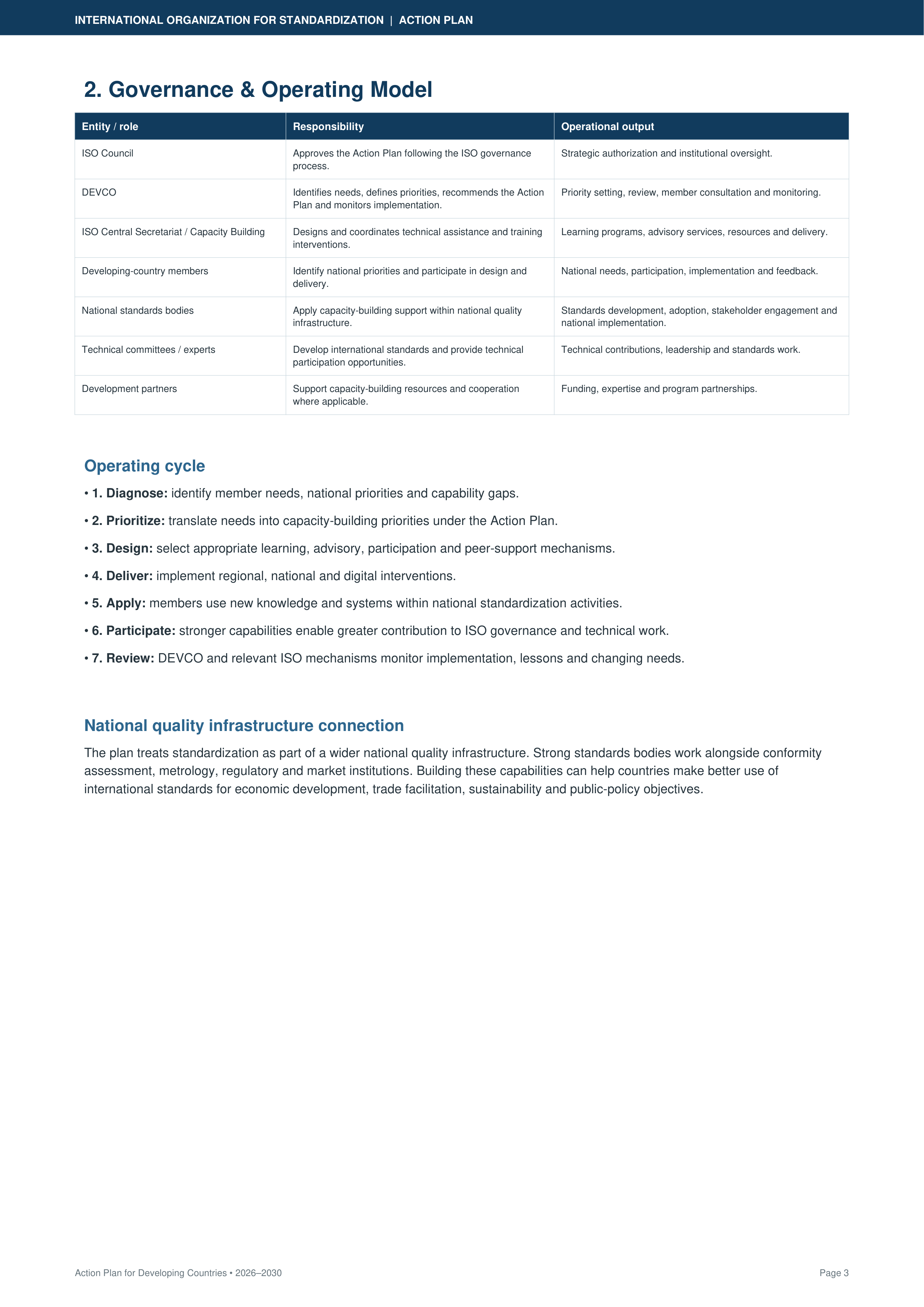
2. Governance & Operating Model
Entity / role
Responsibility
Operational output
ISO Council
Approves the Action Plan following the ISO governance
process.
Strategic authorization and institutional oversight.
DEVCO
Identifies needs, defines priorities, recommends the Action
Plan and monitors implementation.
Priority setting, review, member consultation and monitoring.
ISO Central Secretariat / Capacity Building
Designs and coordinates technical assistance and training
interventions.
Learning programs, advisory services, resources and delivery.
Developing-country members
Identify national priorities and participate in design and
delivery.
National needs, participation, implementation and feedback.
National standards bodies
Apply capacity-building support within national quality
infrastructure.
Standards development, adoption, stakeholder engagement and
national implementation.
Technical committees / experts
Develop international standards and provide technical
participation opportunities.
Technical contributions, leadership and standards work.
Development partners
Support capacity-building resources and cooperation
where applicable.
Funding, expertise and program partnerships.
Operating cycle
•
1. Diagnose:
identify member needs, national priorities and capability gaps.
•
2. Prioritize:
translate needs into capacity-building priorities under the Action Plan.
•
3. Design:
select appropriate learning, advisory, participation and peer-support mechanisms.
•
4. Deliver:
implement regional, national and digital interventions.
•
5. Apply:
members use new knowledge and systems within national standardization activities.
•
6. Participate:
stronger capabilities enable greater contribution to ISO governance and technical work.
•
7. Review:
DEVCO and relevant ISO mechanisms monitor implementation, lessons and changing needs.
National quality infrastructure connection
The plan treats standardization as part of a wider national quality infrastructure. Strong standards bodies work alongside conformity
assessment, metrology, regulatory and market institutions. Building these capabilities can help countries make better use of
international standards for economic development, trade facilitation, sustainability and public-policy objectives.
INTERNATIONAL ORGANIZATION FOR STANDARDIZATION | ACTION PLAN
Action Plan for Developing Countries • 2026–2030
Page 4
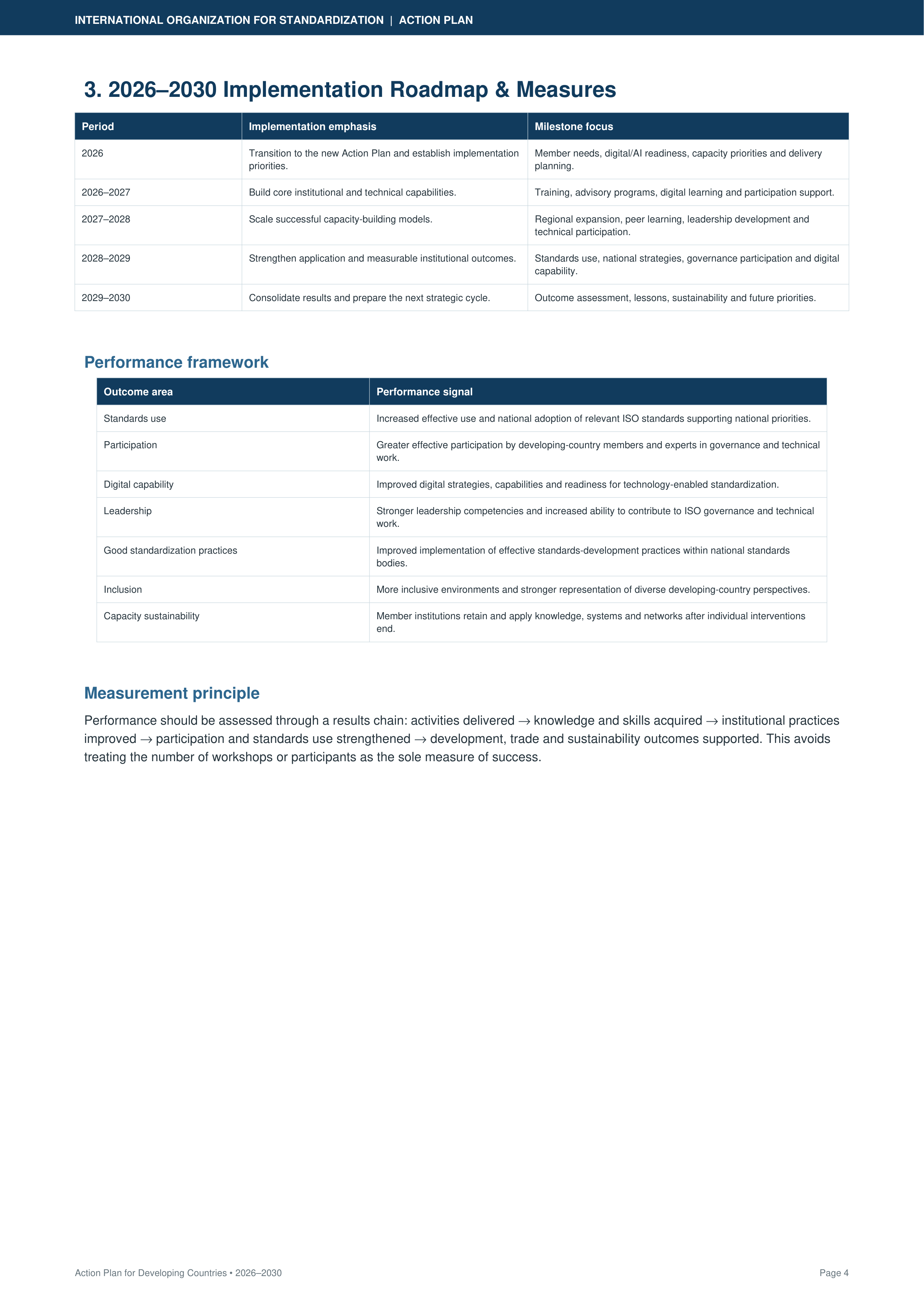
3. 2026–2030 Implementation Roadmap & Measures
Period
Implementation emphasis
Milestone focus
2026
Transition to the new Action Plan and establish implementation
priorities.
Member needs, digital/AI readiness, capacity priorities and delivery
planning.
2026–2027
Build core institutional and technical capabilities.
Training, advisory programs, digital learning and participation support.
2027–2028
Scale successful capacity-building models.
Regional expansion, peer learning, leadership development and
technical participation.
2028–2029
Strengthen application and measurable institutional outcomes.
Standards use, national strategies, governance participation and digital
capability.
2029–2030
Consolidate results and prepare the next strategic cycle.
Outcome assessment, lessons, sustainability and future priorities.
Performance framework
Outcome area
Performance signal
Standards use
Increased effective use and national adoption of relevant ISO standards supporting national priorities.
Participation
Greater effective participation by developing-country members and experts in governance and technical
work.
Digital capability
Improved digital strategies, capabilities and readiness for technology-enabled standardization.
Leadership
Stronger leadership competencies and increased ability to contribute to ISO governance and technical
work.
Good standardization practices
Improved implementation of effective standards-development practices within national standards
bodies.
Inclusion
More inclusive environments and stronger representation of diverse developing-country perspectives.
Capacity sustainability
Member institutions retain and apply knowledge, systems and networks after individual interventions
end.
Measurement principle
Performance should be assessed through a results chain: activities delivered
→
knowledge and skills acquired
→
institutional practices
improved
→
participation and standards use strengthened
→
development, trade and sustainability outcomes supported. This avoids
treating the number of workshops or participants as the sole measure of success.
INTERNATIONAL ORGANIZATION FOR STANDARDIZATION | ACTION PLAN
Action Plan for Developing Countries • 2026–2030
Page 5
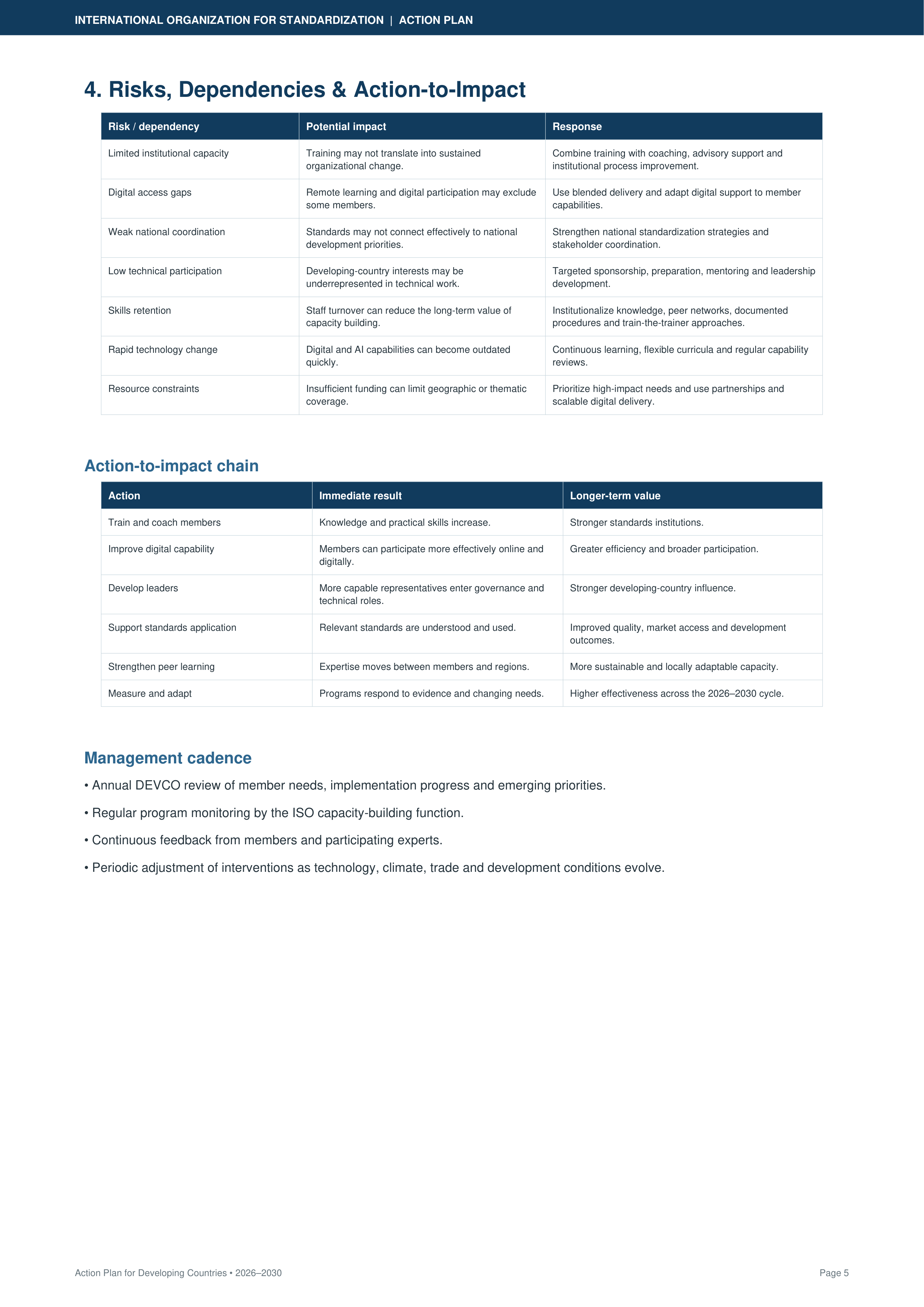
4. Risks, Dependencies & Action-to-Impact
Risk / dependency
Potential impact
Response
Limited institutional capacity
Training may not translate into sustained
organizational change.
Combine training with coaching, advisory support and
institutional process improvement.
Digital access gaps
Remote learning and digital participation may exclude
some members.
Use blended delivery and adapt digital support to member
capabilities.
Weak national coordination
Standards may not connect effectively to national
development priorities.
Strengthen national standardization strategies and
stakeholder coordination.
Low technical participation
Developing-country interests may be
underrepresented in technical work.
Targeted sponsorship, preparation, mentoring and leadership
development.
Skills retention
Staff turnover can reduce the long-term value of
capacity building.
Institutionalize knowledge, peer networks, documented
procedures and train-the-trainer approaches.
Rapid technology change
Digital and AI capabilities can become outdated
quickly.
Continuous learning, flexible curricula and regular capability
reviews.
Resource constraints
Insufficient funding can limit geographic or thematic
coverage.
Prioritize high-impact needs and use partnerships and
scalable digital delivery.
Action-to-impact chain
Action
Immediate result
Longer-term value
Train and coach members
Knowledge and practical skills increase.
Stronger standards institutions.
Improve digital capability
Members can participate more effectively online and
digitally.
Greater efficiency and broader participation.
Develop leaders
More capable representatives enter governance and
technical roles.
Stronger developing-country influence.
Support standards application
Relevant standards are understood and used.
Improved quality, market access and development
outcomes.
Strengthen peer learning
Expertise moves between members and regions.
More sustainable and locally adaptable capacity.
Measure and adapt
Programs respond to evidence and changing needs.
Higher effectiveness across the 2026–2030 cycle.
Management cadence
• Annual DEVCO review of member needs, implementation progress and emerging priorities.
• Regular program monitoring by the ISO capacity-building function.
• Continuous feedback from members and participating experts.
• Periodic adjustment of interventions as technology, climate, trade and development conditions evolve.
INTERNATIONAL ORGANIZATION FOR STANDARDIZATION | ACTION PLAN
Action Plan for Developing Countries • 2026–2030
Page 6
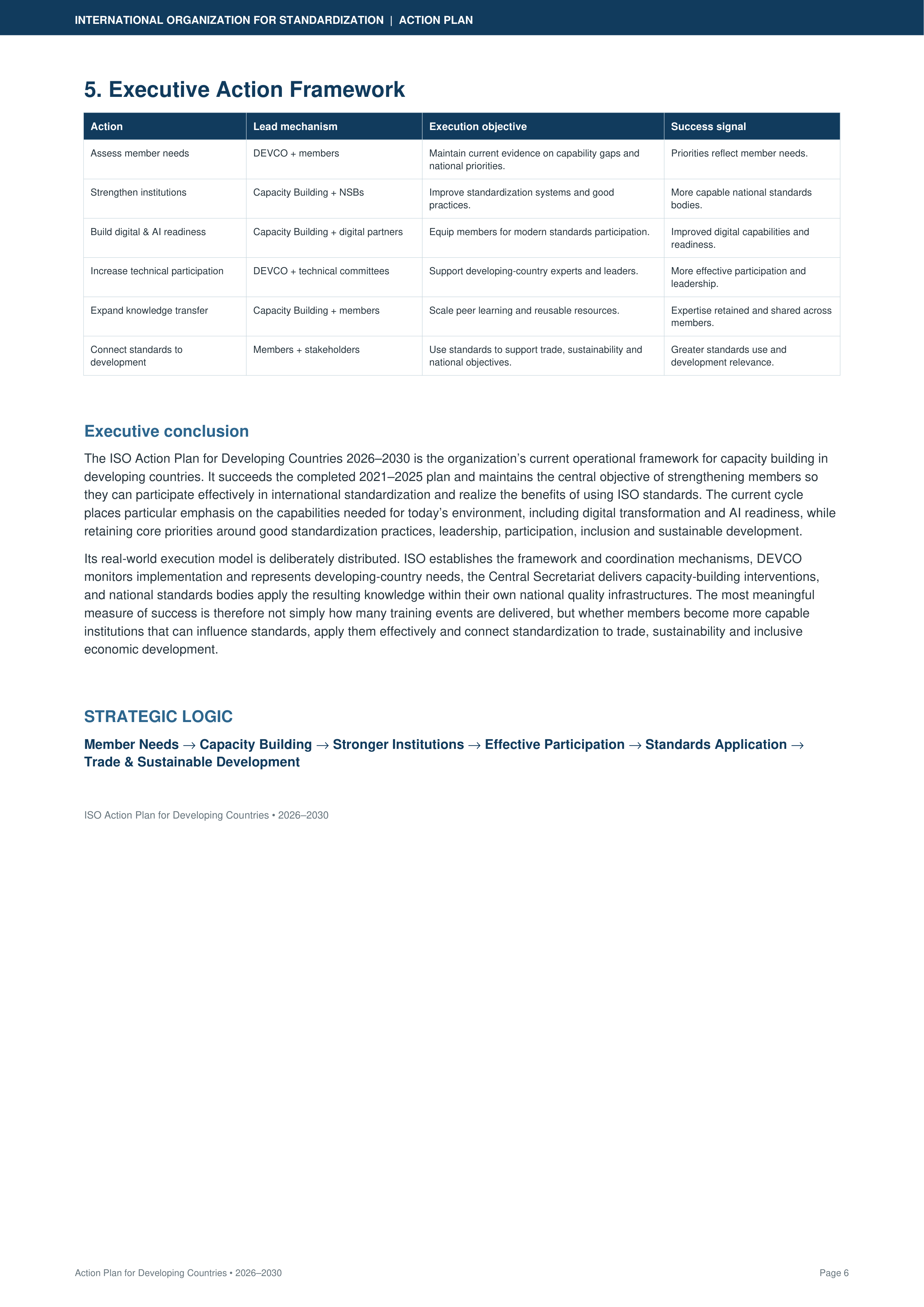
5. Executive Action Framework
Action
Lead mechanism
Execution objective
Success signal
Assess member needs
DEVCO + members
Maintain current evidence on capability gaps and
national priorities.
Priorities reflect member needs.
Strengthen institutions
Capacity Building + NSBs
Improve standardization systems and good
practices.
More capable national standards
bodies.
Build digital & AI readiness
Capacity Building + digital partners
Equip members for modern standards participation.
Improved digital capabilities and
readiness.
Increase technical participation
DEVCO + technical committees
Support developing-country experts and leaders.
More effective participation and
leadership.
Expand knowledge transfer
Capacity Building + members
Scale peer learning and reusable resources.
Expertise retained and shared across
members.
Connect standards to
development
Members + stakeholders
Use standards to support trade, sustainability and
national objectives.
Greater standards use and
development relevance.
Executive conclusion
The ISO Action Plan for Developing Countries 2026–2030 is the organization’s current operational framework for capacity building in
developing countries. It succeeds the completed 2021–2025 plan and maintains the central objective of strengthening members so
they can participate effectively in international standardization and realize the benefits of using ISO standards. The current cycle
places particular emphasis on the capabilities needed for today’s environment, including digital transformation and AI readiness, while
retaining core priorities around good standardization practices, leadership, participation, inclusion and sustainable development.
Its real-world execution model is deliberately distributed. ISO establishes the framework and coordination mechanisms, DEVCO
monitors implementation and represents developing-country needs, the Central Secretariat delivers capacity-building interventions,
and national standards bodies apply the resulting knowledge within their own national quality infrastructures. The most meaningful
measure of success is therefore not simply how many training events are delivered, but whether members become more capable
institutions that can influence standards, apply them effectively and connect standardization to trade, sustainability and inclusive
economic development.
STRATEGIC LOGIC
Member Needs
→
Capacity Building
→
Stronger Institutions
→
Effective Participation
→
Standards Application
→
Trade & Sustainable Development
ISO Action Plan for Developing Countries • 2026–2030