FEDEX
NETWORK 2.0 TRANSFORMATION
Research-based synthesized action plan • Not an official FedEx publication
1
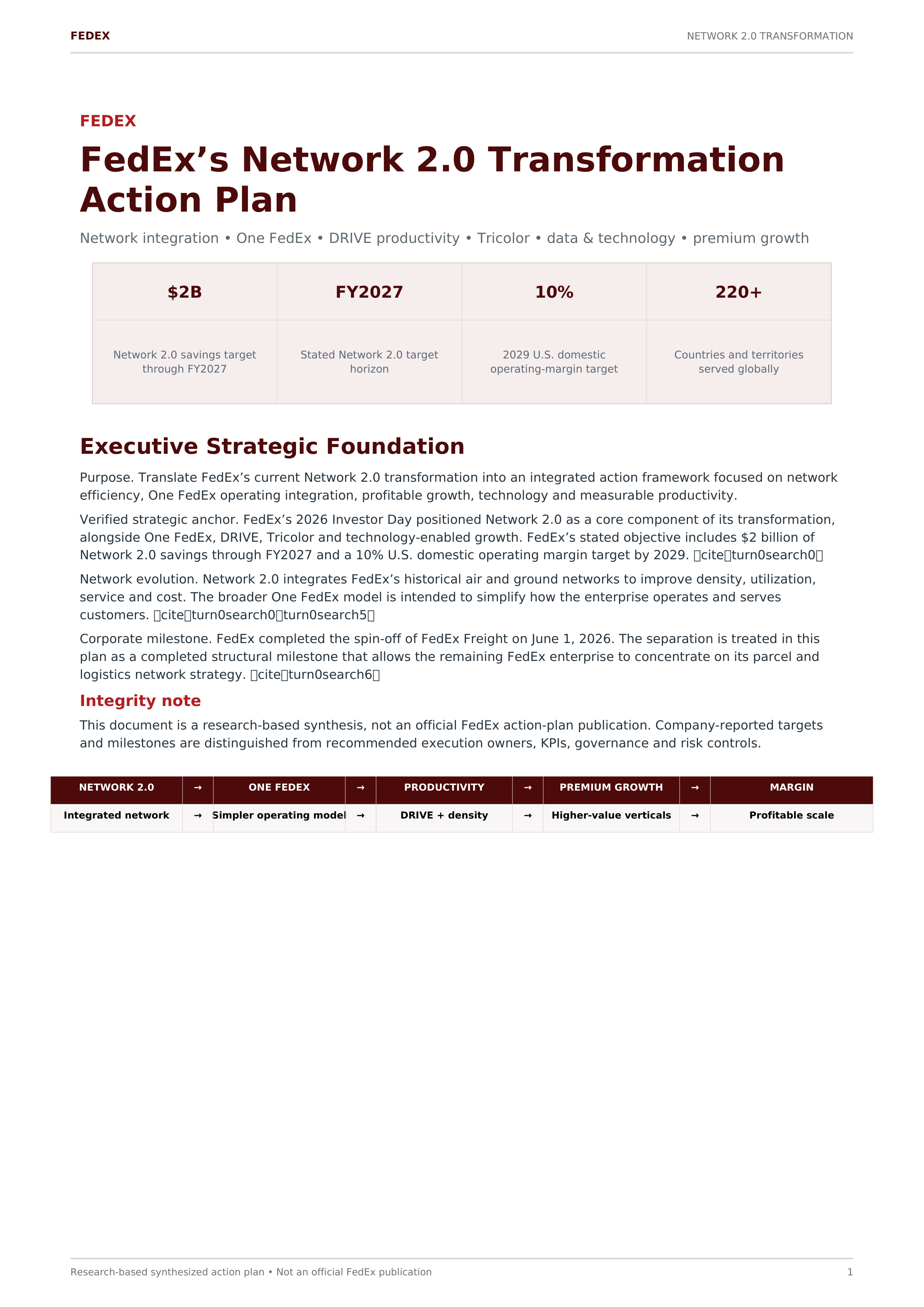
FEDEX
FedEx’s Network 2.0 Transformation
Action Plan
Network integration • One FedEx • DRIVE productivity • Tricolor • data & technology • premium growth
$2B
FY2027
10%
220+
Network 2.0 savings target
through FY2027
Stated Network 2.0 target
horizon
2029 U.S. domestic
operating-margin target
Countries and territories
served globally
Executive Strategic Foundation
Purpose. Translate FedEx’s current Network 2.0 transformation into an integrated action framework focused on network
efficiency, One FedEx operating integration, profitable growth, technology and measurable productivity.
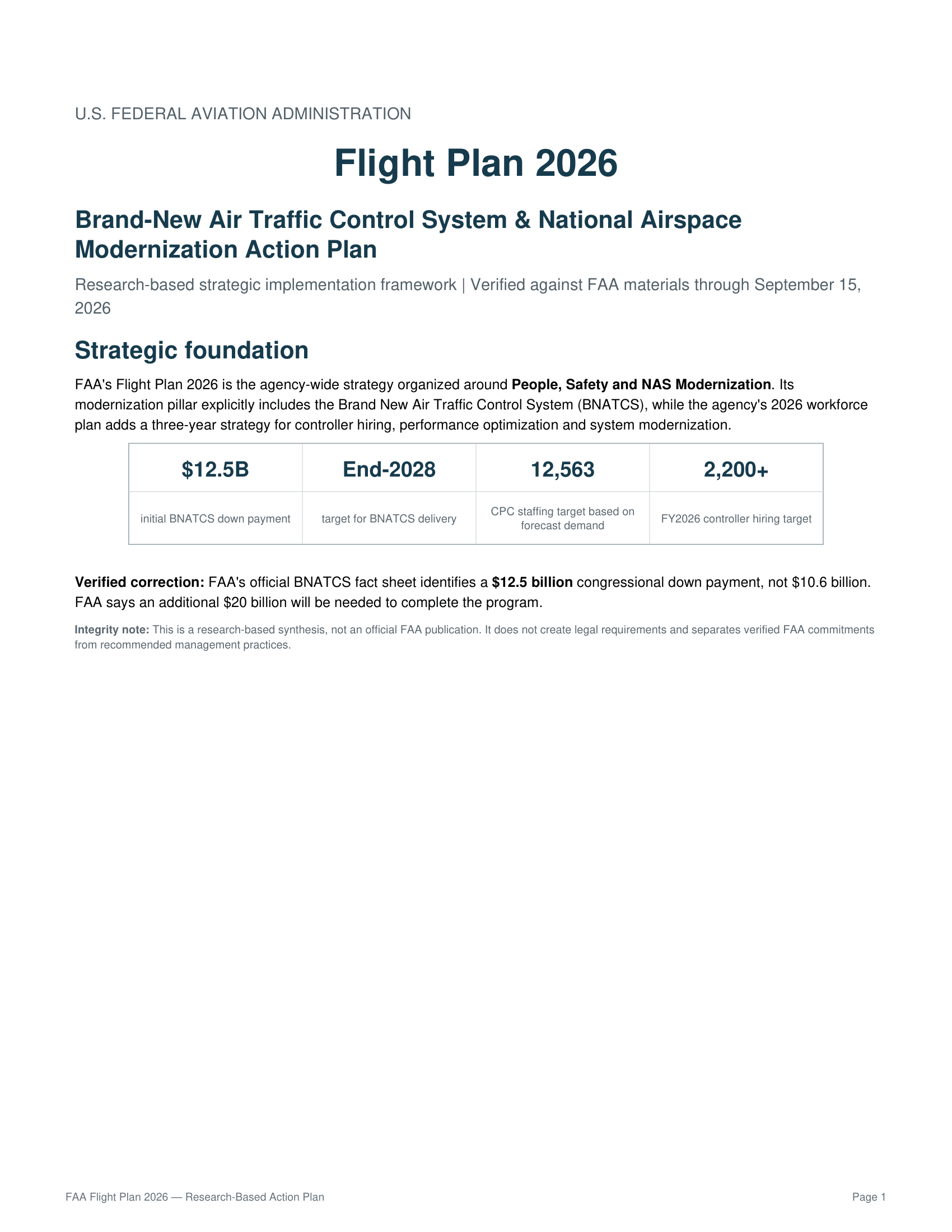
Verified strategic anchor. FedEx’s 2026 Investor Day positioned Network 2.0 as a core component of its transformation,
alongside One FedEx, DRIVE, Tricolor and technology-enabled growth. FedEx’s stated objective includes $2 billion of
Network 2.0 savings through FY2027 and a 10% U.S. domestic operating margin target by 2029.
citeturn0search0
Network evolution. Network 2.0 integrates FedEx’s historical air and ground networks to improve density, utilization,
service and cost. The broader One FedEx model is intended to simplify how the enterprise operates and serves
customers.
citeturn0search0turn0search5
Corporate milestone. FedEx completed the spin-off of FedEx Freight on June 1, 2026. The separation is treated in this
plan as a completed structural milestone that allows the remaining FedEx enterprise to concentrate on its parcel and
logistics network strategy.
citeturn0search6
Integrity note
This document is a research-based synthesis, not an official FedEx action-plan publication. Company-reported targets
and milestones are distinguished from recommended execution owners, KPIs, governance and risk controls.
NETWORK 2.0
→
ONE FEDEX
→
PRODUCTIVITY
→
PREMIUM GROWTH
→
MARGIN
Integrated network
→
Simpler operating model
→
DRIVE + density
→
Higher-value verticals
→
Profitable scale
FEDEX
NETWORK 2.0 TRANSFORMATION
Research-based synthesized action plan • Not an official FedEx publication
2
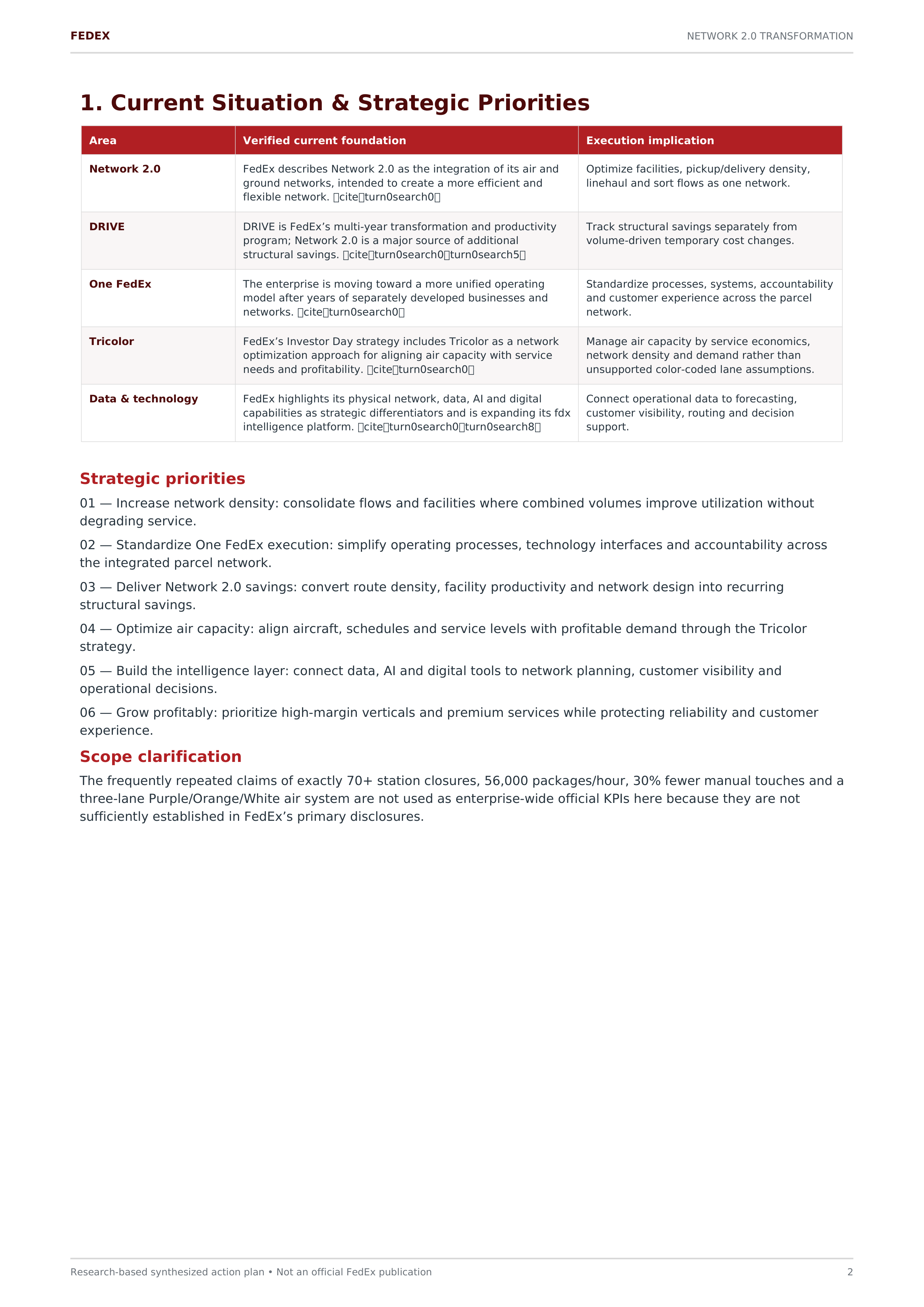
1. Current Situation & Strategic Priorities
Area
Verified current foundation
Execution implication
Network 2.0
FedEx describes Network 2.0 as the integration of its air and
ground networks, intended to create a more efficient and
flexible network.
citeturn0search0
Optimize facilities, pickup/delivery density,
linehaul and sort flows as one network.
DRIVE
DRIVE is FedEx’s multi-year transformation and productivity
program; Network 2.0 is a major source of additional
structural savings.
citeturn0search0turn0search5
Track structural savings separately from
volume-driven temporary cost changes.
One FedEx
The enterprise is moving toward a more unified operating
model after years of separately developed businesses and
networks.
citeturn0search0
Standardize processes, systems, accountability
and customer experience across the parcel
network.
Tricolor
FedEx’s Investor Day strategy includes Tricolor as a network
optimization approach for aligning air capacity with service
needs and profitability.
citeturn0search0
Manage air capacity by service economics,
network density and demand rather than
unsupported color-coded lane assumptions.
Data & technology
FedEx highlights its physical network, data, AI and digital
capabilities as strategic differentiators and is expanding its fdx
intelligence platform.
citeturn0search0turn0search8
Connect operational data to forecasting,
customer visibility, routing and decision
support.
Strategic priorities
01 — Increase network density: consolidate flows and facilities where combined volumes improve utilization without
degrading service.
02 — Standardize One FedEx execution: simplify operating processes, technology interfaces and accountability across
the integrated parcel network.
03 — Deliver Network 2.0 savings: convert route density, facility productivity and network design into recurring
structural savings.
04 — Optimize air capacity: align aircraft, schedules and service levels with profitable demand through the Tricolor
strategy.
05 — Build the intelligence layer: connect data, AI and digital tools to network planning, customer visibility and
operational decisions.
06 — Grow profitably: prioritize high-margin verticals and premium services while protecting reliability and customer
experience.
Scope clarification
The frequently repeated claims of exactly 70+ station closures, 56,000 packages/hour, 30% fewer manual touches and a
three-lane Purple/Orange/White air system are not used as enterprise-wide official KPIs here because they are not
sufficiently established in FedEx’s primary disclosures.
FEDEX
NETWORK 2.0 TRANSFORMATION
Research-based synthesized action plan • Not an official FedEx publication
3
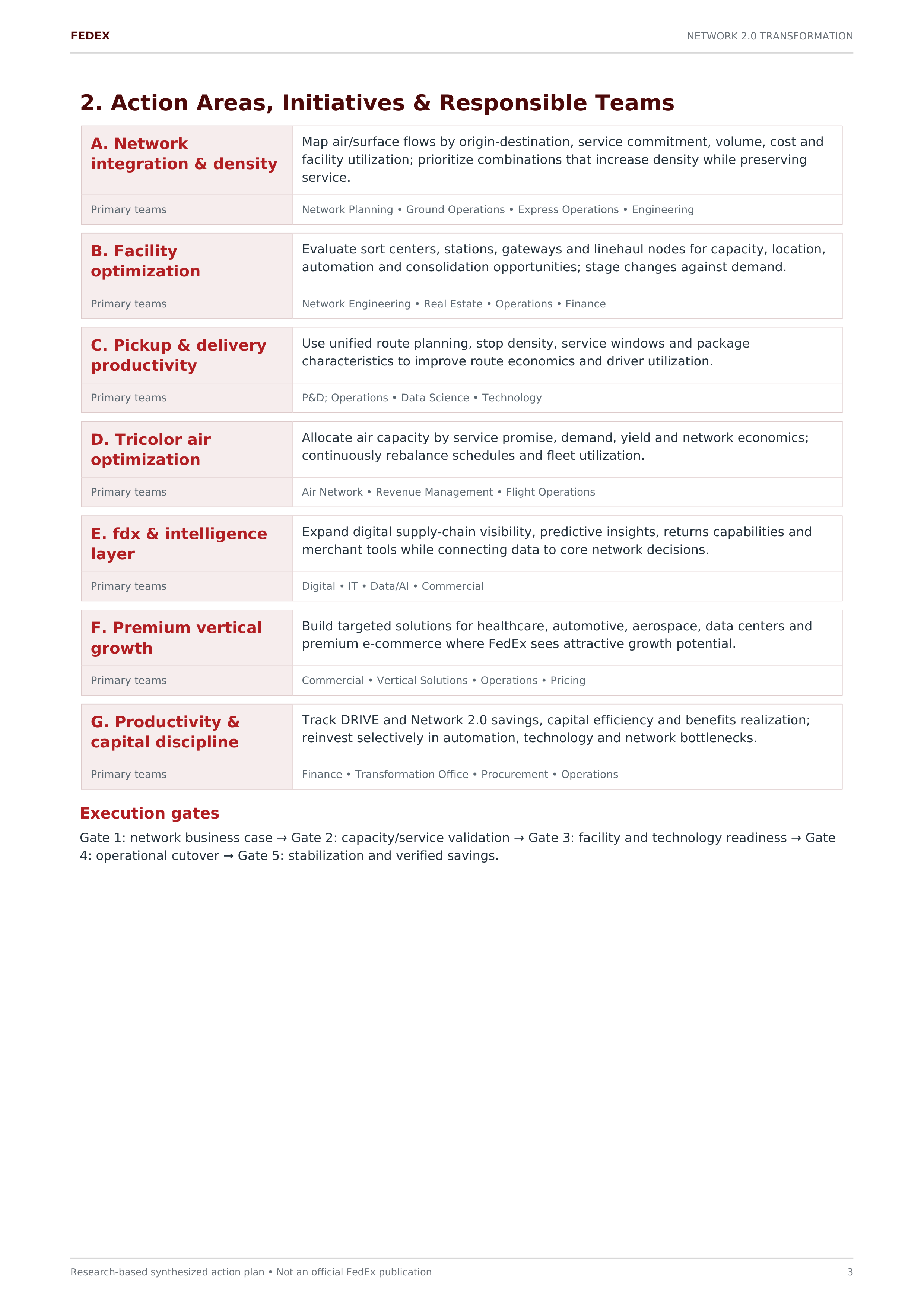
2. Action Areas, Initiatives & Responsible Teams
A. Network
integration & density
Map air/surface flows by origin-destination, service commitment, volume, cost and
facility utilization; prioritize combinations that increase density while preserving
service.
Primary teams
Network Planning • Ground Operations • Express Operations • Engineering
B. Facility
optimization
Evaluate sort centers, stations, gateways and linehaul nodes for capacity, location,
automation and consolidation opportunities; stage changes against demand.
Primary teams
Network Engineering • Real Estate • Operations • Finance
C. Pickup & delivery
productivity
Use unified route planning, stop density, service windows and package
characteristics to improve route economics and driver utilization.
Primary teams
P&D; Operations • Data Science • Technology
D. Tricolor air
optimization
Allocate air capacity by service promise, demand, yield and network economics;
continuously rebalance schedules and fleet utilization.
Primary teams
Air Network • Revenue Management • Flight Operations
E. fdx & intelligence
layer
Expand digital supply-chain visibility, predictive insights, returns capabilities and
merchant tools while connecting data to core network decisions.
Primary teams
Digital • IT • Data/AI • Commercial
F. Premium vertical
growth
Build targeted solutions for healthcare, automotive, aerospace, data centers and
premium e-commerce where FedEx sees attractive growth potential.
Primary teams
Commercial • Vertical Solutions • Operations • Pricing
G. Productivity &
capital discipline
Track DRIVE and Network 2.0 savings, capital efficiency and benefits realization;
reinvest selectively in automation, technology and network bottlenecks.
Primary teams
Finance • Transformation Office • Procurement • Operations
Execution gates
Gate 1: network business case → Gate 2: capacity/service validation → Gate 3: facility and technology readiness → Gate
4: operational cutover → Gate 5: stabilization and verified savings.
FEDEX
NETWORK 2.0 TRANSFORMATION
Research-based synthesized action plan • Not an official FedEx publication
4
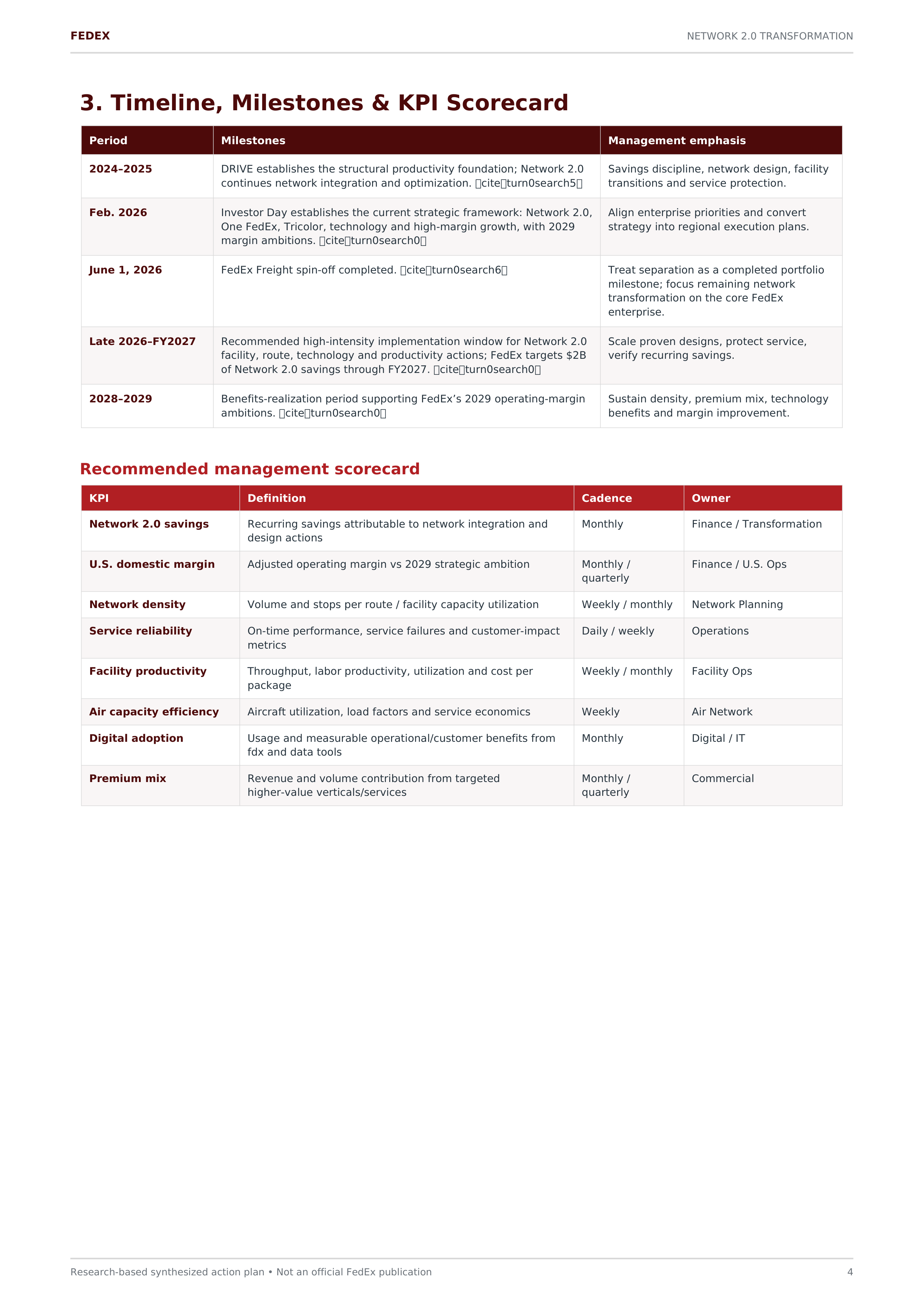
3. Timeline, Milestones & KPI Scorecard
Period
Milestones
Management emphasis
2024–2025
DRIVE establishes the structural productivity foundation; Network 2.0
continues network integration and optimization.
citeturn0search5
Savings discipline, network design, facility
transitions and service protection.
Feb. 2026
Investor Day establishes the current strategic framework: Network 2.0,
One FedEx, Tricolor, technology and high-margin growth, with 2029
margin ambitions.
citeturn0search0
Align enterprise priorities and convert
strategy into regional execution plans.
June 1, 2026
FedEx Freight spin-off completed.
citeturn0search6
Treat separation as a completed portfolio
milestone; focus remaining network
transformation on the core FedEx
enterprise.
Late 2026–FY2027
Recommended high-intensity implementation window for Network 2.0
facility, route, technology and productivity actions; FedEx targets $2B
of Network 2.0 savings through FY2027.
citeturn0search0
Scale proven designs, protect service,
verify recurring savings.
2028–2029
Benefits-realization period supporting FedEx’s 2029 operating-margin
ambitions.
citeturn0search0
Sustain density, premium mix, technology
benefits and margin improvement.
Recommended management scorecard
KPI
Definition
Cadence
Owner
Network 2.0 savings
Recurring savings attributable to network integration and
design actions
Monthly
Finance / Transformation
U.S. domestic margin
Adjusted operating margin vs 2029 strategic ambition
Monthly /
quarterly
Finance / U.S. Ops
Network density
Volume and stops per route / facility capacity utilization
Weekly / monthly
Network Planning
Service reliability
On-time performance, service failures and customer-impact
metrics
Daily / weekly
Operations
Facility productivity
Throughput, labor productivity, utilization and cost per
package
Weekly / monthly
Facility Ops
Air capacity efficiency
Aircraft utilization, load factors and service economics
Weekly
Air Network
Digital adoption
Usage and measurable operational/customer benefits from
fdx and data tools
Monthly
Digital / IT
Premium mix
Revenue and volume contribution from targeted
higher-value verticals/services
Monthly /
quarterly
Commercial
FEDEX
NETWORK 2.0 TRANSFORMATION
Research-based synthesized action plan • Not an official FedEx publication
5
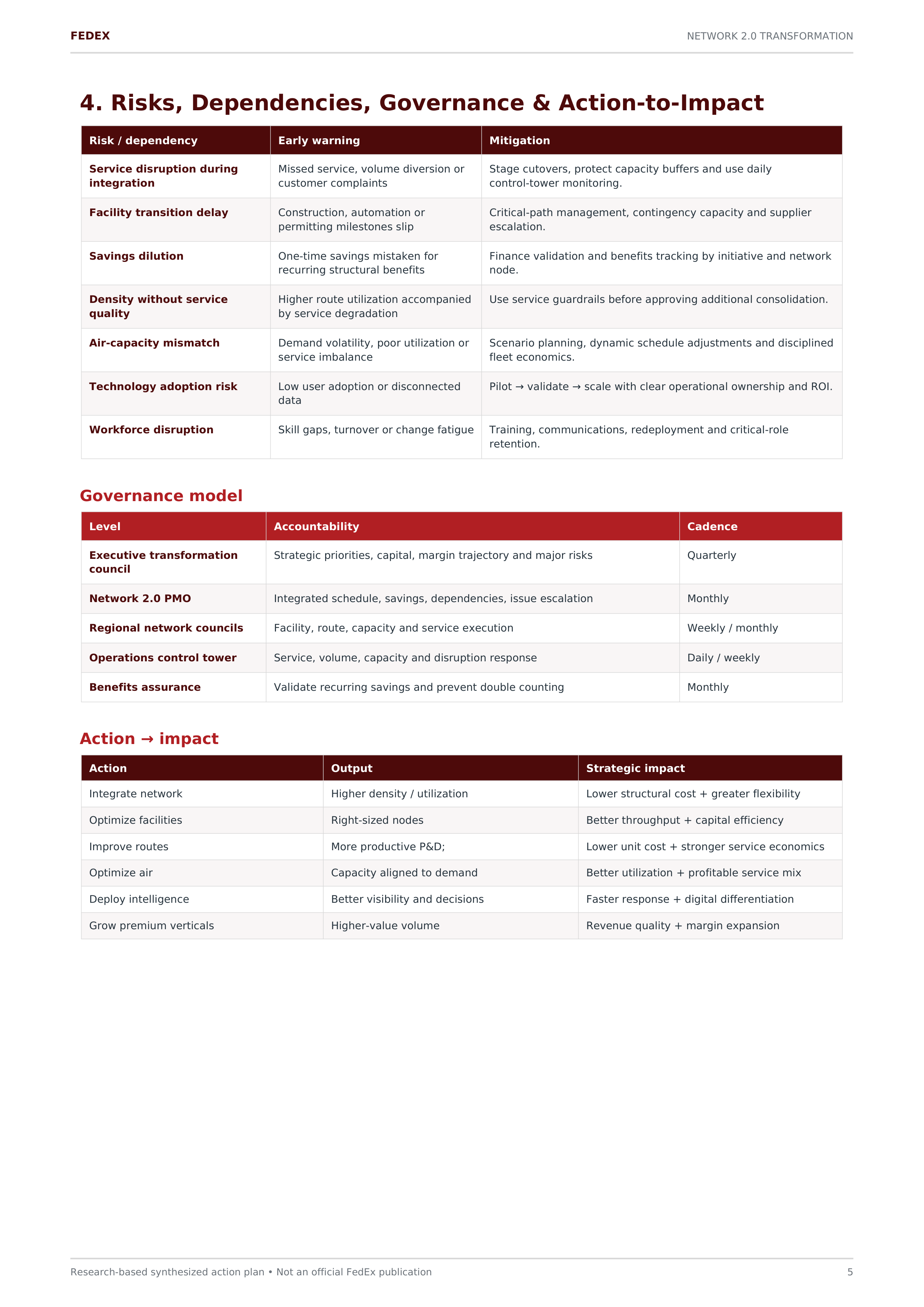
4. Risks, Dependencies, Governance & Action-to-Impact
Risk / dependency
Early warning
Mitigation
Service disruption during
integration
Missed service, volume diversion or
customer complaints
Stage cutovers, protect capacity buffers and use daily
control-tower monitoring.
Facility transition delay
Construction, automation or
permitting milestones slip
Critical-path management, contingency capacity and supplier
escalation.
Savings dilution
One-time savings mistaken for
recurring structural benefits
Finance validation and benefits tracking by initiative and network
node.
Density without service
quality
Higher route utilization accompanied
by service degradation
Use service guardrails before approving additional consolidation.
Air-capacity mismatch
Demand volatility, poor utilization or
service imbalance
Scenario planning, dynamic schedule adjustments and disciplined
fleet economics.
Technology adoption risk
Low user adoption or disconnected
data
Pilot → validate → scale with clear operational ownership and ROI.
Workforce disruption
Skill gaps, turnover or change fatigue
Training, communications, redeployment and critical-role
retention.
Governance model
Level
Accountability
Cadence
Executive transformation
council
Strategic priorities, capital, margin trajectory and major risks
Quarterly
Network 2.0 PMO
Integrated schedule, savings, dependencies, issue escalation
Monthly
Regional network councils
Facility, route, capacity and service execution
Weekly / monthly
Operations control tower
Service, volume, capacity and disruption response
Daily / weekly
Benefits assurance
Validate recurring savings and prevent double counting
Monthly
Action → impact
Action
Output
Strategic impact
Integrate network
Higher density / utilization
Lower structural cost + greater flexibility
Optimize facilities
Right-sized nodes
Better throughput + capital efficiency
Improve routes
More productive P&D;
Lower unit cost + stronger service economics
Optimize air
Capacity aligned to demand
Better utilization + profitable service mix
Deploy intelligence
Better visibility and decisions
Faster response + digital differentiation
Grow premium verticals
Higher-value volume
Revenue quality + margin expansion
FEDEX
NETWORK 2.0 TRANSFORMATION
Research-based synthesized action plan • Not an official FedEx publication
6
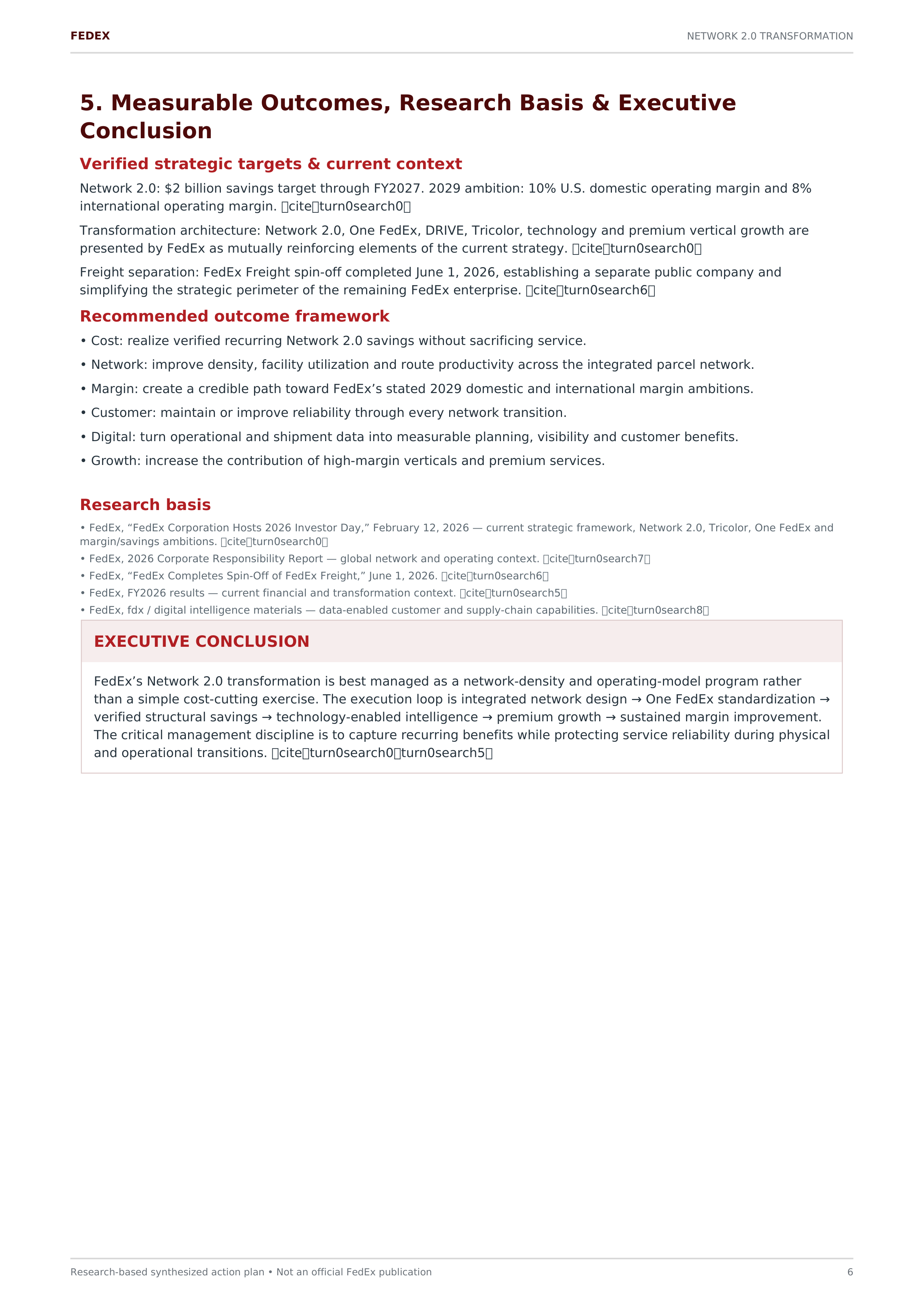
5. Measurable Outcomes, Research Basis & Executive
Conclusion
Verified strategic targets & current context
Network 2.0: $2 billion savings target through FY2027. 2029 ambition: 10% U.S. domestic operating margin and 8%
international operating margin.
citeturn0search0
Transformation architecture: Network 2.0, One FedEx, DRIVE, Tricolor, technology and premium vertical growth are
presented by FedEx as mutually reinforcing elements of the current strategy.
citeturn0search0
Freight separation: FedEx Freight spin-off completed June 1, 2026, establishing a separate public company and
simplifying the strategic perimeter of the remaining FedEx enterprise.
citeturn0search6
Recommended outcome framework
• Cost: realize verified recurring Network 2.0 savings without sacrificing service.
• Network: improve density, facility utilization and route productivity across the integrated parcel network.
• Margin: create a credible path toward FedEx’s stated 2029 domestic and international margin ambitions.
• Customer: maintain or improve reliability through every network transition.
• Digital: turn operational and shipment data into measurable planning, visibility and customer benefits.
• Growth: increase the contribution of high-margin verticals and premium services.
Research basis
• FedEx, “FedEx Corporation Hosts 2026 Investor Day,” February 12, 2026 — current strategic framework, Network 2.0, Tricolor, One FedEx and
margin/savings ambitions.
citeturn0search0
• FedEx, 2026 Corporate Responsibility Report — global network and operating context.
citeturn0search7
• FedEx, “FedEx Completes Spin-Off of FedEx Freight,” June 1, 2026.
citeturn0search6
• FedEx, FY2026 results — current financial and transformation context.
citeturn0search5
• FedEx, fdx / digital intelligence materials — data-enabled customer and supply-chain capabilities.
citeturn0search8
EXECUTIVE CONCLUSION
FedEx’s Network 2.0 transformation is best managed as a network-density and operating-model program rather
than a simple cost-cutting exercise. The execution loop is integrated network design → One FedEx standardization →
verified structural savings → technology-enabled intelligence → premium growth → sustained margin improvement.
The critical management discipline is to capture recurring benefits while protecting service reliability during physical
and operational transitions.
citeturn0search0turn0search5