APMG Change Management Process Framework Action Plan
1
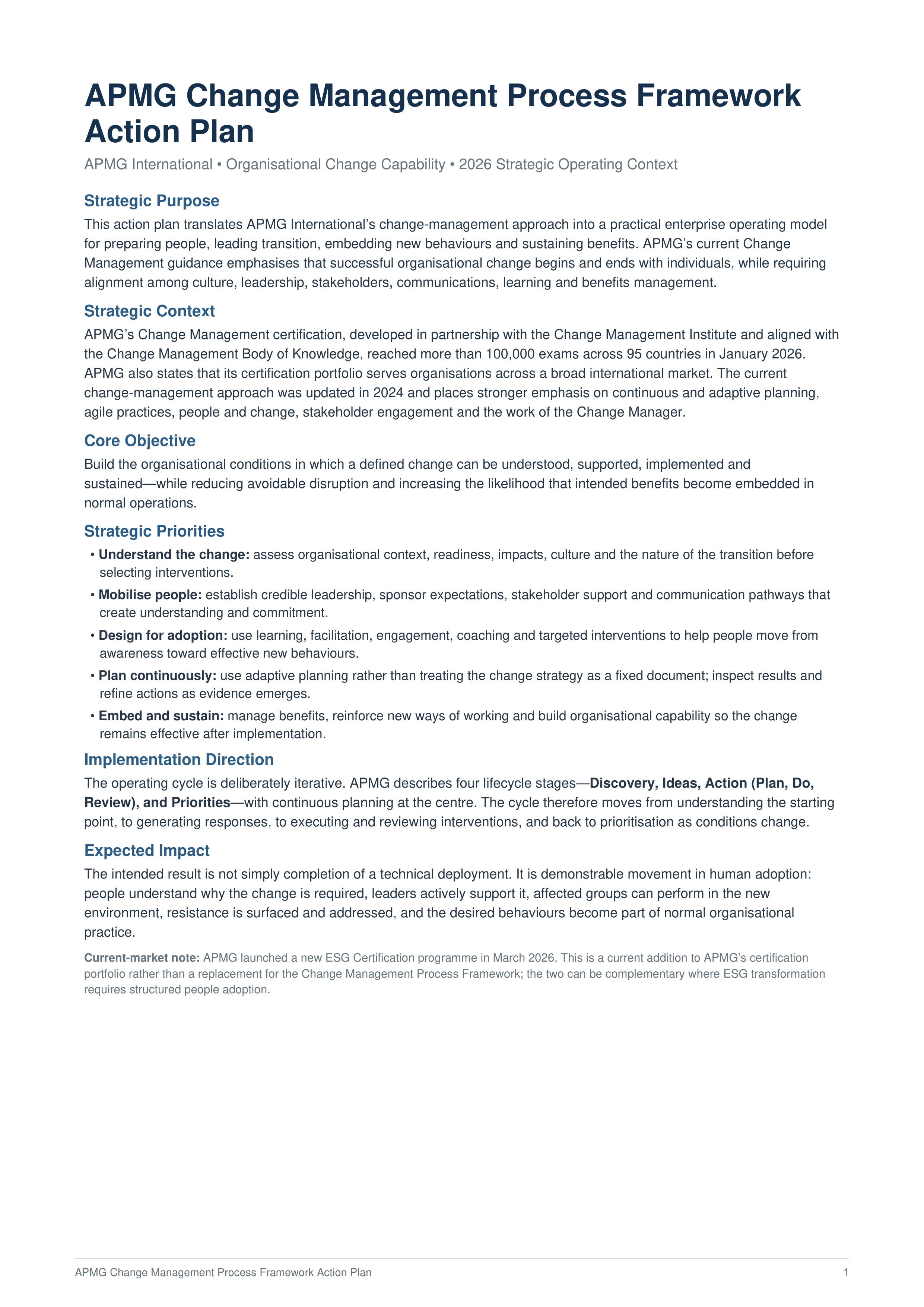
APMG Change Management Process Framework
Action Plan
APMG International • Organisational Change Capability • 2026 Strategic Operating Context
Strategic Purpose
This action plan translates APMG International’s change-management approach into a practical enterprise operating model
for preparing people, leading transition, embedding new behaviours and sustaining benefits. APMG’s current Change
Management guidance emphasises that successful organisational change begins and ends with individuals, while requiring
alignment among culture, leadership, stakeholders, communications, learning and benefits management.
Strategic Context
APMG’s Change Management certification, developed in partnership with the Change Management Institute and aligned with
the Change Management Body of Knowledge, reached more than 100,000 exams across 95 countries in January 2026.
APMG also states that its certification portfolio serves organisations across a broad international market. The current
change-management approach was updated in 2024 and places stronger emphasis on continuous and adaptive planning,
agile practices, people and change, stakeholder engagement and the work of the Change Manager.
Core Objective
Build the organisational conditions in which a defined change can be understood, supported, implemented and
sustained—while reducing avoidable disruption and increasing the likelihood that intended benefits become embedded in
normal operations.
Strategic Priorities
•
Understand the change:
assess organisational context, readiness, impacts, culture and the nature of the transition before
selecting interventions.
•
Mobilise people:
establish credible leadership, sponsor expectations, stakeholder support and communication pathways that
create understanding and commitment.
•
Design for adoption:
use learning, facilitation, engagement, coaching and targeted interventions to help people move from
awareness toward effective new behaviours.
•
Plan continuously:
use adaptive planning rather than treating the change strategy as a fixed document; inspect results and
refine actions as evidence emerges.
•
Embed and sustain:
manage benefits, reinforce new ways of working and build organisational capability so the change
remains effective after implementation.
Implementation Direction
The operating cycle is deliberately iterative. APMG describes four lifecycle stages—
Discovery, Ideas, Action (Plan, Do,
Review), and Priorities
—with continuous planning at the centre. The cycle therefore moves from understanding the starting
point, to generating responses, to executing and reviewing interventions, and back to prioritisation as conditions change.
Expected Impact
The intended result is not simply completion of a technical deployment. It is demonstrable movement in human adoption:
people understand why the change is required, leaders actively support it, affected groups can perform in the new
environment, resistance is surfaced and addressed, and the desired behaviours become part of normal organisational
practice.
Current-market note:
APMG launched a new ESG Certification programme in March 2026. This is a current addition to APMG’s certification
portfolio rather than a replacement for the Change Management Process Framework; the two can be complementary where ESG transformation
requires structured people adoption.
APMG Change Management Process Framework Action Plan
2
1. Change Management Action Architecture
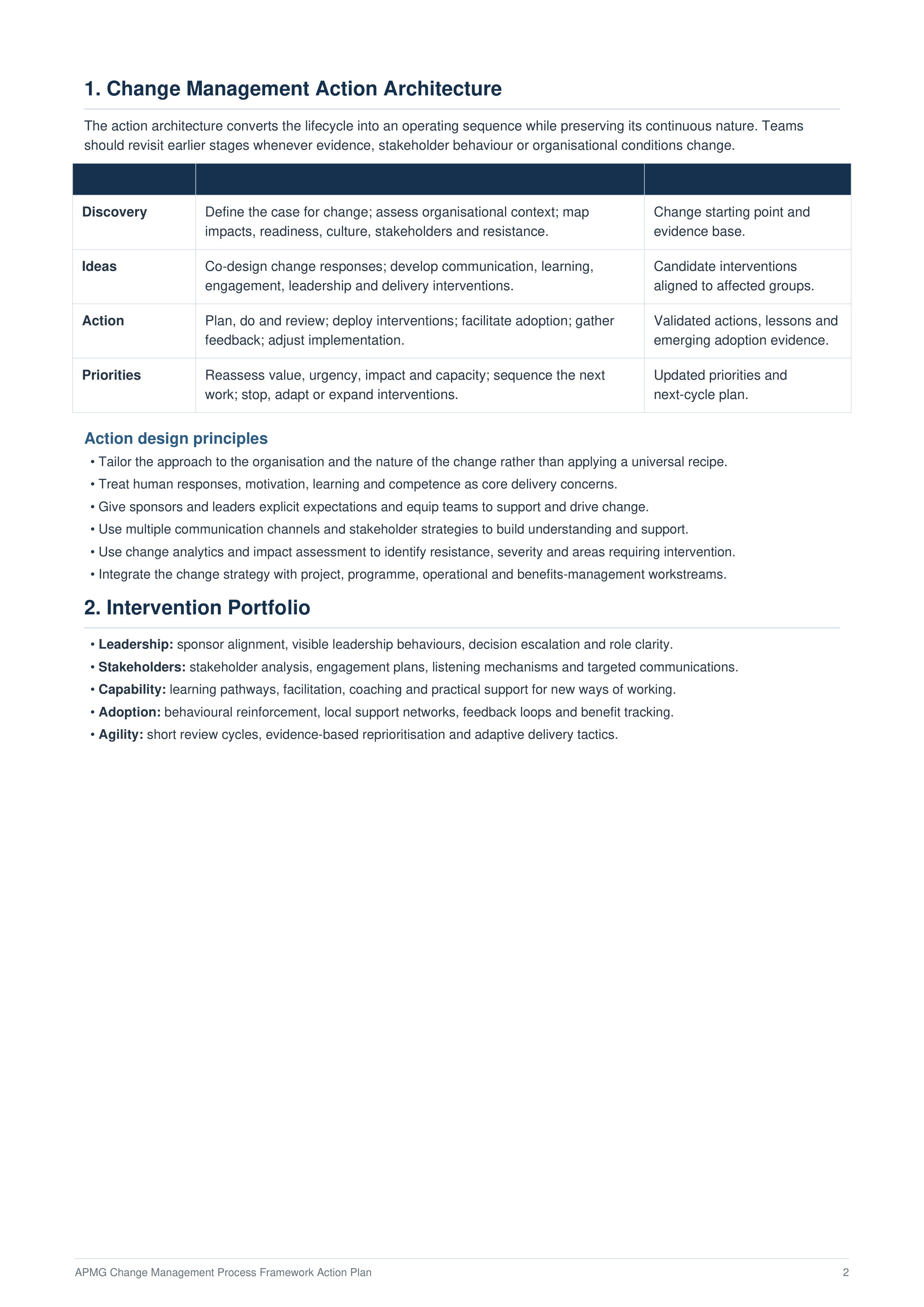
The action architecture converts the lifecycle into an operating sequence while preserving its continuous nature. Teams
should revisit earlier stages whenever evidence, stakeholder behaviour or organisational conditions change.
Stage
Primary actions
Decision output
Discovery
Define the case for change; assess organisational context; map
impacts, readiness, culture, stakeholders and resistance.
Change starting point and
evidence base.
Ideas
Co-design change responses; develop communication, learning,
engagement, leadership and delivery interventions.
Candidate interventions
aligned to affected groups.
Action
Plan, do and review; deploy interventions; facilitate adoption; gather
feedback; adjust implementation.
Validated actions, lessons and
emerging adoption evidence.
Priorities
Reassess value, urgency, impact and capacity; sequence the next
work; stop, adapt or expand interventions.
Updated priorities and
next-cycle plan.
Action design principles
• Tailor the approach to the organisation and the nature of the change rather than applying a universal recipe.
• Treat human responses, motivation, learning and competence as core delivery concerns.
• Give sponsors and leaders explicit expectations and equip teams to support and drive change.
• Use multiple communication channels and stakeholder strategies to build understanding and support.
• Use change analytics and impact assessment to identify resistance, severity and areas requiring intervention.
• Integrate the change strategy with project, programme, operational and benefits-management workstreams.
2. Intervention Portfolio
•
Leadership:
sponsor alignment, visible leadership behaviours, decision escalation and role clarity.
•
Stakeholders:
stakeholder analysis, engagement plans, listening mechanisms and targeted communications.
•
Capability:
learning pathways, facilitation, coaching and practical support for new ways of working.
•
Adoption:
behavioural reinforcement, local support networks, feedback loops and benefit tracking.
•
Agility:
short review cycles, evidence-based reprioritisation and adaptive delivery tactics.
APMG Change Management Process Framework Action Plan
3
3. Governance and Accountability
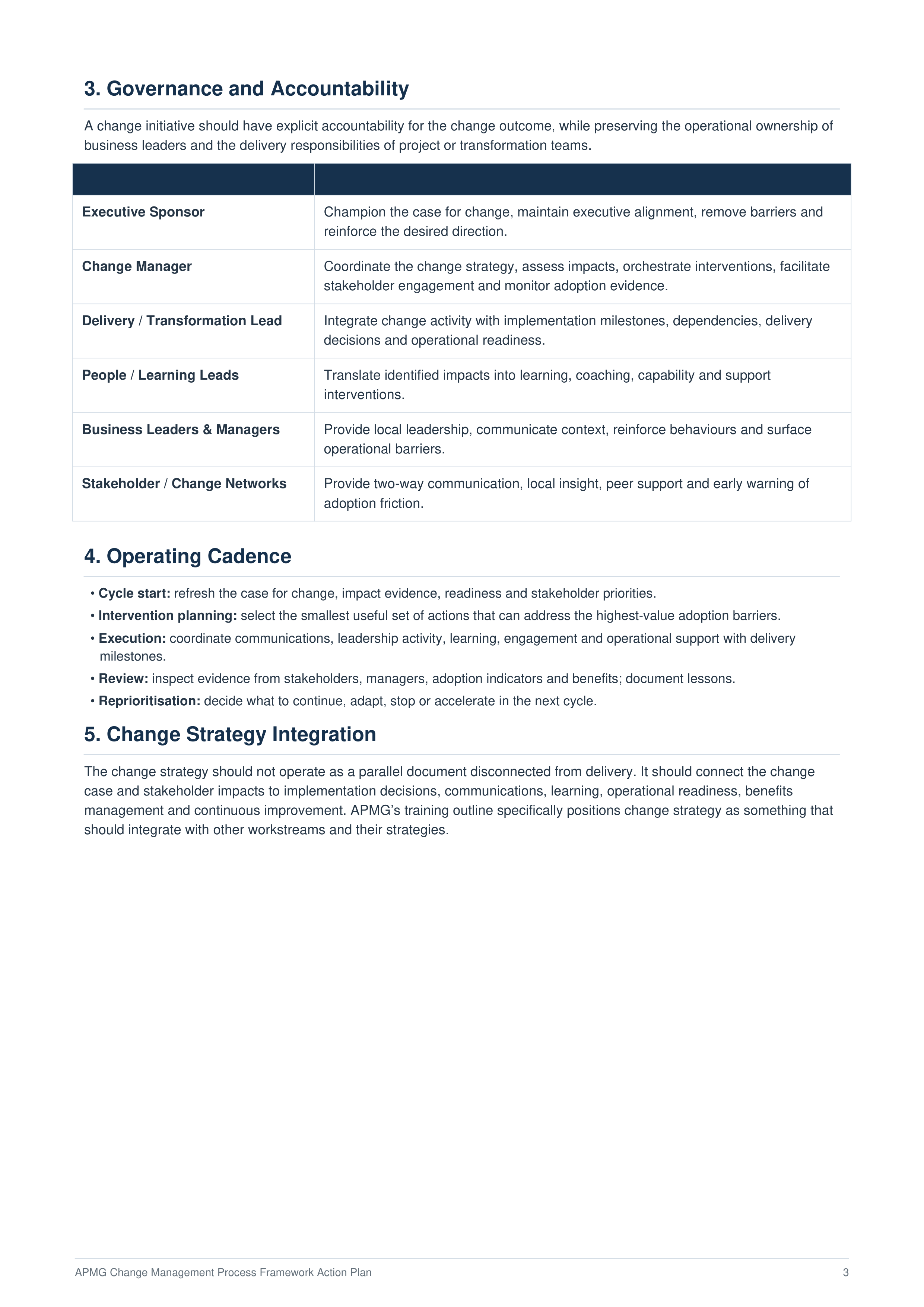
A change initiative should have explicit accountability for the change outcome, while preserving the operational ownership of
business leaders and the delivery responsibilities of project or transformation teams.
Role
Accountability
Executive Sponsor
Champion the case for change, maintain executive alignment, remove barriers and
reinforce the desired direction.
Change Manager
Coordinate the change strategy, assess impacts, orchestrate interventions, facilitate
stakeholder engagement and monitor adoption evidence.
Delivery / Transformation Lead
Integrate change activity with implementation milestones, dependencies, delivery
decisions and operational readiness.
People / Learning Leads
Translate identified impacts into learning, coaching, capability and support
interventions.
Business Leaders & Managers
Provide local leadership, communicate context, reinforce behaviours and surface
operational barriers.
Stakeholder / Change Networks
Provide two-way communication, local insight, peer support and early warning of
adoption friction.
4. Operating Cadence
•
Cycle start:
refresh the case for change, impact evidence, readiness and stakeholder priorities.
•
Intervention planning:
select the smallest useful set of actions that can address the highest-value adoption barriers.
•
Execution:
coordinate communications, leadership activity, learning, engagement and operational support with delivery
milestones.
•
Review:
inspect evidence from stakeholders, managers, adoption indicators and benefits; document lessons.
•
Reprioritisation:
decide what to continue, adapt, stop or accelerate in the next cycle.
5. Change Strategy Integration
The change strategy should not operate as a parallel document disconnected from delivery. It should connect the change
case and stakeholder impacts to implementation decisions, communications, learning, operational readiness, benefits
management and continuous improvement. APMG’s training outline specifically positions change strategy as something that
should integrate with other workstreams and their strategies.
APMG Change Management Process Framework Action Plan
4
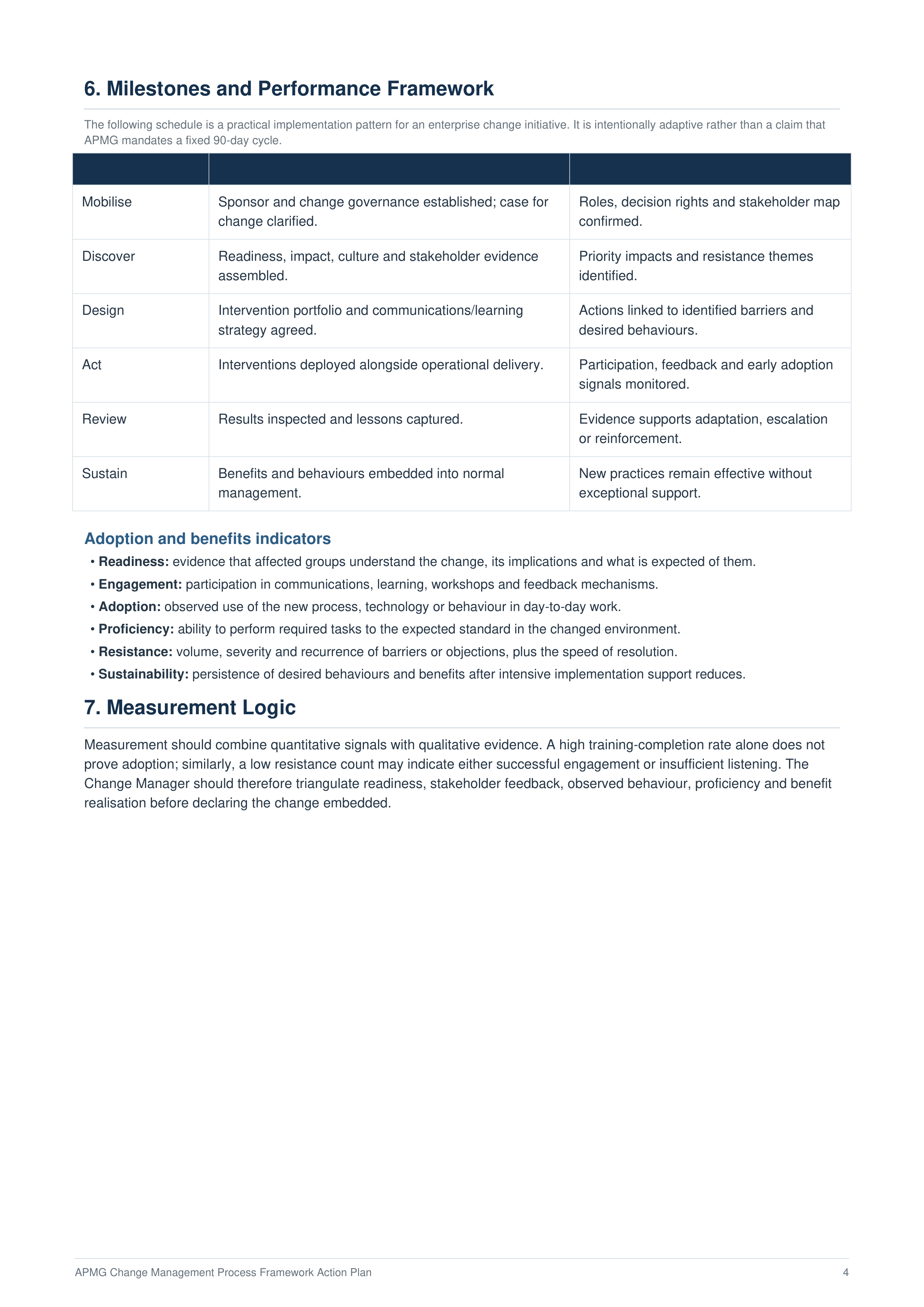
6. Milestones and Performance Framework
The following schedule is a practical implementation pattern for an enterprise change initiative. It is intentionally adaptive rather than a claim that
APMG mandates a fixed 90-day cycle.
Phase
Key milestone
Evidence of progress
Mobilise
Sponsor and change governance established; case for
change clarified.
Roles, decision rights and stakeholder map
confirmed.
Discover
Readiness, impact, culture and stakeholder evidence
assembled.
Priority impacts and resistance themes
identified.
Design
Intervention portfolio and communications/learning
strategy agreed.
Actions linked to identified barriers and
desired behaviours.
Act
Interventions deployed alongside operational delivery.
Participation, feedback and early adoption
signals monitored.
Review
Results inspected and lessons captured.
Evidence supports adaptation, escalation
or reinforcement.
Sustain
Benefits and behaviours embedded into normal
management.
New practices remain effective without
exceptional support.
Adoption and benefits indicators
•
Readiness:
evidence that affected groups understand the change, its implications and what is expected of them.
•
Engagement:
participation in communications, learning, workshops and feedback mechanisms.
•
Adoption:
observed use of the new process, technology or behaviour in day-to-day work.
•
Proficiency:
ability to perform required tasks to the expected standard in the changed environment.
•
Resistance:
volume, severity and recurrence of barriers or objections, plus the speed of resolution.
•
Sustainability:
persistence of desired behaviours and benefits after intensive implementation support reduces.
7. Measurement Logic
Measurement should combine quantitative signals with qualitative evidence. A high training-completion rate alone does not
prove adoption; similarly, a low resistance count may indicate either successful engagement or insufficient listening. The
Change Manager should therefore triangulate readiness, stakeholder feedback, observed behaviour, proficiency and benefit
realisation before declaring the change embedded.
APMG Change Management Process Framework Action Plan
5
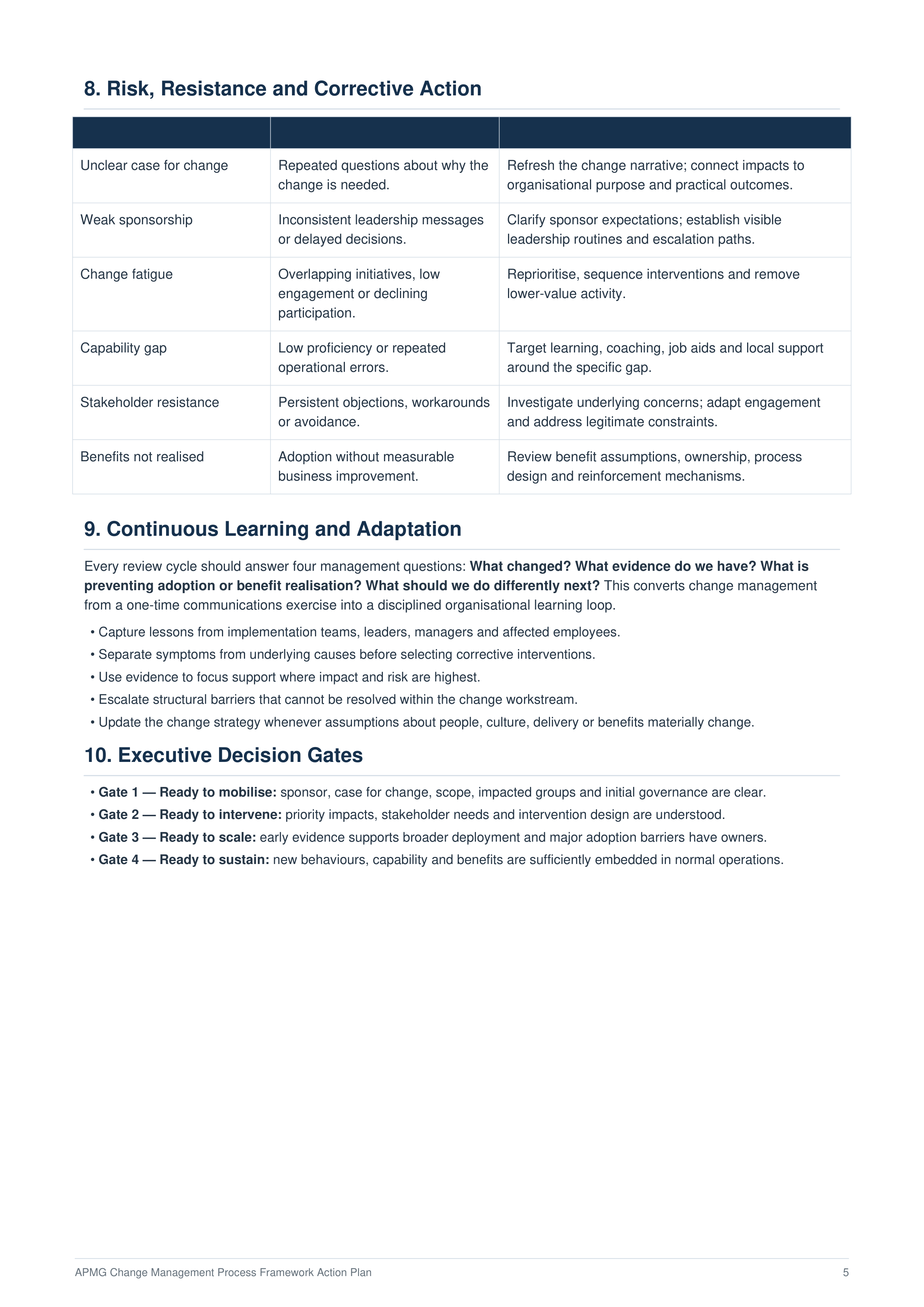
8. Risk, Resistance and Corrective Action
Risk / barrier
Early signal
Corrective action
Unclear case for change
Repeated questions about why the
change is needed.
Refresh the change narrative; connect impacts to
organisational purpose and practical outcomes.
Weak sponsorship
Inconsistent leadership messages
or delayed decisions.
Clarify sponsor expectations; establish visible
leadership routines and escalation paths.
Change fatigue
Overlapping initiatives, low
engagement or declining
participation.
Reprioritise, sequence interventions and remove
lower-value activity.
Capability gap
Low proficiency or repeated
operational errors.
Target learning, coaching, job aids and local support
around the specific gap.
Stakeholder resistance
Persistent objections, workarounds
or avoidance.
Investigate underlying concerns; adapt engagement
and address legitimate constraints.
Benefits not realised
Adoption without measurable
business improvement.
Review benefit assumptions, ownership, process
design and reinforcement mechanisms.
9. Continuous Learning and Adaptation
Every review cycle should answer four management questions:
What changed?
What evidence do we have?
What is
preventing adoption or benefit realisation?
What should we do differently next?
This converts change management
from a one-time communications exercise into a disciplined organisational learning loop.
• Capture lessons from implementation teams, leaders, managers and affected employees.
• Separate symptoms from underlying causes before selecting corrective interventions.
• Use evidence to focus support where impact and risk are highest.
• Escalate structural barriers that cannot be resolved within the change workstream.
• Update the change strategy whenever assumptions about people, culture, delivery or benefits materially change.
10. Executive Decision Gates
•
Gate 1 — Ready to mobilise:
sponsor, case for change, scope, impacted groups and initial governance are clear.
•
Gate 2 — Ready to intervene:
priority impacts, stakeholder needs and intervention design are understood.
•
Gate 3 — Ready to scale:
early evidence supports broader deployment and major adoption barriers have owners.
•
Gate 4 — Ready to sustain:
new behaviours, capability and benefits are sufficiently embedded in normal operations.
APMG Change Management Process Framework Action Plan
6
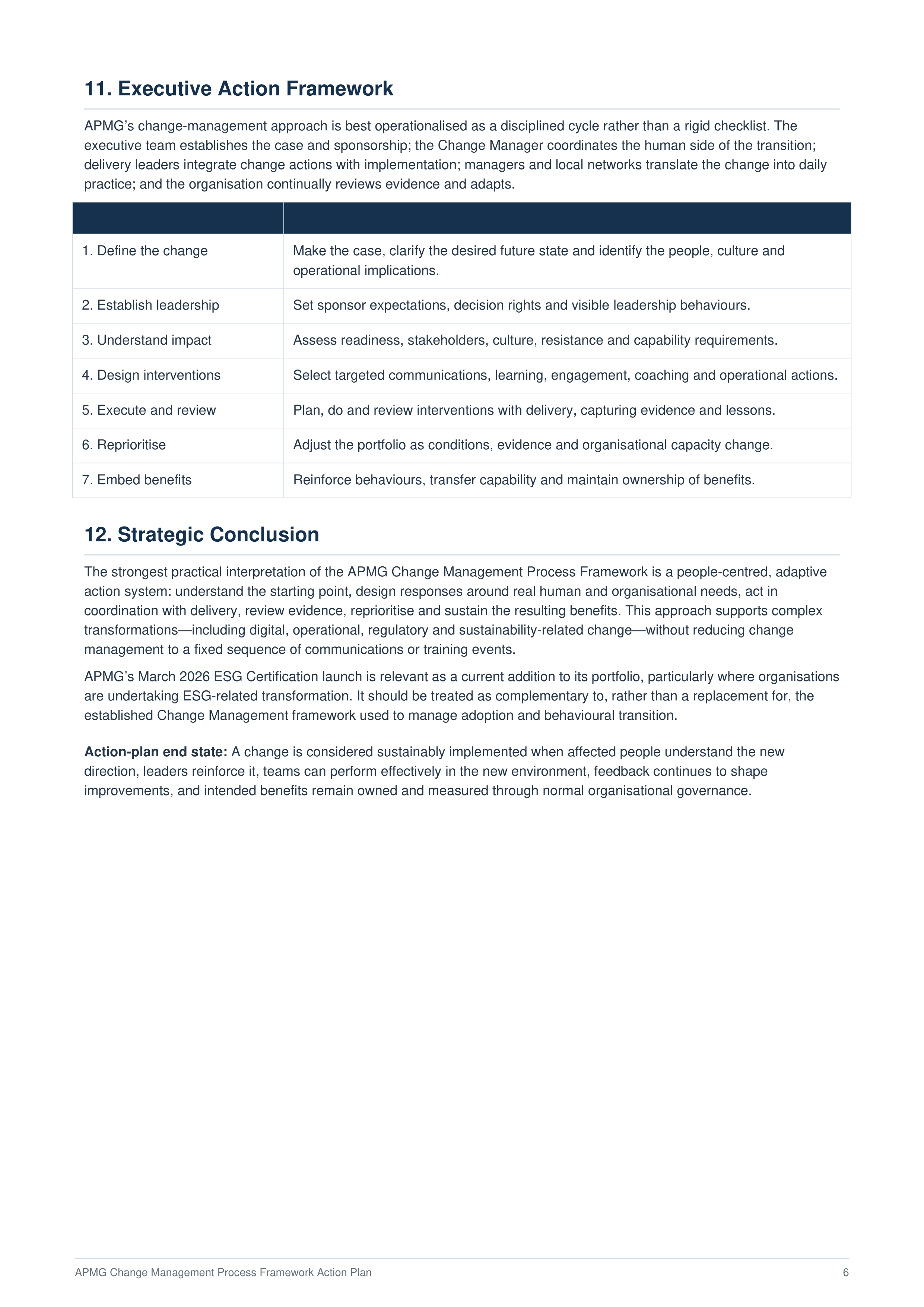
11. Executive Action Framework
APMG’s change-management approach is best operationalised as a disciplined cycle rather than a rigid checklist. The
executive team establishes the case and sponsorship; the Change Manager coordinates the human side of the transition;
delivery leaders integrate change actions with implementation; managers and local networks translate the change into daily
practice; and the organisation continually reviews evidence and adapts.
Executive action
Management expectation
1. Define the change
Make the case, clarify the desired future state and identify the people, culture and
operational implications.
2. Establish leadership
Set sponsor expectations, decision rights and visible leadership behaviours.
3. Understand impact
Assess readiness, stakeholders, culture, resistance and capability requirements.
4. Design interventions
Select targeted communications, learning, engagement, coaching and operational actions.
5. Execute and review
Plan, do and review interventions with delivery, capturing evidence and lessons.
6. Reprioritise
Adjust the portfolio as conditions, evidence and organisational capacity change.
7. Embed benefits
Reinforce behaviours, transfer capability and maintain ownership of benefits.
12. Strategic Conclusion
The strongest practical interpretation of the APMG Change Management Process Framework is a people-centred, adaptive
action system: understand the starting point, design responses around real human and organisational needs, act in
coordination with delivery, review evidence, reprioritise and sustain the resulting benefits. This approach supports complex
transformations—including digital, operational, regulatory and sustainability-related change—without reducing change
management to a fixed sequence of communications or training events.
APMG’s March 2026 ESG Certification launch is relevant as a current addition to its portfolio, particularly where organisations
are undertaking ESG-related transformation. It should be treated as complementary to, rather than a replacement for, the
established Change Management framework used to manage adoption and behavioural transition.
Action-plan end state:
A change is considered sustainably implemented when affected people understand the new
direction, leaders reinforce it, teams can perform effectively in the new environment, feedback continues to shape
improvements, and intended benefits remain owned and measured through normal organisational governance.