WORLD HEALTH ORGANIZATION | GLOBAL ACTION PLAN ON AMR
Research-based synthesized Action Plan • Current through September 2026 • Not an official WHO publication
Page 1
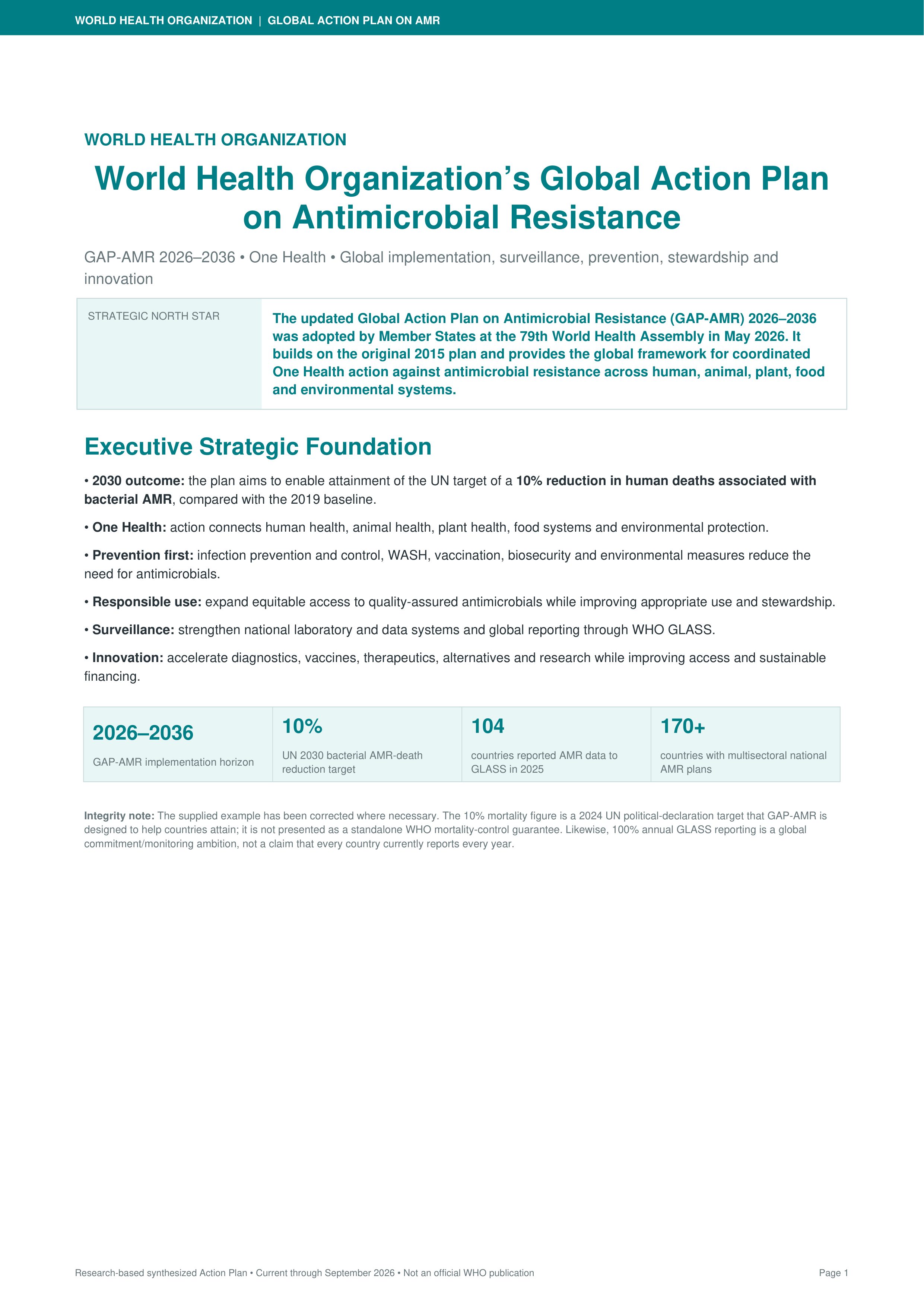
WORLD HEALTH ORGANIZATION
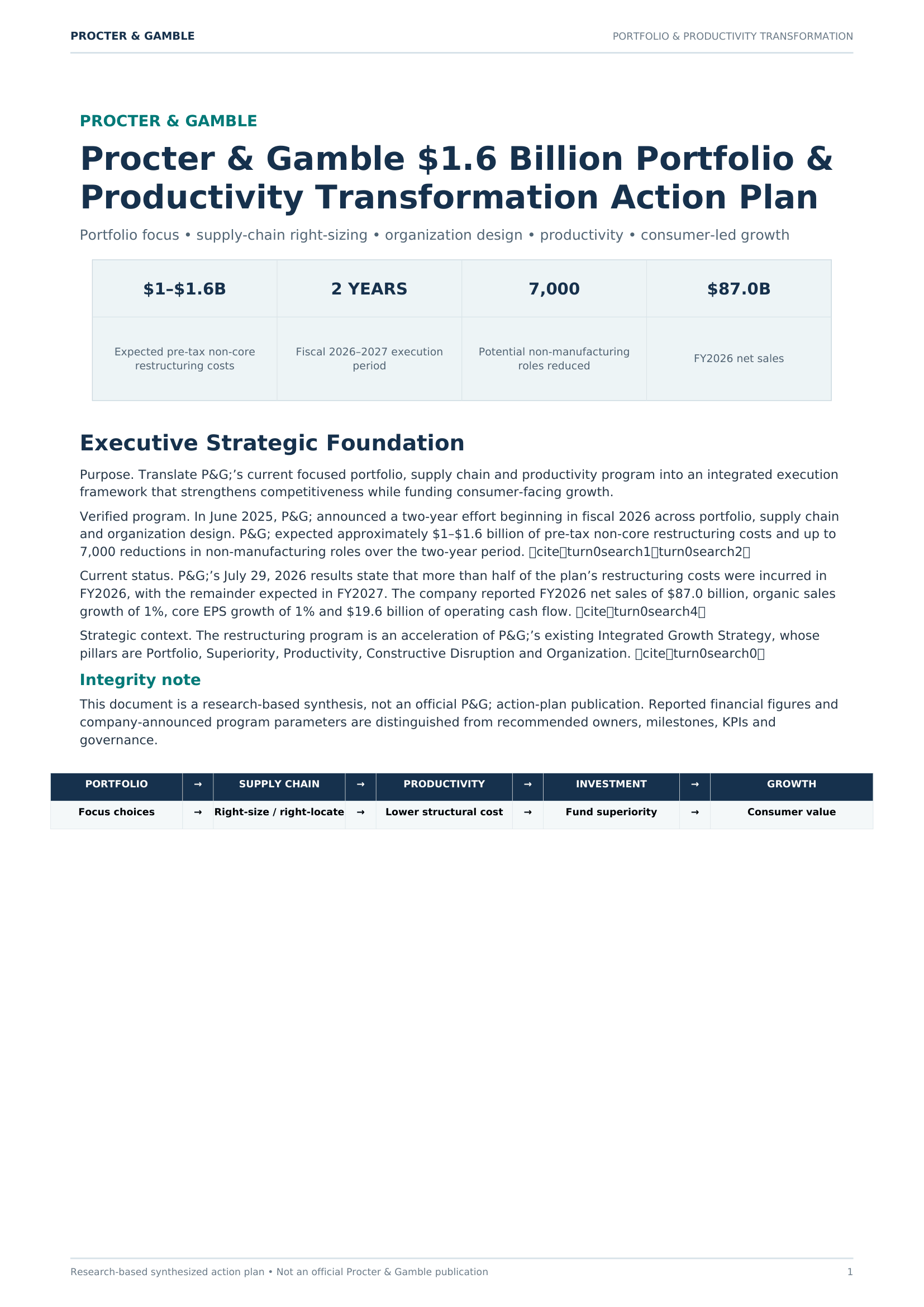
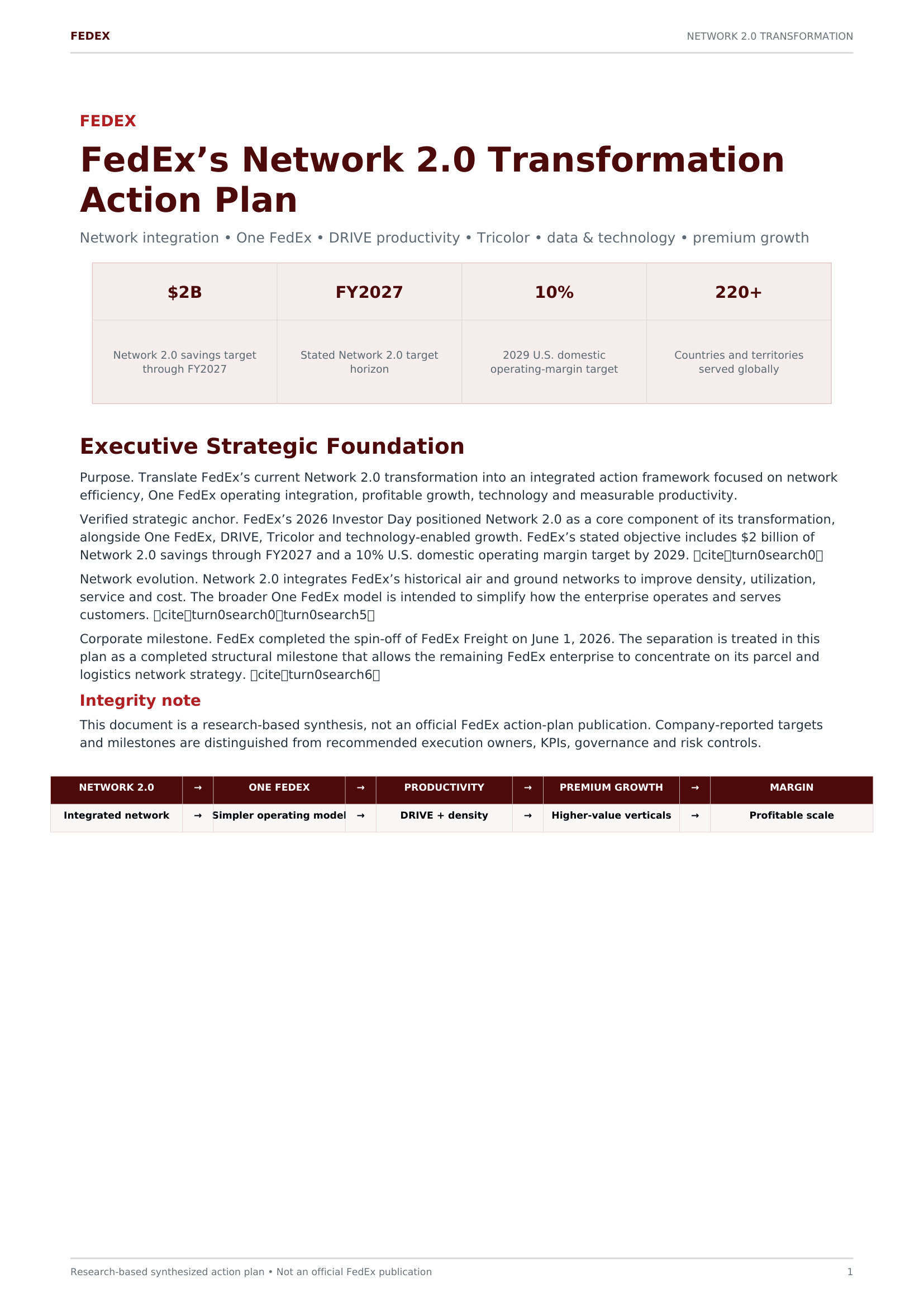
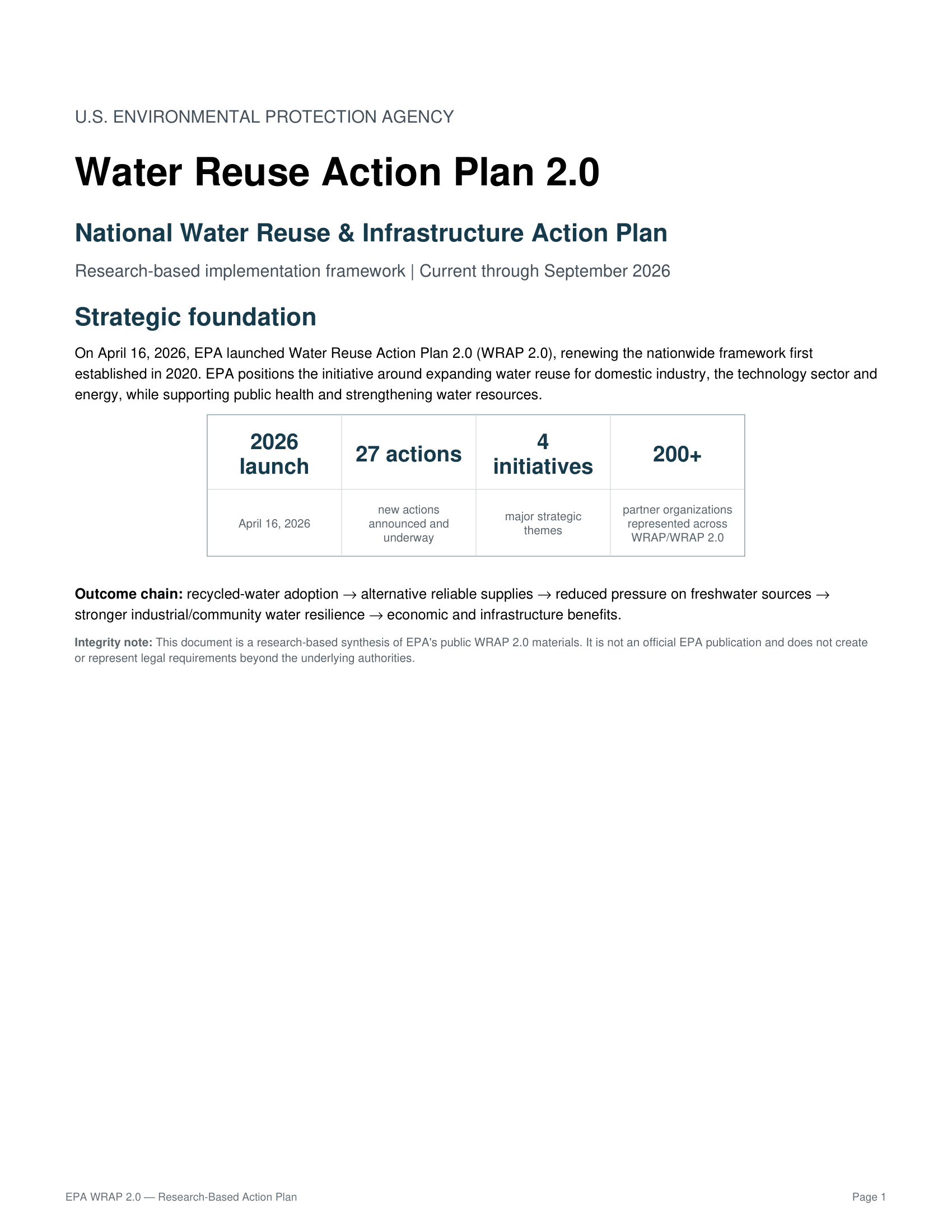
World Health Organization’s Global Action Plan
on Antimicrobial Resistance
GAP-AMR 2026–2036 • One Health • Global implementation, surveillance, prevention, stewardship and
innovation
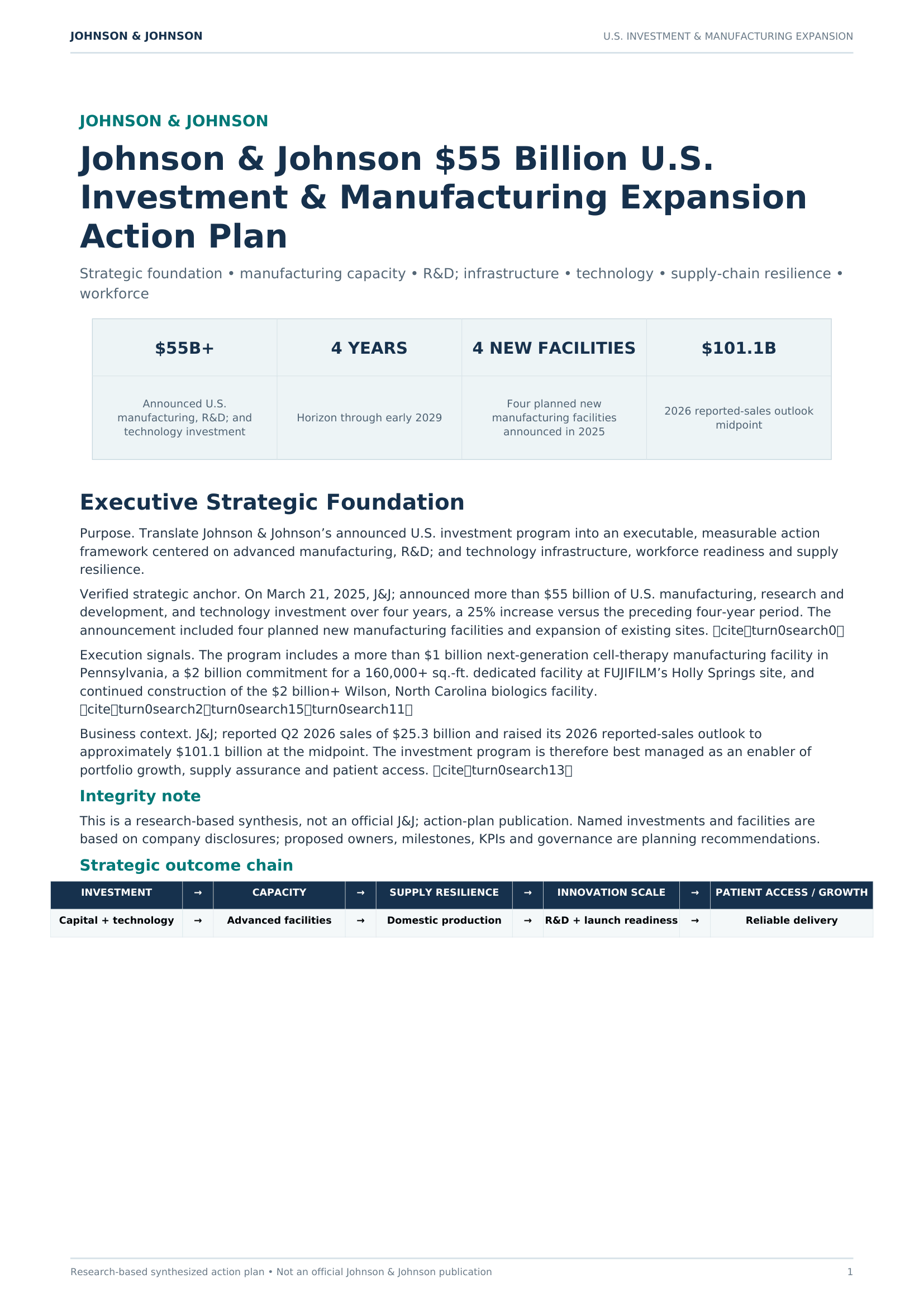
STRATEGIC NORTH STAR
The updated Global Action Plan on Antimicrobial Resistance (GAP-AMR) 2026–2036
was adopted by Member States at the 79th World Health Assembly in May 2026. It
builds on the original 2015 plan and provides the global framework for coordinated
One Health action against antimicrobial resistance across human, animal, plant, food
and environmental systems.
Executive Strategic Foundation
•
2030 outcome:
the plan aims to enable attainment of the UN target of a
10% reduction in human deaths associated with
bacterial AMR
, compared with the 2019 baseline.
•
One Health:
action connects human health, animal health, plant health, food systems and environmental protection.
•
Prevention first:
infection prevention and control, WASH, vaccination, biosecurity and environmental measures reduce the
need for antimicrobials.
•
Responsible use:
expand equitable access to quality-assured antimicrobials while improving appropriate use and stewardship.
•
Surveillance:
strengthen national laboratory and data systems and global reporting through WHO GLASS.
•
Innovation:
accelerate diagnostics, vaccines, therapeutics, alternatives and research while improving access and sustainable
financing.
2026–2036
GAP-AMR implementation horizon
10%
UN 2030 bacterial AMR-death
reduction target
104
countries reported AMR data to
GLASS in 2025
170+
countries with multisectoral national
AMR plans
Integrity note:
The supplied example has been corrected where necessary. The 10% mortality figure is a 2024 UN political-declaration target that GAP-AMR is
designed to help countries attain; it is not presented as a standalone WHO mortality-control guarantee. Likewise, 100% annual GLASS reporting is a global
commitment/monitoring ambition, not a claim that every country currently reports every year.
WORLD HEALTH ORGANIZATION | GLOBAL ACTION PLAN ON AMR
Research-based synthesized Action Plan • Current through September 2026 • Not an official WHO publication
Page 2
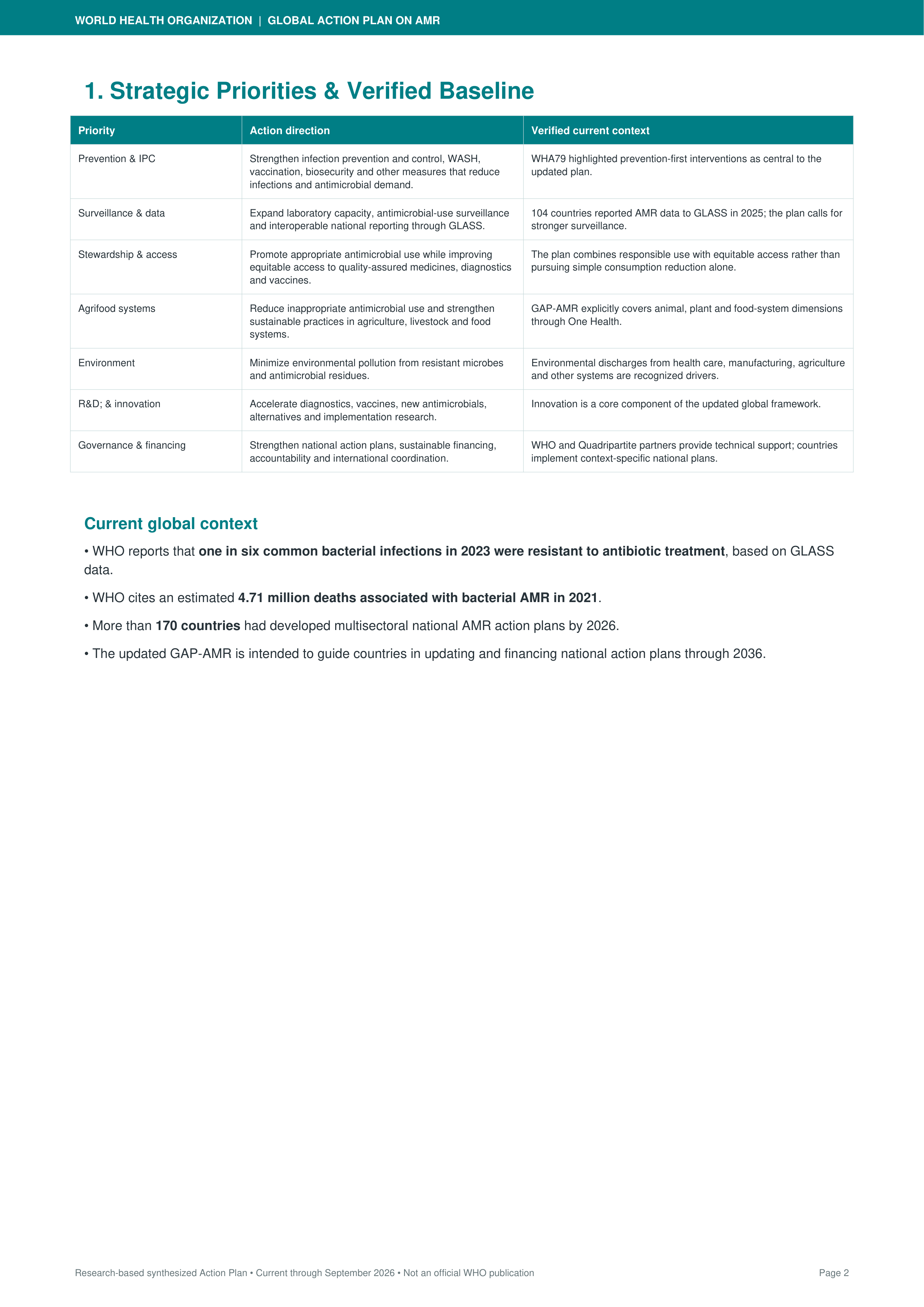
1. Strategic Priorities & Verified Baseline
Priority
Action direction
Verified current context
Prevention & IPC
Strengthen infection prevention and control, WASH,
vaccination, biosecurity and other measures that reduce
infections and antimicrobial demand.
WHA79 highlighted prevention-first interventions as central to the
updated plan.
Surveillance & data
Expand laboratory capacity, antimicrobial-use surveillance
and interoperable national reporting through GLASS.
104 countries reported AMR data to GLASS in 2025; the plan calls for
stronger surveillance.
Stewardship & access
Promote appropriate antimicrobial use while improving
equitable access to quality-assured medicines, diagnostics
and vaccines.
The plan combines responsible use with equitable access rather than
pursuing simple consumption reduction alone.
Agrifood systems
Reduce inappropriate antimicrobial use and strengthen
sustainable practices in agriculture, livestock and food
systems.
GAP-AMR explicitly covers animal, plant and food-system dimensions
through One Health.
Environment
Minimize environmental pollution from resistant microbes
and antimicrobial residues.
Environmental discharges from health care, manufacturing, agriculture
and other systems are recognized drivers.
R&D; & innovation
Accelerate diagnostics, vaccines, new antimicrobials,
alternatives and implementation research.
Innovation is a core component of the updated global framework.
Governance & financing
Strengthen national action plans, sustainable financing,
accountability and international coordination.
WHO and Quadripartite partners provide technical support; countries
implement context-specific national plans.
Current global context
• WHO reports that
one in six common bacterial infections in 2023 were resistant to antibiotic treatment
, based on GLASS
data.
• WHO cites an estimated
4.71 million deaths associated with bacterial AMR in 2021
.
• More than
170 countries
had developed multisectoral national AMR action plans by 2026.
• The updated GAP-AMR is intended to guide countries in updating and financing national action plans through 2036.
WORLD HEALTH ORGANIZATION | GLOBAL ACTION PLAN ON AMR
Research-based synthesized Action Plan • Current through September 2026 • Not an official WHO publication
Page 3
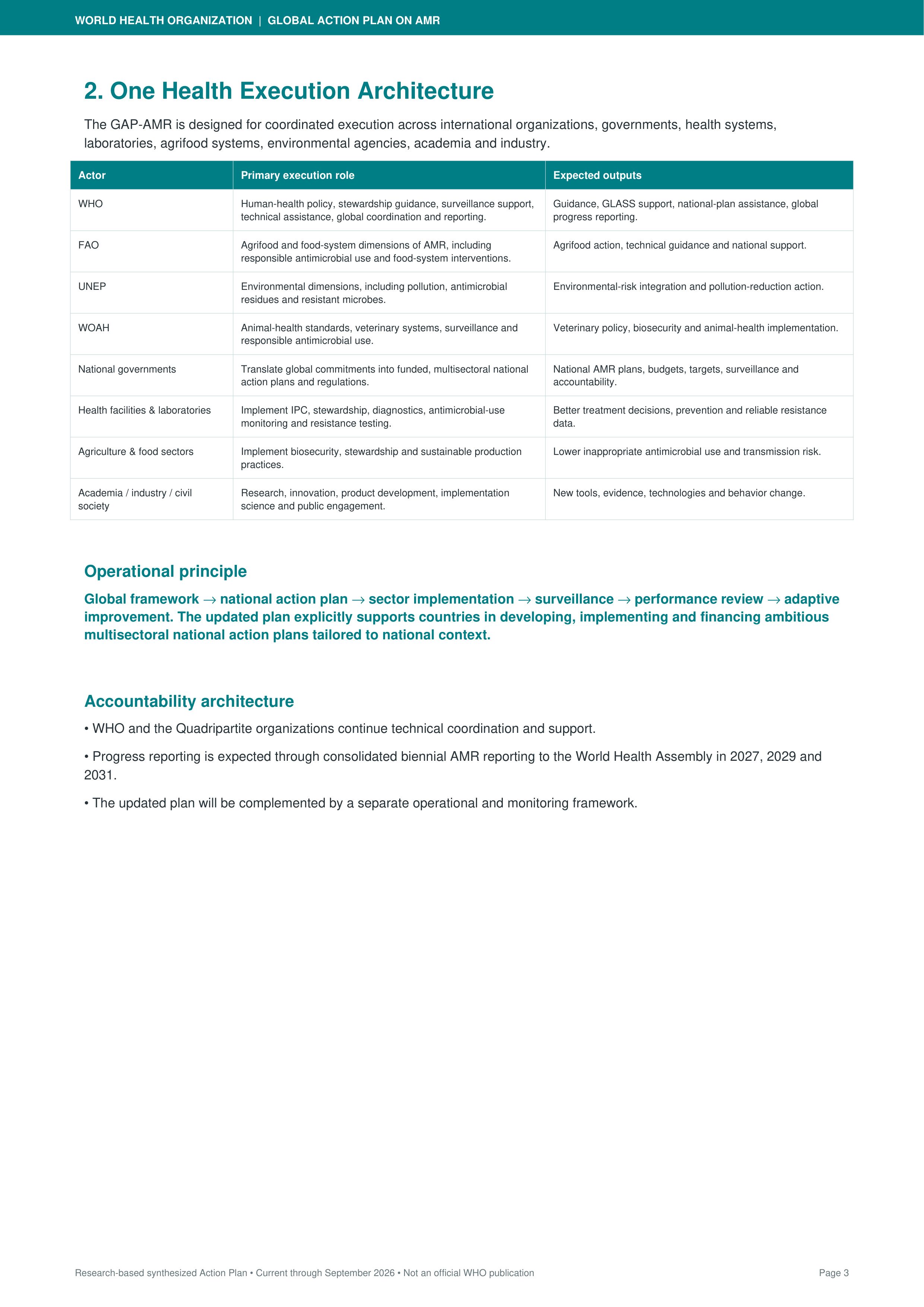
2. One Health Execution Architecture
The GAP-AMR is designed for coordinated execution across international organizations, governments, health systems,
laboratories, agrifood systems, environmental agencies, academia and industry.
Actor
Primary execution role
Expected outputs
WHO
Human-health policy, stewardship guidance, surveillance support,
technical assistance, global coordination and reporting.
Guidance, GLASS support, national-plan assistance, global
progress reporting.
FAO
Agrifood and food-system dimensions of AMR, including
responsible antimicrobial use and food-system interventions.
Agrifood action, technical guidance and national support.
UNEP
Environmental dimensions, including pollution, antimicrobial
residues and resistant microbes.
Environmental-risk integration and pollution-reduction action.
WOAH
Animal-health standards, veterinary systems, surveillance and
responsible antimicrobial use.
Veterinary policy, biosecurity and animal-health implementation.
National governments
Translate global commitments into funded, multisectoral national
action plans and regulations.
National AMR plans, budgets, targets, surveillance and
accountability.
Health facilities & laboratories
Implement IPC, stewardship, diagnostics, antimicrobial-use
monitoring and resistance testing.
Better treatment decisions, prevention and reliable resistance
data.
Agriculture & food sectors
Implement biosecurity, stewardship and sustainable production
practices.
Lower inappropriate antimicrobial use and transmission risk.
Academia / industry / civil
society
Research, innovation, product development, implementation
science and public engagement.
New tools, evidence, technologies and behavior change.
Operational principle
Global framework
→
national action plan
→
sector implementation
→
surveillance
→
performance review
→
adaptive
improvement. The updated plan explicitly supports countries in developing, implementing and financing ambitious
multisectoral national action plans tailored to national context.
Accountability architecture
• WHO and the Quadripartite organizations continue technical coordination and support.
• Progress reporting is expected through consolidated biennial AMR reporting to the World Health Assembly in 2027, 2029 and
2031.
• The updated plan will be complemented by a separate operational and monitoring framework.
WORLD HEALTH ORGANIZATION | GLOBAL ACTION PLAN ON AMR
Research-based synthesized Action Plan • Current through September 2026 • Not an official WHO publication
Page 4
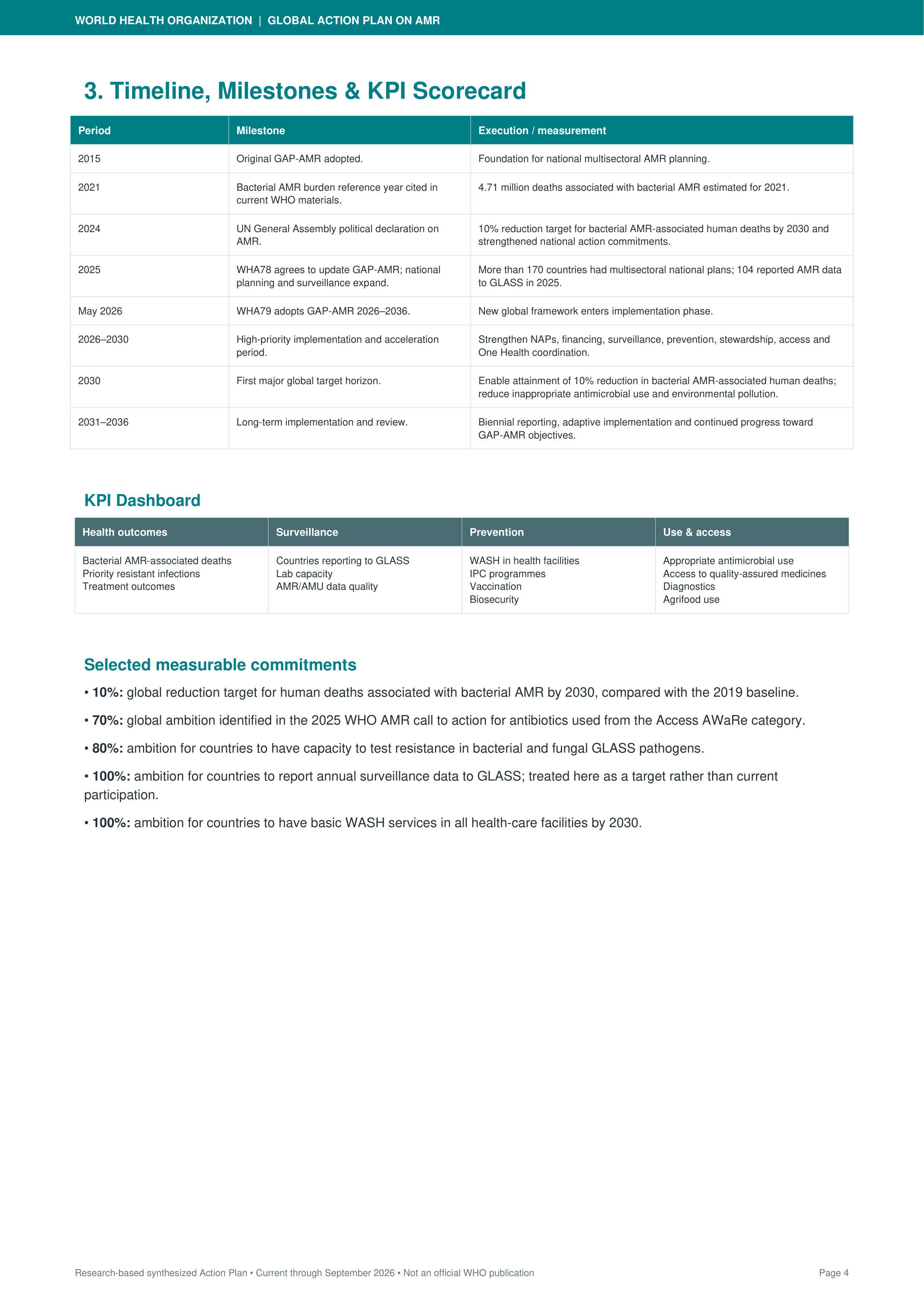
3. Timeline, Milestones & KPI Scorecard
Period
Milestone
Execution / measurement
2015
Original GAP-AMR adopted.
Foundation for national multisectoral AMR planning.
2021
Bacterial AMR burden reference year cited in
current WHO materials.
4.71 million deaths associated with bacterial AMR estimated for 2021.
2024
UN General Assembly political declaration on
AMR.
10% reduction target for bacterial AMR-associated human deaths by 2030 and
strengthened national action commitments.
2025
WHA78 agrees to update GAP-AMR; national
planning and surveillance expand.
More than 170 countries had multisectoral national plans; 104 reported AMR data
to GLASS in 2025.
May 2026
WHA79 adopts GAP-AMR 2026–2036.
New global framework enters implementation phase.
2026–2030
High-priority implementation and acceleration
period.
Strengthen NAPs, financing, surveillance, prevention, stewardship, access and
One Health coordination.
2030
First major global target horizon.
Enable attainment of 10% reduction in bacterial AMR-associated human deaths;
reduce inappropriate antimicrobial use and environmental pollution.
2031–2036
Long-term implementation and review.
Biennial reporting, adaptive implementation and continued progress toward
GAP-AMR objectives.
KPI Dashboard
Health outcomes
Surveillance
Prevention
Use & access
Bacterial AMR-associated deaths
Priority resistant infections
Treatment outcomes
Countries reporting to GLASS
Lab capacity
AMR/AMU data quality
WASH in health facilities
IPC programmes
Vaccination
Biosecurity
Appropriate antimicrobial use
Access to quality-assured medicines
Diagnostics
Agrifood use
Selected measurable commitments
•
10%:
global reduction target for human deaths associated with bacterial AMR by 2030, compared with the 2019 baseline.
•
70%:
global ambition identified in the 2025 WHO AMR call to action for antibiotics used from the Access AWaRe category.
•
80%:
ambition for countries to have capacity to test resistance in bacterial and fungal GLASS pathogens.
•
100%:
ambition for countries to report annual surveillance data to GLASS; treated here as a target rather than current
participation.
•
100%:
ambition for countries to have basic WASH services in all health-care facilities by 2030.
WORLD HEALTH ORGANIZATION | GLOBAL ACTION PLAN ON AMR
Research-based synthesized Action Plan • Current through September 2026 • Not an official WHO publication
Page 5
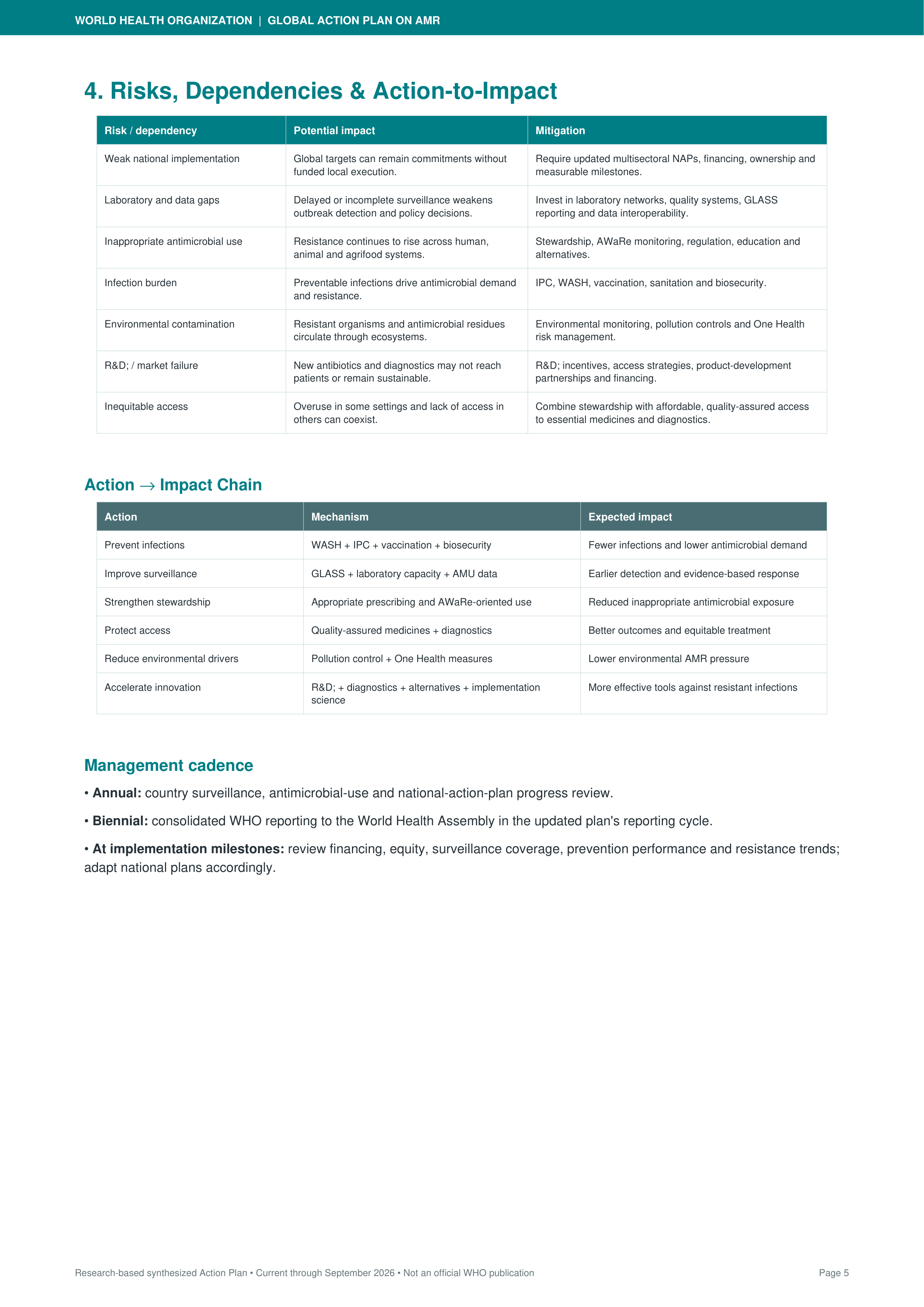
4. Risks, Dependencies & Action-to-Impact
Risk / dependency
Potential impact
Mitigation
Weak national implementation
Global targets can remain commitments without
funded local execution.
Require updated multisectoral NAPs, financing, ownership and
measurable milestones.
Laboratory and data gaps
Delayed or incomplete surveillance weakens
outbreak detection and policy decisions.
Invest in laboratory networks, quality systems, GLASS
reporting and data interoperability.
Inappropriate antimicrobial use
Resistance continues to rise across human,
animal and agrifood systems.
Stewardship, AWaRe monitoring, regulation, education and
alternatives.
Infection burden
Preventable infections drive antimicrobial demand
and resistance.
IPC, WASH, vaccination, sanitation and biosecurity.
Environmental contamination
Resistant organisms and antimicrobial residues
circulate through ecosystems.
Environmental monitoring, pollution controls and One Health
risk management.
R&D; / market failure
New antibiotics and diagnostics may not reach
patients or remain sustainable.
R&D; incentives, access strategies, product-development
partnerships and financing.
Inequitable access
Overuse in some settings and lack of access in
others can coexist.
Combine stewardship with affordable, quality-assured access
to essential medicines and diagnostics.
Action
→
Impact Chain
Action
Mechanism
Expected impact
Prevent infections
WASH + IPC + vaccination + biosecurity
Fewer infections and lower antimicrobial demand
Improve surveillance
GLASS + laboratory capacity + AMU data
Earlier detection and evidence-based response
Strengthen stewardship
Appropriate prescribing and AWaRe-oriented use
Reduced inappropriate antimicrobial exposure
Protect access
Quality-assured medicines + diagnostics
Better outcomes and equitable treatment
Reduce environmental drivers
Pollution control + One Health measures
Lower environmental AMR pressure
Accelerate innovation
R&D; + diagnostics + alternatives + implementation
science
More effective tools against resistant infections
Management cadence
•
Annual:
country surveillance, antimicrobial-use and national-action-plan progress review.
•
Biennial:
consolidated WHO reporting to the World Health Assembly in the updated plan's reporting cycle.
•
At implementation milestones:
review financing, equity, surveillance coverage, prevention performance and resistance trends;
adapt national plans accordingly.
WORLD HEALTH ORGANIZATION | GLOBAL ACTION PLAN ON AMR
Research-based synthesized Action Plan • Current through September 2026 • Not an official WHO publication
Page 6
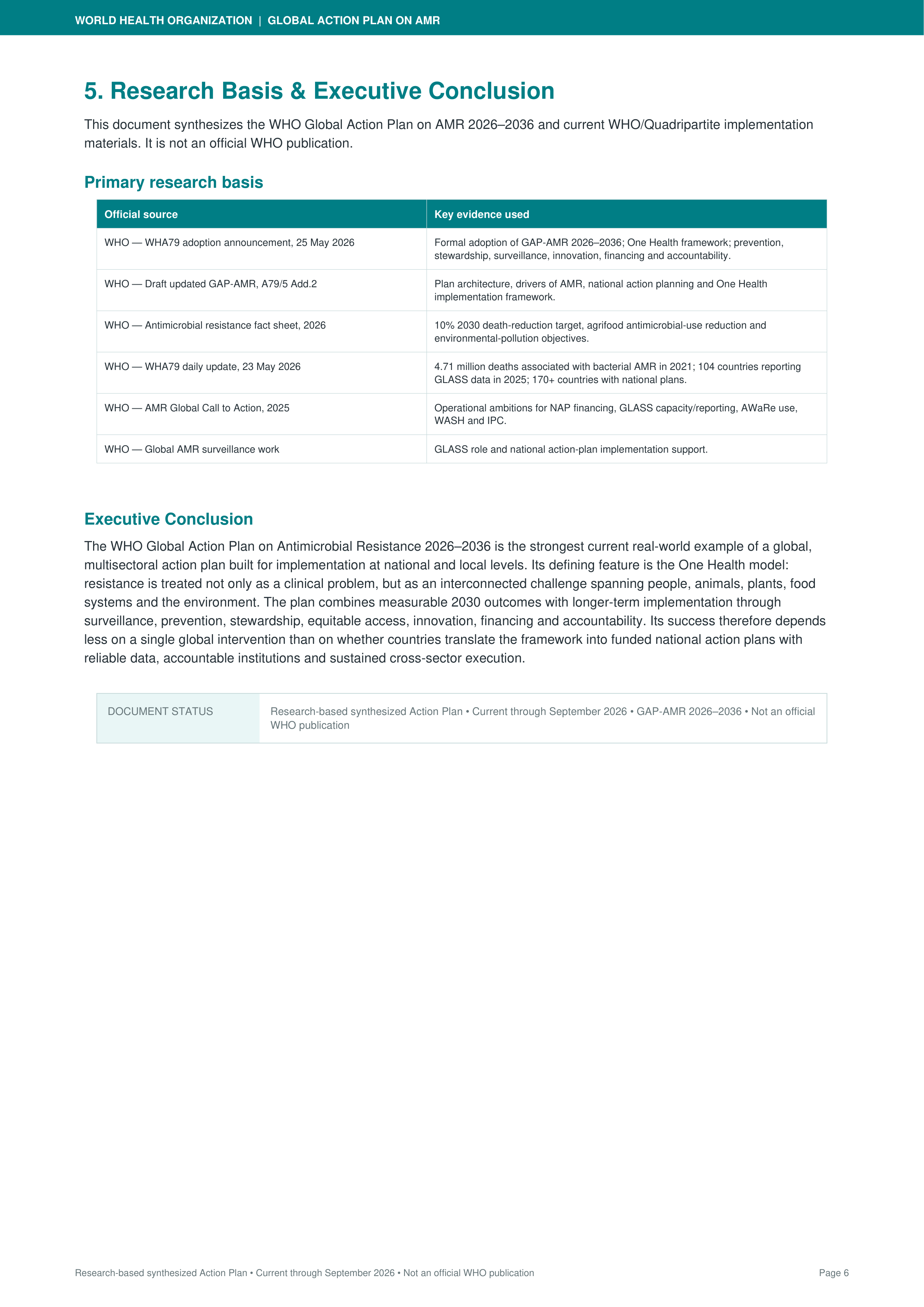
5. Research Basis & Executive Conclusion
This document synthesizes the WHO Global Action Plan on AMR 2026–2036 and current WHO/Quadripartite implementation
materials. It is not an official WHO publication.
Primary research basis
Official source
Key evidence used
WHO — WHA79 adoption announcement, 25 May 2026
Formal adoption of GAP-AMR 2026–2036; One Health framework; prevention,
stewardship, surveillance, innovation, financing and accountability.
WHO — Draft updated GAP-AMR, A79/5 Add.2
Plan architecture, drivers of AMR, national action planning and One Health
implementation framework.
WHO — Antimicrobial resistance fact sheet, 2026
10% 2030 death-reduction target, agrifood antimicrobial-use reduction and
environmental-pollution objectives.
WHO — WHA79 daily update, 23 May 2026
4.71 million deaths associated with bacterial AMR in 2021; 104 countries reporting
GLASS data in 2025; 170+ countries with national plans.
WHO — AMR Global Call to Action, 2025
Operational ambitions for NAP financing, GLASS capacity/reporting, AWaRe use,
WASH and IPC.
WHO — Global AMR surveillance work
GLASS role and national action-plan implementation support.
Executive Conclusion
The WHO Global Action Plan on Antimicrobial Resistance 2026–2036 is the strongest current real-world example of a global,
multisectoral action plan built for implementation at national and local levels. Its defining feature is the One Health model:
resistance is treated not only as a clinical problem, but as an interconnected challenge spanning people, animals, plants, food
systems and the environment. The plan combines measurable 2030 outcomes with longer-term implementation through
surveillance, prevention, stewardship, equitable access, innovation, financing and accountability. Its success therefore depends
less on a single global intervention than on whether countries translate the framework into funded national action plans with
reliable data, accountable institutions and sustained cross-sector execution.
DOCUMENT STATUS
Research-based synthesized Action Plan • Current through September 2026 • GAP-AMR 2026–2036 • Not an official
WHO publication