FEMA | STANDARDIZED INCIDENT ACTION PLAN — HURRICANE RESPONSE
Research-based synthesized operational example • Current through September 2026 • Not an official incident IAP
Page 1
FEDERAL EMERGENCY MANAGEMENT AGENCY
FEMA Standardized Incident Action Plan for
Hurricane Response
NIMS / Incident Command System • Hurricane response • Operational-period planning • Federal, state, local, tribal
and territorial coordination
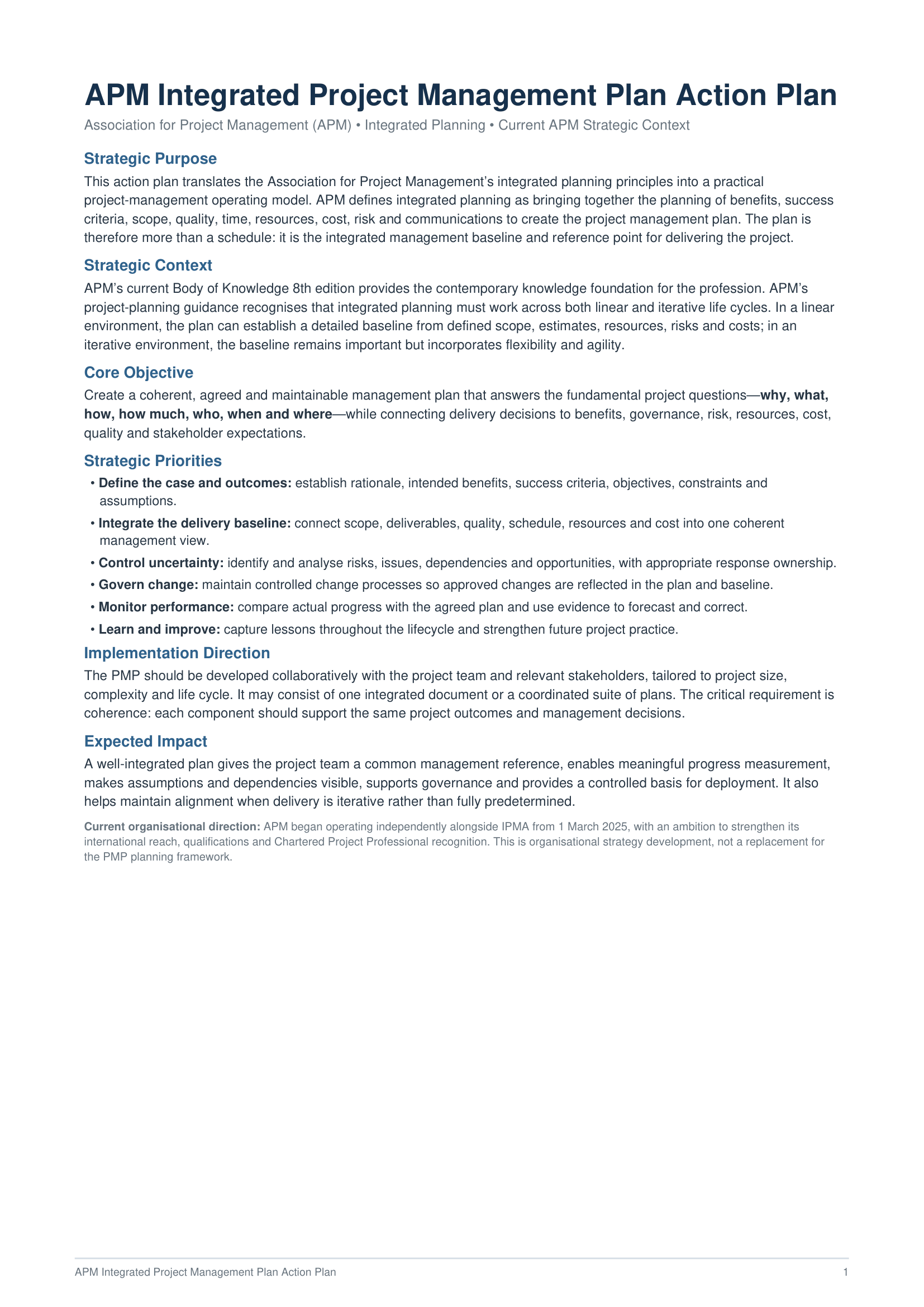
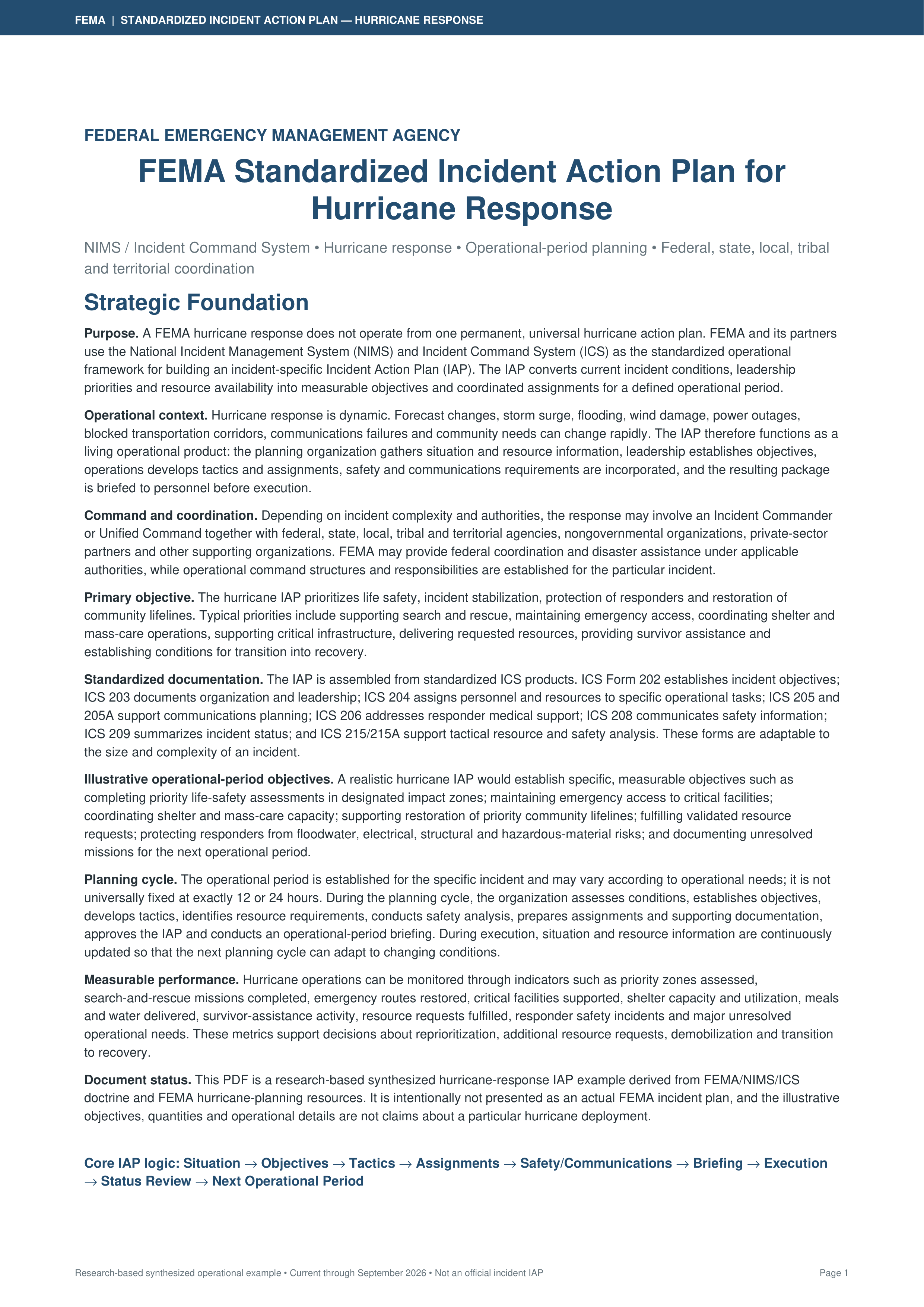
Strategic Foundation
Purpose.
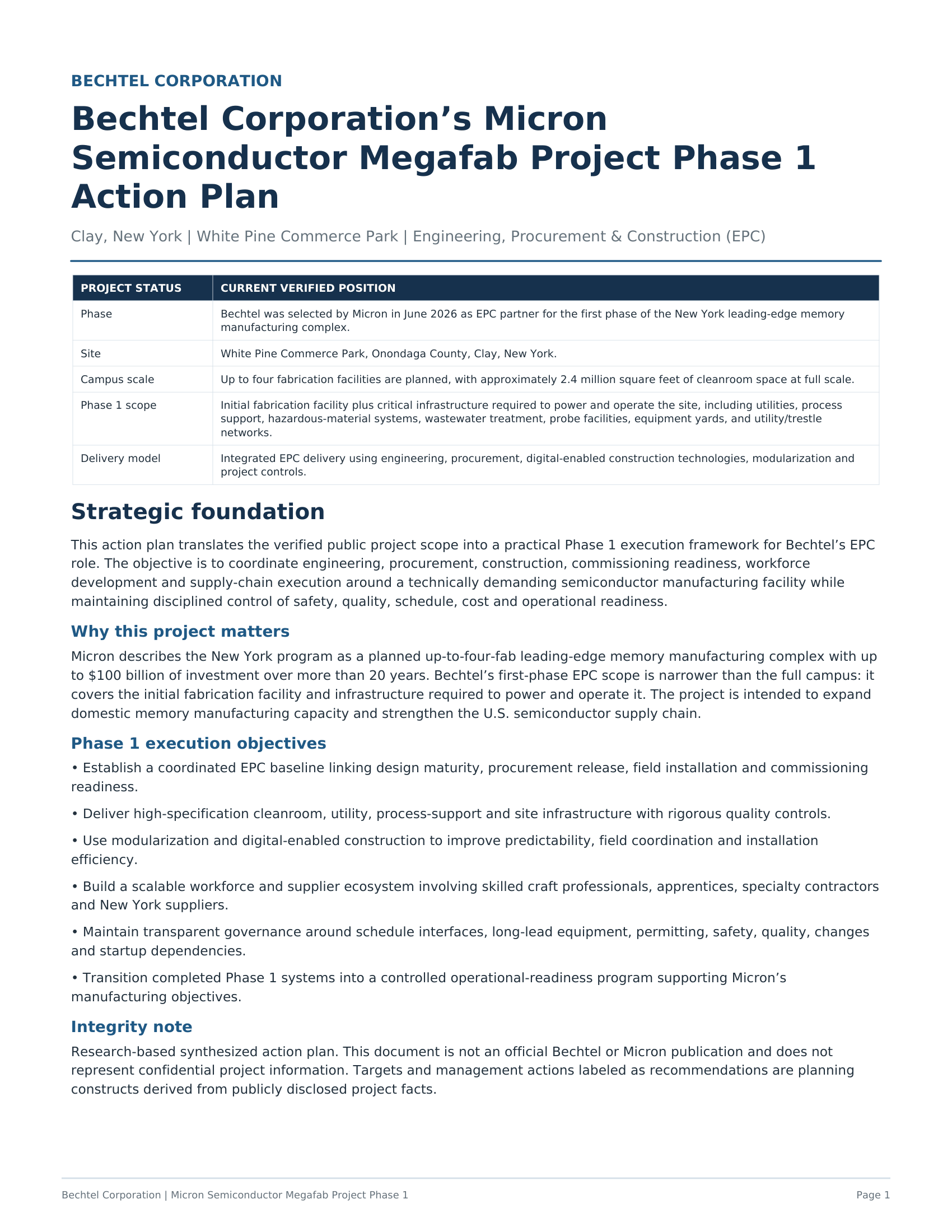
A FEMA hurricane response does not operate from one permanent, universal hurricane action plan. FEMA and its partners
use the National Incident Management System (NIMS) and Incident Command System (ICS) as the standardized operational
framework for building an incident-specific Incident Action Plan (IAP). The IAP converts current incident conditions, leadership
priorities and resource availability into measurable objectives and coordinated assignments for a defined operational period.
Operational context.
Hurricane response is dynamic. Forecast changes, storm surge, flooding, wind damage, power outages,
blocked transportation corridors, communications failures and community needs can change rapidly. The IAP therefore functions as a
living operational product: the planning organization gathers situation and resource information, leadership establishes objectives,
operations develops tactics and assignments, safety and communications requirements are incorporated, and the resulting package
is briefed to personnel before execution.
Command and coordination.
Depending on incident complexity and authorities, the response may involve an Incident Commander
or Unified Command together with federal, state, local, tribal and territorial agencies, nongovernmental organizations, private-sector
partners and other supporting organizations. FEMA may provide federal coordination and disaster assistance under applicable
authorities, while operational command structures and responsibilities are established for the particular incident.
Primary objective.
The hurricane IAP prioritizes life safety, incident stabilization, protection of responders and restoration of
community lifelines. Typical priorities include supporting search and rescue, maintaining emergency access, coordinating shelter and
mass-care operations, supporting critical infrastructure, delivering requested resources, providing survivor assistance and
establishing conditions for transition into recovery.
Standardized documentation.
The IAP is assembled from standardized ICS products. ICS Form 202 establishes incident objectives;
ICS 203 documents organization and leadership; ICS 204 assigns personnel and resources to specific operational tasks; ICS 205 and
205A support communications planning; ICS 206 addresses responder medical support; ICS 208 communicates safety information;
ICS 209 summarizes incident status; and ICS 215/215A support tactical resource and safety analysis. These forms are adaptable to
the size and complexity of an incident.
Illustrative operational-period objectives.
A realistic hurricane IAP would establish specific, measurable objectives such as
completing priority life-safety assessments in designated impact zones; maintaining emergency access to critical facilities;
coordinating shelter and mass-care capacity; supporting restoration of priority community lifelines; fulfilling validated resource
requests; protecting responders from floodwater, electrical, structural and hazardous-material risks; and documenting unresolved
missions for the next operational period.
Planning cycle.
The operational period is established for the specific incident and may vary according to operational needs; it is not
universally fixed at exactly 12 or 24 hours. During the planning cycle, the organization assesses conditions, establishes objectives,
develops tactics, identifies resource requirements, conducts safety analysis, prepares assignments and supporting documentation,
approves the IAP and conducts an operational-period briefing. During execution, situation and resource information are continuously
updated so that the next planning cycle can adapt to changing conditions.
Measurable performance.
Hurricane operations can be monitored through indicators such as priority zones assessed,
search-and-rescue missions completed, emergency routes restored, critical facilities supported, shelter capacity and utilization, meals
and water delivered, survivor-assistance activity, resource requests fulfilled, responder safety incidents and major unresolved
operational needs. These metrics support decisions about reprioritization, additional resource requests, demobilization and transition
to recovery.
Document status.
This PDF is a research-based synthesized hurricane-response IAP example derived from FEMA/NIMS/ICS
doctrine and FEMA hurricane-planning resources. It is intentionally not presented as an actual FEMA incident plan, and the illustrative
objectives, quantities and operational details are not claims about a particular hurricane deployment.
Core IAP logic: Situation
→
Objectives
→
Tactics
→
Assignments
→
Safety/Communications
→
Briefing
→
Execution
→
Status Review
→
Next Operational Period
FEMA | STANDARDIZED INCIDENT ACTION PLAN — HURRICANE RESPONSE
Research-based synthesized operational example • Current through September 2026 • Not an official incident IAP
Page 2
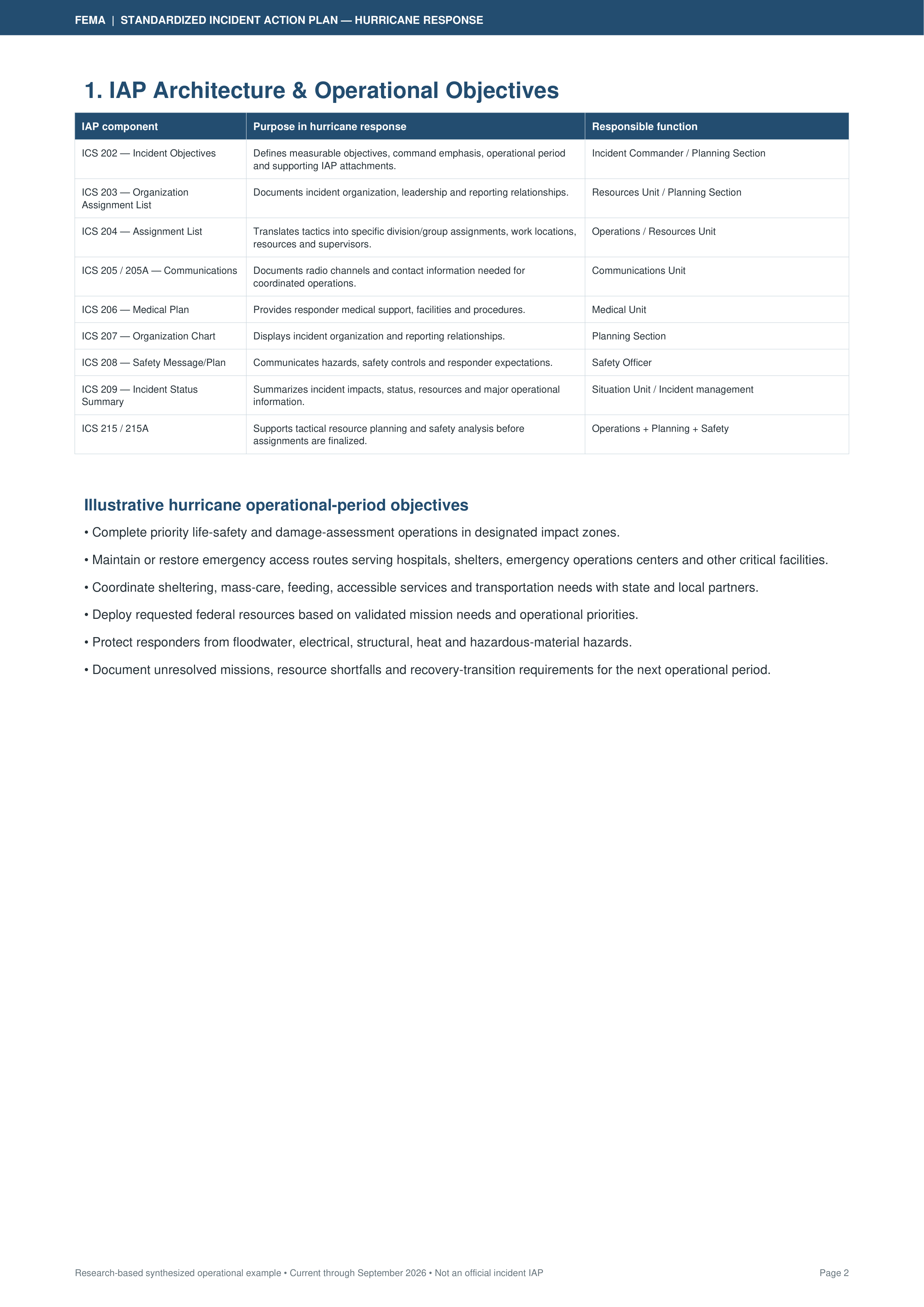
1. IAP Architecture & Operational Objectives
IAP component
Purpose in hurricane response
Responsible function
ICS 202 — Incident Objectives
Defines measurable objectives, command emphasis, operational period
and supporting IAP attachments.
Incident Commander / Planning Section
ICS 203 — Organization
Assignment List
Documents incident organization, leadership and reporting relationships.
Resources Unit / Planning Section
ICS 204 — Assignment List
Translates tactics into specific division/group assignments, work locations,
resources and supervisors.
Operations / Resources Unit
ICS 205 / 205A — Communications
Documents radio channels and contact information needed for
coordinated operations.
Communications Unit
ICS 206 — Medical Plan
Provides responder medical support, facilities and procedures.
Medical Unit
ICS 207 — Organization Chart
Displays incident organization and reporting relationships.
Planning Section
ICS 208 — Safety Message/Plan
Communicates hazards, safety controls and responder expectations.
Safety Officer
ICS 209 — Incident Status
Summary
Summarizes incident impacts, status, resources and major operational
information.
Situation Unit / Incident management
ICS 215 / 215A
Supports tactical resource planning and safety analysis before
assignments are finalized.
Operations + Planning + Safety
Illustrative hurricane operational-period objectives
• Complete priority life-safety and damage-assessment operations in designated impact zones.
• Maintain or restore emergency access routes serving hospitals, shelters, emergency operations centers and other critical facilities.
• Coordinate sheltering, mass-care, feeding, accessible services and transportation needs with state and local partners.
• Deploy requested federal resources based on validated mission needs and operational priorities.
• Protect responders from floodwater, electrical, structural, heat and hazardous-material hazards.
• Document unresolved missions, resource shortfalls and recovery-transition requirements for the next operational period.
FEMA | STANDARDIZED INCIDENT ACTION PLAN — HURRICANE RESPONSE
Research-based synthesized operational example • Current through September 2026 • Not an official incident IAP
Page 3
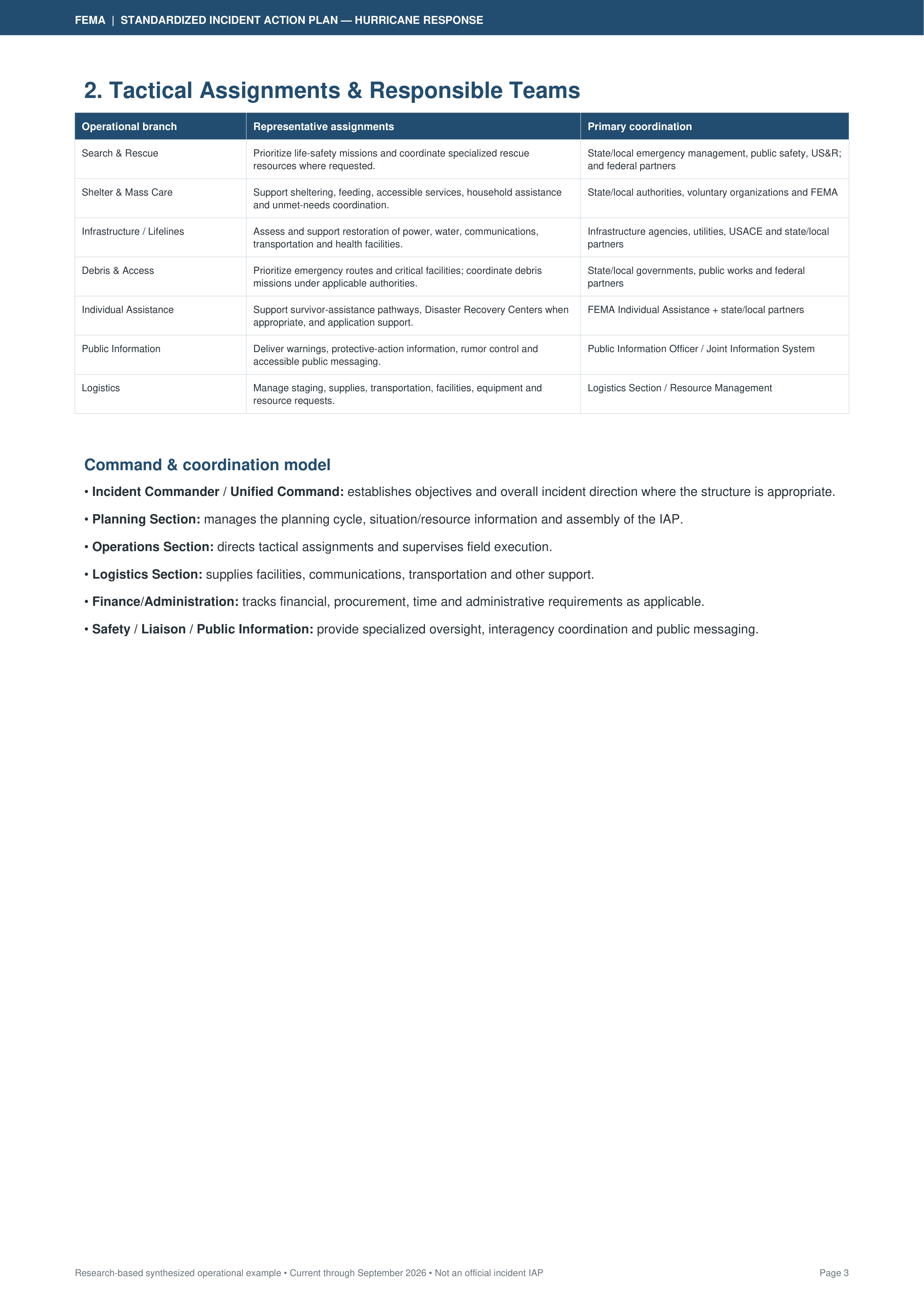
2. Tactical Assignments & Responsible Teams
Operational branch
Representative assignments
Primary coordination
Search & Rescue
Prioritize life-safety missions and coordinate specialized rescue
resources where requested.
State/local emergency management, public safety, US&R;
and federal partners
Shelter & Mass Care
Support sheltering, feeding, accessible services, household assistance
and unmet-needs coordination.
State/local authorities, voluntary organizations and FEMA
Infrastructure / Lifelines
Assess and support restoration of power, water, communications,
transportation and health facilities.
Infrastructure agencies, utilities, USACE and state/local
partners
Debris & Access
Prioritize emergency routes and critical facilities; coordinate debris
missions under applicable authorities.
State/local governments, public works and federal
partners
Individual Assistance
Support survivor-assistance pathways, Disaster Recovery Centers when
appropriate, and application support.
FEMA Individual Assistance + state/local partners
Public Information
Deliver warnings, protective-action information, rumor control and
accessible public messaging.
Public Information Officer / Joint Information System
Logistics
Manage staging, supplies, transportation, facilities, equipment and
resource requests.
Logistics Section / Resource Management
Command & coordination model
•
Incident Commander / Unified Command:
establishes objectives and overall incident direction where the structure is appropriate.
•
Planning Section:
manages the planning cycle, situation/resource information and assembly of the IAP.
•
Operations Section:
directs tactical assignments and supervises field execution.
•
Logistics Section:
supplies facilities, communications, transportation and other support.
•
Finance/Administration:
tracks financial, procurement, time and administrative requirements as applicable.
•
Safety / Liaison / Public Information:
provide specialized oversight, interagency coordination and public messaging.
FEMA | STANDARDIZED INCIDENT ACTION PLAN — HURRICANE RESPONSE
Research-based synthesized operational example • Current through September 2026 • Not an official incident IAP
Page 4
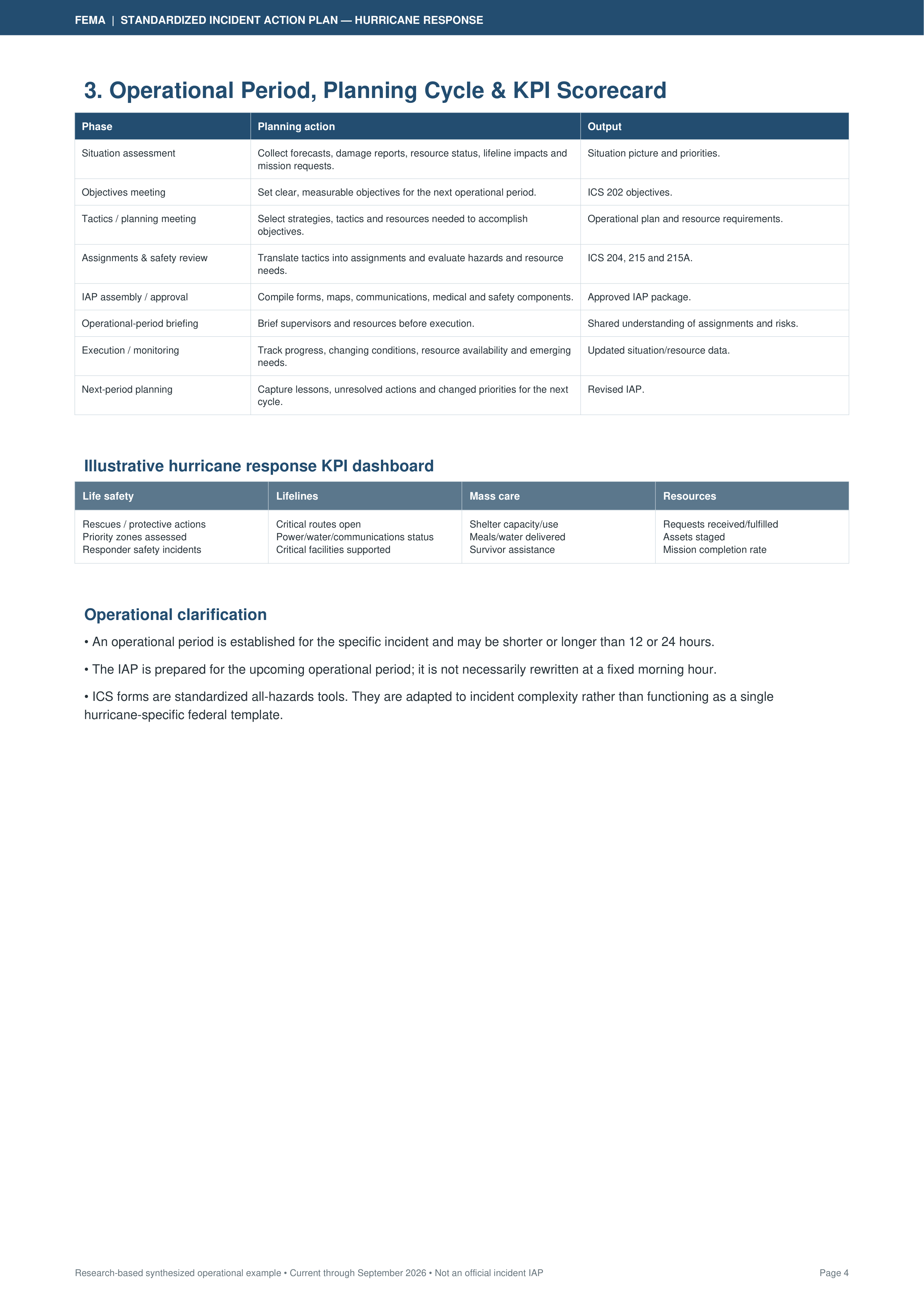
3. Operational Period, Planning Cycle & KPI Scorecard
Phase
Planning action
Output
Situation assessment
Collect forecasts, damage reports, resource status, lifeline impacts and
mission requests.
Situation picture and priorities.
Objectives meeting
Set clear, measurable objectives for the next operational period.
ICS 202 objectives.
Tactics / planning meeting
Select strategies, tactics and resources needed to accomplish
objectives.
Operational plan and resource requirements.
Assignments & safety review
Translate tactics into assignments and evaluate hazards and resource
needs.
ICS 204, 215 and 215A.
IAP assembly / approval
Compile forms, maps, communications, medical and safety components.
Approved IAP package.
Operational-period briefing
Brief supervisors and resources before execution.
Shared understanding of assignments and risks.
Execution / monitoring
Track progress, changing conditions, resource availability and emerging
needs.
Updated situation/resource data.
Next-period planning
Capture lessons, unresolved actions and changed priorities for the next
cycle.
Revised IAP.
Illustrative hurricane response KPI dashboard
Life safety
Lifelines
Mass care
Resources
Rescues / protective actions
Priority zones assessed
Responder safety incidents
Critical routes open
Power/water/communications status
Critical facilities supported
Shelter capacity/use
Meals/water delivered
Survivor assistance
Requests received/fulfilled
Assets staged
Mission completion rate
Operational clarification
• An operational period is established for the specific incident and may be shorter or longer than 12 or 24 hours.
• The IAP is prepared for the upcoming operational period; it is not necessarily rewritten at a fixed morning hour.
• ICS forms are standardized all-hazards tools. They are adapted to incident complexity rather than functioning as a single
hurricane-specific federal template.
FEMA | STANDARDIZED INCIDENT ACTION PLAN — HURRICANE RESPONSE
Research-based synthesized operational example • Current through September 2026 • Not an official incident IAP
Page 5
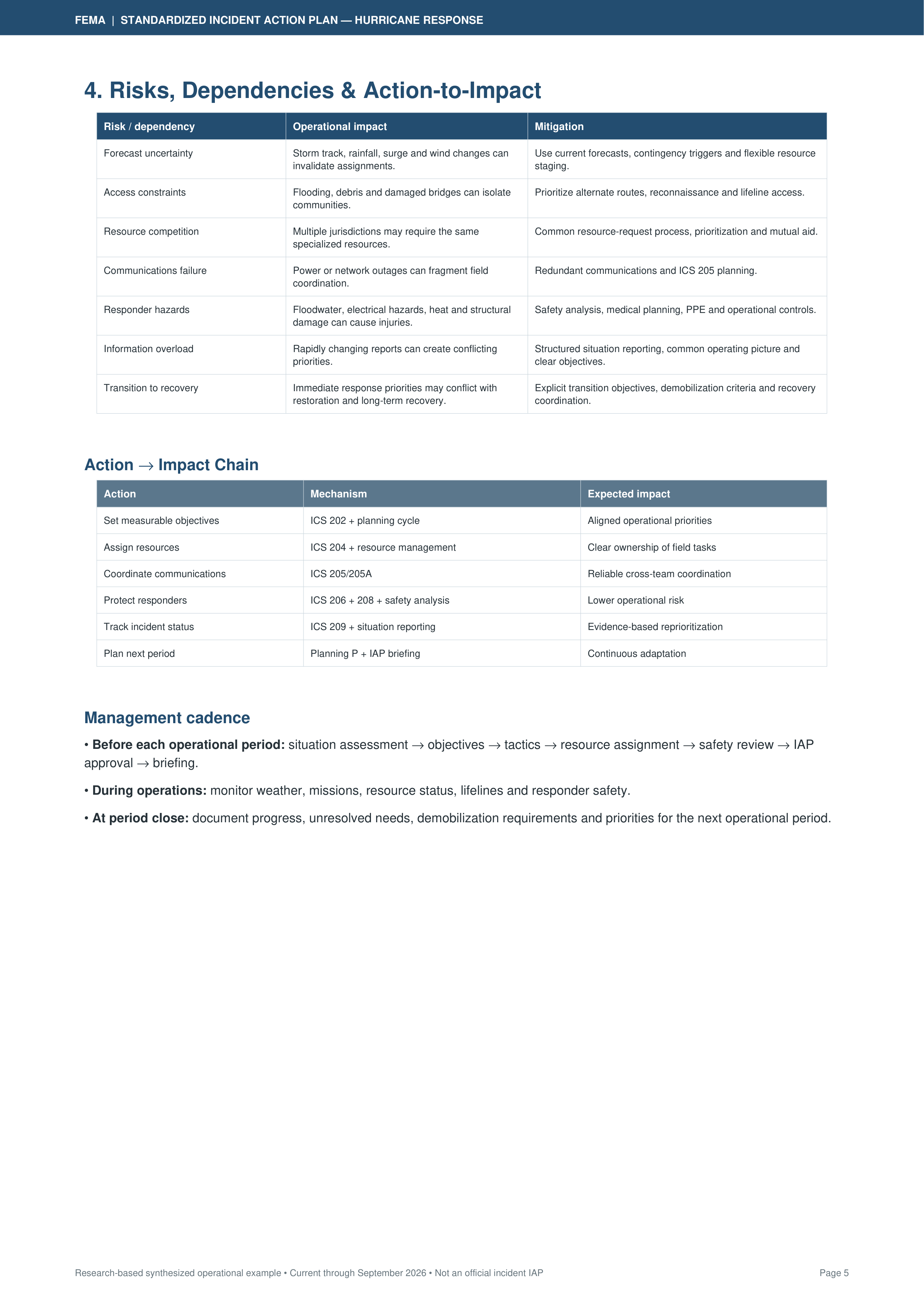
4. Risks, Dependencies & Action-to-Impact
Risk / dependency
Operational impact
Mitigation
Forecast uncertainty
Storm track, rainfall, surge and wind changes can
invalidate assignments.
Use current forecasts, contingency triggers and flexible resource
staging.
Access constraints
Flooding, debris and damaged bridges can isolate
communities.
Prioritize alternate routes, reconnaissance and lifeline access.
Resource competition
Multiple jurisdictions may require the same
specialized resources.
Common resource-request process, prioritization and mutual aid.
Communications failure
Power or network outages can fragment field
coordination.
Redundant communications and ICS 205 planning.
Responder hazards
Floodwater, electrical hazards, heat and structural
damage can cause injuries.
Safety analysis, medical planning, PPE and operational controls.
Information overload
Rapidly changing reports can create conflicting
priorities.
Structured situation reporting, common operating picture and
clear objectives.
Transition to recovery
Immediate response priorities may conflict with
restoration and long-term recovery.
Explicit transition objectives, demobilization criteria and recovery
coordination.
Action
→
Impact Chain
Action
Mechanism
Expected impact
Set measurable objectives
ICS 202 + planning cycle
Aligned operational priorities
Assign resources
ICS 204 + resource management
Clear ownership of field tasks
Coordinate communications
ICS 205/205A
Reliable cross-team coordination
Protect responders
ICS 206 + 208 + safety analysis
Lower operational risk
Track incident status
ICS 209 + situation reporting
Evidence-based reprioritization
Plan next period
Planning P + IAP briefing
Continuous adaptation
Management cadence
•
Before each operational period:
situation assessment
→
objectives
→
tactics
→
resource assignment
→
safety review
→
IAP
approval
→
briefing.
•
During operations:
monitor weather, missions, resource status, lifelines and responder safety.
•
At period close:
document progress, unresolved needs, demobilization requirements and priorities for the next operational period.
FEMA | STANDARDIZED INCIDENT ACTION PLAN — HURRICANE RESPONSE
Research-based synthesized operational example • Current through September 2026 • Not an official incident IAP
Page 6
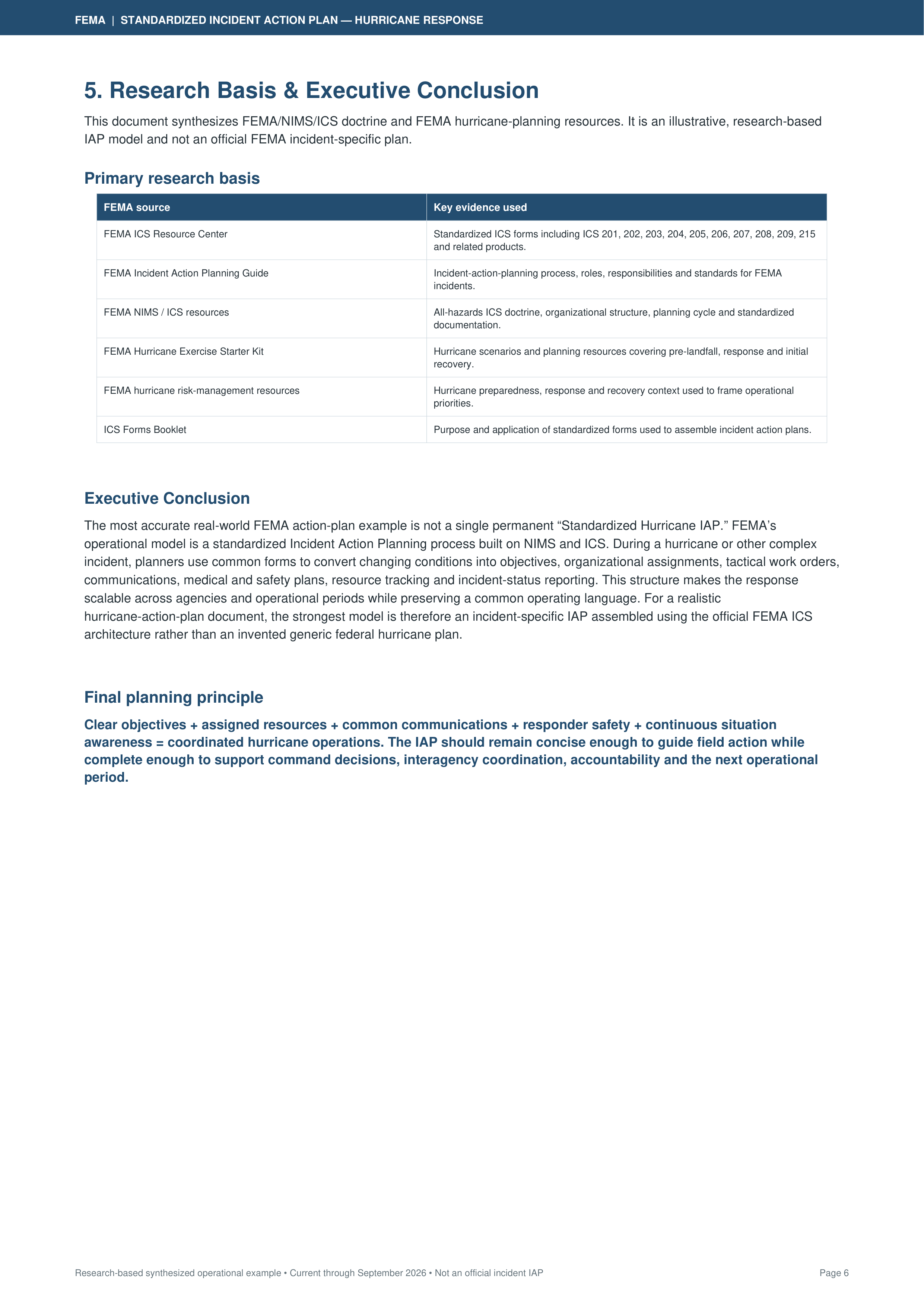
5. Research Basis & Executive Conclusion
This document synthesizes FEMA/NIMS/ICS doctrine and FEMA hurricane-planning resources. It is an illustrative, research-based
IAP model and not an official FEMA incident-specific plan.
Primary research basis
FEMA source
Key evidence used
FEMA ICS Resource Center
Standardized ICS forms including ICS 201, 202, 203, 204, 205, 206, 207, 208, 209, 215
and related products.
FEMA Incident Action Planning Guide
Incident-action-planning process, roles, responsibilities and standards for FEMA
incidents.
FEMA NIMS / ICS resources
All-hazards ICS doctrine, organizational structure, planning cycle and standardized
documentation.
FEMA Hurricane Exercise Starter Kit
Hurricane scenarios and planning resources covering pre-landfall, response and initial
recovery.
FEMA hurricane risk-management resources
Hurricane preparedness, response and recovery context used to frame operational
priorities.
ICS Forms Booklet
Purpose and application of standardized forms used to assemble incident action plans.
Executive Conclusion
The most accurate real-world FEMA action-plan example is not a single permanent “Standardized Hurricane IAP.” FEMA’s
operational model is a standardized Incident Action Planning process built on NIMS and ICS. During a hurricane or other complex
incident, planners use common forms to convert changing conditions into objectives, organizational assignments, tactical work orders,
communications, medical and safety plans, resource tracking and incident-status reporting. This structure makes the response
scalable across agencies and operational periods while preserving a common operating language. For a realistic
hurricane-action-plan document, the strongest model is therefore an incident-specific IAP assembled using the official FEMA ICS
architecture rather than an invented generic federal hurricane plan.
Final planning principle
Clear objectives + assigned resources + common communications + responder safety + continuous situation
awareness = coordinated hurricane operations. The IAP should remain concise enough to guide field action while
complete enough to support command decisions, interagency coordination, accountability and the next operational
period.